

Smart Scales and Bioimpedance: How Accurate Is Your Body Fat Reading?
Key Takeaways
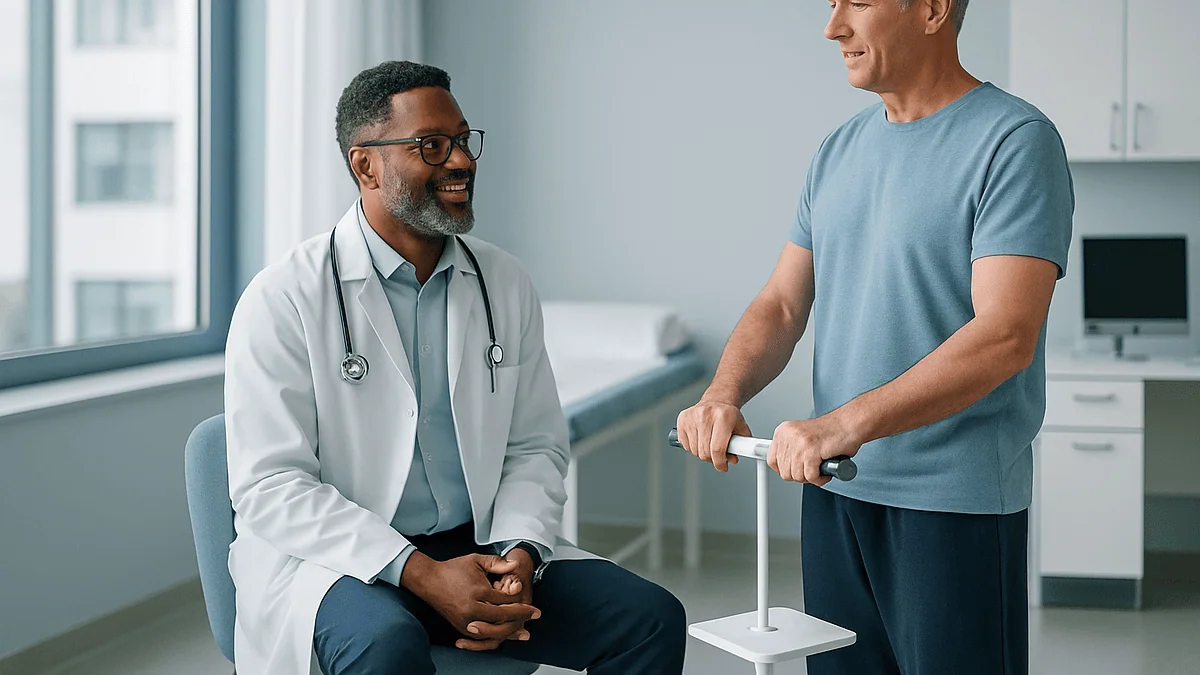
- Bioimpedance estimates body water from electrical resistance and infers fat from an equation, so the fat figure is a calculation rather than a direct measurement.
- Validation studies against DXA scans show individual errors of roughly 4 to 8 percentage points for foot-to-foot scales and about 3 to 5 for multi-frequency, eight-electrode devices.
- Ordinary hydration shifts from meals, exercise, alcohol or time of day can move a home reading by 2 to 5 points within a single day, far more than real fat loss changes it in a week.
- Under identical fasted, rested morning conditions, readings repeat within about 1 to 2 points, which makes the multi-week trend meaningful even when the absolute number is not.
- Foot-to-foot scales send current through the legs and largely miss the trunk, so their visceral fat index is inferred, and a waist measurement is a better-validated indicator of abdominal fat.
- Manufacturers and clinical protocols advise people with pacemakers or implantable defibrillators, and anyone who is pregnant, to skip the body fat function and use weight-only mode.
Bioimpedance (BIA) smart scales estimate body fat by sending a tiny electrical current through the body, and they are moderately accurate at best. For an individual, the reading can be off by roughly 3 to 8 percentage points compared with a research-grade scan, and it shifts with hydration, meals and exercise. Under consistent conditions, the trend over weeks is far more trustworthy than any single number.
A reader wrote to us last month, baffled. Her smart scale had declared her body fat 24 percent at 7 a.m. and 29 percent after a run and a large glass of water that same evening. Nothing about her body had changed in ten hours. The scale, she suspected, was simply guessing. She was closer to the truth than she realized.
Smart scales are having a moment. As of September 2026, searches for bioimpedance, the technology behind those body fat numbers, have climbed sharply, driven by two things: a wave of new multi-electrode scales marketed as near-clinical, and a January 2025 international commission on obesity that urged clinicians to look beyond body mass index and measure body fat more directly. That shift has sent many people to the bathroom scale with fresh expectations.
So how much can a sub-200-dollar-class gadget really tell you? This piece walks through what the current does, where the math quietly fills in gaps, and how to read your numbers like a scientist rather than a worrier.
What is bioimpedance, in plain terms?
Bioimpedance is the resistance your body offers to a very small, painless alternating electrical current. Bioelectrical impedance analysis, usually shortened to BIA, is the method that turns that resistance into estimates of body water, fat-free mass and fat.
The logic rests on a simple contrast in tissues. Muscle, blood and organs are roughly three-quarters water and rich in dissolved salts, so they conduct electricity well. Fat holds far less water, perhaps a tenth to a fifth of its weight, and resists the current. Bone is a poor conductor too. Send a current from one foot to the other and the total opposition you measure, called impedance, depends mostly on how much conductive, watery tissue lies along the path.
That measured impedance is not body fat. It is a single electrical number, typically a few hundred ohms, from which a device infers total body water, then fat-free mass, then subtracts from your weight to produce fat. Each inference leans on an equation built from a reference population. That chain of assumptions is where accuracy is won or lost, and it is why two scales can read the same person differently on the same morning.
Clinical BIA has been studied for decades. A two-part review by the European Society for Clinical Nutrition and Metabolism, indexed on PubMed, laid out both the physics and the limits: BIA works well for estimating body water in healthy, normally hydrated adults, and less well in anyone whose fluid balance, body shape or age falls outside the population used to build the equations. Consumer scales inherit all of those limits and add a few of their own.
How a smart scale turns a tiny current into a body fat number
Stand barefoot on a bioimpedance scale and four metal plates come into play. Two push a current of well under one milliamp, far below anything you can feel, up one leg and down the other. The other two measure the voltage drop. Divide voltage by current and you have impedance.
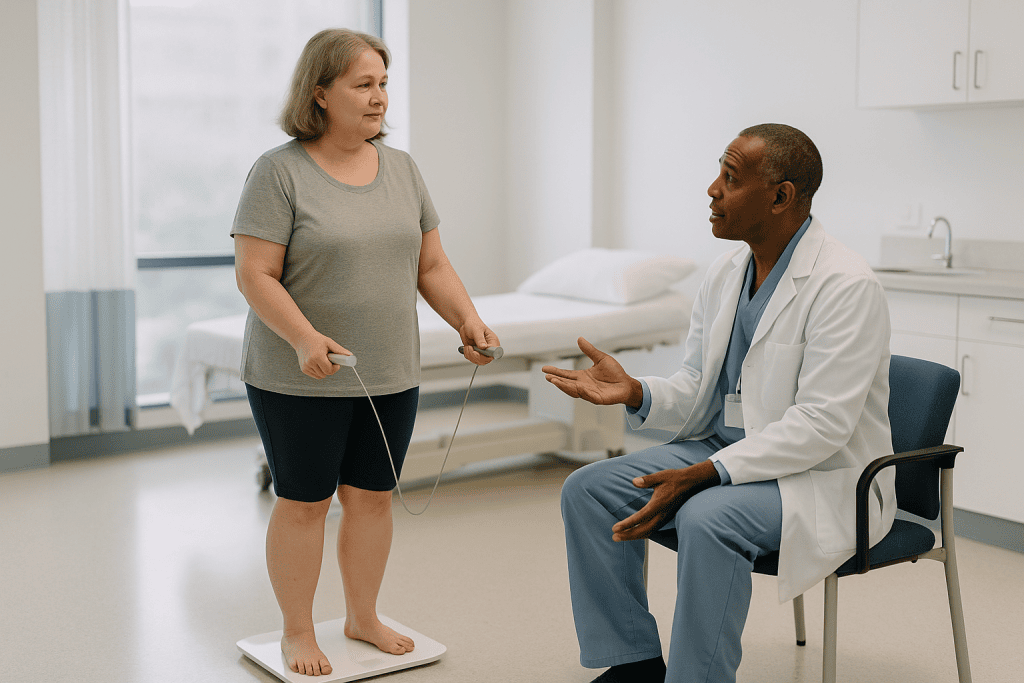
Most scales measure at a single frequency, usually 50 kilohertz, which is a compromise: high enough to pass partly into cells, low enough to be cheap and stable. Frequency simply means how many times per second the current reverses direction. Pricier devices sweep several frequencies, and a related method, bioimpedance spectroscopy (BIS), uses dozens, separating water inside cells from water between them.
Next comes the step that most product pages gloss over. The scale plugs your impedance, height, weight, age and sex into a regression equation. A regression equation is a formula fitted to a reference group whose body fat was measured by a more precise method. If you resemble that group, the formula performs well. If you are taller, more muscular, older or carry fat in a different pattern, the formula still produces a confident-looking number, just a less accurate one.
Foot-to-foot scales face one more hurdle. The current runs through the legs and the lower pelvis and largely bypasses the trunk, where much of adult fat lives. The device therefore estimates your torso from your legs. Newer eight-electrode scales add handgrips so the current can travel arm to leg and segment the body, which research suggests narrows the error, though it does not erase it.
What changed recently
Three developments explain the surge of interest, and only one of them is about the scales themselves.
First, the guideline landscape. In January 2025, an international commission of obesity specialists published a framework that distinguishes preclinical from clinical obesity and recommends confirming excess body fat with direct measures, such as a scan or a validated bioimpedance device, or with waist measures, rather than relying on body mass index alone. The commission’s view is expert consensus rather than a trial result, but it has pushed body composition from the gym into the consulting room.
Second, public health bodies have been nudging in the same direction for a while. The CDC updated its adult BMI guidance in 2024 to stress that BMI is a screening tool, not a diagnosis of body fatness, and that it does not distinguish fat from muscle. The NHS makes the same point in its BMI explainer, noting that muscular adults may be misclassified. Both agencies stop short of endorsing home body fat scales, and that gap matters.
Third, the hardware. Consumer scales now routinely report segmental muscle, visceral fat, bone mass, body water and so-called metabolic age, and several added multi-frequency measurement and handgrips. Marketing increasingly borrows the language of clinical validation.
The honest summary: the clinical interest in body composition is real and well founded. The technology has improved at the margins. What has not changed is the underlying physics, which still relies on assumptions about hydration and body shape that no firmware update can remove.
Is bioimpedance accurate for body fat? What the evidence actually says
The answer depends on which question you are asking: accurate for a crowd, or accurate for you?

At the population level, the evidence is reasonably strong. Validation studies compare BIA with dual-energy X-ray absorptiometry (DXA), a low-dose scan that measures fat, lean tissue and bone directly and serves as the usual reference. When hundreds of people are measured, the average BIA body fat often lands within 1 to 2 percentage points of the average DXA result. That is good enough for epidemiology, and it is why large health surveys have used BIA.
At the individual level, the picture weakens. The spread of errors around that tidy average, called the limits of agreement, is typically plus or minus 4 to 8 percentage points for single-frequency devices, and somewhat tighter for well-calibrated multi-frequency or eight-electrode machines. In practice a reading of 25 percent could reflect a true value anywhere from about 19 to 31 percent. The equations also tend to overestimate fat in very lean people and underestimate it in people with obesity, compressing the extremes toward the middle.
Reproducibility is a different and happier story. Measure the same person under identical conditions on the same device and readings usually repeat within 1 to 2 percentage points. This is why nutrition societies describe BIA as useful for tracking change over time within one person, provided the measurement protocol is standardized.
Grading the evidence: the comparisons against DXA come from many observational validation studies rather than randomized trials, which is the appropriate design for an accuracy question. The guidance to prefer trends over single values is a well-supported expert position built on that data.
Body fat scale accuracy: why your reading swings from day to day
Our reader’s five-point morning-to-evening jump is not a faulty scale. It is bioimpedance doing exactly what the physics predicts.
Because the current travels through water, anything that shifts fluid shifts the reading. Drink two glasses of water and total body water rises, impedance falls, and the scale reports more lean mass and less fat. Sweat through a run and the opposite happens: dehydration raises impedance and inflates body fat by several points. Clinical protocols therefore ask for no exercise for 12 hours and no food or drink for 4 hours before a measurement, precisely because these ordinary acts move the number more than real fat loss does in a week.
Other everyday influences include:
- Time of day: fluid pools in the legs as the day goes on, which lowers leg impedance on foot-to-foot scales and can shift the estimate.
- A full bladder or recent large meal, both of which the scale reads as conductive tissue.
- Skin temperature and sweaty feet, which change contact with the electrodes.
- The menstrual cycle, with premenstrual fluid retention commonly nudging readings.
- Alcohol the night before, which dehydrates.
- Dry, thick skin on the soles, which can raise contact resistance.
A reasonable expectation is that normal hydration swings alone can move a home reading by 2 to 5 percentage points within a single day. Real body fat, by contrast, changes slowly. Losing one kilogram of fat in a month, a respectable rate, corresponds to roughly a 1-point change for many adults. The lesson writes itself: if you want to see a true change, you must hold everything else still, and even then you should wait for a trend of several weeks.
Bioimpedance versus other ways of measuring body fat
No single method is perfect. Each trades accuracy, convenience and access differently, and the right choice depends on whether you need a precise snapshot or a cheap, repeatable trend.
| Method | What it actually measures | Typical error for one person | Best use |
|---|---|---|---|
| Foot-to-foot bioimpedance scale | Leg impedance, then an equation | About ±4 to 8 percentage points | Home trend tracking under fixed conditions |
| Eight-electrode or multi-frequency BIA | Segmental impedance of limbs and trunk | About ±3 to 5 points | Clinic or gym monitoring; research |
| DXA scan | Fat, lean tissue and bone by X-ray attenuation | About ±1 to 2 points | Reference standard; clinical assessment |
| Skinfold calipers | Thickness of subcutaneous fat at set sites | About ±3 to 5 points with a skilled tester | Sports settings with one trained measurer |
| Waist circumference | Abdominal size, a proxy for visceral fat | Not a fat percentage; low measurement error | Cardiometabolic risk screening |
| Body mass index | Weight relative to height | Cannot separate fat from muscle | Population screening only |
Two points stand out from the table. First, the humble tape measure performs surprisingly well for the question most people care about, which is health risk. Harvard Health and Mayo Clinic both note that waist size tracks visceral fat, the metabolically active fat around the organs, and that a waist above about 35 inches for women or 40 inches for men is associated with higher cardiometabolic risk regardless of total weight. Second, the gap between a home scale and a DXA scan is real but not enormous once conditions are controlled, which is why the trend from a home scale can still be informative.
What is bioimpedance used for in clinics and research?
Outside the bathroom, bioimpedance has a quieter and more respectable career, and understanding those uses explains both its strengths and its limits.
Nutrition and dietetics teams use clinical BIA to estimate fat-free mass in patients at risk of malnutrition, including older adults and people undergoing cancer treatment. Here the goal is not a precise fat percentage but a sensitive signal that lean tissue is being lost, which carries real prognostic weight. Because BIA is quick, portable and radiation-free, it suits repeated bedside measurement in a way a DXA scan does not.
Kidney units apply it differently. Bioimpedance spectroscopy, the multi-frequency cousin of BIA, estimates the water between cells and is used in some dialysis centres to help judge how much excess fluid to remove. In this setting the method’s sensitivity to hydration, a nuisance for body fat scales, becomes the whole point.
Sports science uses multi-frequency, segmental devices to monitor athletes across a season, again leaning on reproducibility rather than absolute accuracy. Epidemiologists have used BIA in large national health surveys because it is cheap enough to measure thousands of people.
Researchers have also explored phase angle, a raw BIA value reflecting cell membrane integrity, as a marker of overall cellular health and prognosis in illness. The evidence is observational and still maturing, so phase angle remains a research measure rather than something a home scale should report with confidence.
What unites these uses is standardization: trained staff, fixed timing, fasting rules, and interpretation by someone who knows the method’s blind spots. The home scale drops most of those safeguards.
Who should not use bioimpedance scales?
Bioimpedance is widely regarded as low risk, but a few groups are advised to avoid it, and a larger group should simply not trust the numbers.
People with a pacemaker or an implantable cardioverter-defibrillator are the clearest case. Manufacturers’ instructions and most clinical research protocols exclude them, on the grounds that an external current, however small, could in theory interfere with the device. Published reports of actual interference are sparse, and some clinic studies have measured patients with modern pacemakers without incident, but the evidence is thin enough that the cautious default stands. Anyone with an implanted electrical device should ask their cardiology team before using the body fat function, and should remember that the weight-only mode of most scales does not pass a current.
During pregnancy, manufacturers also advise against body fat measurement. There is no evidence the current harms a fetus; the practical problem is that the prediction equations were never built for the fluid shifts of pregnancy, so the results are meaningless.
Then there is the group for whom the reading is unreliable rather than inadvisable:
- People with significant fluid retention, such as from heart, kidney or liver disease, or with swollen legs (oedema).
- Anyone with a limb amputation, since the equations assume a standard body geometry.
- People at the extremes of BMI, where the equations drift most.
- Children, unless the device uses validated pediatric equations.
- Anyone who has just had a large meal, a hard workout, alcohol or a sauna.
If you fall into one of these categories, a waist measurement and a conversation with your clinician will serve you better than any percentage on a display.
How to get the most consistent bioimpedance reading at home
Accept that your scale cannot tell you your true body fat, and it becomes a decent instrument for a narrower job: detecting whether you are drifting up or down. That job demands ritual.
Weigh yourself first thing in the morning, after using the bathroom and before eating, drinking or exercising. This mirrors the fasting and rest conditions used in clinical protocols and removes the biggest sources of hour-to-hour noise. Stand barefoot with dry feet on a hard, level floor; carpet underneath a scale distorts the weight reading, and damp soles alter electrical contact.
Keep the same scale, the same profile settings and the same spot in the room. Enter your height accurately, because height feeds directly into the equation and a 2-centimetre error can shift the result by a point or more. If your scale has an athlete mode, use it only if you genuinely train hard most days; the mode changes the equation, not your body, and switching it on and off makes readings incomparable.
Then look at averages, not days. A seven-day rolling average smooths hydration swings, and a change of less than 2 percentage points over a few weeks is within the noise. Many apps already calculate this; if yours does not, a simple spreadsheet works.
One last habit protects your judgment as much as your data. Pair the scale with a monthly waist measurement taken at the navel, relaxed, at the end of a normal breath. When the scale and the tape disagree, trust the tape; when they agree, you have two independent signals pointing the same way, which is as close to certainty as home measurement gets.
Muscle mass, visceral fat, body water and metabolic age: what the other numbers mean
Modern scales rarely stop at body fat. Scroll the app and you may find a dozen metrics, each with a reassuring decimal point. They are not equally meaningful.
Body water and fat-free mass are the two values closest to what the scale actually measures, since impedance is fundamentally a water measurement. If the scale is tracking anything with reasonable fidelity, it is these.
Skeletal muscle mass is a step further removed. It is estimated from fat-free mass by assuming a typical proportion of muscle to bone and organ tissue. The absolute figure is rough, but its direction over months can hint at whether a training programme or an older adult’s protein intake is working.
Visceral fat, often shown as an index from 1 to 30, is the number to treat most sceptically on a foot-to-foot scale. The current barely samples the abdomen, so the device infers visceral fat from your age, sex, waist proxies and the overall estimate. A tape measure around the waist is a more direct and better-validated indicator of the same thing.
Bone mass readings are essentially derived from population averages and should not be mistaken for a bone density scan, which is the only way to assess osteoporosis risk.
Metabolic age and similar scores are marketing constructs. They compare your estimated basal metabolic rate, itself calculated from fat-free mass, with the average for your age. They carry no clinical meaning, and a cheerful or alarming number here should not change anything you do.
A useful rule: the further a metric sits from body water, the more it rests on assumption, and the less weight it deserves.
Common myths about smart scales and bioimpedance
Viral claims about body fat scales tend to run in two directions, and both miss the mark.
Myth: smart scales are as accurate as a clinic scan. No consumer scale matches DXA for an individual. Even the best multi-frequency, eight-electrode devices in validation studies show errors of several percentage points for single people. What they offer is convenience and repeatability, not reference accuracy.
Myth: the readings are random, so the scale is useless. Also wrong. Under controlled conditions, readings repeat within about 1 to 2 points. The noise people see comes mostly from inconsistent measurement, not from the sensor. Standardize the ritual and the trend becomes meaningful.
Myth: a higher-priced scale fixes the problem. Added electrodes and frequencies improve sampling of the trunk and the split between intracellular and extracellular water. They do not change the dependence on hydration or the reliance on population equations. Improvement is incremental.
Myth: if your body fat went up, you gained fat. A rise of a few points overnight is almost always water loss. Fat gain of that size would require eating thousands of surplus calories in a day.
Myth: the scale can diagnose obesity or a healthy weight. Diagnosis belongs to a clinician who can combine measurements with history, blood tests and risk factors. Public health bodies classify weight categories using BMI and waist circumference, not home BIA, and no agency has set clinical thresholds for consumer scale readings.
Myth: bioimpedance is dangerous. The current is tiny and imperceptible, and decades of clinical use have shown no harm in the general population. The precautions for implanted cardiac devices and pregnancy are about caution and validity rather than documented injury.
What should you track instead of, or alongside, body fat percentage?
If the number on the scale is fuzzy, where should your attention go? The evidence points to measures that are either more direct, more strongly linked to health outcomes, or both.
Waist circumference leads the list. Observational studies summarised by Harvard Health and Mayo Clinic link abdominal fat to higher risk of type 2 diabetes, cardiovascular disease and some cancers, independently of overall weight. The measurement takes thirty seconds, costs nothing, and is remarkably stable from day to day compared with a BIA reading. A falling waist with stable weight is often the best evidence that fat is going and muscle is staying.
Weight itself, measured daily and averaged weekly, remains useful. It is the one thing a bathroom scale measures directly, and weekly averages are far less noisy than body fat estimates.
Performance and function matter more than they get credit for. How many times you can rise from a chair in thirty seconds, how far you walk in six minutes, how much you can carry: these predict independence and mortality in older adults in a way no composition metric does.
Blood pressure, fasting glucose, HbA1c and lipids, ordered by your clinician, measure the consequences of body fat rather than the fat itself. They are the outcomes that body composition is supposed to predict, so when they improve, the direction of travel is clear regardless of what the scale says.
Framed this way, the smart scale earns a modest place in the toolkit: a convenient daily nudge, best read in combination with a tape measure and an occasional set of blood tests, and never as the sole arbiter of progress.
Bioimpedance in children, older adults and athletes
The equations behind a body fat scale were typically built from adults of average build. Step outside that group and the method’s behaviour changes in predictable ways.
Children and adolescents hold more water per kilogram of lean tissue than adults, and that ratio shifts throughout growth. Adult equations therefore misjudge them, and only devices with validated paediatric equations should be used, generally in a clinical or research setting. Home scales are not a sensible way to monitor a child’s body fat, and the psychological downside of daily numbers for a young person is reason enough to leave the body fat mode off.
Older adults present the opposite drift. With age, lean tissue holds relatively less water and extracellular fluid rises, so standard equations tend to overestimate fat-free mass and underestimate fat. Fluid-shifting conditions and medications common in later life add noise. That said, clinical BIA is genuinely useful for spotting the loss of muscle that accompanies ageing, known as sarcopenia, when performed with age-appropriate equations by trained staff.
Athletes carry more muscle and often more total body water than reference populations, and single-frequency equations frequently overestimate their body fat. Athlete modes attempt to correct this with different coefficients, with mixed validation. Multi-frequency segmental devices perform better. In elite sport, skinfolds by a certified measurer or DXA remain the preferred tools, with BIA used for frequent, standardized tracking rather than absolute values.
The shared theme is that bioimpedance is a comparison against a reference crowd. The further you sit from that crowd in age, build or fluid status, the more you should treat the output as a rough trend indicator and the less as a measurement of you.
When to see a doctor
A smart scale is a wellness gadget, not a diagnostic device, and no reading on it should on its own trigger alarm or complacency. There are, however, situations where what you notice while using one deserves a clinician’s attention.
Make an appointment if you see:
- Unintentional weight change of more than about 5 percent of body weight over six to twelve months, in either direction, without a change in diet or activity.
- Rapid weight gain of several kilograms over days with swelling of the legs, abdomen or face, or breathlessness, which can signal fluid retention from heart, kidney or liver problems rather than fat.
- A steadily increasing waist circumference above the thresholds associated with cardiometabolic risk, particularly with high blood pressure, raised glucose or a family history of diabetes or heart disease.
- Falling lean mass or muscle readings in an older adult alongside weakness, falls or difficulty rising from a chair.
- Preoccupation with the numbers, repeated weighing, or restricting food in response to readings, which can be an early sign of a disordered relationship with eating and merits support.
Seek urgent care for sudden breathlessness, chest pain, or rapid swelling with reduced urine output.
If you have a pacemaker, defibrillator or other implanted electrical device, ask your cardiology team before using the body fat function. If you are pregnant, use the scale for weight only and follow the monitoring your maternity team recommends.
Finally, if a reading has prompted you to consider a diet, a supplement, or a medicine for weight, raise it with your clinician first. Decisions about treatment, including any prescription, belong with the prescribing doctor who knows your history, not with an app.
The bottom line on body fat scale accuracy
Return to our reader and her two numbers, 24 percent at dawn and 29 percent at dusk. Both were honest outputs of the physics; neither was her body fat. The morning value, taken fasted and rested, was the one worth recording. The evening value was a hydration report in disguise.
That is the whole story in miniature. Bioimpedance measures how easily electricity moves through your water, and then estimates everything else. Validation studies against DXA show it is sound for populations, moderately accurate for individuals, and highly repeatable when conditions are held constant. The evidence for those three statements is consistent across many observational studies, which is the right kind of evidence for an accuracy question, even if none of it comes from randomized trials.
What matters most, in our view, is not the gap between your scale and a laboratory. It is whether the information changes what you do in a helpful way. A standardized morning reading, averaged over a week and watched over months, can confirm that a new habit is shifting composition in the right direction. A monthly waist measurement gives you a second, better-validated signal for the fat that matters most to health. Blood pressure and blood tests, arranged with your clinician, tell you whether any of it is paying off where it counts.
Treat the single reading with suspicion, the trend with interest, and the tape measure with respect. Used that way, a smart scale is neither the clinical instrument its marketing implies nor the toy its critics describe. It is a modestly useful tool whose value depends almost entirely on the discipline of the person standing on it.
Frequently asked questions
Is bioimpedance accurate for body fat?
Moderately. For groups of people, average bioimpedance readings sit within a point or two of DXA scan results, but for an individual the error can reach 4 to 8 percentage points on a foot-to-foot scale. Repeatability under fixed conditions is much better, around 1 to 2 points, so the method is more useful for tracking change over weeks than for stating your true body fat on any one day.
Who should not use bioimpedance scales?
People with a pacemaker or implantable defibrillator are advised by manufacturers and clinical protocols to avoid the body fat function unless their cardiology team approves, and pregnant users are advised to use weight-only mode. Readings are also unreliable, though not harmful, for people with fluid retention, limb amputation, very high or very low BMI, and children measured with adult equations.
What is bioimpedance used for?
Beyond home scales, clinicians use bioimpedance to estimate fat-free mass in patients at risk of malnutrition, to monitor muscle loss in older adults, and, in its multi-frequency spectroscopy form, to help judge fluid status in some dialysis units. Researchers use it in large health surveys and sports science because it is quick, portable and radiation-free, with results interpreted under standardized protocols.
How much does a BIA test cost?
This magazine does not publish price figures, and costs vary widely by setting and country. In clinical practice a bioimpedance measurement is often part of a wider nutrition or medical assessment rather than a stand-alone purchase. If you are considering one, ask your clinician whether it would change your care, and whether a waist measurement or routine blood tests would answer the same question.
How does body fat scale accuracy compare with a DXA scan?
DXA measures fat, lean tissue and bone directly with a low-dose X-ray and has an individual error of about 1 to 2 percentage points, which is why it serves as the reference. A home bioimpedance scale estimates fat from an equation and typically carries an error several times larger. The two agree well on averages across many people and less well for any single person.
Why does my body fat reading change so much during the day?
Because bioimpedance measures water, not fat. Eating, drinking, sweating, a full bladder and fluid pooling in the legs all change how easily current passes through you, and the scale reads that as a change in lean mass or fat. Swings of 2 to 5 points within a day are common and reflect hydration, which is why clinical protocols require fasted, rested, same-time measurements.
What is the best time of day to use a bioimpedance scale?
First thing in the morning, after using the bathroom and before eating, drinking, exercising or showering. This approximates the fasting and rest conditions used in clinical measurement and removes the largest sources of hour-to-hour noise. Keep the routine identical each day, stand barefoot with dry feet on a hard floor, and judge progress on a weekly average rather than a single reading.
Are eight-electrode or multi-frequency smart scales more accurate?
Generally yes, by a modest margin. Handgrips let the current travel arm to leg, sampling the trunk that foot-only scales largely miss, and multiple frequencies help separate water inside and outside cells. Validation studies suggest errors narrow to roughly 3 to 5 percentage points for an individual. The dependence on hydration and on population equations remains, so these scales are better, not reference-grade.
Can a smart scale measure visceral fat accurately?
Not directly. The current in a foot-to-foot scale barely passes through the abdomen, so the visceral fat index is inferred from your overall estimate, age and sex. Mainstream sources treat waist circumference, measured at the navel after a normal breath, as a simpler and better-validated indicator of abdominal fat, with thresholds of about 35 inches for women and 40 inches for men linked to higher cardiometabolic risk.
Is the electrical current from a bioimpedance scale safe?
For the general population, yes. The current is far below one milliamp, cannot be felt, and decades of clinical use have shown no harm. The precautions for people with pacemakers or implantable defibrillators and for pregnancy reflect caution and the lack of validated equations rather than documented injury. Anyone with an implanted electrical device should still check with their cardiology team before using the body fat function.
References
This article is for general information only and is not a substitute for professional medical advice. Please consult a qualified doctor about your individual situation.

More from the Blog
Immunotherapy for Cancer: What It Is, Who Qualifies and How It Is Given
Immunotherapy for cancer is a group of treatments that help a person's own immune system recognize and attack cancer cells, rather than killing those…
How a Pacemaker Works and How It Is Fitted
A pacemaker is a small battery-powered device placed under the skin near the collarbone and connected to the heart by thin wires called leads.…

Period and Fertility Apps: How Accurate Are Their Predictions and Who Sees Your Data?
A period tracking app is usually accurate to within a day or two for people with regular cycles, but predictions drift when cycles vary,…

AI Medical Diagnosis: How Accurate Are the Systems, Study by Study?
AI medical diagnosis systems can be highly accurate on narrow, well-defined tasks such as reading mammograms or classifying skin lesions, where some tools match…
AI Medical Diagnosis: How Accurate Are the Systems, Study by Study?
AI medical diagnosis tools can match specialists on narrow, image-based tasks such as reading retinal photographs or mammograms, with sensitivity above 90% in large…
Smart Baby Monitors: What Oxygen and Breathing Sensors Can and Cannot Do
Smart baby monitors with oxygen or breathing sensors can track a sleeping infant's pulse, blood oxygen level or body movement and send alerts to…