

Skin Cancer Apps: Can Your Phone Check a Mole? What Studies Found
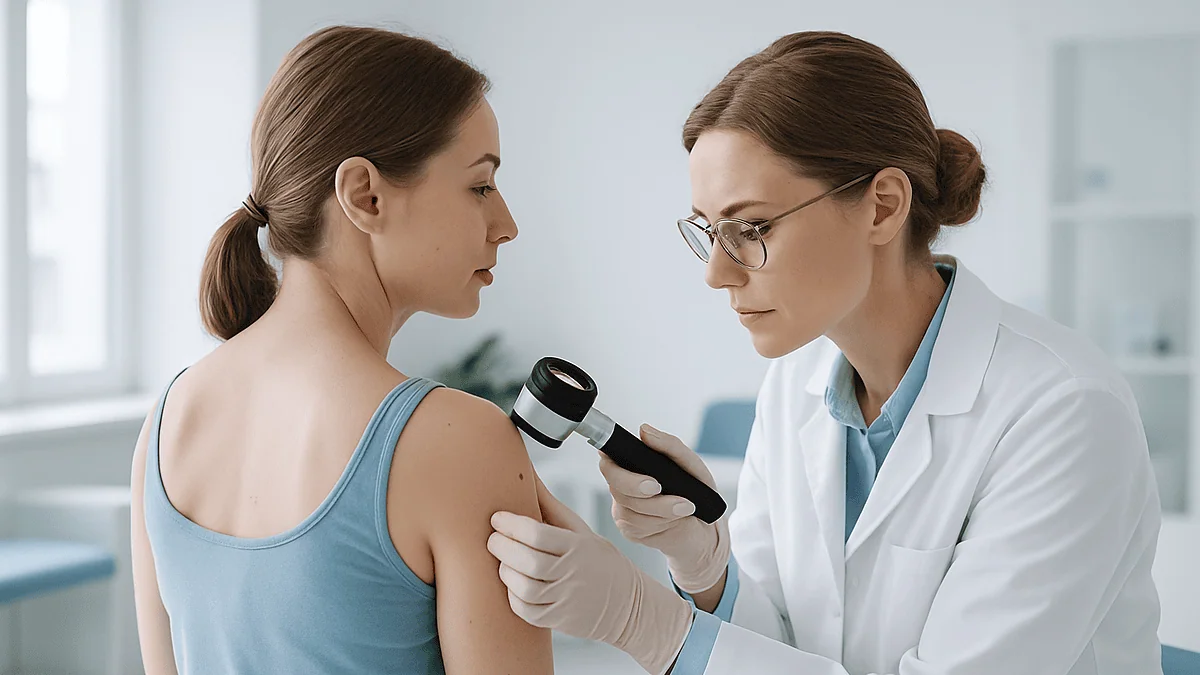
Key Takeaways
- A 2020 BMJ systematic review of nine studies found consumer skin cancer apps missed melanomas and rated the evidence as low quality, with no app reaching a level safe for ruling cancer out.
- In the best-measured app, roughly two to three of every ten melanomas were labeled low risk, and a 2018 Cochrane review reported app sensitivities as low as 7 percent.
- Research AI can match dermatologists on curated dermoscopic images, but that does not transfer to phone photos taken in home lighting with hair, shadows and awkward angles.
- The AI skin lesion devices cleared by regulators in the US and Europe are operated by clinicians in clinics and are a different category from app-store products.
- Apps are least validated on darker skin, where melanoma often appears on palms, soles and nail beds and is more often diagnosed late.
- Melanoma confined to the skin has five-year survival above 99 percent in US registries, which is why a new, changing or unusual spot should go to a clinician rather than wait for an app verdict.
Skin cancer apps can photograph a mole and estimate whether it looks concerning, but studies show they miss a meaningful share of melanomas and flag many harmless spots. Independent reviews rate the evidence as low quality, so no app can rule skin cancer in or out. They may help you track changes, but any new, changing or unusual spot still needs a clinician.
A phone propped against a bathroom mirror, a bare shoulder angled toward the window light, and a green checkmark on screen. That short clip, reposted millions of times this winter, is one reason the phrase skin cancer app has climbed search charts. As of March 2026, the trend has two engines: a wave of videos crediting free apps with catching a melanoma, and a run of regulatory news, including the first artificial intelligence skin lesion device cleared for primary care in the United States and pilots of AI-assisted triage inside UK dermatology clinics.
Those two stories get blurred together, and that is the problem. A tool a doctor holds against your skin in a clinic is not the same thing as a photo filter in an app store. The gap between them is where the evidence lives.
So here is the honest version: what these apps actually do, what the trials and reviews found when they were tested against biopsies, and where a phone genuinely helps.
Why skin cancer apps are trending right now
Skin cancer is the most common cancer in the United States, and most people know someone who has had a spot removed. That familiarity makes a skin cancer app feel like common sense: the camera is already in your pocket, and the stakes are high. The CDC counts tens of thousands of new melanoma cases each year, and melanoma is the form most likely to spread if it is found late.
Three things lit the fuse this time. First, short-form video. Clips in which someone points the phone at a mole, gets a warning, and later shares a pathology report are emotionally powerful, even when the app was only one step in a chain that ended with a dermatologist and a biopsy. Second, the app stores. Dozens of products now describe themselves as AI skin checkers, and several are free to download, which lowers the barrier to trying one. Third, legitimate regulatory movement. Regulators in the US and Europe have cleared or authorized a small number of AI tools for use by clinicians, and headlines about those decisions rarely distinguish between a clinician-operated device and a consumer app.
The result is a confusing moment. People reasonably ask whether their phone can replace the annual skin check, whether a free app is good enough, and whether AI can detect skin cancer from a picture at all. Those are fair questions, and they have answers, but the answers depend on what kind of tool you are talking about, how it was tested, and on whom. The rest of this piece unpacks each layer, starting with what has actually changed in the last few years, because the dates matter more than the hype.
What changed recently
The most rigorous public evaluation of consumer apps remains a systematic review published in the BMJ in February 2020 and indexed by the NIH National Library of Medicine. A systematic review is a study that gathers every eligible trial on a question and grades their quality together. That review examined nine studies covering six apps and found that the apps missed melanomas, that studies were small and prone to bias, and that several excluded the very lesions the apps could not analyze. The authors concluded the evidence did not support relying on these apps to detect skin cancer. Nothing published since has overturned that verdict for app-store products.
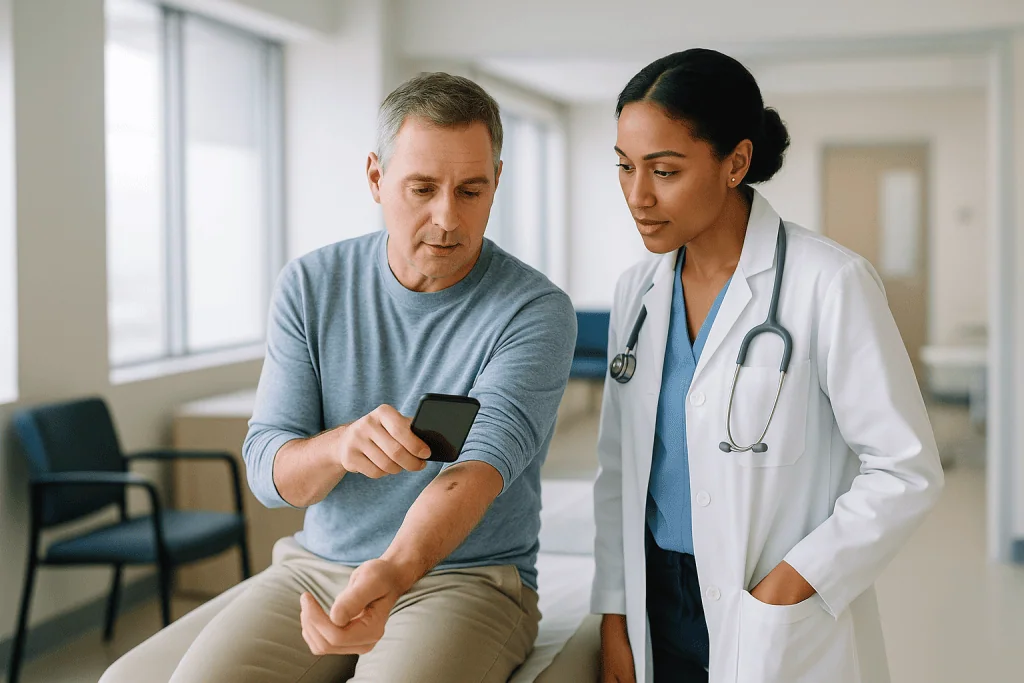
What has changed is the clinic side. In January 2024, the US Food and Drug Administration authorized a handheld AI device intended to help primary care clinicians decide whether to refer a suspicious lesion. It is operated by a clinician, not a patient, and it is not a smartphone app. In the UK, NHS services have been piloting AI-assisted photo triage within dermatology pathways, where a trained photographer uses a dermatoscope attachment and a clinician reviews the output. Those tools are studied in referral settings with professional images, which is a different test from a selfie in bathroom lighting.
Guidance for the public has not shifted. MedlinePlus, the NHS and Mayo Clinic all describe the same path: know your skin, notice change, and see a clinician about anything new or unusual. None of them recommends an app as a screening tool. In other words, the technology moved, the regulators moved for clinical devices, and the evidence for consumer apps stayed roughly where it was. That is the single most useful thing to know before you download anything.
How does a skin cancer app actually work?
Most apps use a convolutional neural network, which is a type of artificial intelligence that learns to recognize patterns in images by studying many labeled examples. Developers feed it thousands of photographs of moles and skin spots, each tagged as benign or malignant based on a dermatologist’s judgment or a biopsy result. The network learns which combinations of color, border, texture and shape tend to appear in the cancerous group. When you photograph your own mole, the app runs that image through the trained network and returns a probability, usually simplified to a low-risk or high-risk label.
Two details shape everything that follows. The first is the training data. If the examples came mostly from clinic photographs taken with a dermatoscope (a handheld magnifier with polarized light that reveals structures beneath the surface), the network learns features that a phone camera cannot capture. If the examples came mostly from people with lighter skin, the network learns less about how skin cancer looks on darker skin. The second detail is the threshold. Developers choose how cautious the app should be. Set it to flag more lesions and it catches more cancers but also sends more people to clinics with harmless spots. Set it to flag fewer and it becomes more reassuring and more dangerous.
Some apps add a second layer: a human review, where a dermatologist looks at the image, often for a fee. That is teledermatology, which means a clinician assessing skin remotely from photographs, and it has a different and generally stronger evidence base than pure AI. Other apps do not analyze at all; they simply store photographs so you can compare a mole over months. Knowing which of these three things an app does tells you how much weight its verdict deserves.
Can AI detect skin cancer from a picture?
Under the right conditions, yes, and sometimes remarkably well. Research teams have shown that deep learning systems trained on large sets of dermoscopic images can classify melanoma versus benign moles at a level comparable to experienced dermatologists when both are judged on the same curated photographs. That finding, repeated across several studies, is why the field is taken seriously and why regulators have cleared clinician-operated devices.
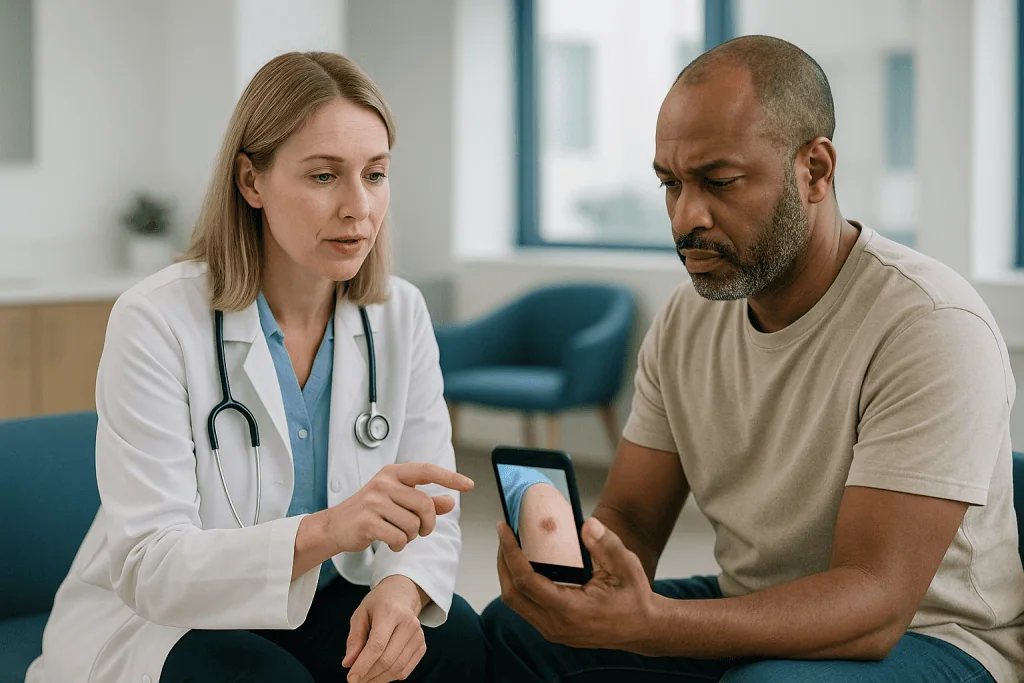
The qualifier is the phrase under the right conditions. In those experiments the pictures were sharp, evenly lit, taken through a dermatoscope and centered on a single lesion. The computer never had to cope with a shadow from a bathroom cabinet, a hair across the mole, a blurry shot of a spot on the back, or a lesion that was too flat, too pale or too raised for the camera to render. A phone photo in daily life fails one or more of those conditions most of the time, and the systems tested in clinic image sets were not trained on that mess.
There is also the gap between classifying and detecting. Classification means deciding what a lesion is once someone has chosen to photograph it. Detection, as a person actually experiences it, includes noticing the spot in the first place. An app cannot see the mole on your scalp that you have never looked at, or the dark streak under a toenail that you assumed was a bruise. Dermatologists examine the entire skin surface, including places a phone cannot easily reach, and that whole-body look is where a surprising number of melanomas are found.
So the honest answer is layered: AI can detect skin cancer from a picture in research and clinical settings, and consumer apps are a weaker, less tested version of that idea operating in far harder conditions.
What the evidence actually says about skin cancer apps
Grade the evidence by type, strongest first. Randomized trials, in which people are assigned by chance to use an app or not and then followed to see who is diagnosed and how early, would answer the question best. For consumer skin cancer apps, none of adequate size exist. That absence matters: it means nobody has shown that using an app leads to earlier diagnosis or better outcomes in real people.
The next tier is diagnostic accuracy studies, which compare an app’s verdict with a reference standard, ideally a biopsy. This is where the data lives, and the quality is low. The 2020 BMJ systematic review pooled nine such studies on six apps. The most-studied app achieved a sensitivity (the share of true cancers correctly flagged) of roughly 73 to 80 percent in two small studies, with specificity (the share of harmless lesions correctly cleared) of around 78 to 83 percent. Those numbers sound respectable until you translate them: for every ten melanomas, two or three were labeled low risk. A Cochrane review from 2018, which examined only two eligible studies, reported sensitivities for melanoma ranging from as low as 7 percent to 73 percent across apps. Both reviews flagged the same flaws: small samples, lesions pre-selected by doctors who had already decided they needed removal, and exclusion of images the app refused to analyze.
The weakest tier is expert opinion and anecdote, which is where the viral videos sit. An individual story in which an app flagged a cancer is real for that person and tells you nothing about how often the app misses one.
Put together, the evidence supports a narrow statement. Consumer apps have not been shown to be safe as a way to rule out skin cancer, and their best measured performance would still miss a substantial minority of melanomas. That is not a criticism of the idea; it is a description of where the science stands today.
How do skin cancer apps compare with a dermatologist visit?
The clearest way to see the difference is to line up the options by what they examine, how they were tested and what they can actually conclude. Dermatoscopy in the table means a clinician examining the skin with a dermatoscope; biopsy means removing a small sample of tissue for a pathologist to examine under a microscope, which is the only way to confirm skin cancer.
| Option | What it examines | How it is evaluated | Strength of evidence | What it can conclude |
|---|---|---|---|---|
| Consumer skin cancer app (AI only) | One phone photo of a spot you chose | Small accuracy studies, often biased samples | Low | A risk label; cannot rule cancer out |
| App with teledermatology review | Your photos, read by a clinician | Moderate-size accuracy studies | Low to moderate | Advice on whether to be seen in person |
| Clinician-operated AI device in clinic | Lesion under controlled lighting or dermatoscope | Larger studies in referral settings; regulatory review | Moderate | Supports a referral decision made by a clinician |
| Dermatologist full-skin exam with dermatoscopy | Entire skin surface, including scalp, soles, nails | Decades of observational data | Moderate to high | Clinical diagnosis and decision to biopsy |
| Biopsy with pathology | Tissue under a microscope | Reference standard | High | Definitive diagnosis |
Two patterns stand out. Evidence quality rises as a trained human enters the loop and as the examination widens from one spot to the whole body. The app sits at the bottom on both counts, not because the algorithms are foolish but because the setting strips away the information a diagnosis depends on. Dermatologists also bring context the camera lacks: your history of sunburns, your family history, whether that spot itched or bled, and whether it looks different from every other mole on your body, a feature clinicians sometimes call the ugly duckling sign.
Is there a free skin cancer app that works?
There are free apps, and some have been studied, but free and validated rarely overlap. Many no-cost downloads are mole diaries: they photograph, date and store images so you can compare them later, and they make no diagnostic claim. Those are honest tools, and the evidence question does not really apply to them. Others offer an AI verdict for free as an entry point and charge for a dermatologist review or for unlimited checks. A third group, often with the most confident marketing, has no published accuracy data at all.
Price tells you nothing about performance. The apps included in the BMJ systematic review spanned both paid and free models, and none reached a level the reviewers considered safe for ruling out melanoma. A free skin cancer app that labels a spot low risk is making the same unproven promise as a paid one, and a reassuring label is where the real harm hides, because it may delay a visit for a lesion that needed one.
If you want to try a free app, the useful questions are not about cost. Does the developer publish peer-reviewed accuracy studies, and were those studies done by independent researchers? Is the app registered or cleared as a medical device anywhere, and for what purpose? Does it tell you clearly what to do when it cannot analyze an image, rather than quietly skipping the spot? Does it store or sell your photographs? Those answers separate a tool from a toy.
The most defensible use of a free app is the least glamorous one: a dated photo archive that helps you notice change. For that job a phone’s own camera and a labeled album work just as well, and no algorithm needs to be involved.
Why apps miss melanomas: light, hair, position and skin tone
Every miss has a mechanism, and most of them are mundane. Start with light. A phone’s camera adjusts exposure automatically, so a dark mole under a warm bathroom bulb can be rendered browner and flatter than it is, erasing the uneven color that often matters most. Add a shadow from your own hand and the border looks different again. Dermatoscopes solve this with polarized light that cancels surface glare and reveals pigment networks, blood vessels and structures a phone cannot see.
Hair is the next problem. Networks trained on clean clinic images stumble when hairs cross a lesion, and many apps simply refuse to analyze such pictures. Several studies in the systematic reviews excluded those unanalyzable images from their accuracy figures, which means the published numbers describe the app at its best, not as you would use it.
Position matters too. Spots on the back, scalp, buttocks and soles are hard to photograph alone, and melanomas on those sites are not rare. A lesion you cannot photograph well is a lesion the app effectively cannot assess.
Then there is skin tone, which deserves more attention than it gets. Training sets have historically overrepresented lighter skin, so apps have less experience with how skin cancer appears on brown or black skin. In people with darker skin, melanoma often develops on the palms, soles, nail beds and mucous surfaces rather than sun-exposed areas, and it is frequently diagnosed at a later stage. An app tuned on sun-damaged lighter skin may be least reliable precisely where delayed diagnosis already does the most harm.
None of these are reasons to distrust technology in general. They are reasons to understand that the photograph, not the algorithm, is often the weakest link.
Who should be most cautious about trusting a phone check
Risk is not evenly distributed, and neither is the cost of a false reassurance. Mainstream guidance from the CDC, Mayo Clinic and the NHS converges on a familiar list of factors that raise skin cancer risk: fair skin that burns easily, a history of blistering sunburns, heavy cumulative sun or tanning bed exposure, a large number of moles or unusually shaped moles, a personal or family history of melanoma, and a weakened immune system, for example after an organ transplant. Age raises risk for basal cell and squamous cell carcinoma, the two most common and usually less aggressive types, while melanoma can appear at any adult age and is among the more common cancers in younger adults.
If several of those describe you, the arithmetic of a phone check turns against you. An app that misses two or three melanomas in ten performs the same for everyone, but the person with 80 moles and a parent who had melanoma has far more at stake in each miss than someone with olive skin and three freckles. For higher-risk people, clinicians often recommend regular full-skin examinations and, in some cases, professional total-body photography or digital mole mapping, where a trained photographer records the entire skin surface under standardized conditions so that change can be measured over time.
People with darker skin tones belong in the cautious group for a different reason: not because their baseline risk is high, but because apps are least validated on their skin and because the sites where melanoma tends to occur are the hardest to photograph.
The flip side is worth saying plainly. Lower-risk people are not immune, and an app cannot assign you to a risk group. What it can do is nudge you to look at your skin, which is a good habit for everyone. The decision about how often to be examined professionally belongs to you and your clinician, informed by your history rather than by a download.
Mole checker app or mole diary: where a phone genuinely helps
Strip away the diagnosis and the phone becomes a strong tool. The feature dermatologists most want you to notice is change: a mole that grows, shifts color, develops an irregular edge or begins to itch or bleed. Human memory is poor at this. Most people cannot say with confidence whether a spot on their forearm looked the same a year ago. A dated photograph can.
The craft lies in consistency. Photograph the same spot in the same place, at the same distance, in daylight near a window rather than under a bulb, and include a reference object such as a coin or a ruler for scale. Repeat at a fixed interval, for example every three months, and keep the images in a single labeled album. Several mole checker app products automate exactly this, with reminders and side-by-side comparison, and that is a reasonable use because it asks the phone to do what cameras are good at and leaves judgment to a person.
Photographs also improve the appointment itself. A clinician who sees three images of a lesion taken over nine months has far more to work with than a description that it seems bigger. In some health systems, patient photographs now feed into teledermatology triage, where a dermatologist decides from images whether you need to be seen urgently. That workflow has reasonable observational support, and it depends on good photographs, not on an algorithm.
What the phone cannot do is replace the look. Set a reminder to examine your whole skin, with a mirror or a partner for the back, scalp and the soles of the feet. The NHS and MedlinePlus both describe this kind of regular self-check as a sensible habit, with the clear instruction that anything new, changing or unusual goes to a clinician rather than to an app for a verdict.
Common myths about skin cancer apps
The viral claims cluster around a few recurring ideas, each with a grain of truth and a misleading shell.
Myth: an app can rule out skin cancer. The published accuracy studies show the opposite. Even the best-performing app in the systematic reviews labeled a meaningful share of melanomas as low risk, and the reviewers judged the studies too small and too biased to support any reassurance claim.
Myth: AI is as good as a dermatologist, so the app is too. Research AI systems have matched dermatologists on curated dermoscopic images. That is a statement about algorithms in controlled tests, not about consumer apps analyzing phone selfies, and the two should not be conflated.
Myth: regulators approved skin cancer apps, so they must be accurate. The devices cleared or authorized in the US and Europe are intended for clinicians, often with a dermatoscope attachment, and are evaluated in that setting. Regulatory status for one product tells you nothing about an unrelated app in the same store category.
Myth: a green checkmark means the spot is fine. A low-risk label is a probability estimate from a model that could not analyze your mole as well as a clinician could. It is not a result.
Myth: apps work equally well on all skin tones. Training data have historically skewed toward lighter skin, and the sites where melanoma occurs on darker skin are difficult to photograph, so performance is least certain exactly where late diagnosis is already more common.
Myth: if the app does not flag anything, no check-up is needed. Apps examine only the spots you choose to photograph. Melanomas on the scalp, back, soles and under nails are missed entirely by a tool that never sees them. A whole-skin examination by a clinician remains the only method that covers everything.
Skin cancer that looks like a wart: why photo matching misleads
One of the most searched questions is whether skin cancer can look like a wart, and the short answer is yes, which is exactly why matching your spot to pictures online is unreliable. Squamous cell carcinoma, the second most common skin cancer, can form a rough, scaly, raised bump that resembles a wart or a patch of thickened skin. Basal cell carcinoma, the most common type, can appear as a pearly bump, a flat scaly patch, or a sore that heals and reopens. A benign growth called a seborrheic keratosis, which is harmless and extremely common with age, has a stuck-on, waxy, warty look that fools even experienced eyes without a dermatoscope. Melanoma itself is sometimes pink or skin-colored rather than dark, a form clinicians call amelanotic melanoma, and it can be mistaken for a wart, a pimple or a scar.
This overlap is the quiet reason image galleries and photo-matching apps cause trouble in both directions. A harmless keratosis can look more alarming in a gallery than the pale, slightly shiny bump that is actually a basal cell carcinoma. A reader scrolls through pictures, decides their spot looks like the benign one, and stops worrying. Dermatologists do not diagnose by resemblance; they combine the appearance under magnification with the lesion’s history, the surrounding skin and, when there is any doubt, a biopsy.
That is why this article deliberately avoids offering a symptom checklist or a picture guide to match against. Mainstream sources such as Mayo Clinic and the NHS describe the general warning idea in a single sentence: a spot that is new, that is changing, that looks different from your other spots, or that does not heal deserves a professional look. Whether it resembles a wart is not the deciding factor; the fact that you noticed it is.
Who needs skin cancer screening, and at what age?
Screening means examining people who have no symptoms in order to find disease early, and for skin cancer the guidance is more nuanced than many assume. The US Preventive Services Task Force, in its most recent statement, concluded that the evidence is insufficient to recommend for or against routine whole-body visual skin examination by a clinician for adults without symptoms. That is not a statement that screening is useless; it means large trials showing that population-wide screening lowers deaths have not been done. Mayo Clinic and the CDC describe the same uncertainty while encouraging people to know their skin and to seek care for changes.
Risk changes the picture. Clinicians commonly advise regular professional skin examinations for people with a personal history of skin cancer, a family history of melanoma, many or atypical moles, a history of significant sun or tanning bed exposure, very fair skin, or a weakened immune system. For those groups, the frequency is set individually, and some dermatology services offer standardized total-body photography to track change.
There is no single screening age for skin cancer the way there is for colon or breast cancer. Basal and squamous cell carcinomas are strongly linked to cumulative sun exposure and rise with age, so older adults with sun-damaged skin are often examined more routinely. Melanoma can occur in younger adults, which is why sun protection and skin awareness are emphasized from childhood onward rather than from a fixed birthday.
Where does an app fit in this? Nowhere in the guidance. No major body lists a skin cancer app as a screening method, and the evidence reviews explain why. The decision about whether you need regular professional checks is best made with a clinician who knows your history, and that conversation is worth having whether or not a phone has ever looked at your moles.
Your photos and your data: what a skin cancer app collects
A mole photograph is medical information. It may show a birthmark, a scar, a tattoo or a body region you would not share publicly, and it is tied to a device that knows who you are. Yet consumer health apps outside a hospital system are often not covered by the privacy laws that protect medical records in a clinic. In the US, those laws generally apply to healthcare providers and insurers, not to app developers selling directly to the public. The protections you get are mostly the ones in the app’s privacy policy, which few people read.
Reasonable questions to ask before uploading: Are images stored on the phone or on a company server? Are they used to train future versions of the model, and can you opt out? Are they shared with advertisers or data brokers? Can you delete them, and does deletion actually remove them from backups? Does the app ask for location, contacts or other permissions it does not need? A product that answers these clearly in plain language is showing the same care it should be showing in its science.
Data use is not only a privacy matter; it also loops back to accuracy. Models improve when they learn from diverse, well-labeled images, and some developers argue that user uploads are the path to better performance on darker skin and on real-world photographs. That is a legitimate goal, but it should be done with explicit consent and with the label supplied by a clinician or biopsy, not by the user’s guess.
If you simply want a dated record of a mole, the lowest-risk option is the one you already own: the phone’s native camera and a labeled album with cloud backup settings you understand. No upload, no model, no terms of service, and the same ability to show a clinician how a spot has changed.
When to see a doctor
Every skin cancer app, and this article, should end at the same door. Guidance from the NHS, Mayo Clinic and MedlinePlus is consistent about the signals that warrant a clinician’s examination rather than a phone’s opinion.
- A new mole or spot that appears in adulthood, especially if it looks different from the others on your body.
- Any existing mole that changes in size, shape or color, or that develops an irregular, blurred or notched edge.
- A spot that itches, tingles, hurts, bleeds, crusts or oozes without a clear injury.
- A sore or patch of skin that does not heal within several weeks, or that heals and then reopens.
- A dark streak under a fingernail or toenail, or a dark spot on the palm, sole or inside the mouth that you cannot explain.
- Rapid growth of a bump, particularly a firm or pearly one on sun-exposed skin.
None of these signs means you have cancer; most moles that change are harmless, and most sores that linger have ordinary causes. The point is that distinguishing the harmless majority from the dangerous minority requires magnification, history and sometimes a biopsy, which only a clinician can provide. Seek care sooner rather than later if you have a personal or family history of melanoma, many moles, very fair skin, or a weakened immune system, and if an app has flagged a spot as high risk, treat that as a reason to book an appointment rather than a reason to re-photograph until the label turns green. If an app labels a spot low risk but your instinct says something has changed, trust the instinct and go.
Melanoma found while still confined to the skin is highly treatable, with five-year survival in US registries above 99 percent; the figure falls sharply once it has spread. That gap is the entire argument for seeing someone early, and no software changes it.
If you still want to use a skin cancer app, here is how to do it sensibly
Plenty of readers will download one anyway, and that is fine as long as the expectations match the evidence. Treat the app as a notebook, not a doctor. Use it to build a dated, consistent photo record of moles you have decided to watch, ideally after a clinician has already looked at your skin and told you which ones are worth tracking. Photograph in daylight by a window, hold the camera steady at the same distance each time, include a scale reference, and keep the images in one place.
Read the verdicts as prompts, never as answers. A high-risk label is a reason to book an appointment. A low-risk label is not a reason to skip one if the spot is new, changing or bothering you. If the app refuses to analyze an image, do not keep retaking the photo until it accepts one; the refusal itself tells you the tool is out of its depth, and the spot still needs eyes on it.
Pick products that publish independent accuracy studies, state their regulatory status honestly, and explain their data practices in language you can follow. Be wary of any app that implies it can rule cancer out, that promises diagnosis, or that uses phrases such as clinically proven without pointing to a study you can read.
Then keep doing the things that have real evidence behind them. Protect your skin from ultraviolet light with shade, clothing and sunscreen, avoid tanning beds, examine your whole skin regularly with a mirror or a partner, and talk with a clinician about how often you should be examined professionally given your history. The phone can hold your photographs and your reminders. The decision about what any of it means belongs in an exam room, and that division of labor is the one the studies support.
Frequently asked questions
Is there a free app that can check for skin cancer?
There are free apps that photograph and store moles, and some that offer an AI risk label at no cost, but none has been shown in independent studies to reliably rule skin cancer in or out. Free and paid apps performed similarly in the published accuracy reviews. The safest free use of a phone is a dated photo record you can show a clinician, not a verdict.
Is there a free AI skin cancer detection app that actually works?
No free AI skin cancer detection app has been validated in large, independent studies as a safe screening tool. The 2020 BMJ systematic review found that the apps it examined missed melanomas and that the supporting studies were small and biased. A free app may help you notice change over time, but any spot it flags, and any spot that worries you, still needs a clinician.
Can AI detect skin cancer from a picture?
In research settings using sharp, evenly lit dermoscopic images, AI systems have classified melanoma about as well as dermatologists. Consumer apps analyzing ordinary phone photos are a much weaker version of that idea, with lower and less certain accuracy. AI also only assesses the spot you chose to photograph; it cannot find a melanoma on your scalp, back or soles that you never noticed.
Can you show me pictures of skin cancer that looks like a wart?
Skin cancer can resemble a wart: squamous cell carcinoma may form a rough, scaly bump, and some melanomas are pink or skin-colored rather than dark. Harmless growths such as seborrheic keratoses look warty too. Because benign and malignant spots overlap so much in appearance, matching your lesion to photographs is unreliable. A new, changing or non-healing spot should be examined by a clinician, whatever it resembles.
What is the best mole checker app?
No mole checker app has strong enough evidence to be called the best for detecting cancer. The most useful products are the ones that help you take consistent, dated photographs, send reminders, and compare images side by side, leaving judgment to you and a clinician. Look for published independent accuracy data, a clear statement of regulatory status, and a plain-language privacy policy before trusting any verdict.
How accurate are skin cancer apps compared with a dermatologist?
Much less accurate, and less tested. Published studies of the most-evaluated app reported sensitivity of roughly 73 to 80 percent for cancer, meaning two or three of ten were missed, and reviewers judged the studies small and biased. A dermatologist examines the whole skin with a dermatoscope, weighs your history, and can biopsy anything uncertain, which no phone photo can replicate.
Do skin cancer apps work on darker skin?
Their performance on darker skin is poorly established. Training image sets have historically overrepresented lighter skin, and in people with brown or black skin melanoma often appears on palms, soles, nail beds and mucous surfaces, which are hard to photograph and are not typical of the sun-damaged lesions apps learned from. Late diagnosis is already more common in these groups, so a reassuring app label deserves extra caution.
Has the FDA approved a skin cancer app?
The FDA has authorized a small number of AI skin lesion tools for use by clinicians, including a handheld device cleared in January 2024 to help primary care clinicians decide on referrals. These are clinician-operated devices evaluated in clinical settings, not consumer apps you point at your own mole. Clearance of one such device says nothing about the accuracy of an unrelated product in an app store.
Can an app replace my annual skin check?
No. An app assesses only the spots you choose to photograph, while a professional skin examination covers the entire surface, including the scalp, back, soles and nails, and uses magnification you do not have. Whether you need regular professional checks, and how often, depends on your risk factors and is a decision for you and your clinician. An app can supplement that plan with photographs, not replace it.
What should I do if a skin cancer app says my mole is high risk?
Book an appointment with a clinician and bring the photographs. A high-risk label is a reasonable prompt to be seen, even though most flagged spots turn out to be harmless. Do not keep retaking the picture until the label changes, and do not try to treat the spot yourself. The clinician will examine it under magnification and decide whether a biopsy is needed.
References
This article is for general information only and is not a substitute for professional medical advice. Please consult a qualified doctor about your individual situation.

More from the Blog
Consumer Genetic Health Reports: What DNA Kits Can Tell You in 2026, and Who Owns the Data
A 23andMe health report uses genotyping, which reads a few hundred thousand selected DNA positions, to flag a limited set of variants linked to…
AI in Surgery: From Robotic Assistance to Predicting Complications
AI in surgery currently means software that helps surgeons rather than replacing them: algorithms that estimate a patient's risk of complications before an operation,…
Hearing and Vision Test Apps: How Accurate Are Phone Screenings?
Hearing test apps and vision test apps are useful screening tools, not diagnoses. In validation studies, smartphone hearing tests taken with the recommended headphones…
Immunotherapy for Cancer: What It Is, Who Qualifies and How It Is Given
Immunotherapy for cancer is a group of treatments that help a person's own immune system recognize and attack cancer cells, rather than killing those…
Smart Scales and Bioimpedance: How Accurate Is Your Body Fat Reading?
Bioimpedance (BIA) smart scales estimate body fat by sending a tiny electrical current through the body, and they are moderately accurate at best. For…
How a Pacemaker Works and How It Is Fitted
A pacemaker is a small battery-powered device placed under the skin near the collarbone and connected to the heart by thin wires called leads.…