

Aphasia Recovery: What Progress Usually Looks Like Across the First Months of Therapy

Key Takeaways
- The NIDCD notes that when aphasia symptoms persist beyond two to three months after a stroke, complete recovery becomes unlikely, yet meaningful improvement can continue for years.
- A Cochrane review of 57 trials found that speech and language therapy improves functional communication, reading, writing and expressive language compared with no therapy, and that higher-intensity schedules bring larger gains but more dropouts.
- Language assessments in the first few days after a stroke tend to overstate long-term severity, because swelling and stunned tissue around the injury are still resolving.
- The American Heart Association guideline supports continued speech and language therapy in the chronic phase beyond six months, so a plateau describes slower change, not an end point.
- Depression after stroke slows language recovery by reducing practice and sleep quality, which is why guidelines recommend routine mood screening during rehabilitation.
- No medicine or brain stimulation technique has an established role for aphasia in major guidelines; speech and language therapy remains the only treatment with strong evidence behind it.
Aphasia recovery after a stroke usually follows a curve: the fastest gains appear in the first weeks and months, the pace slows around three to six months, and slower improvement can continue for years with speech and language therapy. Most people recover to some degree, though few regain every pre-stroke skill. Severity at the start, lesion size, general health and therapy access all shape an individual timeline.
In a rehabilitation room, a retired carpenter holds up a photo of his granddaughter and tries to say her name. What comes out is “the… the small one.” He laughs, then looks at the floor. His wife turns to the speech-language pathologist and asks the question every family asks in the first week: how long will this take?
Honest clinicians rarely answer with a number. The aphasia recovery timeline is one of the most studied and least predictable things in stroke care, and both parts of that sentence matter. Researchers know the general shape of the curve well enough to describe it. They cannot yet say where any one person will land on it.
What follows is the version of that conversation there is rarely time for on a ward: what typically changes in the first days, the first three months and the year that follows, what therapy actually does, and where the evidence runs out.
Why the aphasia recovery timeline is different for every person
Aphasia is a language disorder caused by damage to the parts of the brain that handle words, most often the left side. It affects speaking, understanding, reading or writing in any combination, and it is not a problem with intelligence or with the muscles of the mouth. The National Institute on Deafness and Other Communication Disorders (NIDCD) estimates that around two million people in the United States live with aphasia and roughly 180,000 acquire it each year, most after a stroke.
Two people can leave the same emergency department with the same diagnosis and follow completely different paths. One is speaking in short sentences by the end of the month. The other still struggles to name a cup a year later. The difference is rarely effort or attitude. It comes down to how much tissue was injured, exactly where, how quickly blood flow was restored, and what the rest of the brain has to work with.
That variability is why this article describes ranges rather than deadlines. The NHS puts it plainly: most people with aphasia make some degree of recovery, and a smaller number recover fully, particularly when the cause was a single event such as a stroke rather than a progressive condition. Mayo Clinic adds the other half of the picture: recovery of language is usually a relatively slow process, and although most people make significant progress, few regain their full pre-injury level of communication.
Holding both of those statements at once is the hardest part for families. Improvement is the norm. A complete return to the old self is not the norm. The pages that follow try to make the space between those two truths concrete.
How the brain rebuilds language after injury
Language is not stored in a single spot. It runs on a network that stretches from the front of the left hemisphere, which assembles sounds into words and sentences, to the back, which attaches meaning to what is heard and read. A stroke cuts into part of that network. Recovery is the story of the network re-routing.

Three processes overlap. The first is resolution of the acute injury itself. In the days after a stroke, swelling settles and stunned but surviving cells around the core of the damage start working again. This is why some people change dramatically within a week, before formal therapy has begun. The second is a phenomenon called diaschisis, a term for healthy regions that go quiet because they lost input from the injured area. As those connections stabilize, function can return in places that were never damaged.
The third process, and the one therapy targets, is neuroplasticity: the brain’s ability to strengthen existing connections and build new ones in response to repeated practice. Undamaged tissue near the injury on the left side often takes on new roles. Corresponding regions on the right side can contribute too, though research suggests they tend to support recovery rather than replace the original network.
None of this is instant. Plasticity depends on repetition, attention and feedback, which is exactly what a structured speech and language session provides and what a quiet afternoon in front of the television does not. It also depends on sleep, mood and general health, because a fatigued, depressed or medically unstable brain has fewer resources for learning. The mechanism explains why the American Heart Association’s stroke rehabilitation guideline treats speech and language therapy as a core recommendation rather than an optional extra.
The first two weeks: spontaneous recovery and a picture that keeps shifting
The earliest phase is both the most hopeful and the most misleading. A person who could not say a single word on day one may be producing short phrases by day ten. Another may look worse on day three than on day one because swelling peaks before it subsides. Clinicians call this period spontaneous recovery, meaning change driven mainly by the brain settling rather than by treatment.
Families often ask whether the language they see at this stage is the language they should expect long term. Usually not. Formal assessment in the first days tends to overestimate severity, which is one reason therapists reassess frequently rather than issue a verdict on admission. A speech-language pathologist will typically evaluate four channels separately: speaking, understanding spoken language, reading and writing. A person may understand almost everything yet produce almost nothing, or the reverse.
Swallowing is checked early too, because the same stroke that disrupts language can affect the muscles of swallowing, and safe eating comes before conversation practice. Mayo Clinic notes that language therapy is most effective when it starts soon after the injury, and in many stroke units that means gentle assessment and short, tolerable sessions within the first week, adapted to how alert and medically stable the person is.
What good early care looks like is less about drilling words and more about establishing communication of any kind. Pointing, yes-and-no cards, a whiteboard, a family member reading the room. It also looks like screening for depression and anxiety, which are common after stroke and can quietly slow everything else. The first two weeks set the tone; they do not set the ceiling.
Weeks two to twelve: the steepest stretch of the aphasia recovery timeline
If the curve has a steep part, this is it. Between the end of the acute phase and roughly the three-month mark, the brain is in its most plastic state after injury, and most of the measurable improvement in language scores recorded in stroke research happens here. The NIDCD frames the same window from the other direction: when aphasia symptoms persist beyond two or three months, a complete recovery becomes unlikely, even though meaningful improvement can continue for years.
That sentence lands hard, so it helps to read it precisely. Complete means every pre-stroke skill back to baseline. Unlikely does not mean impossible, and it says nothing about whether a person will be able to order coffee, argue with a sibling or read the sports pages. Those functional goals remain open long after week twelve.
In practice, this period usually involves the highest intensity of therapy a person will receive. Inpatient rehabilitation may offer daily sessions; outpatient programs vary widely by region and by what the person can tolerate. Sessions move from basic naming and comprehension tasks toward sentence construction, conversation strategies and, where relevant, reading and writing. Homework starts to matter.
Fatigue is the great limiter. Post-stroke tiredness is not ordinary tiredness, and a person who was sharp at 10 a.m. may be unable to find any words by 2 p.m. Therapists schedule around this rather than pushing through it. Families sometimes interpret a bad afternoon as regression. Usually it is depletion, and the words return after rest. Tracking progress over weeks rather than hours prevents a lot of unnecessary despair.
Three months, six months, a year: the plateau that isn't a wall
Somewhere between three and six months, most people notice the pace change. Gains that arrived weekly now arrive monthly. Standardized test scores flatten. This is the plateau families dread, and the word deserves some scrutiny, because it describes the speed of change, not its end.
Older rehabilitation thinking held that recovery was essentially finished by six months. That view has softened considerably. The American Heart Association’s rehabilitation guideline supports continued speech and language therapy for people in the chronic phase, the term for aphasia lasting beyond roughly six months, on the grounds that language can still improve with treatment. The Cochrane systematic review of speech and language therapy for aphasia after stroke found benefits for functional communication, reading, writing and expressive language compared with no therapy, and the trials it pooled included many participants well past the acute stage.
What changes in the chronic phase is the character of progress rather than its existence. A person may not add many new words per month, but conversations get smoother because they learn to steer around gaps, use gesture fluently, or write a key word when speech fails. Confidence returns in specific settings first: the kitchen table, then a familiar shop, then a phone call. Those are real gains that a naming test will not capture.
Access is the practical problem. Insurance and health-system rules often taper formal therapy around this point, just as the person is ready to work on real-life goals. Community groups, structured home programs and periodic therapy blocks are the tools used to bridge that gap. The care team can advise what is realistic locally.
What speech therapy for aphasia actually involves
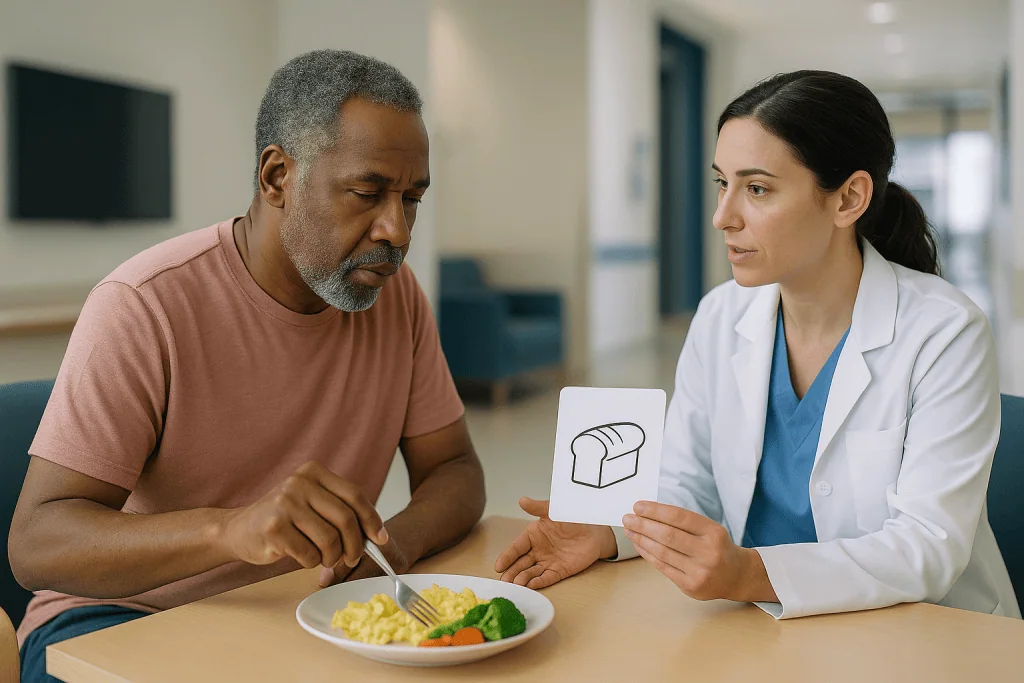
People picture flashcards. There are flashcards, but they are a small part of it. Speech and language therapy for aphasia is a structured retraining program delivered by a speech-language pathologist, a clinician trained in communication and swallowing disorders, and its content depends on which channels of language are affected and what the person needs to do in daily life.
Impairment-based approaches target the broken machinery directly. Naming treatments present a picture and use graded cues, such as the first sound or a rhyming word, to help retrieve the label, then withdraw the cues as retrieval strengthens. Sentence-level programs rebuild the ability to map who did what to whom. Comprehension work trains the person to hold longer spoken instructions in mind. Reading and writing have their own protocols.
Functional approaches work on the conversation rather than the word. Therapists teach strategies for repairing a breakdown mid-sentence, coach the person to combine speech with gesture and drawing, and train family members to change how they talk so that exchanges succeed more often. Group therapy, where several people with aphasia practice together, builds confidence and offers the rare relief of talking with people who are not in a hurry.
A typical session lasts 30 to 60 minutes, though the Cochrane review notes that duration and frequency in trials varied enormously. Most therapists send homework because the total number of practice repetitions across a week drives change more than any single session. Computer and tablet programs can extend that practice; the American Heart Association guideline describes them as a reasonable supplement to, not a replacement for, clinician-led therapy.
How much therapy is enough? What the evidence says about dose
Ask three therapists how many hours are needed and the honest answer from each will begin with “it depends,” but the evidence base has firmed up in recent years. The Cochrane review, which pooled 57 randomized trials involving more than 3,000 participants, found that high-intensity, high-dose regimens delivered over shorter periods produced larger gains in functional communication than lower-intensity schedules. The same review found a cost: more participants dropped out of intensive programs, presumably because they were exhausting.
The American Heart Association’s guideline lands in a similar place. It recommends speech and language therapy for everyone with post-stroke aphasia and states that intensive treatment is probably more beneficial than less intensive treatment, while acknowledging that the ideal schedule has not been defined. It also notes there is no convincing evidence that any single therapy technique outperforms the others, which is liberating in its way: what matters is that practice happens, in volume, on tasks that resemble real communication.
Tolerance is the missing variable in most of these studies. An 80-year-old with heart failure and a 55-year-old with no other conditions cannot absorb the same weekly load. Therapists titrate, an ordinary word here rather than a medical one, by watching for fatigue, frustration and diminishing returns within a session.
A useful reframe for families: think in total hours over a phase rather than sessions per week. Two clinic visits plus daily home practice may deliver more repetitions than four visits with nothing in between. The care team can help design a schedule that is intensive enough to matter and light enough to sustain, and that balance shifts as recovery progresses.
Who starts therapy right away, and who is usually asked to wait
Nearly everyone with aphasia after a stroke is a candidate for speech and language therapy. The question on the ward is usually not whether but when and how much, and there are legitimate reasons a team may hold back at first.
People who are medically unstable come first in the waiting column. Fluctuating blood pressure, ongoing investigation of the stroke’s cause, an active infection or uncontrolled seizures all take priority, because a brain under acute strain cannot learn and because some of those conditions can worsen the stroke itself. Delirium, an acute state of confusion common in older hospitalized adults, is another reason to defer formal language testing; results collected during delirium tell the team little.
Severe post-stroke fatigue or very low alertness may mean sessions start at five minutes and grow. Swallowing safety is addressed before conversation practice when the two compete for the therapist’s limited time. Significant hearing or vision loss does not exclude therapy but changes how it is delivered, and correcting a hearing aid or glasses prescription can produce what looks like a language leap.
One group follows a different pathway entirely. Primary progressive aphasia is a form of dementia in which language declines gradually because of neurodegeneration rather than a single injury. Therapy can still help people maintain skills and adopt compensatory strategies, but the expectation of a recovery curve does not apply, and the timeline questions in this article are not the right ones. Anyone whose language difficulties crept up over months rather than arriving suddenly needs a neurological assessment before a rehabilitation plan.
These are typical patterns, not rules. The treating team weighs each person’s medical picture and decides the pace.
Types of aphasia after stroke and how recovery tends to differ
Clinicians sort aphasia into types based on which language channels are hit hardest. The labels are imperfect because most people have mixed features, and a person’s type often changes as they recover. Still, the categories help predict what early therapy will focus on and what progress tends to look like. The patterns below reflect descriptions from the American Stroke Association and the NIDCD, not guarantees for any individual.
| Type | What it looks like | What recovery often involves |
|---|---|---|
| Broca’s (non-fluent) | Effortful, short phrases; understanding largely preserved; person usually aware of errors | Frustration is high early; sentence-building and word-finding work; awareness helps with self-correction |
| Wernicke’s (fluent) | Speech flows but contains wrong or invented words; understanding impaired; person may not notice errors | Comprehension is the early target; progress can feel slower to families because errors are less obvious to the speaker |
| Global | Severe difficulty in all channels, usually after a large stroke | Early work centers on any reliable communication; many people evolve toward a less severe type over months |
| Anomic | Fluent speech and good understanding, but frequent word-finding pauses | Often the end point for people who started with more severe forms; naming therapy and circumlocution strategies |
The word “functional” appears in two unrelated senses around aphasia, and the confusion is worth clearing up. Functional communication is the therapy goal of getting messages across in real life by any means, and it is the outcome most trials now measure. Functional aphasia, by contrast, is sometimes used to describe language symptoms arising from a functional neurological disorder, a condition in which the nervous system’s signaling is disrupted without structural damage. It is diagnosed by a neurologist on positive features, not by ruling everything else out, and it has its own treatment pathway. Anyone unsure which term applies should ask the care team directly.
Can you recover from aphasia? What shapes the outlook
The short answer, drawn from the NHS and NIDCD, is that most people improve, some substantially, and a minority recover completely. The longer answer depends on a handful of factors that clinicians weigh when they talk about prognosis, and it helps families to know what those are so the conversation feels less like fortune-telling.
Initial severity is the strongest single predictor in most studies. People with mild aphasia at the two-week mark tend to reach near-normal function; people with global aphasia tend to improve but remain impaired. Lesion size and location matter for the same reason: a larger injury leaves less intact network to recruit, and damage to certain deep structures under the cortex tends to slow recovery of speech production.
Age has a smaller influence than most people assume. Older adults recover, and although the average curve is somewhat flatter with advancing age, individual variation swamps that effect. What ages tend to bring with them, other health conditions, hearing loss, medication burden, matters more than the birth year itself.
Mood is the modifiable factor most often overlooked. Depression after stroke is common, and a depressed brain practices less, sleeps worse and consolidates less learning. The American Heart Association guideline recommends screening for depression during rehabilitation for this reason. Social support and access to therapy also shift the curve, which is why isolation is treated as a clinical risk rather than a personal circumstance.
Two things do not predict outcome well: how the person looked on day one, and how hard they seem to be trying. The first overstates severity. The second implies that people who plateau were not trying, which is unfair and untrue.
How to help someone with aphasia at home
Families are the most important therapists a person with aphasia has, not because they should run drills but because they control the environment where most communication happens. The NHS and the American Stroke Association offer similar guidance, and it comes down to changing how the conversation works rather than fixing the speaker.
Slow the pace. Use shorter sentences, pause between ideas, and allow silence while the person searches for a word. Ten seconds feels like an eternity to the listener and like a fair chance to the speaker. Resist finishing sentences unless invited; guessing wrong costs the person the thread they were holding.
Reduce competition. Turn off the television, face the person, and have one conversation at a time. Background noise that a healthy brain filters out effortlessly can swamp a recovering language network. Keep pen and paper nearby and treat drawing, gesture and pointing as legitimate speech, not as failure to talk.
Confirm rather than correct. Repeating back what was understood, “you mean the pharmacy on Main Street,” closes the loop and lets the person fix errors without being graded. Yes-or-no questions help when open questions stall, but too many of them turn every exchange into an interrogation, so mix in choices: “tea or coffee?”
Include the person in decisions about their own care, even when it is slower. Aphasia does not affect intelligence, and being talked over in medical appointments is one of the most consistently reported indignities. Many speech-language pathologists run sessions specifically for family members to practice these techniques, and the evidence reviewed by the American Heart Association supports communication partner training as a useful part of rehabilitation.
Medicines, brain stimulation and apps: what is proven and what is still experimental
Every family eventually asks whether there is a pill, a device or a program that would speed things up. The honest map of that territory has one well-established region and several frontier ones.
Speech and language therapy is the established treatment. The Cochrane review and the American Heart Association guideline both support it, and nothing else has that weight of evidence behind it. Medicines have been studied for decades; drug classes that act on the brain’s dopamine, acetylcholine and noradrenaline signaling have all been tested as add-ons to therapy in small trials with inconsistent results. No medicine currently has an established role for aphasia in major guidelines, and no drug is prescribed for aphasia itself outside research settings. People with aphasia will usually be taking medicines for the stroke’s underlying causes, such as blood pressure or clotting, and those decisions belong entirely to the prescribing clinician.
Non-invasive brain stimulation is the most active research frontier. Transcranial direct current stimulation delivers a weak electrical current through scalp electrodes; transcranial magnetic stimulation uses a magnetic coil to stimulate or dampen a region. Both are being tested as ways to prime the brain before therapy sessions. Results so far are mixed and mostly from small trials, and the American Heart Association guideline describes their benefit for aphasia as not yet established. They are not standard care.
Apps and computer programs sit in between. They cannot diagnose or replace a therapist, but the guideline regards computerized practice as a reasonable supplement because it increases repetitions. The right choice depends on which language channels are impaired, so the speech-language pathologist should recommend the program rather than the app store.
What people often get wrong about aphasia recovery
Myths around aphasia tend to do harm in one of two directions: they make people give up too early or they make them blame themselves for a plateau. A few deserve direct correction.
“Recovery stops at six months.” It slows. The American Heart Association guideline supports therapy in the chronic phase, and the NIDCD notes that some people continue to improve over years and even decades. The shape of progress changes, from vocabulary gains to smoother, more strategic communication, but it does not stop on a calendar date.
“If they understood me, they would answer.” Comprehension and expression are separate channels. A person may follow every word of a conversation and still be unable to produce a reply, or may reply fluently with words that miss the mark while missing much of what was said. Neither pattern reflects intelligence or attention.
“Speaking louder or slower in a childlike voice helps.” Volume does nothing for a language problem. Pace helps; simplification helps; a patronizing tone corrodes the relationship and is remembered long after the words are forgotten.
“Bilingual people lose one language.” Both are usually affected, often to similar degrees, though recovery can proceed unevenly between them. Therapists ask about all languages spoken.
“Trying harder would fix it.” Effort matters for practice volume, but the person straining to name a cup is already trying as hard as anyone in the room. Plateaus reflect biology and access to therapy far more than motivation.
“It is the same as slurred speech.” Slurring is dysarthria, a muscle-control problem. Aphasia is a language problem. They can coexist after a stroke, and they are treated differently.
Questions to ask your care team
Appointments are short and aphasia makes them shorter still, so it helps to arrive with a written list. These questions tend to produce the most useful answers.
- Which channels of language are affected most, speaking, understanding, reading or writing, and how did the most recent assessment compare with the first one?
- What is the current therapy plan: how many sessions, over what period, and what will we work on first?
- What home practice should we do between sessions, and how much is too much on a tired day?
- Are there group programs or communication partner training sessions available for family members?
- What happens when formal therapy tapers, and how do we arrange a review or a new block later?
- Has depression or anxiety been screened for, and who should we tell if mood seems to be slipping?
- Does swallowing need to be reassessed, and are there any eating or drinking precautions still in place?
- Is any hearing or vision problem making communication harder than it needs to be?
- Which changes should we treat as normal fluctuation, and which would mean calling you or emergency services?
- If we are interested in research trials of brain stimulation or other new approaches, how would we find out about them?
Bring someone to take notes, and ask the therapist for a written summary of goals in plain language that the person with aphasia can read or have read to them. Being handed a plan in a form you can access is part of the treatment, not an afterthought. Decisions about the pace and content of rehabilitation remain with the treating team, informed by the person’s own priorities.
When to call your doctor
Most day-to-day variation in aphasia is harmless: a worse afternoon after a poor night’s sleep, a good week after a change of routine. A small number of changes are not variation and need urgent action.
Call emergency services immediately if language suddenly worsens over minutes to hours, particularly if it comes with new weakness or drooping on one side of the face or body, new confusion, a severe headache, loss of vision or trouble with balance. The American Stroke Association’s FAST warning signs, face drooping, arm weakness, speech difficulty, time to call, apply to people who have already had one stroke just as they apply to everyone else, and a second stroke is a real risk in the first year. Do not wait to see whether it passes.
Seek same-day medical advice for a possible seizure, including staring spells or brief episodes of unresponsiveness; new or worsening trouble swallowing, coughing or choking with food or drink, or a wet-sounding voice after meals; a fever with cough, since aspiration pneumonia is a known complication when swallowing is affected; or a fall or head injury.
Contact the care team promptly, though not necessarily the same day, if mood has darkened, if the person has stopped eating, withdrawn from family or expressed hopelessness, if there is any talk of not wanting to live, if sleep has collapsed, or if progress has clearly reversed over a week or two without an obvious reason such as illness or exhaustion.
When in doubt, call. Clinicians who work with stroke would far rather hear about a false alarm than miss a treatable complication.
Frequently asked questions
Can you heal from aphasia?
Most people with aphasia after a stroke improve, and a smaller number recover fully, according to the NHS and NIDCD. The largest gains usually occur in the first three months, with slower progress continuing afterward. Mayo Clinic notes that although most people make significant progress, few regain their exact pre-stroke communication level. Severity at the start, the size and location of the injury, mood and access to therapy all influence how far recovery goes.
How long does aphasia last after a stroke?
It varies enormously. Some people with mild aphasia return to near-normal language within weeks. Others continue to have noticeable difficulty for years. The NIDCD notes that when symptoms last beyond two or three months, complete recovery is unlikely, though improvement often continues long after that. Clinicians describe the pattern as a curve that is steep early and gradual later rather than a fixed duration.
How can I help someone with aphasia?
Slow the conversation down, use shorter sentences, reduce background noise and give the person time to find words without finishing their sentences for them. Treat gesture, drawing and writing as valid ways to communicate. Confirm what you understood rather than correcting errors. Include the person in decisions about their own care. Many speech-language pathologists offer training sessions for family members, and this communication partner training is supported in stroke rehabilitation guidance.
What are the symptoms of aphasia in adults?
Aphasia affects language rather than intelligence or the muscles of speech. People may struggle to find words, produce sentences that are short or grammatically incomplete, use the wrong word without realizing it, have difficulty understanding what is said to them, or find reading and writing hard. Any combination is possible. Because these features can also signal a new stroke, sudden onset is a medical emergency and requires an immediate call to emergency services.
What is functional aphasia?
The term is used in two different ways. In therapy, functional communication refers to getting a message across in daily life by any means, and it is a primary goal of aphasia rehabilitation. Functional aphasia can also describe language symptoms arising from a functional neurological disorder, in which brain signaling is disrupted without structural damage. That diagnosis is made by a neurologist based on specific clinical features and has its own treatment approach.
Does aphasia get worse over time?
Aphasia caused by a stroke does not progress on its own; it usually improves, then stabilizes. Bad days related to fatigue, illness or poor sleep are common and temporary. A sudden worsening over minutes or hours can signal a new stroke and needs emergency care. Gradual decline over months suggests a different cause, such as primary progressive aphasia, a form of dementia, and requires a neurological assessment.
Is speech therapy for aphasia still worth it after a year?
Yes, according to current guidance. The American Heart Association’s stroke rehabilitation guideline supports speech and language therapy in the chronic phase, and the NIDCD notes that some people improve over years. Progress after a year tends to be slower and more focused on strategies and real-life communication than on raw vocabulary, but studies of chronic aphasia have documented measurable gains. The care team can advise on realistic goals and how to access further therapy.
Does aphasia affect intelligence or memory?
Aphasia is a language disorder, not a disorder of intelligence. People with aphasia think, reason and remember; they have difficulty turning thoughts into words or decoding words into meaning. Because a stroke can affect several brain regions at once, some people have separate problems with memory or attention alongside aphasia, but these are distinct conditions. Speaking to someone with aphasia as a capable adult is both accurate and part of good care.
What is the difference between aphasia and dysarthria?
Aphasia is a problem with language itself, with finding words, forming sentences or understanding speech, caused by damage to language networks in the brain. Dysarthria is a problem with the muscle control needed to produce clear speech, which makes words sound slurred or slow even though the underlying language is intact. Both can occur after a stroke, sometimes together, and speech-language pathologists assess and treat them differently.
How does aphasia affect people who speak more than one language?
Usually all languages a person speaks are affected, though not always equally, and recovery can proceed at different rates in each. Patterns vary: some people regain their first language sooner, others the language they used most before the stroke. Therapists ask about every language spoken and may work in more than one. Families should tell the care team which languages matter most for daily life so goals reflect real needs.
References
This article is for general information only and is not a substitute for professional medical advice. Please consult a qualified doctor about your individual situation.

More from the Blog

Demyelinating Diseases Treatment: How Relapse Control and Long-Term Monitoring Are Planned
Demyelinating diseases are treated in three layers: a short course of corticosteroids, or plasma exchange for severe attacks, to settle an acute relapse; longer-term…

Bringing Your Baby Home After Congenital Hydrocephalus Surgery: Feeding, Wound Care and Checks
Caring for a baby after hydrocephalus surgery means feeding on demand while watching for repeated or forceful vomiting, keeping the scalp and abdominal incisions…

How Tethered Cord Release Surgery Is Performed and Why Nerve Monitoring Guides the Surgeon
A tethered cord release procedure is spinal surgery in which a neurosurgeon opens the lower back, locates the tissue holding the spinal cord under…

How Is FND Different From Epilepsy or MS, and Why Does That Change the Treatment?
Functional neurological disorder (FND), epilepsy and multiple sclerosis (MS) can all cause seizure-like episodes, weakness or numbness, but they arise from different problems. Epilepsy…

Can You Drive and Work With Narcolepsy? Safety Planning Your Sleep Specialist Will Discuss
Many people with narcolepsy do drive and hold jobs, but it depends on how well daytime sleepiness and cataplexy are controlled, and on local…

Antiplatelet Medicines After Aneurysm Coiling: Why Stopping Them Is a Specialist Decision
After aneurysm coiling, antiplatelet medicines such as aspirin or clopidogrel are usually prescribed only when a stent or flow diverter was placed alongside the…