

Before Complex Joint Reconstruction: Why Old Implant Records and Scans Shape the Plan

Key Takeaways
- The operative report from your first joint replacement, listing the manufacturer, component names and sizes, is the single most useful document for planning a revision.
- Early post-operative X-rays let the team compare how the implant looked when new with how it looks now, revealing gradual loosening or bone loss that a single film cannot.
- Infection testing with inflammatory blood markers and, where needed, joint aspiration determines whether revision is done in one operation or two stages.
- Revision is generally a longer, more complex operation than a first replacement, using specialized stems, augments and cones to compensate for lost bone.
- The NHS gives a usual hospital stay of 1 to 3 days for primary knee replacement and full recovery of up to a year or more; revision patients are commonly counseled to expect longer.
- Correcting anemia, treating dental infections, controlling blood sugar and stopping smoking before surgery are not delays but part of the treatment.
Preparing for revision joint surgery starts with gathering the records of your original implant, including the manufacturer name, model and sizes from your operative report or implant card, along with prior X-rays and scans. Your surgical team uses these to plan tools, parts and bone-preserving techniques before the operation. Medical optimization, infection testing and home preparation follow, guided by your treating team.
The envelope arrived from the pre-admission clinic with a single highlighted request: find the paperwork from the knee you had done eleven years ago. Not the discharge letter. The operative note, the little card the surgeon slid into a folder on the way out, the X-rays on a disc that may or may not still open. For a lot of people facing a second operation on the same joint, this is the first surprise about preparing for revision joint surgery: the plan depends on history you may have long since filed away.
There is a practical reason. A revision means taking out or rebuilding parts of a joint replacement that has worn, loosened, become infected or was never quite stable. Every implant has a specific shape, size and locking design, and the tools to remove or match it are often specific too.
This article explains why those old records and images matter so much, what the team actually does with them, and how the rest of the preparation, your body, your home, your questions, fits around that groundwork.
Why does the surgeon want my original implant records?
A joint replacement is not one thing. It is an assembly: a metal component fixed to the thigh bone, another to the shin or pelvis, a plastic liner between them, sometimes a patellar button or a ceramic head. Each piece comes from a catalog of sizes, and each system has its own locking mechanisms, tapers and screw threads. The operative report from your first surgery usually lists the manufacturer, the component names and the exact sizes used. Many patients also receive an implant card with sticker labels carrying lot numbers.
That information tells the revision surgeon several things at once. It tells them whether a worn plastic liner can be swapped while leaving well-fixed metal in place, which is a far smaller operation than replacing everything. It tells them which extraction instruments to have in the room, because removal tools are frequently designed around a specific implant. It tells them whether the new components can mate with any part of the old system, or whether every part must go.
Without the record, the team works from radiographs alone, trying to recognize the silhouette of a component the way you might identify a car by its taillights. Experienced surgeons and radiologists can often do this, but it is slower and less certain, and it can mean opening extra instrument trays or preparing for more than one possibility. The Mayo Clinic notes that revision surgery is generally more complex than a first replacement, and much of that complexity is reduced when the surgeon knows exactly what is inside the joint before the incision is made.
If you cannot find the documents, the hospital where the first surgery took place can usually retrieve the operative note from its archives. Ask early; records requests take time.
What actually happens during revision joint surgery?
Revision surgery, in plain terms, is an operation to remove, repair or replace parts of a previous joint replacement. What that involves varies enormously, which is why the planning stage matters so much.
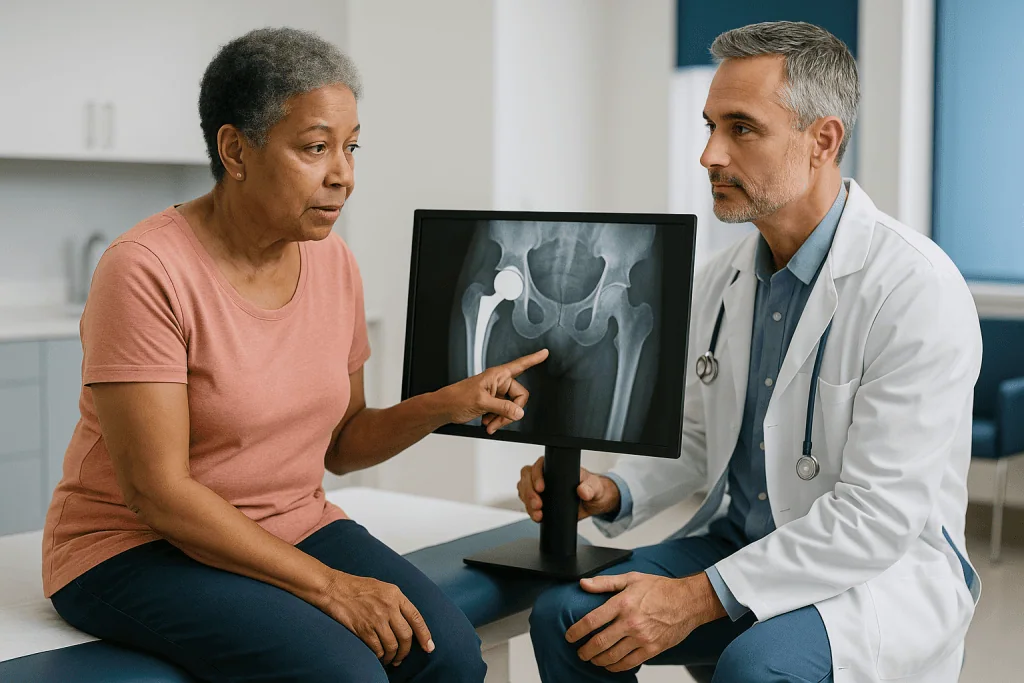
At the simplest end, the surgeon opens the old scar, inspects the components, confirms they are firmly fixed, and exchanges only the plastic insert that has worn thin. At the more demanding end, the surgeon must free a metal component from bone it has grown into or been cemented to, without fracturing the bone around it. Cement is chipped away with fine osteotomes, small chisels designed for bone work, or removed with specialized ultrasonic tools. Bone that has thinned or been lost, which surgeons call diminished bone stock, must be rebuilt before a new implant can sit securely.
Rebuilding often uses revision-specific components: longer stems that reach further into the shaft of the bone to gain purchase, metal augments or wedges that fill defects, sleeves and cones that anchor where bone is weak, and occasionally bone graft. Once the new components are in, the surgeon checks alignment, stability through a full range of motion, and soft-tissue balance before closing.
When infection is the reason for revision, the sequence changes. Some patients undergo a two-stage approach: the infected implant is removed and a temporary antibiotic-loaded spacer is placed, followed by a period of antibiotic treatment, and only then is a new permanent implant fitted in a second operation. Others are candidates for a single-stage exchange. The choice depends on the organism, the condition of the tissues and the person’s overall health, and it rests with the treating team. According to MedlinePlus, replacement surgery of any kind is a major operation, and a revision typically takes longer than a first replacement because of these added steps.
Preparing for revision joint surgery: the documents that shape the plan
Think of this as building a file. The more complete it is when you reach the pre-operative appointment, the fewer gaps the team has to work around.
- Operative report from the original surgery. This is the single most useful item. It names the components, the sizes, the fixation method (cemented or press-fit), and often notes anything unusual the first surgeon encountered.
- Implant card or sticker sheet. Lot numbers allow the team to confirm the exact product and check for any manufacturer notices.
- All prior imaging of the joint. Not just the most recent films. Early post-operative X-rays show how the implant looked when it was new, so later images can be compared to detect gradual loosening or bone loss.
- Records of any previous joint infection, aspiration or antibiotic course. These influence the infection work-up and the choice between one- and two-stage surgery.
- Notes from any previous manipulation, arthroscopy or fracture repair on the same limb. Old hardware elsewhere in the bone changes where a new stem can go.
- A current list of medicines, supplements and allergies, including reactions to metals, adhesives or antibiotics.
The Johns Hopkins Medicine overview of knee replacement stresses that a full history and physical examination precede any joint surgery; for revision, that history extends backward into the first operation. Bring originals or high-quality copies, and keep a set for yourself. If a disc of images will not open on a home computer, do not worry; hospital imaging departments can usually read older formats, or request the studies directly from the facility that performed them.
Which scans are needed before revision surgery, and what do they show?
Plain X-rays remain the workhorse. Standing views of the knee or pelvis show whether the components are still aligned, whether a thin dark line has appeared between implant and bone (a common sign of loosening), and whether the plastic liner has worn so that the metal parts sit closer together than they should. Comparing today’s films with those taken shortly after the first surgery turns a single snapshot into a story of change over time, which is why those early images matter.

Computed tomography, or CT, is a cross-sectional X-ray technique that maps bone in three dimensions. Surgeons use it to measure how much bone remains around the implant, to identify defects that will need augments or grafts, and sometimes to build a template of the new construct in advance. Where a component’s rotation is in question, particularly in the knee, CT can quantify it in a way plain films cannot.
Magnetic resonance imaging, or MRI, uses magnetic fields rather than radiation and is better for soft tissue. Around metal it produces distortion, but modern metal-artifact-reduction sequences allow radiologists to look for fluid collections, tendon damage or the soft-tissue reactions occasionally seen around certain metal-on-metal bearings.
Nuclear medicine scans, in which a small amount of tracer highlights areas of active bone turnover or inflammation, are sometimes used when the cause of pain is unclear.
Infection testing runs alongside imaging. Blood tests for inflammatory markers, C-reactive protein and erythrocyte sedimentation rate, screen for inflammation. If they are raised or suspicion is high, the surgeon may aspirate the joint, drawing fluid with a needle for cell counts and culture. Knowing before surgery whether bacteria are present changes the entire plan, from the number of operations to the antibiotic strategy, which is why Mayo Clinic lists infection among the key complications any replacement team must evaluate.
Who is usually offered revision surgery, and who is asked to wait?
Revision is considered when a replaced joint is causing significant problems that cannot be settled by simpler measures. The common reasons, described by the Mayo Clinic and others, include loosening of a component from bone, wear of the plastic bearing, instability where the joint gives way, infection, fracture of the bone around the implant, and stiffness that limits daily function. Pain on its own, without a clear mechanical or infective explanation on imaging and testing, is a weaker reason to operate, and many surgeons will investigate further rather than proceed.
People are commonly asked to wait, or to complete other steps first, when:
- An active infection elsewhere in the body, a dental abscess or a skin ulcer, for example, needs treating so it cannot seed the new implant.
- Blood sugar control in diabetes is poor, since high glucose impairs wound healing and raises infection risk.
- They currently smoke; nicotine narrows small blood vessels and slows tissue repair, so many teams recommend stopping well before surgery.
- Anemia, low iron or poor nutrition is found on blood tests and can be corrected beforehand.
- Heart, lung or kidney conditions are not yet stable enough for a long anesthetic.
- The cause of pain is still unexplained and further imaging or aspiration is pending.
Waiting in these situations is not a refusal. It is the team trying to make the second operation the last one. A revision performed into a hostile environment, infected tissue, uncontrolled diabetes or fragile bone, carries a higher chance of needing yet another procedure. Some people, after weighing the risks with their surgeon, decide that living with a limited but tolerable joint is preferable to a major reconstruction, and that is a legitimate choice too. The decision belongs to the patient and the treating team together.
Is knee revision harder than knee replacement?
Yes, in most cases, and it is fair to say so plainly. The NHS describes revision as more complicated than a first replacement, and surgeons generally plan for a longer operation and a more demanding recovery.
Several factors drive this. The first is scar. Every previous incision leaves tissue that is stiffer and less forgiving than the original, and the surgeon must navigate through it without damaging the ligaments and tendons that stabilize the joint. The second is bone. Removing a well-fixed implant, whether cemented or ingrown, inevitably takes some bone with it, and the surgeon must then find secure fixation in what remains. The third is the loss of familiar landmarks. During a first replacement, the surgeon uses the natural shape of the bone to set alignment and rotation; after the first cuts have been made, those references are gone, and revision components must be positioned using longer stems, intramedullary guides and pre-operative imaging.
Infection adds another layer entirely. A two-stage approach means two operations, a period with a temporary spacer during which walking is limited, and weeks of antibiotics between them.
None of this means the outcome is poor. It means the margin for error is smaller and preparation counts for more. The extra time spent gathering records, imaging in detail and testing for infection is precisely how teams turn a harder operation into a well-planned one. From the patient’s side, the honest framing is this: expect a longer surgery, a longer hospital stay and a slower return to full activity than you may remember from the first time, and build your home and support arrangements around that expectation rather than around the memory of the primary replacement.
Preparing for revision joint surgery: your body in the weeks before
Once the records and scans are in hand, attention turns to making the body as ready as the plan. The common threads across MedlinePlus, NHS and Mayo Clinic guidance are the same for primary and revision surgery, but the stakes are higher the second time.
Blood and nutrition. Pre-operative blood tests check for anemia, kidney function and glucose. Low iron stores can be corrected before surgery, reducing the chance of needing a transfusion during a longer, bloodier operation. Adequate protein intake supports wound healing; a dietitian may be involved if weight loss or poor appetite is a concern.
Smoking and alcohol. Stopping smoking before surgery improves oxygen delivery to healing tissue and lowers lung complications under anesthesia. Reducing alcohol helps liver function and bleeding risk. Ask the team how far in advance they recommend, and ask about support to make it stick.
Dental and skin. Untreated gum disease or a decayed tooth is a reservoir of bacteria that can travel through the bloodstream to a new implant. Many teams ask for a dental check before surgery. Skin near the joint should be intact; cuts, rashes or fungal infections may lead to postponement.
Medicines. Blood thinners, certain arthritis drugs that suppress the immune system, and some supplements affect bleeding or healing. The prescribing clinician and the surgical team decide together which to continue, pause or adjust, and when. Never change a prescribed medicine on your own; bring the full list and let them make the call.
Strength. Gentle prehabilitation, meaning exercises prescribed by a physical therapist before surgery to maintain muscle around the joint, can make the first days of recovery easier. It should be tailored to what the failing joint can tolerate.
Hip revision surgery preparation: getting your home and helpers ready
Recovery after a revision often begins with more restrictions than after a first replacement, and the home should be set up for the slower version of you. The MedlinePlus discharge guidance for knee replacement, and the equivalent advice for hips, gives a good template that applies with extra emphasis here.
Start with the route from bed to bathroom to kitchen. Remove loose rugs, trailing cords and low furniture that a walker could catch. Add a raised toilet seat and a shower chair if the team recommends them; for hip revision especially, avoiding deep bending and twisting in the early weeks is often advised, and the right equipment makes that possible without thinking about it. A firm chair with arms, at a height that keeps your hips above your knees, is more useful than any recliner.
Plan for sleeping downstairs if stairs are a problem, at least initially. Move frequently used items to waist height so nothing requires reaching up or stooping. Prepare and freeze meals, or arrange for someone to cook.
Then think about people. After a revision, many patients need a companion at home for longer than after a primary operation, particularly if weight-bearing is restricted or a spacer is in place. Someone will need to drive to follow-up appointments and physical therapy sessions for several weeks. Confirm who that is before the surgery date, not after.
Finally, gather the practical items: comfortable clothing that goes on without bending, slip-on shoes with closed backs, a long-handled reacher, and a small bag or apron for carrying things while both hands are on a walker. Small details like these decide whether the first week at home feels manageable or frightening.
Primary replacement versus revision: how the plan differs
People who have already had one joint replaced often assume the second operation will simply repeat the first. The table below sets out where the two typically diverge, drawing on descriptions from the NHS, Mayo Clinic and MedlinePlus. Individual cases vary widely, and your surgeon’s plan may differ from any general pattern.
| Aspect | First (primary) replacement | Revision reconstruction |
|---|---|---|
| Key pre-operative records | Current X-rays, medical history | Original operative report, implant details, all prior imaging, infection tests |
| Imaging | Usually plain X-rays | X-rays plus CT and sometimes MRI or nuclear scans to assess bone loss |
| Implants used | Standard components | Revision systems: longer stems, augments, cones or sleeves; sometimes bone graft |
| Operating time | Typically shorter | Typically longer, with more variability |
| Blood loss | Generally lower | Generally higher; anemia is corrected beforehand where possible |
| Hospital stay | Commonly 1 to 3 days (NHS) | Often longer; depends on the extent of reconstruction |
| Early weight-bearing | Usually the same day | May be restricted if bone was grafted or a spacer was placed |
| Number of operations | One | One, or two stages if infection is present |
| Recovery to full activity | Up to a year or more (NHS) | Commonly counseled as longer and more variable |
The pattern is clear: more information going in, more resources during, and more patience afterward. Reading down the right-hand column is a useful way to frame your questions at the pre-operative visit.
Knee revision recovery time: what the first days and weeks usually look like
People searching for a knee revision recovery time usually want a single number, and the honest answer is that no single number exists. What can be described is a typical shape.
In hospital, the first day or two focus on pain control, preventing blood clots and getting out of bed. For primary knee replacement the NHS gives a usual stay of around 1 to 3 days; after revision, stays are often longer because of larger incisions, greater blood loss and, sometimes, weight-bearing restrictions. Physical therapists begin work early, teaching safe transfers and the first exercises.
The first two weeks at home are about wound care, swelling control and small daily goals. Elevation, ice as directed and gentle range-of-motion exercises dominate. Clot prevention continues, whether through prescribed medicine, compression or both; the choice is the team’s. Follow-up usually includes a wound check and sometimes an X-ray to confirm the components have not shifted.
Weeks two through six typically bring a gradual increase in walking distance and a progressive reduction in walking aids. After primary knee replacement, the NHS notes that many people can stop using aids at about six weeks; after revision, that milestone may arrive later, especially if bone graft or a spacer is involved. Driving resumes only when the team confirms it is safe.
Beyond six weeks, strength and endurance rebuild. The NHS describes full recovery from primary knee replacement as taking up to a year or more, and revision patients are commonly counseled to expect at least that long. Two-stage infected revisions add the interval between operations to the total.
Progress is rarely linear. Good weeks follow harder ones. What matters is the direction of travel across months, not the difference between one day and the next.
How painful is a knee revision?
Pain after revision is real and should be planned for, not minimized. Larger incisions, more bone work and longer surgery generally mean more early discomfort than after a first replacement. The good news is that the approach to managing it is well established and begins before the operation.
Modern pain plans are multimodal, meaning they combine several approaches that work through different mechanisms so no single one has to do all the work. A regional nerve block, in which an anesthetic is placed near the nerves supplying the limb, can numb the area for the first hours or, with a catheter, longer. Spinal anesthesia is often used for the surgery itself. Afterward, non-opioid analgesics such as acetaminophen and anti-inflammatory drugs, where kidneys and stomach allow, form the base; opioids are reserved for breakthrough pain and tapered as swelling settles. Ice, elevation and early controlled movement all reduce pain by reducing swelling. Which of these applies to you, and for how long, is a decision for the anesthesia and surgical teams, informed by your medical history and other prescriptions.
The Johns Hopkins Medicine overview emphasizes that pain after joint replacement is expected and that patients should tell their team before it becomes severe rather than waiting; the same applies, more so, after revision.
Some pain patterns deserve mention. Pain that improves and then suddenly worsens, pain at rest that is out of proportion to activity, or pain accompanied by fever or wound changes is different from ordinary recovery soreness and needs review. Stiffness and aching after exercise, on the other hand, usually settle within hours. Knowing the difference is part of preparing well, and the team should explain it before discharge.
What people often get wrong about revision joint surgery
“The old records don’t matter; the surgeon will see everything when they open the knee.” By the time the joint is open, the team is committed to whatever instruments and implants are in the room. Records allow the right tools to be there. Discovering an unfamiliar locking mechanism under anesthesia is a problem that planning exists to prevent.
“My implant failed, so it must have been defective or the first surgery was botched.” Most revisions follow ordinary wear, gradual loosening or infection, none of which necessarily reflects a mistake. The NHS notes that many knee replacements last 15 to 20 years or more, which also means that people who received a joint young may simply outlive it.
“Revision is just a redo of the first operation.” It is a different operation with different implants, longer duration and more variable recovery, as the comparison table above shows.
“If I feel fine I can skip the infection tests.” Low-grade infection can smolder with little more than aching and stiffness. Missing it and placing a new implant into infected tissue is one of the most common paths to a third operation.
“Waiting is the surgeon being cautious for no reason.” Correcting anemia, controlling blood sugar, treating a dental infection or stopping smoking all directly change healing biology. Delay in those circumstances is part of the treatment.
“Recovery will be like last time.” Expect longer and plan for it. Many people find the second recovery psychologically harder precisely because they compare it with the first.
“More movement early is always better.” After revision, weight-bearing and range-of-motion limits are sometimes deliberately imposed to protect grafted bone or healing tissue. Follow the therapist’s specific instructions rather than a general principle.
Questions to ask your care team before revision surgery
A good pre-operative conversation is a two-way exchange. These questions, grouped by theme, help you leave the room with a plan you actually understand. Write down the answers; recall fades once the date approaches.
About the reason and the plan
- What exactly has gone wrong with my current implant, and how confident are you in that diagnosis?
- Have you been able to identify the original components? Is there anything still missing from my records that I could help find?
- Which parts will be removed and which, if any, will stay?
- Will this be one operation or two stages, and what would change that decision?
About risks and alternatives
- What are the main risks for me specifically, given my health and the state of my bone?
- What happens if I choose not to have surgery, or to wait?
- Are there any non-surgical options that could reasonably be tried first?
About preparation
- Which of my medicines should I continue, and who will tell me about any that need adjusting?
- Do I need a dental check, blood tests for iron, or a skin screening before the date?
- Is there a prehabilitation exercise program suited to my joint?
About recovery
- How long do you expect me to stay in hospital, and what would extend it?
- Will I have weight-bearing or movement restrictions, and for roughly how long?
- What equipment should I have at home before I arrive?
- What signs after surgery should make me call, and what number do I call?
The Mayo Clinic encourages patients to bring a family member or friend to these appointments; a second set of ears catches details that a nervous patient can miss.
When to call your doctor before or after revision surgery
Preparation includes knowing the difference between ordinary discomfort and a sign that needs prompt attention. Your team will give you a contact number for the surgical service; keep it visible at home.
Before surgery, contact the team if:
- You develop a fever, a cough with colored sputum, a urinary infection or any new illness in the days before the date.
- The skin near the joint becomes broken, red or develops a rash or blister.
- A tooth becomes painful or a gum abscess appears.
- You have been unable to follow instructions about pausing or continuing a medicine, or are unsure what was meant.
After surgery, call the same day if:
- The wound leaks fluid beyond the first few days, the edges separate, or drainage becomes cloudy or foul-smelling.
- Redness spreads outward from the incision, or the area becomes increasingly hot and swollen.
- You have a fever or shaking chills.
- Pain suddenly worsens after having improved, or the joint feels unstable or gives way.
- The calf becomes painful, swollen or tender, which can indicate a blood clot.
Seek emergency care immediately if:
- You develop sudden shortness of breath, chest pain or cough up blood, which may signal a clot that has traveled to the lungs.
- The limb becomes cold, pale, numb or you cannot move the foot.
- You fall onto the operated joint or hear a crack.
The MedlinePlus discharge guidance for knee replacement lists these warning signs, and they apply with equal force to hips and to revisions. When in doubt, call. Teams would far rather review a false alarm than treat a delayed complication.
Frequently asked questions
How long does it take to fully recover from revision knee surgery?
There is no single figure, because revisions range from a liner exchange to a full rebuild with bone graft or a two-stage infection protocol. For primary knee replacement, the NHS describes full recovery as taking up to a year or more; surgeons generally counsel revision patients to expect at least that long, with slower early milestones such as stopping walking aids. Your team can give a range tailored to your operation.
How painful is a knee revision compared with the first replacement?
Early pain is usually greater after revision because the incision is longer and more bone work is involved. Teams use multimodal plans combining regional nerve blocks, non-opioid analgesics, limited opioids for breakthrough pain, ice and elevation. Pain that steadily improves is expected; pain that suddenly worsens, or comes with fever or wound changes, is not and should prompt a call to the surgical team.
Is knee revision harder than knee replacement?
Yes, in most cases. The NHS describes revision as more complicated than a first replacement. Scar tissue, bone lost during implant removal and the absence of natural landmarks all make positioning new components more demanding, and operations typically take longer with greater blood loss. Detailed planning from old records and scans is the main way teams reduce that added difficulty.
How to prepare for knee revision surgery at home?
Set up a clear walking route with rugs and cords removed, a firm chair with arms, a raised toilet seat and a shower chair if recommended, and frequently used items at waist height. Arrange a companion for the early weeks and transport to follow-up visits. Prepare meals in advance, and gather slip-on shoes, loose clothing and a long-handled reacher before the surgery date.
What if I cannot find my original implant card or operative report?
Contact the hospital where the first surgery took place and ask its medical records department for the operative note and implant log; these are usually archived even many years later. Request early, since retrieval takes time. If records truly cannot be found, radiologists and surgeons can often identify components from X-ray silhouettes, though the team may then prepare for more than one possibility.
Why do I need a dental check before revision joint surgery?
Gum disease or an abscessed tooth can release bacteria into the bloodstream, and those bacteria can settle on a newly placed implant, causing a deep infection that may require yet another operation. Many surgical teams therefore ask for dental problems to be treated before elective joint surgery. Your surgeon will say whether a check is required in your case.
Will I need a CT scan before revision hip or knee surgery?
Often, though not always. Plain X-rays are the starting point, and CT is added when the surgeon needs a three-dimensional view of remaining bone, component rotation or defects that will need augments or graft. MRI with metal-artifact reduction may be used to look at soft tissue. The imaging chosen depends on what question the surgeon is trying to answer.
Should I stop my blood thinner or arthritis medicine before revision surgery?
Do not stop or change any prescribed medicine on your own. Blood thinners, immune-suppressing arthritis drugs and some supplements affect bleeding and healing, and the surgical team and the prescribing clinician decide together which to continue, pause or adjust and on what timeline. Bring a complete list to the pre-operative appointment and ask for written instructions.
What is the difference between one-stage and two-stage revision?
In a one-stage revision the old implant is removed and the new one placed in a single operation. A two-stage revision, usually reserved for infection, removes the implant and inserts a temporary antibiotic-loaded spacer, followed by a course of antibiotics and a later second operation to fit the permanent implant. The choice depends on the organism, tissue condition and overall health.
Can I exercise before revision surgery to speed up recovery?
Gentle prehabilitation prescribed by a physical therapist can help maintain muscle strength around the joint and make early mobilization easier, but it must be tailored to what a failing or loose implant can safely tolerate. Ask your team for a specific program rather than following general exercises, and stop any activity that increases instability or sharp pain.
References
- Knee joint replacement: MedlinePlus Medical Encyclopedia
- Knee joint replacement, discharge, MedlinePlus
- Knee replacement: NHS
This article is for general information only and is not a substitute for professional medical advice. Please consult a qualified doctor about your individual situation.

More from the Blog

How Robotic Knee Replacement Works: What the Robot Does and What Your Surgeon Still Decides
In robotic knee replacement, the surgeon builds a plan from a CT scan or mapped points on the knee, then a robotic arm or…

Joint Hypermobility: When Being Bendy Is a Problem
Joint hypermobility means one or more joints move beyond the usual range, and for most people it causes no trouble at all. It becomes…

Plates, Screws, Rods and Pins: What Internal Fixation Actually Does for a Healing Fracture
Plates, screws, rods and pins are internal fixation devices that hold the pieces of a broken bone in the correct position and keep them…

Knee Injections Compared: Cortisone, Hyaluronic Acid and PRP
The three main knee injections for osteoarthritis are cortisone (a corticosteroid), hyaluronic acid (gel) and platelet-rich plasma (PRP). Cortisone has the strongest evidence for…

How Long a Slipped Disc Takes to Heal, and Whether It Heals on Its Own
Most slipped (herniated) discs settle without surgery. Mainstream guidance says pain typically eases within about six weeks, and roughly nine in ten people improve…

Hand Arthritis: Osteoarthritis vs Rheumatoid, and What Protects Grip
Hand arthritis is joint damage or inflammation in the fingers, thumb or wrist. Osteoarthritis wears down cartilage, usually at the fingertip joints and thumb…