

Before Your Conjunctivitis Appointment: Lenses Out, Makeup Off and Which Details to Bring

Key Takeaways
- Contact lenses come out at home before the visit, because a red eye in a lens wearer may be a corneal infection rather than conjunctivitis and the lens hides exactly the surface the examiner needs to see.
- Eye cosmetics stay off for the appointment and any used during an infectious episode should be discarded afterward, since applicators that touched infected discharge can reintroduce microbes.
- The single most useful thing to bring is a dated timeline: when it started, which eye first, what the discharge looked like, and everything you have put in the eye, including leftover drops.
- Most conjunctivitis is diagnosed from history and examination alone; swabs are reserved for severe, newborn, unusual or unresponsive cases.
- Viral conjunctivitis usually runs 1–2 weeks and antibiotics do not help it, while mild bacterial cases often improve in 2–5 days without treatment according to the CDC.
- Pain, light sensitivity and blurred vision that does not clear with blinking are the three warning signs that turn a routine red eye into a same-day problem.
Before a conjunctivitis appointment, take out contact lenses and switch to glasses, skip eye makeup so the examiner can judge redness, lid margins and discharge accurately, and bring a short record: when symptoms began, which eye first, the type and color of discharge, any pain, light sensitivity or vision change, recent contact with anyone who had pink eye, allergies, and every medicine or eye drop you use or have already tried.
The eye that greets you in the bathroom mirror is not the one you went to sleep with. Lashes glued together, a rim of pink where white should be, a crust at the inner corner that you rinse off before you have fully woken up. You book the appointment. Then comes the small standoff with the mirror: lenses or glasses? A little concealer, so it looks less dramatic? And what, exactly, is the clinician going to ask?
Those minutes before a conjunctivitis appointment matter more than most people expect. Conjunctivitis, the inflammation of the thin clear membrane that covers the white of the eye and lines the eyelids, is one of the most common reasons people walk into a primary care or eye clinic, and it is also one of the easiest conditions to make harder to read.
A soft lens sitting on an irritated eye, a line of kohl along a lid margin, a vague memory of “maybe Tuesday” for when it started: each one blurs the picture. Getting a few things right beforehand gives the examiner a clearer view and gives you a shorter, more useful conversation.
What to expect at a pink eye appointment
Most visits for a red, sticky eye are shorter than people fear, and the bulk of the diagnostic work happens in conversation rather than with instruments. The clinician wants to know how the eye felt on day one, whether the second eye followed, and whether the discharge is watery, stringy or thick. According to Mayo Clinic, conjunctivitis is usually diagnosed from your history and a look at the eye; laboratory samples are reserved for severe, unusual or persistent cases.
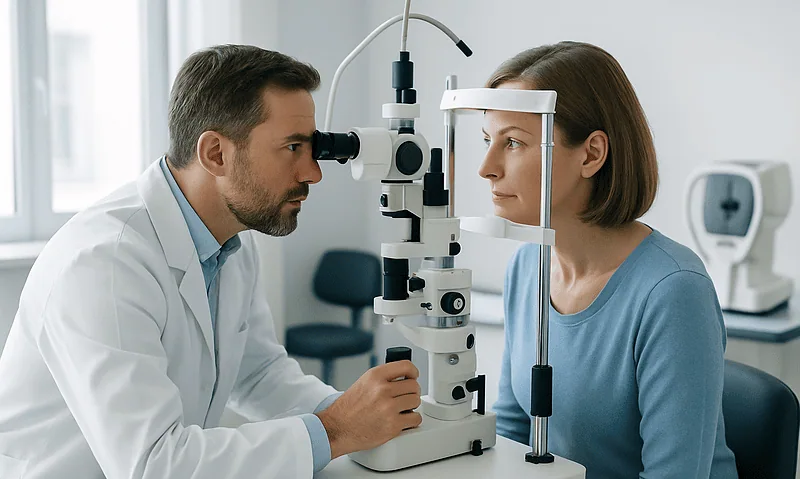
Then comes the examination. In a primary care room this may be a bright pen torch and a magnifier; in an eye clinic it will often be a slit lamp, a table-mounted microscope with a narrow beam of light that lets the examiner see the surface of the eye in fine detail. Expect the lower lid to be pulled down and the upper lid gently everted, because the pattern of tiny bumps on the inner lid, and the way the discharge collects, can point toward a viral, bacterial or allergic cause.
Vision is usually checked with a chart, one eye at a time. Blurring that clears when you blink away mucus is common; blurring that does not clear is something the clinician will want to explore. The examiner may feel just in front of your ear for a tender lymph node, which is more typical of viral infection, and may ask whether light bothers you.
Some clinics apply a drop of orange dye called fluorescein and shine a blue light on the eye. The dye pools in any scratch or ulcer on the cornea, the clear front window of the eye, and helps rule out problems that mimic simple conjunctivitis. None of this hurts, though the dye can leave an orange tint on tissues for a few hours.
Before your conjunctivitis appointment: why contact lenses come out first
If there is one instruction to follow before a conjunctivitis appointment, it is this one. A lens sitting on an inflamed eye does three unhelpful things at once. It hides the surface the clinician most needs to see. It traps discharge and microbes against the cornea. And in a lens wearer, a red painful eye is not automatically conjunctivitis at all; it may be keratitis, an infection or inflammation of the cornea that can threaten sight if it is missed.
The NHS asks contact lens wearers with a suspected eye infection to stop wearing lenses until the symptoms have gone, and to seek advice promptly rather than waiting to see whether things settle. The CDC gives the same message and adds a practical step: disposable lenses worn while the eye was infected should be thrown away, and reusable lenses and cases disinfected or replaced before wearing again.
So take the lenses out at home, well before you leave, and travel in glasses. If you do not own a pair, tell the receptionist when you book or arrive; clinics see this situation daily and will not be surprised.
Bring information rather than the lens itself. The examiner will want to know:
- the lens type (daily disposable, two-weekly, monthly, rigid) and the brand printed on the box;
- how many hours a day you usually wear them, and whether you ever sleep in them;
- whether the lenses have touched tap water, a shower, a pool or a hot tub recently;
- how old the current case and solution are.
These details matter because water exposure and overnight wear are the best-established risk factors for the corneal infections that a clinician most wants to exclude in a lens wearer with a red eye.
Makeup off: what eye cosmetics hide from the examiner
The instinct to soften an angry-looking eye with a little liner or mascara is understandable, and it works against you in the exam room. Much of the diagnostic information in conjunctivitis lives along the lid margin: the row of tiny oil glands, the base of the lashes, the exact color and texture of crusting. Pencil and mascara sit precisely there.
Cosmetics also add noise to the picture. Flakes of mascara in the tear film look like debris, waterproof products can smear when the lid is everted, and an irritated eye may in fact be reacting to a newly opened product. If you started a new eye cream, serum, false-lash glue or drugstore mascara in the days before the redness began, say so; irritant and allergic reactions to cosmetics are a recognized cause of a red, itchy, watery eye and are managed very differently from an infection.
Arrive with the eye area clean. Warm water on a soft cloth is enough. Skip the harsh removers on the morning of the visit, because alcohol-based products sting an inflamed surface and can add redness of their own.
Then think about the makeup bag itself. Mayo Clinic and the CDC both advise discarding eye cosmetics used while you had an infectious conjunctivitis, because a mascara wand or liner tip that has touched infected discharge can reintroduce microbes once the eye has settled. Never share eye makeup, and never use saliva to wet a brush. For applicators you cannot bear to throw away, the honest answer is that no household cleaning method has been shown to sterilize them reliably.
One more small thing: leave false lashes off. The adhesive and the lash band hide the lid margin completely and make eversion of the upper lid uncomfortable for both of you.
Which details to bring: your pink eye doctor visit checklist
Clinicians say the most useful patient is not the one who has diagnosed themselves online, but the one who can answer “when did it start?” with a day rather than a shrug. Spend five minutes before you leave writing down the story. Phone notes are fine.
- Timeline. The day and, if you can, the time you first noticed anything. Whether the second eye joined in, and how many days later.
- Discharge. Watery and clear, stringy and white, or thick and yellow-green? Are the lashes stuck shut on waking, and does that ease during the day?
- Sensation. Itch, grit, burning or true pain. Itch points more toward allergy; a gritty, sandy feeling is common with viral infection; aching pain is a warning sign rather than a typical feature.
- Vision and light. Any blur that does not clear with blinking, any halos, any need to squint in ordinary daylight.
- Company. A child with a cold, a colleague with a red eye, a recent swim or a new pillow, sofa or pet.
- Health background. Allergies, hay fever, eczema, autoimmune disease, diabetes, pregnancy, any condition or medicine that lowers immunity, previous eye surgery or injury.
- Everything you have put in the eye. Lubricating drops, redness relievers, leftover antibiotic drops from a previous episode or another family member, saline rinses, home remedies. Bring the bottles.
A photograph taken at the eye’s worst, usually first thing in the morning before rinsing, is worth bringing too. Redness often looks milder by afternoon, and an image of the crusting pattern can settle a question in seconds.
Finally, bring your glasses, your usual medication list and a note of any drug allergies. If the clinician does decide a prescription is appropriate, that list prevents an avoidable second phone call.
Who usually needs an appointment, and who is asked to wait and watch
Not every pink eye needs a clinician, and knowing which group you are in shapes how you prepare. The NHS notes that most conjunctivitis improves on its own within about two weeks without any treatment, and that a pharmacist can advise on self-care for mild cases: cleaning the lashes with cotton wool soaked in water that has been boiled and cooled, cool compresses for comfort, and lubricating drops if the eye feels gritty.
Certain people are asked to be seen promptly rather than wait. Guidance from the NHS, Mayo Clinic and CDC converges on the same list:
- anyone who wears contact lenses, because of the risk of a corneal infection masquerading as conjunctivitis;
- a baby under 28 days old with a red or sticky eye, which needs urgent assessment;
- anyone with eye pain, sensitivity to light, or a change in vision that does not clear with blinking;
- intense redness in one or both eyes, or symptoms that are getting worse rather than better after a few days;
- a weakened immune system, whether from a condition or from medicine;
- a red eye following an injury, chemical splash or recent eye surgery;
- symptoms that have not started to improve after about a week.
“Wait and watch” is not the same as “ignore.” It means a short period of self-care with a clear plan for what would trigger a visit, and it is a decision best made with a pharmacist or clinician rather than alone. If you are in the watch group, keep a note of how the eye changes day to day; that record becomes your history if you do end up needing an appointment.
The decision about whether and when to be seen, and by whom, always rests with the clinician you speak to. When in doubt, a phone call to the practice is a reasonable middle step.
How the three main types of conjunctivitis compare
Clinicians sort conjunctivitis into three broad groups, and the questions you will be asked are designed to place you in one of them. The boundaries are blurrier than tidy tables suggest; a viral case can produce yellowish crusting, and an allergic eye can look alarmingly red. Still, the pattern helps explain why the discharge question comes up so often.
| Feature | Viral | Bacterial | Allergic |
|---|---|---|---|
| Typical discharge | Watery, sometimes with a little mucus | Thicker, yellow or green; lashes often stuck on waking | Clear, stringy or ropy |
| Eyes affected | Often starts in one eye, spreads to the other within days | One or both | Usually both at once |
| Main sensation | Gritty, burning | Gritty, sticky | Itch, often intense |
| Company it keeps | Cold or sore throat, tender node in front of the ear | Sometimes an ear infection in children | Sneezing, runny nose, seasonal pattern, eczema |
| Contagious? | Yes | Yes | No |
| Usual course | Improves over 1–2 weeks; some strains up to 3 weeks (Mayo Clinic, CDC) | Mild cases often improve in 2–5 days without antibiotics; may take up to 2 weeks to clear fully (CDC) | Waxes and wanes with exposure to the trigger |
Two cautions. First, the color of discharge is a clue, not a verdict; the CDC notes that it can be difficult to tell viral from bacterial conjunctivitis by appearance alone, which is why the surrounding story matters so much. Second, this table is for understanding the conversation, not for diagnosing yourself at the mirror. A fourth group, irritant conjunctivitis from chlorine, smoke, a stray eyelash or a chemical splash, does not fit the grid and is one more reason the clinician will ask what you were doing the day before it began.
How long is pink eye contagious, and how does that change your visit?
Infectious conjunctivitis, whether viral or bacterial, is generally considered contagious for as long as the eye is producing tears and discharge, according to the CDC. For viral cases that usually means the whole course, commonly 7–14 days and occasionally longer. Allergic and irritant conjunctivitis are not contagious at all, which is one reason the clinician will try to distinguish them.
That has practical consequences for the appointment itself. Mention the red eye when you book and again when you check in, so staff can seat you sensibly and wipe down surfaces afterward. Bring your own tissues, use them once, and bin them rather than pocketing them. Wash your hands for at least 20 seconds with soap and water before you leave home and again when you arrive; the CDC recommends this as the single most effective way to limit spread. Avoid rubbing the eye in the waiting room, and try not to handle magazines or shared toys.
Pillowcases, towels and washcloths are the usual routes of spread at home. Use a separate towel, change the pillowcase daily while the eye is discharging, and wash both on a hot cycle. Do not share eye drops, even lubricating ones; a dropper tip that brushes an infected lash margin carries microbes to the next eye.
On work and school, the picture is more relaxed than many expect. The NHS advises that you do not need to stay away from work or school unless you feel unwell, although individual nurseries and employers may have their own policies, and the CDC suggests that children with a discharging eye who cannot yet keep their hands away from their face may need to stay home until it improves. Ask the clinician for a written note if your child’s daycare requires one; that is a common request and no one will find it odd.
What tests might happen, and what usually does not
People often arrive braced for swabs and blood tests, and most leave without either. Mayo Clinic describes conjunctivitis as a clinical diagnosis: the history and the examination do the work, and samples are taken only in particular situations.
A swab of the discharge, sent to a laboratory to identify bacteria or viruses, is generally reserved for severe cases, for infections that have not responded to initial treatment, for newborns, and where a sexually transmitted infection is a possibility. If a swab is taken, it is a quick sweep of a soft-tipped applicator along the inner lower lid, uncomfortable for a second or two rather than painful, and results typically take a few days. Rapid in-office tests for adenovirus, the commonest viral cause, exist in some settings but are not routine.
The tests you are more likely to encounter are the ones already described: a vision check, a look at the eye under magnification, and possibly fluorescein dye to check the cornea. In an eye clinic the examiner may also measure the pressure inside the eye, particularly if there is pain or blurring, because a few serious conditions that turn the eye red also raise pressure. Allergy testing is not done during a pink eye visit; if allergy is suspected, the conversation will focus on triggers and timing instead.
Knowing this in advance helps in two ways. It lowers the stakes of the appointment, and it tells you what information the clinician is relying on: yours. The better your account of the timeline, discharge and exposures, the less the examiner has to guess, and the less likely you are to be asked to come back simply because a question could not be answered the first time.
What the treatment conversation usually sounds like
Because the three main types behave differently, the conversation after the exam depends on which one the clinician thinks you have. It helps to know the shape of that conversation beforehand, so that you can ask the right follow-up questions rather than nodding through it.
For viral conjunctivitis there is no medicine that clears the virus faster. Management is about comfort while the immune system does its work: cool compresses, lubricating drops (often called artificial tears) to ease the gritty feeling, and strict hygiene to protect the other eye and other people. Antibiotics have no effect on viruses, and the CDC specifically cautions against using them for viral cases.
For bacterial conjunctivitis the picture is more nuanced than “infection equals antibiotics.” The CDC notes that mild bacterial conjunctivitis often improves without treatment within 2–5 days, and that antibiotic eye drops or ointment, where a clinician judges them appropriate, may shorten the illness and reduce spread. Whether that trade-off is worth making in your case is a decision for the prescribing clinician, weighing severity, your health background and whether you wear lenses.
For allergic conjunctivitis the aim is to calm the reaction and reduce exposure. Drops in the antihistamine or mast-cell stabilizer classes work by blocking or preventing the release of histamine, the chemical that drives the itch and swelling; cool compresses and avoiding the trigger are part of the plan too.
Two things you will not usually be offered in a first visit: steroid eye drops, which suppress inflammation but can worsen certain infections and raise eye pressure, so they are reserved for specialist use; and redness-relief drops, which whiten the eye by narrowing blood vessels without treating the cause. If you use any prescribed eye drops for another condition, ask before changing anything rather than stopping on your own.
What the following days and weeks usually look like
The appointment is one point on a curve, and knowing the usual shape of that curve stops normal fluctuations from becoming alarming. Timelines below are typical ranges from mainstream sources, not promises about your eye.
Viral conjunctivitis tends to get worse before it gets better. Redness and watering often peak around the third to fifth day, and the second eye commonly joins in during that window. Mayo Clinic gives a usual course of one to two weeks, with some adenovirus strains taking up to three; the CDC describes the same range. A gritty sensation can linger for a few days after the redness fades.
Bacterial conjunctivitis, in its mild form, usually begins to improve within days, and the morning crusting is often the first thing to ease. If antibiotic drops have been prescribed and nothing has changed after a couple of days, that is worth a phone call rather than simply persisting; the clinician may want to reassess the diagnosis.
Allergic conjunctivitis follows the trigger. A pollen-driven eye settles when the count drops or when you stay indoors with windows closed; a pet-driven eye improves after a night away from the house. Keeping a brief diary for a week or two often reveals the pattern more clearly than any test.
For lens wearers, the sequence matters. Lenses stay out until the eye is completely quiet and the clinician has agreed you can restart, then you begin with a fresh lens and a new case, discarding any solution that was open during the infection, as the CDC advises. Eye makeup follows the same rule: the infected-era products go in the bin, and new ones come out only when the lid margin is calm.
Plan a check-in with the clinic if the eye is not clearly improving after about a week, or sooner if any of the warning signs in the final section appear.
Preparing a child before a conjunctivitis appointment
Children get pink eye more often than adults, largely because they touch their faces constantly and share everything from crayons to colds. Preparing a child before a conjunctivitis appointment is mostly about lowering the temperature of the visit, for them and for you.
Explain what will happen in simple, honest terms: someone will look closely at the eye with a bright light and may pull the eyelid down a little, and it will not hurt. Avoid promising there will be no drops, since the fluorescein dye or a numbing drop is occasionally used. Bring a comfort object and, for a small child, a plan for holding them securely on your lap facing outward; clinicians are practiced at examining wriggly toddlers and will guide you.
Do not try to clean the eye thoroughly or force it open just before you leave. A quick wipe with a damp cotton pad is fine, but the crusting pattern itself is informative, and a struggle at the sink sets the wrong tone for the visit.
The history you bring for a child has a few extra items. Note whether anyone at daycare or school has had pink eye, whether the child has a cold, cough or ear pain, since bacterial conjunctivitis and ear infection often travel together in young children, and whether the child has known allergies or eczema. If the child wears contact lenses, all the adult rules apply, and the lenses must come out before the visit.
Two age-specific points. Any red or discharging eye in a baby under 28 days needs urgent assessment on the day, according to the NHS, because newborn conjunctivitis can be caused by infections that require prompt treatment. And for older children, ask the clinician for guidance on when they can return to daycare or school; policies vary, and a written note saves a second conversation at the gate.
What people often get wrong about pink eye
Some of the most persistent ideas about conjunctivitis make the appointment less useful, or the recovery slower. A few deserve correcting plainly.
“Pink eye always needs antibiotics.” Most cases are viral, on which antibiotics have no effect, and the CDC notes that mild bacterial cases often settle without them. Whether an antibiotic is appropriate is a judgment the clinician makes case by case.
“Yellow discharge means bacteria.” It leans that way, but the overlap is large enough that the CDC says appearance alone cannot reliably separate viral from bacterial. The rest of the story matters more than the color.
“Keep the lenses in so the doctor can see the problem.” The opposite is true. Lenses hide the surface, trap discharge and can conceal a corneal infection that is far more serious than conjunctivitis. Lenses come out at home, before you leave.
“A bit of makeup will make it look less dramatic.” The clinician needs to see the lid margin exactly as it is, and cosmetics used during an infection should be discarded afterward anyway.
“Leftover drops from last time will do.” Old drops may be the wrong class for this episode, may be contaminated, and using a family member’s prescription is unsafe. Bring the bottle to the appointment, but do not use it.
“Breast milk, urine, tea bags or honey will clear it.” None of these has evidence of benefit for conjunctivitis, and introducing non-sterile substances into an inflamed eye carries real risk of adding infection.
“You are contagious until the last trace of pink has gone.” Infectious cases are generally considered contagious while the eye is tearing or discharging. Fading redness on a dry, comfortable eye is a different stage.
“All pink eye is contagious.” Allergic and irritant conjunctivitis are not, which is why establishing the type changes advice about work, school and shared towels.
Questions to ask your care team
The most common regret after a short appointment is the question remembered in the car park. Write yours down before you go, and add any of these that fit your situation.
- Which type of conjunctivitis do you think this is, and what makes you think so?
- Is there anything in the examination that suggests this might be something other than conjunctivitis?
- Do I need any tests today, and if not, what would make you want to take a swab later?
- If you are suggesting treatment, what is it doing, how soon should I expect a change, and what should I do if nothing changes by then?
- If you are suggesting no treatment, what does good self-care look like for the next few days?
- Am I contagious, for roughly how long, and what does that mean for work, school or a nursery that asks for a note?
- When can I restart contact lenses, and should I replace my case and solution as well as the lenses?
- Which of my eye cosmetics should I throw away, and when is it reasonable to start using new ones?
- I use other prescribed eye drops or medicines; should anything change while this is being treated?
- Which specific signs should prompt me to call back or seek urgent care, and where should I go if that happens outside your hours?
- Is there a reason for me to be seen by an eye specialist, now or if things do not settle?
Ask for the answers to be written down or added to your record summary, especially the timeline and the return-if triggers. If a prescription is given, ask the pharmacist to talk you through how to put drops or ointment in without touching the tip to the eye; technique matters more than most people realize, and a contaminated bottle can reinfect an eye that was recovering well.
When to call your doctor
Most conjunctivitis is uncomfortable, unsightly and ultimately uneventful. A small number of red eyes are something else, and the signs that separate them are consistent across the NHS, Mayo Clinic and CDC guidance. Call your doctor, or seek same-day care, if you notice any of the following:
- eye pain that is more than mild grittiness, or pain that is getting worse;
- sensitivity to light that makes you squint or turn away from a normally lit room;
- blurred or reduced vision that does not clear when you blink away the discharge;
- intense redness, especially concentrated around the colored part of the eye, or a red eye that is becoming more painful and swollen rather than settling;
- a red eye in someone who wears contact lenses, particularly if there is pain, because corneal infection must be excluded promptly;
- swelling and redness of the eyelids spreading onto the surrounding skin, especially with fever, which can signal infection in the tissues around the eye;
- any red or sticky eye in a baby under 28 days old;
- a red eye after an injury, a chemical splash or recent eye surgery;
- symptoms in someone with a weakened immune system;
- no improvement after about a week, or worsening after starting a prescribed treatment.
Where in doubt, a phone call is always reasonable. Describe the timeline, the discharge, whether you wear lenses and which of the signs above you have noticed; the person on the line can decide how quickly you need to be seen. If the eye is painful, light-sensitive and blurred all at once, do not wait for a routine slot; those three together are the combination that eye clinicians most want to see the same day.
Every decision about testing, treatment, lens wear and return to school or work sits with the clinician who examines you. This article prepares you for that conversation; it does not replace it.
Frequently asked questions
Should I wear contact lenses before an eye appointment for pink eye?
No. Remove your lenses at home and travel in glasses. The NHS and CDC both advise lens wearers with a suspected eye infection to stop wearing lenses until the eye has settled and a clinician agrees to a restart. Lenses hide the eye surface, trap discharge and can mask a corneal infection. Bring the lens box or a note of the brand and type instead.
What happens at a conjunctivitis appointment?
The clinician takes a detailed history, then examines the eye with a bright light or slit lamp, gently everts the eyelids, checks your vision and may feel for a tender node in front of the ear. Fluorescein dye is sometimes used to check the cornea. According to Mayo Clinic, laboratory swabs are uncommon and reserved for severe or unusual cases.
Can I wear makeup to a pink eye doctor visit?
It is best not to. Liner and mascara sit on the lid margin, which is where much of the diagnostic information lives, and flakes in the tear film add confusion. Arrive with the eye area cleaned using warm water only. Eye cosmetics used during an infectious episode should be thrown away afterward, as both Mayo Clinic and the CDC advise.
What details should I tell my doctor about pink eye?
Bring the start date, which eye came first, the type and color of discharge, whether lashes are stuck on waking, any itch, pain, light sensitivity or blurred vision, recent contact with anyone who had a red eye, allergies, contact lens habits, other medical conditions and every drop or remedy you have used. A morning photograph of the eye is genuinely helpful.
How long is pink eye contagious?
Infectious conjunctivitis is generally considered contagious for as long as the eye is producing tears or discharge, according to the CDC. For viral cases that often means 7–14 days and occasionally up to three weeks. Allergic and irritant conjunctivitis are not contagious. Good handwashing, separate towels and not sharing eye drops are the main ways to protect others.
Do I need antibiotics for conjunctivitis?
Often not. Most cases are viral, and antibiotics have no effect on viruses. The CDC notes that mild bacterial conjunctivitis frequently improves within 2–5 days without treatment, though antibiotic drops or ointment may be considered in some situations to shorten the illness or reduce spread. Whether they are appropriate for you is a decision for the clinician who examines your eye.
Should my child stay home from school with pink eye?
Not necessarily. The NHS advises that children and adults do not need to stay away unless they feel unwell, although many nurseries and schools have their own policies, and the CDC suggests that a child with a discharging eye who cannot keep their hands off their face may need to stay home until it improves. Ask the clinician for a note if one is required.
Will the doctor take a swab of my eye?
Usually not. Mayo Clinic describes conjunctivitis as a diagnosis made from the history and examination, with swabs reserved for severe infections, cases that have not responded to treatment, newborns, or when a sexually transmitted infection is possible. If a swab is taken, it is a brief sweep of the inner lower lid and results typically take a few days.
When can I put my contact lenses back in after pink eye?
Only when the eye is completely comfortable and clear, and the clinician who examined you has agreed. Restart with a brand-new lens and a new case, and discard any solution that was open during the infection, as the CDC recommends. Disposable lenses worn while the eye was infected should be thrown away rather than cleaned and reused.
What red flags mean I should not wait for a routine appointment?
Eye pain beyond mild grittiness, sensitivity to light, blurred vision that does not clear with blinking, intense redness, swelling spreading onto the skin around the eye with fever, a red eye in a contact lens wearer, any red or sticky eye in a baby under 28 days, or a red eye after injury or surgery. These warrant same-day advice from a clinician.
References
- CDC: About Conjunctivitis (Pink Eye)
- NHS: Conjunctivitis
- MedlinePlus: Conjunctivitis or pink eye
- Cleveland Clinic: Pink Eye (Conjunctivitis)
This article is for general information only and is not a substitute for professional medical advice. Please consult a qualified doctor about your individual situation.

More from the Blog

When Do Glaucoma Drops Give Way to Laser or Surgery? How Treatment Usually Escalates
Glaucoma drops usually give way to laser or surgery when eye pressure stays above the target the eye specialist has set, when visual-field or…

Reading Your Glaucoma Treatment Plan: Target Pressure, Follow-Up Intervals and What to Ask
A glaucoma treatment plan usually sets a target eye pressure, chosen individually to slow damage to the optic nerve, and a follow-up interval for…

Questions to Ask Your Retina Specialist About Macular Degeneration Injections and Follow-Up
Before macular degeneration injections begin, ask your retina specialist what type and stage of AMD you have, which scans confirmed it, how the anti-VEGF…

Steroid Injection vs Surgical Removal for a Chalazion: How Doctors Weigh the Two
For a chalazion that has not settled with warm compresses, doctors usually choose between a corticosteroid injection into the lump and surgical drainage under…

Will You Be Awake During Eye Surgery? Drops, Blocks, Sedation and General Anesthesia
Most adults are awake for eye surgery. Cataract, glaucoma and many laser procedures are usually done with numbing drops or a local anesthetic injection…
Does a Robot Operate on Your Eye Alone? Robotic Ophthalmology Myths, Put Right
No. Today, no robot performs eye surgery on its own. In every approved procedure, a trained ophthalmologist makes the decisions and controls the instruments.…