

Bird Flu in Humans: How H5N1 Spreads, What Has Been Reported and Why Experts Watch It Closely

Key Takeaways
- Nearly every confirmed US case of bird flu in humans since 2024 has been in someone who worked directly with infected dairy cattle or poultry, and most presented with red, irritated eyes rather than a classic flu.
- Sustained human-to-human transmission of H5N1 has never been documented; the few historical clusters involved prolonged, intimate care of a severely ill relative and stopped after one or two people.
- Pasteurization inactivates H5N1 in milk, but live virus has been found in raw milk from infected herds and has killed cats that drank it, which is why public health agencies advise against raw milk.
- The often-quoted 50 percent fatality figure comes from cases reported to the WHO since 2003 and is widely believed to overstate the true rate, because antibody surveys show many mild infections were never diagnosed.
- Antiviral treatment with oseltamivir is recommended for anyone with suspected bird flu and works best when started within 48 hours of symptoms, so people with a relevant exposure should report symptoms early rather than wait.
- Licensed H5N1 vaccines exist in national stockpiles, and a few countries offer them to high-risk workers, but as of mid-2025 no health authority recommends a bird flu vaccine for the general public.
Bird flu in humans is uncommon and, so far, spreads mainly from infected birds or dairy cattle to people who have close, unprotected contact with them, not from person to person. Reported illness has ranged from eye redness and mild flu-like symptoms to severe pneumonia. Health agencies currently rate the risk to the general public as low, and no bird flu vaccine is recommended for the wider population.
A dairy worker in Texas noticed his eyes were red and gritty in the spring of 2024. It looked like ordinary pink eye. It turned out to be the first known case of H5N1 passing from a cow to a person anywhere in the world, and it pushed the phrase bird flu in humans from a topic for virologists into a topic for dinner tables.
Since then the story has kept moving: a wave of infections among farmworkers across several US states, virus turning up in raw milk, the first US death reported in January 2025, and a confirmed case on a farm in England the same month. Each new headline sends people back to the same searches. Can I catch it? Is chicken safe? Is there a shot?
As of mid-2025, the honest answers are calmer than the headlines. Here is what has actually been reported, how the virus moves, and why scientists watch it so carefully even while the everyday risk stays low.
What changed recently with bird flu in humans
For most of the past two decades, H5N1 was a poultry problem with occasional, tragic human cases in Southeast Asia, Egypt and a handful of other places. Two developments changed the tempo.
The first came in March 2024, when the virus was confirmed in dairy cattle in Texas and Kansas, the first time an influenza A virus of this kind had been found spreading among cows. Cattle turned out to carry high amounts of virus in their milk, and the outbreak spread across herds in more than a dozen states over the following year. In April 2024 a dairy worker with conjunctivitis, the medical word for inflammation of the thin membrane covering the eye, became the first documented human infection linked to cattle.
The second development was the accumulation of human cases in the United States. By early 2025, the CDC had confirmed roughly 70 infections, most in people who worked with dairy cows or with poultry being culled on infected farms. Nearly all were mild. Then in January 2025, Louisiana health officials reported the country’s first death, in an older adult with underlying conditions who had been exposed to a backyard flock and wild birds. That same month, England confirmed a human case in a person exposed to infected birds on a farm.
A third, quieter change happened in laboratories. In February 2025, federal scientists reported that a second version of the virus, known as genotype D1.1 (a genotype is a specific genetic lineage of the virus), had jumped into dairy cattle in Nevada, separate from the strain already circulating in herds. That told researchers the leap from birds to cows was not a one-time fluke.
By mid-2025, new human cases had slowed considerably as the spring bird migration ended and farm outbreaks declined, and the CDC shifted from an emergency footing back to routine surveillance. The CDC continues to describe the risk to the general public as low, while asking clinicians to keep testing anyone with flu symptoms and a relevant animal exposure. That combination, low current risk paired with intense monitoring, is the frame for everything that follows.
What is bird flu, and why is H5N1 the strain everyone names?
Bird flu is shorthand for avian influenza, a family of influenza A viruses that live naturally in wild water birds such as ducks, geese and shorebirds. Most of the time these viruses stay in birds. When one infects a person, doctors call it a zoonotic infection, meaning a disease that passes from animals to humans.
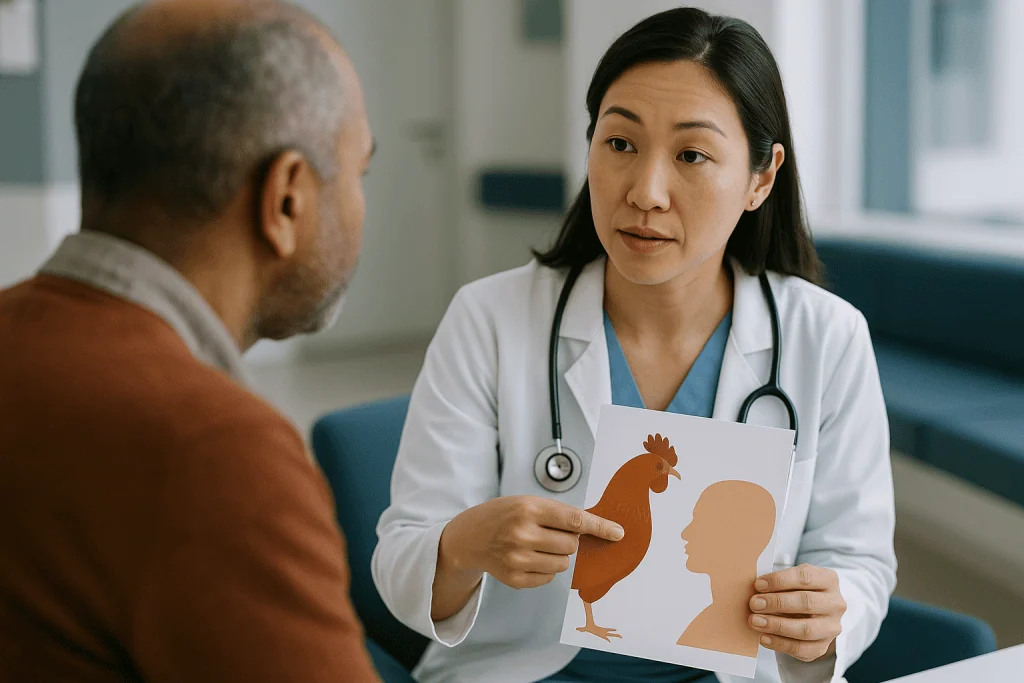
Influenza A viruses are named by two proteins on their surface: H for hemagglutinin, the protein the virus uses to latch onto cells, and N for neuraminidase, the protein it uses to break free and spread to the next cell. There are 16 H types and 9 N types found in birds, so H5N1 is one specific combination. Others, including H7N9 and H9N2, have infected people too, but H5N1 has caused the largest number of severe human cases since it was first recognized in Hong Kong in 1997.
Within H5N1 there are further branches called clades, essentially family trees of closely related viruses. The one dominating headlines, clade 2.3.4.4b, has spread across every continent except Australia since 2020, killing wild birds in record numbers and spilling into mammals from foxes and sea lions to, most recently, dairy cattle.
Why does one strain earn so much attention? Three reasons drive the vigilance. It kills poultry quickly and in large numbers, which is why farms cull entire flocks when it appears. It has repeatedly shown it can infect mammals, each infection an opportunity for the virus to adapt. And historically, when it has infected people, the illness has often been severe.
None of that means H5N1 is currently a human virus. Its hemagglutinin protein prefers receptors found deep in the human lung and, notably, on the surface of the eye, rather than the receptors lining the nose and throat that seasonal flu uses so efficiently. That receptor mismatch is a large part of why the virus struggles to move from person to person, and it explains the unusual pattern of eye infections among US farmworkers.
How does bird flu spread to people?
Picture the exposures that have actually made people sick, and a pattern emerges. A worker leans into a milking parlor as a cow’s infected milk splashes. A poultry crew spends hours in a barn thick with dust and feathers during a cull. Someone handles a dead wild bird or a sick backyard hen without gloves. In each case, large amounts of virus reach a person’s eyes, nose or mouth.
According to the CDC, infected birds shed virus in saliva, mucus and droppings, and infected cattle shed it heavily in raw milk. People become infected when enough virus lands on mucous membranes or is breathed in as fine droplets or dust. Touching a contaminated surface and then rubbing the eyes is thought to be a common route in the dairy setting, which fits the many cases of red, irritated eyes.
Some routes are much less certain. Airborne spread over distance has not been demonstrated in people. Whether virus in the environment, such as on equipment or in wastewater, has infected anyone is unclear. A small number of US cases have had no identified animal exposure at all, and investigators were not able to determine how those people were infected.
Food is a separate question with a clearer answer. Properly cooked poultry and eggs do not transmit the virus; heat destroys it. Commercial milk in the United States is pasteurized, a heating process that kills bacteria and viruses, and federal testing has found that pasteurization inactivates H5N1. Raw, unpasteurized milk is a different matter, covered in its own section below.
Pets add a footnote. Cats on affected dairy farms have died after drinking raw milk, and a few indoor cats have fallen ill after eating raw pet food that contained infected poultry. No human infection from a pet has been confirmed, but the CDC advises keeping cats away from raw milk and raw poultry products.
The takeaway on transmission is simple: dose and proximity matter. The people at risk are those with sustained, close, unprotected contact with infected animals, not those walking past a farm or buying eggs.
Can bird flu spread from human to human?
This is the question that decides whether an animal outbreak becomes a human pandemic, so it deserves a precise answer rather than a reassuring one.

Since 1997, a small number of probable human-to-human transmissions of H5N1 have been documented, almost all within families caring for a severely ill relative. Investigators in Thailand in 2004 and Indonesia in 2006 described clusters where prolonged, intimate contact with a very sick person appeared to pass the virus on. In every instance, the chain stopped after one or two people. There has never been sustained spread, the kind where each infected person reliably infects others and the virus keeps going.
In the US cattle-linked outbreak, the CDC’s contact tracing found no evidence of person-to-person spread. Household members of infected workers were monitored and tested; none turned out to be infected. Blood tests looking for antibodies in exposed workers found that some infections had gone unrecognized, but those, too, traced back to animals rather than to other people.
The WHO defines sustained human-to-human transmission as one of the key criteria that would change its risk assessment, and it has not been met. That said, virologists identify specific genetic changes that could move the virus closer to that threshold, including mutations that would let the hemagglutinin protein bind more easily to receptors in the human upper airway. A few individual cases, including the fatal Louisiana case, showed mutations of this kind developing during the illness, without any onward spread. Scientists flag these findings as worth watching, not as evidence the virus has adapted.
Another concern is reassortment, the process by which two flu viruses infecting the same cell swap genetic segments. A person or pig infected with both H5N1 and seasonal flu could, in theory, produce a hybrid that carries H5N1’s novel surface proteins on a frame better suited to spreading among people. This is one reason the CDC encourages seasonal flu vaccination for farmworkers: fewer dual infections mean fewer chances for the viruses to mix.
Where does that leave the average reader? Bird flu in humans is, for now, a disease you catch from animals. The evidence for human-to-human spread is limited to rare, historical, dead-end clusters.
What happens if a human gets bird flu? Reported symptoms
The reported picture depends heavily on where and when the infection happened, because the virus, the exposure and the medical care have all differed.
Among the roughly 70 US cases linked to cattle and poultry in 2024 and 2025, the most common presentation was conjunctivitis: red, watery, irritated eyes, sometimes with a discharge, often without fever. Many people also had mild respiratory symptoms such as cough, sore throat or runny nose, and some had fatigue or muscle aches. Only a few needed hospital care.
Historically, cases reported to the WHO from Asia, Egypt and elsewhere looked very different. Those patients often arrived with high fever, cough and shortness of breath that progressed within days to pneumonia and, in the worst cases, acute respiratory distress syndrome, a condition in which the lungs fill with fluid and cannot supply enough oxygen. Diarrhea, vomiting and abdominal pain were reported more often than with seasonal flu. Neurological complications, including seizures and altered consciousness, were occasionally described.
The CDC lists the range of possible symptoms as including fever or feeling feverish, cough, sore throat, runny or stuffy nose, muscle aches, headache, fatigue, eye redness or irritation, and less commonly diarrhea, nausea, vomiting or seizures. It notes that some people have had no symptoms at all and were identified only through testing after exposure.
Why such a wide range? Part of the answer is the route of infection: virus splashed into the eye produces eye disease, while virus inhaled deep into the lungs produces pneumonia. Part is the virus itself, since different genotypes appear to behave differently. And part is who gets tested. When health departments actively test every exposed worker, they find mild cases that would otherwise never be counted, which shifts the apparent severity downward.
What this means for a reader worried about their own symptoms is that bird flu in humans does not have a signature you can recognize at home. Red eyes and a cough are far more likely to be allergies or a cold. The single feature that changes the calculation is recent close contact with sick or dead birds, dairy cattle, raw milk or a known outbreak, which is why doctors ask about exposure first.
How long does the avian flu last in humans?
Timelines from reported cases fall into three phases: the wait before symptoms, the illness itself, and recovery.
The incubation period, meaning the time between exposure and first symptoms, has typically been 2 to 5 days for H5N1, though the WHO notes it can stretch to about a week and occasionally longer. This is why the CDC asks people exposed to infected animals to watch for symptoms for 10 days after their last contact.
For the mild, eye-predominant illness seen in most US farmworkers, symptoms have generally resolved within about a week, similar to a bout of viral conjunctivitis or a cold. People were advised to stay home and away from others while symptomatic, and most were treated with an antiviral medicine and recovered without complications.
Severe cases run on a different clock. In hospitalized patients described in the medical literature, respiratory symptoms typically worsened around day 3 to 5, with pneumonia developing over the following days. Intensive care stays of weeks were common in the historical case series, and recovery from severe lung injury can take months. Fatigue, reduced exercise tolerance and cough can linger well after the virus itself is cleared.
How long someone remains contagious is less well defined for H5N1 than for seasonal flu, partly because there have been so few cases and partly because human-to-human spread is rare. Studies of severe cases have found virus in the respiratory tract for longer than is typical with seasonal influenza, sometimes beyond a week, which is one reason hospitals use strict isolation. Public health guidance generally treats people as potentially infectious until symptoms have resolved and, where testing is available, until tests are negative.
Two practical points come out of these numbers. First, if you had a relevant exposure more than 10 days ago and feel well, the window for developing bird flu has essentially closed. Second, the duration of illness in the mild form is short, and the antiviral medicines used work best when started early, which makes prompt reporting of symptoms after exposure more valuable than watchful waiting.
Who is most at risk of bird flu in humans?
Risk here is about exposure far more than about age or general health. The CDC organizes it in tiers.
At the top are people who work directly with animals that can carry the virus: dairy farm workers, especially those in milking parlors; poultry farm workers and the crews who depopulate infected flocks; people who process raw milk; veterinarians and animal health responders; wildlife biologists and rehabilitators handling wild birds; and workers at slaughterhouses or live bird markets. Nearly every confirmed US case has come from this group.
A second tier includes people with less intense but still meaningful contact: owners of backyard flocks, hunters who handle waterfowl, and people who drink raw milk from unpasteurized sources. The fatal Louisiana case involved backyard birds, a reminder that hobby farming carries real exposure.
A third tier is household contacts of infected people and healthcare workers caring for them. Their risk is considered low given the lack of human-to-human spread, but they are monitored because any transmission there would matter enormously.
Everyone else, including people who buy commercial poultry, eggs and pasteurized dairy, sits at the bottom, with a risk the CDC and WHO both describe as low.
Within those exposure groups, who tends to get sicker? The historical case series suggests that severe disease can strike otherwise healthy young adults, which is one of the features that distinguishes H5N1 from seasonal flu, where the very young and very old bear the brunt. In the US outbreak, the small number of severe cases involved older adults or people with underlying medical conditions, but with so few severe cases it is impossible to draw firm conclusions.
Pregnancy, chronic lung or heart disease, weakened immunity and older age are recognized risk factors for severe outcomes with any influenza, and clinicians treat them as such for H5N1 as well. If you fall into a high-exposure occupation and also have one of these conditions, that combination is worth a conversation with your doctor and your employer about protective equipment, seasonal flu vaccination and what to do if symptoms appear.
Is it safe to eat chicken, eggs and dairy right now?
The short answer for the commercial food supply is yes, with one clear exception: raw milk.
Poultry and eggs from infected flocks do not enter the commercial market; infected farms are quarantined and birds are culled. Even if virus were present, normal cooking destroys influenza viruses. The CDC advises cooking poultry to an internal temperature of 165°F (74°C) and cooking eggs until both white and yolk are firm, which is standard food safety advice regardless of bird flu. Runny yolks were never a bird flu risk in practice, but this guidance is the official line.
Dairy is where the 2024 outbreak introduced something new. Infected cows shed very large amounts of virus into their milk. Federal testing found that pasteurization, the process of heating milk to a set temperature for a set time, inactivates H5N1 effectively, and studies of retail pasteurized milk found only fragments of viral genetic material with no live, infectious virus. Pasteurized milk, cheese, yogurt and ice cream are considered safe.
Raw milk skips that step. Live H5N1 has been found in raw milk from infected herds, and cats that drank it have died. Whether people can be infected by drinking it has not been proven, but laboratory studies in mice found infection after ingestion, and public health agencies advise against consuming raw milk or raw milk products. In late 2024, raw milk sold in California was recalled after H5N1 was detected in retail samples. This is an evidence-based precaution, not a certainty either way, and the CDC and FDA state it plainly.
Beef has drawn questions too. Federal testing of retail ground beef has not found live virus, and muscle tissue is not thought to carry significant amounts. Cooking to recommended temperatures removes any residual concern.
Raw pet food deserves a mention because several cats have become ill after eating raw poultry-based products. For households with cats, that is a reason to prefer cooked or heat-treated food.
A sensible household rule, then, is unchanged from before the outbreak: cook poultry and eggs thoroughly, choose pasteurized dairy, and keep raw milk away from people and pets.
How is bird flu treated in humans?
Treatment for confirmed or suspected H5N1 infection centers on antiviral medicines, the same class used for severe seasonal flu, plus supportive care for anyone who becomes seriously ill.
An antiviral is a medicine that interferes with a virus’s ability to copy itself. For influenza, the most widely used is oseltamivir (Tamiflu), a neuraminidase inhibitor, meaning it blocks the protein the virus needs to release new copies from infected cells. The CDC recommends that clinicians start antiviral treatment as soon as possible for anyone with suspected or confirmed bird flu, without waiting for test results, and notes that treatment works best when begun within the first two days of symptoms. In observational studies of past H5N1 cases, early treatment was associated with better survival than late treatment. Other neuraminidase inhibitors, zanamivir and peramivir, and a newer medicine called baloxavir marboxil (Xofluza) are also active against H5 viruses in laboratory studies, though human data for H5N1 specifically are limited.
The CDC also allows antiviral medicine to be offered as post-exposure prophylaxis, meaning treatment given to someone who has been heavily exposed but has no symptoms, in an effort to prevent infection. This is a judgment call made by public health officials and clinicians based on how intense the exposure was; it is not something a person can or should arrange for themselves.
Beyond antivirals, care depends on severity. Mild cases with conjunctivitis and cold-like symptoms are managed at home with rest, fluids and isolation from others. Severe cases with pneumonia may need oxygen, intensive care and mechanical ventilation. Antibiotics do not treat viruses but may be used if a secondary bacterial pneumonia develops. Steroids have not been shown to help and may cause harm in influenza pneumonia.
Resistance is monitored closely. Most circulating H5N1 viruses remain susceptible to oseltamivir, though scattered mutations conferring reduced susceptibility have been reported and are tracked by the CDC and WHO.
Every decision about which medicine, when and for whom belongs to the treating clinician working with public health authorities. If you have had a relevant exposure and develop symptoms, the single most useful thing you can do is contact a doctor or your health department quickly and mention the exposure, so that testing and treatment can start early.
Is there a bird flu vaccine, and who can get it?
There are licensed H5 vaccines, and there is a great deal of vaccine work under way, but as of mid-2025 no country recommends a bird flu vaccine for the general public.
In the United States, the Food and Drug Administration has licensed several H5N1 vaccines over the years, and the federal government maintains a stockpile of vaccine and of bulk antigen that could be finished into doses if needed. These vaccines were developed against earlier H5N1 strains, and studies suggest they produce antibodies that cross-react with the currently circulating clade, though how much protection that would translate to in people is uncertain. The CDC has not recommended vaccinating farmworkers or the public, reasoning that the current risk does not justify it, and the stockpiled vaccines are not available for individual use.
Other countries have made different, equally evidence-based choices about who to offer vaccine. Finland began offering an H5 vaccine in 2024 to people at elevated occupational risk, such as fur farm and poultry workers. The United Kingdom secured a supply of H5 vaccine for pandemic preparedness, and the NHS states that people are not currently offered a bird flu vaccine routinely. Canada purchased doses in 2025 for potential use in high-risk groups. In each case, eligibility is decided by the national health authority, not by individual request.
Research vaccines are moving through trials. mRNA-based H5 vaccines, which use the same platform as some COVID-19 vaccines to deliver genetic instructions for the H5 protein, have shown strong antibody responses in early-phase trials and are being studied further. Vaccines for cattle and poultry are also under development, with the aim of reducing the amount of virus in animal populations and therefore the chance of human exposure. These investigational products are not approved for general use and are available only within clinical trials.
One vaccine recommendation does apply now: the CDC encourages people who work with poultry and cattle to receive the ordinary seasonal flu vaccine. It does not protect against H5N1, but it reduces the chance of being infected with seasonal flu and H5N1 at the same time, lowering the opportunity for the two viruses to exchange genes.
If you work in a high-exposure setting and wonder whether you should receive an H5 vaccine, the answer will come from your national public health agency and your occupational health provider, and it may change as the situation evolves.
What the evidence actually says, graded by strength
Not every statement about bird flu in humans rests on the same footing. Sorting the claims by the quality of evidence behind them makes the picture clearer.
Strong evidence (surveillance data, laboratory confirmation, multiple consistent studies): H5N1 infects people who have close contact with infected birds and cattle; nearly 1,000 human cases have been reported to the WHO since 2003. Pasteurization inactivates the virus in milk, confirmed by multiple federal laboratory studies. Cooking destroys the virus in poultry and eggs. Sustained human-to-human transmission has not occurred; this is supported by decades of outbreak investigations and by contact tracing in the US outbreak.
Moderate evidence (observational studies, case series): Early antiviral treatment improves outcomes in severe H5N1, based on retrospective analyses of hospitalized patients rather than randomized trials. Conjunctivitis is the predominant presentation in cattle-linked infections, based on a case series of several dozen US patients. Raw milk from infected cows can infect mammals, shown in cats on farms and in mouse experiments; direct evidence of human infection from drinking raw milk is lacking.
Limited evidence or expert opinion: Estimates of how deadly the virus really is. The WHO’s cumulative figures show roughly half of reported cases have died, but experts widely believe that mild and asymptomatic cases have gone undetected in past outbreaks, which would make the true fatality rate lower. Blood antibody surveys of US dairy workers found infections that were never diagnosed, supporting this view. The degree of protection stockpiled vaccines would give against the current clade is inferred from antibody studies, not from trials in people during an outbreak. Predictions about whether the virus will adapt to spread among humans are expert judgment informed by genetic surveillance, not established fact.
What the evidence does not support: Claims that the virus is currently spreading silently among people, claims that commercial food is dangerous, and claims that a pandemic is imminent or impossible. Both extremes outrun the data.
The pattern is worth noticing. The facts about how to protect yourself, cook food, avoid raw milk, avoid sick animals, are the best-established. The questions that generate the most anxiety, how deadly and how likely to become pandemic, are precisely the ones where honest scientists say they do not yet know.
Bird flu vs seasonal flu: how they compare
People often assume bird flu is simply a worse version of the flu they already know. The two viruses share a family but behave quite differently in humans, and seeing them side by side clarifies why the public health response looks the way it does.
| Feature | H5N1 bird flu in humans | Seasonal influenza |
|---|---|---|
| Virus type | Influenza A subtype H5N1, adapted to birds | Influenza A (H1N1, H3N2) and influenza B, adapted to humans |
| How people catch it | Close contact with infected birds, cattle or raw milk | Person to person via respiratory droplets and surfaces |
| Human-to-human spread | Rare, limited, never sustained | Efficient and sustained every year |
| Reported human cases | Under 1,000 worldwide since 2003 | Tens of millions of illnesses each year in the US alone |
| Typical symptoms | Conjunctivitis in recent US cases; fever, cough, pneumonia in historical cases | Fever, cough, sore throat, aches, fatigue |
| Reported severity | Roughly half of reported cases fatal historically; most US 2024-25 cases mild; true rate uncertain | Less than 0.1 percent of infections fatal; highest risk in very young, elderly, chronically ill |
| Antiviral treatment | Oseltamivir recommended, ideally started early | Oseltamivir and others for high-risk or severe cases |
| Vaccine for the public | None recommended; licensed vaccines held in national stockpiles | Annual vaccine recommended for everyone 6 months and older |
| Incubation period | Typically 2 to 5 days, occasionally longer | Typically 1 to 4 days |
Two contrasts stand out. Seasonal flu is far more common and far less severe per case; H5N1 is the reverse. And seasonal flu is a human virus that vaccines and immunity keep in check, while H5N1 remains an animal virus that humans encounter only at the edges.
That second contrast is why experts describe H5N1 as a pandemic risk rather than a pandemic. The population has essentially no prior immunity to H5 proteins, so a version of the virus that learned to spread between people would find little resistance. Seasonal flu, however unpleasant, meets a population that has seen its relatives many times before.
Common myths about bird flu in humans
Viral posts and half-remembered headlines have produced a set of confident claims that the evidence does not back up. Here are the ones that circulate most.
Myth: Bird flu is already spreading between people and officials are hiding it. Contact tracing of every US case, antibody testing of household members and genetic sequencing of viruses from patients have found no evidence of person-to-person spread. The findings are published by the CDC and reported to the WHO. Undetected mild infections in farmworkers are a documented reality, but those trace to animals.
Myth: Eating chicken or eggs can give you bird flu. No human infection has ever been attributed to properly cooked poultry or eggs. Infected flocks are removed from the food supply, and heat destroys the virus.
Myth: Store-bought milk is dangerous now. Pasteurized milk has been tested repeatedly and found free of live virus. The warning applies to raw, unpasteurized milk, which has contained live H5N1 and has sickened cats.
Myth: Bird flu kills half the people it infects, so any outbreak would be catastrophic. The roughly 50 percent figure comes from cases reported to the WHO, which skew toward the sickest patients who reached hospitals. Antibody surveys suggest many mild cases were never counted, and the US cattle-linked cases were overwhelmingly mild. The true fatality rate is unknown and is almost certainly lower than the headline number, though experts emphasize it could still be far higher than seasonal flu.
Myth: A pandemic is coming this year. No one can say that. The virus lacks key adaptations for efficient human spread, and it has circulated in birds for nearly three decades without acquiring them. Equally, the myth that it could never happen ignores why scientists monitor it.
Myth: Red eyes mean you have bird flu. Conjunctivitis is overwhelmingly caused by common viruses, bacteria and allergies. Without an animal exposure, bird flu is not a realistic explanation.
Myth: The seasonal flu shot protects against H5N1. It does not, though it is recommended for exposed workers to reduce the chance of co-infection.
Myth: You can buy or stockpile antivirals or an H5 vaccine to protect yourself. Antivirals are prescription medicines that must be prescribed and supervised by a clinician, and stockpiled H5 vaccines are not available to individuals. Products marketed online as bird flu cures or preventives have no regulatory approval and no evidence behind them.
Is bird flu expected to affect humans in 2026? What experts watch
Ask an influenza scientist to predict next year and you will get a list of signals rather than a forecast. That list is, in itself, the most useful answer.
Sporadic human cases are expected to continue as long as the virus circulates widely in wild birds, poultry and cattle. In that sense, yes, bird flu will affect some humans in 2026, most likely people with occupational exposure, and most likely in small numbers. The WHO has recorded human H5N1 cases in most years since 2003, and clade 2.3.4.4b remains established across several continents.
What experts watch for is different from what they expect. The first signal is any cluster of cases without animal exposure, which would suggest the virus is passing between people. The second is genetic change: surveillance laboratories sequence virus from every human case and from animal outbreaks, looking for mutations in the hemagglutinin gene that improve binding to human upper-airway receptors, and changes in the polymerase genes that help the virus replicate at the cooler temperatures of the human nose. A handful of these have appeared in individual patients; none has become established.
The third signal is spread in pigs. Pigs carry receptors for both bird and human flu viruses, making them an efficient mixing vessel for reassortment. A single H5N1 detection in a backyard pig in Oregon in 2024 drew intense scrutiny for exactly this reason.
The fourth is the trajectory of the cattle outbreak. If dairy herds continue to harbor the virus, human exposure continues and the virus gets ongoing practice in a mammal. If milk testing and farm biosecurity bring the outbreak under control, that pressure eases. Seasonal patterns matter too: human cases in the US spiked during autumn poultry outbreaks tied to bird migration and fell in spring and summer.
Finally, experts watch preparedness itself: stockpile size, vaccine production capacity, and how quickly a vaccine matched to a pandemic strain could be made. That is where the public conversation about a bird flu vaccine belongs, as a contingency plan rather than a current recommendation.
The honest summary for 2026 is that continued sporadic infections are likely, a pandemic is neither predicted nor ruled out, and the world’s surveillance system is better tuned to this virus than to almost any other.
How to lower your risk of bird flu, whatever your exposure
Protection scales with exposure. For most readers it amounts to a few kitchen habits; for people around animals it means equipment and routines.
For the general public, the CDC’s advice is short. Avoid touching sick or dead birds and other wild animals, and keep pets away from them. If you must handle a dead bird, use gloves or a plastic bag turned inside out, and wash your hands afterward. Cook poultry and eggs thoroughly and choose pasteurized dairy. Get your annual seasonal flu vaccine. Report unusual clusters of dead wild birds to your state wildlife agency rather than cleaning them up yourself.
Backyard flock owners carry more exposure and should adopt basic biosecurity: dedicated footwear and clothing for the coop, hand washing after every visit, keeping wild birds away from feed and water, and isolating and reporting any bird that becomes ill or dies suddenly. Eye protection and a mask during coop cleaning, when dust and droppings become airborne, add a layer that matters given how often the virus reaches the eyes.
Farm and animal workers fall under specific guidance. The CDC recommends personal protective equipment for anyone in contact with potentially infected animals or their raw milk: fluid-resistant coveralls, waterproof aprons, boots, gloves, a properly fitted respirator such as an N95, and goggles or a face shield. The order in which equipment is put on and removed matters, since contaminated gloves touching the face defeat the purpose. Employers are expected to provide training and equipment, and workers with symptoms after exposure are asked to report them and to be tested rather than working through them.
Hunters who handle waterfowl should dress birds in the field with gloves, avoid eating or smoking during processing, and cook game birds fully.
Travelers to regions with poultry outbreaks are advised to avoid live bird markets and farms and to follow the same cooking rules.
None of these steps is dramatic, and that is the point. The measures that prevent bird flu in humans overlap almost completely with ordinary food safety and animal hygiene, which is a reassuring sign of how contained the current risk remains.
When to see a doctor about possible bird flu
The decision hinges on one question that most symptom checklists skip: have you had close contact with birds, poultry, dairy cattle, raw milk or a known outbreak in the past 10 days?
If the answer is yes and you develop any of the following, contact a healthcare professional or your local health department promptly and tell them about the exposure before you arrive, so they can arrange testing and protect others: red, irritated or watery eyes; fever or chills; cough, sore throat or runny nose; muscle aches, headache or unusual fatigue; diarrhea, nausea or vomiting. Early contact matters because antiviral treatment is most effective when started within the first two days of symptoms, and testing for H5 influenza requires a specific laboratory request that a clinician must make.
Seek emergency care immediately, regardless of exposure history, for any red-flag sign of severe respiratory illness: difficulty breathing or shortness of breath; chest pain or pressure; bluish or gray lips, face or fingertips; confusion, drowsiness or difficulty staying awake; seizures; inability to keep fluids down or signs of dehydration such as dizziness and very little urine; a fever that returns or worsens after improving; or, in children, fast breathing, ribs pulling in with each breath, or unusual limpness or unresponsiveness. These signs indicate serious illness from any cause and need urgent evaluation.
If you have had an exposure but no symptoms, you do not need emergency care. Public health officials may ask you to monitor yourself for 10 days and may offer testing or antiviral prophylaxis depending on how intense the exposure was. That decision rests with them and your clinician.
If you have no animal exposure and have cold or flu symptoms, bird flu is not a realistic explanation, and the usual advice for respiratory illness applies: rest, fluids and a call to your doctor if you are in a high-risk group or symptoms worsen.
People who take prescribed medicines for chronic conditions should not stop or change them out of concern about bird flu; any adjustment belongs to the prescribing clinician. And if you are a farmworker who fears that reporting symptoms will cost you work, know that health departments have arrangements to support testing and that early treatment protects both you and the people around you.
Frequently asked questions
What happens if a human gets bird flu?
Reported illness ranges widely. In recent US cases linked to dairy cattle and poultry, most people developed conjunctivitis, meaning red, watery, irritated eyes, sometimes with mild cough, sore throat or fatigue, and recovered within about a week. In historical cases from Asia and Egypt, many patients developed high fever, cough and pneumonia that could progress to respiratory failure. The route of exposure, the virus genotype and how quickly antiviral treatment starts all appear to influence severity.
How long does the avian flu last in humans?
Mild cases, such as the eye infections seen in most US farmworkers, have typically resolved within about a week. Symptoms usually begin 2 to 5 days after exposure, which is why exposed people are monitored for 10 days. Severe cases with pneumonia have required hospital stays lasting weeks, and recovery from lung injury can take months. People are generally considered potentially contagious until their symptoms have fully resolved.
How is bird flu treated in humans?
Clinicians treat suspected or confirmed bird flu with an antiviral medicine, most commonly oseltamivir (Tamiflu), started as early as possible and ideally within two days of symptoms. Observational studies of past cases link early treatment to better survival. Severe illness is managed in hospital with oxygen and intensive care as needed. Antivirals may also be offered after heavy exposure to prevent infection, a decision made by public health officials and the treating clinician.
Is bird flu expected to affect humans in 2026?
Sporadic human cases are expected to continue as long as H5N1 circulates widely in wild birds, poultry and dairy cattle, mostly among people with occupational exposure. A pandemic is neither predicted nor ruled out. Experts watch for clusters without animal exposure, genetic changes that improve the virus’s ability to bind to human airway cells, spread in pigs, and the trajectory of the cattle outbreak. Health agencies currently rate the risk to the general public as low.
Is there a bird flu vaccine for people?
Licensed H5N1 vaccines exist and are held in national stockpiles in the United States and elsewhere, but no country recommends them for the general public as of mid-2025. Finland has offered an H5 vaccine to workers at high occupational risk, and the UK and Canada have secured supplies for preparedness. Eligibility is set by national health authorities. mRNA-based H5 vaccines are in clinical trials and are not available outside those studies.
Can you get bird flu from eating chicken or eggs?
No human infection has ever been attributed to properly cooked poultry or eggs. Infected flocks are removed from the commercial food supply, and cooking poultry to 165°F (74°C) and eggs until firm destroys influenza viruses. The food-related concern in the current outbreak is raw, unpasteurized milk, which has contained live virus from infected cows. Pasteurized milk and dairy products have been tested repeatedly and found free of infectious virus.
Is bird flu contagious between people?
Rarely, and never in a sustained way. A few probable human-to-human transmissions were documented in family clusters in the mid-2000s, each ending after one or two people. In the US outbreak beginning in 2024, contact tracing and antibody testing of household members found no person-to-person spread. The virus prefers receptors deep in the lungs and on the eye rather than in the upper airway, which limits its ability to pass between people.
What are the first symptoms of bird flu in humans?
In recent cattle-linked US cases, the first and often only symptom was eye redness and irritation. Fever, cough, sore throat, runny nose, muscle aches, headache and fatigue have also been reported as early symptoms, and some infected people had no symptoms at all. Because these overlap with colds, allergies and seasonal flu, the feature that matters is recent close contact with sick or dead birds, dairy cattle or raw milk.
How deadly is H5N1 in humans really?
The true fatality rate is uncertain. Since 2003 roughly half of the human cases reported to the WHO have died, but those figures capture mainly the sickest patients who reached hospitals. Antibody surveys of US dairy workers found infections that were never diagnosed, and nearly all recent US cases were mild, suggesting the real rate is lower than the headline number. Experts still caution that it could be substantially higher than seasonal flu.
Should I worry about bird flu if I do not work with animals?
The CDC and WHO currently describe the risk to people without animal exposure as low. Everyday protection amounts to cooking poultry and eggs thoroughly, choosing pasteurized dairy, avoiding contact with sick or dead birds, keeping pets away from wild birds and raw milk, and getting a seasonal flu vaccine. If you develop flu-like symptoms with no animal exposure, bird flu is not a realistic explanation, and ordinary advice for respiratory illness applies.
References
- CDC – A(H5) Bird Flu: Current Situation
- CDC – Signs and Symptoms of Bird Flu in People
- WHO – Influenza (Avian and Other Zoonotic) Fact Sheet
- NHS – Bird Flu
This article is for general information only and is not a substitute for professional medical advice. Please consult a qualified doctor about your individual situation.

More from the Blog

Vitamin D Test: What Level Is Actually Deficient and Who Needs Testing
A vitamin D test measures 25-hydroxyvitamin D in blood. Most US laboratories and the NIH call a level below 12 ng/mL (30 nmol/L) deficient…

Preventive Care Checklist: The Screenings and Vaccines Recommended by Age
Preventive care is the set of screenings, vaccines and counseling that find or prevent disease before symptoms appear. For most adults that means blood…

Whole Genome Sequencing and Polygenic Risk Scores: What Consumer Genomics Can Predict
Whole genome sequencing reads nearly all 3 billion letters of a person's DNA and can reliably identify rare single-gene variants linked to conditions such…

Protein in Urine: What a Urinalysis Finding Means for Your Kidneys
Protein in urine, called proteinuria, means the kidneys' filters are letting protein such as albumin leak through. A single positive result on a urinalysis…

Lynch Syndrome: The Inherited Cancer Risk Worth Knowing About
Lynch syndrome is an inherited condition, caused by a change in one of the DNA mismatch repair genes, that raises lifetime risk of colorectal,…

Genetic Testing: What It Can Detect and How Long Results Take
Genetic testing can detect single-gene conditions such as cystic fibrosis, sickle cell disease and Huntington disease, chromosome differences such as Down syndrome, inherited cancer…