

Bleeding Peptic Ulcer: The Warning Signs That Call for Emergency Care, Not a Wait-and-See

Key Takeaways
- Vomit that looks like coffee grounds and black, tarry stools are digested blood, and either one on its own is reason to go to an emergency department.
- Ulcer pain often eases when bleeding starts because blood buffers stomach acid, so feeling better is not evidence that the ulcer is healing.
- Black stool can appear many hours after bleeding begins, so the first sign you notice may reflect blood loss that started the previous day.
- Slow-bleeding ulcers may cause no visible stool change and instead show up as unexplained tiredness, breathlessness and a low blood count.
- Most peptic ulcers are caused by H. pylori infection or regular NSAID painkillers, not stress or spicy food, and treating the cause is what prevents a repeat bleed.
- Never stop a prescribed aspirin, anticoagulant or antiplatelet medicine after a bleed on your own; the balance of clot and bleeding risk is a decision for the prescribing team.
A bleeding peptic ulcer is an emergency when it causes vomiting of blood or material that looks like coffee grounds, black or tarry stools, or dizziness, fainting and a racing pulse. These signs mean the ulcer has eroded into a blood vessel and blood is being lost inside the gut. Anyone with these symptoms should call emergency services or go to an emergency department rather than waiting to see whether things settle.
The stool was black. Not dark brown after a plate of spinach, but black and sticky, the way road tar looks after rain. He noticed it at six in the morning, flushed, and went to work. The stomach ache he had been nursing for a fortnight had, if anything, eased. That felt like progress. By lunchtime he stood up from his desk, the room tilted, and a colleague caught his elbow.
Stories like that arrive in emergency departments every day, and the detail that unsettles clinicians is rarely the bleeding itself. It is the gap. Hours, sometimes a full day, between the first unmistakable clue and the decision to seek help. Bleeding ulcer warning signs are easy to misread precisely because the most dramatic ones do not hurt. Blood in the stomach is oddly soothing; it can even dull ulcer pain for a while.
This article sets out, with the evidence behind it, what a bleeding peptic ulcer looks and feels like, why it cannot be safely watched at home, what happens once you reach hospital, and what the weeks afterward usually involve.
What is a bleeding peptic ulcer, and why does it happen?
A peptic ulcer is an open sore in the lining of the stomach or the first part of the small intestine, called the duodenum. The lining normally protects itself from stomach acid with a layer of mucus and a steady supply of blood. When that defense is weakened, acid and digestive enzymes eat into the tissue beneath and leave a crater.
Two causes account for most ulcers, according to the Mayo Clinic and the National Institute of Diabetes and Digestive and Kidney Diseases (NIDDK). The first is infection with Helicobacter pylori, a spiral-shaped bacterium that lives in the stomach lining and triggers chronic inflammation. The second is regular use of non-steroidal anti-inflammatory drugs, or NSAIDs, the class of painkillers that includes aspirin and ibuprofen, which reduce the protective chemicals the lining relies on. Smoking, alcohol and stress do not cause ulcers on their own, though they can slow healing and worsen symptoms.
Bleeding is the most common complication. The stomach and duodenal walls are threaded with arteries, and an ulcer that deepens far enough will eventually breach one. Sometimes the leak is a slow ooze from tiny vessels at the ulcer base. Sometimes it is a brisk spurt from a larger artery, and the stomach can fill with blood surprisingly fast. The NHS describes both patterns, slow bleeding that quietly causes anemia and rapid bleeding that produces vomited blood or black stools, as reasons for urgent assessment.
What makes this complication treacherous is that the ulcer does not warn you in proportion to the danger. A shallow ulcer can burn for weeks; a deep one that has just opened an artery may feel no worse, and for a short time may feel better. The signals to watch for are therefore not about pain at all. They are about what blood does when it travels through the gut.
Bleeding ulcer warning signs: what vomited blood and black stools really look like
The two hallmark bleeding ulcer warning signs have medical names worth knowing, because they are the words a triage nurse will use. Hematemesis means vomiting blood. Melena means passing black, tarry stools that contain digested blood.
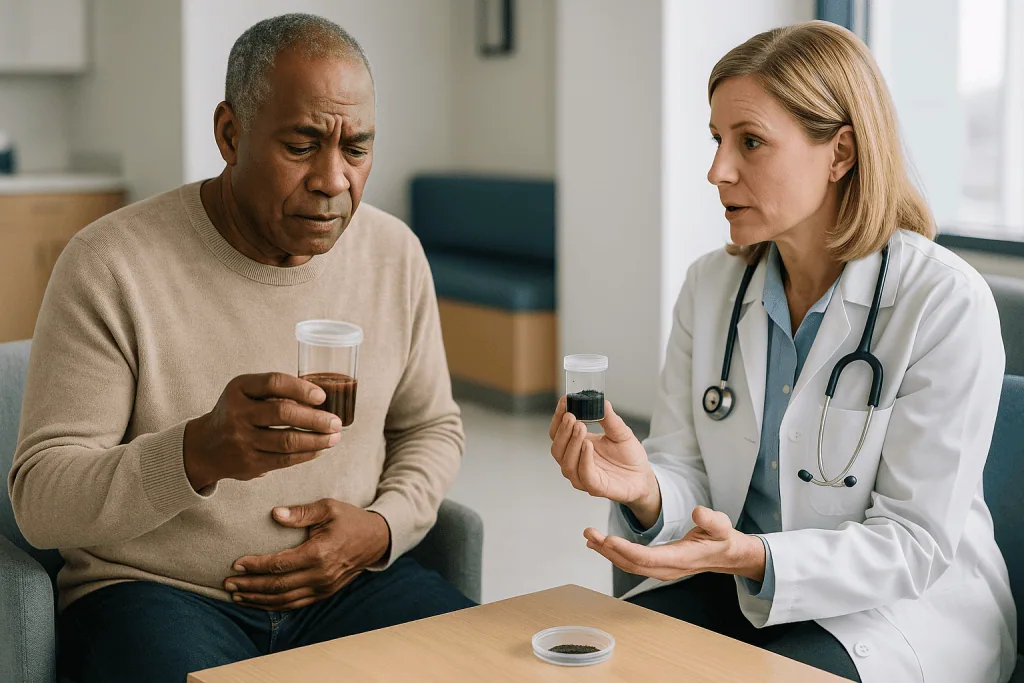
Vomited blood is not always bright red. When blood sits in the stomach for a while, acid converts its iron-rich pigment into a dark brown material, and the vomit ends up looking like wet coffee grounds or used tea leaves. Bright red vomit usually points to faster, more recent bleeding. Both patterns are described by MedlinePlus and Cleveland Clinic as signs of upper gastrointestinal bleeding that need emergency evaluation. Neither is something to photograph and email to a doctor in the morning.
Melena has a texture as much as a color. The stool is typically jet black, sticky, unusually foul-smelling, and may look almost shiny. It clings to the bowl. This is different from the dark, formed stool that follows iron tablets, licorice, blueberries or a large helping of beets, which tends to be dark green-brown rather than tar-like and does not have the same sticky quality. If you are genuinely unsure, the cautious answer is to treat it as blood and be assessed.
Less often, a bleeding ulcer produces maroon or even red blood from the rectum. That happens when bleeding is heavy enough that blood rushes through the intestine before it has time to darken. Red blood in the toilet is more commonly from hemorrhoids or the lower bowel, but when it comes with lightheadedness, sweating or a pounding heart, an upper source becomes a serious possibility.
One more pattern deserves a mention: a person who has vomited once, seen something dark, and felt fine afterward. Feeling fine is not reassurance. A single episode of coffee-ground vomit is enough to justify emergency care, because the vessel that bled once can bleed again, and the second time may be heavier.
How a bleeding ulcer works inside the body
Understanding the mechanism explains why the symptoms take the shape they do, and why they can lag behind the bleeding itself.
Picture the ulcer as a small pit in a wall that has plumbing running through it. As acid and inflammation deepen the pit, the wall thins over a blood vessel. When the vessel wall gives way, blood escapes into the stomach or duodenum. The body responds in two ways at once. Platelets and clotting proteins rush to plug the hole, and the stomach acid, which is strongly acidic, works against them, because clots form poorly in an acidic environment. This tug-of-war is why bleeding can stop, restart and stop again over hours or days.
The blood that has leaked has to go somewhere. If a large volume arrives quickly, the stomach stretches, nausea follows, and the person vomits blood. If the volume is smaller or the bleeding is from the duodenum, blood passes onward through roughly six meters of intestine. During that trip, digestive enzymes and bacteria break the hemoglobin down, turning it black. The result, many hours later, is melena. That delay matters: black stool seen this morning may reflect bleeding that started yesterday.
The circulation, meanwhile, is losing volume. Early on, the body compensates by tightening blood vessels and speeding the heart, so blood pressure can look normal while the pulse climbs. A person may notice only that they feel a little washed out, or that standing up brings a swimming sensation. As losses mount, the brain gets less oxygen and dizziness, confusion or fainting appear. MedlinePlus lists these circulatory signs alongside vomiting blood and black stools as reasons to seek emergency care, because they indicate the bleeding has outpaced the body’s ability to compensate.
Pain, oddly, is a poor guide throughout. Blood is a buffer, and a stomach full of it can neutralize acid enough to make the burning of the ulcer fade.
The quiet version: slow bleeding, anemia and the symptoms nobody links to the gut
Not every bleeding ulcer announces itself. The NHS points out that some ulcers ooze slowly over weeks, losing a small amount of blood each day. There may be no visible change in the stool at all, because the quantity is too small to blacken it noticeably. What builds up instead is anemia, a shortage of the red blood cells that carry oxygen.

The symptoms of gradual anemia are famously unspecific. Tiredness that sleep does not fix. Breathlessness on a flight of stairs that used to be easy. A pale cast to the skin, the inside of the lower eyelid, or the nail beds. Palpitations, a fluttering awareness of the heartbeat. Cold hands and feet. Headaches. Some people notice they crave ice or feel their heart race when they lie down. None of these points to the stomach, and many are dismissed as stress, age or a busy season at work.
The clue that ties them together is usually a blood test showing low hemoglobin, the iron-containing protein inside red cells, along with low iron stores. In an adult with no obvious reason to be iron deficient, the NIDDK and NHS both identify unexplained anemia as a reason to look for a bleeding source in the digestive tract, and a peptic ulcer is a leading candidate.
Slow bleeding is less immediately dangerous than a torrential bleed, but it is not benign. A vessel that has been oozing for weeks can open more widely at any point, and a person who is already anemic has less reserve to cope when it does. That is why doctors take a modest fall in blood count seriously in someone with indigestion, and why a pattern of black stools that comes and goes is treated as a bleeding ulcer warning sign rather than a curiosity.
If this describes you, the right route is a prompt appointment rather than an ambulance, unless the emergency signs described later appear. But it is a prompt appointment, not one to postpone until after the holidays.
Why wait-and-see is the wrong instinct with a bleeding ulcer
People wait for understandable reasons. Ulcer pain has often been present for weeks and has felt manageable. The dramatic sign happened once. The person feels better than they did. The emergency department is a long night. Each of these is a real consideration, and each is outweighed by what the evidence says about how ulcer bleeds behave.
The central problem is rebleeding. A vessel that has clotted over is not a vessel that has healed. The clot is sitting in an acid bath, over a crater that is still inflamed, and the NHS and Cleveland Clinic both describe recurrent bleeding as a recognized pattern in untreated ulcers. The first episode often serves as a rehearsal for a larger one. When the second bleed comes, it may arrive without the interval that allowed a calm decision the first time.
The second problem is silent blood loss. Because the pulse compensates before blood pressure falls, a person can lose a meaningful fraction of their circulating volume while still walking and talking. By the time they faint, the margin for error has narrowed considerably. Older adults and people with heart or kidney disease have less physiological reserve and tolerate this poorly, which is one reason guidelines treat age and other illnesses as factors that raise the urgency.
The third problem is that the bleeding may not be from an ulcer at all. Vomited blood and black stools can also come from stomach cancer, from swollen veins in the esophagus in people with liver disease, or from a tear at the junction of the esophagus and stomach after forceful vomiting. Only a camera examination can tell these apart, and the treatment differs. Waiting does not just risk the ulcer; it risks the wrong diagnosis being assumed.
There is a place for watchful waiting in medicine. A single episode of internal bleeding is not it. The honest summary of what the evidence shows is that ulcer bleeds are unpredictable, that predicting who will rebleed at home is not reliable, and that assessment is safer than reassurance.
Who is most at risk of a bleeding ulcer?
Anyone with a peptic ulcer can bleed, but certain patterns raise the odds enough that clinicians ask about them in the first minutes of an assessment.
Regular NSAID use stands out. These painkillers are effective for arthritis, back pain and headaches, and they also reduce prostaglandins, the chemical messengers that maintain the stomach’s protective mucus and blood flow. The Mayo Clinic notes that the risk rises with longer use, higher doses and use in older adults. Low-dose aspirin taken for heart protection belongs in this category too, which surprises many people who think of it as gentle.
Blood-thinning medicines do not cause ulcers, but they make any ulcer that exists bleed more readily and for longer. This includes anticoagulants, the drugs that slow clotting to prevent strokes and clots in the legs or lungs, and antiplatelet medicines, which stop platelets sticking together after a heart stent. Someone on these medicines who develops indigestion has more reason to mention it, not less.
H. pylori infection, often acquired in childhood and carried without symptoms for decades, is the other major driver. The NIDDK describes it as the cause of most ulcers not linked to painkillers.
Age matters twice over: older adults are more likely to take NSAIDs and blood thinners, and their stomach lining defends itself less vigorously. A history of previous ulcer or previous gastrointestinal bleed raises the risk again. Heavy alcohol use, smoking and serious illness such as being in intensive care also feature in guideline lists.
None of these factors should prompt anyone to stop a prescribed medicine on their own. Aspirin, anticoagulants and antiplatelets are usually prescribed because the alternative risk, a stroke or heart attack, is serious. What they should prompt is a conversation with the prescribing clinician about whether stomach protection is appropriate, and a lower threshold for seeking help if bleeding ulcer warning signs appear.
Bleeding, perforation, obstruction: telling the three ulcer emergencies apart
Bleeding is the most common ulcer complication, but the NHS lists two others that also demand urgent care. Knowing how they differ helps make sense of what an emergency team is looking for.
Perforation is when the ulcer erodes completely through the wall of the stomach or duodenum, opening a hole into the abdominal cavity. Stomach contents leak out and cause peritonitis, an infection of the lining of the abdomen. The pain is typically sudden, severe and constant, and the abdomen becomes rigid to the touch. The NHS describes this as a surgical emergency.
Gastric outlet obstruction develops more slowly. Scar tissue or swelling from an ulcer near the stomach’s exit narrows the passage, so food cannot leave. The result is repeated vomiting of undigested food, bloating, feeling full after a few mouthfuls, and unintended weight loss over weeks.
| Complication | What is happening | Typical pattern | Urgency |
|---|---|---|---|
| Bleeding | Ulcer erodes into a blood vessel | Vomiting blood or coffee-ground material, black tarry stools, dizziness, racing pulse; pain may ease | Emergency |
| Perforation | Ulcer breaks through the gut wall | Sudden, severe, constant abdominal pain; rigid abdomen; fever; feeling very unwell | Emergency, often surgical |
| Obstruction | Scarring or swelling blocks the stomach exit | Repeated vomiting of food, bloating, early fullness, weight loss over weeks | Urgent assessment |
The patterns overlap more in real life than in a table. A perforated ulcer can also bleed. A person with obstruction may have an ulcer that is oozing. That is why, rather than trying to sort out which complication is present, the practical rule is simpler: any of these patterns means hospital assessment. The team will use examination, blood tests, imaging and endoscopy to work out which it is and what to do next.
What actually happens in the emergency department
The first minutes are about stability, not diagnosis. A nurse checks pulse, blood pressure, oxygen level and how alert you are. An intravenous line goes in, sometimes two, so that fluids can be given quickly. Blood is drawn to measure hemoglobin, kidney function, clotting and blood type, in case a transfusion is needed. You will be asked, often several times, exactly what the vomit or stool looked like, when it started, what medicines you take, and how much alcohol you drink. The repetition is deliberate; these answers shape the plan.
Clinicians use structured scoring systems that combine your blood results, blood pressure, pulse and other illnesses to estimate how serious the bleed is and how urgently you need a camera examination. People whose scores are very low may occasionally be assessed as safe for early discharge with an outpatient scope; most people with clear bleeding are admitted.
Acid suppression is usually started early, through the drip. The medicines used belong to a class called proton pump inhibitors, which switch off the acid-producing pumps in the stomach lining. The purpose at this stage is mechanical rather than curative: a less acidic stomach lets clots form and hold. Whether you receive this, and for how long, is a decision for the treating team based on what the endoscopy shows.
If you take a blood thinner, expect a careful discussion rather than a reflex instruction. Stopping it lowers bleeding risk but raises clot risk, and the balance depends on why it was prescribed. In some cases a reversal medicine is considered. This is one of the clearest examples of a decision that belongs to the team looking after you, weighing your particular history.
Food and drink are usually held until after the scope, partly so the stomach is empty for the examination and partly in case a procedure is needed. It can be a long, hungry wait. It is also, for most people, the point at which the situation starts to feel controlled.
Who gets an urgent endoscopy, and who is usually asked to wait?
Endoscopy is the examination that settles the question. A thin, flexible tube with a camera and a light at its tip is passed through the mouth, down the esophagus and into the stomach and duodenum. The NHS and Mayo Clinic describe it as the standard test for a suspected bleeding ulcer because it both finds the source and allows treatment through the same tube in the same session.
Timing depends on how unstable you are. Someone whose blood pressure keeps falling despite fluids, or who is vomiting large volumes of fresh blood, is taken for endoscopy as soon as the team judges them stable enough to tolerate it, sometimes in the operating theatre with an anesthetist present. Someone who is stable, with a steady pulse and a hemoglobin that has not dropped alarmingly, is typically scoped within the first day of admission. Guideline bodies favor this early window because it identifies the people who need treatment and lets the rest go home sooner.
Who is asked to wait? Chiefly, people who are not yet fit for the procedure. Very low blood pressure, ongoing confusion or a full stomach of blood make endoscopy less safe and less useful, so resuscitation comes first. People with certain heart or lung conditions may need extra preparation. And people whose story turns out to point somewhere else, a lower bowel bleed, for example, may be redirected to a different test.
The procedure itself usually takes well under an hour. You receive sedation through the drip, a local anesthetic spray to the throat, or both, and most people remember little of it. Afterward, a sore throat and a bloated feeling from the air used to inflate the stomach are common and settle within hours.
You will not be asked to decide when your scope happens. What you can do is tell the team clearly about any medicines you take, any allergies, and any previous problems with sedation, all of which influence timing.
How doctors stop the bleeding
Once the camera finds the ulcer, the endoscopist grades what they see. A clean, pale ulcer base has a low chance of bleeding again. A visible vessel, an adherent clot or active oozing indicates a higher chance and calls for treatment on the spot. This grading, rather than the size of the ulcer or how frightened you were, drives the next steps.
Endoscopic treatment uses the working channel of the scope. Several methods exist and are often combined. A small volume of medicine can be injected around the vessel to constrict it and slow flow. A heated probe can be applied to seal the vessel by controlled burning, a technique called thermal coagulation. Metal clips, each a few millimeters across, can be placed to pinch the vessel closed, much as a paper clip closes a sheaf of pages. Newer options include a powder sprayed onto the ulcer surface to form a protective crust. The NHS and Cleveland Clinic describe these as the main tools, and the choice between them rests with the endoscopist based on the ulcer’s position and appearance.
Acid suppression continues afterward, typically through the drip for a period and then by mouth, because an environment with less acid protects the freshly treated vessel. Blood transfusion is given if hemoglobin has fallen far enough to threaten oxygen delivery; it is not given for a modest drop, because transfusion carries its own risks.
Most bleeds are controlled endoscopically. When one is not, or rebleeds despite a second attempt, two further options exist. In interventional radiology, a catheter is threaded through an artery in the groin or wrist to the bleeding vessel and small particles or coils are released to block it, a procedure called embolization. Surgery, once the mainstay, is now reserved for cases the other approaches cannot manage. Each carries distinct risks that the team will lay out if they become relevant.
This is a treatment explainer, not a guarantee. Outcomes depend on the ulcer, the person and their other conditions, and the treating team is the right source for what to expect in an individual case.
What the following days and weeks usually look like
Recovery from a bleeding ulcer has two timelines running side by side: the short one, in which the bleeding is confirmed to have stopped, and the longer one, in which the ulcer heals and its cause is dealt with.
In hospital, the first two or three days are a period of observation. Nurses watch pulse and blood pressure, repeat the hemoglobin, and check each stool. Black stool can continue for a day or two after bleeding has stopped, because blood already in the intestine is still working its way through, so a dark bowel movement on the second morning is not automatically a rebleed. A fresh drop in hemoglobin, new vomiting of blood or a return of dizziness is. Eating usually resumes with fluids and light meals once the team is satisfied. Length of stay varies with how heavy the bleed was and what other conditions are present, and the team will give a realistic estimate rather than a fixed number.
At home, tiredness is the dominant complaint, and it is mostly the anemia. Red cells are rebuilt over weeks, not days, and iron supplements are often prescribed to speed that along. Breathlessness on stairs and a fast pulse on exertion ease gradually. Most people can return to desk work within a week or two of discharge, physical work somewhat later, but this is a range drawn from typical practice rather than a rule, and your own team’s advice applies.
Acid-suppressing treatment continues by mouth. The NHS describes a typical healing course of several weeks, with the duration set by the prescriber according to the size and location of the ulcer and whether painkillers remain necessary. Stopping early because the pain has gone is a common and avoidable mistake.
A follow-up plan usually includes a test to confirm any H. pylori infection has cleared, and for stomach ulcers specifically, a repeat endoscopy to check healing and rule out anything more serious, since some stomach ulcers can harbor cancer. Duodenal ulcers generally do not need a repeat scope. These appointments are part of the treatment, not optional extras.
Treating the cause: H. pylori, painkillers and preventing the next bleed
Stopping the bleeding treats the emergency. Preventing another one means addressing why the ulcer formed, and this part of care is easy to neglect once the crisis has passed.
If H. pylori is found, whether by biopsy during the endoscopy, a breath test, a stool test or a blood test, it is treated with a short combination of antibiotics alongside acid suppression. The bacterium is stubborn and resistance to some antibiotics is rising, so the combination and duration are chosen by the prescriber and vary by region. Finishing the course matters more here than almost anywhere else in medicine, because an incomplete course encourages resistant organisms. The NHS recommends a test after treatment to confirm the infection has gone; the NIDDK notes this test is done after a waiting interval so that recent acid suppression does not mask a persisting infection. Successfully clearing H. pylori substantially lowers the chance of the ulcer returning, though it does not reduce it to zero.
If an NSAID was the cause, the conversation is about whether it can be stopped, swapped for a painkiller from a different class, or continued alongside long-term stomach protection. For arthritis pain this can be a genuinely difficult trade-off, and it deserves a proper appointment rather than a corridor remark. Never stop a prescribed painkiller, aspirin or anticoagulant on your own after a bleed; your prescriber will weigh the reason it was started against the bleed you have just had, and may involve a cardiologist or neurologist.
Lifestyle measures are supporting acts, not stars. Smoking slows ulcer healing and raises recurrence, so stopping helps. Alcohol irritates the lining. Spicy food does not cause ulcers, although some people find it aggravates symptoms while healing. Stress alone is not a cause, but it does push people toward more painkillers, more cigarettes and more alcohol, which are.
The single most useful thing a person can do after a bleeding ulcer is attend the follow-up. It is where the cause is confirmed cleared, the medicines are reviewed, and the risk of a repeat is actually reduced.
What people often get wrong about bleeding ulcers
“The pain stopped, so it must be healing.” The opposite can be true. Blood in the stomach buffers acid, and a bleeding ulcer often hurts less than a non-bleeding one. Relief that arrives with black stool or dark vomit is a warning, not a reprieve.
“Bright red blood would be worse than black stool.” Black, tarry stool is digested blood from the upper gut and is itself a serious sign. Red blood from the rectum is more often a lower-bowel cause, though heavy upper bleeding can produce it too. Color helps locate the source; it does not rank the danger.
“It was only once.” A single episode of coffee-ground vomit or melena is enough. The vessel that bled has not healed just because it clotted, and the NHS and Cleveland Clinic both describe rebleeding as a recognized risk.
“Can a bleeding ulcer heal on its own?” Small bleeds sometimes stop spontaneously, and shallow ulcers can heal if the cause is removed. But there is no way to know from home whether a bleed has truly stopped or which ulcer will heal unaided, and the cause, usually H. pylori or a painkiller, does not remove itself. Watching and hoping is not a strategy the evidence supports.
“Ulcers come from stress and spicy food.” They come mostly from H. pylori and NSAIDs, per the Mayo Clinic and NIDDK. Stress and chilli can worsen symptoms and are worth moderating, but treating them as the cause leaves the real one untreated.
“Milk soothes the stomach.” Milk briefly buffers acid and then stimulates more of it. It is not harmful in moderation, but it is not treatment.
“I should stop my aspirin or blood thinner immediately.” That decision depends on why it was prescribed and belongs to the team. Stopping some of these medicines abruptly carries its own serious risks.
“Antacids from the pharmacy will fix it.” Over-the-counter antacids neutralize acid for an hour or two and can ease discomfort. They do not heal ulcers, treat infection or stop bleeding, and relying on them can delay a diagnosis.
Questions to ask your care team
A bleeding ulcer is disorienting, and most people leave hospital with questions they wish they had asked. These are the ones that tend to matter most, grouped by the moment they usually arise. Write the answers down; sedation and anemia both blur memory.
In the emergency department or on the ward:
- What did the endoscopy show, and where exactly is the ulcer?
- Was the bleeding treated during the scope, and how?
- Was a biopsy taken, and when will the result be available?
- Was H. pylori tested for, and what was the result?
- What signs would tell you the ulcer has bled again, and what should I do if I notice them?
Before going home:
- Which of my usual medicines should I keep taking, which are paused, and who decides when paused ones restart?
- If I take aspirin, an anticoagulant or an antiplatelet, has the specialist who prescribed it been consulted about the plan?
- How long is the acid-suppressing treatment expected to continue, and what happens at the end of it?
- Do I need iron, and how will you check my blood count is recovering?
- What can I eat, and are there foods or drinks you want me to avoid while the ulcer heals?
For the follow-up plan:
- Do I need a repeat endoscopy, and if so, roughly when?
- How and when will you confirm that H. pylori has been cleared?
- If I need pain relief for another condition, which options are safer for me now?
- Who is my point of contact if something changes before the follow-up appointment?
It is reasonable to ask a family member or friend to sit in for these conversations. It is also reasonable to ask the team to repeat something you did not follow. The people caring for you would far rather explain twice than discover at follow-up that a medicine was stopped, or restarted, on a misunderstanding.
When to call your doctor, and when to call emergency services
The distinction here is between signs that mean call emergency services or go straight to an emergency department, and signs that mean contact your doctor promptly for an appointment in the coming days. Both matter. Only one can wait for office hours.
Call emergency services or go to an emergency department now if you have:
- Vomit that is bright red, dark red, or looks like coffee grounds
- Black, sticky, tarry stools, especially with a foul smell
- Large amounts of maroon or red blood from the rectum
- Dizziness, fainting or near-fainting, particularly on standing
- A racing heartbeat, cold clammy skin, or breathlessness that came on with the other signs
- Sudden, severe, constant abdominal pain with a hard, tender belly, which can indicate perforation
- New confusion or drowsiness in someone with any of the above
- Any of these signs while taking an anticoagulant, antiplatelet medicine or aspirin
Do not drive yourself. Do not eat or drink while you wait, in case a procedure is needed. Bring a list of your medicines, or the containers themselves.
Contact your doctor promptly, within days, if you have:
- Burning or gnawing pain in the upper abdomen that has lasted more than a couple of weeks or wakes you at night
- Indigestion that started or worsened while you take NSAIDs or aspirin regularly
- Unexplained tiredness, breathlessness on exertion or pallor, which can point to slow blood loss
- Repeated vomiting, feeling full after small meals, or losing weight without trying
- Difficulty or pain swallowing
- A previous ulcer and a return of familiar symptoms
After treatment for a bleeding ulcer, the same emergency list applies for any return of bleeding signs. Your discharge team should give you a direct number; use it for anything on the second list rather than waiting for the scheduled follow-up.
Every judgment about what your symptoms mean, and what to do about them, rests with the clinicians examining you. This section is a guide to when to make the call, not a substitute for their assessment.
Frequently asked questions
What are the first bleeding ulcer symptoms most people notice?
The most common first signs are black, tarry stools or vomiting material that looks like coffee grounds. Some people instead notice lightheadedness on standing, a fast heartbeat or unusual tiredness before they see any blood. Ulcer pain may actually fade as bleeding begins, which is why a change in stool or vomit, not pain, is the clue to act on.
What does black stool from an ulcer look like compared with stool darkened by food or iron?
Blood-blackened stool, called melena, is typically jet black, sticky, shiny and unusually foul-smelling, and it clings to the bowl. Stool darkened by iron tablets, beets, blueberries or licorice tends to be dark green-brown, formed and without the tarry texture. If you cannot tell, treat it as blood and seek assessment; a clinician can test the stool if needed.
Can a bleeding ulcer heal on its own if I rest and avoid spicy food?
Small bleeds sometimes stop spontaneously, but there is no reliable way to know from home whether bleeding has truly stopped or will restart, and the underlying cause, usually H. pylori or a painkiller, does not resolve by itself. Guideline sources treat any sign of ulcer bleeding as a reason for hospital assessment, where the ulcer can be examined and treated directly.
What are the signs of internal bleeding in the stomach when there is no visible blood?
Internal bleeding can show up as dizziness or fainting when standing, a racing or pounding heartbeat, cold and clammy skin, breathlessness, unusual pallor and profound tiredness. These reflect the body compensating for lost blood volume. When they appear in someone with a history of indigestion or painkiller use, they warrant emergency assessment even if the stool has not turned black yet.
Does a bleeding ulcer always hurt?
No. Many people describe less pain once bleeding begins, because blood in the stomach neutralizes acid and soothes the ulcer. Others have had no pain at all, particularly older adults and people taking NSAIDs, which can mask ulcer symptoms. The absence of pain should never be taken as reassurance when there is vomited blood, black stool or dizziness.
How is a bleeding ulcer diagnosed in hospital?
The main test is an upper endoscopy, in which a thin flexible camera is passed through the mouth into the stomach and duodenum under sedation. It shows the ulcer, grades how likely it is to bleed again, and allows treatment through the same tube. Blood tests measure hemoglobin and clotting, and biopsies or breath and stool tests check for H. pylori infection.
How do doctors stop an ulcer from bleeding during endoscopy?
The endoscopist can inject medicine around the vessel to constrict it, apply a heated probe to seal it, place small metal clips to pinch it closed, or spray a powder that forms a protective crust. These methods are often combined. Acid-suppressing medicine is given alongside so that clots can form and hold. If endoscopy cannot control the bleed, radiology-guided embolization or surgery are the alternatives.
Should I stop taking aspirin or my blood thinner if I think my ulcer is bleeding?
Do not stop these medicines on your own. They are usually prescribed to prevent strokes, heart attacks or dangerous clots, and abruptly stopping carries its own serious risks. Seek emergency care and tell the team exactly what you take. They will weigh the bleeding against the reason for the medicine, often together with the specialist who prescribed it, and decide whether to pause, reverse or continue it.
How long does it take to recover after a bleeding ulcer is treated?
Hospital observation typically lasts a few days while the team confirms bleeding has stopped, though this varies with how heavy the bleed was and other conditions. Tiredness from anemia can persist for weeks as red blood cells are rebuilt. Acid-suppressing treatment usually continues for several weeks to allow the ulcer to heal, with the exact duration set by your prescriber.
Will a bleeding ulcer come back?
It can, particularly if the cause is not addressed. Clearing an H. pylori infection with a completed course of treatment and confirming it has gone, reviewing NSAID and aspirin use with your prescriber, and stopping smoking all lower the chance of recurrence, though none eliminates it. Attending the follow-up appointments and any repeat endoscopy your team recommends is the most reliable way to reduce the risk.
References
- NHS: Stomach ulcer: Complications
- NHS: Stomach ulcer
- MedlinePlus: Gastrointestinal Bleeding
- NIH NIDDK: Peptic Ulcers (Stomach or Duodenal Ulcers)
This article is for general information only and is not a substitute for professional medical advice. Please consult a qualified doctor about your individual situation.

More from the Blog

Living With a PEG Feeding Tube: Showering, Sleeping, Going Out and Staying Active
Most people living with a PEG tube can shower, sleep in their usual position, leave the house and stay physically active once the stoma…

Hepatitis A Myths: Does It Become Chronic and Can You Catch It Twice?
Hepatitis A does not become chronic. The infection is acute: the immune system clears the virus, and the liver typically heals without lasting damage,…

Stool Tests, Blood Tests and Hydration Checks: How Gastroenteritis Is Assessed
Gastroenteritis is usually assessed by history and a hydration check rather than by laboratory tests, because most viral cases settle on their own within…

Celiac Follow-Up Blood Tests: What Antibody Levels Say About Your Gluten-Free Diet
After a celiac diagnosis, doctors usually repeat the tissue transglutaminase IgA (tTG-IgA) antibody test a few months into a gluten-free diet and then about…

Lactose Intolerance in Children and Teens: How the Pathway Differs From Adults
Lactose intolerance in children follows a different path than in adults. Young children most often develop it temporarily after a gut infection and usually…

Preparing for PEG Placement: Fasting, Blood Thinners and Pausing Existing Tube Feeds
Preparing for PEG tube placement usually means no solid food or enteral formula for about six to eight hours beforehand, small sips of clear…