

Living With a PEG Feeding Tube: Showering, Sleeping, Going Out and Staying Active

Key Takeaways
- A PEG tube changes where food enters, not how it is digested, so hunger, fullness and bowel function usually continue much as before.
- The tract between stomach and abdominal wall typically matures over two to four weeks, and that timeline governs when soaking baths, swimming and tube rotation can begin.
- Showering is usually allowed once the initial dressing is off and the site has stopped oozing; soaking the stoma is held back until the tract has healed.
- Staying upright during feeds and for 30 to 60 minutes afterward is the single most important positioning habit, day or night.
- Whether you can eat by mouth depends on why the tube was placed and on a swallow assessment, not on the presence of the tube itself.
- A tube that falls out is urgent because the tract can start closing within hours, but it is a rehearsed situation: cover the site, keep the tube and call the team or go to emergency care.
Most people living with a PEG tube can shower, sleep in their usual position, leave the house and stay physically active once the stoma has healed and the care team has confirmed the tube sits securely. The main adjustments are keeping the site clean and dry, protecting the tube from being pulled, staying upright during and after feeds, and avoiding soaking or contact sports until the team says the tract has matured.
The first evening home, most people do the same thing: they stand in the bathroom doorway, look at the shower, look down at the soft tube taped under their T-shirt, and decide to wait one more day. Then they lie awake wondering whether rolling onto their side will pull something loose.
Those small hesitations are the real texture of living with a PEG tube. The procedure itself is over in well under an hour. What follows is months, sometimes years, of ordinary life negotiated around a piece of silicone the width of a drinking straw: washing, sleeping, meeting friends for coffee you may not drink, getting back on the bike.
The encouraging part is that the evidence and the practical guidance from nutrition teams point the same way. Very little has to stop. A fair amount has to be adjusted, and knowing which is which saves a great deal of unnecessary caution.
What a PEG tube is and how it actually works
PEG stands for percutaneous endoscopic gastrostomy: a feeding tube placed through the skin of the abdomen directly into the stomach, guided by an endoscope, which is a thin flexible camera passed through the mouth. The endoscope lights the stomach from the inside so the doctor can see exactly where the abdominal wall and stomach wall touch, numb the skin, and pass the tube through that point. MedlinePlus describes the procedure as usually taking around 30 to 45 minutes, most often under sedation with local anesthetic rather than a general anesthetic.
Two parts hold it in place. Inside the stomach sits a small soft disc or mushroom-shaped bumper (some later replacement tubes use a water-filled balloon instead). Outside sits a second flat bumper that rests against the skin. Between them, the stomach wall is held gently against the inside of the abdominal wall. Over the following weeks the two surfaces knit together into a lined channel called the tract, and the opening in the skin is called the stoma.
The tube changes where food enters, not how it is digested. Liquid feed, water and (when appropriate) medicines go through the tube past the mouth, throat and esophagus, then arrive in the stomach exactly as a meal would. Stomach acid, the small intestine, the pancreas and the liver carry on as before. That is why most people feel hunger and fullness in the usual way and why bowel habits usually settle once the feeding plan is established.
Understanding this mechanism answers a surprising number of everyday questions. Water on the skin around the stoma is not water in the stomach. Lying on your side does not tip feed out of the tube. The stomach is not open to the outside; it is joined to the outside through a healed, sealed channel.
Who is usually offered a PEG tube, and who is usually asked to wait
A PEG is generally considered when someone cannot swallow safely or cannot take in enough by mouth, and that situation is expected to last more than a few weeks. A review in the World Journal of Gastroenterology summarizes the usual threshold as tube feeding anticipated beyond roughly four weeks, the point at which a nasogastric tube (a temporary tube passed through the nose into the stomach) becomes uncomfortable and prone to displacement.
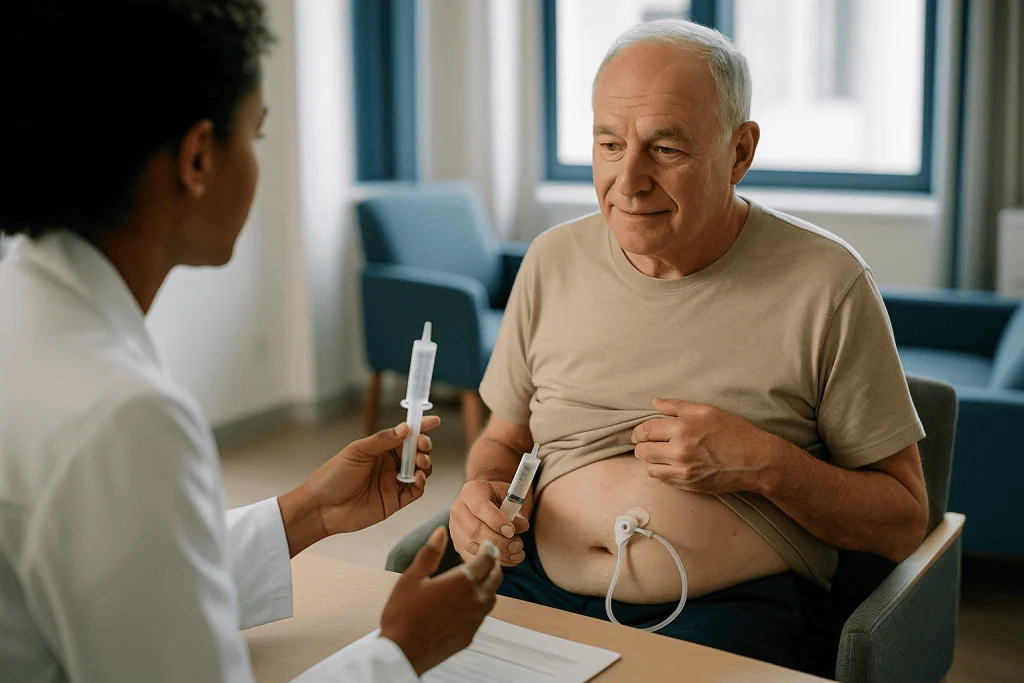
Typical reasons include stroke affecting the swallow, motor neuron disease and other progressive neurological conditions, head and neck cancers during and after treatment, severe injury, and some conditions in childhood that make oral feeding unsafe. In each case the aim is the same: reliable nutrition, fluid and medicine delivery without the risk of food entering the lungs, which is called aspiration.
Some people are asked to wait or are offered a different route. Active infection of the abdominal wall, uncontrolled bleeding tendency, a large amount of fluid in the abdomen (ascites), previous stomach surgery that has changed the anatomy, or an obstruction that stops the endoscope reaching the stomach can all make the standard PEG technique unsafe or impossible at that moment. Alternatives include a radiologically inserted gastrostomy placed using X-ray guidance, a surgical gastrostomy, or a tube that runs onward into the small intestine (PEG-J) when the stomach empties poorly.
One situation deserves plain language. In advanced dementia, the evidence reviewed by the same authors does not show that PEG feeding prolongs life, prevents aspiration pneumonia or improves comfort. Guidelines therefore encourage careful discussion of goals rather than automatic placement. Whether a PEG is right for any individual is a decision for the person, their family where appropriate, and the treating team together.
How painful is a PEG tube, during and afterward?
The honest answer has two halves. Placement is usually not remembered as painful, because sedation and a local anesthetic in the abdominal wall take the edge off; people commonly describe pressure or a brief sharp moment when the skin is numbed. The days afterward are a different matter. The site behaves like a fresh puncture through muscle and skin, and MedlinePlus lists soreness around the tube as expected in the early period. Most people compare it to a deep bruise: worse when coughing, sneezing, bending or getting out of bed, easier when lying still.
That early soreness should fade steadily rather than build. Pain that is getting worse, spreading across the abdomen, or accompanied by fever, redness tracking outward from the stoma, or feed leaking from the site is not a normal part of healing and needs a same-day call. So does pain when the tube is gently rotated, which can be a sign that the external bumper is too tight or that the internal bumper is pressing into the stomach wall.
Pain relief in the first days is planned by the team that placed the tube. If a pain reliever is prescribed or suggested, it will usually be given in liquid form through the tube; tablets should not be crushed and pushed through without a pharmacist confirming it is safe, because some coatings and slow-release designs can block the tube or change how the medicine works. None of this should be adjusted at home without asking.
Once the tract has healed, a PEG is not usually painful at all. Most people forget it is there for long stretches of the day. Ongoing pain months later is a reason to be reviewed, not something to accept.
What the first days and weeks with a new PEG usually look like
Feeding through the tube often begins within hours of placement, starting with water and small amounts of feed while the team checks for discomfort, bloating and any leakage. A dietitian builds up the plan over the first days, and MedlinePlus notes that most people are taught to manage the tube, the feeds and the site themselves or with a caregiver before going home.
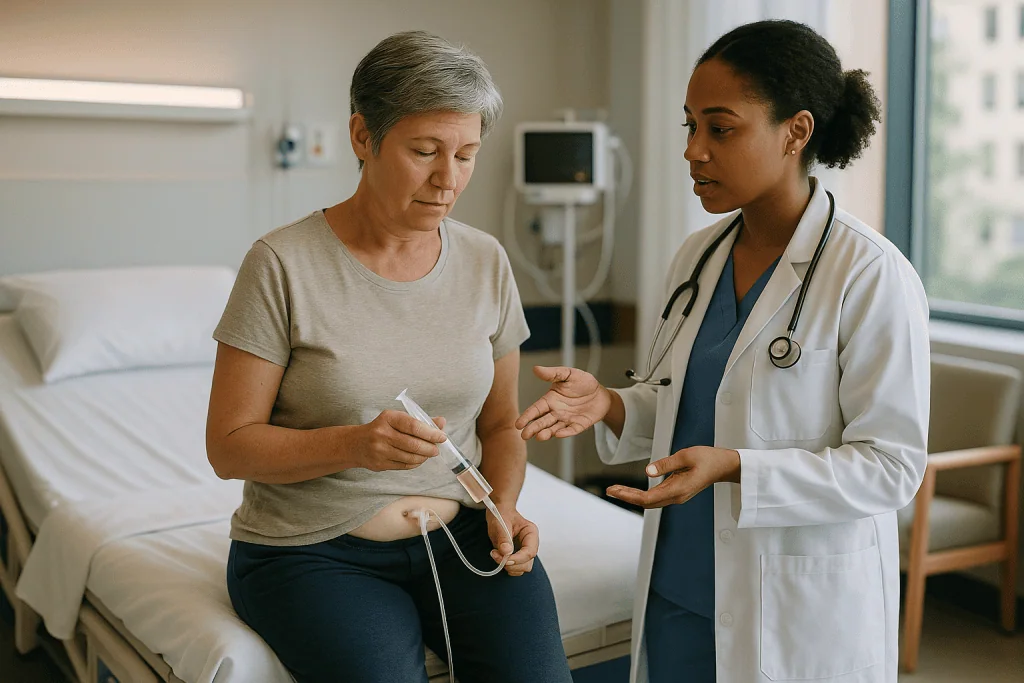
The stoma is usually covered with a light dressing for the first day or two, then left open to the air. Early on the skin may look slightly pink, and a small amount of clear or straw-colored ooze is common while the channel forms. The external bumper is positioned to sit against the skin without squeezing it; teams typically leave a small gap so the skin can breathe and so swelling does not turn a snug fit into a tight one.
Tract maturation, the point at which the stomach wall and abdominal wall have fused into a stable channel, takes weeks rather than days. The World Journal of Gastroenterology review describes this as typically occurring over two to four weeks, longer in people who are malnourished, on steroids, or receiving chemotherapy. This timeline matters because it sets the pace for everything else: soaking baths, swimming, tube rotation, and what happens if the tube comes out early. Before maturation, a dislodged tube is treated urgently because the stomach can drift away from the abdominal wall; after maturation, the channel stays open for a while and a replacement can often be placed through it.
Follow-up usually includes a site check within the first weeks and a dietitian review of weight, hydration and tolerance. Bloating, loose stools or reflux in the early period are common and usually managed by adjusting the rate, timing or type of feed rather than by stopping it.
Can you shower with a PEG tube?
Yes, and usually sooner than people expect. Most nutrition teams allow showering once the initial dressing has been removed and the site has stopped oozing, which for many people is within the first week; the exact day should come from the team that placed the tube, because it depends on how the site is healing. The distinction that matters is between running water over the site and soaking the site. Showers, with the water flowing off the skin, are fine once cleared. Baths, hot tubs and swimming, where the stoma sits under water, are held back until the tract has matured, as described above.
A few habits make showering simpler. Close the end cap and any clamp before stepping in, so water cannot run into the tube. Let water run around the site rather than aiming a strong jet directly at it. Use plain, mild soap on the surrounding skin and rinse it off completely; residue under the external bumper is a common cause of soreness. Afterward, pat the skin dry with a clean towel or a piece of gauze and check under the bumper. Damp skin trapped against silicone is where irritation starts.
Skip lotions, powders and ointments around the stoma unless the team has prescribed one. Talc and thick creams trap moisture and can encourage the overgrowth of granulation tissue, the soft red bumps that sometimes form at the edge of the stoma. If a waterproof dressing has been recommended in the early days, apply it just before the shower and remove it straight after; leaving it on keeps the site wet, which defeats the purpose.
Hair washing, shaving and everything else carry on as normal. The main practical risk is snagging the tube on a towel or a shower door, so many people tuck it into a waistband or use a soft securing loop before they start.
Sleeping with a PEG tube: positions, reflux and tangles
Side sleeping is fine, back sleeping is fine, and most people settle into their usual position within a few nights. The tube is soft, the internal bumper is designed to tolerate movement, and lying on the side away from the stoma is comfortable for most. Lying directly on the tube is uncomfortable rather than dangerous, though many people avoid stomach sleeping in the early weeks simply because the site is tender.
The one position that genuinely matters is the angle of the upper body during and after feeding. MedlinePlus advises staying sitting up or with the head and shoulders raised during a feed and for 30 to 60 minutes afterward, so that gravity keeps stomach contents where they belong and reduces the chance of reflux and aspiration. For overnight pump feeds, this means raising the head of the bed, using a wedge pillow or a foam block under the mattress rather than stacking pillows, which tends to bend the neck without lifting the stomach.
Tubing is the other nighttime nuisance. A pump line that wraps around an arm or catches on the bedframe can tug the tube and wake you, or leave a sore stoma in the morning. Securing the tube to the skin with a soft fixation device or tape well away from the stoma, and routing the line over the shoulder rather than across the body, reduces the pulling. Loose pajama tops with the tube tucked inside help too.
Night coughing, a wet-sounding voice on waking, heartburn that persists despite being propped up, or waking with feed in the mouth are all reasons to tell the team promptly. These can signal that the feed rate is too fast, the stomach is emptying slowly, or the position needs adjusting, and each has a workable solution.
Going out with a PEG tube: work, restaurants and travel
A PEG is invisible under most clothing. The tube sits flat against the abdomen, and a soft belt or a securing tab keeps it from swinging. People go back to work, school, worship, concerts and family dinners with it. The adjustments are logistical rather than medical: where the next feed will happen, what to carry, and how to answer the occasional question.
Bolus feeding, in which a measured amount of feed is given by syringe over minutes, is the easiest to fit around a day out; it can be done in a car, a quiet corner or an accessible bathroom. Many people who use a pump switch to overnight feeding precisely so their daytime is free. Whichever pattern is used, a small bag with a syringe, water, spare cap, tape, wipes and a copy of the feeding plan covers most situations.
Restaurants raise a different question, which is emotional as much as practical. Sharing a table without sharing the meal is a real loss for many people, and speech-language pathologists often suggest ways to stay part of it, from tasting small amounts if the swallow assessment allows, to sipping something for the flavor and simply choosing the company over the menu.
Travel is entirely possible with planning. Mayo Clinic’s guidance on home enteral nutrition emphasizes arranging feed and equipment supplies ahead of any trip and carrying documentation of the medical need. Keep enough feed, water and a syringe in hand luggage to cover delays, ask the team for a short letter describing the tube and the equipment, and plan how you will stay upright after feeds during long journeys. For long flights, the general advice about moving the legs regularly and staying hydrated applies as it does for anyone. Sensible travel with a PEG is about supplies and follow-up, not about a particular place.
Staying active with a PEG tube: exercise, swimming and lifting
Movement is encouraged from the start. Walking on the day of placement and in the days after helps the gut settle and lowers the risk of clots, and there is no evidence that ordinary activity harms a healing stoma. What changes in the early weeks is the type of load on the abdominal wall. Heavy lifting, sit-ups and anything that strains the core pull on the fresh tract, so most teams ask people to hold off until the site has healed and to build back gradually.
After maturation, the range widens considerably. Running, cycling, yoga, gym work and dancing are all compatible with a PEG, provided the tube is secured so it cannot swing or catch. Some people use a snug elasticated band or a specially designed tube belt; others simply tuck the tube into fitted underwear or a compression top. Sports that involve direct blows to the abdomen or grappling deserve a conversation with the team and usually a protective guard.
Swimming follows the same rule as bathing: once the tract has matured and the skin is fully healed, most teams allow it, with the cap closed and the site dried carefully afterward. Chlorinated pools are generally preferred to open water because of the lower bacterial load, and any redness after swimming should be watched.
| Activity | Early weeks (tract healing) | After the tract has matured |
|---|---|---|
| Walking, light housework | Usually encouraged | Unrestricted |
| Showering | Usually once dressing is off and team agrees | Routine |
| Soaking baths, hot tubs, swimming | Usually held back | Often allowed with cap closed; dry site well |
| Heavy lifting, core exercise | Usually avoided | Gradual return with tube secured |
| Contact or collision sports | Avoided | Ask the team; protective guard usually advised |
The table reflects common practice described in patient guidance; the timing for any individual is set by the treating team.
Can you still eat regular food with a PEG tube?
Sometimes yes, sometimes no, and the deciding factor is the reason the tube was placed rather than the tube itself. Having a PEG does not physically stop anyone from swallowing. What it does is remove the pressure to get every calorie by mouth, which for many people makes eating safer and less exhausting.
If the tube was placed because intake was inadequate, for example during cancer treatment when the mouth is too sore to manage full meals, eating and drinking usually continue alongside tube feeds, and the tube provides the shortfall. As appetite recovers, the balance shifts and the tube may eventually be removed. Johns Hopkins describes this supplementary role as one of the most common uses of a gastrostomy tube.
If the tube was placed because swallowing is unsafe, meaning food or liquid is entering the airway, then eating by mouth carries a real risk of pneumonia, and the team may advise nothing by mouth or only specific textures. This is decided by a swallow assessment, usually by a speech-language pathologist, who can watch how liquids and solids move through the throat and recommend what is safe: perhaps thickened fluids, perhaps small tastes for pleasure, perhaps nothing for now. Swallowing can improve after a stroke, so these assessments are often repeated over time.
Two cautions apply to everyone. Do not push blended household food down the tube unless a dietitian has designed a blended-diet plan; ordinary purees can block the tube and are hard to balance nutritionally. And keep up mouth care even when eating nothing, because a dry, neglected mouth breeds bacteria that can be aspirated. Brushing teeth and gums twice a day remains part of living with a PEG tube, whether or not a single crumb passes the lips.
Living with a PEG tube day to day: skin, flushing and keeping it secure
Once the site has healed, daily care takes a few minutes. The skin around the stoma is washed once a day with mild soap and water, rinsed and dried, and inspected for redness, swelling, leakage or new lumps. Many teams ask that the external bumper be lifted slightly so the skin underneath can be cleaned and checked. If the tube has a traditional internal bumper, the team may also ask for it to be rotated gently once a day after the tract has matured, to stop it settling into one position against the stomach wall. Tubes held by a balloon are not rotated in the same way, which is one reason to know which type you have.
Flushing keeps the tube open. Water is pushed through with a syringe before and after every feed and every medicine, and at intervals during the day if the tube is not otherwise in use. The amount and the type of water are specified by the team; the principle is that anything left standing inside the tube can clog it. MedlinePlus lists blockage as the most frequent everyday problem and flushing as its main prevention.
Medicines deserve particular respect. Liquid forms are usually preferred. Tablets should only be crushed and given through the tube if a pharmacist has confirmed that the specific product is suitable, and each medicine is given separately with a water flush in between, never mixed with feed. Some medicines interact with feed and need timing adjustments; that is a conversation for the prescriber and pharmacist, not something to improvise.
Finally, note the position of the external bumper against the centimeter markings on the tube. If that number changes, the tube has moved, and the team should know before the next feed.
Living with a PEG tube long term: what are the downsides of PEG feeding?
An honest explainer has to name them. Minor problems are common and mostly manageable; serious ones are uncommon but need recognizing.
The everyday frustrations are skin irritation, small amounts of leakage around the stoma, granulation tissue, and tube blockage. Feed intolerance shows up as bloating, cramping, nausea or loose stools, and is usually addressed by changing the feed, the rate or the schedule. The tube itself wears out; internal bumpers and balloons degrade over months, so tubes are replaced periodically, often as a simple outpatient procedure once the tract is established.
Infection at the site is the most frequent complication after placement in the World Journal of Gastroenterology review, which is why a single dose of antibiotic is commonly given beforehand and why redness and warmth spreading from the stoma are taken seriously. Less common but more serious problems include buried bumper syndrome, in which an overly tight internal bumper gradually migrates into the stomach wall, peritonitis if the stomach and abdominal wall separate early, bleeding, and injury to neighboring organs during placement.
Two points are easy to miss. First, a PEG does not eliminate aspiration. Saliva can still be inhaled, and reflux of feed can still reach the lungs, which is why positioning and mouth care remain important. Second, the burden is not only physical. People describe grief about meals, self-consciousness about their body, the tedium of supplies and pumps, and strain on family members who take on the care. None of this is a reason to refuse a tube that is clinically needed, but it is a reason to expect support, including from dietitians, speech-language pathologists and, where useful, counseling, and to keep asking whether the tube is still serving the goals it was placed for.
What people often get wrong about living with a PEG tube
The first myth is that a PEG is forever. It is not. When the underlying problem improves, the tube can be removed, and once the tract has matured the opening usually closes on its own within days; a persistent opening is uncommon and can be closed. Plenty of people have a PEG through a course of cancer treatment or stroke recovery and then never think about it again.
The second is that a PEG signals the end of life. Because tubes are sometimes placed in advanced illness, families can read the offer of one as a message about prognosis. In reality, the decision to place a tube reflects a swallowing or intake problem, not a life expectancy. Some of the longest-term users are children and younger adults with neurological conditions who have lived active decades with a gastrostomy.
The third is that everything through the tube must be special. Water is water. Most feeds are complete nutrition designed for the purpose, and the dietitian’s plan is not a menu to improve on. Adding extra feed to gain weight faster, pouring in energy drinks or coffee, or skipping flushes to save time each create predictable problems.
The fourth is that the tube must be kept dry forever. As described above, showering usually resumes early, and swimming and bathing return once the tract has matured.
The fifth is that a tube falling out is a catastrophe. It is urgent, especially early on, because the tract can begin to close within hours, but it is a common and well-rehearsed situation. Covering the site, saving the tube and calling the team or going to an emergency department promptly is the whole job. Trying to push it back in without instruction is the one thing to avoid.
Questions to ask your care team about your PEG tube
A ten-minute conversation before discharge prevents most of the uncertainty of the first weeks. These are the questions people wish they had asked.
- Which type of tube do I have, a bumper or a balloon, and does it need rotating?
- What number on the tube should the external bumper sit at, and what should I do if it changes?
- When can I shower, and when can I bathe or swim?
- What will my feeding schedule look like, and can it be arranged so my days are free?
- How much water should I flush with, and how often, including on days I feel unwell?
- Which of my medicines can go through the tube, and has a pharmacist reviewed the list?
- Am I allowed anything by mouth, and when will my swallow be reassessed?
- What activities should I hold back from, and for how long?
- What does normal healing look like at the site, and what should worry me?
- What exactly should I do if the tube blocks, leaks or comes out, day or night?
- Who do I call out of hours, and who supplies my feed and equipment at home?
- When will the tube be reviewed for replacement or removal, and how will we know it is time?
Write the answers down. Feeding plans, flush volumes and contact numbers are easy to muddle in the first tired days at home, and a single sheet on the refrigerator door removes the guesswork for everyone helping with care. It is equally reasonable to ask for the goals of feeding to be revisited at each follow-up, so that the tube continues to serve the person rather than the other way round.
When to call your doctor about a PEG tube
Most days with a PEG are uneventful, which makes it worth being clear about the handful of situations that need a same-day call and the few that need emergency care.
Contact the care team the same day if you notice redness, warmth or swelling spreading out from the stoma; pus or a foul smell at the site; feed or stomach contents leaking persistently around the tube; a tube that will not unblock with the flushing technique you were taught; new or worsening pain at the site; a change in the position marker on the tube; persistent vomiting, diarrhea or bloating after feeds; or a fever without another obvious cause. Bleeding from the site that is more than a small streak on gauze should also be reported promptly.
Seek emergency care without waiting if the tube comes out, especially in the first weeks after placement, because the tract can begin to close within hours and the stomach may separate from the abdominal wall. Emergency assessment is also needed for severe or spreading abdominal pain, a rigid or very tender abdomen, vomiting blood or passing black stools, sudden shortness of breath or a cough producing feed-colored sputum, which can indicate aspiration, and any signs of severe infection such as confusion, rapid breathing, a racing heart or feeling very unwell.
If in doubt, call. Nutrition and endoscopy teams expect these questions, and a quick phone check about a slightly red stoma is far preferable to a delayed visit for a deep infection. Every decision about the tube, the feed and the medicines that go through it sits with the treating team; this article is a guide to what is common, not a substitute for their advice.
Frequently asked questions
Can you shower with a PEG tube?
Yes, in most cases within the first week or so, once the initial dressing has been removed and the care team has confirmed the site is healing. Close the cap, let water run around rather than directly at the stoma, use mild soap, rinse well and pat dry, including under the external bumper. Soaking baths, hot tubs and swimming are usually delayed until the tract has matured, which the team will confirm.
How painful is a PEG tube?
Placement is done with sedation and local anesthetic, so most people recall pressure rather than pain. The site is typically sore for the first days, worse with coughing or bending, and then settles steadily. A healed PEG is not usually painful at all. Pain that worsens, spreads, or comes with fever, redness or leakage is not normal healing and should be reported the same day.
Eating with a PEG tube: can you still eat regular food?
It depends on why the tube was placed. If it supplements poor intake, eating and drinking usually continue and the tube fills the gap. If swallowing is unsafe because food is entering the airway, the team may advise specific textures or nothing by mouth. A speech-language pathologist’s swallow assessment decides this, and it is often repeated because swallowing can improve over time.
What are the PEG tube downsides people should know about?
Common problems include skin irritation, leakage, granulation tissue, tube blockage and feed intolerance such as bloating or loose stools, most of which are manageable. Less common but serious issues include site infection, buried bumper syndrome, early separation of the stomach from the abdominal wall, and bleeding. A PEG also does not fully remove the risk of aspiration, and the emotional and practical burden on people and families is real.
Can you sleep on your side with a PEG tube?
Yes. Side sleeping and back sleeping are both fine, and most people return to their usual position within a few nights. What matters more is keeping the head and shoulders raised during feeds and for 30 to 60 minutes afterward, and for overnight pump feeds throughout the night, to reduce reflux and aspiration. Securing the tube and routing the line over the shoulder prevents pulling.
Can you swim with a PEG tube?
Usually yes once the tract has matured and the skin is fully healed, typically after a few weeks, and only after the care team has agreed. Close the cap, keep the tube secured, and dry the site carefully afterward. Chlorinated pools are generally preferred to open water because of the lower bacterial load. Any redness or soreness after swimming should be checked.
How long does a PEG tube last before it needs replacing?
Tubes are not permanent fixtures. The internal bumper or balloon wears over months, and tubes are replaced periodically, often as an outpatient procedure once the tract is established. The interval varies with the tube type and how it is used, so the team sets a review schedule. A tube that cracks, leaks at the hub, or has a balloon that will not hold water needs earlier attention.
What should you do if a PEG tube falls out?
Treat it as urgent. Cover the stoma with a clean dressing, keep the tube, and contact the care team or go to an emergency department promptly, because the tract can begin to close within hours, particularly in the first weeks after placement. Do not attempt to reinsert it yourself unless you have been specifically trained and instructed to do so with a replacement tube.
Can you travel or fly with a PEG tube?
Yes, with preparation. Arrange feed and equipment supplies for the whole trip in advance, carry enough feed, water and syringes in hand luggage to cover delays, and ask the team for a letter describing the tube and equipment. Plan where and how you will stay upright after feeds, move your legs regularly on long journeys, and know how to reach a clinician at your destination if needed.
Can a PEG tube be removed, and does the hole close?
Yes. When the underlying reason for the tube has resolved, the team can remove it, sometimes endoscopically and sometimes by gentle traction depending on the type. Once the tract has matured, the opening usually closes on its own within days with a simple dressing. A persistent opening is uncommon and can be closed with a minor procedure if needed.
References
- MedlinePlus Medical Encyclopedia: Feeding tube insertion – gastrostomy
- MedlinePlus Patient Instructions: Gastrostomy feeding tube – bolus
This article is for general information only and is not a substitute for professional medical advice. Please consult a qualified doctor about your individual situation.

More from the Blog

Hepatitis A Myths: Does It Become Chronic and Can You Catch It Twice?
Hepatitis A does not become chronic. The infection is acute: the immune system clears the virus, and the liver typically heals without lasting damage,…
Bleeding Peptic Ulcer: The Warning Signs That Call for Emergency Care, Not a Wait-and-See
A bleeding peptic ulcer is an emergency when it causes vomiting of blood or material that looks like coffee grounds, black or tarry stools,…

Stool Tests, Blood Tests and Hydration Checks: How Gastroenteritis Is Assessed
Gastroenteritis is usually assessed by history and a hydration check rather than by laboratory tests, because most viral cases settle on their own within…

Celiac Follow-Up Blood Tests: What Antibody Levels Say About Your Gluten-Free Diet
After a celiac diagnosis, doctors usually repeat the tissue transglutaminase IgA (tTG-IgA) antibody test a few months into a gluten-free diet and then about…

Lactose Intolerance in Children and Teens: How the Pathway Differs From Adults
Lactose intolerance in children follows a different path than in adults. Young children most often develop it temporarily after a gut infection and usually…

Preparing for PEG Placement: Fasting, Blood Thinners and Pausing Existing Tube Feeds
Preparing for PEG tube placement usually means no solid food or enteral formula for about six to eight hours beforehand, small sips of clear…