

Stool Tests, Blood Tests and Hydration Checks: How Gastroenteritis Is Assessed

Key Takeaways
- Most gastroenteritis is diagnosed from the history and a bedside hydration check, and the NHS notes vomiting usually settles within 1 to 2 days and diarrhea within 5 to 7, with or without testing.
- A stool test is typically reserved for bloody diarrhea, high fever, illness beyond about a week, recent travel, recent antibiotics, immune suppression or suspected outbreaks, because only then does the result change management.
- Stool culture grows bacteria and takes roughly two to three days but allows antibiotic sensitivity testing, whereas PCR panels detect genetic material from many organisms within hours but cannot tell live infection from dead fragments.
- Blood tests do not detect the infection; they measure electrolytes, kidney function and glucose to show how severely dehydration is affecting the body and to guide intravenous fluids when needed.
- Dysentery means diarrhea with blood and mucus, which points to invasive organisms and is one of the few situations where identifying the pathogen before treatment is clearly worthwhile, since antibiotics can worsen certain E. coli infections.
- A rotavirus stool test is run mainly for infection control and surveillance, since the result does not change the rehydration-based treatment for the individual child.
Gastroenteritis is usually assessed by history and a hydration check rather than by laboratory tests, because most viral cases settle on their own within about a week. A stool test for gastroenteritis is typically reserved for bloody diarrhea, high fever, severe or prolonged illness, recent travel, a weakened immune system, or suspected outbreaks. Blood tests mainly check for dehydration and electrolyte disturbance, and the treating team decides which tests, if any, are needed.
The clinic waiting room is quiet except for the sound of a plastic cup being clutched a little too tightly. A father has carried his three-year-old in after a night of vomiting, three stained sheets and a half-finished juice box. He has one question ready, and it is not about germs. He wants to know whether somebody is going to run a stool test for gastroenteritis, and if not, how anyone can be sure what this is.
It is a fair question, and the honest answer surprises many people. For most adults and children with sudden vomiting and diarrhea, the assessment that matters is not done in a laboratory at all. It happens at the bedside, with a clinician watching how a child drinks, pressing a fingertip to check how fast color returns to the skin, and asking a dozen precise questions about timing, travel and who else at home is unwell.
Tests still have a place. Knowing when they help, when they do not, and what each one can and cannot reveal turns a frightening night into something more manageable.
What is a stool test for gastroenteritis, and why isn't everyone offered one?
A stool test for gastroenteritis is any laboratory examination of a sample of feces to look for the organism causing an acute gut infection. That might be a bacterial culture, a molecular panel, a microscope search for parasites, or a rapid antigen test for a specific virus. Each has a different job, and none of them is routine.
The reason is simple arithmetic. Most episodes of gastroenteritis in high-income countries are viral, caused by norovirus, rotavirus, adenovirus or similar. The NHS notes that in adults and children, diarrhea usually stops within 5 to 7 days and vomiting within 1 or 2 days, with or without a test. A stool result returning on day three, when the person is already eating toast, changes nothing about their care. No antiviral medicine is used for these infections, and antibiotics do not work against viruses.
Testing earns its place when the result would alter a decision. Will it steer a choice about antibiotics for a bacterial infection? Will it flag a parasite that needs specific treatment? Will it identify an outbreak strain so a nursing home or nursery can act? Will it protect a person whose immune system cannot clear an infection alone? In those situations, a stool test becomes a tool rather than a reassurance.
Mayo Clinic describes the usual approach to viral gastroenteritis as diagnosis based on symptoms and a physical examination, with a stool sample used to rule out bacterial or parasitic infection when the picture is unclear. That phrase, when the picture is unclear, is the hinge on which the whole decision turns. Clear pictures do not need extra pixels.
How gastroenteritis is actually assessed: what happens in the room
Picture the consultation as detective work in three layers. The first layer is the story. When did it start? Vomiting first, or diarrhea first? Is there blood or mucus in the stool? Any fever? Who else is ill, and did symptoms begin within hours of a shared meal or days after a trip abroad? The incubation period, meaning the gap between exposure and first symptoms, is a quiet but powerful clue. The CDC reports that norovirus symptoms typically begin 12 to 48 hours after exposure, whereas some bacterial toxins act far faster.
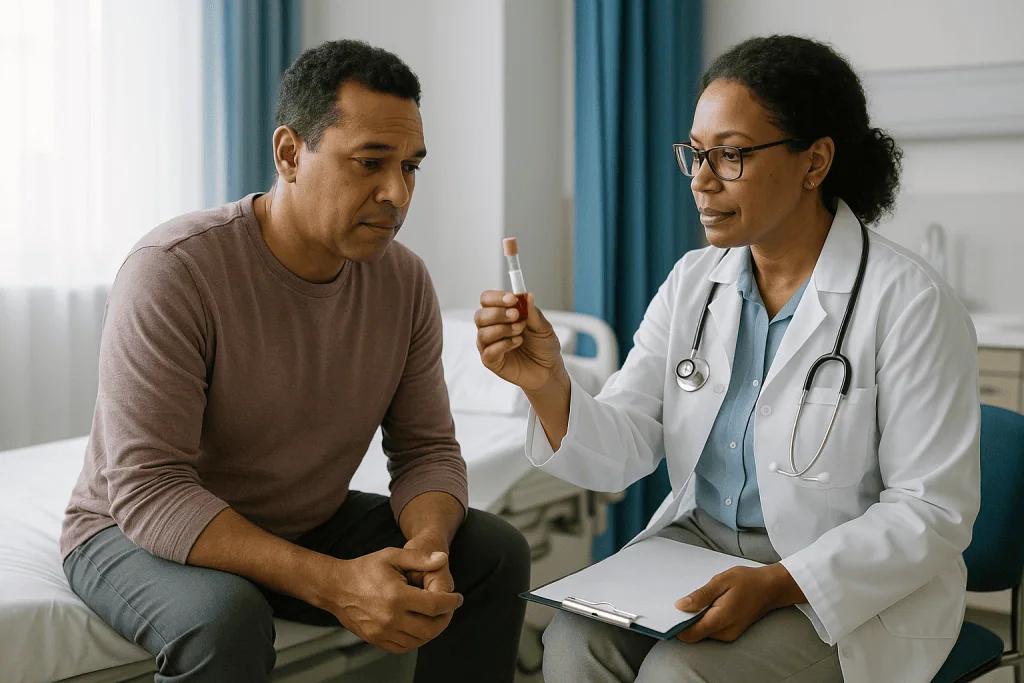
The second layer is the examination. A clinician looks at the person before touching them: alertness, breathing pattern, whether a child is playful or limp. Then come the hands-on checks described in the hydration section below, plus a gentle feel of the abdomen. Marked tenderness in one spot, a rigid belly or a swollen abdomen pushes the differential diagnosis away from simple gastroenteritis and toward appendicitis, bowel obstruction or inflammatory bowel disease. These are the moments when imaging or surgical review enters the conversation, not because of a stool test but because of what the hands found.
The third layer is deciding whether any test adds information. For a previously healthy adult with 24 hours of watery diarrhea, no fever and sips of fluid staying down, the answer is usually no. For a traveler with fever and bloody stools, or an infant who has stopped producing wet diapers, the answer shifts.
The father in the waiting room gets most of his answer from this process. The cup in his hand may or may not be needed; what he will certainly receive is a judgment about how dry his daughter is and whether she can be safely managed at home.
Hydration checks: the assessment that matters most
If one measurement in gastroenteritis deserves the spotlight, it is hydration. The WHO identifies dehydration as the most significant threat posed by diarrheal disease, and it remains a leading cause of death in children under five worldwide, with more than 440,000 deaths each year in that age group according to WHO estimates. In well-resourced settings deaths are rare, but dehydration still drives most hospital admissions for gastroenteritis.
The hydration check is low-tech and quick. Clinicians look at several signs together rather than relying on any one:
- Capillary refill time: a fingernail or the skin over the breastbone is pressed until it blanches, then released. Color normally returns within about two seconds; slower return suggests reduced circulation.
- Skin turgor: a fold of skin on the abdomen or forearm is lifted and released. Well-hydrated skin springs back at once; dehydrated skin returns slowly.
- Mucous membranes: dry lips and a tacky tongue point toward fluid loss.
- Eyes and fontanelle: sunken eyes, absent tears when crying, and in babies a sunken soft spot on the head.
- Heart rate, breathing and blood pressure: a fast pulse and rapid breathing are early signs; low blood pressure is late and serious.
- Urine output: fewer wet diapers or no urination for many hours.
- Weight: where a recent accurate weight exists, the drop since illness began is one of the most objective measures, especially in infants.
From these signs clinicians grade dehydration as none, some, or severe, following WHO and national guideline frameworks. That grade, far more than any laboratory result, decides whether a person goes home with oral rehydration advice, stays for supervised oral fluids, or needs intravenous fluids. A stool test cannot tell anyone how thirsty the body is. A trained pair of hands and eyes can.
Who is usually offered a stool test for gastroenteritis, and who is usually asked to wait
Guidelines from bodies such as NICE, the CDC and the WHO converge on a similar list of situations where a stool test for gastroenteritis is worth sending. The common thread is that the result might change management or protect other people.

Testing is usually considered when:
- Diarrhea contains visible blood or mucus, raising the possibility of invasive bacteria or amoebic infection.
- Fever is high and the person appears systemically unwell.
- Diarrhea has persisted beyond about a week, or keeps returning, which raises suspicion of parasites such as Giardia.
- There has been recent travel to regions where bacterial and parasitic causes are more common.
- Antibiotics were taken recently, which increases the chance of Clostridioides difficile infection, a bacterium that overgrows when normal gut flora are disrupted.
- The person is immunocompromised, very young, frail or elderly, where infections may behave unusually and consequences are greater.
- Several people are affected after a shared meal or in a care setting, and public health teams need to identify the organism.
- The person works in food handling, healthcare or childcare, where knowing the cause affects when they can safely return.
Who is usually asked to wait? The otherwise healthy person with watery, non-bloody diarrhea of a few days, no fever of note, and good fluid tolerance. Here, sending a sample often produces either a negative result or a viral finding that confirms what everyone already suspected. The NHS advice for most people in this group is to manage symptoms at home and seek help if things change.
Waiting is not neglect. It reflects the fact that the body is usually already doing the work, and that a laboratory report arriving after recovery helps no one. The decision, as always, rests with the clinician who has examined the person and knows their history.
Stool culture for diarrhea versus PCR panels: what each test finds
Two very different technologies sit behind the phrase stool test, and understanding the difference explains why results take the time they do.
A stool culture for diarrhea is the traditional method. A small amount of sample is spread on nutrient plates designed to encourage specific bacteria such as Salmonella, Shigella, Campylobacter and certain strains of E. coli to grow while suppressing the trillions of harmless gut bacteria. Growth takes time, so culture results typically return after two to three days, and some organisms need longer. Culture has one advantage no other method offers: a living organism can be tested against antibiotics, which guides treatment when treatment is needed.
A molecular panel uses PCR, which stands for polymerase chain reaction, a laboratory technique that copies tiny amounts of an organism’s genetic material millions of times so it can be detected. Modern multiplex panels screen a single sample for a dozen or more viruses, bacteria and parasites at once, often within hours. Sensitivity is high, which is a strength and a weakness. PCR cannot distinguish a live, disease-causing organism from fragments of a dead one, and it sometimes detects organisms that are present without causing the current illness.
Older methods persist for good reasons. Microscopy for ova and parasites, in which a technician examines stool under a microscope for eggs and cysts, remains useful where PCR is unavailable or for organisms not on the panel. Antigen tests detect proteins from specific pathogens and give quick answers for rotavirus, adenovirus or C. difficile toxin.
Which one a laboratory runs depends on the clinical question, local protocols and what is available. The clinician ordering the test will usually specify what they are looking for, which is why the story told in the consultation matters so much.
How to collect a stool sample properly
A stool sample that is contaminated with urine or toilet water, left warm for hours, or scraped from the toilet bowl can give a misleading result. Collection technique is unglamorous but it determines whether the test is worth doing. The NHS and MedlinePlus both describe a straightforward method.
Start by passing urine first, so the stool does not mix with it. Then catch the stool rather than letting it enter the water. A clean, dry container placed in the toilet, a layer of plastic wrap stretched loosely under the seat, or a clean disposable potty for a child all work. Avoid using a sample that has touched toilet water or disinfectant, since cleaning chemicals can kill the organisms the laboratory is trying to find.
Use the small spoon attached to the lid of the specimen pot to transfer a portion. Laboratories generally want roughly a walnut-sized amount of formed stool, or enough liquid stool to fill about a third of the pot. Choosing the part with visible blood or mucus, if present, increases the chance of detecting invasive organisms. Screw the lid on firmly, label the pot with name, date of birth and the time of collection, and wash hands thoroughly.
Timing matters. Samples should reach the laboratory as soon as possible; if there is a delay, most services advise refrigerating the pot in a sealed bag, kept away from food, and following the specific instructions provided with the kit. For infants, stool can be scraped from a diaper, taking care to avoid the urine-soaked areas, or collected using a liner. Diapers themselves are not accepted by most laboratories.
Finally, collect only what is requested. Some tests need a single sample; parasite searches may ask for two or three on separate days, because eggs are shed intermittently.
Is there a rotavirus stool test, and when is it used?
Yes. A rotavirus stool test detects the virus directly in feces, most commonly through a rapid antigen immunoassay that identifies viral proteins, or through PCR on a multiplex panel. Both are performed on an ordinary stool sample collected as described above. Results from antigen tests can be available within hours.
Rotavirus is a leading cause of severe diarrhea in infants and young children. The CDC describes symptoms beginning about two days after exposure, with vomiting and watery diarrhea lasting three to eight days, often with fever and abdominal pain. Before routine vaccination was introduced, it was the single commonest reason for a young child to be hospitalized with dehydration in many countries; vaccination has reduced that burden substantially, and the vaccine is part of standard childhood schedules in the US and UK.
So why test for it, when there is no specific treatment? The answer is almost always about other people rather than the individual child. In a hospital ward, a positive result triggers isolation precautions to protect other vulnerable infants. In a nursery outbreak, confirming rotavirus lets public health teams focus on handwashing and exclusion rather than hunting for a food source. Laboratories also report results to surveillance systems that monitor how well vaccination programs are working.
For the individual child, the result does not change the plan. Rehydration, careful observation for red-flag signs and time remain the treatment regardless of whether the virus is rotavirus, norovirus or adenovirus. Parents sometimes feel that a named virus makes the illness more real or more worrying. In practice it is the hydration assessment, repeated as needed, that tells the team how the child is doing.
A negative rotavirus test does not rule out viral gastroenteritis either; it simply means a different virus is likely responsible.
Blood tests in gastroenteritis: what they do and don't tell you
Blood tests do not diagnose gastroenteritis. They assess its consequences. That distinction matters, because people often assume a blood sample will reveal the infection when its actual purpose is to measure how the body is coping with fluid loss.
The most useful test is a panel of electrolytes, the dissolved salts such as sodium, potassium and bicarbonate that the body needs to keep nerves, muscles and the heart working. Vomiting and diarrhea can push these out of range in either direction. Kidney function markers, urea and creatinine, rise when the kidneys are underperfused by a dehydrated circulation and settle as fluids are restored. Blood glucose is checked because small children can run low after a day of vomiting and not eating.
A full blood count may show a raised white cell count, which hints at bacterial infection or simply reflects the stress of illness. Inflammatory markers such as C-reactive protein rise in bacterial and inflammatory conditions more than in typical viral gastroenteritis, but the overlap is wide and no cut-off is reliable on its own. Blood cultures, in which blood is incubated to look for bacteria, are reserved for people who are febrile and systemically unwell, since some gut bacteria, Salmonella among them, can spread into the bloodstream.
Who gets blood tests? Generally those who appear moderately or severely dehydrated, infants, older adults, people with kidney disease, heart failure or diabetes, those on diuretics, and anyone whose presentation does not fit a simple viral picture. For a well-hydrated adult, blood tests add discomfort and little information.
When intravenous fluids are needed, electrolyte results guide what goes in the bag and how fast. That is the moment when a blood test earns its place: not in naming the enemy, but in steering the response.
Dysentery vs gastroenteritis: why blood in the stool changes the workup
Gastroenteritis is the broad term for inflammation of the stomach and intestines causing vomiting and diarrhea, from any infectious cause. Dysentery is a narrower, older word for diarrhea that contains blood and often mucus, usually accompanied by fever and cramping, and it points to organisms that invade the bowel wall rather than simply irritating it.
The distinction is not academic. Watery, non-bloody diarrhea is most often viral or caused by bacteria that release toxins, and it rarely needs antibiotics. Bloody diarrhea raises the odds of Shigella, Campylobacter, Salmonella, certain invasive E. coli strains, or the parasite Entamoeba histolytica. Some of these benefit from targeted antibiotics; one of them, a toxin-producing E. coli known as STEC, can be made more dangerous by antibiotics, because killing the bacteria releases more toxin and increases the risk of a rare kidney complication in children. Clinicians therefore want to know which organism is present before deciding, and that is precisely what a stool culture or PCR panel provides.
Blood in the stool also widens the differential beyond infection. Inflammatory bowel disease, ischemic colitis in older adults, and other non-infectious conditions can present the same way. A negative stool panel in someone with persistent bloody diarrhea is itself informative, prompting a different line of investigation.
The practical lesson for anyone at home is that bright red blood, dark tarry stool or persistent mucus in diarrhea is a reason to contact a clinician rather than wait out the illness. It is one of the situations where a stool test is almost always worthwhile, and where the right medicine depends on knowing the cause.
Food poisoning, norovirus or something else? How clinicians read the pattern
Before any test result arrives, the pattern of illness already narrows the field. Timing, dominant symptom and context each shift the probabilities. The table below summarizes typical features drawn from CDC and NHS descriptions; it is a guide to how clinicians think, not a self-diagnosis tool, since individual cases vary widely and overlap.
| Likely cause | Typical onset after exposure | Usual duration | Common clues | Is a stool test usually sent? |
|---|---|---|---|---|
| Norovirus | 12–48 hours (CDC) | 1–3 days (CDC) | Sudden vomiting, several household members ill, winter clusters | Rarely for individuals; yes in outbreaks |
| Rotavirus | About 2 days (CDC) | 3–8 days (CDC) | Infants and toddlers, watery diarrhea, fever | Sometimes, mainly for infection control |
| Bacterial toxin food poisoning | Hours after a meal | Usually under 24 hours | Rapid vomiting, shared meal, fast recovery | Usually no; yes if several people affected |
| Invasive bacteria (Campylobacter, Salmonella, Shigella) | 1–5 days | Up to a week or more | Fever, cramps, bloody stools, undercooked poultry or eggs | Yes, culture or PCR |
| Parasites (Giardia and others) | 1–2 weeks | Weeks if untreated | Prolonged bloating, greasy stools, travel or untreated water | Yes, microscopy or PCR, often repeated |
Two patterns deserve emphasis. Vomiting that starts within a few hours of a meal and is over by the next day points toward a preformed toxin and almost never needs testing. Diarrhea that drags past a week, especially with weight loss or recent travel, moves parasites and non-infectious causes up the list and makes testing far more likely to be useful.
Norovirus illustrates how common the untested majority is. The CDC estimates it causes roughly 19 to 21 million illnesses a year in the United States, the overwhelming majority of which never see a laboratory.
What the following days usually look like
For the typical viral illness, the trajectory is steep then gentle. Vomiting tends to be the first symptom to fade; the NHS describes it usually stopping within one or two days. Diarrhea lingers longer, generally settling within five to seven days. Appetite returns before stools fully normalize, and a few days of looser, more frequent stools after the illness is common as the gut lining repairs itself.
Fluids remain the central task. Oral rehydration solutions, which are pre-measured mixes of glucose and salts designed to be absorbed efficiently by an inflamed gut, are the approach supported by WHO and NHS guidance, taken in small frequent sips rather than large volumes that may trigger vomiting. Breastfed infants continue feeding. There is no evidence that withholding food speeds recovery; once vomiting eases, resuming a normal diet in small amounts is generally encouraged.
If a stool sample was sent, results arrive on different timelines. Antigen and PCR results may come back the same or next day; cultures take two to three days; parasite microscopy varies. Most laboratories report positive findings for notifiable organisms directly to public health teams, who may contact the person about food handling, work exclusion or household hygiene. A negative result in someone who is recovering simply confirms that no specific treatment is needed.
Returning to work, school or nursery usually waits until 48 hours after the last episode of vomiting or diarrhea, a figure used by the NHS to reduce onward spread. Food handlers and healthcare workers may face longer exclusion for certain organisms, decided by occupational health or public health teams.
Fatigue can outlast the gut symptoms by several days. That is expected after fluid shifts and poor intake, and it fades as eating and sleeping normalize. Persistent symptoms past two weeks warrant a review rather than patience.
What people often get wrong about gastroenteritis tests
Myths cluster around testing, partly because a test feels like action. Several deserve correcting.
A stool test will tell me what I ate. It will not. Laboratories identify organisms, not meals. Linking an illness to a specific food requires public health investigation, usually across multiple affected people. A single culture naming Salmonella says nothing about whether it came from the chicken, the eggs or a contaminated surface.
No test means the doctor is not taking this seriously. The opposite is often true. The hydration assessment is the serious part, and declining a test the result of which would arrive after recovery is sound medicine, not shortcut medicine.
A negative result means I was never infected. Tests have limits. Culture misses organisms that have stopped being shed; PCR panels only detect what they are designed to find; parasite eggs appear intermittently. A negative result in someone recovering normally is reassuring; a negative result in someone still unwell is a prompt to look elsewhere.
Antibiotics are the point of testing. Most gastroenteritis, including most bacterial gastroenteritis, resolves without antibiotics, and in some infections they do harm. Testing more often prevents an unnecessary prescription than triggers one.
Blood tests show the infection. They show dehydration and electrolyte disturbance. The germ is in the stool, not the blood, except in the uncommon event of bloodstream spread.
Antidiarrheal medicines speed recovery. Antimotility medicines slow bowel movement and can reduce stool frequency, but they do not shorten the infection, and clinicians generally avoid them in children, in bloody diarrhea or with fever, where slowing the gut may be harmful. Whether any such medicine is appropriate is a decision for the treating clinician, not a reflex.
Questions to ask your care team
A short consultation goes further when the right questions are ready. These are the ones that tend to produce useful answers in gastroenteritis, whether for yourself or a child.
- How dehydrated do you think I am, or my child is, and what signs should I watch for that would mean it is getting worse?
- Do you recommend a stool test in this case? If so, what are you looking for, and if not, what would make you change your mind?
- How should I collect the sample, how quickly does it need to reach the laboratory, and do you need one sample or several?
- When will results be back, and how will I be told? Will I hear only if something is found?
- Are blood tests needed, and what specifically would they tell you?
- Which oral rehydration approach do you suggest, and how will I know fluids are being absorbed rather than lost?
- Should I continue or pause any of my regular medicines while I am vomiting? This matters particularly for diuretics, blood pressure medicines, diabetes medicines and anything taken by mouth that cannot be kept down, and it is a decision for the prescriber.
- Is there any medicine that could help with symptoms, and is there any that I should specifically avoid right now?
- How long should I stay away from work, school or nursery, and are there extra rules because of my job?
- What should the next few days look like, and at what point should I come back if things are not improving?
- Could this be something other than gastroenteritis, and what would make you consider that?
Writing down the answers, especially the red-flag signs, helps at two in the morning when memory is unreliable and worry is not. If the plan is to manage at home, agree a clear point at which you will seek review, and ask who to contact out of hours.
When to call your doctor
Most gastroenteritis is managed safely at home, but certain signs mean a clinician should assess the situation promptly, and some mean emergency care. Guidance from the NHS, CDC and Mayo Clinic converges on the following.
Seek urgent medical advice if you or someone you are caring for has:
- Signs of significant dehydration: very little or no urine for many hours, no wet diapers for six hours or more in a baby, dry mouth, sunken eyes, no tears when crying, dizziness on standing, or unusual drowsiness and confusion.
- Blood in the stool, black tarry stools, or persistent mucus.
- Vomiting that will not stop, so that fluids cannot be kept down, or vomit that is green or contains blood.
- Severe or constant abdominal pain, a swollen or rigid abdomen, or pain concentrated in one area.
- A high fever, or any fever in an infant under three months.
- Diarrhea lasting more than a week, or vomiting lasting more than two days.
- Recent travel to a region where bacterial or parasitic gut infections are common, especially with fever or bloody stools.
- Recent antibiotic use followed by new diarrhea, which raises the possibility of C. difficile infection.
- A weakened immune system from illness or treatment, pregnancy, frailty, or a long-term condition such as diabetes, kidney disease or heart failure that makes fluid loss more dangerous.
Call emergency services or go to the nearest emergency department if there is a cold, mottled appearance, rapid breathing, fainting, a seizure, a child who is floppy, unresponsive or cannot be woken, or any sign that breathing or consciousness is affected.
Where a stool test is pending, do not wait for the result before seeking help if any of these signs appear. The result identifies the cause; the signs above identify danger, and danger is treated first. Every decision about tests, fluids and medicines rests with the team who examines you.
Frequently asked questions
How do you test if you have gastroenteritis?
There is no single test; gastroenteritis is usually recognized from the pattern of sudden vomiting and diarrhea, the exposure history and a physical examination that focuses on hydration. A stool sample is sent only when the result would change management, such as with bloody diarrhea, high fever, prolonged symptoms, recent travel or an outbreak. Blood tests, when used, assess dehydration and electrolytes rather than identifying the organism.
What is the best way to collect a stool sample?
Pass urine first, then catch the stool in a clean dry container, on plastic wrap under the toilet seat or in a clean potty, keeping it away from toilet water and cleaning chemicals. Use the spoon in the lid to transfer a walnut-sized portion, choosing any part with blood or mucus, close the lid firmly, label it with your name and the time, wash your hands, and deliver it to the laboratory as soon as possible, refrigerating if there is a delay.
Is there a rotavirus stool test?
Yes. Rotavirus can be detected in a stool sample using a rapid antigen test that identifies viral proteins, or by PCR as part of a multiplex panel. Results are often available within hours. The test is used mainly to guide isolation precautions in hospitals and nurseries and for surveillance of vaccination programs, since treatment for the child is rehydration regardless of which virus is responsible.
What is the difference between dysentery and gastroenteritis?
Gastroenteritis is the general term for infectious inflammation of the stomach and intestines causing vomiting and diarrhea. Dysentery refers specifically to diarrhea containing blood and usually mucus, often with fever and cramps, caused by organisms that invade the bowel wall such as Shigella, Campylobacter or amoebae. Dysentery is more likely to need a stool test and, in some cases, targeted treatment decided by the clinician.
How long does a stool culture for diarrhea take to come back?
A conventional stool culture usually takes two to three days because bacteria must grow on culture plates before they can be identified, and a few organisms take longer. Molecular PCR panels can return results within hours to a day. Parasite microscopy varies and may require more than one sample. Your care team can tell you the expected turnaround in your laboratory and how results will be communicated.
Can a blood test show gastroenteritis?
Not directly. Blood tests in gastroenteritis measure the body’s response to fluid loss: electrolytes such as sodium and potassium, kidney function markers, glucose and sometimes inflammatory markers or a white cell count. They help decide whether intravenous fluids are needed and what they should contain. The organism itself is found in stool, except in uncommon cases where bacteria spread into the bloodstream and blood cultures are taken.
Why did my doctor not send a stool sample?
For a previously healthy person with watery, non-bloody diarrhea and no high fever, a stool test usually returns after recovery and would not change care, since most cases are viral and no specific treatment exists. Clinicians prioritize the hydration assessment, which does guide treatment. If symptoms persist beyond a week, blood appears in the stool or fever develops, the decision is often revisited.
What does a negative stool test mean if I still have diarrhea?
A negative result means the organisms the laboratory looked for were not detected in that sample; it does not prove there is no infection, since shedding can be intermittent and panels only cover certain pathogens. If symptoms continue, especially beyond two weeks or with blood or weight loss, clinicians may repeat testing, look for parasites, or consider non-infectious causes such as inflammatory bowel disease.
When can I return to work or school after gastroenteritis?
The NHS advises staying off work, school or nursery until 48 hours after the last episode of vomiting or diarrhea, to reduce the chance of spreading infection. Food handlers, healthcare workers and childcare staff may be given longer exclusion periods for certain organisms, decided by occupational or public health teams. Handwashing with soap and water remains the most effective way to protect others at home.
Does gastroenteritis need antibiotics if the stool test finds bacteria?
Not necessarily. Many bacterial gut infections resolve without antibiotics, and for some, such as toxin-producing E. coli, antibiotics may increase the risk of complications. Treatment depends on the organism identified, the severity of illness, the person’s age and immune status, and culture sensitivities. The prescribing clinician weighs these factors; a positive result is information for that decision, not an automatic prescription.
References
- NHS: Diarrhoea and vomiting
- CDC: About norovirus
- CDC: About rotavirus
- WHO: Diarrhoeal disease fact sheet
This article is for general information only and is not a substitute for professional medical advice. Please consult a qualified doctor about your individual situation.

More from the Blog

Living With a PEG Feeding Tube: Showering, Sleeping, Going Out and Staying Active
Most people living with a PEG tube can shower, sleep in their usual position, leave the house and stay physically active once the stoma…

Hepatitis A Myths: Does It Become Chronic and Can You Catch It Twice?
Hepatitis A does not become chronic. The infection is acute: the immune system clears the virus, and the liver typically heals without lasting damage,…

Bleeding Peptic Ulcer: The Warning Signs That Call for Emergency Care, Not a Wait-and-See
A bleeding peptic ulcer is an emergency when it causes vomiting of blood or material that looks like coffee grounds, black or tarry stools,…

Celiac Follow-Up Blood Tests: What Antibody Levels Say About Your Gluten-Free Diet
After a celiac diagnosis, doctors usually repeat the tissue transglutaminase IgA (tTG-IgA) antibody test a few months into a gluten-free diet and then about…

Lactose Intolerance in Children and Teens: How the Pathway Differs From Adults
Lactose intolerance in children follows a different path than in adults. Young children most often develop it temporarily after a gut infection and usually…

Preparing for PEG Placement: Fasting, Blood Thinners and Pausing Existing Tube Feeds
Preparing for PEG tube placement usually means no solid food or enteral formula for about six to eight hours beforehand, small sips of clear…