

Braces, Splints and Seating in Pediatric Physical Therapy: Checking Fit as Your Child Grows

Key Takeaways
- MedlinePlus puts normal growth at about 2.5 inches of height per year from age two to puberty, which is why a device fitted in autumn can be wrong by spring.
- The ankle strap seats the heel in an AFO, so fastening it first and checking for heel lift is the most useful single home test.
- Light pink marks that fade quickly are expected; persistent redness over a bony point is the earliest stage of a pressure injury and should not be braced over.
- Scoliosis braces are generally offered only while a child is still growing and a curve is progressing, because growth is what gives the brace leverage.
- Clubfoot boots-and-bar bracing continues to around age four, moving from full-time to sleep-time wear, and the boots are resized repeatedly along the way.
- A wheelchair seating assessment starts on a mat, measuring hip and spine range before chair dimensions, so the chair supports what can move and accommodates what cannot.
A child braces and splints fit check is a planned review of how an orthosis, splint or seating system sits on a growing body. Parents look daily for skin marks, strap position and heel seating; the orthotist or physical therapist reassesses alignment and function at scheduled visits and after growth spurts. Devices that rub, slip or no longer hold position are adjusted or remade, with every decision made by the treating team.
The ankle-foot orthosis that fit in September is fighting the shoe by February. The heel lifts a finger’s width, the top strap now digs where it used to rest, and the new sneakers were bought a half size up for exactly this reason. If you are the parent of a child in pediatric physical therapy, you learn to read a device the way other families read a growth chart on the kitchen door.
That reading is the core of a child braces and splints fit check: a habit, not a one-off event. Orthoses, hand splints, night splints and wheelchair seating are made for a body that will not stay that size, and the gap between a good fit and a poor one can be a matter of weeks in a fast-growing year.
This explainer walks through what the care team looks for, what you can check at home, how growth changes the schedule, and which signs mean the next appointment should come sooner rather than later.
What a child braces and splints fit check actually involves
An orthosis is any external device that supports, aligns or limits movement of a body part; a splint is usually a lighter, often removable version, and seating means the cushions, backrest and supports in a wheelchair or special chair. A fit check tests one question for each: is this device still doing its job on this body, today?
The team looks in three layers. The first is skin. Pressure concentrates wherever a rigid shell meets bone, so the heel, the inner and outer ankle bones, the top of the foot and the front of the shin are inspected after wear. Pressure injuries begin as persistent redness over a bony point, which is why MedlinePlus describes early-stage sores as skin that stays red and does not blanch; in a child who cannot report pain or has reduced sensation, that visual check is the only early warning.
The second layer is position. Does the heel sit fully down in an ankle-foot orthosis (AFO)? Do the straps close at the same holes they did last month, or has the child grown into the last notch? Does a hand splint still hold the thumb and wrist where the therapist set them, or has the wrist crept into flexion inside the shell?
The third is function, and this is the layer parents sometimes forget. A brace exists to change how a child stands, walks, reaches or sits. The therapist watches gait with and without the device, checks knee and hip alignment in standing, and asks whether the child is doing more or less than before. A device can be comfortable and still have stopped working, and that counts as a failed fit just as much as a blister does.
Why would a child need splints or braces in the first place?
Children are prescribed orthoses for very different reasons, and the reason shapes how the fit will drift with growth. The largest group in pediatric physical therapy is children with cerebral palsy, a group of conditions caused by injury to the developing brain that affects muscle tone, movement and posture. The NHS and Mayo Clinic both list orthoses and splints among standard treatments, used to reduce the effect of tight muscles, keep joints in a better position and support walking.

Other common reasons include:
- Clubfoot, where the foot turns inward and downward from birth; after a series of casts, a boots-and-bar brace is worn to hold the correction while the child grows.
- Idiopathic scoliosis, a sideways curve of the spine that appears in otherwise healthy children, where a trunk brace may be offered during growth to slow progression.
- Low muscle tone from genetic or neuromuscular conditions, where a supportive AFO or supramalleolar orthosis gives a stable base for standing.
- Joint contractures, meaning a joint that has lost its full range because the surrounding soft tissue has shortened; night splints hold a gentle stretch for hours at a time.
- Recovery after surgery or a fracture, where a splint protects healing tissue for a defined period.
The mechanism differs in each case. A clubfoot brace is holding a correction already achieved; a scoliosis brace is applying force to a curve; a cerebral palsy AFO is managing tone and alignment in real time while the child moves. The common thread is growth. In each situation the device was built for a specific length of bone and shape of joint, and MedlinePlus notes that after the second birthday children typically gain around 2.5 inches of height each year until puberty. Devices do not grow with them.
Who is usually offered orthotics, and who is usually asked to wait
The decision to brace is a clinical judgement, not a reflex, and families sometimes expect a device before the team believes one will help. Understanding the reasoning makes the wait easier.
Children are usually offered an orthosis when a specific, observable problem can be changed by external support: a foot that collapses inward in standing, an ankle that cannot reach neutral, a wrist held in flexion that limits grasp, a trunk that cannot hold upright in a chair. The device has a named goal, such as a flatter foot in stance or a more open hand for play, and that goal becomes the yardstick at every fit check.
Children are often asked to wait when:
- The pattern is within the normal range for age. Flexible flat feet and intoeing are common in toddlers and many resolve as the child grows, so many services observe before bracing.
- The child is not yet standing or walking, and a walking orthosis would have nothing to act on.
- Tone or movement is still changing quickly after an injury, so a device made now would be wrong within weeks.
- A simpler step, such as a stretching program, footwear change or seating adjustment, has not yet been tried.
Scoliosis illustrates the logic well. According to the NHS, a brace is generally considered for a curve that is still progressing in a child who is still growing, because the brace only has leverage while the spine is lengthening; once growth has finished, bracing is not usually offered. The same growth that makes fit checks so demanding is also the reason the treatment works at all.
Whatever the condition, the choice to start, pause or stop a device sits with the treating team, who weigh the child’s goals, the family’s capacity and the evidence for that diagnosis.
How to check AFO fit at home: the daily routine
An ankle-foot orthosis is the device most families will handle, so it is the one worth learning thoroughly. The home check takes about two minutes at each removal and builds a record the orthotist can use.
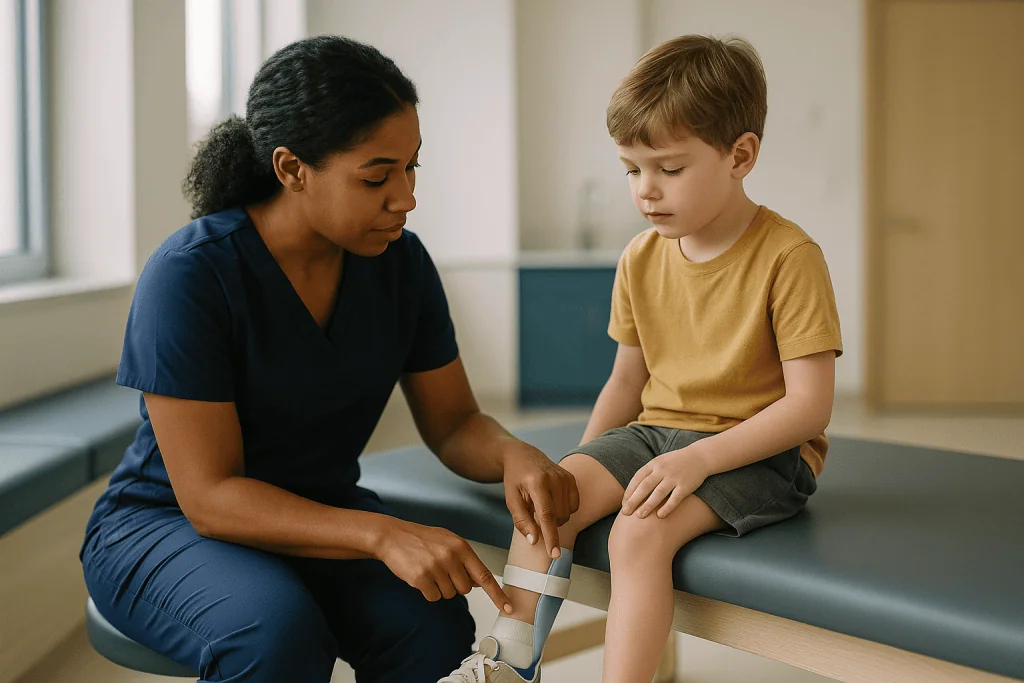
Start with the skin. Remove the AFO and the sock, and look at the heel, the ankle bones, the top of the foot where the strap crosses, the front of the shin under the upper edge and the toes. Light pink marks from a well-fitted shell are common. Orthotic services commonly teach that any redness should fade within roughly 30 minutes of removal; this is a practical rule of thumb rather than a trial-derived threshold, but it is the standard most teams use. Redness that outlasts that window, a mark that is raised, shiny or blistered, or any break in the skin means the device should not go back on until the team has seen it.
Next, position. Put the AFO on with the heel pressed fully into the heel cup before any strap is closed, then fasten the ankle strap first; the ankle strap is what seats the heel, and a heel that lifts during walking is the single most common sign of a size problem. Close the remaining straps and note which holes or markings you used. If you are closing further out each month, growth is already showing.
Then the shoe. An AFO adds volume, so shoes often need a wider fit and a removable insole. A shoe that is too tight will pinch the foot against the shell and create marks the brace itself did not cause.
Last, watch a few steps. Does the foot land as it did at the last clinic visit, or is the knee bending more, the foot slapping or the child tripping? Changes here are worth a phone call even when the skin is perfect.
Signs a child has outgrown orthotics or splints
Outgrowing a device rarely announces itself with pain. More often it shows as a drift in small details, and parents who know the list catch it earlier than any schedule can.
In a leg or foot orthosis, the typical signs are a heel that will not sit down, toes that reach or pass the end of the footplate, a top edge that now sits over the muscle belly instead of below the knee crease, straps fastened at their last notch, and new pressure marks where there were none. The device may also start to feel tight across the instep, which in a growing foot is often width rather than length.
In hand and wrist splints, the clues are a thumb strap that pulls across the web space, finger tips extending past the end of the splint, a wrist that slides into bending inside the shell, and marks across the knuckles or the base of the thumb. Because hand splints are often worn at night, parents may only see the marks in the morning.
In seating, look for a pelvis that slides forward, a lap belt that rides up onto the stomach, lateral trunk supports that now sit under the arms rather than at the ribcage, and a headrest that meets the neck instead of the back of the head. A child who constantly leans, wriggles or asks to get out may be telling you the chair no longer fits.
There is also a functional sign that overrides all of these: the device is no longer achieving its goal. If the foot that used to stay flat in the AFO is collapsing again, or the hand that used to open is closing, growth or a change in tone may have outpaced the device. That observation belongs to the therapist, who can decide whether a remake, an adjustment or a different approach is needed.
Night splints, wrist splints and hand splints: what growth changes
Splints worn for stretch or positioning behave differently from walking braces because they are static. A resting hand splint holds the wrist and fingers in a set position; a night AFO or knee splint maintains a gentle, sustained stretch on a muscle that shortens during the day. The forces are small, the wear is long, and the child is usually asleep, so fit problems are easier to miss.
Growth affects these splints in two ways. The first is simple length and width: fingers that outgrow the trough, a palm that broadens, a calf that thickens. The second is more subtle. As a child grows, tone and range can change, and a splint set at a certain angle months ago may now be holding the joint short of what it could reach, or pushing past what it can comfortably tolerate. The therapist checks the resting angle against current range at each visit, and may heat and remold a thermoplastic splint rather than make a new one.
Night wear brings its own comfort challenge. A splint that is tolerable for an hour can become unbearable over eight, and a child who removes it repeatedly in the night is giving useful data rather than being difficult. Many services build wear time up gradually and ask families to record how many hours the splint stayed on; that log is a fit-check tool in its own right.
Skin care matters more here than with daytime devices. Sweat pools under a closed splint, and a cotton liner or stockinette between skin and plastic is a routine recommendation. Check the skin every morning, and look for the same persistent redness, swelling of the fingers beyond the splint, or a change in color or temperature of the hand that would signal the straps are too tight.
Pediatric wheelchair seating assessment: what happens and why it matters
Seating is the part of this topic families least often think of as a brace, yet a wheelchair cushion, backrest and pelvic belt are doing exactly what an orthosis does: holding a body in a position it cannot hold alone, for hours at a time. A pediatric wheelchair seating assessment is the structured review of that system.
The assessment usually begins on a mat, not in the chair. The therapist checks how the pelvis sits, whether the hips and spine can reach a neutral position, and what range the child has at the hips, knees and ankles. Those findings decide what the chair must support and what it must simply accommodate. A fixed curve cannot be straightened by a cushion; a flexible one can be guided.
In the chair, the team measures seat depth against thigh length, seat width against hip width, back height against the trunk, footplate height against lower leg length, and the position of lateral supports and headrest against the ribcage and skull. Each of these is a dimension that grows. A seat that is now too short leaves the thighs unsupported; one that is too long presses behind the knee and pulls the pelvis forward into a slumped posture.
Pressure is the other half of the assessment. Children who sit for long periods and cannot shift their own weight are at risk of pressure injuries over the sitting bones, the tailbone and the shoulder blades, the same bony sites MedlinePlus lists as typical for pressure sores. Cushion type, tilt and scheduled position changes are all part of the plan, and the skin over those points is checked at every review.
Finally the team watches what the child does: reach, eat, operate a device, look around a room. A chair is a workstation and a social seat, not just a support, and a fit that limits participation is a fit that needs changing.
Growth spurts and the refit calendar: what the numbers say
Parents often ask for a fixed replacement schedule. There is none, because growth is not linear and devices wear at different rates, but the broad arithmetic helps set expectations.
MedlinePlus describes normal growth as roughly 2.5 inches of height per year from age two until puberty, followed by a faster adolescent spurt. Feet and hands grow in bursts that do not always match height, so a child can need a new footplate in a year when the growth chart looks flat. Devices that hold a correction, such as clubfoot boots, are checked and resized throughout the wear period; Mayo Clinic describes clubfoot bracing as continuing until around age four, with the brace worn full time for the first months and then during sleep, which means several sizes across the course of treatment.
| Device | What grows out first | Early home sign | Typical review trigger |
|---|---|---|---|
| Ankle-foot orthosis | Foot length and width | Heel lift, toes at footplate end | Shoe size change, new marks |
| Resting hand splint | Finger and palm length | Fingertips past trough, thumb strap pulling | Morning redness, splint removed at night |
| Knee or night stretch splint | Calf and thigh girth | Straps at last notch | Range change at therapy |
| Scoliosis brace | Trunk height, hip width | Brace rides up, waist indent misplaced | Scheduled growth and imaging review |
| Wheelchair seating | Thigh length, trunk height | Belt on stomach, laterals under arms | Posture change, pressure marks |
The table is a prompt, not a rulebook. Most services pair a fixed review interval with an open door: a planned appointment at a set spacing, plus an earlier visit whenever a home check raises a flag. The interval itself is set by the treating team for the individual child and the device in question.
Scoliosis braces and clubfoot boots: when wear time is the whole point
Two pediatric devices stand apart because their benefit depends almost entirely on hours worn, which makes fit a question of tolerance as much as alignment. A brace that fits badly gets taken off, and a brace that is off is not working.
In idiopathic scoliosis, the brace is a rigid or semi-rigid jacket molded to the trunk that applies corrective pressure to the curve. The NHS explains that it is generally offered to a child who is still growing with a curve that is getting worse, that it is worn for most of the day, and that it is intended to stop the curve progressing rather than to straighten it. Because the trunk lengthens and the hips widen through puberty, the pressure pads that were over the curve can migrate as the child grows. The orthotist checks pad position against the latest imaging, and the team reviews the curve at intervals it sets. A brace that rides up, pinches at the hips or leaves marks under the arms is a brace due for adjustment.
In clubfoot, the foot abduction brace, usually shoes or boots joined by a bar, holds the corrected foot in an outward-turned position. Mayo Clinic describes the pattern of wear: full time in the early months after casting, then during naps and overnight, continuing until the child is about four years old. The feet grow throughout, so the boots are resized repeatedly, and the bar width is adjusted to shoulder width. Signs of trouble include a heel that pops out of the boot, blistering over the heel or ankle, and a child who suddenly refuses a brace they previously tolerated.
For both, the evidence supports the device only while it is worn as prescribed by the team. Families who find wear time slipping should raise it at the next visit rather than wait; a small fit change often solves what looks like a behavior problem.
What the first days and weeks in a new or refitted device usually look like
A new device is never finished at the fitting appointment. The first weeks are a trial in which the body, the device and the family routine all adjust, and most services build in a review during that window.
The early days are usually about short wear and close skin checks. Many teams start with an hour or two and lengthen gradually, so pressure points reveal themselves before they become sores. Light redness that fades quickly is expected; marks that last, blisters or skin breaks are not, and they are the reason to pause and call. Children who cannot describe discomfort may show it as irritability, pulling at the device, or avoiding the activity it is meant to help.
Walking in a new AFO often looks worse before it looks better. The shell changes how the ankle moves, and a child who was compensating with a bent knee or a turned-out foot has to find a new pattern. Therapists expect a short period of stiffness or hesitancy and plan sessions to practice the new movement. If gait is clearly worse after the adjustment period the team set, that is a fit question, not a patience question.
Comfort is where the routine either settles or fails. Practical steps that help families include putting devices on at the same point in the day, using a long sock or liner to keep seams off the skin, choosing shoes with a removable insole and a wide opening, and letting the child help with straps where they can. Older children often do better when they know the goal: a flatter foot for soccer, a hand that opens for a tablet, a chair they can eat lunch in with friends.
By the end of the first review period the team will usually confirm the wear plan, make small adjustments to trim lines or straps, and set the next fit check.
Risks, side effects and the alternatives the team may weigh
Orthoses are low-risk compared with most medical treatments, but they are not risk-free, and an honest fit check includes knowing what can go wrong.
The most common harm is a pressure injury, where sustained force over a bony point damages the skin and the tissue beneath. In children with reduced sensation or limited communication these can progress quickly, which is why daily skin checks are non-negotiable. Other recognized problems include muscle weakness when a joint is held rigid for long periods without a complementary strengthening program, skin irritation or allergy to liners and straps, overheating in warm weather, and, in the case of trunk braces, discomfort that leads to poor adherence. Mayo Clinic and the NHS both frame orthoses as one element of a broader program that includes physical therapy, stretching and, where appropriate, medicines to manage tone or surgery, rather than as a standalone fix.
Alternatives depend on the goal. For tight muscles in cerebral palsy, the NHS lists physiotherapy, stretching, medicines that relax muscle, injections into specific muscles and, in selected children, surgery; a brace may be used alongside any of these, and the mix is set by the team. For flexible flat feet, observation or footwear change may be preferred to a device. For seating, a change in tilt, cushion or schedule of position changes may solve a problem that a new backrest would not.
Where medicines are part of the plan, they work by reducing muscle overactivity so a brace can hold a better position with less force; their timing and any changes are decided by the prescribing clinician, and a fit check is a good moment to report whether tone seems different since the last visit. The decision to adjust, replace, continue or stop any device stays with the treating team.
What people often get wrong about child braces and splints
“Braces for a 7-year-old or an 11-year-old means teeth.” The search engines blur two very different things. Orthodontic braces move teeth; the braces discussed here are orthoses that support limbs, trunk and seating, and the two have nothing in common except the word. A child of 7 or 11 in physical therapy may well wear an AFO or a scoliosis brace, and the age is set by the condition and by growth, not by a dental calendar. If your question is about teeth, your dentist or orthodontist is the right person to ask.
“A good brace should not leave any marks.” A snug shell usually leaves light, short-lived pink marks over bony points. The problem sign is a mark that persists, is raised or blistered, or breaks the skin. No marks at all can mean the device is too loose to do its job.
“If it still fits in the shoe, it still fits.” Shoes stretch and families buy them large. The heel cup, footplate length and strap holes are the real measures.
“We will know it is too small because it will hurt.” Many children with neurological conditions have altered sensation or cannot report pain. Skin and position checks are the safety net, not complaints.
“Once the brace comes off, the problem is solved.” Most pediatric orthoses manage a condition rather than resolve it. Scoliosis bracing aims to slow progression; clubfoot boots hold a correction while the foot grows; cerebral palsy AFOs manage tone and alignment. Stopping is a team decision based on growth and review, not a milestone to aim for on a date.
“Longer wear is always better.” Wear time follows the prescription for that device. Static splints and rigid braces worn beyond the plan can contribute to weakness or skin problems, and the team balances hours against those risks.
Questions to ask your care team at the next fit check
A fit appointment goes faster and lands better when the questions are ready. These are the ones experienced families bring, grouped by what they tell you.
About the goal:
- What is this device meant to change, and how will we know at home whether it is working?
- If it stopped working tomorrow, what would we see first?
About fit and growth:
- Which marks are acceptable and which mean stop and call?
- What is the planned review interval for this device, and what should bring us in sooner?
- Can this device be adjusted or remolded as my child grows, or will it need remaking?
- What shoe features work with this orthosis?
About wear and comfort:
- How many hours a day is the plan, and how should we build up to it?
- What should we do if my child keeps removing it at night?
- Is a liner or sock recommended, and how should we clean the device?
About the wider plan:
- How does this fit with therapy, stretching or any medicines for tone?
- Are there alternatives if this device is not tolerated?
- Who do we contact between appointments, and how quickly can a fit problem be seen?
Bring the evidence with you: photographs of marks taken right after removal, a note of which strap holes you are using, a wear-time log for night splints, and a short video of walking or sitting if something looks different. Teams can act on a clear record far more quickly than on a description from memory, and children often behave differently in clinic than they do at home.
When to call your doctor
Most fit problems can wait for the next scheduled review. Some cannot, and the distinction is worth knowing by heart.
Contact the orthotist, therapist or your child’s doctor promptly, and keep the device off until advised, if you see:
- Redness over a bony point that has not faded within about 30 minutes of removal, or any mark that is raised, shiny, blistered or broken.
- Swelling, a change in color or temperature of the fingers or toes beyond a splint, or a limb that looks pale, blue or dusky.
- New pain, crying or distress that starts with the device and stops when it is removed.
- A sudden refusal to wear a brace that was previously tolerated.
- A clear change in walking, posture or hand use that persists beyond the adjustment period the team described.
- Any sign of infection around a pressure mark, such as warmth, spreading redness, discharge or fever.
Seek urgent care the same day if a limb beyond a splint or cast is numb, cold or cannot be moved, if a pressure area has opened and looks deep, or if your child has a fever alongside a skin wound. Children with reduced sensation or who cannot communicate pain need a lower threshold for calling, because the usual warning signs may never appear.
Between those extremes, trust the pattern. A heel that lifts a little more each week, straps creeping to their last notch, a seat belt that now rests on the stomach: none of these is an emergency, and all of them are a reason to move the next appointment forward. The team would always rather see a device early than meet a pressure sore late, and every decision about adjusting, pausing or replacing a brace, splint or seating system belongs with them.
Frequently asked questions
Why would a child need splints or braces?
Children are prescribed splints or braces to support, align or gently stretch a body part that cannot hold position on its own. Common reasons include cerebral palsy, clubfoot, scoliosis, low muscle tone, joint contractures and recovery after surgery or fracture. Each device has a named goal, such as a flatter foot in standing or a more open hand, and that goal guides every fit check.
Is it normal for a 7 year old to get braces in physical therapy?
Yes, orthoses such as ankle-foot orthoses and hand splints are routinely used at age seven and younger when a specific movement or alignment problem can be helped by external support. The timing depends on the condition and the child’s development, not on age alone. Note that these are not dental braces; orthodontic questions belong with a dentist or orthodontist.
What are the early signs kids need braces or splints?
The signs are usually noticed by a therapist or doctor rather than at home: a foot that collapses inward in standing, an ankle that cannot reach neutral, a wrist held in bending that limits grasp, a trunk that cannot stay upright when seated, or a spinal curve that is progressing during growth. Any concern about posture or movement should be raised with the child’s care team for assessment.
Is age 11 too early for a scoliosis brace?
No. According to the NHS, scoliosis bracing is generally considered for children who are still growing and whose curve is getting worse, which commonly includes children around 11 as they approach the adolescent growth spurt. The brace aims to slow progression while the spine lengthens, so the growing years are precisely when it can act. Whether it is right for an individual child is a decision for the treating team.
How do I check AFO fit at home?
After each removal, inspect the heel, ankle bones, top of the foot and front of the shin for marks that outlast about 30 minutes. When putting it on, press the heel fully into the cup, fasten the ankle strap first, then note which holes the other straps use. Check that toes do not reach the footplate end, that the shoe is wide enough, and watch a few steps for changes.
What are the signs a child has outgrown orthotics?
In a leg orthosis, watch for a heel that lifts, toes at or past the end of the footplate, straps on their last notch, a top edge creeping up the shin and new pressure marks. In hand splints, fingertips past the trough or a thumb strap pulling. In seating, a belt riding onto the stomach or supports sitting under the arms. A device that no longer achieves its goal has also been outgrown.
How often does a child's AFO need replacing?
There is no universal interval because growth comes in bursts and devices wear differently. Teams usually combine a scheduled review, often timed around expected growth, with an earlier visit whenever home checks show heel lift, outgrown footplates or new marks. Some adjustments, such as trimming or remolding, extend a device’s life; a change in foot size usually means a remake. The schedule is set by the orthotist for each child.
What happens at a pediatric wheelchair seating assessment?
The therapist first examines the child on a mat to see how the pelvis, hips and spine move and what range is available. In the chair, seat depth, width, back height, footplate height and the position of lateral supports and headrest are measured against the child’s body. Skin over the sitting bones and tailbone is checked for pressure, and the team watches how the child reaches, eats and interacts from the seat.
Should a brace leave marks on my child's skin?
Light pink marks over bony points that fade soon after removal are common with a snug, well-fitted shell. Marks that persist beyond roughly half an hour, that are raised, shiny or blistered, or that break the skin indicate too much pressure and the device should stay off until the team has checked it. No marks at all can mean a device is too loose to work.
Can my child stop wearing the brace once it fits well and they seem better?
Stopping is a decision for the treating team, not a milestone to reach at home. Most pediatric orthoses manage a condition rather than resolve it: clubfoot boots hold a correction while the foot grows, scoliosis braces aim to slow progression during growth, and cerebral palsy devices manage tone and alignment. Stopping early can allow the problem to return, so raise the question at a review and let the team weigh growth and findings.
References
- NHS: Cerebral palsy – Treatment
- MedlinePlus: Normal growth and development
- MedlinePlus: Pressure sores
This article is for general information only and is not a substitute for professional medical advice. Please consult a qualified doctor about your individual situation.

More from the Blog
What Happens in a Sensory Integration Therapy Session? Swings, Textures and Guided Play
A sensory integration therapy session is a structured, play-based occupational therapy visit, typically lasting about an hour, in which a trained therapist guides a…

Phototherapy for Newborn Jaundice: What Happens Under the Lights and How Feeding Continues
Phototherapy treats newborn jaundice by shining blue-green light onto the baby's skin. The light changes bilirubin, the yellow pigment that builds up when an…

Living With Febrile Seizures: Household Planning, Caregiver Briefings and Calm Fever Routines
Parents cope best with febrile seizures by preparing before the next fever: a one-page plan every caregiver can follow, a calm first-aid routine (time…

When Can a Child Bathe, Play and Return to School After Pediatric Surgery? Recovery Milestones
Most children can shower or bathe once the surgical team says the wound may get wet, often within one to two days of a…

Why Are Repeat Echocardiograms Scheduled After Kawasaki Disease and What Do They Track?
Repeat echocardiograms after Kawasaki disease track the coronary arteries, the vessels that supply the heart muscle, because inflammation can stretch them into aneurysms during…

Tongue Tie in Babies: What It Looks Like, Feeding, Speech and Whether It Grows Back
Tongue tie (ankyloglossia) is a condition present from birth in which the thin band of tissue under the tongue, called the lingual frenulum, is…