

What Comes After Bronchiolitis? Lingering Cough, Later Wheezing and Follow-Up Visits

Key Takeaways
- Bronchiolitis is an illness of the smallest airways, and RSV is its most common but not its only cause; rhinovirus and other viruses produce the same picture.
- The acute illness usually peaks between day three and day five and settles within one to two weeks, but the cough can continue for up to three weeks as part of normal recovery.
- Wheezing after bronchiolitis is largely explained by airways that stay twitchy for weeks after the infection, a state doctors call bronchial hyperresponsiveness.
- Episodic viral-induced wheeze, which occurs only with colds and clears completely in between, is outgrown by most children by school age; wheeze between colds is the pattern more likely to persist.
- Bronchiolitis is associated with a modestly higher chance of later asthma, concentrated in children who already have eczema, allergy or a parent with asthma, and most children who had bronchiolitis do not develop asthma.
- Antibiotics, cough medicines and routine bronchodilators have not been shown to help bronchiolitis in infants; smoke-free air, hand hygiene and a simple symptom diary are the measures with the best practical value.
Wheezing after bronchiolitis is common and usually reflects airways that stay sensitive for weeks after the infection, not permanent damage. Most lingering coughs settle within about three weeks, while a minority of children go on to have repeated viral-triggered wheeze in the preschool years. Follow-up visits track breathing, feeding and growth; a clinician decides whether any wheeze pattern needs further assessment.
The discharge paperwork says “bronchiolitis, improving,” the car seat is buckled, and for the first time in four nights everybody sleeps. Then, two weeks later, the cough is still there at 3 a.m., a little rattle rides each breath, and the next cold brings a whistling sound that nobody heard before. Parents at this point often ask the same quiet question: is this over, or is this the start of something?
Wheezing after bronchiolitis sits in an awkward space between “completely normal” and “worth a closer look,” and the honest answer depends on the child, the pattern and the timeline. The infection itself is short. The airway irritation it leaves behind is not always.
This explainer walks through what actually happens inside a small chest during and after bronchiolitis, how long the cough and wheeze usually last, what the evidence says about later asthma, and what follow-up visits are really checking for. Every medical decision stays with the child’s own care team; the aim here is to make those conversations easier.
Is bronchiolitis a form of RSV?
Not exactly, although the two overlap so heavily that they are often spoken about as one thing. Bronchiolitis is the name of an illness: swelling and mucus in the bronchioles, the smallest branching air tubes deep in the lungs. Respiratory syncytial virus, or RSV, is the name of a germ. RSV is the single most common cause of bronchiolitis, but other viruses can produce the same picture, including rhinovirus (the ordinary cold virus), human metapneumovirus, parainfluenza and influenza, according to Mayo Clinic.
So an infant can have bronchiolitis without RSV, and an older child or adult can catch RSV and simply have a cold. What makes babies different is plumbing. A bronchiole in a six-month-old is already narrow; add a thin film of swelling and some sticky mucus and the usable space shrinks dramatically. The same virus that gives a parent a scratchy throat can leave a baby working hard for every breath.
The condition clusters in the first year of life. The NHS notes that around one in three children in the UK develop bronchiolitis during their first year, and that most cases are mild and clear up at home. The CDC adds that nearly all children have been infected with RSV at least once by their second birthday, which is a useful reframe for worried parents: this is a near-universal rite of passage, not a sign of a fragile child.
Why does the distinction matter after the illness? Because the virus matters for the later story. Research summarized by mainstream sources suggests that bronchiolitis caused by rhinovirus may carry a somewhat stronger association with later wheeze and asthma than RSV bronchiolitis, though the evidence is observational and the picture is still being worked out. Most families never learn which virus was involved, and for day-to-day care that is fine.
What actually happens in the airways during and after bronchiolitis
Picture the lungs as a tree turned upside down. The trunk is the windpipe, the thick branches are the bronchi, and the thousands of twig-sized tubes at the ends are the bronchioles. Bronchiolitis is an infection of those twigs.
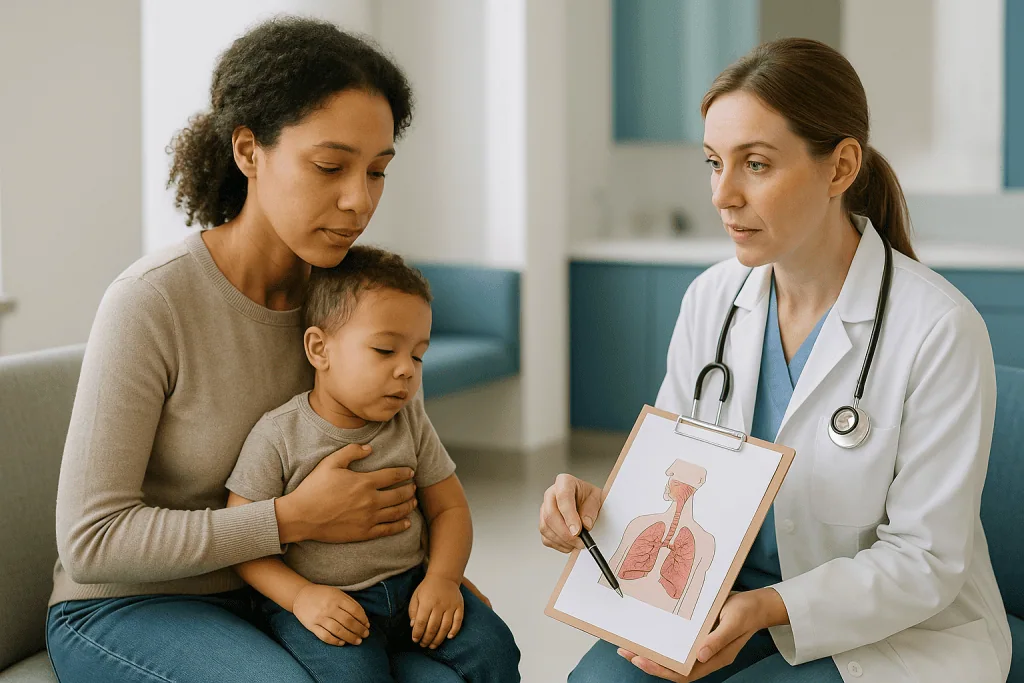
The virus lands on the lining cells, multiplies, and the body responds the way it always does to an invader: the lining swells, immune cells arrive, and the cells pour out mucus to flush the problem away. In an adult’s wide airways this is a minor nuisance. In an infant’s bronchioles, swelling plus mucus plus some sloughed-off dead cells can plug the tube almost completely. Air gets in but struggles to get out, which is why the chest can look puffed and why breathing sounds wet, crackly or wheezy.
The NHS describes the typical arc: cold-like symptoms first, then symptoms that are usually worst between day three and day five, then gradual improvement. The virus itself is cleared within days. What takes longer is the repair job.
Repair is the part families rarely hear about. The damaged lining has to regrow, the mucus glands have to calm down, and the nerves in the airway wall, which were exposed and irritated during the infection, have to settle. While that happens the airway behaves like sunburned skin: ordinary stimuli such as cold air, a feed, crying or the next mild cold can provoke an exaggerated response. Doctors call this bronchial hyperresponsiveness, meaning airways that twitch and narrow more easily than usual. It is the single most useful concept for understanding wheezing after bronchiolitis, because it explains why a child who is “better” can still sound unwell for weeks.
Most airways finish this repair quietly. In some children, the tendency to overreact lingers longer, and that is where the later-wheeze story begins.
Bronchiolitis cough: how long does it last?
Longer than most parents expect, and that gap between expectation and reality causes a lot of unnecessary worry.
The acute illness is short. Mayo Clinic notes that symptoms of bronchiolitis typically last one to two weeks. The cough, though, has its own timetable. According to the NHS, the cough can continue for up to three weeks after other symptoms have gone, and that is considered a normal part of recovery rather than a sign that something has gone wrong. A smaller number of children cough for longer still, particularly if a second cold arrives before the first recovery has finished, which in a nursery-attending toddler in winter is practically guaranteed.
The character of the cough usually changes as it fades. Early on it is wet and rattly because of the mucus in the small airways. As the mucus clears, it often becomes drier and more intermittent: a few coughs on waking, a bout after running around or laughing, a spell at night. That night-time pattern is partly gravity (mucus pooling) and partly the natural dip in airway caliber that happens in everyone during sleep.
What the cough should not do is get steadily worse after the first week, or come with a return of fast breathing, feeding difficulty or fever. A cough that improves, then plateaus, then slowly fades is the expected shape. A cough that improves and then clearly deteriorates deserves a call.
One reassuring point from MedlinePlus: bronchiolitis in otherwise healthy infants usually resolves completely, and the lingering cough is not itself evidence of lasting lung damage. Parents sometimes ask whether they should be “doing something” about the cough. Cough suppressants are not recommended for young children, and the cough is doing a job, clearing the last of the debris. Patience, fluids and time are the standard advice.
What does wheezing after coughing mean?
A wheeze is a high-pitched, musical, whistling sound made when air squeezes through a narrowed tube, most obviously on breathing out. It is different from the coarse rattle of mucus in the throat or nose, which parents often describe as “wheezy” but which doctors would call a rattle or stridor-like noise depending on where it sits. Genuine wheeze comes from the chest and tends to be heard on the out-breath.

When a wheeze appears straight after a coughing fit, two things are usually going on. The cough itself has briefly squeezed the chest and pushed air out fast through airways that are already narrow, which produces the whistle. And the mechanical irritation of coughing can trigger a short burst of airway muscle tightening in a child whose airways are already twitchy from the recent infection. In other words, cough-then-wheeze is a common pattern in the recovery weeks and is often brief.
What matters more than the sound is the breathing around it. Cleveland Clinic and other sources point to the same signs of a child who is working hard: breathing that is clearly faster than usual, the skin pulling in between or below the ribs with each breath, nostrils flaring, grunting, or difficulty feeding because the baby cannot coordinate sucking and breathing. A wheeze with easy, comfortable breathing and normal feeding is a different situation from a wheeze with any of those signs.
Parents also ask about a wheeze that appears with feeding or lying flat. In small babies this can reflect mucus shifting, reflux, or simple positional narrowing, and a clinician can usually sort this out by listening to the chest. The honest answer to “what does it mean” is that in isolation it means very little; the context decides, and that context is what a follow-up visit is designed to capture.
Wheezing after bronchiolitis: how common is it, and why does it happen?
Common enough that pediatricians consider it a known sequel rather than a surprise. The exact proportion varies widely across studies, depending on how severe the original illness was, which virus caused it, how “wheeze” was defined and for how long children were followed. Mayo Clinic notes that bronchiolitis is associated with recurrent episodes of wheezing in some children, and that the link is strongest in those who needed hospital care. It is fair to say that a meaningful minority of infants wheeze again at least once in the year or two after bronchiolitis, and that a smaller group develop a repeating pattern.
Three mechanisms are thought to contribute, and they are not mutually exclusive.
The first is the airway hyperresponsiveness already described: a lining that has been stripped and rebuilt reacts more strongly to the next cold. Because toddlers catch several colds a winter, there are plenty of triggers.
The second is simple anatomy. Some infants are born with slightly narrower airways relative to lung size. Those children are more likely to wheeze with any viral infection, bronchiolitis included, and they are also more likely to wheeze again afterward. In this case bronchiolitis is not so much the cause of later wheeze as the first time the underlying tendency showed itself.
The third is immune style. A subset of children have an inflammatory tendency, often alongside eczema, food allergy or a strong family history of asthma, and in them a severe early viral infection may nudge the immune system toward an asthma-like pattern. Whether the virus causes that shift or merely reveals it is one of the live debates in respiratory research, and anyone who tells you the answer is settled is overstating the evidence.
The practical upshot: wheezing after bronchiolitis is expected often enough that it should prompt observation and good notes, not alarm. The pattern over months tells the story, not any single episode.
Viral-induced wheeze versus asthma: how long does a viral-induced wheeze last?
Viral-induced wheeze, sometimes written as viral-induced wheeze or episodic viral wheeze, is a wheeze that appears only during a cold or other viral infection and disappears completely between infections. The term exists precisely because doctors did not want to label every wheezy preschooler as asthmatic.
Each episode generally follows the virus. The wheeze typically appears a day or two into a cold, when the airway lining is at its most inflamed, and resolves as the cold clears. Because an ordinary viral cold in a young child lasts around a week to ten days, a single episode of viral-induced wheeze usually tracks a similar course, with the wheeze itself often shorter than the cough. The NHS notes that asthma diagnosis is difficult in young children partly because wheeze with colds is so common at this age and so often outgrown.
The bigger question is how long the tendency lasts. Here the evidence is reassuring but not absolute. A large proportion of children with episodic viral wheeze stop wheezing by school age, usually as the airways grow and the immune system matures. The children more likely to continue are those with wheeze that also occurs between colds (triggered by exercise, laughing, cold air, dust or pets), those with eczema or food allergy, and those with a parent who has asthma.
Doctors sometimes describe two broad patterns: episodic viral wheeze, which is only ever with colds, and multiple-trigger wheeze, which also appears without infection. The second pattern looks and behaves more like asthma and is more likely to persist. Children can shift between patterns as they grow, which is why clinicians are deliberately cautious about labels under the age of five and why follow-up over time matters more than a verdict at any single visit.
Does bronchiolitis cause asthma? What the evidence actually shows
This is the question underneath every other question, so it deserves a straight answer: bronchiolitis is associated with a higher chance of later asthma, but association is not the same as cause, and most children who have bronchiolitis do not go on to have asthma.
The association is well documented. Mayo Clinic lists recurrent wheezing and an increased risk of asthma among the possible longer-term complications, particularly after severe illness. Cohort studies that follow infants for years consistently find more asthma diagnoses in the bronchiolitis group than in children who were never hospitalized for it.
The causation question is harder. Two explanations compete, and both are probably partly true. One is that a severe early viral injury alters the developing airway and immune system, tipping a child toward asthma who would otherwise have avoided it. The other is that children already heading toward asthma, because of their genes, airway size or allergic tendency, are the ones who get the worst bronchiolitis in the first place. In that version, the infection is a marker rather than a trigger.
Supporting the marker view: the asthma risk after bronchiolitis is strongly concentrated in children with other risk factors, such as a parent with asthma, personal eczema or early allergic sensitization. Supporting the trigger view: some studies suggest that preventing severe RSV illness in high-risk infants is followed by less wheeze in the next year or two, though findings on longer-term asthma are mixed.
What this means for a family is more useful than it sounds. Bronchiolitis does not hand a child an asthma diagnosis. It raises the odds modestly, and it raises them most in children who already carried other risk factors. Those are exactly the children a clinician will want to see again if wheeze recurs, which brings us to who gets followed up and who is asked to wait.
Who is usually followed up closely, and who is usually asked to wait and watch?
Follow-up after bronchiolitis is not one-size-fits-all, and understanding the logic helps parents feel less dismissed if their child is simply sent home with advice.
Children most likely to be offered a planned review include those who needed oxygen, feeding support or high-flow breathing support in hospital; babies born prematurely, especially before 32 weeks; infants with known heart or lung conditions, neuromuscular disease or immune problems; and very young babies, under about three months at the time of illness. Cleveland Clinic and the NHS both identify these groups as more vulnerable to severe illness, and the same groups tend to be watched more carefully afterward. Children with a strong family history of asthma or with eczema are also more likely to be flagged for review if wheeze recurs, because that combination raises the chance of a persisting pattern.
Children usually managed with watchful waiting are the much larger group: previously healthy infants who had a mild to moderate illness, recovered at home or after a short admission, and are feeding and growing well. For them, the standard advice is to expect a cough for up to three weeks, to return if red-flag signs appear, and to mention any repeat wheeze at the next routine check. That is not neglect. It reflects evidence that most of these children recover fully and that early labels and early medication in this group do more harm than good.
The threshold shifts with pattern. A single wheezy cold after bronchiolitis rarely changes the plan. Three or four wheezy episodes in a year, wheeze between colds, any episode needing emergency care, or faltering weight gain generally moves a child from the wait-and-watch group into the review group. Parents who keep a simple diary of episodes, triggers and what helped give their clinician exactly the information needed to make that call.
Lingering cough, viral-induced wheeze or early asthma? A comparison at a glance
Parents are often trying to work out which of three things they are looking at. The table below sets out the patterns clinicians typically use to tell them apart. It is a guide to the conversation, not a diagnostic tool; the final judgment always rests with the child’s own care team, who can listen to the chest and watch the child breathe.
| Feature | Lingering post-bronchiolitis cough | Episodic viral-induced wheeze | Pattern that may suggest early asthma |
|---|---|---|---|
| Timing | Continues after the acute illness, fading over roughly three weeks (NHS) | Appears only during colds, clears fully in between | Occurs with colds and also without them (exercise, laughing, cold air, dust, pets) |
| Sound | Wet then dry cough; little or no true wheeze | Whistling on breathing out during the cold | Recurrent wheeze plus persistent night cough |
| Between episodes | Child is well, feeding and growing | Completely symptom-free | Residual cough or wheeze, often at night or early morning |
| Associated features | None specific | Common in toddlers attending childcare | Eczema, food allergy, parental asthma, allergic rhinitis |
| Typical outlook | Resolves | Most children outgrow it by school age | More likely to persist; warrants structured review |
| Usual approach | Reassurance, fluids, time | Watchful waiting; review if episodes become frequent or severe | Clinician-led assessment over time; asthma diagnosis is rarely confirmed under five |
Two caveats. First, children move between columns. A toddler with pure episodic viral wheeze at eighteen months can look more like the third column at three and back to the second at five. Second, lung function testing, the backbone of adult asthma diagnosis, is not reliably possible before about age five, which is why the preschool years are a period of observation rather than labeling. The Mayo Clinic childhood asthma overview is a useful starting point if the third column sounds familiar.
The weeks after bronchiolitis: what recovery usually looks like
Recovery has a recognizable shape, and knowing it in advance turns a frightening noise at night into an expected milestone.
The first few days at home are usually about feeding and sleep rather than breathing. The acute phase has passed, but babies are often tired, feed in shorter bursts and may still have a blocked nose that makes bottle or breast feeding noisy. Smaller, more frequent feeds are the standard advice. Saline drops and gentle nasal suction before feeds help many babies, because infants under about six months breathe mostly through the nose.
By the end of the first week most babies are back to roughly their usual feeding volume and their breathing at rest looks normal. The cough persists. It is often worse at night and first thing in the morning, and it can sound dramatic. Many parents describe a second dip around this time, when a child who seemed better coughs so hard they bring up a feed. On its own, with comfortable breathing in between, this is usually part of the clearing process.
Weeks two and three are the long tail. The NHS timeline of a cough lasting up to three weeks covers this period. Appetite, mood and play usually return well before the cough disappears, and clinicians use those markers more than the cough itself to judge recovery.
The next cold is the real test, and in a toddler it often arrives within weeks. Some children sail through it. Others wheeze for the first time, which is the moment many families first hear the phrase viral-induced wheeze. One wheezy cold does not change the long-term picture; it is the pattern over a season or two that a clinician will want to see. Babies who are growing along their usual centile, feeding normally and happy between illnesses are, by every mainstream guideline, doing well, even if the soundtrack says otherwise.
What treatment can and cannot do for cough and wheezing after bronchiolitis
This is the section where parents most want a clear plan and where honesty requires some restraint, because the evidence on medicines for this age group is thinner than most people assume. Every decision about any medicine belongs with the prescribing clinician; what follows describes mechanisms and typical reasoning only.
For bronchiolitis itself, the mainstream position is consistent across the NHS, Mayo Clinic and Cleveland Clinic: there is no medicine that shortens the illness. Antibiotics do not work because the cause is a virus. Inhaled bronchodilators, the class of medicine that relaxes airway muscle, have been studied extensively in infants with bronchiolitis and are not routinely recommended, because the narrowing in bronchiolitis is mostly swelling and mucus rather than muscle tightening. Oral or inhaled corticosteroids, which reduce inflammation, have likewise not shown consistent benefit for the acute illness in infants. Treatment in hospital is supportive: oxygen if levels are low, help with feeding, and monitoring.
For wheeze that recurs with later colds, the picture shifts slightly. In a toddler with clear episodic viral wheeze, a clinician may trial a bronchodilator during an episode to see whether the child responds, because in this older age group muscle tightening plays a bigger role. The response, or lack of it, is itself diagnostic information. For children whose pattern looks more asthma-like, a clinician may consider a time-limited trial of a preventer inhaler, which works by calming inflammation in the airway lining over weeks rather than minutes, and will usually review whether it made a difference before continuing. Cough suppressants and over-the-counter cold remedies are not advised for young children.
What families can do without a prescription is not trivial: keep the air smoke-free, keep fluids up, use saline and suction for a blocked nose, keep the head of the cot flat and safe for sleep, and keep notes. Those notes are often worth more than any inhaler trial in helping a clinician decide the next step.
Can the next episode be prevented? Smoke, germs and RSV protection
Not every wheezy winter can be avoided, but a few measures have real evidence behind them.
Smoke exposure is the biggest modifiable factor. Mayo Clinic lists exposure to tobacco smoke as a risk factor both for severe bronchiolitis and for ongoing respiratory problems afterward. Smoke irritates airways that are already hyperresponsive, increases mucus production and impairs the tiny hairs that sweep debris out of the lungs. A home and car that are entirely smoke-free, not just “not while the baby is in the room,” is the single most protective change a family can make, because smoke particles linger on clothing and surfaces.
Hand hygiene and distance from obviously ill people matter more than they sound. RSV and the other bronchiolitis viruses spread through droplets and on surfaces, and the CDC notes that the virus can survive for hours on hard surfaces. Washing hands before handling the baby, avoiding shared cups and spoons, and keeping siblings with colds from kissing the baby’s face reduce exposure during the vulnerable first year.
Breastfeeding, where it is possible and chosen, is associated with lower rates of severe respiratory infection in infancy, likely through antibodies and other immune factors in milk. This is an association rather than a guarantee, and formula-fed babies also recover fully from bronchiolitis.
RSV-specific protection now exists in two forms described by public health bodies: a vaccine given during pregnancy that passes antibodies to the baby, and a long-acting monoclonal antibody, a laboratory-made antibody that provides passive protection, given to infants in certain age groups or seasons. Eligibility, timing and availability vary by country and by season and are decided by health systems and clinicians, not by this article. Whether these measures reduce later wheeze and asthma, as opposed to severe acute illness, is still being studied, and the evidence so far is mixed. Families interested in them should ask their child’s clinician what applies locally.
What people often get wrong about wheezing after bronchiolitis
Myths cluster around this topic because the sounds are frightening and the labels are confusing. A few deserve direct correction.
“The cough means the infection is still there.” Usually not. The virus is typically cleared within days; the cough that lasts up to three weeks is the airway finishing its clean-up. A cough that is slowly fading is the sign of recovery, not persistence.
“Wheezing after bronchiolitis means my child has asthma.” One wheezy episode, or even several episodes confined to colds, does not meet any guideline definition of asthma. Mainstream sources are explicit that asthma is rarely diagnosed with confidence under about five years of age, because wheeze with colds is so common and so often outgrown.
“Antibiotics would have stopped this.” Bronchiolitis is viral. Antibiotics do nothing against viruses and carry their own risks, including diarrhea and the development of resistant bacteria. Clinicians who decline to prescribe them are following the evidence.
“A bronchodilator inhaler will fix a bronchiolitis cough.” In infants with bronchiolitis, trials have repeatedly failed to show meaningful benefit, because the narrowing is swelling and mucus rather than muscle spasm. The role of inhalers in older toddlers with recurrent wheeze is different and is a clinician’s call.
“It only counts as wheeze if I can hear it across the room.” True wheeze is often quiet and only audible with a stethoscope. The loud rattle parents hear is frequently mucus in the throat. This cuts both ways: a quiet chest is not automatically a clear chest, and a noisy one is not automatically a dangerous one. Breathing effort and feeding are better guides than volume.
“Bronchiolitis damaged my child’s lungs for good.” For the overwhelming majority of previously healthy infants, MedlinePlus and other sources describe full recovery. The modest association with later asthma is real but applies mainly to children who carried other risk factors, and it is a risk, not a verdict.
Questions to ask your care team at the follow-up visit
A follow-up appointment is short, and the useful questions are the ones that change what you do at home. These are the ones clinicians generally welcome.
On the illness just passed: Was anything about this episode more severe than typical, and does that change how you want to see my child in the future? Were there any findings, such as oxygen levels or feeding, that you would want to recheck?
On the lingering cough: How long would you expect this cough to last for my child specifically, and at what point would you want to hear from me if it has not improved? Are there any features of the cough that would make you want to look further?
On wheeze: If my child wheezes with the next cold, what would you like me to note down, and what would make you want to see them during the episode rather than afterward? Is there any point at which you would want to try a treatment during a wheezy cold, and how would we know whether it helped?
On risk: Given our family history and my child’s history of eczema or allergy, does that change how closely you want to follow them? What pattern over the next year would make you think about asthma, and what pattern would reassure you?
On prevention: What RSV protection, if any, applies to my child or to any future pregnancy in our family, and who decides that? Is there anything in our home environment you would prioritize changing?
On practicalities: Who should I contact out of hours, and what is the threshold for using an emergency service rather than waiting for the clinic? Is there a written plan you can give me for the next wheezy episode?
Writing the answers down in the same notebook as the symptom diary means the next clinician, who may not be the same person, sees the whole story at once.
When to call your doctor: red-flag signs after bronchiolitis
Most children with a lingering cough or an occasional wheeze after bronchiolitis can be safely watched at home. The signs below are the ones that, according to the NHS, Cleveland Clinic and Mayo Clinic, mean the child should be seen promptly rather than waiting for a scheduled visit.
Call emergency services or go to the nearest emergency department straight away if the child has pauses in breathing, a blue or gray tinge to the lips, tongue or skin, is struggling so hard to breathe that they cannot cry or make sounds, is unusually floppy, drowsy or hard to wake, or if a wheezy episode is clearly getting worse rather than better over a short period despite any plan agreed with the care team.
Contact the doctor the same day if breathing is persistently fast or the skin is sucking in under or between the ribs with each breath; if the child is taking less than half their usual feeds or has had noticeably fewer wet nappies, which the NHS uses as a practical marker of dehydration; if a baby under three months has a temperature of 38°C (100.4°F) or above, or an older child has a persistent high fever; if the cough is getting worse after the first week rather than slowly improving; or if a wheeze appears for the first time and you are unsure whether the breathing is comfortable.
Arrange a routine appointment if the cough has lasted more than three to four weeks without clear improvement, if your child has had several wheezy episodes over a season, if wheeze is appearing without a cold, if weight gain has slowed, or if you simply feel something is not right. Parental instinct is taken seriously in pediatric guidelines for good reason.
Where any sign sits between these categories, the safer choice is the earlier call. Every decision about assessment, investigation or treatment then rests with the clinicians who can examine the child.
Frequently asked questions
Is bronchiolitis a form of RSV?
No, bronchiolitis is an illness of the small airways and RSV is the virus that most often causes it. Other viruses, including rhinovirus, human metapneumovirus and influenza, can cause identical bronchiolitis. The same RSV infection that produces bronchiolitis in a baby usually produces only a cold in an older child or adult, because wider airways tolerate the swelling and mucus far better.
How long does a viral-induced wheeze last?
A single episode usually follows the cold that triggered it, appearing a day or two in and clearing as the cold resolves, typically within about a week to ten days. The tendency to wheeze with colds often continues for a few winters and is outgrown by most children by school age. Wheeze that also appears without a cold is more likely to persist and should be reviewed by a clinician.
What does wheezing after coughing mean in a baby?
It usually means air is being pushed quickly through airways that are still narrow and irritable after the infection, which produces a brief whistle. On its own, with comfortable breathing and normal feeding, it is a common feature of the recovery weeks. The signs that matter are fast breathing, skin pulling in around the ribs, nostril flaring or difficulty feeding, which should prompt a same-day call.
How long does bronchitis asthma or viral wheeze last in toddlers?
People often use terms like bronchitis asthma loosely for recurrent wheeze with colds in toddlers. Each wheezy episode generally lasts as long as the cold, and the overall tendency usually fades over several years as the airways grow. Asthma itself is rarely diagnosed with confidence under about age five, because lung function tests are not reliable before then; the pattern over time guides the decision.
Does bronchiolitis cause asthma later in childhood?
Bronchiolitis is associated with a higher chance of later asthma, especially after severe illness, but most children who have bronchiolitis do not go on to have asthma. The increased risk is concentrated in children who already have eczema, allergy or a parent with asthma, and researchers still debate whether the infection triggers asthma or simply reveals an existing tendency.
Bronchiolitis cough: how long should I expect it to last?
Up to about three weeks after the other symptoms have gone, according to NHS guidance, and that lingering cough is a normal part of recovery rather than a sign of ongoing infection. It usually changes from wet and rattly to drier and more intermittent as it fades. A cough that gets steadily worse after the first week, or that comes with fast breathing or poor feeding, should be assessed.
What causes recurrent wheeze in babies after bronchiolitis?
Three overlapping factors: airways left irritable by the infection, which overreact to the next cold; naturally narrower airways in some infants, which makes any viral infection more likely to wheeze; and an allergic or inflammatory immune tendency, often alongside eczema or a family history of asthma. Which factors apply to a given child becomes clearer over a season or two of observation.
Will my baby need a follow-up visit after bronchiolitis?
It depends on how severe the illness was and on the child’s background. Infants who needed oxygen or feeding support, premature babies, and children with heart, lung or immune conditions are usually offered a planned review. Previously healthy babies who recovered well are often managed by watchful waiting, with advice to return if red-flag signs appear or if wheeze keeps recurring.
Do inhalers help wheezing after bronchiolitis?
In infants with bronchiolitis itself, trials have not shown consistent benefit from bronchodilator inhalers, because the narrowing is mainly swelling and mucus rather than muscle tightening. In older toddlers with recurrent viral wheeze, a clinician may trial one during an episode to see whether the child responds. Any decision about starting, continuing or stopping an inhaler belongs with the prescribing clinician.
Can RSV protection prevent later wheezing?
RSV vaccination in pregnancy and long-acting antibody products for infants are designed to reduce severe acute RSV illness, and public health bodies describe them for specific groups and seasons. Whether they also reduce later wheeze or asthma is still being studied and the evidence so far is mixed. Eligibility and timing are decided by local health systems and clinicians, so ask your child’s doctor what applies.
References
This article is for general information only and is not a substitute for professional medical advice. Please consult a qualified doctor about your individual situation.
Add us as a Preferred Source to see more of our trusted health content across Google Search, AI Overviews and Discover.

More from the Blog

Helping a Child Through Chickenpox: Cool Baths, Trimmed Nails and Easing the Itch Safely
To stop a child scratching chickenpox, cool the skin and blunt the tools: short lukewarm or cool baths with colloidal oatmeal or baking soda,…

When Can Someone With Whooping Cough Return to School or Work? Isolation Guidance Explained
Someone with whooping cough is usually asked to stay home from school or work until they have completed about five full days of an…

Fitting Pediatric Physical Therapy Into Family Life: Bath Time, Bedtime and Play Routines
Pediatric physical therapy home exercises work best when they are folded into routines a child already has: tummy time during a diaper change, reaching…

Kawasaki Disease Treatment in Hospital: What the IVIG Infusion Day Involves for Your Child
Kawasaki disease treatment in hospital usually centers on a single intravenous immunoglobulin (IVIG) infusion run slowly through a drip over roughly 10 to 12…

Stages of a Cold in Babies: The Usual Timeline, Day by Day, and When to Call the Doctor
The stages of a cold in babies usually follow a set pattern: a stuffy, sneezy start over the first two days, the worst congestion…

Are Chickenpox Parties a Bad Idea? Deliberate Exposure Myths Pediatricians Correct
Chickenpox parties are not recommended by pediatric and public health bodies. Deliberately exposing a child to varicella risks a full infection with possible complications…