

Brain Injury Rehabilitation Milestones: Realistic Timelines for Movement and Memory

Key Takeaways
- Injury severity, measured by the Glasgow Coma Scale and the length of post-traumatic amnesia, is the strongest early predictor of how long recovery takes.
- Concussion symptoms usually settle within about two weeks in adults and up to four weeks in children, while severe injury recovery is measured in months and years.
- The steepest gains after moderate or severe injury typically occur in the first six months, but thinking skills often keep improving into the second year.
- Agitation and confusion after waking from a coma are recognized recovery stages, not evidence of a permanently changed personality.
- Older, well-rehearsed memories generally return first; the ability to form new memories is usually the last to stabilize.
- Structured multidisciplinary rehabilitation, protected sleep and graded activity have the best evidence for supporting recovery; no medicine or supplement has been shown to speed brain healing itself.
A brain injury recovery timeline depends mostly on injury severity. Concussion symptoms often settle within about two weeks for adults and up to four weeks for children, though some last longer. After moderate or severe injury, the fastest gains in movement and memory usually happen in the first six months, with slower improvement continuing for a year or more. Progress is individual, and the treating team judges each stage.
On the whiteboard in a neuro intensive care room, someone has written the date, the nurse’s name, and a question in a shaky hand: “When will Dad walk?” Beneath it, another pen has added, “And will he remember us?” Nobody has erased either line. The family checks them every morning, as if the answers might have appeared overnight.
Those two questions, movement and memory, sit at the heart of almost every conversation about a brain injury recovery timeline. They are fair questions, and they deserve better than the two answers families usually hear: a vague “everyone is different” or a confident number pulled from a story about someone else’s cousin.
The honest picture lies between those extremes. Recovery follows recognizable phases, the phases have typical ranges, and those ranges are shaped by things doctors can measure early on. What follows is that picture, laid out the way a rehabilitation team would explain it if they had an unhurried hour.
How the brain actually heals after an injury
A brain injury is really two injuries. The first happens in the instant of impact: brain tissue is bruised, small blood vessels tear, and long nerve fibers can be stretched or sheared. Doctors call that fiber damage diffuse axonal injury, meaning injury to the cable-like extensions that carry signals between brain cells. The second injury unfolds over hours and days as swelling, reduced blood flow and chemical stress damage cells that survived the impact itself. Much of early hospital care, from controlling pressure inside the skull to keeping oxygen and blood sugar steady, exists to limit that second wave, according to the National Institute of Neurological Disorders and Stroke (NINDS).
Healing then runs on three overlapping tracks. Swelling and bleeding resolve, which is why some people improve noticeably over the first few weeks without any therapy at all. Stunned but intact cells resume work as the chemical environment normalizes. Finally, and most slowly, the brain reorganizes. Neuroplasticity is the brain’s ability to strengthen surviving connections and recruit neighboring regions to take over lost functions. It is not magic; it is repetition. Every time a person practices standing, or rehearses a name, the pathway involved fires and is reinforced.
Two consequences follow. First, early gains are often the largest because they ride on the resolving swelling and the recovery of stunned tissue. Second, later gains depend on effortful practice, which is why rehabilitation is not a passive wait for healing but an active training program. Understanding this dual process helps families read the pace of recovery without panic when the steep early curve begins to flatten.
Mild, moderate or severe: why the grade shapes the brain injury recovery timeline
The single strongest early predictor of a brain injury recovery timeline is severity, and clinicians grade it with tools that are surprisingly simple. The Glasgow Coma Scale (GCS) scores eye opening, speech and movement, from 3 to 15. Mayo Clinic and NINDS describe scores of 13 to 15 as mild, 9 to 12 as moderate and 8 or below as severe. A second measure is post-traumatic amnesia, the period after injury during which a person cannot form new continuous memories. Amnesia lasting under an hour points toward a mild injury; amnesia lasting more than a day points toward a severe one.

These grades matter because they track different biology. A mild injury, including concussion, is usually a functional disturbance without visible structural damage on a standard scan. The CDC notes that most people with concussion feel better within a couple of weeks, and children within roughly one to four weeks, though a minority have symptoms that persist for months. Moderate and severe injuries involve structural damage, and the NHS describes recovery from a severe head injury as a process measured in months and often years, with the most rapid improvement typically in the first six months.
Severity is not destiny. Age, general health, the specific brain regions involved, whether surgery was needed, and the presence of other injuries all bend the curve. Two people with identical GCS scores can follow very different paths. What severity does offer is a realistic starting frame, so that a family with a loved one at GCS 6 is not measuring progress against a neighbor who had a concussion.
The stages of brain injury recovery: what the 10 levels describe
Rehabilitation teams often describe the stages of brain injury recovery using the Rancho Los Amigos Levels of Cognitive Functioning, a 10-level scale that tracks how a person responds to the world rather than what a scan shows. It is a descriptive map, not a schedule, and people can skip levels, plateau at one, or show features of two at once.
Levels I to III cover the period of no response, generalized response (a flinch or change in breathing to any stimulus) and localized response (turning toward a voice or pulling away from discomfort). Level IV is the confused and agitated stage, often the hardest for families: the person is awake but may shout, pull at lines or fail to recognize relatives. It is a sign that the brain is coming back online, not a sign of a changed personality. Level V is confused but calmer, with attention lasting only minutes. Level VI brings confused but appropriate behavior; the person follows simple commands and may recall old memories while new ones remain unreliable.
Levels VII and VIII describe automatic and then purposeful, appropriate behavior: routines are completed, the person is oriented, and problems with planning or judgment become the main issue. Levels IX and X, added later, capture the subtle difficulties of independent adults who still need extra time, lists or stand-by help for complex tasks.
The scale’s value is in expectation-setting. A person at Level IV is not “failing” memory tests; memory testing is not yet meaningful. The team will say which level applies and what the next observable change would look like, which is a far more useful question than “how many weeks until normal?”
A realistic brain injury recovery timeline by phase
Timelines are ranges, not promises, and every row below applies mainly to moderate and severe injuries unless noted. The ranges reflect descriptions from the NHS, NINDS and Mayo Clinic; individual courses vary widely.
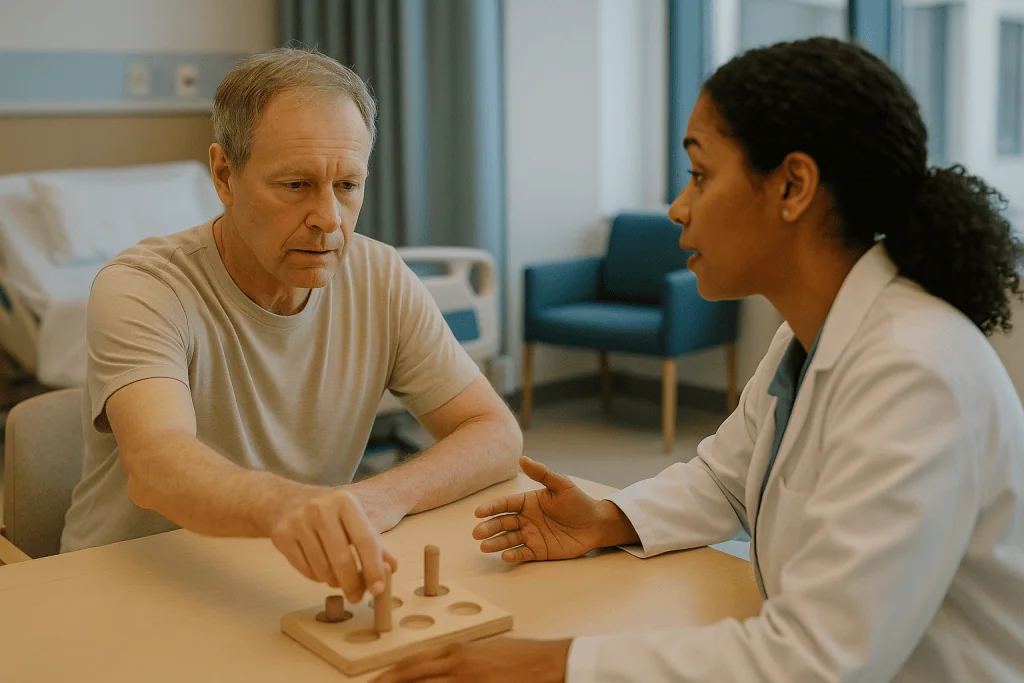
| Phase | Typical window | What commonly happens | Movement focus | Memory focus |
|---|---|---|---|---|
| Acute hospital care | Days to a few weeks | Swelling controlled, surgery if needed, coma or heavy sedation possible | Positioning, passive range of motion to prevent stiffness | Not assessable; family voices and routine still matter |
| Emerging consciousness | Days to weeks after sedation ends | Eye opening, tracking, first commands followed, agitation common | Sitting at bed edge with support, tilt table | Post-traumatic amnesia; orientation boards, repeated cues |
| Inpatient rehabilitation | Roughly 2–12 weeks | Daily physical, occupational and speech therapy | Transfers, standing, first assisted steps, hand use | Amnesia clears, day-to-day memory returns unevenly |
| Early community phase | Months 3–6 | Home or outpatient therapy, fatigue dominates | Walking endurance, stairs, balance, fine motor control | Strategies: notebooks, alarms, structured routines |
| Consolidation | Months 6–24 | Slower but real gains, return to roles explored | Higher-level balance, sport or driving assessment | Attention, processing speed, planning improve with practice |
| Long-term adaptation | Beyond 2 years | Ongoing adjustment; new learning still possible | Maintenance, managing spasticity or fatigue | Compensation becomes habit |
For concussion, the table compresses dramatically: the CDC describes most adults improving within about two weeks and most children within four, with a smaller group needing specialist follow-up for persistent symptoms.
Who is usually ready for intensive rehabilitation, and who is asked to wait
Families are often told that intensive rehabilitation will not start yet, and the reasons are worth understanding because waiting can feel like neglect. Rehabilitation medicine works on a simple principle: therapy must be tolerable and the person must be able to participate in some way, even minimally, for the effort to translate into learning.
People are usually considered ready when they are medically stable, meaning pressure inside the skull is controlled, breathing does not require a ventilator, blood pressure and infection are under control, and there are no planned operations. They also need to tolerate sitting up for stretches of time and show at least emerging responses to commands. The NHS describes this transition as moving from acute care to a rehabilitation setting once the immediate danger has passed.
Those typically asked to wait include people still in a coma or a prolonged disorder of consciousness, those with unstable fractures or chest or abdominal injuries that make mobilization unsafe, and those whose agitation is so severe that structured therapy cannot yet be delivered safely. Waiting does not mean nothing happens. Nurses and therapists still reposition limbs, splint hands and ankles to prevent contractures (permanent shortening of muscles and tendons), and use sensory stimulation programs. These are quieter forms of rehabilitation, and they protect the body for the day active work begins.
Age alone is not a reason to withhold rehabilitation, although older adults often progress more slowly and may have other conditions that shape the plan. The decision about timing and setting sits with the treating team, and it is reviewed frequently. Asking “what would need to change for rehabilitation to start?” usually produces a concrete, checkable answer.
How long does it take to walk again after a brain injury?
Walking is the milestone families watch for most closely, partly because it is visible and partly because it stands for independence. It is also a task that recruits nearly every system the injury may have affected: strength, balance, sensation, vision, attention and the confidence to try.
Movement recovery generally follows a sequence. Head control and trunk stability come first; a person who cannot hold their body upright cannot safely stand. Sitting at the bed edge, then transferring to a chair with help, then standing in a frame or with two therapists, then stepping with a harness or parallel bars, then walking with an aid, and finally walking without one. Each step is practiced hundreds of times, because repetition drives the plasticity described earlier.
Several factors slow the sequence. Weakness on one side (hemiparesis) is common after focal injury. Spasticity, the involuntary tightening of muscles caused by damaged control signals from the brain, can make a leg stiff or a foot point downward; physiotherapists manage it with stretching, positioning and splints, and the medical team may consider medicines that relax muscle tone, a decision that rests with the prescribing clinician. Ataxia, a loss of coordination from cerebellar injury, produces an unsteady, wide-based gait that improves with balance training rather than strengthening.
Honest ranges: many people with moderate injury walk with or without an aid before leaving inpatient rehabilitation, within the weeks-to-few-months window the NHS describes for that phase, while some with severe injury take many months, and a minority remain wheelchair users for distance. The team measures progress in specific terms, such as steps taken with assistance, standing time and balance scores, and those numbers are the truest answer to “is he getting better?”
Memory after brain injury: what usually comes back first
Memory is not one thing, and recovery reflects that. The brain stores knowledge of facts and events, learns skills and habits, holds information briefly while working on it, and files away new experiences for later. A brain injury tends to disrupt these systems unevenly, which explains the confusing picture families see: a person who can play a card game from childhood yet cannot recall the visitor who left an hour ago.
Older, well-rehearsed memories typically survive best, so recognition of long-standing family members and knowledge of one’s own history usually returns early, often as the confused stages pass. The ability to form new memories is generally the last to stabilize; this is the post-traumatic amnesia period described earlier, and its length is one of the best clinical predictors of longer-term memory function. While it lasts, repeated orientation, a visible clock and calendar, a consistent daily routine and a simple notebook of who visited and what happened all reduce distress.
Once amnesia clears, the common residual problems are slowed processing, difficulty holding several things in mind, trouble learning new names or procedures, and executive dysfunction, meaning difficulty planning, starting, switching and checking tasks. Speech and language therapists and neuropsychologists address these with two approaches: restorative drills that train attention and working memory, and compensatory strategies such as alarms, checklists, a single household calendar and “one thing at a time” rules. The evidence base, as summarized by NINDS, supports compensation most strongly, especially for daily functioning.
Improvement in thinking skills continues for longer than many expect, often well into the second year after a severe injury, but the pace is slower than physical gains and easier to miss without formal reassessment.
What the first weeks at home usually look like
Discharge is a victory that often feels like a cliff. In hospital, the day is structured, help is one call away and progress is measured. At home, the same person can seem suddenly worse. Usually they are not; the environment has simply stopped compensating for them.
Fatigue dominates the early weeks. Neurofatigue is exhaustion caused by the injured brain working harder for ordinary tasks, and it arrives faster and hits deeper than tiredness after physical effort. A supermarket trip that once took twenty minutes may cost the rest of the day. Families who plan one demanding activity per day, protect a rest period after lunch and keep evenings quiet tend to see fewer meltdowns and better therapy attendance.
Sleep is often disrupted, with difficulty falling asleep, waking early or reversed day-night rhythm. Mayo Clinic lists sleep disturbance among the common lasting effects, and a fixed wake time, daylight exposure in the morning, limited daytime napping and a screen-free hour before bed are the first-line measures. Headaches, dizziness, sensitivity to noise and light, and irritability are frequent and typically ease over the following months.
Outpatient or home-based therapy usually continues at a lower intensity than inpatient care, and a home exercise program fills the gaps. Most rehabilitation teams advise against driving until formally assessed, against alcohol because it worsens balance, judgment and seizure risk, and against contact sport until cleared. Return to work or study, if realistic, is generally staged: a few hours, a few days a week, with low-demand tasks first. Clinical follow-up appointments in this window are where medicines, mood and progress are reviewed, and any change to a prescription belongs to that conversation, not to a decision made at the kitchen table.
Does a TBI ever go away? Long-term consequences, honestly
The truthful answer has two halves. For most people with a concussion, yes: the CDC describes full recovery as the usual outcome, typically within weeks, and there is no lasting structural damage. A minority develop persistent symptoms, and those symptoms usually respond to structured management over months.
For moderate and severe injuries, the injury itself does not disappear; the brain adapts around it. Many people recover to independent living, work and relationships, yet retain some changes that persist. NINDS and Mayo Clinic describe the common long-term consequences as problems with memory, attention and processing speed; changes in mood, including depression, anxiety and irritability; fatigue; headaches; sleep disorders; and, for some, physical changes such as weakness, spasticity or balance difficulty. Post-traumatic epilepsy, meaning recurrent seizures that begin after the injury, is a recognized risk, higher after penetrating injury, skull fracture or early bleeding.
Research summarized by NINDS also points to an association between moderate to severe TBI and a higher risk of later neurodegenerative conditions, including dementia. This is an association measured across populations, not a prediction for any individual, and the mechanisms are still being studied. Repeated injuries, as in some contact sports, carry their own cumulative risk.
Where does that leave a family? With a realistic frame: the goal of rehabilitation is not to erase the injury but to maximize function and quality of life around it. People continue to learn and adapt years afterward. Ongoing follow-up matters because late problems, particularly mood disorders and seizures, are treatable, and the earlier they are named the better they are managed.
What is the life expectancy after a severe TBI?
This question is asked quietly, often by a spouse in a corridor, and it deserves a direct answer even though the data allow only a general one. Studies following people after moderate to severe traumatic brain injury find that, as a group, they live shorter lives on average than people of the same age without injury. NINDS notes that TBI can be a chronic condition with effects on long-term health, and the CDC reports that TBI contributes to tens of thousands of deaths each year in the United States, most of those in the acute phase.
Behind the group average sits enormous individual variation. The factors that most reduce life expectancy are not mysterious: persistent severe disability that limits mobility, difficulty swallowing that raises pneumonia risk, seizures, a history of other serious health conditions, and the injury occurring at an older age. People who regain independent mobility, eat safely and remain engaged in care have outcomes far closer to the general population. Falls, alcohol misuse and untreated depression are among the modifiable contributors, which means the years after injury are not simply a countdown but a period in which choices and good follow-up genuinely change the odds.
For someone in a prolonged disorder of consciousness, the conversation is different and belongs with the treating team, who can speak to that person’s specific medical picture. No article can responsibly assign a number to an individual, and any clinician who does so will hedge it heavily.
The practical translation: ask the team what the main medical risks are for your relative, and how each is being monitored. Those answers are more useful than a statistic.
How can I recover from brain trauma? What rehabilitation science supports
People searching this question are usually looking for a lever they can pull. Some exist, and they are less glamorous than the internet suggests.
The intervention with the strongest evidence is structured rehabilitation itself: physical, occupational and speech therapy delivered by a coordinated team, at sufficient intensity, with goals the person helps set. NINDS and the NHS describe this multidisciplinary model as the standard of care after moderate and severe injury. Repetition matters more than novelty; a plain home exercise program done daily outperforms an exciting one done occasionally.
Sleep is the second lever. New connections consolidate during sleep, and disrupted sleep worsens attention, mood and pain. Protecting a regular schedule is a therapeutic act, not a luxury. Graded physical activity is the third: after concussion, the CDC now advises a gradual return to light activity rather than prolonged bed rest, because complete inactivity tends to prolong symptoms. After severe injury, aerobic exercise within therapy limits supports mood and cardiovascular health.
Alcohol slows recovery, raises seizure risk and impairs the judgment the injured brain is trying to rebuild; most teams advise avoiding it during active rehabilitation. Mood deserves active attention, since depression after brain injury is common and undermines participation in therapy. Psychological support and, where a clinician judges it appropriate, medicines that adjust brain chemical signaling are options that the prescribing team weighs individually.
Where medicines appear in the acute phase, they are usually supportive: anti-seizure medicines, which dampen abnormal electrical activity, are sometimes used for about the first week after a severe injury, as Mayo Clinic describes, and medicines to control muscle tone or agitation may follow. No medicine has been shown to speed brain healing itself, and supplements marketed for that purpose lack convincing evidence.
What people often get wrong about the TBI recovery timeline
The most damaging myth is the cliff: the idea that all recovery happens in the first year and stops on the anniversary. The steep part of the curve does fall in the first six months, as the NHS notes, but people continue to gain function into the second year and beyond, especially in thinking skills and in adapting to daily life. A flattening curve is not a finished one.
A second myth runs the other way: that waking from a coma means the hard part is over. In practice, the confused and agitated stages that follow can be more distressing for families than the coma itself, and cognitive recovery often lags physical recovery by months.
Third, rest is not always the treatment. After concussion, the CDC’s guidance has shifted from dark rooms and total rest toward a brief rest period followed by gradual, symptom-guided return to activity. Prolonged avoidance of exercise, screens and social contact tends to lengthen recovery.
Fourth, a normal CT scan does not mean a normal brain. Standard scans detect bleeding and swelling, not the microscopic fiber damage that causes many persistent symptoms. Ongoing difficulty with a clear scan is real and deserves follow-up.
Fifth, personality change in the early weeks is often a stage, not a permanent verdict. Agitation, disinhibition and flat emotion frequently improve as confusion clears. Some changes do persist, and those are managed rather than dismissed, but early behavior is a poor predictor of the person who will emerge.
Finally, comparing timelines between people is almost always misleading. Severity, age, injury location and other injuries differ so much that another family’s story, however hopeful or bleak, is not a forecast.
Questions to ask your care team
Good questions turn a bewildering process into one you can follow. These are the ones rehabilitation clinicians most often wish families would ask, grouped by phase.
In the acute hospital:
- What was the injury severity by Glasgow Coma Scale, and how long did post-traumatic amnesia last?
- Which parts of the brain were affected, and what functions do they normally handle?
- What would need to change for rehabilitation to begin, and who decides?
- Is there a plan to prevent stiffness, pressure injuries and chest infections while we wait?
During rehabilitation:
- Which Rancho level best describes the current stage, and what is the next observable change you expect?
- What are this week’s specific goals for movement and for memory, and how are they measured?
- What can we do during visits that helps, and what tends to overwhelm?
- Are any medicines being used for agitation, tone or seizures, and how will you decide when to review them?
Before and after discharge:
- How much therapy will continue, where, and how often will progress be reassessed?
- What activities are off limits for now, including driving, alcohol and work?
- Who do we contact if mood changes, seizures or new symptoms appear?
- When is the next formal cognitive assessment, and what support exists for caregivers?
Write the answers down, or ask permission to record them; memory strain affects families too. Bringing the same notebook to every appointment lets you track the answers over time and notice when a goal has quietly been met.
When to call your doctor
Most bumps on the recovery road are expected: a worse day after a busy one, a headache that follows a long appointment, tears that arrive without warning. Some signs are different, and they call for prompt medical contact rather than waiting for the next scheduled visit.
Seek emergency care immediately for a seizure, whether or not the person has had one before; a headache that is sudden, severe or steadily worsening; repeated vomiting; new weakness, numbness or drooping on one side of the face or body; new difficulty speaking or understanding speech; unequal pupils; increasing drowsiness, difficulty waking or new confusion; clear or bloody fluid from the nose or ears; or any fall or blow to the head during recovery. Mayo Clinic and the NHS list these as warning signs of bleeding, swelling or a new injury that need urgent assessment.
Call the doctor or rehabilitation team the same day for a fever with a productive cough or coughing during meals, which can signal aspiration; new or worsening swallowing difficulty; a sudden change in behavior that is out of keeping with the recent trend; expressions of hopelessness or thoughts of self-harm, which are a medical emergency in their own right; a painful, swollen or warm calf, which can indicate a clot; or a marked, unexplained drop in function, such as losing the ability to stand when standing had been stable.
Arrange a routine review for slower changes: worsening sleep, escalating irritability or low mood, headaches that are gradually more frequent, or a sense that progress has stalled for several weeks. None of these are failures, and all are things the treating team would rather hear about early. The decision about what each sign means, and what to do next, always rests with them.
Frequently asked questions
How long does it take to recover from a brain injury?
It depends on severity. Most adults with a concussion feel better within about two weeks and most children within four, according to the CDC, though some have longer-lasting symptoms. After moderate or severe injury, the fastest improvement usually happens in the first six months, with slower gains continuing for a year or more. Individual factors such as age and injury location change the pace considerably.
What are the long-term consequences of traumatic brain injury?
Common long-term effects after moderate or severe TBI include problems with memory, attention and processing speed, mood changes such as depression and irritability, fatigue, headaches and sleep disturbance. Some people have persistent weakness, spasticity or balance difficulty, and post-traumatic seizures are a recognized risk. Research also shows an association with later dementia risk at a population level, though this is not a prediction for any individual.
What is the life expectancy for someone with a severe TBI?
Studies show that, as a group, people who survive moderate to severe TBI have a somewhat shorter average life expectancy than the general population, but individual variation is very large. Persistent severe disability, swallowing problems, seizures and older age at injury lower it most; regaining mobility and good follow-up care bring outcomes closer to the norm. Only the treating team can speak to one person’s situation.
Does a TBI ever go away?
For most concussions, yes: symptoms resolve fully within weeks with no lasting structural damage. For moderate and severe injuries, the injury itself does not disappear, but the brain adapts around it through neuroplasticity, and many people return to independent lives. Some changes in thinking, mood or movement may persist and are managed rather than eliminated, with adaptation continuing for years.
How can I recover from brain trauma?
The best-supported approach is structured rehabilitation with physical, occupational and speech therapy, practiced consistently at home as well as in sessions. Protecting regular sleep, returning gradually to physical activity, avoiding alcohol during recovery and getting help early for low mood all support progress. No medicine or supplement has been shown to speed brain healing, so time and repetition remain the core ingredients.
What are the stages of brain injury recovery?
Clinicians often use the Rancho Los Amigos scale, which describes 10 levels from no response, through generalized and localized responses, to confused and agitated, confused and appropriate, automatic, and finally purposeful behavior with increasing independence. People move through these at different speeds and can plateau or skip levels, so the scale sets expectations rather than predicting dates.
Why is my relative agitated and aggressive after waking from a coma?
Agitation is a recognized stage of emerging consciousness, often called Rancho Level IV. The brain is awake but cannot yet filter information, so noise, light and unfamiliar faces feel threatening. It usually eases as confusion clears. A quiet room, one visitor at a time, short visits and calm repetition help. The medical team may consider medicines for safety, a decision that rests with them.
When can someone drive again after a brain injury?
Not until a clinician has formally assessed vision, reaction time, attention and judgment, and any legal reporting requirements have been met. After a concussion this may be a matter of weeks once symptoms have settled; after moderate or severe injury it often takes months and may require a specialist driving evaluation. Seizure history imposes additional restrictions that vary by jurisdiction.
Is it normal to feel worse after leaving the hospital?
Yes, and it rarely means true deterioration. Home lacks the structure and constant support of hospital, so fatigue, headaches and confusion become more visible. Planning one demanding task a day, protecting rest periods and keeping routines steady usually helps within a few weeks. New or rapidly worsening symptoms such as seizures, severe headache, vomiting or one-sided weakness are different and need urgent assessment.
Can memory keep improving years after a brain injury?
It can, particularly in the practical sense of managing daily life. Formal memory scores tend to show their largest gains in the first one to two years, while compensatory strategies such as calendars, alarms and routines keep improving function well beyond that. Continued mental engagement, good sleep and treating depression all support later gains, so ongoing effort remains worthwhile.
References
- NINDS: Traumatic Brain Injury (TBI)
- NHS: Severe head injury, Recovery
- CDC: About Traumatic Brain Injury and Concussion
- MedlinePlus: Traumatic Brain Injury
This article is for general information only and is not a substitute for professional medical advice. Please consult a qualified doctor about your individual situation.
Add us as a Preferred Source to see more of our trusted health content across Google Search, AI Overviews and Discover.

More from the Blog
Long-Term Life With a Prosthesis or Orthosis: Refits, Cleaning and When Comfort Changes
Long-term care of a prosthetic leg centers on three habits: clean the residual limb and liner every day, watch the skin for redness or…

Questions to Ask Your Physical Therapist at the Start of a Rehabilitation Program
The most useful questions to ask a physical therapist at the start of rehabilitation cover five areas: what the therapist thinks is causing the…

How Family Members Can Support Neurological Rehabilitation Between Therapy Sessions
Family members can support neurological rehabilitation between sessions by helping the person practice the specific exercises and everyday tasks their therapists have prescribed, keeping…

What Happens in a Manual Therapy Session: Mobilization, Manipulation and Soft Tissue Work
A manual therapy session usually begins with a short conversation about your symptoms and a physical assessment, followed by hands-on techniques chosen for your…

How Long Does Vestibular Rehabilitation Take? Typical Milestones From Dizziness to Steady
Vestibular rehabilitation commonly takes about six to eight weeks of supervised sessions plus daily home exercises, though the range is wide. Positional vertigo (BPPV)…

Which Medicines Matter During Stroke Rehabilitation and Why the Team Keeps Reviewing Them
During stroke rehabilitation the medicines that matter most prevent a second stroke, such as antiplatelets or anticoagulants, statins and blood pressure medicines, and treat…