

Breast Fat Transfer vs Implants: Volume, Feel, Scars and Which Goals Each Option Suits
Key Takeaways
- Fat transfer is limited by how much fat you can donate and how much the breast can keep alive, so a single session produces a modest increase while implants can be sized for anything from subtle to dramatic.
- Grafted fat that survives its first weeks becomes permanent breast tissue, but the reabsorbed share varies so widely that final volume can only be judged months later, not promised beforehand.
- Mayo Clinic gives an average implant lifespan of around ten years and the NHS says implants are likely to need replacing at some point, but there is no scheduled swap; surgery is triggered by a problem, not a date.
- Silicone gel rupture is often silent, which is why Mayo Clinic reports surveillance imaging by MRI or ultrasound starting five to six years after placement and every two to three years thereafter.
- Fat necrosis and oil cysts from non-surviving fat can calcify and mimic suspicious mammogram findings, so fat transfer patients should expect a somewhat higher chance of extra imaging or biopsy call-backs.
- Both procedures typically require one to two weeks off work and about six weeks away from strenuous activity according to NHS guidance, but fat transfer adds a bruised donor site and a months-long wait to see the settled result.
Fat transfer moves your own fat, taken by liposuction, into the breast for a modest, soft increase with only tiny needle-entry scars, but part of the fat is reabsorbed and the volume gain is limited. Implants deliver a larger, more predictable increase with a longer incision scar and a device that is not lifelong. Neither is universally better; the right choice depends on your goals, your tissue and your surgeon's assessment.
She has two browser tabs open and has had them open for a week. One shows a woman who gained a cup size using fat lipo’d from her thighs; the other shows a set of implants sized in cubic centimeters, like a recipe. Both women look happy. Both surgeons sound confident. What nobody on either page seems willing to say is the plain thing she actually needs to hear: these two procedures are not rivals for the same job.
The fat transfer vs breast implants question is really several smaller questions stacked on top of each other. How much bigger do you want to be? Do you have spare fat to give? How do you feel about a device inside your body, and about a scar you can see? How many future operations are you willing to accept?
Answer those honestly and the decision mostly makes itself. This explainer walks through each one using what the evidence shows, not what the marketing does.
How fat transfer vs breast implants actually work
Start with the mechanics, because the mechanics explain almost every trade-off that follows.
Fat transfer, also called autologous fat grafting, means taking fat from one part of your own body and placing it in another. A surgeon first performs liposuction, usually from the abdomen, flanks or thighs, using a thin hollow tube called a cannula. The harvested fat is then processed, typically by spinning, filtering or rinsing, to separate living fat cells from blood, fluid and broken cell oil. The purified fat is injected into the breast through small cannulas in many thin passes, layering tiny parcels through the tissue rather than one pool. That layering matters: each parcel of fat has to pick up a fresh blood supply from surrounding tissue within days, and fat sitting in a large clump cannot. Cells that do not reconnect to blood flow die and are gradually cleared by the body.
An implant is a silicone shell filled with either sterile salt water (saline) or silicone gel. The surgeon makes an incision, most often in the fold under the breast, along the lower edge of the areola or in the armpit, then creates a pocket for the device either behind the breast tissue or partly beneath the chest muscle. Nothing has to survive; the implant is simply placed, and the body forms a thin capsule of scar tissue around it, as it does around any implanted device. MedlinePlus describes implant surgery as usually taking one to two hours under general anesthesia or sedation, while fat transfer adds liposuction time and often takes longer.
One approach is a living graft with an uncertain survival rate. The other is a manufactured object with a known volume. Nearly everything else follows from that difference.
How much volume can each option add?
Volume is where the two options separate most sharply, and where expectations most often go wrong.

With implants, size is chosen before surgery, in cubic centimeters, from a wide range of widths, projections and fills. The number selected is close to the number you get, because a device does not shrink. A surgeon can therefore plan a specific look, and a person who wants a clearly larger breast, or a defined projection from the chest wall, can usually be offered it in one operation. Mayo Clinic notes that implants also come in different shapes and shell textures, though smooth round devices are now the most widely used.
Fat transfer is bounded on two sides. The first limit is supply: you can only move fat you have, and the processing step discards a meaningful share of what is harvested. Very lean people may not have enough donor tissue for a noticeable change. The second limit is the recipient site. Breast tissue can only hold so much grafted fat while still supplying every parcel with blood. Push past that and more fat dies, forming firm lumps (fat necrosis) or oil-filled cysts, rather than surviving as soft volume. For that reason surgeons keep single-session volumes modest and, when a larger change is wanted, may propose a second or occasionally third session spaced months apart.
The practical translation most surgeons give is that one fat transfer session produces a subtle to moderate increase, while implants can deliver anything from subtle to dramatic. Some teams combine the two, using an implant for the core volume and fat around the edges to soften the upper border or fill a hollow. That hybrid approach adds the risks of both procedures, so it is offered case by case, not as a default.
How do fat transfer and implant breasts feel and move?
Ask people who have had either procedure what they notice most, and they rarely say size. They say feel.
Grafted fat that survives becomes ordinary breast fat. It is soft, warm, moves with you, and in most cases cannot be distinguished by touch from the tissue it sits in. It also behaves like fat elsewhere: gain weight and the breast tends to grow a little, lose weight and it may shrink. For people whose main aim is a natural hand-feel and a gentle, all-over fullness, that is the appeal.
Implants vary. Mayo Clinic describes silicone gel as feeling more like natural breast tissue than saline, while saline implants feel firmer and can show visible rippling, particularly in thin tissue. Placement changes the picture too: an implant set partly beneath the chest muscle has more soft tissue over its upper edge, which usually disguises the transition, while a device in front of the muscle may be more visible in a slim frame but does not distort when the pectoral muscle flexes. Over time the scar capsule around any implant can tighten, a complication called capsular contracture, which can make the breast feel hard or look higher than intended.
Shape is the other half of the story. Implants hold their form independently of gravity, so they can create upper-pole fullness and cleavage that fat alone struggles to build; fat settles where tissue already exists and tends to enlarge the breast’s existing shape rather than redesign it. Fat, on the other hand, is well suited to correcting a specific dent, an asymmetry or the visible edge of an existing implant, because it can be placed exactly where a small amount is needed.
Neither feel is superior. They are different, and only one of them is right for what you personally want to touch and see.
Where are the scars with fat transfer vs implants?
Scars are visible for the rest of your life, so they deserve more attention than the single line most consultations give them.
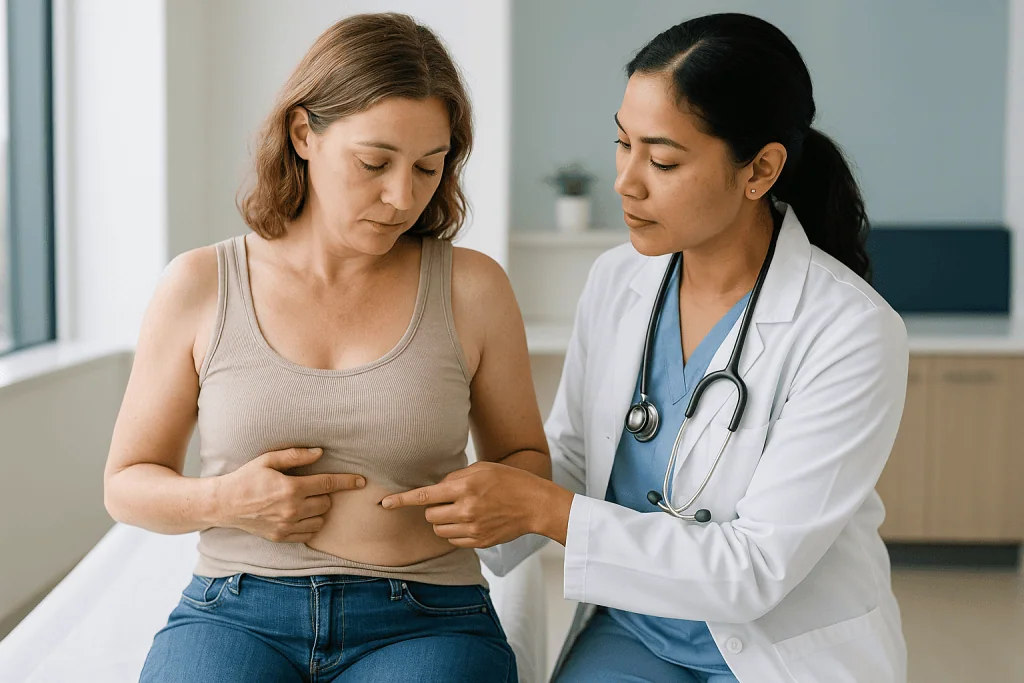
Implant surgery needs an incision long enough to slide a device through, and gel implants need a longer opening than saline devices, which are inserted empty and filled afterward. The three common placements are the fold beneath the breast, the border between the darker areola skin and the paler breast skin, and the armpit crease. The fold scar is hidden when standing but visible when lying down; the areola scar blends at the color change but passes close to the milk ducts and nerves; the armpit scar keeps the breast itself unmarked but is seen with raised arms. Each has a different profile of sensation change and infection risk, which is why the choice is usually made with the surgeon rather than by preference alone.
Fat transfer leaves a different pattern: several very small entry points rather than one line. At the donor site, liposuction cannulas enter through openings a few millimeters wide, often placed in the bikini line, navel edge or a natural crease. At the breast, the injection cannulas pass through similarly small punctures, commonly at the fold or the areola edge. These marks usually fade to faint dots, though they can stay slightly darker or lighter than surrounding skin, especially in deeper skin tones.
Two caveats keep the picture honest. Liposuction can leave contour irregularities at the donor area, which is a cosmetic scar of a different kind. And any scar, however small, can widen, thicken or form a raised keloid in people prone to them. If you scar badly from minor cuts, say so at consultation; it changes the calculus.
Do fat transfers to breasts last?
The honest answer has two parts, and both are true at once: fat that survives is permanent, and not all of it survives.
In the first days after grafting, each parcel of injected fat depends on nutrients diffusing from surrounding tissue until new capillaries grow into it. Parcels that connect become living breast fat. Those that do not are broken down and absorbed over the following weeks and months, which is why the breast looks fullest immediately after surgery, when swelling and soon-to-be-lost fat are both present, and then gradually settles. Surgeons generally judge the retained volume only once the swelling has resolved, several months later, and plan any second session from that settled baseline.
How much survives varies widely between individuals, techniques and even between the two breasts of the same person, and the published range is broad enough that quoting a single percentage would be misleading. What the evidence does support is that retention depends on gentle harvesting, careful processing, small-volume layered placement and a healthy recipient site. Smoking, poor blood supply and overfilling all reduce survival.
Once fat has taken, it stays as long as any other fat in your body. It does not need replacing and it does not degrade. It does, however, follow your weight. A significant loss can shrink the result; a gain can enlarge it. Pregnancy, breastfeeding and menopause alter breast tissue whether or not fat was ever added, so the grafted fat ages with the rest of you rather than remaining fixed while everything else changes.
So: do fat transfers last? The surviving portion does, indefinitely. The uncertainty lives in how big that portion turns out to be, and that is a question your surgeon can only estimate, not promise.
What happens to fat transfer breast augmentation after 10 years, and to implants?
Ten years is a useful horizon because it exposes the deepest difference between the two options: one ages as tissue, the other ages as a device.
A decade after fat transfer, the grafted fat is simply part of the breast. There is no shell to wear, no capsule to tighten, no valve to fail. What can appear over time are the footprints of fat that did not survive: small oil cysts, firm areas of fat necrosis, and calcifications visible on mammography. Radiologists are familiar with these findings, and most can be distinguished from suspicious changes, but some prompt additional imaging or occasionally a biopsy to be certain. Beyond that, weight changes and hormonal shifts reshape the breast exactly as they would have anyway.
Implants tell a different story. Both the NHS and Mayo Clinic are explicit that implants are not lifetime devices. Mayo Clinic gives an average lifespan of roughly ten years, while stressing that some last much longer and others fail sooner; the NHS advises that implants are likely to need replacing at some point. Failure modes include rupture (saline deflates visibly, silicone gel can leak silently), progressive capsular contracture, shifting position and cosmetic changes as the natural breast ages over a fixed device. Because silent silicone rupture produces no obvious sign, Mayo Clinic reports the current recommendation of screening by MRI or ultrasound starting five to six years after placement and repeating every two to three years.
Neither pathway is trouble-free at ten years. The practical difference is that a fat transfer patient is monitoring tissue, while an implant patient is monitoring tissue and a device, and should plan on the possibility of at least one further operation in her lifetime.
What are the downsides of fat transfer?
Fat transfer is often marketed as the natural option, a phrase that quietly implies risk-free. It is not, and its downsides are specific enough to list plainly.
The first is that it is two operations in one. Liposuction carries its own risks: bruising, prolonged swelling, numbness, contour irregularities or dents at the donor site, and, rarely, more serious complications such as bleeding or injury to deeper structures. A person who wanted only a breast change ends up with a second area to heal.
The second is unpredictability. Because survival varies, the final volume cannot be guaranteed, the two breasts may retain different amounts, and a second session is sometimes needed to reach the intended size. Anyone with a firm size target may find that open-endedness frustrating.
The third is the biology of dead fat. Parcels that fail to take can form oil cysts or firm nodules, and these can calcify. On a mammogram, calcifications are also one of the signs radiologists look for in early cancer, so grafted breasts may generate more call-backs for extra views, ultrasound or biopsy. Most turn out benign, but the anxiety and the additional procedures are real.
Fourth is eligibility. Very lean people may not have enough donor fat, and those whose weight fluctuates markedly will watch the result fluctuate with it.
Finally, there is the question of long-term oncologic safety. Concern was raised historically that placing fat near breast tissue might influence cancer risk or, in reconstruction patients, recurrence. The evidence accumulated so far has not shown an increased risk, but follow-up periods in many studies remain shorter than researchers would like, and expert bodies continue to describe the data as reassuring rather than conclusive. That is the accurate wording, and any surgeon who says otherwise is overstating.
What are the risks of breast implants?
Implants have been studied for decades, so their risks are better quantified than those of fat transfer, and knowing them is part of choosing them.
Early complications mirror any surgery: bleeding into the pocket (hematoma), infection, poor wound healing and changes in nipple or breast sensation that may be temporary or lasting. The NHS lists these alongside implant-specific problems: rippling or wrinkling visible through the skin, implants sitting too high, too low or rotating, and asymmetry.
Capsular contracture is the most common longer-term issue. Every implant is surrounded by a thin capsule of scar tissue; in some people that capsule thickens and squeezes, producing firmness, distortion, an unnaturally high position and sometimes pain. Treatment usually means further surgery to release or remove the capsule and often replace the device.
Rupture is the other major concern. A saline implant that ruptures deflates over days and is obvious. A silicone gel implant may rupture without any sign at all, which is why Mayo Clinic notes the imaging surveillance schedule discussed above. Leaked gel usually stays within the capsule but can occasionally spread into surrounding tissue.
Two rarer issues need naming. Breast implant-associated anaplastic large cell lymphoma (BIA-ALCL) is an uncommon cancer of the immune system that develops in the capsule, almost always around textured-surface implants, and typically presents as late, persistent swelling from fluid around the device. Separately, some people report a cluster of symptoms such as fatigue, joint pain and cognitive fog that they attribute to their implants; regulators acknowledge these reports while noting that a causal link has not been established. Mayo Clinic covers both.
Implants also change breast screening: mammography needs extra displacement views, and the device can obscure a portion of the tissue, so tell every imaging service you have them.
Who is each option usually for, and who is usually asked to wait?
Surgeons do not match people to procedures by preference alone. They match goals, anatomy and timing, and the same person can be a good candidate for one and a poor one for the other.
Fat transfer tends to suit someone who wants a modest, soft increase; who has enough donor fat to spare; whose weight has been stable for a while; who specifically wants to avoid a device; or who needs a targeted correction, for example a hollow, an asymmetry or the visible edge of an existing implant.
Implants tend to suit someone who wants a clearly larger breast or a defined, projected shape; who is lean with little fat to donate; who wants a predictable size in a single operation; or who accepts that a device brings a maintenance relationship, including imaging and possible future surgery.
Both groups may be asked to wait, and the reasons overlap. Pregnancy and breastfeeding change breast size and blood supply, so surgeons generally defer until well after weaning; Mayo Clinic also notes that implants can make breastfeeding harder for some women, which matters if a family is planned. Significant intended weight loss or gain shifts both the donor fat and the result, so stability first is the usual advice. Smoking impairs blood supply, lowering fat survival and raising wound complications, and most teams ask people to stop for a period before and after. Poorly controlled diabetes, bleeding disorders and certain medicines that affect clotting are addressed with the prescribing clinician before any date is set.
Age matters for implants: Mayo Clinic reports that US regulators approve saline implants for cosmetic augmentation from age 18 and silicone gel from 22. And every reputable team screens for expectations, because an operation cannot resolve distress about appearance that a mirror alone did not create.
Fat transfer vs breast implants at a glance
Laid side by side, the two options are less a contest than a set of trade-offs. The table summarizes the differences that most often decide the matter; the surrounding sections explain the reasoning behind each row.
| Question | Fat transfer | Implants |
|---|---|---|
| How much volume? | Modest per session; limited by donor fat and by what the breast can hold | Chosen in advance; subtle to dramatic in one operation |
| Predictability of size | Variable; part of the fat is reabsorbed and the final result is judged months later | High; the device does not shrink |
| Feel | Indistinguishable from natural fat once healed | Silicone gel closer to natural than saline; may firm if the capsule contracts |
| Shape and projection | Enlarges existing shape; good for targeted filling | Can build upper-pole fullness and cleavage independently of tissue |
| Scars | Several small puncture marks at donor and breast sites | One incision per breast in the fold, areola edge or armpit |
| Longevity | Surviving fat is permanent; follows weight changes | Not a lifetime device; replacement or removal likely at some point |
| Follow-up imaging | Standard screening; calcifications may prompt extra views | Displacement mammogram views; MRI or ultrasound surveillance for silicone |
| Specific risks | Donor-site irregularities, fat necrosis, oil cysts, need for repeat sessions | Capsular contracture, rupture, malposition, rare BIA-ALCL |
| Who tends to suit it | Wants subtle, soft change; has spare fat; prefers no device | Wants larger or defined result; lean frame; accepts device maintenance |
Two rows deserve a second look. The longevity row is not a win for fat transfer so much as a different kind of commitment: fat asks you to keep your weight steady, implants ask you to keep an eye on a device. And the predictability row cuts both ways: a fixed number is reassuring if you know exactly what you want, and constraining if your goal is simply to look a little fuller and see how it feels. Read the table as a description of two different relationships with your own body, not a scorecard.
What do the days and weeks after surgery usually look like?
Recovery from either operation is measured in weeks, not days, and the shape of those weeks differs in ways worth knowing before you book time off.
Implant surgery is usually a day case or a single overnight stay. Expect tightness, swelling and soreness across the chest, with movement of the arms feeling restricted for the first several days. Many people wear a supportive, non-underwired bra around the clock at first. The NHS advises that most people need one to two weeks away from work, that it can take a few weeks to fully recover, and that strenuous activity should be avoided for about six weeks. Implants placed beneath the muscle often sit high and look unnatural early on, then settle into position over the following weeks as swelling eases and the muscle relaxes.
Fat transfer recovery runs on two tracks. The breasts themselves are usually less sore than after implant placement because no pocket has been created, but they are swollen and may show patchy bruising at the injection points. The donor area is often the harder part: liposuction produces bruising, tenderness and swelling that can persist for weeks, and a compression garment is typically worn to control it. Time off work and activity limits are similar to those the NHS gives for implants, though the exact advice depends on how much liposuction was performed.
The biggest difference is when you can judge the result. An implant patient sees roughly her final size once swelling resolves. A fat transfer patient watches the breast shrink from its post-operative fullness as non-surviving fat is absorbed, with the settled volume becoming clear only over several months. Surgeons build that waiting period into any decision about a second session, so patience is part of the procedure.
What people often get wrong about fat transfer and implants
Some of the most confident statements in online forums are simply untrue. Correcting them changes decisions.
“Fat transfer is natural, so it has no real risks.” Using your own tissue removes device-related problems, but it introduces liposuction risks, fat necrosis, oil cysts and imaging call-backs. Natural describes the material, not the risk profile.
“Implants must be swapped every ten years.” There is no scheduled replacement. Mayo Clinic and the NHS both say implants are not lifetime devices and may need replacing, but the trigger is a problem, such as rupture, contracture or a change you dislike, not a date on a calendar. Some people keep the same implants for decades; others need surgery earlier.
“Fat transfer can give me two cup sizes in one go.” Overfilling kills fat. Reputable surgeons limit single-session volumes precisely to avoid lumps and cysts, so large changes mean multiple sessions or an implant.
“Fat transfer causes breast cancer.” The studies so far have not shown an increased risk. What is true is that the follow-up periods are still relatively short, and that fat necrosis can mimic suspicious findings on a mammogram, which is a screening nuisance rather than a cancer cause.
“You can’t have a mammogram with implants.” You can and you should. Screening uses additional views that push the implant back, and the technologist needs to know in advance.
“Silicone ruptures are obvious.” Saline deflation is obvious; silicone gel rupture is frequently silent, which is why surveillance imaging exists.
“One option makes people happier.” Reviews comparing satisfaction between fat grafting and implants rely largely on separate patient groups with different starting goals, so they cannot say which would have satisfied any one person more. Satisfaction tracks how well the result matched what that person wanted, which brings the question back to you.
Questions to ask your care team about fat grafting vs implants
A good consultation is a conversation, and the questions you bring shape it as much as the answers. These are the ones that most reliably surface what matters.
- Looking at my body and my goal, which option do you think fits, and what would make you recommend the other one?
- How much volume increase is realistic for me with fat transfer in a single session, and how would we judge whether a second session is needed?
- Where would the incisions or entry points be, how long are they likely to be, and how do people with my skin tone and scarring history usually heal?
- If I have implants, which type, size and placement would you propose and why, and how would each choice affect feel, rippling and mammograms?
- What happens to this result if I gain or lose weight, become pregnant or breastfeed?
- How do you handle fat necrosis, oil cysts or lumps if they appear, and how should I describe my surgery to a breast-screening service?
- What is your plan if an implant ruptures or a capsule tightens, and what imaging schedule would you advise me to follow?
- How many of these procedures do you perform, and what are your own complication and revision rates?
- Who do I contact after hours if something feels wrong, and what would you want to see me for urgently?
- What is the realistic timeline for returning to desk work, exercise, driving and lifting?
- Are there reasons you would ask me to wait, and what would need to change first?
Notice what is not on the list: any question that asks the surgeon to guarantee an outcome. Volume retention, capsule behavior and healing all vary, and a team that answers with ranges and conditions is being more truthful than one that answers with certainties. Write the answers down, take them home, and give yourself at least a few weeks before deciding. The cooling-off period exists for good reasons.
When to call your doctor
Most recoveries are uneventful, but a few signs mean you should contact your surgical team the same day rather than wait for a scheduled check, and some mean calling emergency services.
Contact your team promptly if you notice a fever or chills; redness that is spreading or warm to touch around an incision or the donor area; wound edges that open, or fluid that is cloudy, foul-smelling or increasing rather than tapering; a breast or donor site that becomes suddenly, markedly more swollen or tense than the other side, which can indicate bleeding; pain that is worsening after the first days rather than easing, or that is not controlled by what you were advised to take; or skin over the breast that turns dusky, very pale or blistered.
Call emergency services or go to an emergency department if you develop chest pain, sudden shortness of breath, coughing up blood, or pain, swelling and warmth in one calf. These can be signs of a blood clot in the leg or lung, a recognized risk after any surgery involving anesthesia and reduced movement, and the risk is somewhat higher when liposuction is part of the procedure.
Do not stop watching once the incisions have healed. Months or years later, seek review for a new lump, a change in breast shape or firmness, a breast that suddenly deflates, or persistent swelling that develops long after surgery, particularly on one side; late fluid collection around an implant is the typical first sign of the rare lymphoma BIA-ALCL and should always be assessed. Keep up with routine breast screening appropriate for your age and history, and tell every imaging service exactly what surgery you have had, so the pictures are read correctly.
When in doubt, call. Teams would far rather reassure you over a non-problem than hear about a real one late.
Frequently asked questions
What are the downsides of fat transfer to the breast?
The main downsides are unpredictable volume, a limited increase per session, and the added recovery and risks of liposuction at the donor site. Fat that does not survive can form firm lumps or oil cysts and later calcify, which may lead to extra mammogram views or a biopsy. People with little spare fat may not be candidates, and results change with weight.
Do fat transfers to breasts last?
Fat that establishes a blood supply in the first weeks is permanent and does not need replacing. Fat that fails to connect is reabsorbed over the following months, so the breast shrinks from its immediate post-surgery fullness before settling. The surviving fat then behaves like any other body fat, enlarging with weight gain and shrinking with loss.
Does fat transfer cost more than implants?
It depends on the plan, and this article does not give price figures. Fat transfer combines liposuction, fat processing and injection, and may need a second session; implants involve a device plus a possible future replacement or removal operation. Ask your care team for a written breakdown of what is included, including follow-up imaging, before comparing options.
What happens to fat transfer breast augmentation after 10 years?
After a decade the surviving fat is simply part of your breast and ages with the rest of your body through weight changes, pregnancy or menopause. There is no device to wear out. Footprints of non-surviving fat, such as small oil cysts or calcifications, may be visible on mammograms, and radiologists usually recognize them, though occasionally further imaging is requested.
Can you combine fat grafting with implants?
Yes. A hybrid approach uses an implant for core volume and layered fat to soften the upper edge, fill a hollow or improve cleavage in a slim frame. It can also disguise the rim of an existing implant. Because it combines the risks of both procedures, surgeons offer it selectively rather than routinely, based on your tissue and goals.
How many cup sizes can fat transfer add?
Usually a modest amount per session, because injecting large volumes causes more fat to die and form lumps rather than survive as soft tissue. Surgeons deliberately limit single-session volumes for that reason. Someone who wants a clearly larger change is generally offered either several fat transfer sessions spaced months apart or an implant, which can deliver the target size in one operation.
Do breast implants or fat transfer affect mammograms?
Both do, differently. Implants require additional displacement views and can hide part of the breast tissue, so the imaging service must be told in advance; silicone implants also need periodic MRI or ultrasound to detect silent rupture, per Mayo Clinic. Fat transfer can leave calcifications from fat necrosis that sometimes prompt extra views or a biopsy to rule out cancer.
Do silicone implants feel natural compared with fat transfer?
Silicone gel implants feel closer to natural breast tissue than saline ones, according to Mayo Clinic, and placement beneath the muscle further softens the upper edge. Surviving grafted fat is indistinguishable from natural breast fat. Implants can become firmer over time if the surrounding scar capsule tightens, whereas fat does not develop a capsule.
Can I breastfeed after fat transfer or implants?
Many people can, but Mayo Clinic notes that implants may make breastfeeding more difficult for some women, particularly with incisions around the areola that pass near milk ducts and nerves. Fat transfer avoids a device but still involves needle passes through breast tissue. If you plan to have children, raise it at consultation; surgeons often advise timing surgery after breastfeeding is complete.
Which makes people happier, fat grafting or implants?
The evidence cannot answer that for an individual. Reviews comparing satisfaction generally study separate groups who chose each procedure for different goals, so they show that both can satisfy patients whose expectations matched the result, not that one is superior. Satisfaction tracks how closely the outcome fits what you personally wanted in volume, feel, scars and future maintenance.
References
This article is for general information only and is not a substitute for professional medical advice. Please consult a qualified doctor about your individual situation.

More from the Blog

Breast Lift Scars and Daily Life After Mastopexy: Sleeping, Sports Bras and Sun Protection
Breast lift scars are permanent, but they usually change a great deal. Most fade from raised and pink to flat, pale lines over roughly…

Healing After Nipple Reconstruction: Protective Dressings, Bras to Avoid and the First Weeks
Nipple reconstruction recovery is usually gentler than earlier breast surgery. Most people wear a protective dressing or shield for the first weeks, choose soft…
Why Ultrasound or Mammography Comes Before Accessory Breast Surgery: Confirming the Tissue
Ultrasound, and sometimes mammography, comes before accessory breast surgery because a lump in the armpit or along the chest wall is not always breast…

Is Capsulectomy Needed With Breast Prosthesis Removal? How Surgeons Decide What Comes Out
Capsulectomy is not automatically required with breast prosthesis removal. Surgeons usually remove the capsule when it is thickened, calcified, ruptured silicone is present, or…

Local or General Anesthesia for Gynecomastia Surgery? What Shapes the Choice and Recovery
Gynecomastia surgery can be done under local anesthesia with or without sedation, or under general anesthesia. The choice depends mainly on how much glandular…

How Accessory Breast Removal Works: Excision, Liposuction and the Armpit Incision Explained
Accessory breast removal surgery takes out extra breast tissue, most often in the armpit, through a short incision hidden in the natural underarm crease.…