

Bronchoscopy Risks Explained Honestly: What Is Normal Afterward and When to Call Your Team

Key Takeaways
- Published reviews place death attributable to flexible bronchoscopy at roughly 1 to 4 per 10,000 procedures, concentrated among critically ill patients rather than outpatients.
- The most frequently recorded complication is a temporary drop in oxygen during the procedure, which the team usually corrects within seconds by adjusting supplemental oxygen.
- Pneumothorax is essentially a transbronchial lung biopsy risk, reported in about 1 to 6 percent of those procedures, and is rare after inspection, lavage or EBUS alone.
- A low-grade fever starting 4 to 8 hours after bronchoalveolar lavage is an inflammatory response, not infection, and typically resolves within a day.
- Blood-streaked sputum for 24 to 48 hours is expected after brushings or biopsies; bright red blood in more than small amounts or bleeding that does not taper off needs an urgent call.
- Most people return to routine activity the day after a diagnostic bronchoscopy, but sedation rules out driving, alcohol and important decisions for the rest of the procedure day.
Flexible bronchoscopy is generally considered a low-risk procedure. Published reviews report serious complications in well under 1 percent of cases and death in roughly 1 to 4 per 10,000, with bleeding, low oxygen and pneumothorax the main concerns. Mild sore throat, cough and small blood streaks in sputum for a day or two are common; heavy bleeding, chest pain or breathlessness need urgent contact with your team.
The consent form is one page long, and the word that stops most people is near the bottom: complications. Someone sits in a clinic chair, a pulmonologist across the desk, and the list is read aloud in a steady voice: bleeding, infection, a collapsed lung, a reaction to sedation. It sounds worse than it usually is, and it sounds vaguer than it needs to be. What the form rarely says is how often each of those things actually happens, or what “a little blood” means when you are coughing into a tissue at home the next morning.
This article is an attempt to say those things plainly. Bronchoscopy risks and complications are well documented, and the honest summary is reassuring for most people and genuinely important for a few. The goal is to help you tell the difference: to recognize the ordinary aftermath of having a thin camera in your airways, and to know the handful of signs that mean you should pick up the phone rather than wait until morning.
What actually happens during a bronchoscopy
A bronchoscopy is a procedure in which a doctor passes a thin, flexible tube with a light and camera, called a bronchoscope, through the nose or mouth, down the windpipe and into the branching airways of the lungs. The tube is roughly the width of a pencil. Most people receive a sedative through a small IV line so that they are relaxed and drowsy, plus a local anesthetic sprayed onto the throat and airways to numb the gag and cough reflexes. Some procedures, particularly longer or more complex ones, are done under general anesthesia with a breathing tube in place.
Once the scope is in, the doctor looks at the lining of the airways on a screen. Depending on the reason for the test, several small tasks may follow. Bronchoalveolar lavage, often shortened to BAL, means squirting a small amount of sterile saline into a lung segment and suctioning it back to collect cells and microbes. A brushing scrapes a few cells from the airway wall. A transbronchial biopsy uses tiny forceps to take a pinch of lung tissue through the airway wall. Endobronchial ultrasound, or EBUS, adds a small ultrasound probe to the scope so that lymph nodes beside the airways can be seen and sampled with a needle.
The camera part typically takes 20 to 30 minutes, though the whole visit, including preparation and recovery, is usually several hours, according to the Mayo Clinic. Oxygen is delivered through a nasal tube throughout, and a clip on your finger tracks oxygen levels while a monitor follows heart rate and blood pressure. You will cough. That is expected, and the team will pause and add more numbing spray if needed. Afterward you rest until the sedative fades and you can swallow safely again, which is why eating and drinking are held for an hour or two.
Bronchoscopy risks and complications: how likely are they really?
Risk lists on consent forms are complete by design, not proportional. Every possible event appears, whether it happens to one person in fifty or one in ten thousand. A more useful way to think about bronchoscopy risks and complications is to sort them into three groups: expected effects, uncommon complications and rare emergencies.
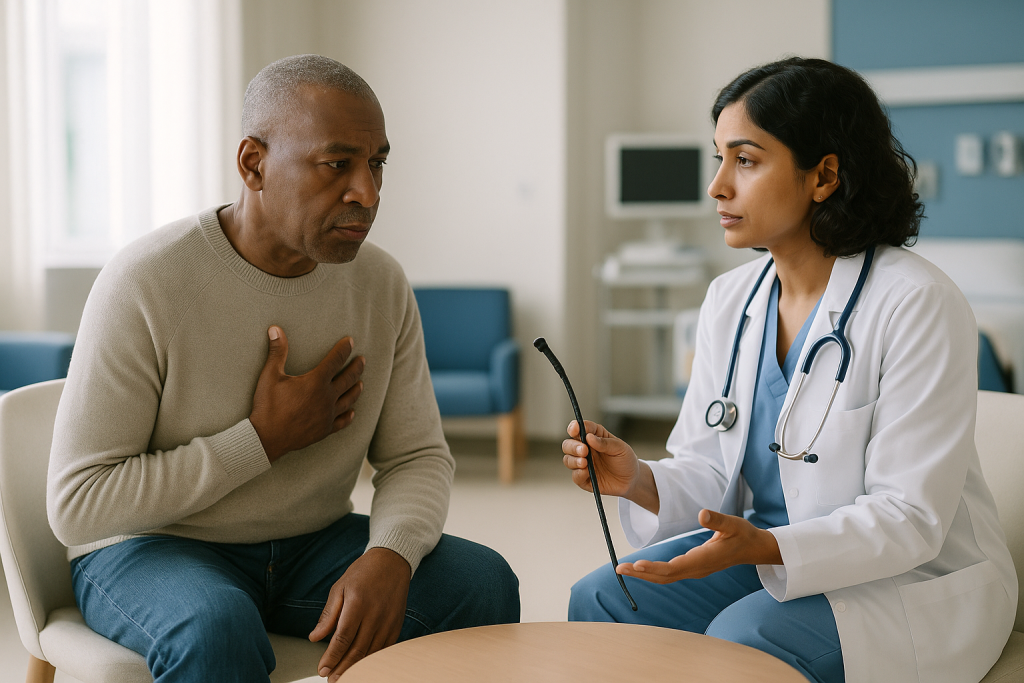
Expected effects are the ordinary consequences of having a tube in the airway for half an hour: sore throat, hoarseness, a nagging cough, small streaks of blood in what you cough up and, after lavage, sometimes a low-grade fever that evening. MedlinePlus and the Cleveland Clinic both describe these as normal and short-lived. They are not complications in the medical sense, even though they can feel alarming at home.
Uncommon complications are events that need attention but are usually managed on the day: a temporary drop in oxygen that responds to extra oxygen, bleeding that is more than a streak but stops with simple measures through the scope, or bronchospasm, a tightening of the airways similar to an asthma flare. Published reviews of large case series place the overall rate of significant complications below about 1 percent for diagnostic flexible bronchoscopy, rising modestly when biopsies are taken.
Rare emergencies are the reason the procedure is done in a monitored setting with resuscitation equipment nearby: severe bleeding, a pneumothorax large enough to need a chest drain, a serious heart rhythm disturbance or a major reaction to sedation. These are the events people fear most, and they are the least likely. Later sections put numbers on each, but the headline is that for a person who is reasonably stable and well prepared, the procedure is among the safer invasive tests in medicine.
Is bronchoscopy a high risk procedure? What the mortality data say
People ask this question directly, so it deserves a direct answer: no, flexible bronchoscopy is not classed as a high-risk procedure. It is invasive, and it carries real risks, but the magnitude is small. Published reviews summarizing tens of thousands of procedures report death attributable to flexible bronchoscopy in the range of about 0.01 to 0.04 percent, which is roughly 1 to 4 people in every 10,000. Those deaths cluster among people who were already critically ill, for example patients on ventilators in intensive care or those with severe heart or lung disease, rather than outpatients having a diagnostic look.
Why does the number vary between studies? Partly because “bronchoscopy” covers many different procedures. A ten-minute inspection to find the source of a cough is not the same as an hour-long EBUS with multiple needle passes, or a therapeutic procedure to remove a blocked airway plug in someone who is struggling to breathe. Partly it reflects who is being scoped. Risk sits mostly in the patient, not the tube.
The factors that raise risk are consistent across the literature: very low oxygen levels before the procedure starts, unstable heart disease or a recent heart attack, uncontrolled bleeding tendencies from disease or blood thinners, severe pulmonary hypertension (high pressure in the lung’s blood vessels), and being on a ventilator. The Johns Hopkins patient information page frames it the same way: complications are uncommon, and your doctor will discuss the specific risks that apply to your health situation.
So when someone types “is bronchoscopy dangerous” into a search engine at midnight, the honest reply is that it carries about the same order of risk as a colonoscopy with biopsies, done by a team that watches your oxygen and heart rhythm second by second. It is a procedure to respect, not to dread.
What is the most common complication of a bronchoscopy?
If you count only events that a doctor would record as a complication, the answer in most series is a temporary drop in blood oxygen, known as hypoxemia. It happens because the scope partly fills the airway, the sedative slows breathing, and suction during lavage briefly removes air along with fluid. The team sees it on the finger probe before you feel anything, turns up the oxygen, pauses, and it resolves. Only when it fails to correct, or is deep and prolonged, does it become a problem.
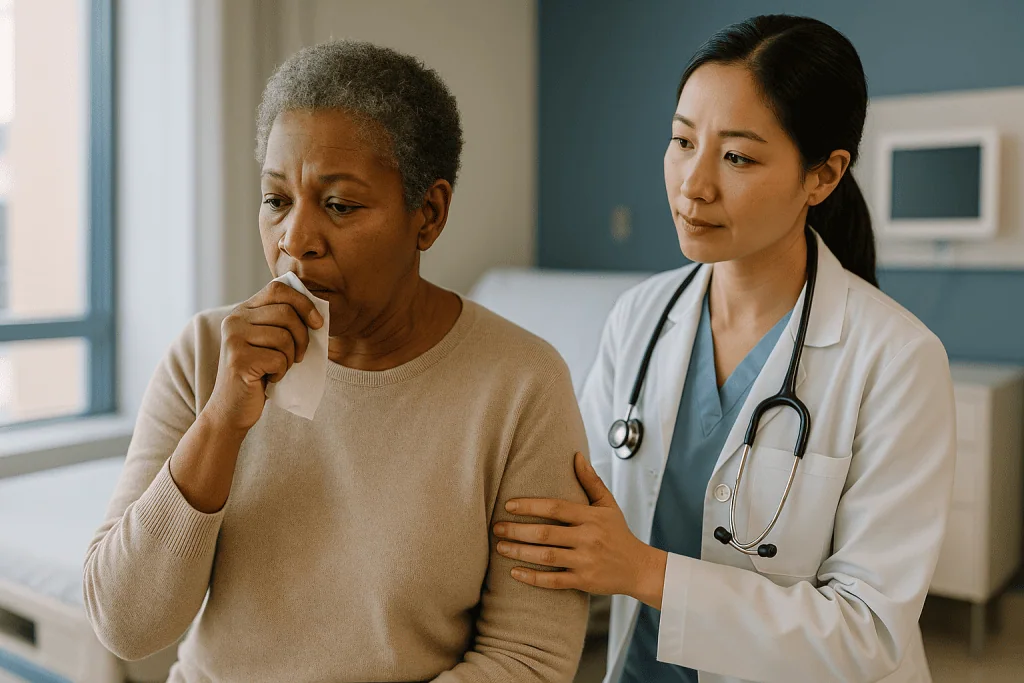
If you count what patients notice, the most common experiences are different: a raw throat, a hoarse voice for a day, coughing fits and blood-streaked sputum. After lavage, fever is the standout. Reviews report a self-limiting fever in a notable minority of people, sometimes quoted between 5 and 30 percent depending on how much fluid was used and how fever was defined. It usually begins within 4 to 8 hours and settles within a day. It is thought to come from inflammatory chemicals released when saline washes the air sacs, not from infection, which is why it rarely needs treatment beyond rest and fluids.
Minor bleeding is the other everyday event, particularly when a brushing or biopsy was taken. Blood-tinged mucus for 24 to 48 hours is expected. The Cleveland Clinic describes small amounts of blood as normal after the procedure, while heavier bleeding needs a call.
Less often, the numbing spray or the scope itself can trigger laryngospasm, a brief involuntary closure of the vocal cords, or bronchospasm. Both are more likely in people with asthma or a recent chest infection and are treated on the spot. Vasovagal reactions, the fainting response driven by the nervous system, and short-lived heart rhythm changes round out the list of things the team handles routinely before you are wheeled to recovery.
Bleeding after bronchoscopy: what is normal and what is not
Bleeding worries people more than any other item on the consent form, and it is the one area where knowing the thresholds really matters. The airway lining is rich in blood vessels, so even a gentle brushing leaves a few streaks. Coughing up sputum with pink or brown flecks, or a teaspoon or two of darker old blood, over the first day or two is within the expected range according to MedlinePlus and Mayo Clinic patient guidance.
Clinically significant bleeding is defined in most studies as blood loss large enough to need intervention through the scope, such as cold saline flushes, a vessel-constricting medicine applied locally, wedging the scope against the airway, or placing a temporary balloon. Reviews report this in under 1 percent of purely diagnostic procedures, rising to a few percent when transbronchial biopsies are taken from lung tissue, and higher still in people with certain conditions.
The conditions that raise bleeding risk are predictable. Kidney failure, because it impairs platelet function. Liver disease, because clotting proteins are made there. Low platelet counts from any cause. Lung transplant recipients, immunosuppressed patients and people with cancer invading the airway wall. Anticoagulant and antiplatelet medicines, which are the classes of drugs that thin the blood or stop platelets sticking, are usually reviewed before the procedure. The prescribing clinician decides whether and when any of these should be paused, weighing bleeding risk against the reason the medicine was started, such as a heart stent or a recent clot. Never adjust them on your own.
At home, the signs that bleeding has crossed from normal into concerning are volume and persistence: coughing up bright red blood in more than a few tablespoons, blood that keeps coming rather than tailing off, or blood accompanied by dizziness or breathlessness. Those warrant an urgent call, not a wait-and-see.
Pneumothorax and other less common complications
A pneumothorax is air leaking into the space between the lung and the chest wall, causing part of the lung to collapse away from the ribs. It is essentially a biopsy complication. When forceps or a needle pass through the airway wall into lung tissue, a small puncture can let air escape. Reviews of transbronchial biopsy report pneumothorax in roughly 1 to 6 percent of cases, with the higher figures in older series before ultrasound and fluoroscopy guidance became routine. Simple inspection, brushing and lavage very rarely cause it. EBUS needle sampling of lymph nodes carries a low risk because the needle stays near the central airways.
Most pneumothoraces after bronchoscopy are small and found on a routine chest X-ray taken before discharge. Many need nothing more than observation and a repeat film. A larger one, or one causing symptoms, is treated by drawing the air out with a needle or placing a small chest drain, which typically means an overnight stay. The symptoms to watch for at home are sudden sharp chest pain, usually on one side, and breathlessness that is new or worsening, particularly if it develops within the first 24 hours.
Infection is often listed but is genuinely uncommon. The scope is sterilized between patients to strict standards, and the airways below the vocal cords are not sterile to begin with. A true pneumonia after bronchoscopy is rare; the more frequent post-lavage fever described earlier is inflammatory, not infectious.
Cardiac events such as significant rhythm disturbances or angina occur mainly in people with existing heart disease, driven by the stress response and dips in oxygen. Air embolism, in which air enters a blood vessel, and airway perforation are described in case reports and are extraordinarily rare. Damage to teeth, lips or the voice box from the scope or a bite block is minor and uncommon but worth knowing about if you have loose teeth or dental work.
Sedation and airway risks explained
A meaningful share of the risk in bronchoscopy sits not in the scope but in the medicines used to make it tolerable. Moderate sedation, sometimes called conscious sedation, uses drug classes that reduce anxiety and blunt memory of the procedure. General anesthesia goes deeper and takes over breathing entirely. Each has trade-offs the team weighs against your health.
Sedatives slow breathing and relax the throat muscles, which is exactly what makes the scope easier to pass and exactly what can push oxygen levels down. This is why a nurse or anesthesia professional watches the monitors continuously and why supplemental oxygen runs throughout. People with obstructive sleep apnea, obesity, severe lung disease or heavy alcohol use are more sensitive to these effects and are sometimes scheduled with an anesthesiologist present. Older adults may clear sedatives more slowly and feel groggy or confused for longer afterward.
The local anesthetic sprayed onto the throat and airways deserves a specific mention. It is safe at the amounts used in routine practice, but the drug class involved can cause toxicity if too much is absorbed, with symptoms such as ringing in the ears, tingling around the mouth or, rarely, seizures. Teams track the total used, which is one reason the procedure is not simply extended indefinitely if you keep coughing.
Allergic reactions to any of these agents are rare but possible, and you will be asked about previous reactions to anesthesia or dental numbing. The practical consequences of sedation follow you home: MedlinePlus advises not driving, operating machinery or making important decisions for the rest of the day, and the Mayo Clinic notes that you should not eat or drink until the numbing wears off, usually one to two hours, because swallowing reflexes are impaired and food or liquid could enter the airway. An adult companion to take you home is not a courtesy; it is a safety requirement.
Who bronchoscopy is usually for, and who is usually asked to wait
Bronchoscopy is chosen when looking directly at the airways, or sampling what lies beside them, will change a decision. Common reasons include a lung shadow or nodule on a CT scan that needs a tissue diagnosis, enlarged lymph nodes in the chest, a cough or pneumonia that will not clear, coughing up blood with no obvious cause, suspected infection in someone with a weakened immune system, checking the airways after a lung transplant, and removing an inhaled object or a plug of mucus. In each case the alternatives, such as a CT-guided needle biopsy through the chest wall, sputum tests, imaging follow-up or surgical biopsy, carry their own risks, and the treating team’s job is to pick the route with the best balance for you.
Certain situations lead the team to delay or reconsider. The strongest reasons are things that raise the chance of a serious complication: a heart attack or unstable angina within the past few weeks, a dangerous heart rhythm, blood pressure that is very high or very low, oxygen levels that cannot be brought to a safe range even with support, severe uncontrolled asthma, and a bleeding tendency that cannot be corrected in time. An active chest infection in someone otherwise well may also prompt a short wait so that the inflamed airways are less reactive.
Some “waits” are practical rather than medical. If you take an anticoagulant or antiplatelet medicine, the prescribing clinician may need to plan a pause and a restart around the procedure, which can take days. If you have diabetes, fasting instructions need to be coordinated with your usual regimen. If no adult can accompany you home, an outpatient procedure under sedation cannot safely go ahead that day.
None of these are refusals. They are the team matching the timing of a low-risk test to the moment when it is lowest-risk for you specifically.
Bronchoscopy side effects in the first 24 hours: what normal feels like
The first evening is where most of the worry happens, so it helps to know the texture of a normal recovery. You will leave the recovery area drowsy, with a throat that feels scratched, a voice that sounds like you have shouted at a concert, and a cough that comes in waves. The Cleveland Clinic and Johns Hopkins describe all of these as expected bronchoscopy side effects, typically fading within a day or two.
Swallowing may feel odd for an hour or two while the numbing wears off; that is why the team waits until you can sip water without coughing before allowing food. Starting with cool liquids and soft foods that evening is gentler on the throat. Warm drinks and throat lozenges, if your team has no objection, ease the rawness.
Your sputum may be streaked or flecked with blood, often darker rather than bright, and this is expected especially if brushings or biopsies were taken. A low-grade fever and a general achy, wiped-out feeling can appear four to eight hours after lavage and usually settle overnight. Feeling slightly breathless when you first climb stairs is common after any sedation and should ease by the next day.
Where you were scoped through the nose, a stuffy or slightly bloody nostril is normal. If a bite block was used, the corners of your mouth or your gums may feel bruised.
What does not belong in a normal first 24 hours: bright red blood in more than small amounts, chest pain, breathlessness that is getting worse rather than better, a fever above the threshold your team gave you that persists past the next morning, or confusion beyond ordinary post-sedation grogginess. Those belong in the section on when to call.
Bronchoscopy recovery time: what the following days usually look like
People searching for bronchoscopy recovery time usually want two numbers: when they can get back to normal life, and when they will hear results. Both depend on what was done.
For a diagnostic bronchoscopy under moderate sedation, most people are back to routine activities the next day, according to Mayo Clinic and MedlinePlus guidance. The sedation itself is the limiting factor on day one: no driving, alcohol or important decisions until it has fully cleared. Day two typically brings a fading sore throat and a cough that is more productive as the airways clear the saline and mucus stirred up by the procedure. By the end of the first week, most people have no reminder that anything happened.
Recovery stretches out in specific situations. After transbronchial biopsies, teams often advise avoiding heavy lifting, straining or air travel for a short period because of the small pneumothorax risk, and a chest X-ray before leaving is standard practice in many centers. After general anesthesia, grogginess and a sore throat from the breathing tube can last an extra day. After therapeutic procedures, such as clearing a blocked airway or placing a stent, the underlying condition, not the bronchoscopy, dictates the pace.
Results follow their own clock. The doctor can often tell you what the airways looked like before you leave. Cultures for bacteria take a few days, and fungal or tuberculosis cultures can take weeks. Pathology from biopsies commonly returns within several days to two weeks depending on the tests requested. Ask your team for a realistic window and how you will be contacted, because waiting for results is, for many people, the hardest part of the whole experience.
Returning to work is usually reasonable within one to two days for desk-based roles, longer for physically demanding jobs or where biopsy precautions apply. These are typical ranges from patient guidance, not promises; your team will tailor them.
Bronchoscopy risks and complications by type of procedure
Not all bronchoscopies carry the same risk, and the consent conversation is far more useful when it is specific to what will actually be done. The table below summarizes the typical pattern reported across published reviews and major patient-information sources. The figures are approximate ranges drawn from case series, not guarantees, and your own risk depends heavily on your health.
| Procedure | What it involves | Main risks | Typical frequency reported in reviews |
|---|---|---|---|
| Inspection only | Camera examination of airways | Hypoxemia, cough, laryngospasm, sore throat | Serious complications well under 1% |
| Bronchoalveolar lavage (BAL) | Saline instilled and suctioned back | Post-procedure fever, transient oxygen drop | Fever in roughly 5–30% depending on definition; almost always self-limiting |
| Brushing or endobronchial biopsy | Cells or tissue from airway lining | Minor bleeding | Blood-streaked sputum common; significant bleeding under about 1% |
| Transbronchial lung biopsy | Forceps sample of lung tissue through airway wall | Pneumothorax, bleeding | Pneumothorax about 1–6%; significant bleeding low single-digit percent |
| EBUS needle aspiration | Ultrasound-guided needle into lymph nodes | Bleeding, rare infection of node, rare pneumothorax | Serious complications about 1% or less |
| Therapeutic (rigid or flexible) | Removing obstruction, stent, debulking | Bleeding, airway injury, anesthesia-related events | Higher than diagnostic; depends on underlying disease |
Two points stand out. First, the everyday effects that trouble patients most, fever and blood streaks, are the most frequent and the least dangerous. Second, the complication people fear most, pneumothorax, is essentially confined to lung tissue biopsy, so if your procedure does not involve one, that line of the consent form barely applies to you. Asking “which of these will I be having?” turns a generic list into a personal one.
What people often get wrong about bronchoscopy risks
Myth one: the scope goes into the lungs, so you cannot breathe during the procedure. In fact the bronchoscope occupies only part of the airway, air flows around it, and oxygen is supplied throughout. The sensation of not being able to catch your breath is uncomfortable but is not the same as not breathing, and the sedative is chosen partly to soften that sensation.
Myth two: any blood afterward means something has gone wrong. Small streaks or flecks for a day or two are expected, particularly after biopsies. What matters is volume and trajectory: a little that tapers off is normal, a lot or a steady flow is not.
Myth three: the fever that evening means you caught an infection from the scope. Post-lavage fever is an inflammatory response to saline washing the air sacs, typically starting within hours and gone by the next day. Infection from a properly reprocessed bronchoscope is rare, and a fever that starts two or three days later, with worsening cough or breathlessness, is a different matter that does need assessment.
Myth four: general anesthesia is always safer because you will not feel anything. Deeper anesthesia has its own risks and recovery burden, and for most diagnostic procedures moderate sedation is appropriate. Which is chosen depends on the planned procedure, your health and the team’s judgment.
Myth five: you should stop your blood thinner yourself to be safe. Stopping an anticoagulant or antiplatelet medicine without guidance can cause the very clot or stent blockage it was prescribed to prevent. The prescribing clinician decides, and the bronchoscopy team plans around that decision.
Myth six: a normal-looking airway means the test was a waste. Ruling things out is often the point, and lavage samples can reveal infection or inflammation that the camera cannot see. A clear view is information, not failure.
Questions to ask your care team
A good consent conversation is a dialogue, and the most useful questions are the ones that convert a general risk list into your own situation. Consider bringing a short written list; sedation makes it hard to remember answers afterward, and a companion can take notes.
- Which specific procedures are planned: inspection only, lavage, brushings, biopsies, EBUS? Which of the listed risks actually apply to what you will be doing?
- Given my heart, lung, kidney and bleeding history, are there factors that raise my risk above the usual, and what will you do differently because of them?
- Will I have moderate sedation or general anesthesia, and why that choice for me?
- Do any of my medicines need to be paused or adjusted, and who is making that decision: you, my cardiologist or my primary clinician?
- What is your plan if there is bleeding or a pneumothorax during the procedure?
- Will I have a chest X-ray before I leave, and what will you be looking for?
- What should the first evening feel like, and what exactly should make me call: how much blood, what temperature, which symptoms?
- Who do I call, at what number, including outside office hours?
- When and how will I receive results, and who will explain them?
- What are the alternatives to this procedure for answering the same question, and why is bronchoscopy the preferred route for me?
- Are there restrictions on driving, flying, lifting or returning to work, and for how long?
None of these are challenges to the team’s competence. Clinicians who perform bronchoscopy regularly expect them and generally welcome a patient who understands what is planned, because informed patients recover with less anxiety and call at the right moments rather than too early or too late.
When to call your doctor
Most people never need this section, which is exactly why it matters to have it written down before the sedative blurs your memory. Keep the number your team gave you somewhere visible, and do not hesitate to use it; teams would far rather hear about a false alarm than miss a real one.
Contact your team urgently, or seek emergency care, if you experience any of the following after bronchoscopy, based on guidance from MedlinePlus, Mayo Clinic and Cleveland Clinic:
- Coughing up bright red blood in more than small streaks, more than a few tablespoons in total, or bleeding that continues rather than tapering off.
- New or worsening breathlessness, especially breathlessness that is getting harder rather than easier over the first hours.
- Chest pain, particularly sharp pain on one side that worsens with breathing, which can signal a pneumothorax.
- Fever above the threshold your team specified that persists beyond the next day, or any fever that starts two or more days after the procedure alongside worsening cough or colored sputum.
- Lips or fingertips turning blue or gray, or a home oxygen reading well below your usual level if you use a monitor.
- Fainting, severe dizziness, a racing or irregular heartbeat, or confusion that goes beyond ordinary post-sedation grogginess.
- Difficulty swallowing that has not resolved by the next day, or a hoarse voice that lasts more than a week.
- Signs of a reaction to medicines such as widespread rash, swelling of the face or throat, or wheezing.
For the softer concerns, a cough that lingers past a week, a throat still raw on day three, uncertainty about when to restart a paused medicine, or worry while waiting for results, a routine call during office hours is appropriate. Restarting or continuing any medicine that was paused should follow the plan the prescribing clinician gave you, not a guess. Every decision about your care, including whether a symptom needs to be seen, sits with the treating team, and the safest default when you are unsure is to ask.
Frequently asked questions
Is bronchoscopy a high risk procedure?
No. Flexible bronchoscopy is classed as a low-risk invasive procedure, with serious complications reported in well under 1 percent of diagnostic cases in published reviews. Risk rises with lung tissue biopsies and in people who are critically ill, have unstable heart disease, very low oxygen or uncorrected bleeding problems. For a stable outpatient having a diagnostic examination, the risk is comparable to other common endoscopic tests done under monitored sedation.
What is the most common complication of a bronchoscopy?
A temporary fall in blood oxygen during the procedure is the most commonly recorded complication, caused by the scope in the airway, sedation and suction. It is usually corrected immediately with extra oxygen. From the patient’s point of view, the most common experiences are sore throat, cough, blood-streaked sputum and, after lavage, a short-lived fever the same evening, none of which usually require treatment.
What is the mortality rate for patients undergoing bronchoscopy?
Published reviews summarizing large case series report mortality attributable to flexible bronchoscopy of roughly 0.01 to 0.04 percent, about 1 to 4 in 10,000 procedures. These deaths occur mainly in patients who are already very unwell, such as those on ventilators or with severe heart or lung disease. Your team can tell you how your own health affects this baseline.
How long does it take to recover from a bronchoscopy?
Most people feel back to normal within one to two days after a diagnostic bronchoscopy, according to Mayo Clinic and MedlinePlus guidance. Sedation means no driving or alcohol on the day itself. Sore throat and cough usually fade within 48 hours. After lung biopsies or general anesthesia, teams may advise a few extra days before heavy exertion or air travel. Results can take days to weeks depending on the tests.
Is bleeding after bronchoscopy normal?
Small amounts are normal. Pink, brown or flecked sputum for 24 to 48 hours is expected, especially after brushings or biopsies. Bleeding becomes a concern when it is bright red in more than a few tablespoons, keeps coming rather than tapering off, or is accompanied by dizziness or breathlessness. Those situations need an urgent call to your team or emergency care.
Is bronchoscopy dangerous if I have asthma or COPD?
It can be done safely in most people with asthma or COPD, but airway disease raises the chance of bronchospasm and oxygen dips during the procedure. Teams typically want the condition as well controlled as possible beforehand and may adjust sedation or add an anesthesiologist. Uncontrolled asthma or a current flare is a common reason to postpone briefly. Discuss your usual inhalers and recent symptoms with the team in advance.
What bronchoscopy side effects should I expect the same day?
Expect a raw throat, hoarseness, coughing spells, drowsiness from sedation and possibly blood-streaked sputum. If lavage was performed, a low-grade fever and achiness may appear within 4 to 8 hours and settle by the next morning. Swallowing feels odd until the numbing spray wears off, so eating and drinking are delayed for an hour or two. A stuffy or slightly bloody nostril is common if the scope went through the nose.
Can bronchoscopy cause a collapsed lung?
Yes, but almost exclusively when a transbronchial lung biopsy is taken, because forceps pass through the airway wall into lung tissue. Reviews report pneumothorax in roughly 1 to 6 percent of these biopsies. Many are small and need only observation; larger ones are treated with a chest drain. Inspection, lavage and EBUS sampling of lymph nodes very rarely cause it.
Should I stop my blood thinner before a bronchoscopy?
Not on your own. Anticoagulant and antiplatelet medicines raise bleeding risk, particularly with biopsies, so the team will review them before the procedure. Whether to pause, for how long, and when to restart is a decision for the prescribing clinician, who weighs bleeding risk against the reason the medicine was started, such as a stent or previous clot. Stopping without guidance can be more dangerous than the bleeding it aims to prevent.
How do I know if a fever after bronchoscopy is serious?
A mild fever starting within hours of lavage and gone by the next day is an expected inflammatory reaction and is rarely serious. A fever that persists beyond the day after, exceeds the threshold your team gave you, or begins two or more days later alongside worsening cough, colored sputum, chest pain or breathlessness could indicate infection or another complication and should prompt a call to your team.
References
- MedlinePlus Medical Encyclopedia: Bronchoscopy
- PubMed: published reviews on complications of bronchoscopy
This article is for general information only and is not a substitute for professional medical advice. Please consult a qualified doctor about your individual situation.
Add us as a Preferred Source to see more of our trusted health content across Google Search, AI Overviews and Discover.

More from the Blog
How Asbestosis Progresses: Why Lung Scarring Is Monitored for Decades After Exposure
Asbestosis progresses slowly. Inhaled asbestos fibers lodge deep in the lungs, trigger long-lasting inflammation, and gradually form scar tissue that stiffens the lungs. Symptoms…
Pulmonary Disease Treatment for International Patients: Tests, Follow-Up and Care Back Home
Pulmonary disease treatment for international patients works best when it is planned as an ongoing partnership rather than a single trip. Lung conditions such…

Can Pulmonary Edema Come Back? Warning Signs After Discharge and When to Seek Care
Yes, pulmonary edema can come back, and whether it does depends almost entirely on its cause. When the trigger was a weak or stiff…
Pain After Robotic Lung Surgery: Why Small Incisions Still Ache and How It Is Managed Safely
Pain after robotic lung surgery is common even though the incisions are small, because the ports pass between ribs where the intercostal nerves run,…

Emphysema With Heart Disease: How Pulmonologists and Cardiologists Coordinate Your Care
Emphysema and heart disease frequently occur together because they share causes such as smoking and chronic inflammation, and each can worsen the other. Coordinated…
Viral vs Bacterial Lung Infection: How the Difference Shapes Your Treatment Plan
Viral and bacterial lung infections can feel almost identical, but they are managed differently. Viral infections, which cause most bronchitis and many pneumonias, are…