

Calf Stretches: The Forgotten Muscles Behind Knee and Foot Pain
Key Takeaways
- The gastrocnemius crosses both the knee and ankle, which is why tight calves can contribute to pain at either joint, and why a straight-knee stretch targets it while a bent-knee stretch reaches the deeper soleus.
- The evidence-supported dose is about 30 seconds per hold, two to four repetitions per leg, at least two to three days a week, daily practice produces faster results.
- Measurable gains in ankle flexibility typically take three to six weeks of near-daily stretching; very tight calves may need two to three months.
- A quick self-test: kneel with your foot 10 centimeters from a wall, if your knee can't touch the wall without the heel lifting, your ankle dorsiflexion is limited.
- Never bounce during a calf stretch; ballistic stretching triggers a protective reflex that contracts the muscle and raises strain risk.
- One-sided calf pain with swelling, warmth, or redness can signal a deep vein thrombosis, do not stretch or massage it; seek medical care the same day.
Calf stretches lengthen the gastrocnemius and soleus muscles at the back of the lower leg, easing strain on the Achilles tendon, heel, and knee. Held for about 30 seconds and repeated two to four times per leg most days of the week, gentle standing or seated stretches can improve ankle mobility within several weeks. Sudden, swollen, or one-sided calf pain needs prompt medical evaluation.
A physical therapist once told me she can often guess why a patient’s knee hurts before they sit down, by watching them climb the two steps into her office. Heels popping off the ground, feet angled outward like a duck’s. The knee is complaining, but the story usually starts two joints lower.
The calves are the workhorses nobody thanks. Every step you take, they launch you forward and catch your body weight on the way down, thousands of contractions a day. Then we park them in cushioned heels, under desks, and on car pedals for hours, and they quietly shorten.
That shortening rarely announces itself in the calf. Instead it shows up as heel pain with the first steps of the morning, an aching Achilles, or a knee that grumbles on stairs. The fix is unglamorous, cheap, and better supported by evidence than most gadgets on the market: consistent, correctly performed calf stretches.
Why do tight calves show up as knee and foot pain?
Blame geography. The larger calf muscle, the gastrocnemius, doesn’t just cross the ankle: it attaches above the knee, on the back of the thigh bone. When it’s short and stiff, it tugs on both joints at once. A tight gastrocnemius can subtly resist full knee extension and change how forces travel through the joint with every stride.
The bigger problem happens at the ankle. Healthy walking requires the shin to glide forward over the planted foot: a motion called dorsiflexion. Tight calves limit that glide. The body, ever resourceful, finds workarounds: the foot rolls inward (pronates), the arch flattens under load, or the heel lifts early. Each workaround shifts stress somewhere it doesn’t belong: the plantar fascia along the sole, the Achilles tendon, the inside of the knee.
This is why calf tightness keeps company with such a wide cast of complaints. The NHS lists tight calf muscles among the contributors to plantar heel pain, and clinicians routinely check ankle mobility in people with anterior knee pain. One study observation worth remembering: people with plantar fasciitis frequently show measurably reduced ankle dorsiflexion on the painful side.
None of this means calf stretching cures knee or foot conditions: the evidence doesn’t support promises that strong. It means the calf is a plausible, checkable, and fixable link in the chain, and it’s usually the cheapest one to address first.
What are the signs of tight calves?
Most people discover their calves are tight indirectly. Here’s what the pattern tends to look like:
- Heels that lift when you squat. Try a bodyweight squat with feet flat. If your heels rise or you tip forward, limited ankle dorsiflexion, often from calf tightness, is a prime suspect.
- Stiff first steps. A tight, cable-like feeling in the back of the lower leg when you get out of bed or stand after a long meeting, easing as you move.
- Heel or arch pain in the morning. Classic plantar fasciitis territory, and tight calves frequently ride along.
- A grumbling Achilles. Tenderness or thickening a few centimeters above the heel, especially after hills or speed work.
- Night cramps. Sudden calf cramps during sleep have many causes, dehydration, prolonged sitting, certain health conditions, but muscles kept short all day seem more prone to them.
- Failing the knee-to-wall test. Kneel one foot about 10 centimeters (4 inches) from a wall, then drive the knee forward without the heel lifting. Can’t touch the wall? Your ankle mobility is below what comfortable walking and stair descent generally require.
One caveat worth stating plainly: tightness that arrived suddenly, sits on one side only, or comes with swelling, warmth, or redness is a different animal entirely, skip the stretches and read the final section of this article first.
Meet the two muscles doing all the work
The calf is really a two-story building. Upstairs sits the gastrocnemius: the diamond-shaped muscle you can see flex when someone stands on tiptoe. It crosses both the knee and the ankle, generates explosive power for running and jumping, and fatigues relatively quickly.
Downstairs, hidden beneath it, lies the soleus, flatter, deeper, and arguably more important for daily life. It crosses only the ankle. The soleus is built for endurance: it fires with every step you walk and works constantly just to keep you from tipping forward while standing. It has also earned the nickname of the body’s second heart, because its rhythmic contractions squeeze the deep veins of the leg and help pump blood back up against gravity.
Both muscles funnel into the Achilles tendon, the thickest tendon in the human body, which anchors to the heel bone. Tension in either muscle travels straight down that cable to the heel, one reason calf tightness and heel pain are such frequent companions.
Here’s why the anatomy matters practically: because the gastrocnemius crosses the knee and the soleus doesn’t, the position of your knee determines which muscle a stretch actually reaches. Straight knee, you stretch the gastrocnemius. Bent knee, the gastrocnemius slackens and the stretch drops down to the soleus. Most people only ever do the straight-knee version, which means the endurance muscle doing most of their daily walking never gets stretched at all.
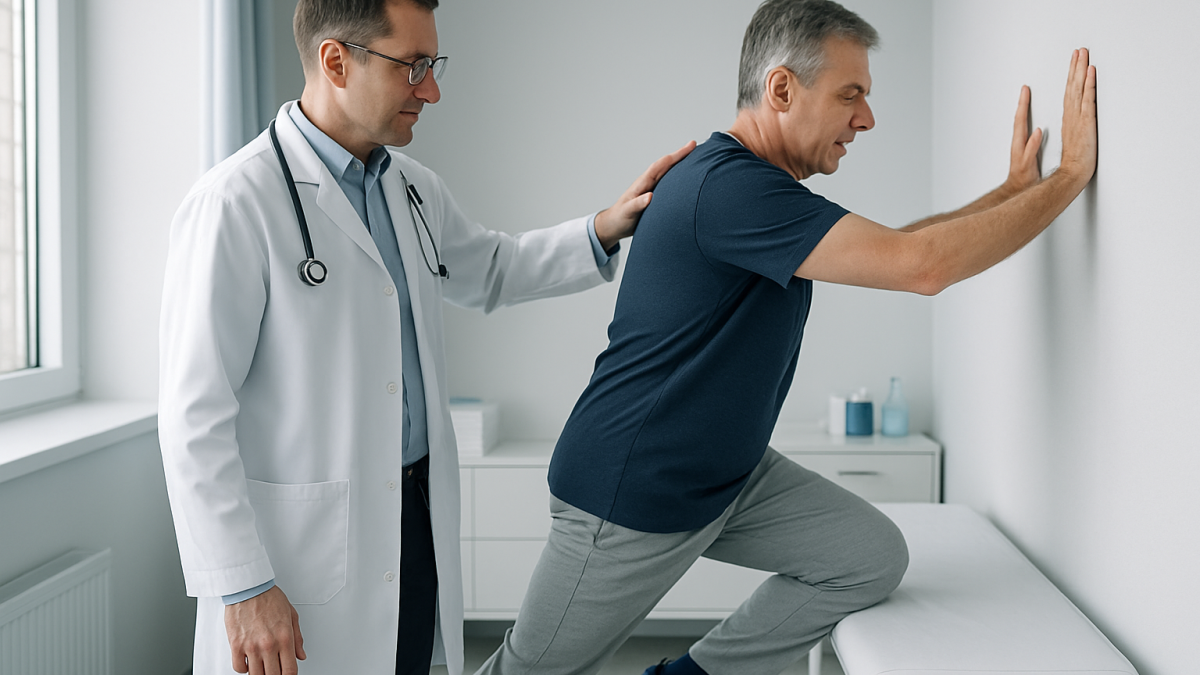
How can I stretch my calves myself? Start with the wall stretch
You need a wall and about 90 seconds per leg. The classic runner’s wall stretch targets the gastrocnemius and remains the version most widely recommended in mainstream guidance, including Mayo Clinic’s flexibility material.
- Stand facing a wall, roughly arm’s length away, and place both palms on it at chest height.
- Step one foot back: a comfortable stride, not a lunge. Point both feet straight at the wall, like skis. This detail matters; toes angled outward let the foot cheat the stretch.
- Keep the back leg straight and press that heel firmly into the floor.
- Bend the front knee and lean your hips toward the wall until you feel a gentle pull along the upper calf of the back leg. It should feel like a stretch, not a strain, around a 4 or 5 out of 10.
- Hold about 30 seconds, breathing normally. Don’t bounce. Switch legs.
- Repeat two to four times per side.
Two adjustments fix the most common problems. If you feel nothing, step the back foot farther away or lean the hips forward more: the stretch comes from hip position, not from bending the spine. If you feel pinching in the front of the ankle rather than a pull in the calf, shorten your stance and check that your back heel is truly flat.
Warm muscles stretch more comfortably than cold ones. A five-minute walk beforehand, or doing your stretches after a shower, makes the whole routine feel noticeably easier.
The soleus stretch almost everyone skips
If you only add one thing from this article to your routine, make it this. The soleus does the bulk of the calf’s daily labor, sits closest to the Achilles tendon, and is the muscle most people have never once deliberately stretched.
The setup looks nearly identical to the wall stretch, with one change that changes everything:
- Stand facing the wall, hands on it, one foot stepped back, but closer this time, perhaps half your normal stride.
- Keep the back heel planted, then bend the back knee, sinking straight down as if sliding your shin toward the wall.
- The sensation moves lower and deeper: a duller pull just above the heel rather than the sharp band behind the knee. That’s the soleus.
- Hold about 30 seconds; repeat two to four times per leg.
Because the soleus stretch works at a smaller joint angle, it often reveals asymmetries the straight-leg version hides. Plenty of people breeze through the gastrocnemius stretch and then discover one soleus is dramatically stiffer than the other, frequently on the side with the cranky heel or Achilles.
Pair the two versions back to back on each leg: straight knee first, then bent knee. The whole sequence takes under five minutes, and it covers both stories of the building instead of just the penthouse.
How to do calf stretches while sitting
Standing stretches aren’t an option for everyone, balance concerns, recent surgery, or simply a desk you can’t leave. Seated versions work the same tissue with far less demand on stability.
The towel stretch is the workhorse here, and it’s the one physical therapists most often hand to people recovering from foot and heel problems:
- Sit on the floor or on a firm bed with one leg extended straight in front of you.
- Loop a bath towel, belt, or resistance band around the ball of that foot.
- Keeping the knee straight and your back tall, gently pull the towel so your toes draw toward your shin.
- Stop when you feel the familiar pull along the calf. Hold about 30 seconds, then release. Repeat two to four times, then switch legs.
Chair-based ankle work suits an office. Sitting tall with feet flat, slide one foot back under the chair as far as comfortable while keeping the heel down: you’ll feel the deep soleus engage. Alternate with slow ankle circles and deliberate toe raises (lift the forefoot, heel planted) and heel raises (lift the heel, toes planted), ten of each.
Seated stretches produce a milder sensation than standing ones because gravity isn’t loading the ankle. That’s not a flaw. Gentler stretching held consistently still improves range of motion: the towel stretch has been a standard rehabilitation exercise for decades precisely because it’s effective without being provocative.
What are the best calf stretches for seniors?
Calf flexibility quietly shapes how safely older adults move. Restricted ankle motion shortens stride, encourages a shuffling gait, and makes curbs and stairs harder to negotiate, and given that the CDC reports more than one in four adults 65 and older falls each year, anything that improves foot clearance and balance deserves attention.
The priorities for seniors are support and gradual progression, not intensity:
- Supported wall stretch. The standard wall stretch works well with one adjustment: stand close enough that both hands rest solidly on the wall the entire time. A kitchen counter works just as well and offers a firmer grip.
- Seated towel stretch. Ideal for anyone with balance concerns or arthritis. Done from a sturdy chair or the edge of a bed, it removes the fall risk entirely.
- Chair-assisted heel drops, with caution. Standing on a low step and lowering the heels is a strong stretch, but it demands good balance. Skip it unless a solid railing is within grasp and balance is reliable; the wall version delivers most of the benefit at a fraction of the risk.
Start with shorter holds, 15 to 20 seconds, and build toward 30 as comfort allows. Stretch after a warm shower or a short walk, when tissue is more pliable. And a note for anyone with diabetes or reduced sensation in the feet: check foot positioning visually rather than relying on feel, and inspect the feet regularly, as MedlinePlus advises for foot care generally.
Which calf stretches should runners do, and when?
Runners ask their calves to absorb and return forces of two to three times body weight with every footstrike, several thousand times per run. Small wonder the calf–Achilles complex tops the injury lists for recreational runners.
Timing matters more than most runners realize. The evidence, summarized well in Harvard Health’s stretching guidance, points away from long static stretches on cold muscles right before a run. A better sequence:
- Before running: a dynamic warm-up, brisk walking, gentle heel raises, ankle circles, a few minutes of easy jogging. Save the long holds for later.
- After running: this is when static stretching earns its keep. Muscles are warm, and the run itself has just shortened them repeatedly. Do the straight-knee wall stretch and the bent-knee soleus stretch, 30 seconds each, two rounds per leg.
- The step stretch, used judiciously: standing with forefeet on a stair edge and slowly lowering the heels below step level gives a deeper stretch. It’s effective, but it’s also a significant load on the Achilles. Anyone with active Achilles pain should get individual guidance before using it, since the same movement done with resistance is a strengthening exercise, and dosage matters.
An honest note on prevention: research has not shown that stretching alone reliably prevents running injuries. What calf stretching demonstrably does is maintain ankle range of motion, which keeps running mechanics from degrading as mileage climbs. Treat it as maintenance, like rotating tires, rather than a force field.
How long does it take to stretch out very tight calves?
Here’s the answer nobody puts in a headline: weeks, not days, and the first change you notice won’t be length at all.
Within the first several sessions, stretching mainly changes your nervous system’s tolerance. The muscle doesn’t measurably lengthen; your body simply stops guarding against the stretch as aggressively, so the same position feels easier. That’s real progress, but it’s fragile, skip a week and it fades.
Measurable improvements in ankle range of motion typically show up after three to six weeks of near-daily stretching. Flexibility studies generally find meaningful gains when stretches are held around 30 seconds and repeated most days over that span, consistent with Mayo Clinic’s recommendation to stretch major muscle groups at least two to three times a week, with daily practice producing better results.
Very tight calves, decades of desk work, years in heeled shoes, or stiffness after an injury or immobilization, sit at the longer end. For that group, two to three months of patient, consistent work is a more honest expectation, and a physical therapist’s assessment is worth the appointment, because sometimes what feels like muscle tightness is actually joint stiffness or nerve sensitivity, which stretching alone won’t fix.
The encouraging flip side: consistency beats intensity by a wide margin. Ninety seconds per leg, once or twice daily, outperforms a heroic twenty-minute session every Sunday. Attach the routine to something you already do, the kettle boiling, brushing your teeth, and the weeks take care of themselves.
How long should I hold a calf stretch, and how often?
The research on stretch dosage is one of the tidier corners of exercise science, and the numbers are refreshingly modest. Holding a static stretch around 30 seconds appears to capture most of the benefit; longer holds add little for healthy adults, though older adults may get slightly more from holds approaching 60 seconds.
| Question | What the evidence supports |
|---|---|
| How long per hold? | About 30 seconds; up to 60 seconds may help adults over 65 |
| How many repetitions? | 2–4 per leg, per stretch variation |
| How often? | Minimum 2–3 days a week; daily works faster |
| How intense? | Gentle pull, roughly 4–5 out of 10, never sharp pain |
| Warm up first? | Yes: 5 minutes of easy movement, or stretch after activity |
| When to expect change? | Easier movement within 1–2 weeks; measurable range gains in 3–6 weeks |
Notice what’s absent from that table: pain. A stretch that hurts is a stretch your nervous system will fight, tightening the very muscle you’re trying to lengthen. The productive sensation is a firm, tolerable pull that eases slightly as you breathe through the hold.
Total time cost for the full menu, gastrocnemius and soleus, both legs, three rounds each, is about six minutes. That’s less time than most people spend deciding what to watch in the evening, which is perhaps the most persuasive statistic in this article.
Which mistakes make calf stretching useless, or worse?
Technique errors explain most cases of “I stretch all the time and nothing changes.” Five come up constantly:
- Bouncing. Ballistic, pulsing stretches trigger the muscle’s protective stretch reflex, causing it to contract against you, the opposite of the goal, and raising strain risk in tissue that’s already tight. Hold still and breathe.
- The heel that quietly lifts. The instant the back heel rises off the floor, the stretch largely disappears. If you can’t keep it down, your stance is too long. Shorten it.
- Toes turned out. Angling the back foot outward shifts load off the calf and into the arch and ankle. Both feet should point at the wall like train tracks.
- Stretching through sharp pain. A gentle pull is productive; sharp, burning, or electric sensations are a stop sign. Pain that radiates below the calf or causes tingling suggests nerve involvement: a reason to see a professional, not to push harder.
- Only stretching when something hurts. Two frantic weeks of stretching after the heel starts aching, then nothing until the next flare-up. Flexibility behaves like fitness: it’s earned slowly and lost with disuse.
One more subtle error deserves mention: stretching only the leg that hurts. Tightness is usually bilateral even when symptoms aren’t, and the quieter leg is often next in line. Stretch both, always: the symmetric habit takes three extra minutes and spares you a sequel.
Are your shoes and your chair part of the problem?
Muscles adapt to the positions they’re held in. Keep a calf shortened for eight hours a day and it will, quite reasonably, conclude that short is its new normal.
Two modern habits do exactly that. Heeled footwear, and this includes many men’s dress shoes and cushioned running shoes with a thick heel-to-toe drop, not just stilettos, holds the ankle in slight plantar flexion all day, keeping the calf in a shortened position. Regular wearers of elevated heels tend to show measurably reduced ankle dorsiflexion compared with people in flatter shoes. Then there’s sitting: knees bent, ankles idle, soleus switched off for hours at a stretch. Neither habit is a moral failing, but both stack the deck.
The countermeasures are pleasantly small:
- Alternate shoe heights across the week rather than living in one pair. Sudden switches to completely flat or minimalist shoes, incidentally, can provoke calf and Achilles soreness, transition gradually.
- Break up sitting every 30 to 60 minutes with a one-minute walk or a set of standing heel raises. Your soleus, the “second heart” pumping blood back from your legs, benefits, and so does your circulation generally.
- Do the bent-knee soleus stretch at the wall during natural pauses: waiting for coffee, between meetings.
Think of these as reducing the daily deficit so your stretching sessions aren’t constantly bailing water out of a leaking boat.
Why stretching alone isn't enough
Here’s an opinion, grounded in a couple of decades of rehabilitation research: if you have to choose between stretching your calves and strengthening them, strengthen. Fortunately you don’t have to choose.
A calf that’s both flexible and strong tolerates far more than one that’s merely flexible. Tendons in particular respond to load, not length, which is why progressive heel-raise exercises, especially the slow lowering (eccentric) phase, sit at the center of standard care for Achilles tendon problems, while stretching plays a supporting role.
The foundational exercise is almost embarrassingly simple:
- Double-leg heel raises. Stand tall, fingertips on a counter for balance. Rise slowly onto the balls of both feet over two seconds, pause, then lower over three seconds. Build toward two or three sets of 10–15, a few days per week.
- Progress to single-leg raises once fifteen double-leg repetitions feel easy. A useful benchmark from clinical practice: many healthy adults under 60 can manage 20 or more single-leg heel raises per side. Fewer than ten, with the other side noticeably better, is worth investigating.
- Bent-knee heel raises shift emphasis to the soleus: the same knee-position logic as the stretches.
Strength work also protects the range you’re building. New flexibility without the strength to control it is like getting a longer ladder without checking the rungs. The combination, stretch for range, strengthen for capacity, is what the better evidence actually supports, and it’s what a good physical therapist would hand you on day one.
When calf pain means it's time to see a doctor
Most calf tightness is exactly what it feels like: stiff muscle that responds to patient stretching. But the calf is also where a few genuinely serious problems announce themselves, and telling them apart matters more than any stretch in this article.
Seek urgent medical carethe same day, if you notice:
- Calf pain with swelling, warmth, redness, or tenderness in one leg, especially after surgery, long travel, illness, or immobility. These can signal a deep vein thrombosis (DVT), a blood clot that becomes an emergency if it travels to the lungs. MedlinePlus notes that sudden shortness of breath or chest pain alongside leg symptoms warrants emergency care immediately. Do not stretch or massage a leg you suspect of harboring a clot.
- A sudden pop or snap in the calf or above the heel during activity, followed by weakness or inability to push off the foot, possible muscle tear or Achilles rupture.
Book a routine appointment for:
- Cramping calf pain that reliably appears with walking and eases within minutes of rest. This pattern, called claudication, can indicate narrowed leg arteries and deserves evaluation, particularly in people who smoke or have diabetes or high blood pressure.
- Numbness, tingling, or pain radiating from the back or buttock into the calf, which points toward nerve involvement rather than muscle tightness.
- Tightness or pain that hasn’t budged after six to eight weeks of consistent, correctly performed stretching and strengthening.
A useful rule of thumb: muscle tightness is usually symmetric-ish, gradual, and better with movement. Pain that is sudden, one-sided, swollen, or worse with movement has earned a professional opinion.
Frequently asked questions
What are the signs of tight calves?
Common signs include heels lifting during a squat, morning stiffness in the back of the lower leg, heel or arch pain with the first steps of the day, a tender Achilles tendon, and night cramps. A practical self-check is the knee-to-wall test: kneeling with your foot about 10 centimeters from a wall, you should be able to touch your knee to the wall without your heel lifting. If you can’t, calf tightness is a likely contributor.
How can I stretch my calves myself at home?
Two wall stretches cover both calf muscles. Stand facing a wall, hands on it, one leg stepped back with the heel down: keep the back knee straight and lean forward to stretch the gastrocnemius, then repeat with the back knee bent to reach the deeper soleus. Hold each for about 30 seconds, two to four times per leg. If standing is difficult, loop a towel around the ball of your foot while seated and gently pull the toes toward you.
What are the best calf stretches for seniors?
Supported versions are best: the wall stretch done close to the wall with both hands planted, a counter-supported version in the kitchen, or the seated towel stretch, which removes fall risk entirely. Start with 15–20 second holds and build to 30. Stretch after a warm shower or short walk when muscles are more pliable, and skip step-edge heel drops unless balance is reliable and a solid railing is within reach.
How long does it take to stretch out very tight calves?
Expect three to six weeks of near-daily stretching before ankle range of motion measurably improves, though movement often feels easier within the first week or two as your nervous system adapts. Very tight calves, from years of desk work, heeled shoes, or previous injury, may need two to three months. Consistency matters far more than intensity: 90 seconds per leg daily beats one long weekly session.
Should I stretch my calves before or after exercise?
After, primarily. Long static holds on cold muscles before activity don’t improve performance and may briefly reduce power, so warm up with dynamic movement instead, easy walking, heel raises, ankle circles. Save the 30-second static stretches for after exercise, when muscles are warm and have just been working in a shortened position. If you stretch at other times of day, a five-minute walk beforehand makes the stretch more comfortable and productive.
Can tight calves cause plantar fasciitis?
Tight calves are a recognized contributing factor, though rarely the sole cause. Limited ankle dorsiflexion changes how the foot loads during walking, increasing strain on the plantar fascia along the sole, and people with plantar fasciitis frequently show reduced ankle mobility on the painful side. That’s why calf stretching, both straight-knee and bent-knee versions, appears in standard self-care advice for plantar heel pain from sources like the NHS and Mayo Clinic.
Is it OK to stretch my calves every day?
Yes, daily gentle stretching is safe for most people and produces faster flexibility gains than the minimum of two to three days per week. The key word is gentle: each hold should feel like a mild pull, around 4 or 5 out of 10, never sharp pain. If a muscle is acutely strained, torn, or you suspect a blood clot, don’t stretch it; those situations need rest and medical assessment first.
Why do my calves cramp at night?
Night calf cramps have many possible causes: muscles held short all day, dehydration, prolonged sitting or standing, mineral imbalances, certain health conditions, and some medications. Gentle calf stretching before bed reduces cramp frequency for some people, and it’s a low-risk habit worth trying. If cramps are frequent, severe, or accompanied by swelling, weakness, or numbness, discuss them with your doctor, since occasionally they signal circulation or nerve issues.
Do calf stretches help knee pain?
They can help as part of a broader approach, because the gastrocnemius attaches above the knee and limited ankle mobility alters knee loading during walking, squatting, and stairs. The honest caveat: stretching alone has not been shown to resolve knee conditions, and evidence for pain relief varies. Combining calf stretches with strengthening, and getting persistent knee pain properly assessed, reflects what the evidence actually supports.
When should I worry about calf pain instead of stretching it?
Seek same-day medical care for calf pain with one-sided swelling, warmth, redness, or tenderness, possible signs of a deep vein thrombosis, and never stretch or massage a leg you suspect of a clot. A sudden pop with weakness suggests a tear and also needs prompt evaluation. See a doctor routinely for cramping that appears with walking and eases at rest, radiating numbness or tingling, or tightness unchanged after six to eight weeks of consistent stretching.
References
- NHS: Plantar fasciitis
- Cleveland Clinic: Calf Muscle: Anatomy and Function
- MedlinePlus: Deep Vein Thrombosis
This article is for general information only and is not a substitute for professional medical advice. Please consult a qualified doctor about your individual situation.

More from the Blog

Strength Training for Women: Why Lifting Heavy Does Not Make You Bulky, and What It Does for Bone
Strength training for women does not cause bulky muscle because women produce far less testosterone than men, and visible size requires years of deliberate…
Morning Stretches: A 10-Minute Routine Built From Physiology, Not Instagram
Gentle morning stretching is safe for most people and helps ease overnight stiffness, which comes from cooled muscles, thickened joint fluid, and fluid absorbed…

Muscle Memory Is Real: The Cell Biology Behind Getting Strong Again Faster
Muscle memory is real, and it works on two levels. In the brain, practiced movements are stored as procedural memory, so skills like a…
Kettlebell Swings: Form, Benefits and the Back-Pain Mistake
A kettlebell swing is a hip-hinge exercise that trains the glutes, hamstrings and back muscles while raising heart rate, and small trials show it…

How Long Does It Take to Walk a Mile? Pace, Age and What It Says About Fitness
Most adults walk a mile in about 15 to 22 minutes, which works out to roughly 3 miles per hour. A brisk pace covers…

The Post-Workout Meal: The Anabolic Window, Revisited
A post workout meal still matters, but the strict 30-minute anabolic window does not hold up in randomized trials. Evidence suggests eating 20–40 grams…