

Can Antibiotics Treat Uncomplicated Appendicitis Without Surgery? How Doctors Weigh Both Paths

Key Takeaways
- In the CODA trial, 29 percent of people treated with antibiotics for appendicitis had surgery within 90 days, rising to about 49 percent by three to four years.
- An appendicolith, a calcified stool stone visible on CT, raised the 90-day appendectomy rate in CODA from 25 to 41 percent and accounted for most of the excess complications in the antibiotic group.
- APPAC's five-year follow-up found a 39.1 percent cumulative recurrence rate after antibiotics, and most recurrent cases were still uncomplicated when operated on.
- Nearly half of CODA's antibiotic group, 47 percent, were treated without any hospital admission.
- The NHS reports that many people go home within 24 hours of a keyhole appendectomy, with activity limited for roughly three to five days according to Mayo Clinic.
- Appendicitis is not contagious; it is caused by blockage of the appendix, usually from swollen lymphoid tissue or a hardened piece of stool.
Yes, for carefully selected patients. Large randomized trials show that an antibiotic-first approach is a reasonable option for uncomplicated appendicitis, meaning an inflamed appendix with no rupture, abscess or stool stone on imaging. Roughly three in ten people treated with antibiotics still have surgery within a few months, and close to half within several years. Appendectomy remains the standard, definitive treatment, and the choice rests with the treating team.
It usually begins in the small hours. A dull ache near the belly button that, by breakfast, has settled low on the right side and sharpened with every bump of the car ride to the emergency department. A scan confirms what the surgeon already suspected. Then comes a sentence that would have surprised most patients a generation ago: “There are two reasonable ways to treat this.”
That conversation, antibiotics vs surgery for appendicitis, now happens in emergency departments across the country, and it leaves many people blinking. The appendix is supposed to come out. That is what happened to a parent, a roommate, a coworker. Being handed a choice feels less like progress and more like homework assigned at the worst possible moment.
This explainer lays out the evidence that your surgeon is weighing: who the antibiotic path tends to suit, how often it holds, and what the weeks afterward look like on either road. The decision belongs to you and your treating team. What follows is the material they will be drawing on.
What is uncomplicated appendicitis, and why does that word matter so much?
The appendix is a finger-sized pouch hanging off the first part of the large intestine, tucked into the lower right abdomen. Appendicitis is inflammation of that pouch, most often because its narrow opening becomes blocked and bacteria multiply behind the blockage.
Surgeons split the condition into two camps. Uncomplicated appendicitis means the appendix is inflamed but intact: no perforation (a hole in the wall), no abscess (a walled-off pocket of pus), and no diffuse peritonitis (inflammation spreading across the lining of the abdominal cavity). Complicated appendicitis is everything else. In the major trials, the uncomplicated label also usually excluded an appendicolith, a hardened, calcified lump of stool lodged in the appendix, for reasons that get a section of their own below.
The sorting is done mostly by CT, a cross-sectional X-ray that builds a detailed picture of the abdomen. In children and in pregnancy, ultrasound or MRI is often used first to avoid radiation. Every antibiotic-first trial required imaging confirmation, which is why a surgeon will not discuss the non-operative route on the basis of a physical exam alone.
The word matters because the entire antibiotics-versus-surgery debate applies only to the uncomplicated group. Once the appendix has ruptured or formed an abscess, antibiotics shift from being an alternative to surgery to being a supporting player alongside drainage or an operation. Mayo Clinic notes that a ruptured appendix can spread infection throughout the abdomen, a situation that is life-threatening and demands prompt surgical care.
One honest caveat belongs here. Imaging is good but not perfect. A small share of people whose scans look uncomplicated turn out to have a perforation when the surgeon looks directly, and some who begin antibiotics turn out to need an operation within the first day or two. The label is the best available starting point, not a guarantee.
Antibiotics vs surgery for appendicitis: what the big trials actually found
Two randomized trials anchor nearly every modern discussion. Both compared people assigned to antibiotics alone with people assigned to appendectomy, which is the surgical removal of the appendix.

The Finnish APPAC trial enrolled 530 adults with CT-confirmed uncomplicated appendicitis. Within one year, 27.3 percent of the antibiotic group had undergone appendectomy, which also means 72.7 percent had not. The trial technically failed its noninferiority test, a study design that asks whether a new approach is not meaningfully worse than the standard within a margin set in advance. Even so, it showed that most people with uncomplicated disease could get through a year without an operation.
The American CODA trial was larger and messier in a useful way: 1,552 adults, 25 centers, and it did not exclude people with an appendicolith. At 30 days, antibiotics were noninferior to surgery on a standard measure of general health. By 90 days, 29 percent of the antibiotic group had undergone appendectomy. Complications were more common in the antibiotic group, 8.1 versus 3.5 per 100 participants, and that difference was concentrated almost entirely among those with an appendicolith. Nearly half of the antibiotic group, 47 percent, were treated without any hospital admission at all.
Follow-up tells the rest of the story. In CODA, the share of antibiotic-treated participants who eventually had surgery rose to 40 percent at one year and 49 percent by three to four years. In APPAC, the five-year cumulative recurrence rate was 39.1 percent.
Read plainly, the trials say two things at once. Antibiotics resolve the acute episode for a clear majority, and over the years roughly half of those people end up having the operation anyway. Neither finding cancels the other. How a person weighs them is the heart of the decision.
How does appendicitis treatment without surgery actually work?
The logic is straightforward. Appendicitis is driven by bacteria multiplying inside a blocked, swollen tube. Reduce the bacterial load quickly enough and the wall may stop deteriorating, the swelling may ease, and in many cases the obstruction clears as the tissue calms down.
The antibiotics used are broad-spectrum, which means they cover the mixed population of gut bacteria, including anaerobes, the types that thrive without oxygen. In the trials this was typically a beta-lactam class antibiotic, sometimes paired with an agent active against anaerobes such as metronidazole. These are named here only to explain the strategy. Which combination a person receives depends on local resistance patterns, allergies and kidney function, and it is entirely the prescribing clinician’s call.
The course usually begins intravenously, in the emergency department or on a ward. In CODA, participants received at least 24 hours of intravenous treatment before switching to oral tablets; APPAC used three days of intravenous therapy. Both trials completed roughly ten days of total treatment. These are the published trial protocols, not instructions, and individual regimens vary.
The first day or two are the real test. Clinicians watch pain, temperature, heart rate and blood markers of inflammation. Steady improvement is the expected pattern. Pain that worsens, a rising fever or a hardening abdomen in that window usually prompts a move to surgery rather than persisting with medication.
What antibiotics do not do is remove the appendix or dissolve a stool stone. The organ stays, with its anatomy unchanged, which is precisely why recurrence is possible. Routine follow-up imaging is not standard after a successful course; the decision to re-scan is driven by symptoms.
Side effects are real, if usually modest: nausea, diarrhea, rash, and a small risk of Clostridioides difficile infection, a bacterium that can overgrow in the gut when normal flora are suppressed. Anyone with known antibiotic allergies should raise them before the first dose is given.
What actually happens during an appendectomy?
Appendectomy is one of the most frequently performed emergency operations in the world, and in most hospitals it is done laparoscopically, a keyhole technique using a camera and slim instruments passed through three small incisions. The alternative is open surgery through a single cut in the lower right abdomen, used when scar tissue, severe inflammation or surgeon judgment makes keyhole access difficult. Either way, the procedure is performed under general anesthesia, so the patient is fully asleep.
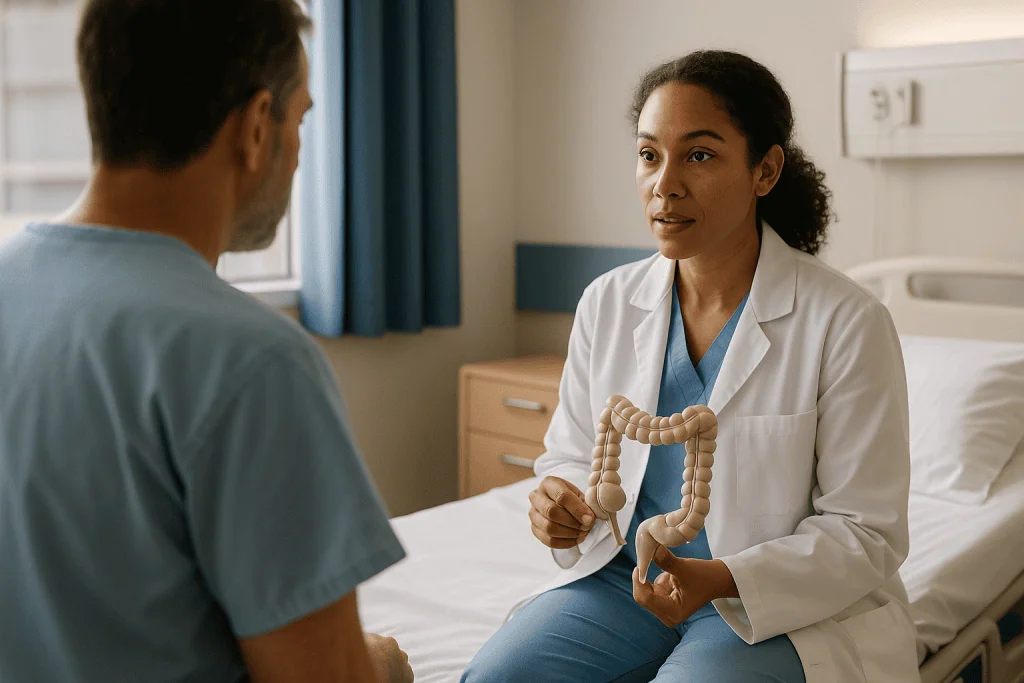
The surgeon frees the appendix from surrounding tissue, seals its blood supply and the base where it joins the large intestine, and lifts it out. If the appendix has already perforated, the surgeon washes out the cavity and may leave a drain. The whole operation commonly takes under an hour, though complicated cases run longer.
The NHS notes that surgery is usually carried out soon after diagnosis and that many people go home within 24 hours of a keyhole appendectomy. Mayo Clinic advises limiting activity for three to five days after a laparoscopic operation and ten to fourteen days after an open one, with full return to normal life guided by the surgical team.
The removed appendix goes to a pathology laboratory, where it is examined under a microscope. In a small minority of cases this reveals something unexpected, such as a tumor, and the pathology report is one argument surgeons raise in favor of removal, particularly in older adults.
Risks are those of any abdominal operation: bleeding, wound infection, a pelvic abscess after the fact, injury to nearby bowel or vessels, blood clots, and reactions to anesthesia. Keyhole surgery is sometimes converted to open surgery mid-procedure if the view is poor. A proportion of operations also find a normal appendix, a so-called negative appendectomy, which is why pre-operative imaging has become the norm.
After surgery there is no appendix to flare again. Stump appendicitis, inflammation of the small remnant left at the base, is a rare exception.
Who is usually offered antibiotics first, and who is usually steered toward surgery?
Eligibility tracks the trial populations closely. The person most likely to be offered an antibiotic-first approach is an adult with imaging-confirmed uncomplicated appendicitis, stable vital signs, no appendicolith, the ability to swallow and keep down oral medication, and a realistic way to return quickly if things change. Reliable follow-up matters more than many people expect; a surgeon is unlikely to offer the non-operative route to someone leaving the area the next morning.
Several groups are generally steered toward surgery, either because the trials excluded them or because the biology argues against waiting. These include people with perforation, abscess or free fluid on imaging; those with signs of sepsis, the body’s dangerous, system-wide response to infection; pregnant patients, who were excluded from the major adult trials; people with severe immune suppression or inflammatory bowel disease; and anyone in whom the scan raises suspicion of a tumor. A previous episode treated with antibiotics that has now recurred also tilts most surgeons toward removal.
An appendicolith sits in the gray zone. CODA did not exclude it, so the data exist, and the data are unfavorable enough that many teams treat it as a relative reason to operate rather than an absolute one. That is a conversation, not a rule.
Children are a separate question. Pediatric trials of antibiotic-first treatment exist, with broadly similar themes, but practice varies between centers and the decision rests with pediatric surgeons who know the child’s history. This article is written around adults.
Some people are asked to wait in a different sense: when the diagnosis itself is uncertain, clinicians may observe with repeat examinations and blood tests over several hours rather than commit to either path. Watchful waiting on a ward is not the same as antibiotic treatment, and patients sometimes confuse the two.
Finally, preference counts. CODA was built around shared decision-making, and the trial’s authors were explicit that people weigh the same facts differently.
Appendectomy vs antibiotics recurrence: what "it came back" really means
Two different events hide inside the word failure, and separating them clarifies the numbers.
The first is early non-response: the antibiotics simply do not settle the episode, and surgery follows within hours or days. The second is true recurrence: the antibiotics work, the person goes home well, and months or years later the appendix flares again. Trials usually lump both into the headline appendectomy rate, which is why that figure climbs over time.
APPAC’s five-year follow-up gives the clearest long view. The cumulative recurrence rate among antibiotic-treated participants reached 39.1 percent, and most recurrences happened within the first year. Two details from that report are worth more attention than they usually get. The majority of recurrent cases were still uncomplicated when they reached the operating room, and the people who had surgery late did not fare worse than those operated on at the first episode. Delay, in other words, did not appear to convert a routine operation into a dangerous one for most people.
CODA’s longer follow-up showed appendectomy in 40 percent of the antibiotic group at one year, rising to 49 percent by three to four years. The curve flattens after the first year or two; the appendix does not keep failing at the same rate forever.
Turn the figures around and the other half of the picture appears: roughly half of people who chose antibiotics in these trials were still living with their appendix years later and had not needed surgery.
After appendectomy, recurrence is close to a non-issue. The organ is gone. Stump appendicitis, inflammation in the small remnant at the base, is rare and is the only way the condition can genuinely return.
The practical upshot is that the antibiotic path trades a certain, modest operation now for an uncertain, roughly coin-flip chance of a similar operation later. How that trade feels depends on temperament as much as on biology.
The appendicolith problem: why one CT finding changes the odds
If one piece of information deserves to be asked about before anything else, it is whether the scan shows an appendicolith.
An appendicolith is a hardened, mineralized pellet of stool wedged in the appendix, visible on CT as a bright white speck. Mechanically, it is a cork. Antibiotics can reduce the bacterial population behind it, but they cannot shift the cork, so pressure in the appendix stays high and the inflammation has a ready reason to return.
CODA quantified the consequence. Participants with an appendicolith who were randomized to antibiotics had a 90-day appendectomy rate of 41 percent, compared with 25 percent in those without one. Complications in the antibiotic group were strikingly concentrated in the appendicolith subgroup, 20.2 per 100 participants versus 3.6 per 100 among those without a stone. Strip out the appendicolith cases and the complication rates of the two treatment arms looked far closer.
APPAC had excluded appendicolith patients from the start, which is one reason its early failure rate was lower and why the two trials are not quite comparing the same thing.
In practice, many surgeons now treat an appendicolith as a strong nudge toward surgery, and some decline to offer antibiotics at all when one is present. Others still discuss it, framed honestly as a path with worse odds. Neither position is wrong; the evidence supports caution without mandating an operation.
Appendicoliths also tend to be found more often in children than in adults, which is one of several reasons pediatric decisions differ.
The takeaway is simple. Ask the surgeon to show you the report. The presence or absence of that one bright speck changes the conversation more than age, sex or how much the abdomen hurts.
Antibiotics vs surgery for appendicitis: a side-by-side summary
The table below condenses the published evidence into the comparisons people ask about most. Figures come from the trials and sources listed in the references; they describe trial populations, not any individual’s outlook.
| Question | Antibiotics first | Appendectomy |
|---|---|---|
| What it involves | Intravenous then oral antibiotics, roughly ten days total in the trials | Keyhole or open removal under general anesthesia |
| Typical hospital time | Often under 24 hours; about 47% of CODA’s antibiotic group avoided admission | Home within about 24 hours of keyhole surgery (NHS) |
| Chance of surgery later | 29% by 90 days, 40% at one year, 49% by 3–4 years (CODA); 39.1% at five years (APPAC) | Not applicable; rare stump appendicitis only |
| Early complications | 8.1 per 100 in CODA, driven by appendicolith cases | 3.5 per 100 in CODA |
| Activity restriction | As symptoms allow; no incisions | 3–5 days keyhole, 10–14 days open (Mayo Clinic) |
| Pathology check | None; appendix stays | Specimen examined under microscope |
| Who it usually suits | Stable adults, no appendicolith, reliable follow-up | Anyone eligible for surgery; required for complicated disease |
What the grid cannot show is the texture of each path. The antibiotic route front-loads convenience and back-loads uncertainty: less disruption this week, an open question for the next few years. Surgery does the reverse, concentrating the disruption and the small but real operative risks into a single, finite episode and then closing the file.
People who travel often, live far from a hospital, or simply dislike unresolved questions tend to find the surgical column more comfortable. People with a pressing exam, a new baby at home, or a strong wish to avoid anesthesia often lean the other way. Both responses are rational readings of the same numbers.
What do the next days and weeks usually look like on each path?
On the antibiotic path, the first 24 to 48 hours set the tone. Some people stay on a ward for intravenous treatment and observation; others, as in nearly half of CODA’s antibiotic group, are discharged from the emergency department with oral tablets and clear instructions on when to return. Pain should ease steadily. A clinician will usually want a check-in by phone or in person within a day or two, and then at the end of the course.
Once home, the limiting factor is how the abdomen feels rather than any surgical restriction. Many people are back to desk work within a few days. CODA participants in the antibiotic group missed fewer days of work than those who had surgery, roughly five versus nearly nine, though the surgery group’s figure includes the operation itself. The full oral course in the trials ran about ten days, and finishing it matters even once symptoms have vanished. After that, life resumes with one new habit: paying attention to right-sided abdominal pain for the next year or two, when recurrence is most likely.
On the surgical path, most people are home within a day of a keyhole appendectomy, according to the NHS. The first few days bring soreness at the incisions, shoulder-tip discomfort from the gas used to inflate the abdomen, and fatigue from anesthesia. Mayo Clinic’s guidance is to limit activity for three to five days after laparoscopic surgery and ten to fourteen days after open surgery. Walking early is encouraged because it lowers the risk of blood clots and helps the bowel wake up.
Wounds are kept clean and dry; stitches are often dissolvable. Driving waits until a person can brake sharply without flinching, and heavy lifting waits as long as the surgical team advises. The NHS describes full recovery from keyhole appendectomy as typically taking a couple of weeks, longer after open surgery or a perforation.
Neither timeline is a promise. Both are averages drawn from large groups, and the treating team’s instructions override any general range.
Is appendicitis contagious, and what actually causes it?
Appendicitis is not contagious. It cannot be caught from a family member, a classmate or a coworker, and no isolation precautions are needed around someone who has it. The question comes up often because the condition sometimes seems to cluster, with two siblings or two roommates falling ill within months of each other. Those clusters reflect coincidence, shared anatomy within families, and the simple fact that appendicitis is common, not transmission.
The underlying cause is blockage. The appendix is a narrow, blind-ended tube, and anything that plugs its opening traps mucus and bacteria inside. Mayo Clinic lists the usual culprits: swelling of the lymphoid tissue that lines the appendix, often after a viral infection elsewhere in the body; a hardened piece of stool, the appendicolith discussed above; and, far less often, tumors, parasites or scarring. Behind the plug, pressure rises, blood flow to the wall falls, and the bacteria that normally live quietly in the gut begin to multiply and invade the tissue. Within a day or two, an untreated appendix can lose its blood supply and perforate.
This chain of events explains why antibiotics can work at all. They attack the bacterial overgrowth, the part of the process that does the most damage. They cannot undo the blockage, which is why the appendix remains at risk of a repeat performance.
No reliable prevention exists. Diets higher in fiber have been loosely associated with lower rates in population studies, but the evidence is weak and no one should expect a change in eating habits to protect them. Hand-washing and hygiene, so central to preventing truly infectious illness, have no bearing on appendicitis.
One more reassurance: having appendicitis says nothing about a person’s cleanliness, diet or lifestyle. It is, for the most part, an accident of plumbing.
What is the gold standard treatment for acute appendicitis today?
Appendectomy remains the standard, definitive treatment for acute appendicitis. The NHS describes surgical removal as the main treatment, Mayo Clinic frames it the same way, and no major guideline has displaced it. The reasons are durable: the operation resolves the problem permanently, it allows the appendix to be examined for unexpected disease, and more than a century of experience has made it safe in most settings.
What has changed is the status of the alternative. Surgical societies in North America and Europe now acknowledge an antibiotic-first strategy as an acceptable option for selected adults with imaging-confirmed uncomplicated appendicitis, provided the patient understands the recurrence figures and chooses it after a genuine discussion. This is a guideline-level endorsement of a choice, not a declaration that one path has beaten the other. The evidence behind it is strong: two large randomized trials, consistent in their main findings, with multi-year follow-up.
For complicated appendicitis, the picture is different and less debated. A perforation with generalized peritonitis is a surgical emergency. A contained abscess is often managed first with antibiotics and, where needed, a drain placed through the skin under imaging guidance, with the appendix sometimes removed weeks later in a planned operation called an interval appendectomy. Whether interval appendectomy is always necessary is itself a live question, and that decision again belongs to the treating team.
The phrase gold standard can mislead in one respect. It implies that choosing anything else is settling for second best. The trial data do not support that reading. For a stable adult without an appendicolith, antibiotics are a legitimate first move backed by high-quality evidence, carrying a known chance of surgery later. For someone who wants certainty, surgery is the equally legitimate first move. The standard has not been overturned; it has acquired company.
What people often get wrong about antibiotics and appendicitis
Misunderstandings cluster around a few predictable points, and clearing them up tends to make the actual decision easier.
- “If I choose antibiotics, I will never need surgery.” The trials say otherwise. About half of antibiotic-treated participants in CODA had an appendectomy within three to four years. Antibiotics are a reasonable first option, not a permanent exit.
- “If I choose antibiotics, my appendix will burst.” The feared catastrophe did not dominate the trial results. Complications were higher in the antibiotic group, but overwhelmingly among people with an appendicolith, and most recurrences in APPAC were still uncomplicated when operated on. Risk exists; it is not the cliff edge many imagine.
- “Surgery means a week in hospital.” The NHS notes that many people go home within 24 hours of a keyhole appendectomy.
- “The pain went away, so it wasn’t appendicitis.” Pain that suddenly eases can signal perforation, as pressure inside the appendix is released. Improvement without medical review is not reassurance.
- “I can take leftover antibiotics at home.” No. The trials used specific intravenous-then-oral regimens under monitoring, with imaging confirmation first. Self-treatment risks masking a perforation and breeding resistance.
- “The appendix is useless, so removal is always the obvious answer.” The appendix contains immune tissue and may serve as a reservoir for gut bacteria, though removing it has no proven long-term harm. Its usefulness is not the deciding factor either way.
The deeper error is treating this as a contest with a winner. The honest summary is that both paths work for most people, each carries a different shape of risk, and the right choice depends on which risks a particular person is willing to carry. Anyone who promises a clean answer in either direction is selling certainty the evidence does not contain.
Questions to ask your care team before choosing
A good surgical conversation in the emergency department is short on time and long on consequence. Having questions ready helps. These are the ones that tend to change decisions.
- Is my appendicitis uncomplicated on the scan, and how confident are you in that reading?
- Does the scan show an appendicolith? If so, how does that change what you would recommend?
- Am I a candidate for antibiotics first at this hospital, and what would that involve for me, including whether I would be admitted or sent home?
- If I start antibiotics, what signs would tell you they are not working, and how quickly would we switch to surgery?
- If I have surgery, is it likely to be keyhole or open, and what are the specific risks for someone with my medical history?
- Roughly how long would you expect me to be away from work or caregiving on each path?
- Who do I call, and at what number, if I am at home and things change at night or over a weekend?
- If I choose antibiotics and the appendicitis returns, is a later operation harder or riskier than one now?
- Are there features of my case, such as age, pregnancy, immune status or other conditions, that make one path clearly preferable?
- If the appendix is removed, will I hear about the pathology results, and when?
Two softer questions are also worth asking yourself. How much do I dislike unresolved medical questions hanging over me? And how disruptive would an unplanned hospital visit be in the coming year? People who answer “a great deal” to either often find surgery the more restful choice. People who answer “not much” often lean toward antibiotics.
Write the answers down or ask a companion to. Decisions made at three in the morning on little sleep are easier to live with when the reasoning is on paper.
When to call your doctor: red-flag signs on either path
Whichever route is chosen, certain developments mean the plan needs to change, and quickly. Appendicitis that worsens can progress to perforation within hours, so these are not symptoms to monitor overnight and mention at the next appointment.
Seek urgent medical attention, or call emergency services if symptoms are severe, for any of the following: abdominal pain that intensifies rather than easing, or that spreads from the right side across the whole abdomen; an abdomen that feels rigid or board-like to the touch; fever that climbs or returns after improving; repeated vomiting or an inability to keep fluids down; a racing heartbeat, lightheadedness, confusion or fainting, which can signal sepsis; and pain that suddenly vanishes without treatment, which can mean the appendix has perforated and pressure has been released.
During a course of antibiotics, additional warning signs include no meaningful improvement within the first 48 hours, new or worsening pain after an initial good response, severe or bloody diarrhea, or a widespread rash, swelling of the lips or difficulty breathing, which may indicate an allergic reaction. Pain on the right side returning weeks, months or years after a completed course should be assessed promptly rather than waited out; recurrence is a known possibility, and early review keeps the options open.
After surgery, contact the surgical team for increasing redness, warmth, swelling or discharge at an incision; a wound that opens; fever; worsening rather than improving abdominal pain; persistent vomiting; a swollen, painful calf; or chest pain and shortness of breath, which need emergency assessment for a blood clot.
None of these lists is exhaustive, and none replaces the specific instructions given at discharge. When in doubt, call. Clinicians would far rather hear about a false alarm than meet a perforation that could have been caught earlier. Every decision about what happens next rests with the treating team.
Frequently asked questions
What is uncomplicated appendicitis?
Uncomplicated appendicitis means the appendix is inflamed but has not perforated, formed an abscess or caused widespread inflammation of the abdominal lining. The label is assigned on imaging, usually CT, and in most trials it also required the absence of an appendicolith. Only this category is eligible for antibiotic-first treatment; complicated appendicitis is managed with surgery or drainage plus antibiotics.
What is the gold standard treatment for acute appendicitis?
Appendectomy, the surgical removal of the appendix, remains the standard and definitive treatment, as described by the NHS and Mayo Clinic. Surgical guidelines now also recognize an antibiotic-first approach as an acceptable alternative for selected adults with imaging-confirmed uncomplicated appendicitis, chosen after a frank discussion of recurrence rates. The standard has not been replaced; a second evidence-based option sits alongside it.
Is appendicitis contagious?
No. Appendicitis cannot be passed from one person to another and requires no isolation. It results from a blockage of the appendix, most often by swollen lymphoid tissue or a hardened piece of stool, behind which normal gut bacteria multiply. Apparent clusters in families or households are coincidence or shared anatomy, not transmission.
Which antibiotics are used for appendicitis treatment without surgery?
Clinicians use broad-spectrum antibiotics that cover the mixed gut bacteria involved, typically a beta-lactam class agent, sometimes combined with a drug active against anaerobic bacteria such as metronidazole. Treatment usually starts intravenously and continues by mouth for about ten days in total, following the published trial protocols. The exact choice depends on allergies, local resistance patterns and kidney function, and rests entirely with the prescribing clinician.
How often does appendicitis come back after antibiotics compared with appendectomy?
In the APPAC trial, 39.1 percent of antibiotic-treated participants had recurrent appendicitis within five years, most within the first year. In CODA, 40 percent of the antibiotic group had surgery by one year and 49 percent by three to four years. After appendectomy, recurrence is essentially not possible apart from rare stump appendicitis in the remnant tissue.
Can appendicitis be treated with antibiotics at home?
Sometimes, but only after imaging confirmation and an initial assessment in hospital. In the CODA trial, 47 percent of antibiotic-treated participants were discharged from the emergency department without admission, with oral tablets and strict return instructions. Self-treating suspected appendicitis with leftover antibiotics is unsafe; it can mask a perforation and delay care that may be urgently needed.
How long does recovery take after an appendectomy?
The NHS notes that many people go home within 24 hours of a keyhole appendectomy and recover fully in about a couple of weeks. Mayo Clinic advises limiting activity for three to five days after laparoscopic surgery and ten to fourteen days after open surgery. Recovery takes longer if the appendix had perforated. Individual timelines vary and the surgical team’s advice applies.
Does having an appendicolith rule out antibiotics?
Not absolutely, but it changes the odds considerably. In CODA, people with an appendicolith who received antibiotics had a 41 percent chance of surgery within 90 days versus 25 percent without one, and a far higher complication rate. Many surgeons treat the finding as a strong reason to recommend surgery, while some still discuss antibiotics with the poorer odds explained.
Can children have antibiotics instead of surgery for appendicitis?
Pediatric trials of antibiotic-first treatment exist and show broadly similar themes to adult studies, but practice varies widely between centers and children more often have an appendicolith. The decision rests with pediatric surgeons who know the child’s history and imaging. Parents should expect a discussion of the pathway, monitoring and comfort rather than a universal recommendation.
Will my appendix burst if I choose antibiotics instead of surgery?
The trials did not show the sudden catastrophe many fear. Complications were more frequent in antibiotic-treated participants in CODA, 8.1 versus 3.5 per 100, but that excess was concentrated among people with an appendicolith. Most recurrences in APPAC were still uncomplicated at surgery. Risk exists and is monitored closely in the first 48 hours, which is why worsening pain or fever means returning immediately.
This article is for general information only and is not a substitute for professional medical advice. Please consult a qualified doctor about your individual situation.

More from the Blog

Robotic vs Laparoscopic Gallbladder Removal: Does the Robot Change Your Recovery?
Robotic and laparoscopic gallbladder removal are both keyhole operations, and current evidence does not show that the robot shortens recovery, reduces pain, or lowers…

When Do Surgeons Still Choose Open Appendectomy Over Laparoscopic? The Deciding Factors
Surgeons still choose open appendectomy when the abdomen cannot be safely worked in with a camera: a burst appendix with widespread infection, dense scar…

Eating After Achalasia Treatment: Meal Habits That Support Swallowing in the Long Term
After achalasia treatment, most people are advised to eat slowly, take small bites, chew thoroughly, sit upright during and after meals, sip water between…

When Is Hepatopancreatobiliary (HPB) Surgery Needed? From Tumors to Bile Duct Strictures
HPB surgery is usually needed when a liver, pancreas, gallbladder or bile duct problem cannot be safely managed with medicines, endoscopy or watchful waiting.…

Do Gallstones Always Need Surgery? Watchful Waiting vs Cholecystectomy Explained
No. Gallstones do not always need surgery. Most people who have them never develop symptoms, and silent stones found by chance are usually monitored…

How Do Surgeons Choose Between Robotic, Laparoscopic and Open Hernia Repair?
Surgeons choose between robotic, laparoscopic and open hernia repair based on the hernia's location and size, whether it is a first repair or a…