

Do Gallstones Always Need Surgery? Watchful Waiting vs Cholecystectomy Explained

Key Takeaways
- The NIDDK estimates that about 10 to 15 percent of US adults have gallstones, and most never develop symptoms.
- Silent stones found by chance are usually monitored, not removed; surgery is generally offered once stones cause repeated pain or a complication.
- A gallstone attack happens when a stone temporarily blocks the gallbladder outlet, and the NHS notes the pain can last from a few minutes up to about five hours.
- Surgeons remove the whole gallbladder rather than just the stones because an organ that has formed stones is very likely to form more.
- The NHS indicates most people return to normal activities around two weeks after keyhole cholecystectomy, compared with six to eight weeks after open surgery.
- Fever with abdominal pain, yellowing of the skin or eyes, or pain that will not settle after a few hours are red flags that should move someone from waiting to urgent assessment.
No. Gallstones do not always need surgery. Most people who have them never develop symptoms, and silent stones found by chance are usually monitored rather than removed. Surgery to remove the gallbladder (cholecystectomy) is generally offered once stones cause repeated pain or complications such as gallbladder inflammation, bile duct blockage or pancreatitis. The treating team weighs symptoms, scan findings and overall health before recommending either path.
The scan was for something else. A kidney check, a vague ache, a routine look after a car accident. Then the radiology report mentions, almost in passing, “multiple gallstones noted.” Within an hour the person holding that report is typing the question into a phone: do gallstones always need surgery?
It is a fair thing to ask, because gallbladder removal is one of the most common operations performed in general surgery, and plenty of people know someone who has had it. What fewer people know is that the gallbladder is also one of the most common organs to be left exactly where it is. A great many gallstones are discovered, documented and then simply watched.
This explainer sets out how surgeons and gastroenterologists actually decide. It covers the mechanism behind gallstone pain, who is usually offered an operation, who is usually asked to wait, what the procedure involves, what recovery tends to look like, and the warning signs that should move a conversation from “let’s monitor” to “let’s act.”
Do gallstones always need surgery? The short, honest answer
Gallstones are hardened deposits that form inside the gallbladder, the small pear-shaped pouch tucked under the liver that stores bile. The National Institute of Diabetes and Digestive and Kidney Diseases (NIDDK) estimates that roughly 10 to 15 percent of adults in the United States have them, and that most of those people will never notice.
That single fact reshapes the whole question. If stones were inherently dangerous, millions of people would be in trouble. They are not. A stone sitting quietly in the gallbladder, not blocking anything, causes no harm. Surgeons therefore do not treat the stone; they treat what the stone is doing.
So the honest answer splits into two parts. Silent stones, found by chance on a scan done for another reason, are usually left alone and monitored. Symptomatic stones, meaning stones that have caused an attack of pain or a complication, usually tip the balance toward removing the gallbladder, because once one attack has happened, further attacks become more likely and complications become harder to predict.
Between those two poles sits a grey zone: one mild episode, atypical pain that may or may not be gallstone-related, or a person with other health conditions that make an operation riskier than usual. In that zone the decision is a conversation, not a rule, and it belongs to the person and the treating team together.
What the evidence does not support is either extreme. Removing every gallbladder that contains a stone would expose many people to an operation they would never have needed. Ignoring recurring attacks because “it settled last time” leaves people exposed to inflammation, infection and bile duct blockage that can arrive without much warning.
What gallstones actually are, and why some stay silent
Bile is a digestive fluid made by the liver. It contains water, bile salts, cholesterol and a pigment called bilirubin, which is the yellowish breakdown product of old red blood cells. The gallbladder concentrates bile between meals and squeezes it out into the small intestine when fat arrives, helping break that fat into absorbable droplets.

Trouble starts when the chemistry tips out of balance. According to the Mayo Clinic, most gallstones form when bile holds more cholesterol than the bile salts can keep dissolved; the excess crystallizes and the crystals slowly grow. A smaller group, pigment stones, form when there is too much bilirubin in the bile, something seen in certain blood disorders, liver disease and biliary infections. A third pathway is simple stasis: if the gallbladder does not empty well, bile sits, thickens and seeds stones.
Size varies enormously. Some people carry a single stone the size of a golf ball; others have dozens the size of grains of sand. Counterintuitively, the very small ones often cause more trouble, because they are small enough to slip into the narrow ducts that drain the gallbladder and liver, while a large stone may be too big to go anywhere.
That is the heart of why many stones stay silent. A stone resting in the body of the gallbladder, not wedged in the outlet, does nothing to the surrounding tissue. Bile flows around it. The person eats, digests and feels fine. Risk factors identified by the Mayo Clinic include being female, being over 40, pregnancy, higher body weight, rapid weight loss, diabetes and a family history of stones, but none of those predict which particular stone will one day move.
How gallstones cause pain: the mechanism behind biliary colic
Picture the gallbladder contracting after a meal and a stone sliding into its neck, the cystic duct, like a marble into a drinking straw. Pressure builds behind the blockage. The muscular wall stretches. That stretch is what the brain registers as pain.
Doctors call this biliary colic, a slightly misleading name because the pain is usually steady rather than cramping. The NHS describes it as a sudden, intense ache in the upper right or center of the abdomen that can last anywhere from a few minutes up to about five hours, often beginning an hour or two after a fatty meal or waking the person at night. It frequently spreads to the back between the shoulder blades or to the right shoulder tip, because the nerves supplying the gallbladder share pathways with those areas.
An attack ends when the stone drops back into the gallbladder or passes onward. Nothing is damaged; the pain simply stops, sometimes abruptly. This is uncomplicated biliary colic, and it is the most common reason people are referred for a surgical opinion.
Complicated disease is different in kind. If the stone stays wedged, bile trapped behind it becomes a culture medium and the wall inflames: acute cholecystitis, meaning inflammation of the gallbladder, which brings fever and tenderness that does not fade. A stone that escapes into the common bile duct, the main channel carrying bile from the liver to the intestine, can block the flow entirely and cause jaundice (yellowing of the skin and eyes). If it lodges near the opening of the pancreatic duct, digestive enzymes back up and trigger gallstone pancreatitis. Each of these is a reason surgeons stop waiting.
Can gallstones go away on their own?
Fully formed stones do not dissolve back into bile under ordinary conditions. The chemistry that built them is still present, and a stone the size of a pea has no route out of the gallbladder except through the cystic duct, which is narrower than the stone. So in the literal sense, an established gallstone rarely disappears by itself.
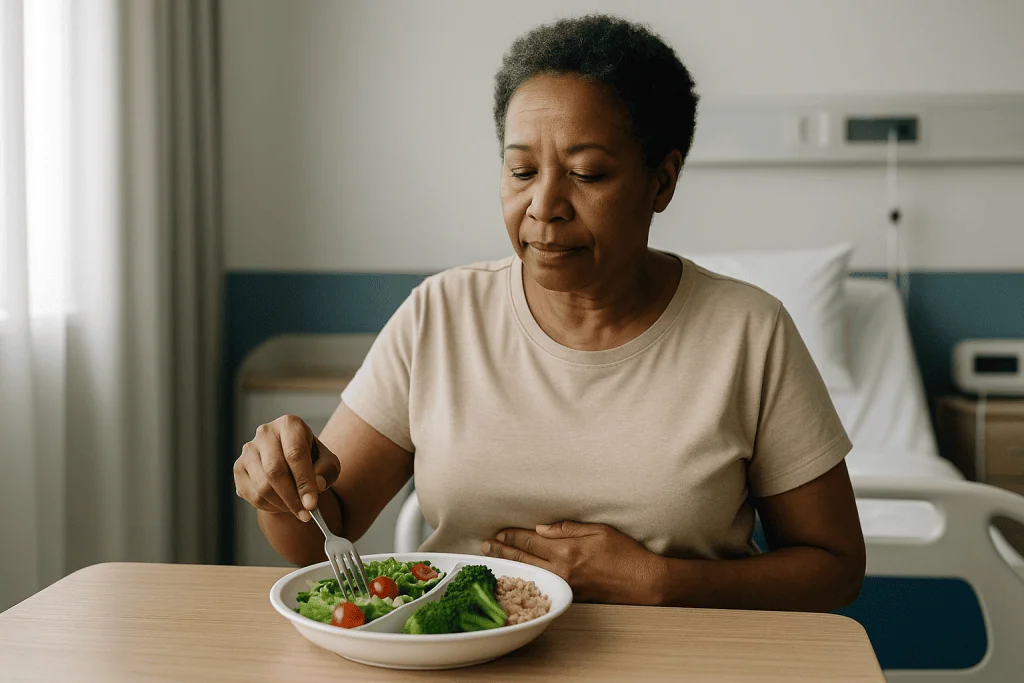
What can and often does happen is that symptoms go away. The stone that caused an attack falls back into the gallbladder and may never move again. Very small stones and biliary “sludge” (a thick, grainy bile that is a precursor to stones) can sometimes pass through the duct system and out into the intestine unnoticed. Sludge in particular can clear, which is one reason a repeat ultrasound is occasionally arranged before any decision is made.
The Mayo Clinic notes that many people with gallstones never need treatment because the stones never cause symptoms, and that a doctor will usually recommend being alert for symptoms rather than acting pre-emptively. That is a sensible reading of the evidence: silent stones are common and complications in silent stones are uncommon.
Lifestyle changes deserve an honest framing here. Keeping a stable weight, eating regular meals and avoiding crash diets reduce the chance of forming new stones, because rapid weight loss shifts cholesterol into bile and encourages crystals. The NIDDK lists these as prevention measures. They do not shrink existing stones. Internet “gallbladder flushes” with oil and citrus juice have no mainstream evidence behind them; the greasy lumps people report passing are generally soap-like products of the oil itself, not stones.
In short: the stone usually stays, the symptoms may not, and the decision rests on the symptoms.
When is gallbladder removal necessary? Who is usually offered surgery
Guidance from the NHS is direct: gallstones generally only need treatment once they cause symptoms, and when they do, removing the gallbladder is usually the recommended approach. The reasoning is practical. Once a stone has shown it can block the outlet, it or its neighbors can do so again, and each episode carries a chance of becoming a complication rather than a passing attack.
Groups who are typically advised to proceed include people with:
- recurrent biliary colic, especially attacks severe enough to disrupt sleep, work or eating;
- a confirmed episode of acute cholecystitis, where the inflamed gallbladder has already demonstrated the risk of staying in place;
- gallstone pancreatitis, because removing the source is the main way to prevent a second, potentially more severe attack;
- stones that have passed into or blocked the common bile duct, usually after the duct has been cleared by an endoscopic procedure;
- a gallbladder that has stopped functioning or shows a thickened, scarred wall on scanning.
Some teams also discuss surgery for silent stones in particular situations, such as a heavily calcified “porcelain” gallbladder wall, larger gallbladder polyps found alongside stones, or people awaiting other treatments where a sudden gallbladder attack would be especially disruptive. These are individualized judgments rather than universal rules, and they should be explained in those terms.
Timing matters too. When someone is admitted with acute cholecystitis, many services aim to operate during that same admission or soon after, because operating on a recently inflamed gallbladder is often simpler than waiting for scar tissue to form. Where a person is too unwell for an anesthetic, the team may instead drain the gallbladder through the skin as a bridging measure. The exact sequence is always set by the surgeons involved, based on the individual’s scans and fitness.
Who is usually asked to wait: watchful waiting explained
Watchful waiting, sometimes called active monitoring, is not the same as doing nothing. It is a deliberate decision that the risks of an operation currently outweigh the risks of the stones, paired with a clear plan for what would change that calculation.
The largest group on this path is people whose stones were found by chance and who have never had an attack. Both the NHS and the NIDDK advise that stones without symptoms usually need no treatment. Monitoring here is often as simple as knowing what an attack feels like and whom to contact if one happens; routine repeat scans are not always necessary.
A second group has had a single, mild, self-limiting episode and has risk factors that make anesthesia and surgery less safe: significant heart or lung disease, frailty, or a condition that complicates healing. For them the team may reasonably prefer to see whether symptoms recur before committing to an operation, while making sure the person understands the warning signs.
Pregnancy is a special case. Hormonal changes slow gallbladder emptying and stones are more common, but surgery is usually deferred unless complications force the issue, and when it is required the second trimester is generally regarded as the safest window. Obstetric and surgical teams decide this together.
Finally, some people simply choose to wait after a full discussion, and that is legitimate. What a good watchful-waiting plan always includes is a named trigger: a further attack, any jaundice, any fever with abdominal pain. Any of those should prompt a prompt reassessment rather than another round of waiting. The arrangement is a pause with conditions attached, not a closed file.
Watchful waiting vs cholecystectomy at a glance
The table below summarizes how the two paths differ in practice. It is a general orientation drawn from NHS, Mayo Clinic and NIDDK patient guidance, not a substitute for the individual assessment a surgical team provides.
| Question | Watchful waiting | Cholecystectomy |
|---|---|---|
| Who it usually suits | Silent stones found by chance; a single mild episode in someone with higher surgical risk; pregnancy without complications | Recurrent biliary colic; acute cholecystitis; gallstone pancreatitis; bile duct stones once cleared |
| What it involves | Awareness of symptoms, agreed warning signs, sometimes a repeat ultrasound | Keyhole operation under general anesthetic, typically 60–90 minutes according to the NHS |
| Main benefit | Avoids an operation that may never have been necessary | Removes the source of stones and the chance of future attacks from that organ |
| Main drawback | Attacks or complications can still occur, sometimes without warning | Carries the risks of any abdominal operation, including uncommon bile duct injury |
| Typical recovery | None required | Around 2 weeks to normal activity after keyhole surgery; 6–8 weeks after open surgery (NHS) |
| Reversibility | Can switch to surgery at any point | Permanent; the gallbladder does not grow back |
| Follow-up | Report any new symptoms promptly | Wound check and review of recovery |
Reading across the rows, the pattern that matters most is reversibility. Choosing to wait keeps every door open; choosing surgery closes one. That asymmetry is precisely why silent stones are watched and symptomatic ones are usually removed. The cost of waiting on a silent stone is low; the cost of waiting on a stone that keeps blocking the duct rises with each episode.
What happens during a cholecystectomy
Cholecystectomy is the surgical removal of the entire gallbladder, stones included. Surgeons do not pluck out the stones and leave the organ behind, because a gallbladder that has made stones once tends to make them again.
Almost all planned operations are done laparoscopically, also called keyhole surgery. The NHS describes the standard approach: under general anesthetic the surgeon makes three or four small cuts in the abdomen, inflates the belly with carbon dioxide gas to create working space, and inserts a thin camera and long instruments through the cuts. The gallbladder is freed from the underside of the liver, its duct and artery are clipped and divided, and the organ is lifted out through one of the incisions, usually the one at the navel. The gas is released and the cuts are closed with stitches or glue. The NHS puts the operation at around 60 to 90 minutes.
Many people go home the same day or after one night. Some surgeons take an X-ray of the bile ducts during the procedure, injecting dye to check that no stone has slipped into the main duct.
Occasionally the keyhole approach has to be converted to open surgery through a single larger cut beneath the right ribs. This happens when scarring, severe inflammation or unexpected anatomy makes the camera view unsafe. Conversion is a judgment made for safety, not a failure, and it is one of the things a surgeon will explain beforehand.
After the gallbladder is gone, bile still reaches the intestine; it simply flows continuously from the liver down the bile duct instead of being stored and released in pulses. For most people digestion carries on without noticeable change, a point the Mayo Clinic makes in its patient guidance on the procedure.
Treating gallstones without surgery: what the evidence shows
People understandably ask whether gallstones can be managed without an operation. There are non-surgical options, but each has a narrow role, and it is worth being precise about what they can and cannot do.
Oral dissolution therapy uses a bile acid medicine (ursodeoxycholic acid, also known as ursodiol) to make bile less saturated with cholesterol so that small cholesterol stones can slowly dissolve. The Mayo Clinic is candid about the limits: it can take months or years to work, it only suits small, non-calcified cholesterol stones in a gallbladder that still functions, and stones often return once the medicine is stopped. The NHS adds that it is not commonly used because it is not always effective. Whether it is appropriate, and for how long, is a decision for the prescribing clinician.
Endoscopic retrograde cholangiopancreatography (ERCP) is a procedure in which a flexible scope is passed through the mouth to the opening of the bile duct so that stones lodged there can be removed. It treats duct stones, not gallbladder stones, and is frequently followed by cholecystectomy to prevent further stones migrating down.
Shock-wave lithotripsy, which breaks stones with sound waves, is rarely used for gallstones because fragments can still block the duct and stones recur.
Percutaneous cholecystostomy places a drain through the skin into an infected gallbladder. It is a bridging measure for people too unwell for an operation, not a lasting solution.
Diet and weight stability help prevent new stones but do not remove existing ones. None of these approaches is a hidden alternative that surgeons withhold; each is simply best suited to a specific, limited situation, which the treating team will identify if it applies.
Living with gallstones: what day to day looks like on watchful waiting
For most people on active monitoring, daily life is unchanged. The stones are a line in the medical record and nothing more. Still, a few practical habits make the arrangement more comfortable and safer.
Eating pattern matters more than any single food. Because the gallbladder contracts hardest in response to fat, very large or very fatty meals are the most common trigger for an attack in someone whose stones are prone to moving. Spreading intake across regular, moderate meals keeps those contractions gentler. Skipping meals for long stretches is counterproductive: bile sits in the gallbladder and thickens. The NIDDK recommends eating regular meals and avoiding rapid weight loss for this reason.
Weight loss, if wanted, is best gradual. Crash diets and very-low-calorie plans are well-documented stone formers, and the NIDDK specifically flags losing weight too quickly as a risk.
Many people find it reassuring to learn what an attack actually feels like, so that a bout of indigestion does not trigger panic and a genuine episode is not dismissed. Steady upper-right or central abdominal pain building over minutes and lasting an hour or more, often after a meal, is the pattern to recognize. Ordinary bloating, belching or heartburn is usually something else.
Keep a brief note of any episode: when it started, how long it lasted, what preceded it. If a pattern emerges, that record turns a vague story into useful evidence for the team deciding whether the plan should change.
Travel, exercise and ordinary medicines are not restricted by silent stones. The one firm rule is the trigger list agreed with the clinic: a new attack, fever with abdominal pain, or any yellowing of the skin or eyes means a prompt call, not a wait-and-see.
What the days and weeks after cholecystectomy usually look like
Recovery after keyhole gallbladder removal is generally quicker than people expect, though the first few days have a distinctive feel. The ranges below come from NHS patient guidance; individual timelines vary and the surgical team’s advice takes precedence.
The first 24 to 48 hours are dominated by soreness at the incision sites and, often, an odd ache in the right shoulder. The shoulder pain is referred from the diaphragm, irritated by the gas used to inflate the abdomen, and settles as the gas is absorbed. Walking around the house helps disperse it. Most people go home the same day or the next morning.
Across the first week, appetite returns and the incisions begin to close. Light activity is encouraged early because it reduces the risk of blood clots and chest problems. Many people are back to desk work or gentle daily routines within a few days, though tiredness is common.
The NHS indicates that after keyhole surgery most people are able to return to normal activities within about two weeks, including driving once they can comfortably perform an emergency stop and are no longer affected by pain relief. Heavier lifting is usually held back a little longer. After open surgery the hospital stay is typically three to five days and full recovery takes around six to eight weeks.
Bowel habits can shift. Some people notice looser or more frequent stools in the early weeks as the intestine adjusts to a continuous trickle of bile rather than mealtime pulses. For most this settles. The Mayo Clinic lists persistent diarrhea as an uncommon longer-term effect; if it continues, the team can advise on management.
Diet after surgery does not need to be permanently restricted. Reintroducing fat gradually over the first weeks is sensible; a lifelong low-fat diet is not usually required.
Risks on both sides of the ledger
Any honest comparison has to acknowledge that both waiting and operating carry risk, and that the right choice depends on which set of risks a particular person is better placed to accept.
Risks of leaving symptomatic stones in place include further attacks of colic, acute cholecystitis with infection, migration of a stone into the common bile duct with jaundice, and gallstone pancreatitis. Pancreatitis is the one surgeons worry about most, because its severity is unpredictable and a severe episode can be life-threatening. These risks are low for truly silent stones, which is why monitoring is appropriate there, and they rise once symptoms begin.
Risks of cholecystectomy, as set out by the NHS and Mayo Clinic, include wound infection, bleeding, bile leak from the stump of the duct, injury to the bile duct itself, blood clots, reaction to the anesthetic and the general risks of any operation. Bile duct injury is the most serious specific complication; it is uncommon but can require further procedures to repair. Retained stones in the main duct can cause pain or jaundice after surgery and are usually dealt with endoscopically. A proportion of people experience ongoing digestive symptoms afterward, sometimes called post-cholecystectomy syndrome, although these are often due to another cause that was present all along.
Where a person has serious heart or lung disease, the anesthetic risk may be the deciding factor and the team may favor monitoring even after a mild episode. Where a person has had pancreatitis, the balance usually swings firmly toward operating.
None of this can be reduced to a single number that applies to everyone. What the treating team does is place a specific person, with specific scans and specific health, on this ledger and explain where the weight falls. That explanation, in plain language, is something every patient is entitled to ask for.
What people often get wrong about gallstones
Myths cluster around gallstones, partly because almost everyone knows someone who has had the operation. A few deserve correcting with evidence.
“If you have stones, you need surgery.” The most common misconception, and the one this article exists to answer. The NIDDK and NHS both state that stones without symptoms usually need no treatment. Stones are treated for what they do, not for existing.
“A gallbladder flush gets rid of them.” Drinking olive oil and citrus juice produces soft green lumps in the toilet that look convincing. They are soap-like products of the oil reacting with digestive juices, not stones. There is no mainstream evidence that these regimens remove gallstones, and binge-drinking oil can itself trigger a biliary attack in someone whose stones are prone to moving.
“Surgery means a lifelong low-fat diet.” Most people eat normally after the early weeks of recovery. Bile still reaches the intestine; it is simply delivered continuously rather than stored.
“The stones can be removed and the gallbladder saved.” Surgeons remove the whole organ because a gallbladder that has formed stones is very likely to form more. Taking out stones alone is not standard practice.
“Only overweight middle-aged women get them.” That group has a higher risk, but stones occur in men, in slim people, in young adults and in children, particularly those with blood disorders or who have lost weight rapidly.
“If the pain stopped, the problem is over.” The end of an attack means the stone moved, not that it vanished. One episode makes another more likely, which is why even a settled attack is worth reporting.
“Keyhole surgery is minor.” It is less invasive than open surgery and recovery is faster, but it is still an operation under general anesthetic inside the abdomen, with real if uncommon risks. Respecting that is part of making a good decision.
Questions to ask your care team
A consultation moves faster, and ends more usefully, when the person in the chair arrives with specific questions. These are the ones surgeons and gastroenterologists most often wish patients would ask.
- Are my symptoms definitely coming from the gallstones, or could something else explain them? Stones are common enough that they are sometimes an innocent bystander to reflux, a peptic ulcer or irritable bowel.
- Have my stones caused any complication so far, such as inflammation, a duct stone or pancreatitis? The answer changes the urgency entirely.
- If I choose to wait, what exactly should make me come back, and how quickly?
- If I choose surgery, what is the likelihood you would need to convert from keyhole to open in my case, given my scans and history?
- What are the specific risks for me, considering my other health conditions and the medicines I take?
- Will you check the main bile duct during the operation, and what happens if a stone is found there?
- How long would you expect me to be in hospital, and when could I realistically return to my work and my usual activity?
- Are there any non-surgical options that genuinely apply to my situation, and why or why not?
- What should I expect my digestion to be like in the first weeks afterward, and what would be unusual?
- Who do I contact after the operation if I have a fever, worsening pain or yellowing skin?
- If I am pregnant or planning pregnancy, how does that change the timing?
Write the answers down, or bring someone who will. A good team will welcome these questions, give answers in plain language and be clear about where the evidence is firm and where it is a judgment call. The decision that follows is shared, but the recommendation and its reasoning come from them.
When to call your doctor
Most gallstone episodes settle on their own within hours. Some do not, and a few signal a complication that needs same-day assessment. Both the Mayo Clinic and the NHS highlight the following as reasons to seek urgent care rather than wait for the next clinic appointment.
Seek immediate medical help if abdominal pain is so intense that you cannot sit still or find a comfortable position, if it has lasted more than a few hours without easing, or if it is accompanied by a high temperature with chills or shaking. Yellowing of the skin or the whites of the eyes, dark urine or pale, clay-colored stools point to a blocked bile duct and should never be left overnight. Persistent vomiting that prevents you keeping fluids down also warrants urgent review.
After a cholecystectomy, contact the surgical team or seek emergency care for fever, pain that is worsening rather than improving after the first couple of days, redness or discharge spreading from an incision, a swollen or painful calf, breathlessness or chest pain, or any yellowing of the eyes or skin.
During watchful waiting, a less dramatic trigger still matters: any new attack of typical gallstone pain, even one that resolved, should be reported at the next opportunity so that the plan can be reviewed. Pain that is changing in character, becoming more frequent, or arriving without the usual relationship to meals deserves the same.
If you are unsure whether what you are feeling is serious, that uncertainty is itself a reason to call. Clinicians would far rather hear about a false alarm than see a complication that could have been caught earlier. Every decision about whether, when and how to treat gallstones rests with the team looking after you, and it is informed by what you tell them, so tell them early.
Frequently asked questions
Do gallstones always need surgery?
No. Gallstones that cause no symptoms are usually left alone and monitored, because most never cause harm. Surgery to remove the gallbladder is generally recommended once stones have caused an attack of pain or a complication such as inflammation, a blocked bile duct or pancreatitis, since further episodes then become more likely. The treating team weighs symptoms, scan findings and overall health before advising either path.
Can gallstones go away on their own?
Established stones rarely dissolve or disappear by themselves, because the chemistry that formed them is still present and they are usually too large to pass through the narrow gallbladder duct. Symptoms, however, often go away: the stone drops back into the gallbladder after an attack. Biliary sludge and very small stones can occasionally pass unnoticed, which is why a repeat ultrasound is sometimes arranged before a decision.
When is gallbladder removal necessary rather than optional?
Removal becomes the usual recommendation after recurrent attacks of biliary colic, an episode of acute cholecystitis, gallstone pancreatitis, or stones that have migrated into the common bile duct. In those situations the gallbladder has already shown it can cause complications, and taking it out removes the source. For a single mild episode or silent stones, the decision is more individual and often starts with monitoring.
Is it safe to treat gallstones without surgery?
For stones without symptoms, monitoring is the standard and safe approach. Non-surgical treatments exist but have narrow roles: a bile acid medicine can slowly dissolve small cholesterol stones over months or years, with frequent recurrence after stopping; ERCP removes stones from the bile duct but not the gallbladder; a skin drain is a temporary measure for people too unwell to operate. The clinician decides which, if any, applies.
What does living with gallstones on watchful waiting actually involve?
Usually very little. Daily life, work, exercise and travel are not restricted. Sensible habits include eating regular, moderate meals rather than very large fatty ones, avoiding crash diets and rapid weight loss, and knowing what a genuine attack feels like. The essential part is an agreed trigger list: a new attack, fever with abdominal pain, or any yellowing of the skin or eyes means a prompt call.
How long does recovery take after keyhole gallbladder surgery?
According to the NHS, most people can return to normal activities within about two weeks of laparoscopic cholecystectomy, with many going home the same day or after one night. The first two days usually involve incision soreness and a referred ache in the right shoulder from the gas used during the operation. Open surgery takes longer, typically a hospital stay of three to five days and six to eight weeks to full recovery.
Will I need a special diet for life after my gallbladder is removed?
Usually not. Bile still reaches the intestine after cholecystectomy; it flows continuously from the liver instead of being stored and released at mealtimes. Most people eat a normal diet once the early weeks of recovery have passed. Reintroducing fat gradually is sensible at first, and a minority notice looser stools for a while. Persistent changes should be discussed with the care team rather than managed alone.
Can surgeons take out the stones and leave the gallbladder?
This is not standard practice. A gallbladder that has formed stones is very likely to form more, so removing only the stones would leave the underlying problem in place and invite repeat attacks. Cholecystectomy removes the entire organ, stones included. Endoscopic procedures can remove stones from the bile duct, but that treats a different location and is often followed by gallbladder removal to prevent recurrence.
Do gallbladder flushes with olive oil and lemon juice work?
There is no mainstream medical evidence that these regimens remove gallstones. The soft green lumps people report passing afterward are soap-like products formed when large amounts of oil meet digestive juices, not gallstones. Drinking a large quantity of oil can also provoke a biliary attack in someone whose stones are prone to moving. Anyone considering such a regimen should raise it with their doctor first.
What are the warning signs that gallstones have become an emergency?
Seek urgent care for abdominal pain so severe you cannot sit still or that has lasted more than a few hours without easing, a high temperature with chills, yellowing of the skin or eyes, dark urine or pale stools, or persistent vomiting. These can indicate gallbladder infection, a blocked bile duct or pancreatitis. After surgery, worsening pain, fever, wound redness, calf swelling or breathlessness also need prompt assessment.
References
- NIDDK (NIH): Gallstones, Definition & Facts
- NHS: Gallstones, Treatment
- NHS: Gallbladder removal
- MedlinePlus: Gallstones
This article is for general information only and is not a substitute for professional medical advice. Please consult a qualified doctor about your individual situation.

More from the Blog

How Do Surgeons Choose Between Robotic, Laparoscopic and Open Hernia Repair?
Surgeons choose between robotic, laparoscopic and open hernia repair based on the hernia's location and size, whether it is a first repair or a…

What Does Progress Look Like in Fecal Incontinence Treatment? Biofeedback and Follow-Up
Biofeedback can help some adults with fecal incontinence, especially when weakened or poorly coordinated pelvic floor muscles or reduced rectal sensation are part of…

Who Actually Needs Hemorrhoid Surgery? When Office Procedures Are No Longer Enough
Hemorrhoid surgery is usually reserved for people whose symptoms persist despite fiber, fluids and office procedures such as rubber band ligation, or who have…

Minimally Invasive Surgery Recovery: Why Small Cuts Still Need a Gradual Return to Activity
Minimally invasive surgery recovery time is usually shorter than after open surgery, yet it is still measured in weeks. NHS guidance suggests many people…

Fever, Wound Redness or Bowel Trouble After Appendectomy: What to Watch and When to Call
A mild temperature in the first day or two after appendectomy is common and usually reflects the body's inflammatory response to surgery. A fever…

Fever, Wound Redness or Bowel Trouble After Appendectomy: What to Watch and When to Call
A mild temperature in the first 24 to 48 hours after appendectomy is common and usually reflects the body's response to surgery, not infection.…