

Bowel Habit Training and Pelvic Floor Exercises: Daily Routines in Fecal Incontinence Care
Key Takeaways
- The NHS estimates bowel incontinence affects up to 1 in 10 people at some point, yet it is among the least discussed treatable conditions in primary care.
- Pelvic floor exercises target the voluntary external anal sphincter and puborectalis; the internal sphincter that holds stool at rest cannot be trained consciously.
- MedlinePlus describes a starting pattern of about 10 contractions held for 3 to 5 seconds, three times a day, with full relaxation between each squeeze.
- Timed toilet sitting 15 to 30 minutes after a meal uses the gastrocolic reflex, the colon's response to eating, to make complete emptying more predictable.
- Soluble fiber firms loose stool and softens hard stool at once, which is why the Mayo Clinic's fecal incontinence guidance emphasizes a gradual increase toward roughly 20 to 35 grams of fiber daily.
- Rushing to the toilet during an urge tends to cause leaks; standing still and performing several quick squeezes followed by a hold gives the rectum time to adapt.
Pelvic floor exercises for bowel control strengthen and coordinate the muscles that close the anus, while bowel habit training uses timed toilet visits, unhurried posture and stool-consistency changes to make leaks less likely. Guideline bodies such as the NHS and the NIH list both as first-line conservative care for fecal incontinence, usually alongside diet adjustments and, when needed, supervised biofeedback.
The moment usually arrives somewhere ordinary. A grocery aisle. The second half of a long meeting. A grandchild’s soccer game where the restroom is a five-minute walk across a field. The urge comes, the muscles that should buy a few minutes do not hold, and a person who has managed every other part of adult life quietly begins to plan their days around bathrooms.
What rarely gets said out loud is how common this is. The NHS estimates that bowel incontinence touches up to 1 in 10 people at some point, yet many wait years before mentioning it to a clinician. That silence matters, because the first treatments a care team usually suggests are not surgical. They are routines: pelvic floor exercises for bowel control, timed toilet habits, and small changes to what the stool is made of.
This explainer walks through those routines in the detail people actually want, including what the evidence supports and what it does not.
How pelvic floor exercises for bowel control actually work
Picture the pelvic floor as a hammock of muscle slung between the pubic bone at the front and the tailbone at the back. The bowel passes through it, and two rings of muscle at the exit do most of the work of keeping stool in. The internal anal sphincter is a smooth muscle you cannot consciously control; it keeps the anus closed at rest. The external anal sphincter and a neighboring muscle called the puborectalis are under voluntary control, which is why you can hold on when a toilet is not nearby.
Continence, the ability to hold stool until you choose to release it, depends on three things happening together. The rectum must be able to store stool, the nerves must sense that it is there and tell you whether it is gas, liquid or solid, and the muscles must respond in time. Fecal incontinence, the accidental leakage of stool or gas, can arise when any one of these fails. Childbirth injury, prior anal surgery, nerve damage from diabetes, chronic diarrhea and simple aging are among the causes listed by the NIH’s digestive diseases institute.
Pelvic floor exercises target the voluntary part of that system. Repeated contractions can improve the strength of the external sphincter and puborectalis, but the more useful gain is often coordination: learning to feel the muscle, squeeze it quickly when an urge arrives, and hold that squeeze while the rectum adapts. This is why clinicians talk about training rather than simply strengthening.
Bowel habit training works on a different lever. By encouraging a predictable, complete emptying at a chosen time, usually after a meal, it reduces the volume of stool waiting in the rectum during the rest of the day. Less stool sitting close to a weakened exit means fewer moments when the muscles are tested.
Who these routines are usually for, and who is asked to wait
Most adults with fecal incontinence are offered conservative care first, and the NHS and Mayo Clinic both describe exercise and bowel training as early steps rather than last resorts. People with mild to moderate leakage, urge incontinence (a strong need to go that cannot be delayed), postpartum weakness, or leakage after prostate or rectal surgery are typical candidates. Older adults with mixed causes often benefit as well, because the routine also addresses constipation and stool consistency.
Some people are usually asked to complete other steps before or alongside exercise. When the leakage is driven mainly by loose stool, from an infection, a medicine side effect, inflammatory bowel disease or a diet high in sugar alcohols, the care team will generally treat that cause first, since no amount of squeezing holds liquid well. When stool is severely impacted, a condition called overflow incontinence where liquid stool leaks around a hard mass, the blockage has to be cleared before bowel training can begin.
A smaller group needs assessment rather than home exercise. The Mayo Clinic notes that new incontinence with rectal bleeding, weight loss or a change in bowel habit requires investigation to rule out structural causes. People with a rectal prolapse, where part of the rectum slides out through the anus, or with a significant sphincter tear identified on ultrasound, may still be taught exercises, but the treating team decides whether repair comes first.
Cognitive impairment, severe mobility limits or nerve injury that removes sensation entirely do not rule out a bowel routine, but they change it. In these situations the emphasis shifts toward scheduled, assisted toileting and stool management rather than voluntary squeezes. The right plan is worked out with a clinician, a continence nurse or a pelvic health physical therapist who has examined the person.
What a bowel retraining program involves day to day
Bowel retraining, sometimes called bowel habit training, is a deliberate routine designed to teach the body to empty at a predictable time. It is unglamorous and it works slowly, which is why people abandon it early. The components below are drawn from the NIH’s digestive diseases institute and the Mayo Clinic’s descriptions of bowel training.
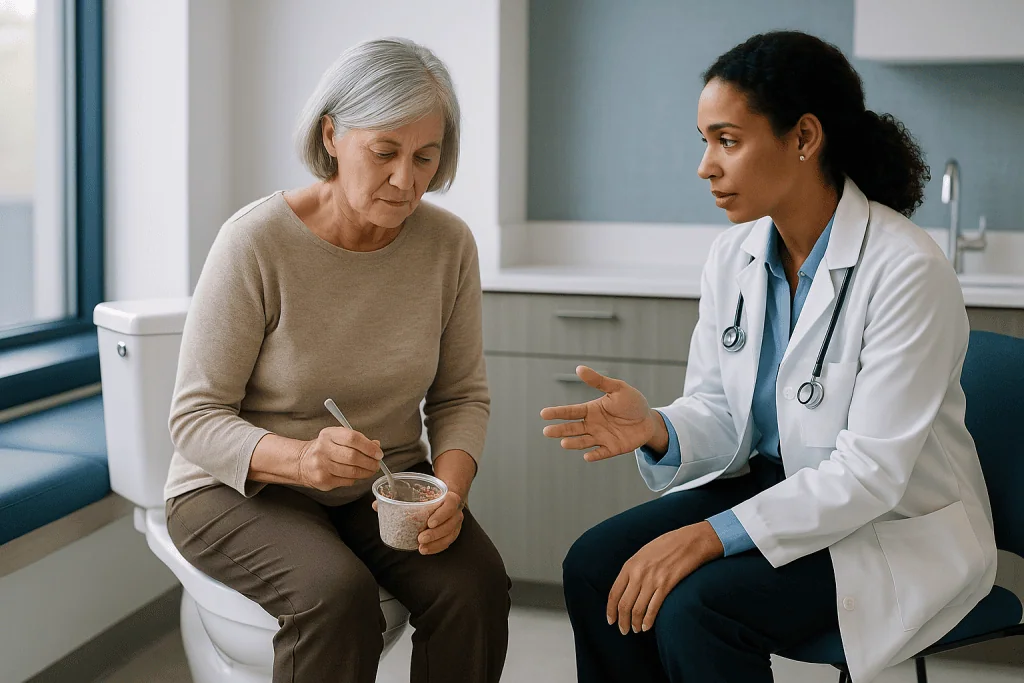
The anchor is timing. Choose one time each day, ideally 15 to 30 minutes after the same meal, when the gastrocolic reflex is active. That reflex is the wave of colon activity triggered by food arriving in the stomach; it is the reason many people feel the urge after breakfast. Sit on the toilet at that time whether or not an urge is present, for a limited period rather than an open-ended one.
Posture matters more than most people expect. Feet raised on a low stool so the knees sit above the hips, leaning slightly forward with forearms on the thighs, straightens the angle between rectum and anus and makes emptying easier. Straining should be avoided; instead, relax the abdomen, breathe out slowly and let the pelvic floor lengthen.
Complete emptying is the goal. Leaving stool behind is a common reason for leakage an hour later, when the person is dressed and out of the house. Some clinicians suggest a second gentle attempt after standing and moving briefly.
A diary ties the routine together. Recording the time, stool type, any leakage and what was eaten gives the care team something concrete to adjust, and shows the person their own progress, which is easy to miss when change comes in small steps. The daily routine typically runs alongside pelvic floor exercises, so the two reinforce each other: the training empties the rectum, and the exercises protect against what remains.
Step by step: doing a pelvic floor contraction correctly
Ask ten people to squeeze their pelvic floor and several will hold their breath, tighten their buttocks or push downward, none of which trains the right muscle. Getting the movement right before adding repetitions is the single most useful thing a person can do at home.

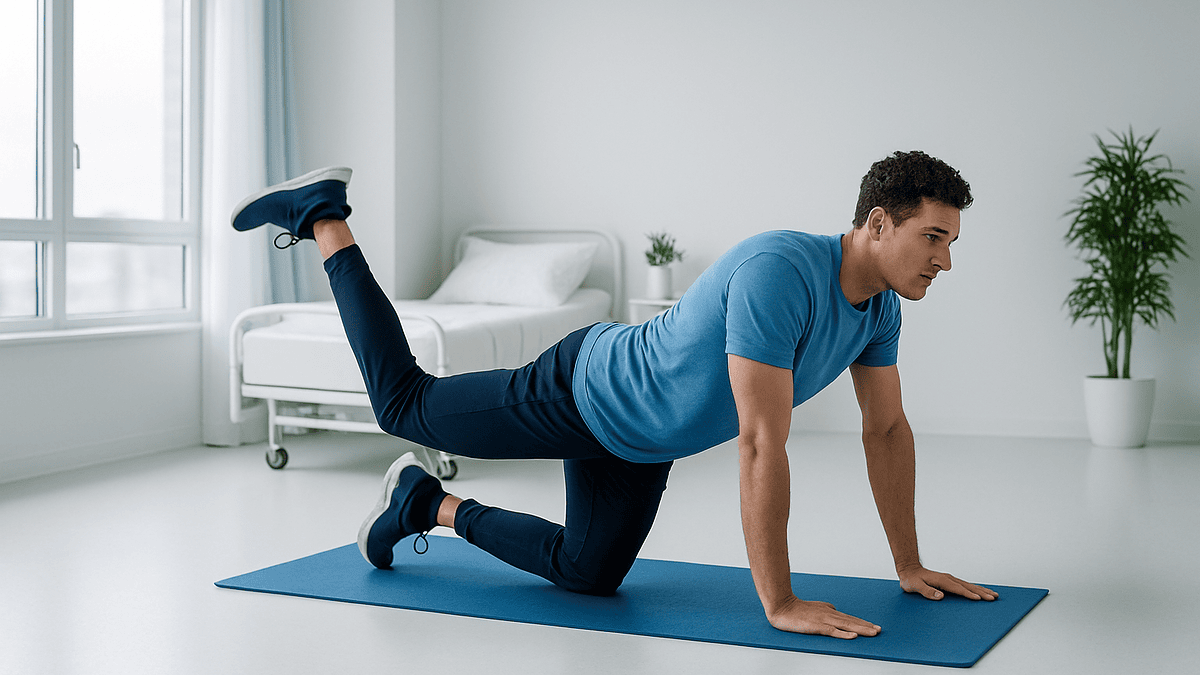
Start lying on your side or on your back with knees bent, positions where gravity is not working against you. Imagine you are trying to stop passing gas, and at the same time gently lift the back passage up and inward. MedlinePlus describes the sensation as tightening the muscles you would use to stop urine and stool at the same time. The buttocks and thighs should stay soft. Breathing continues normally; if you find yourself holding air, the effort is going to the wrong place.
Two kinds of contraction are usually taught. A slow hold builds endurance: squeeze, hold for a count of several seconds, then relax fully for the same length of time. MedlinePlus suggests holding for 3 to 5 seconds initially and building up as the muscle allows. A quick flick trains the reflex you need when an urge arrives: squeeze hard and release immediately, repeated several times. The full relaxation between efforts is not optional; a muscle that never lets go becomes tired and less responsive.
Frequency guidance from MedlinePlus is a set of around 10 contractions, three times a day. Some pelvic health therapists adjust this up or down after examining a person, and their instructions override any general figure.
Once the movement feels reliable lying down, it is practiced sitting and then standing, because most leaks happen upright. Linking sets to daily cues, such as brushing teeth or waiting for a kettle, helps the habit stick. If you cannot feel anything at all, or you feel pressure moving downward, that is worth telling a clinician, since it may point to a need for supervised biofeedback.
The daily routine at a glance
People managing fecal incontinence often juggle several small habits at once, and it helps to see how they fit together. The table below summarizes the elements most guideline sources describe, what each is meant to do, and roughly how long it takes to show effect. Every timeline is a typical range from the cited source, not a promise, and an individual’s plan may differ.
| Routine element | What it targets | Typical daily pattern | When change is commonly noticed |
|---|---|---|---|
| Slow pelvic floor holds | Endurance of the voluntary sphincter and puborectalis | Sets of about 10, three times daily (MedlinePlus) | Weeks to a few months (Mayo Clinic) |
| Quick pelvic floor flicks | Speed of response to sudden urge | Several quick squeezes added to each set | Often alongside slow holds |
| Timed toilet sitting | Predictable, complete emptying using the gastrocolic reflex | Once daily, 15 to 30 minutes after the same meal (NIH) | Several weeks of consistency (NIH) |
| Fiber and fluid adjustment | Stool consistency, bulkier and easier to hold | Gradual increase toward about 20 to 35 grams of fiber daily (Mayo Clinic) | Days to weeks |
| Bowel and food diary | Pattern recognition for the care team | Brief entries after each toilet visit | Useful from the first review |
Two things stand out. First, nothing on the list is fast. The muscle work and the habit work both operate on a scale of weeks, and clinicians commonly ask people to persist for a few months before judging the result. Second, the elements are complementary rather than interchangeable. Someone who exercises diligently but eats erratically and never empties fully will still leak; someone who empties on schedule but has no reflex squeeze will struggle on the days the schedule slips. The routine is a system, and the care team’s job is to tune it, which is why they ask for the diary.
Do pelvic floor exercises help with bowel control? What the evidence shows
The honest answer is: for many people, yes, but the size of the benefit varies and the research base is smaller and less tidy than the one for urinary incontinence. It helps to separate what is well supported from what is assumed.
Well supported: pelvic floor muscle training is a standard first-line recommendation. The NHS lists it among the main treatments for bowel incontinence, the Mayo Clinic includes it under exercise and other therapies, and the NIH’s digestive diseases institute describes muscle training as a way to strengthen the pelvic floor and improve control. These recommendations rest on clinical trials and long clinical experience showing that a meaningful proportion of people report fewer episodes and greater confidence after a course of training.
Less certain: how much of the effect comes from raw strength versus improved sensation, coordination and confidence. Studies that measure squeeze pressure do not always find that pressure rises in step with symptom improvement, which suggests the training may work partly by teaching people to notice and respond to rectal filling sooner. This is not a weakness of the approach; it is a reminder that the goal is fewer accidents, not a stronger number on a pressure gauge.
Also less certain: whether unsupervised home exercise matches supervised programs. Several sources, including the Mayo Clinic, note that exercises are often taught and monitored by a physical therapist, and that biofeedback can be added when a person struggles to identify the muscle. Trials comparing supervised and unsupervised training in fecal incontinence are limited in number and size.
What the evidence does not show is a guaranteed result for everyone, or a benefit for people whose leakage is driven by liquid stool or by a large structural defect that has not been addressed. Guideline language is deliberately measured, and a care team will frame expectations the same way: worth trying, likely to help, not certain to resolve the problem alone.
Does pelvic floor therapy work for fecal incontinence? Biofeedback explained
Pelvic floor therapy is the supervised version of everything described so far, delivered by a physical therapist or continence nurse with specialist training. The distinguishing tool is biofeedback, a technique that uses sensors to show a person, in real time, what their pelvic floor is doing.
In practice it looks like this. A small sensor is placed in the anal canal or on the skin nearby, sometimes alongside a soft balloon inserted into the rectum. When the person squeezes, a screen shows the muscle response as a line or bar. When the balloon is gently inflated, they learn what rectal filling feels like and practice squeezing in response. The therapist coaches: squeeze harder here, relax fully there, respond sooner to that sensation. Over a series of sessions the person learns to reproduce the correct pattern without the screen.
Biofeedback addresses two failures at once. It corrects technique for people who have been pushing down or using the wrong muscles at home, and it sharpens sensation for people whose rectum has become less able to signal that stool has arrived. The Mayo Clinic and the NIH both describe it as an option for people who have not improved enough with exercise alone, or who cannot locate the muscle.
Does it work? Guideline sources describe biofeedback as effective for many people, and it is widely recommended, but the quality of the underlying trials is mixed, sample sizes are often small and comparison groups vary. That is why responsible sources avoid quoting a single success figure. What can be said is that biofeedback is low-risk, does not close the door to other treatments, and gives the care team useful information about muscle function and sensation even when symptoms improve only partly.
A course typically involves several sessions spaced over weeks, with home practice in between. The exact number is set by the therapist based on progress.
What the first weeks and months usually look like
Nobody should expect a transformation in the first fortnight. Understanding the usual arc helps people stay with the routine long enough for it to matter.
The first one to two weeks are mostly about finding the muscle and setting the schedule. Many people report that the contractions feel vague, that they lose count, or that timed toilet sitting produces nothing. This is normal. The gastrocolic reflex, the colon’s response to eating, has been ignored or overridden for years in some people and takes time to become reliable. The diary is at its most useful now, because it shows whether leaks cluster at particular times or after particular foods.
By roughly weeks three to six, the contraction usually becomes more definite and can be held a little longer. The Mayo Clinic notes that results from pelvic floor exercises may take a few weeks to a few months to appear, and the NIH describes bowel training as something that takes several weeks of consistency. Some people notice the first small wins here: a warning that arrives a minute earlier, a day with no leak, an emptying that feels complete.
The two to four month mark is when most care teams review progress properly. If episodes have dropped, the plan continues, often with fewer daily sets once strength is established. If they have not, the team may add biofeedback, revisit stool consistency, or consider whether a cause has been missed. This review is not a verdict on effort; it is the point at which the plan is either confirmed or adjusted.
Beyond that, the routine becomes maintenance. Muscle gains fade if training stops entirely, so a smaller ongoing program is usually advised. Bowel habits, once established, tend to be more durable, but illness, travel and changes in diet can unsettle them, and people often find that returning to the timed routine after a disruption restores things faster the second time.
Why stool consistency is half the battle
A strong sphincter holds a formed stool well and a liquid one poorly. That single fact explains why every guideline source on fecal incontinence spends as much time on diet as on exercise, and why a person who ignores this part of the routine often concludes, wrongly, that the exercises failed.
The aim is a stool that is soft but formed, the kind that passes easily and completely without being loose. Fiber is the main tool. Soluble fiber, found in oats, beans, apples and psyllium, absorbs water and gives stool a gel-like bulk; insoluble fiber, from wheat bran and vegetable skins, adds volume and speeds transit. Most people with incontinence do better with an emphasis on soluble fiber, which firms loose stool and softens hard stool at the same time. The Mayo Clinic suggests working gradually toward roughly 20 to 35 grams of fiber a day, increasing slowly to limit gas and bloating, and drinking enough fluid for the fiber to do its work.
Certain foods and drinks are commonly reported triggers. Caffeine and alcohol stimulate the bowel. Sugar alcohols such as sorbitol, common in sugar-free gum and candy, draw water into the gut. Large fatty meals, very spicy food and, for some people, dairy or artificial sweeteners can loosen stool. Rather than cutting everything, the NIH suggests using a food diary to identify individual patterns, then trialing the removal of one suspected trigger at a time.
Meal timing also feeds directly into bowel training. Regular meals produce a regular gastrocolic reflex; skipped meals and late-night eating scatter it. Someone trying to establish an after-breakfast toilet routine will find it far easier if breakfast happens at a similar time each day and contains some fiber.
Medicines can change consistency too, in both directions. Any change to those is a decision for the prescribing clinician, not something to adjust at home.
How to tighten your sphincter naturally when an urge strikes
People search this phrase because they want something to do in the moment, not just a long-term program. There is a practical answer, and it draws on the same muscle training already described.
Urge suppression is the technique. When the need to go arrives suddenly, the instinct is to rush toward a toilet. Rushing is counterproductive: walking fast jostles the rectum, the pelvic floor relaxes with the movement, and anxiety tightens the abdomen in a way that pushes downward. The alternative taught in pelvic health clinics is to stop, stand or sit still, and perform several quick, firm pelvic floor squeezes followed by a sustained hold. Breathing out slowly during the hold keeps the abdomen soft. The rectum, given a moment, will often adapt to the stool inside it and the urgency fades to a manageable level. Then, and only then, walk calmly to the toilet.
This works because the rectum is a stretchy reservoir. The wave of urgency is a signal, not a countdown, and the sensation eases when the reflex relaxation of the internal sphincter passes and the voluntary muscles have engaged. Quick flicks in daily practice exist precisely so that this reflex squeeze is available under pressure.
A few supporting habits help. Emptying on schedule earlier in the day means less stool is waiting when an urge arrives. Keeping stool formed means the muscles have something they can actually hold. Sitting rather than standing, when possible, takes gravity out of the equation. Distraction, counting backward or focusing on breath, reduces the panic that feeds the urge.
What does not tighten the sphincter is straining, clenching the buttocks or holding the breath; each of these increases abdominal pressure and makes leakage more likely. Nor is there evidence that any supplement, cream or device sold for this purpose strengthens the muscle without the training itself.
Where medicines, devices and surgery fit alongside the routine
Daily routines are the foundation, but they are rarely the whole plan, and it is fair for people to understand what else exists. The following is descriptive only; every decision about these options belongs to the treating team.
Medicines are typically used to change stool consistency rather than to act on the muscle. Bulk-forming fiber supplements, taken as advised by a clinician, thicken loose stool. Antidiarrheal agents such as loperamide slow the gut, giving the colon more time to absorb water and firming the output; the NIH lists these among treatments when loose stool is the main driver. For people whose leakage comes from overflow around impacted stool, a clinician may use laxatives or enemas in a supervised way to clear the bowel and then establish emptying. None of these should be started, stopped or adjusted without medical advice, because the wrong choice in the wrong direction can worsen the problem.
Devices include anal plugs, small inserts that block the passage temporarily, and vaginal inserts that press against the rectum to support the anal canal. Some people find them useful for specific situations; others find them uncomfortable. Their use is a conversation with a continence specialist.
Further options, described by the Mayo Clinic and the NHS, are considered when conservative care has been tried adequately without enough benefit. Sacral nerve stimulation involves a small implanted device that sends mild electrical pulses to the nerves controlling the bowel and pelvic floor. Injectable bulking agents thicken the tissue around the anal canal. Sphincter repair may be offered when imaging shows a discrete tear. Each carries risks, including infection, device problems and incomplete benefit, and each requires assessment.
The routine remains relevant even when these are used. Emptying habits, stool management and muscle awareness support every other treatment rather than being replaced by them.
What people often get wrong
Myths around bowel control are stubborn, partly because so few people discuss it. Several deserve correcting.
The first is that leakage is simply a fact of aging and nothing can be done. Age is a risk factor, and the NHS confirms the problem is common, but guideline bodies list a range of treatments precisely because many people improve. Accepting the symptom without an assessment means missing treatable causes.
The second is that more squeezing is always better. Pelvic floor muscles fatigue like any other, and a muscle held tense all day becomes less able to respond when it matters. Full relaxation between contractions is part of the exercise, not a rest from it. Some people, especially those with pain or constipation, have a pelvic floor that is too tight rather than too weak, and for them relentless strengthening can worsen symptoms. A pelvic health therapist can tell the difference; guesswork cannot.
The third is that stopping the exercises once things improve locks in the gain. It does not. Muscle strength declines when training stops, and most clinicians advise a lighter ongoing program.
The fourth is that fiber is only for constipation. Soluble fiber firms loose stool as well as softening hard stool, which is why it appears in almost every incontinence plan.
The fifth is that holding stool is harmful and a person should go the instant an urge appears. For someone with incontinence the opposite is often true: rushing provokes leaks, while a calm, controlled squeeze and a short delay gives the rectum time to settle. Regular, complete emptying on a schedule prevents the harmful kind of holding, which is chronic retention.
The last is that pelvic floor exercises are for women. Men after prostate or rectal surgery, and men with nerve-related weakness, are taught exactly the same program, and the anatomy they are training is the same.
Questions to ask your care team
A ten-minute appointment goes further when the questions are ready. These are the ones that tend to produce useful answers for someone starting bowel habit training and pelvic floor exercises for bowel control.
- What do you think is driving my leakage: muscle weakness, sensation, stool consistency, or a mix? The answer shapes which part of the routine matters most for me.
- Am I doing the contraction correctly, and can you check? Many people are surprised to learn they have been using the wrong muscles for months.
- Would supervised pelvic floor therapy or biofeedback be appropriate for me, and if so, when? Some teams offer it early; others reserve it for people who plateau.
- How many weeks should I follow this routine before we judge whether it is working, and what would count as meaningful progress?
- What should I record in my diary so it is actually useful to you at review?
- Are any of my current medicines or supplements affecting my stool, and is that something you would want to revisit? This is a question, not a request to change anything on my own.
- Which foods or drinks are the most likely triggers given my diary, and how should I trial removing them?
- Do I need any tests, such as an ultrasound of the sphincter or a pressure study, before we commit to this plan?
- If the routine helps only partly, what would the next options be, and what are their main risks?
- Is there a continence nurse or pelvic health physical therapist I can be referred to for hands-on teaching?
Bringing a week or two of diary entries to the first conversation makes every one of these questions easier to answer. So does naming the impact honestly: how many episodes, how much it limits leaving the house, what it has done to sleep or intimacy. Clinicians calibrate the urgency and intensity of treatment partly on that account, and understatement can lead to a slower plan than a person wants.
When to call your doctor
Bowel habit training and pelvic floor exercises are safe for almost everyone, but the symptom they address can occasionally signal something that needs prompt attention. The routine is not a substitute for assessment, and certain changes should prompt a call rather than another week of diary entries.
Contact your care team soon if you notice any of the following, which the Mayo Clinic and the NHS flag as reasons for medical review:
- Blood in the stool or on the toilet paper, whether bright red or dark and tarry.
- Unexplained weight loss, or a loss of appetite that persists.
- A new and lasting change in bowel habit, especially new incontinence in someone who has never had it, or a shift from formed stool to persistent diarrhea.
- Severe abdominal pain, a swollen abdomen, or vomiting alongside bowel changes.
- A lump or tissue protruding from the anus, or a sensation that something is bulging.
- New numbness in the buttocks, inner thighs or genital area, new weakness in the legs, or a sudden loss of bladder control alongside bowel leakage. Together these can indicate pressure on the nerves at the base of the spine and are treated as an emergency.
- Fever with bowel symptoms, or signs of dehydration from ongoing diarrhea such as dizziness, very dark urine or confusion.
- Skin around the anus that has become raw, broken or infected despite careful hygiene.
Also worth a call, though less urgently: incontinence that is getting steadily worse despite several weeks of consistent routine, leakage after a recent childbirth that has not begun to improve, or a sense that you cannot feel the muscle at all when you try to squeeze. None of these means the routine has failed; they mean the plan may need adjusting, and the sooner the care team knows, the sooner that can happen.
If in doubt, ask. Continence teams hear these concerns daily, and no symptom described here is too minor or too embarrassing to raise.
Frequently asked questions
Do pelvic floor exercises help with bowel control?
For many people, yes, and the NHS, Mayo Clinic and NIH all list pelvic floor muscle training as a first-line treatment for fecal incontinence. The benefit comes from stronger voluntary sphincter muscles and, just as importantly, better awareness and faster response to rectal filling. Results vary, the research base is smaller than for urinary leakage, and exercises help least when loose stool or an unrepaired structural defect is the main cause.
What exercises can I do for fecal incontinence at home?
The core exercises for fecal incontinence are slow pelvic floor holds and quick flicks. Lie down, tighten the muscles as if stopping gas, lift inward, hold for several seconds, then relax completely; MedlinePlus suggests around 10 repetitions, three times daily. Add several fast squeeze-and-release contractions to train the urge reflex. Progress to sitting and standing once the movement feels reliable, and ask a clinician to check your technique.
How do you tighten your sphincter naturally during an urge?
Stop moving, sit or stand still, and perform several quick firm pelvic floor squeezes followed by a sustained hold while breathing out slowly. Avoid clenching the buttocks, straining or holding your breath, all of which push downward. The rectum is a stretchy reservoir, and given a brief pause the urgency usually eases enough to walk calmly to a toilet. This technique works best when the same muscles are trained daily.
Does pelvic floor therapy work for fecal incontinence?
Supervised pelvic floor therapy, often including biofeedback, is described by the Mayo Clinic and NIH as an effective option for many people, particularly those who cannot locate the muscle or have not improved with home exercise alone. The underlying trials are mixed in quality and size, so responsible sources avoid quoting one success figure. It is low-risk, informative for the care team, and does not rule out later treatments.
What is a bowel retraining program and how long does it take?
A bowel retraining program is a daily routine of sitting on the toilet at a fixed time, usually 15 to 30 minutes after the same meal, using good posture and avoiding straining, with the aim of complete and predictable emptying. The NIH describes it as taking several weeks of consistency, and most care teams review progress after two to four months. A diet and bowel diary runs alongside it.
How long before pelvic floor exercises improve bowel leakage?
The Mayo Clinic notes that results from pelvic floor exercises may take a few weeks to a few months to appear. Early weeks are often about simply finding the muscle; a clearer contraction and small changes in warning time commonly emerge around weeks three to six. Care teams usually ask for consistent practice for two to four months before deciding whether to continue as is or add biofeedback or other measures.
Can men benefit from pelvic floor exercises for bowel control?
Yes. The muscles being trained, the external anal sphincter and puborectalis, are the same in men and women, and men after prostate or rectal surgery or with nerve-related weakness are taught the identical program. The perception that pelvic floor work is only for women after childbirth is a myth. Men who struggle to feel the contraction may be referred for biofeedback in the same way.
Should I stop the exercises once my bowel control improves?
Generally no. Muscle strength declines when training stops, so most clinicians advise a lighter ongoing maintenance program rather than stopping entirely. Bowel habits, once established, tend to be more durable, though illness or travel can unsettle them. Your care team will suggest how many sets to continue; many people find a single daily set, linked to a routine cue, is enough to hold gains.
Does fiber help with fecal incontinence or make it worse?
Fiber usually helps, provided it is increased gradually. Soluble fiber from oats, beans and psyllium absorbs water and gives stool a formed, gel-like consistency that a weakened sphincter can hold, while also easing constipation that causes overflow leakage. The Mayo Clinic suggests working toward roughly 20 to 35 grams a day with adequate fluid. A sudden large increase can cause gas and bloating, so build up over weeks.
When should I see a doctor about bowel leakage instead of exercising at home?
See a clinician before starting any routine if you have blood in the stool, unexplained weight loss, severe abdominal pain, a lump at the anus, or new numbness in the saddle area with leg weakness or bladder changes, which needs emergency care. Also seek review if leakage worsens despite several weeks of consistent practice, if you cannot feel the muscle at all, or if postpartum leakage is not improving.
References
- NHS: Bowel incontinence
- NIH NIDDK: Treatment for fecal incontinence
- MedlinePlus: Kegel exercises, self-care
- Cleveland Clinic: Fecal (bowel) incontinence
This article is for general information only and is not a substitute for professional medical advice. Please consult a qualified doctor about your individual situation.

More from the Blog

How Achalasia Progresses: Why the Esophageal Valve Stops Relaxing and Food Backs Up
Achalasia progresses slowly, usually over years. Nerve cells in the wall of the esophagus are lost, so the lower esophageal sphincter stops relaxing and…

Hemorrhoid Treatment in Order: Fiber and Fluids, Office Procedures, Then Surgery
Hemorrhoid treatment options follow a stepwise order in mainstream guidance. Most people start with more dietary fiber, more fluids, less straining on the toilet,…

Stapled, Laser and Artery-Ligation Hemorrhoid Techniques: What Each Changes for Recovery
Stapled hemorrhoidopexy, laser hemorrhoidoplasty and hemorrhoidal artery ligation all aim to spare the sensitive anal skin that conventional excision cuts through, so early pain…

Do Seeds Cause Appendicitis? Common Myths About the Appendix, Examined by Surgeons
No. Mainstream evidence does not support the idea that seeds cause appendicitis. Appendicitis usually begins when the appendix is blocked by hardened stool, swollen…

How Is Pain Managed After an Appendectomy? Anesthesia Wear-Off, Gas Discomfort and Day One
Pain after appendectomy is usually managed with a layered plan: local anesthetic in the wounds, scheduled non-opioid pain relievers such as acetaminophen or an…

When Achalasia Symptoms Return After Treatment: Repeat Dilation, Redo Myotomy and Next Steps
Achalasia symptoms can return months or years after pneumatic dilation, Heller myotomy or POEM because the treated muscle can tighten again, scar tissue can…