

Can Dandruff Cause Hair Loss? The Link, the Real Causes and How to Treat Both
Key Takeaways
- Dandruff flakes come from the scalp's outer surface and never reach the follicle, so simple dandruff does not cause permanent hair loss.
- Shedding linked to a flaky scalp is usually mechanical breakage from scratching or temporary early shedding from inflammation, both of which reverse once the scalp calms.
- Losing 50 to 100 hairs a day is normal, according to the NHS, and several days' worth appears at once if you wash infrequently.
- Seborrheic dermatitis peaks in adults aged roughly 30 to 60 and is more common in men, the same group in which hereditary thinning becomes visible, which is why the two so often coexist.
- The NHS recommends using an anti-dandruff shampoo for about a month before judging whether it works, with contact time on the scalp more important than lather.
- Round smooth bald patches, scaly patches with broken stubble, or a scalp that is red and weeping point to conditions other than dandruff and should be assessed by a clinician.
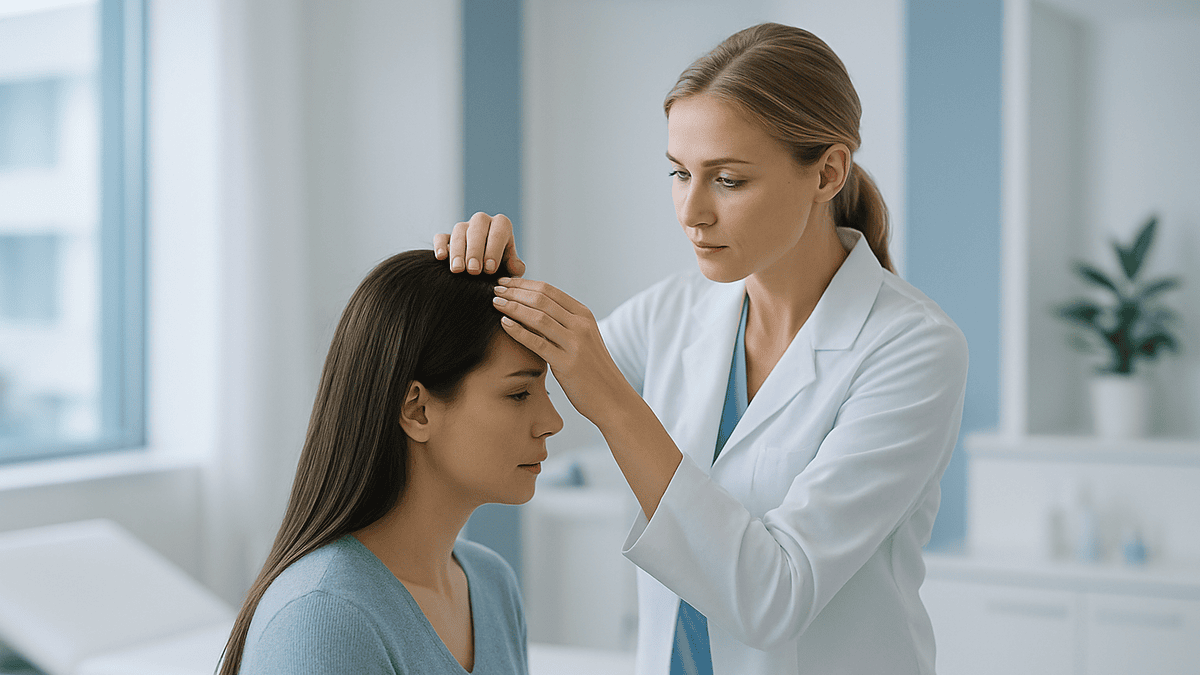
Ordinary dandruff does not damage hair follicles, so on its own it does not cause lasting hair loss. Persistent scalp inflammation and repeated scratching can increase temporary shedding and breakage, and dandruff often appears alongside unrelated hair thinning, which creates the impression of a link. Once the scalp settles, hair lost this way generally regrows. Ongoing or patchy loss deserves a clinician's assessment.
A friend of mine keeps a black sweater in her office drawer and refuses to wear it before noon. By lunchtime she has usually checked her shoulders twice. She also keeps count of the hairs in her hairbrush, and somewhere along the way the two habits fused into one anxious theory: the flakes are stealing her hair.
She is not alone. Type the question into a search bar and you will find thousands of people convinced that dandruff is quietly thinning their hair, along with a chorus of confident answers pointing in opposite directions. Some insist the flakes are harmless. Others describe dandruff as a slow-motion follicle killer.
The evidence sits in a more interesting place than either camp admits. Dandruff and hair loss really do travel together more often than chance would predict, but the reason is rarely the one people assume. Understanding why changes how you treat both.
Does dandruff actually cause hair loss? The short, honest answer
Dandruff is a surface problem. The flakes you see are clumps of dead skin cells shed from the outermost layer of the scalp, and that layer sits well above the hair follicle, the tiny pocket deep in the skin where each strand is manufactured. Flakes cannot reach the follicle, and they do not dissolve, choke or starve it. Mainstream references, including the NHS, describe dandruff as harmless to health, and that includes the health of the hair root.
So why does the question refuse to go away? Because two honest caveats sit underneath the reassuring headline. First, the itch. A scalp that itches gets scratched, and fingernails working over the same patch of skin day after day can snap hairs off at the surface and irritate follicle openings. Second, the inflammation. Mild dandruff involves almost none, but its heavier cousin, seborrheic dermatitis, produces red, greasy, inflamed skin, and an inflamed scalp tends to shed more hair than a calm one.
Neither of those routes destroys the follicle. They nudge it into resting early or break the shaft it produces. That distinction matters enormously, because a follicle that is intact will make a new hair once conditions improve. The scientific literature contains no convincing evidence that simple dandruff causes the permanent, scarring kind of hair loss. What it can do is make an existing shedding problem look worse and feel more alarming.
Why dandruff and hair loss so often show up together
Here is the pattern that fuels the myth. A person notices more hair on the pillow, looks closer at the scalp for the first time in years, and finds flakes. The brain does what brains do: it draws a line between the two.
Timing helps the illusion along. Seborrheic dermatitis is most common in adults between roughly 30 and 60 and occurs more often in men, according to the Cleveland Clinic. Those are precisely the decades when hereditary hair thinning, the most common cause of hair loss in both men and women, becomes visible. Two frequent conditions overlapping in the same age group will coexist in a great many people without one causing the other.
Oil is another shared thread. The yeast implicated in dandruff feeds on scalp oil, so oily scalps flake more. Hereditary thinning is driven by hormone activity in the follicle, and the same hormonal environment tends to increase oil production. An oily, flaky scalp and a gradually receding hairline can therefore be two downstream effects of one upstream cause rather than a chain in which flakes lead to loss.
Stress rounds out the picture. Emotional or physical stress can worsen seborrheic dermatitis flares, and a significant shock can also push large numbers of hairs into the shedding phase at once, with the fallout arriving several months later. The stressful period ends, the flakes flare, the hair sheds, and dandruff takes the blame for a sequence it did not start.
Dandruff vs. seborrheic dermatitis: the difference that matters for your hair
Doctors often describe dandruff and seborrheic dermatitis as points on the same spectrum. At the mild end, you get white or grayish flakes, some itching, and a scalp that otherwise looks normal. At the more severe end, the skin turns red or pink, the scales become yellowish and greasy, and patches may spread beyond the hairline to the eyebrows, the sides of the nose, behind the ears or the center of the chest. The Mayo Clinic lists all of these as typical sites.
Both share the same suspected mechanism. A yeast that lives on nearly everyone’s skin, called Malassezia, breaks down scalp oil into by-products that irritate some people’s skin more than others. The skin responds by speeding up its turnover, shedding cells in visible clumps before they have fully matured. In dandruff the irritation stays minor. In seborrheic dermatitis the immune response is stronger, and inflammation becomes part of the picture.
Inflammation is the variable that changes the hair conversation. A calm, flaky scalp has no meaningful effect on the growth cycle. An inflamed scalp, particularly one that has been red and itchy for weeks, can shorten the growth phase of nearby follicles and tip them into shedding early. Add scratching and the effect compounds. This is why people with pronounced seborrheic dermatitis report more hair fall during flares than people with everyday flakes do, and why the hair usually returns once the flare is brought under control.
How scratching turns flakes into shedding
Watch someone with an itchy scalp for ten minutes and you will understand the most direct route from dandruff to hair in the sink. It is not biochemical. It is mechanical.
Each hair grows from a follicle, but the visible shaft is dead protein with no ability to repair itself. Run a fingernail across it firmly enough and repeatedly enough, and it weakens at the point of contact. Some strands snap a few millimeters above the skin, leaving stubble that feels rough to the touch. Others are tugged out with their root still attached, because a hair in the resting phase is held loosely and releases with little force.
Scratching also injures the scalp surface. Small breaks in the skin let bacteria in, and inflamed follicle openings can develop into folliculitis, a condition of tender red bumps around the hair. Persistently inflamed follicles are less efficient producers of hair. In extreme cases of chronic picking, scarring can develop, though this is uncommon and typically linked to compulsive behavior rather than ordinary itching.
The practical implication is simple and underappreciated. Controlling the itch protects the hair more than any shampoo ingredient marketed for thickness ever could. When people say a dandruff treatment reduced their hair fall, the likeliest explanation is that a calmer scalp stopped being scratched, not that the shampoo stimulated growth. The evidence supports that modest, mechanical account far better than it supports dramatic claims in either direction.
Is dandruff harmful for hair? What it does and does not do
Strip away the marketing and the fear, and dandruff’s effects on hair come down to a short, unglamorous list.
What it does not do: it does not clog follicles in any way that stops hair from growing. It does not weaken the root. It does not thin hair permanently or cause bald patches. It is not contagious, and it is not a sign of poor hygiene; the NHS is explicit that dandruff is not caused by dirty hair. People who wash daily get dandruff, and so do people who wash weekly.
What it can do: it can make the scalp itch, and itching leads to the scratching and breakage described above. It can coexist with, and mask, a separate cause of hair loss, delaying the moment someone seeks help. Heavy scale can also make hair look dull and lie flat, which reads as thinness even when the count of hairs is unchanged. Greasy flakes cling to the shaft near the root, and hair that is weighed down loses the lift that makes it look full.
Where dandruff shades into seborrheic dermatitis, the inflammation itself becomes the concern. The good news is that this inflammation is superficial and reversible. Unlike scarring alopecias, which destroy follicles and replace them with fibrous tissue, seborrheic dermatitis leaves the follicle intact. Treat the skin, and the follicle resumes its usual rhythm. That is the single most reassuring fact in this entire discussion, and it is well supported by every major clinical reference on the condition.
Which scalp conditions really cause hair loss
Because dandruff so often gets blamed for hair loss that has another cause, it helps to know what the real culprits look like. The table below summarizes the conditions clinicians consider most often when a patient arrives with both flakes and thinning.
| Condition | What you see on the scalp | Effect on hair | Does hair regrow? |
|---|---|---|---|
| Simple dandruff | Fine white flakes, mild itch, skin otherwise normal | Breakage from scratching only | Yes |
| Seborrheic dermatitis | Red, greasy patches with yellowish scale; may affect face and chest | Temporary increased shedding during flares | Yes, once inflammation settles |
| Scalp psoriasis | Thick, silvery, well-defined plaques, often past the hairline | Shedding with scratching or flare | Usually |
| Fungal infection (ringworm of the scalp) | Scaly, sometimes bald patches with broken hairs; common in children | Patchy loss, can scar if untreated | Usually, with treatment |
| Hereditary thinning | Scalp looks normal; hair miniaturizes over crown or temples | Gradual, progressive thinning | Partially, with ongoing treatment |
| Alopecia areata | Smooth, round bald patches, no scale | Sudden patchy loss | Often, though it may recur |
Two entries deserve a closer look. Ringworm of the scalp is a true fungal infection, different from the yeast involved in dandruff, and it is one of the few scaly conditions that can leave permanent bald spots if it goes untreated. It is far more common in children and spreads between people. Hereditary thinning, by contrast, produces no flakes at all. When it appears alongside dandruff, the two are simply neighbors, as MedlinePlus notes in its overview of hair loss causes.
How to tell normal shedding from a real problem
Most people have no idea how much hair they lose on an ordinary day, and the number is higher than they expect. The NHS puts normal daily shedding at between 50 and 100 hairs. Wash your hair only twice a week and several days’ worth arrives in the drain at once, which is why shower days feel so alarming.
A useful reference point is your own baseline. Hair that has always come out in similar amounts, with a scalp that looks the same as it did five years ago, is unlikely to signal anything. Change is what matters: a part line that has widened, a ponytail that feels thinner in the hand, temples that have moved back, or a sudden jump in what the brush collects.
Pattern tells you almost as much as quantity. Shedding from an irritated, dandruff-prone scalp tends to be diffuse, spread evenly across the head, and it rises and falls with how itchy the scalp has been. Hereditary thinning follows a map, concentrating at the crown and front in men and along the central part in women, while the sides and back stay dense. Round, completely smooth bald patches point toward alopecia areata. Scaly patches with short broken hairs raise the question of a fungal infection.
One more clue: hairs shed from a resting follicle have a small white bulb at the root. Hairs broken by scratching or heat styling have no bulb, just a blunt or frayed end. A quick look at what you are actually losing often settles the question of whether the scalp or the styling is responsible.
Will hair loss from dandruff grow back?
Yes, in the great majority of cases, and the reason lies in how the hair cycle works.
Every follicle moves through a long growing phase, a brief transition, and a resting phase that ends when the old hair falls out and a new one begins to push up behind it. Inflammation and scratching do not destroy the follicle; they persuade it to leave the growing phase early or snap the hair it has already produced. The factory stays open. Once the irritation resolves, the follicle completes its rest and starts a fresh strand.
Patience is the hard part. Because hair cycles are measured in months rather than days, the shedding you notice today often reflects a scalp flare from earlier in the year, and regrowth after a flare will not be visible for a comparable stretch. New hairs emerge fine and short, and it takes further months before they blend with the rest. People frequently declare a treatment a failure at week four, when the biology has barely begun to respond.
There are exceptions, and honesty demands naming them. Hair lost to hereditary thinning does not return simply because the dandruff clears, since the flakes were never the cause. Hair lost to an untreated fungal infection that has scarred the scalp may not return either. And where seborrheic dermatitis has been severe and untreated for years, a small minority develop a degree of inflammation-related thinning that recovers slowly. For the everyday case of flakes, itch and a worrying brush, though, the evidence points toward recovery.
How to stop hair fall due to dandruff: a realistic plan
Treat the scalp, not the hair. That single reordering of priorities solves most of the problem, and it is what dermatology guidance from the NHS and the Mayo Clinic consistently recommends.
Start with an anti-dandruff shampoo from the pharmacy shelf. These products work through a handful of mechanisms: some slow the growth of the yeast that irritates the scalp, some reduce the rate at which skin cells are produced, and some loosen and lift existing scale so it rinses away. The NHS advises using one for about a month to judge whether it is helping. Leave it on the scalp for the time stated on the label rather than rinsing immediately; most of these ingredients need contact time to work.
Technique matters more than people think. Massage with fingertips, never nails. Rinse thoroughly, because residue can itch on its own. Wash as often as your scalp needs rather than following a rule; oily, flaky scalps often do better with more frequent washing, and there is no evidence that daily washing causes hair loss.
Handle the hair gently while the scalp recovers. Skip tight styles that pull at the roots, dial back heat, and comb wet hair from the ends upward. None of this grows new hair, but it stops you losing strands you would otherwise have kept.
If a month of consistent use leaves the scalp still red, itchy or heavily scaled, that is the moment to involve a clinician. Prescription options exist, including stronger antifungal preparations and short courses of anti-inflammatory treatments, and the choice among them belongs with the prescriber who can see your scalp.
What the "big 3 for hair regrowth" really are, and where dandruff fits
Search forums about hair loss and you will meet a phrase repeated like scripture: the big three. It refers to a trio of treatments popular among people managing hereditary thinning, and understanding what they are explains why dandruff keeps wandering into conversations about regrowth.
The first is a topical solution applied to the scalp that appears to lengthen the growing phase of the hair cycle and enlarge miniaturized follicles. The second is an oral prescription medication that lowers the level of a hormone by-product responsible for shrinking follicles in genetically susceptible people. The third is an antifungal shampoo, the very same category used for dandruff, which found its way onto the list because some small studies suggested it might have a modest supporting role beyond clearing flakes.
That third slot is where the confusion lives. Because an anti-dandruff shampoo appears on a hair regrowth list, people infer that dandruff must cause the hair loss the list is treating. The logic runs backward. The shampoo is included for its possible effects on scalp inflammation and follicle environment, not because flakes cause baldness, and the evidence for its regrowth benefit is considerably thinner than the evidence for the first two.
A few grounding facts. The first two treatments are aimed specifically at hereditary thinning and do nothing for shedding caused by scalp inflammation. Both require continuous use to maintain results; stopping generally means the gains fade over the following months, as the Mayo Clinic notes. Both carry potential side effects that a prescribing clinician weighs against the likely benefit. Whether any of them is right for you is a decision for that conversation, not a forum thread.
Do diet, stress and washing habits affect dandruff and hair loss?
Ask three people why they have dandruff and you may hear three theories: too much sugar, too much stress, not enough washing. The evidence supports each to a different degree, and it pays to know which.
Washing frequency has the clearest answer. Infrequent washing lets oil and dead skin accumulate, giving the yeast more to feed on and making flakes more visible. The Mayo Clinic lists not shampooing enough among the factors that can worsen dandruff. Washing more often does not cause hair loss; the strands you see in the drain were already loose and would have fallen out on the pillow instead.
Stress sits in the middle. Both the Mayo Clinic and the Cleveland Clinic list stress as a trigger for seborrheic dermatitis flares, and severe stress can independently trigger a wave of shedding that arrives months later. Stress does not create dandruff from nothing, but it reliably worsens an existing tendency, and managing it is reasonable advice on multiple grounds.
Diet has the weakest evidence. No high-quality trial shows that cutting sugar or dairy clears dandruff, and no specific food has been proven to cause it. Genuine nutritional deficiency can cause hair shedding, particularly low iron and inadequate protein intake, but those are separate problems with separate tests. Supplements marketed for hair have not been shown to help people who are not deficient, and taking large amounts of certain nutrients can itself cause shedding. The honest summary: eat well for your general health, and do not expect it to fix your scalp.
Common myths about dandruff and hair loss, checked against the evidence
Some beliefs about flaky scalps are so widespread that they feel like common sense. Several of them fall apart on inspection.
- “Dandruff blocks the follicle so hair cannot grow.” Flakes sit on the surface. The follicle opening is not a drain that clogs, and hair pushes past surface debris without difficulty.
- “Dandruff means your scalp is dry, so oil it.” Most dandruff occurs on oily scalps, and the yeast involved thrives on oil. Adding more can worsen flaking. Genuinely dry, tight scalps produce smaller, drier flakes and are a different problem.
- “Dandruff is a hygiene issue.” The NHS states plainly that dandruff is not caused by poor hygiene, though washing less often can make it more noticeable.
- “Once you have dandruff, you have permanently damaged hair.” Hair is dead protein; it cannot be damaged from below by a scalp condition. New hair emerging from a calm scalp is normal hair.
- “Anti-dandruff shampoo causes hair loss.” People often start these shampoos during a shedding phase and blame the product. No mainstream evidence supports the claim, and the mechanisms these ingredients use do not act on follicles.
One belief holds up better than skeptics allow: that dandruff runs in families. Susceptibility to the yeast’s irritating by-products appears to have a genetic component, and seborrheic dermatitis clusters in families and in people with certain neurological and immune conditions. Knowing that helps reframe the condition as a tendency to manage rather than a failing to correct.
When to see a doctor about dandruff or hair loss
Most flaky scalps can be managed at home, and most extra shedding settles on its own. Certain patterns, though, deserve a professional look rather than another month of trial and error.
Book an appointment if a month of consistent anti-dandruff shampoo use has not improved things, if the scalp is red, swollen, weeping or painful, or if the scale is thick and crusted rather than fine and powdery. Seek assessment promptly for hair loss that arrives in distinct bald patches, comes on suddenly, or is accompanied by broken stubble in a scaly area, since fungal infection and alopecia areata both need a diagnosis before they can be treated. Hair loss alongside unexplained fatigue, weight change, joint pain or a rash elsewhere on the body warrants a broader medical review, because the scalp is sometimes the first place a systemic condition shows itself.
Red flags that should not wait: pus or spreading redness on the scalp, fever with a scalp infection, a scaly patch on a child’s head with hair breaking off, or rapid hair loss in someone who has recently started a new medication.
What to expect at the visit is usually straightforward. A clinician will examine the scalp, ask about the timeline and your family history, and may gently tug a small section of hair to gauge how loosely it is held. Occasionally a skin scraping, blood test or small biopsy is needed. The aim is to name the actual cause, because seborrheic dermatitis, hereditary thinning and a fungal infection each call for a different approach, and treating the wrong one wastes months.
Living with a flaky scalp long term: what to expect
Seborrheic dermatitis has a habit of coming back. The Mayo Clinic describes it as a condition that may clear without treatment or require repeated courses, and one that tends to recur. Understanding that in advance spares a great deal of frustration and prevents the cycle of abandoning a shampoo that was working simply because the flakes eventually returned.
Many people settle into a rhythm: an active anti-dandruff product during flares, tapering to once or twice a week for maintenance once the scalp is calm, with an ordinary shampoo in between. Winter, when indoor heating dries the air and hats trap oil and heat, is a common season for flares. So are periods of poor sleep and high stress. Recognizing your own triggers is more useful than any general rule.
For the hair, the long view is reassuring. A scalp that is kept mostly calm, mostly free of scratching, and mostly clear of heavy scale gives follicles the environment they need to cycle normally. If hair continues to thin despite that, the cause lies elsewhere, most often in genetics, and that is a conversation worth having early rather than late, since treatments for hereditary thinning work better at preserving hair than at restoring it.
My friend, for the record, still owns the black sweater. She wears it more often now, after a clinician identified inflamed seborrheic dermatitis rather than the follicle catastrophe she had imagined, and after she stopped counting hairs. The flakes come and go. The hair, as the evidence predicted, stayed.
Frequently asked questions
Will hair loss from dandruff grow back?
In most cases, yes. Dandruff and its inflamed form, seborrheic dermatitis, do not destroy hair follicles; they cause breakage from scratching or push follicles into an early resting phase. Once the scalp settles, the follicle produces a new hair on its usual cycle, though visible regrowth takes months. Hair lost to hereditary thinning or an untreated fungal infection is a different matter and will not return simply because flakes clear.
Is dandruff harmful for hair?
Dandruff is not harmful to the hair root or the hair shaft itself. Its main indirect effect is itching, which leads to scratching and mechanical breakage at the scalp surface. Heavy, greasy scale can also make hair look flat and dull, which reads as thinness even when the number of hairs is unchanged. The NHS classes dandruff as a harmless, common condition that is not caused by poor hygiene.
How do I stop hair fall due to dandruff?
Treat the scalp first. Use an over-the-counter anti-dandruff shampoo consistently for about a month, leaving it on for the time the label states, and wash as often as your scalp needs. Avoid scratching, tight hairstyles and heavy heat styling while the skin recovers. If the scalp remains red, itchy or heavily scaled after a month, a clinician can assess for seborrheic dermatitis or another cause and discuss prescription options.
What are the big 3 for hair regrowth?
The phrase refers to three treatments popular among people with hereditary thinning: a topical solution that appears to prolong the hair growth phase, an oral prescription that lowers a follicle-shrinking hormone by-product, and an antifungal shampoo of the type also used for dandruff. The first two have the stronger evidence and require ongoing use; the shampoo’s regrowth role is modest and less well supported. Suitability is a decision for a prescribing clinician.
Does dandruff cause permanent baldness?
No. Neither dandruff nor seborrheic dermatitis is a scarring condition, meaning the follicle survives intact beneath the irritated skin. Permanent hair loss requires the follicle to be destroyed and replaced by scar tissue, which occurs in a small group of unrelated conditions and in untreated fungal scalp infections. Baldness that appears alongside dandruff is almost always hereditary thinning that happens to share the same scalp.
Why does my hair fall out more when my scalp is itchy?
Itching leads to scratching, and scratching does two things: it snaps hairs at the surface and it tugs out strands already in the loose resting phase. Inflammation beneath an itchy scalp can also shorten the growth phase of nearby follicles, so more hairs enter the shedding stage at once. Controlling the itch, usually with an anti-dandruff shampoo, tends to reduce this type of hair fall within a few weeks of the scalp calming.
Can washing my hair every day with anti-dandruff shampoo cause hair loss?
There is no mainstream evidence that daily washing or anti-dandruff ingredients cause hair loss. The hairs you see in the drain were already detached and would have fallen out elsewhere. Oily, flaky scalps often improve with more frequent washing because the yeast involved in dandruff feeds on oil. If a product irritates your scalp or causes stinging, switch to a different active ingredient and mention it to a pharmacist or clinician.
How long does it take for dandruff shampoo to reduce shedding?
Flakes and itch often ease within a few weeks of consistent use, and the NHS suggests giving a product about a month before judging it. Hair fall lags behind, because the hair cycle runs on a timescale of months. Shedding caused by an earlier flare may continue briefly after the scalp calms, and new hairs take further months to become visible. Steady improvement over one to three months is a realistic expectation.
Is it dandruff or a fungal infection causing my hair loss?
Dandruff produces fine flakes across an otherwise normal scalp with no bald areas. Ringworm of the scalp, a true fungal infection, produces scaly patches where hairs break off close to the skin, sometimes with swelling or tenderness, and it is much more common in children. Because untreated ringworm can scar and spread to others, any scaly patch with broken hairs should be examined by a clinician rather than treated with dandruff shampoo alone.
When should I see a doctor about dandruff and hair loss?
See a clinician if a month of anti-dandruff shampoo has not helped, if the scalp is red, swollen, weeping or painful, or if hair loss is sudden, patchy or accompanied by broken stubble in a scaly area. Hair loss alongside fatigue, weight change or symptoms elsewhere in the body also warrants review. Pus, spreading redness or fever with a scalp problem should be assessed promptly.
References
This article is for general information only and is not a substitute for professional medical advice. Please consult a qualified doctor about your individual situation.

More from the Blog

How Does Phototherapy Help Atopic Dermatitis? What Sessions Involve and Who May Be Offered Them
Phototherapy for atopic dermatitis exposes affected skin to carefully measured ultraviolet light, usually narrowband UVB, in a clinic cabinet several times a week for…

A Daily Routine That Supports Atopic Dermatitis Treatment: Bathing, Moisturizing and Nail Care
A supportive atopic dermatitis daily routine rests on three anchors: a short, lukewarm bath or shower with a gentle, fragrance-free cleanser; a generous layer…
Is Coconut Oil Good for Your Hair? The One Oil That Penetrates
Coconut oil can genuinely help hair, and the reason is unusual: its main fatty acid, lauric acid, is small enough to penetrate the hair…

Peptides in Skincare: What Signal Peptides Do and What the Studies Show
Peptides in skincare are short chains of amino acids applied topically to signal skin cells, most often to encourage collagen production or soften expression…

How to Get Clear Skin: What Actually Works, According to Dermatology Trials
Dermatology trials show that clear skin comes mainly from treating acne consistently: a gentle cleanser, benzoyl peroxide, an adapalene retinoid, daily sunscreen, and patience…

Why Is Cellulitis Not Improving? Spreading Redness, Fever and When to Contact Your Care Team
Cellulitis usually begins to improve within about 48 hours of starting antibiotics, although redness can spread slightly at first. When it keeps worsening after…