

Can Exercise Replace a Scoliosis Brace? Bracing Myths Spine Specialists Correct

Key Takeaways
- In the BrAIST randomized trial, 72 percent of braced adolescents kept their curve below the surgical threshold compared with 48 percent under observation alone.
- Adolescents who wore their brace for more than about 13 hours a day had success rates above 90 percent, while wearing it under roughly 6 hours gave results close to no treatment.
- Bracing is usually recommended for curves of about 25 to 40 degrees in children who are still growing, and it works by guiding growth, not by pulling the spine straight.
- Scoliosis-specific exercise such as the Schroth method has small-trial evidence for posture and mild curves, but no high-quality evidence that it replaces bracing once bracing criteria are met.
- Lung restriction from scoliosis occurs only with severe thoracic curves far above the bracing range; moderate curves do not affect the organs.
- Bracing cannot change an adult's curve because growth has finished; adult care focuses on pain management, physical therapy and, rarely, surgery.
Exercise cannot replace a scoliosis brace for a growing child whose curve has reached the range where guidelines recommend bracing, usually about 25 to 40 degrees. A rigid brace worn as prescribed has trial evidence for reducing curve progression, while scoliosis-specific exercise has weaker evidence and is generally used alongside, not instead of, bracing. The treating spine team decides based on curve size and remaining growth.
The X-ray goes up on the screen, and a 12-year-old who played a full soccer season without a twinge is now looking at a spine that bends like a gentle S. Her parents have already read three forum threads in the waiting room. One says braces are torture devices from another era. Another swears a cousin fixed her curve with yoga. The specialist has roughly fifteen minutes to sort fact from folklore.
Few conditions attract as many confident opinions from people who have never read a trial. Scoliosis brace myths travel fast because bracing asks a lot of a young person, and because the alternative, structured exercise, sounds kinder. The honest picture is less tidy than either camp wants it to be.
This explainer walks through what a brace actually does to a growing spine, what the strongest study on the subject found, where exercise genuinely helps, and where it falls short. Every figure here comes from mainstream sources, and every decision stays with the team reading that X-ray.
How a scoliosis brace actually works on a growing spine
Scoliosis is a sideways curve of the spine measuring 10 degrees or more on an X-ray, using a measurement called the Cobb angle, which is the angle between the most tilted vertebra at the top of the curve and the most tilted one at the bottom. In about eight out of ten cases no cause is found, and doctors call it idiopathic, meaning of unknown origin, according to NIH NIAMS.
A brace does not pull the spine straight the way a splint holds a broken wrist. It works through pressure and growth. Rigid plastic shells are molded to press on the convex side of the curve, the outer bulge, while leaving room on the opposite side for the spine to shift toward. The idea is to guide the vertebrae to grow more evenly while the skeleton is still developing. Bone that is loaded unevenly grows unevenly; a brace tries to change that loading pattern during the years when growth is fastest.
That mechanism explains almost everything else in this article. It explains why bracing is a childhood and adolescent treatment: once growth plates close, there is nothing left to steer. It explains why hours matter: pressure that is removed for most of the day cannot shape growth. And it explains the realistic goal, which Mayo Clinic states plainly: bracing aims to prevent the curve from getting worse, not to reverse it.
The brace is fitted by an orthotist, a clinician trained to design and adjust supportive devices. Follow-up X-rays, typically every four to six months during growth per Mayo Clinic, check whether the curve is holding steady and whether the brace needs adjusting as the child grows taller.
Can exercise replace a scoliosis brace? What the evidence shows
The question deserves a direct answer, graded by the quality of the evidence behind it. For curves that have reached the bracing range in a child who is still growing, there is no high-quality trial showing that exercise alone matches a brace in preventing progression. International scoliosis guidelines from SOSORT, the Society on Scoliosis Orthopaedic and Rehabilitation Treatment, position scoliosis-specific exercise as a first step for small curves and as an add-on during bracing, not as a substitute once bracing criteria are met (SOSORT 2016 guidelines, PubMed).
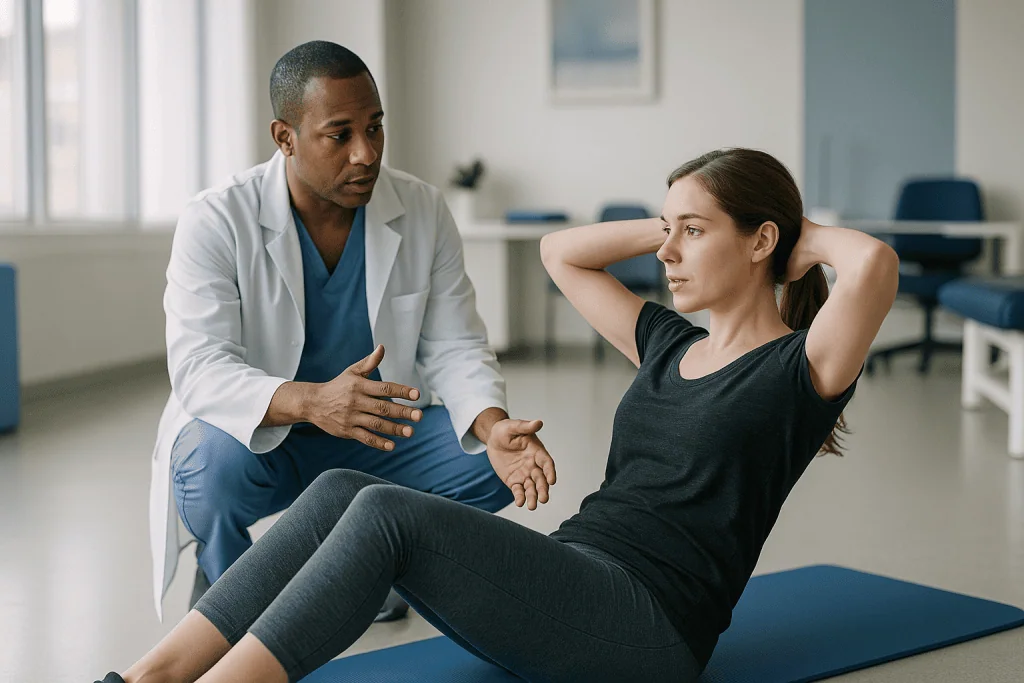
Scoliosis-specific exercise, often abbreviated PSSE for physiotherapeutic scoliosis-specific exercises, means a supervised program tailored to the individual curve pattern. It teaches the person to recognize their curve, elongate the spine, correct trunk shift and breathe into the collapsed side of the ribcage. The Schroth method is the best-known example. Small randomized studies suggest PSSE may slow progression in mild curves and improve posture, trunk balance and self-image, but the studies are small, follow-up is short and the risk of bias is real. That is a world away from the randomized and dose-response data behind bracing.
General fitness, by contrast, has no evidence for changing a curve at all. Swimming, pilates, yoga and core work are good for almost everyone with scoliosis for the same reasons they are good for anyone else: strength, flexibility, mood and cardiovascular health. The NHS notes that exercise is encouraged but does not describe any form of it as a treatment that stops curves worsening.
So the honest summary is this: exercise and bracing are not rivals competing for the same job. One shapes growth under pressure for most of the day; the other trains posture, strength and awareness. In many clinics they are prescribed together, and the brace carries the burden of proof.
Is wearing a back brace good for scoliosis? The trial that settled the argument
For decades, honest specialists admitted that bracing rested on tradition and observational data. That changed with BrAIST, the Bracing in Adolescent Idiopathic Scoliosis Trial, published in the New England Journal of Medicine (PubMed). It enrolled adolescents with curves of 20 to 40 degrees who were still growing, and compared bracing with observation.
The trial was stopped early because the benefit was clear. Treatment was counted as successful if the curve stayed below 50 degrees at skeletal maturity, the point at which surgery is usually discussed. Success occurred in 72 percent of the braced group compared with 48 percent of the observation group. Put another way, bracing roughly halved the proportion of young people whose curves grew into the surgical range.
Equally important was the dose-response finding. Braces in the study contained heat sensors that recorded actual wear. Adolescents who wore the brace for more than about 13 hours a day had success rates in the 90 to 93 percent range, while those wearing it for very few hours did little better than the observation group. That single finding dismantles the two most common opposing myths at once: that braces do nothing, and that a brace worn a few hours at night or during school is as good as a full prescription.
No trial is perfect. BrAIST measured curve angle, not long-term pain or quality of life decades later, and it studied idiopathic curves in adolescents, not scoliosis caused by neuromuscular or congenital conditions. Still, as randomized evidence in pediatric orthopedics goes, it is unusually strong, and it is the reason guidelines from mainstream sources describe bracing as the standard non-surgical treatment for moderate curves during growth.
When is a scoliosis brace needed, and who is usually asked to wait
Bracing is a decision about two numbers: how big the curve is now and how much growth is left. Both come from X-rays. Growth remaining is estimated using the Risser sign, a grade from 0 to 5 based on how much the iliac crest, the top rim of the pelvis, has turned to bone. Risser 0 or 1 means plenty of growth ahead; Risser 4 or 5 means it is nearly finished.
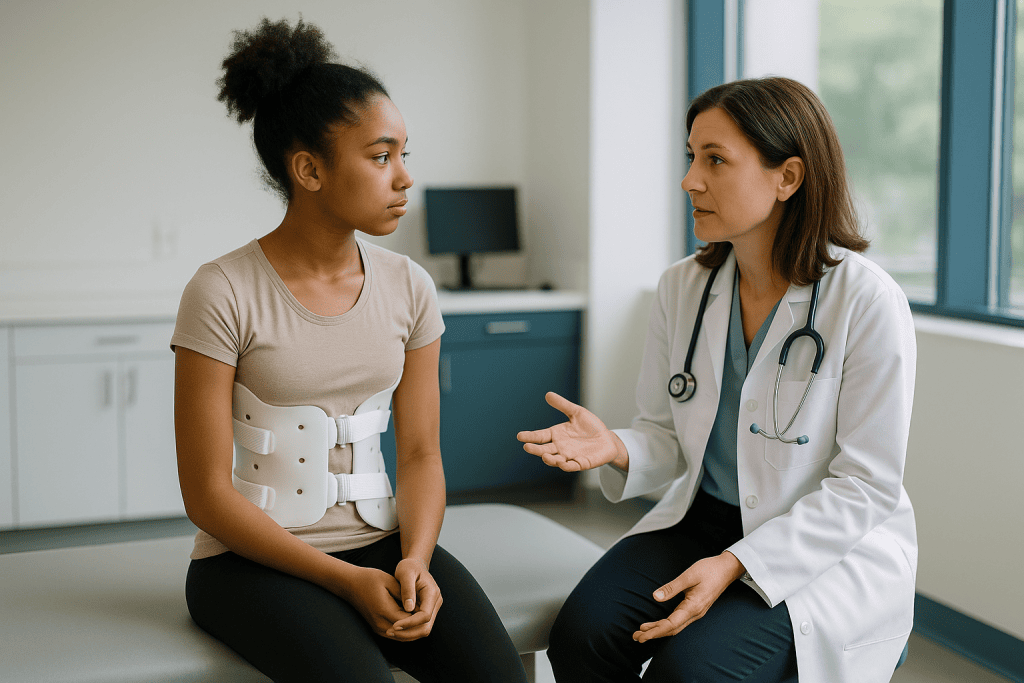
Guideline-level practice described by Cleveland Clinic and Mayo Clinic groups curves roughly as follows:
- Under about 20 to 25 degrees: observation with repeat X-rays, often every four to six months while growing.
- Roughly 25 to 40 degrees in a child who is still growing: bracing is usually recommended.
- Around 45 to 50 degrees or more, or a curve still progressing despite bracing: surgery is discussed.
Who is asked to wait? Children with small curves, because many never progress and a brace would be a burden without a benefit. Adolescents who have finished growing, because the mechanism no longer applies. And adults, for whom a brace may ease pain for short periods but will not change the curve. Waiting is not neglect; it is a monitoring plan with clear triggers, and specialists lean on it heavily because roughly 2 to 3 percent of adolescents have some degree of scoliosis per MedlinePlus, while only a minority ever need treatment.
The gray zone, curves near 20 to 25 degrees in a rapidly growing child, is where individual judgment enters. A curve of 22 degrees at Risser 0 worries a specialist more than a curve of 30 degrees at Risser 4. Family history, the curve’s location and how fast it has changed between visits all weigh in. This is exactly the conversation worth having in person rather than online.
Types of scoliosis braces compared
Not all braces are built alike, and some myths come from people describing one type while thinking of another. The old image of a chin-to-pelvis metal frame belongs to the Milwaukee brace, now rarely used. Modern braces are mostly low-profile thermoplastic shells that sit under clothing.
| Brace type | How it is worn | Typical role | Evidence note |
|---|---|---|---|
| Rigid thoracolumbosacral orthosis (TLSO), e.g. Boston-style | Daytime and night, usually 13 to 16 hours per Mayo Clinic | Standard brace for moderate curves during growth | Type used in BrAIST; strongest randomized evidence |
| Nighttime bending brace (Charleston- or Providence-style) | Worn only while sleeping, about 8 hours | Selected single curves, mainly lower in the spine | Observational studies only; works by over-correcting the curve during sleep |
| Milwaukee brace (CTLSO) | Full-time, includes a neck ring | High thoracic curves; now uncommon | Historical evidence, largely replaced by TLSO designs |
| Soft or dynamic brace | Variable | Comfort or adjunct use | Limited evidence for altering curve progression |
A TLSO, pronounced by its letters, is a thoracolumbosacral orthosis: a device supporting the chest, lower back and pelvis. The term orthosis simply means an external support. Which design suits a given child depends on where the curve sits, how flexible it is and how the family expects to manage wear.
The Johns Hopkins Medicine overview notes that brace choice is individualized by the specialist and orthotist. A brace with weaker trial evidence is not automatically a worse choice for a particular child; a well-tolerated nighttime brace that is actually worn may serve a reluctant teenager better than a full-time brace left in the closet. The point of the table is to show that evidence strength varies, so questions about which type is recommended, and why, are legitimate ones to bring to the clinic.
Scoliosis brace hours per day: why the number is not negotiable
Ask a specialist what single factor most often decides whether bracing works and the answer is rarely the brace itself. It is wear time. Mayo Clinic states that most braces are worn between 13 and 16 hours a day, and that the brace’s effectiveness increases with the number of hours worn. The BrAIST data give that statement teeth: adolescents logging more than about 13 hours daily had success rates above 90 percent, while those wearing the brace under roughly 6 hours fared close to untreated peers (PubMed).
Why so demanding? Return to the mechanism. Growth happens continuously, including during sleep. A brace shapes growth only while it is pressing on the spine. Twelve hours off is twelve hours of growth guided by nothing. There is no catch-up effect from wearing it longer tomorrow.
This is where many scoliosis brace myths quietly do harm. A family hears that a cousin wore a brace “and it didn’t work” without hearing that the cousin wore it mostly at night and never at school. The brace gets blamed for a prescription that was never filled. Modern braces often contain temperature sensors, and the printout at follow-up shows real hours rather than remembered ones. Specialists use this not to scold but to troubleshoot: if wear is low because of skin pressure, the orthotist can adjust the shell; if it is low because of embarrassment at school, the conversation shifts to clothing, timing and peer support.
Families sometimes ask whether hours can be reduced once the curve looks stable. That is a legitimate question for the treating team, who may adjust the plan as skeletal maturity approaches. It is not a decision to make at home based on how the back looks in the mirror, since a stable X-ray at one visit says nothing about the growth spurt that may begin the next month.
Scoliosis brace myths spine specialists hear every week
Here are the beliefs that come up most, and what the evidence says about each.
Myth: braces are outdated and do not work. The randomized trial above showed a clear reduction in progression to surgical range, with a dose-response relationship. Few non-surgical treatments in orthopedics have that kind of support.
Myth: a brace will straighten the spine. The goal stated by Mayo Clinic and the NHS is to stop the curve getting worse during growth. Some curves measure smaller in the brace or improve modestly, but families promised a straight spine are being set up for disappointment.
Myth: braces weaken the back muscles permanently. Muscles do adapt to support, which is one reason exercise is prescribed alongside bracing and why many programs include out-of-brace activity daily. There is no evidence of lasting weakness once bracing ends and normal activity continues.
Myth: you cannot play sports in a brace. Most braces are removed for sport and physical education, and specialists generally encourage activity. The NHS notes that exercise is beneficial and should be encouraged during treatment.
Myth: if the curve is still growing in a brace, the brace has failed. Success in trials was defined as staying below the surgical threshold at maturity, not as zero change. A curve that creeps from 30 to 34 degrees while a child grows five inches may represent a brace doing its job.
Myth: braces are only for girls. Girls are more likely to have curves that progress, which is why more girls are braced, but boys with progressing curves in the bracing range are offered the same treatment, per NIH NIAMS.
None of these myths is foolish. Each contains a grain of real experience, usually from a brace that was poorly fitted, poorly explained or barely worn. The remedy is better information, not a rejection of the treatment.
What people often get wrong about Schroth exercises for scoliosis
Scoliosis-specific exercise has a loyal following, and the loyalty is not baseless. Schroth exercises for scoliosis, developed in Germany a century ago, train three-dimensional self-correction: elongating the trunk, shifting the rib hump back toward midline and using breathing to expand the concave, or caved-in, side of the chest. Done with a trained therapist, the method teaches a young person to understand their own curve, which is a real psychological gain in a condition that can feel like something happening to them.
Where enthusiasm outruns evidence is in the leap from “helps posture and awareness” to “replaces bracing.” Systematic reviews of PSSE find small trials, short follow-up and mixed outcome measures. The SOSORT guidelines, which are generally supportive of exercise, still recommend it as the first step for mild curves and as a companion to bracing rather than as a standalone treatment for curves at bracing thresholds (PubMed). Mainstream patient sources such as Cleveland Clinic and the NHS describe exercise as beneficial without listing it as a method of preventing progression.
Three specific misunderstandings deserve correction:
- General stretching or yoga is not scoliosis-specific exercise. The method matters because the exercises are built around the individual curve pattern.
- Exercise cannot change what happens to bone during the hours a child is not exercising, which is most of the day. A brace can.
- Improvement in how the back looks or feels does not reliably reflect what the X-ray shows. Only imaging measures the Cobb angle.
What exercise does well is worth stating with equal honesty. It may improve trunk symmetry and function, it supports fitness during a period when bracing can make a child feel fragile, and it appears to help with tolerating the brace itself. The best framing is not exercise versus bracing but exercise with bracing, with the specialist deciding how much of each.
The first weeks in a scoliosis brace: what usually happens
Nobody puts on a rigid plastic shell and wears it for 16 hours on day one. Orthotists typically build up wear time over one to two weeks, allowing skin to toughen at pressure points and letting the child learn to sit, bend and sleep in a new shape. Pressure marks that fade within about 20 to 30 minutes of removal are expected; marks that blister, break the skin or persist mean the brace needs adjusting, and NHS guidance notes that braces are adjusted as the child grows.
A thin, seamless cotton undershirt worn beneath the brace reduces chafing and absorbs sweat. Clothing a size up hides most low-profile designs. The brace comes off for bathing, swimming and usually for sport. Many families settle into a rhythm within a month: brace on after breakfast, off for after-school activity, back on for homework and sleep.
Expect an early follow-up, often within the first month or two, to check fit and take an in-brace X-ray. This image shows how much the brace corrects the curve while worn, which gives the orthotist a target for adjustments. Thereafter, visits every four to six months, as Mayo Clinic describes for growing children, track the curve and remaining growth.
Emotionally, the first weeks are often the hardest. Adolescents may feel conspicuous, stiff and angry at a body that has, from their perspective, done nothing wrong. Specialists see this constantly and consider it part of the treatment rather than a side issue. Small accommodations help: a note for school about sitting comfort, a plan for what to say if a friend asks, a deliberate out-of-brace window for the activity the teenager cares about most. Wear improves when the person wearing the brace feels some control over how it fits into their life.
Do scoliosis braces work by straightening the curve, or just holding it?
This question hides a real nuance. In the brace, the curve usually does measure smaller, sometimes dramatically so, because the pads are physically pushing the spine toward midline. That in-brace correction is a sign of a well-made brace. It is not the same as a permanent change.
At skeletal maturity, once the brace is weaned off, most spines settle back toward their original curve or slightly less. The realistic outcomes fall into three groups: the curve stays roughly where it started, which counts as success; the curve improves modestly, which happens in a minority and cannot be promised; or the curve progresses despite good wear, which is why monitoring never stops during bracing. Mayo Clinic and Cleveland Clinic both frame bracing as prevention of worsening.
Why does this distinction matter so much? Because it reframes what success looks like for a family. A parent who expected a straight spine will see a 30-degree curve at maturity as failure. A parent who understood the goal will see the same result as a child who avoided surgery and will now carry a mild, usually harmless, curve into adulthood. Expectations set correctly at the first fitting prevent a great deal of grief at the last visit.
It also explains why bracing and surgery address different problems. Surgery, usually spinal fusion, physically realigns and fuses the curved segment and is reserved for curves around 45 to 50 degrees or more, per Cleveland Clinic. Bracing tries to make sure a child never arrives there. One treatment holds a line; the other redraws it. Neither is a substitute for the other, and a brace that held a curve at 35 degrees through puberty did exactly what it was asked to do.
What organ is most affected by scoliosis?
This question is often asked with real fear behind it, so the answer should be proportionate. For the large majority of people with idiopathic scoliosis, no organ is affected at all. Mild and moderate curves live in the spine and the muscles around it; the heart, lungs and digestive system carry on unaware.
The organs that can be affected in severe cases are the lungs. The thoracic spine, the part attached to the ribs, forms the back wall of the chest. When a curve in this region becomes very large, the ribcage twists and the chest cavity narrows on one side, leaving less room for the lungs to expand. Mayo Clinic lists breathing problems among the complications of severe scoliosis, and NIH NIAMS notes that very large curves can restrict lung function. The curves associated with measurable breathing limitation are generally far above the bracing range, which is one of the reasons specialists work to keep moderate curves from becoming severe ones.
The heart is sometimes mentioned, but direct heart effects are rare and usually a consequence of long-standing severe lung restriction rather than of the curve pressing on the heart. Digestive symptoms are occasionally reported with very large lumbar curves but are not a typical feature.
So the honest ranking is: spine first, by definition; then the muscles and joints around it, which may ache in adults with long-standing curves; then, only in severe thoracic curves, the lungs. A teenager with a 28-degree curve being fitted for a brace is not at risk of organ damage from that curve. The brace is there to keep it that way.
Scoliosis brace myths about adults, disability and everyday life
A separate cluster of scoliosis brace myths concerns grown-ups. The first is that an adult with a newly noticed curve should be braced like a teenager. The mechanism rules this out: with growth complete, there is nothing for a brace to steer. Adults are sometimes offered a brace for short-term pain relief or support during a flare, but NHS guidance is clear that bracing in adults does not alter the curve. Adult care centers on pain management, physical therapy, activity and, for a minority with large or progressing curves and nerve symptoms, surgery.
The second myth runs the other way: that scoliosis inevitably leads to disability. Most people with mild to moderate curves work, exercise, raise families and age much like anyone else. Back pain is somewhat more common in adults with scoliosis, but it is usually manageable with the same approaches used for other back pain.
People also ask whether scoliosis qualifies for disability benefits. In the United States, scoliosis is not listed as a qualifying condition on its own. Government disability programs evaluate spine disorders by their functional effect: whether nerve compression, pain or limited mobility prevents sustained work, documented by imaging and clinical findings. The diagnosis matters less than what it does to daily function. Anyone considering a claim should ask their treating physician about documentation and seek advice from the relevant agency rather than a forum.
A final question people type is who the most famous person with scoliosis is. Many well-known athletes, musicians and actors have spoken about it, and their openness has helped teenagers feel less alone. No single name tops the list, and that is perhaps the more useful fact: a diagnosis compatible with elite sport and performance careers is not a diagnosis that defines a life.
When bracing does not work: what happens next
Even with excellent wear, some curves progress. In BrAIST, 28 percent of braced adolescents still reached the surgical threshold (PubMed). This is not usually anyone’s fault. Curves that are very flexible in one direction, that begin at a young age with a lot of growth remaining, or that sit high in the thoracic spine are simply harder to control.
The first response to progression is rarely to abandon bracing. The team will check actual wear hours, review in-brace correction on X-ray and ask the orthotist whether the shell needs rebuilding for a child who has grown. A brace fitted at 150 centimeters tall may be pressing in the wrong places at 160.
If progression continues past roughly 45 to 50 degrees, or the child is close to maturity with a large curve, the conversation turns to surgery. Spinal fusion joins the vertebrae in the curved segment with rods and bone graft so that they heal as one straighter unit. It is a major operation with a recovery measured in weeks to months, and Cleveland Clinic describes it as reserved for severe curves. Newer growth-modulating procedures exist for selected skeletally immature patients, but their long-term evidence is still accumulating and they are not suitable for every curve.
Bracing that ends in surgery has not been wasted. Delaying a large curve for two or three years of growth often means a shorter fusion, more spine left mobile and an operation on a bigger, stronger body. Families in this situation deserve to hear that from their team rather than reading it here, but it is worth knowing that the pathway is a sequence, not a single pass-or-fail test.
Questions to ask your care team about bracing and exercise
Fifteen minutes in a consultation goes quickly. Arriving with questions written down turns a lecture into a conversation. These are the ones specialists say they wish families asked more often.
- What is the curve measuring now, and how much growth do you estimate is left? Ask for the Cobb angle and the Risser grade so you can follow the numbers yourself.
- Which brace type are you recommending, and why this one for this curve?
- How many hours a day are you prescribing, and how will wear be measured?
- What does success look like at the end of treatment? Ask specifically whether the goal is holding the curve or reducing it.
- Should scoliosis-specific exercise be added, and can you refer us to a therapist trained in it?
- Which activities and sports can continue, and should any be done in the brace?
- How often will X-rays be repeated, and what change between visits would prompt a change in plan?
- What signs at home should make us contact you before the next appointment?
- If the curve progresses despite good wear, what are the next options, and at what angle would surgery be discussed?
- When and how will the brace be weaned off?
One more question is worth asking of yourselves rather than the clinician: what will make wearing this brace livable for our child? The answer might be a particular shirt, a schedule that protects evening dance class, or simply a promise that the teenager, not the parent, controls when it goes on each morning. Teams who hear these answers can often build them into the plan. The evidence is clear that the brace works when it is worn, so anything that helps it be worn is part of the treatment.
When to call your doctor
Most bracing concerns are fitting problems that the orthotist solves at a scheduled visit. A smaller number of signs should prompt a call before the next appointment, and a very few need urgent attention.
Contact the care team promptly if any of the following occur:
- Skin under the brace that blisters, breaks, bleeds or shows red marks lasting well beyond half an hour after removal.
- New or worsening back pain that is present at rest or at night, or pain that is clearly different from the stiffness of early brace wear.
- A visible change in the back, shoulders or waist between visits, suggesting the curve may be progressing.
- Numbness, tingling, weakness or a heavy feeling in the legs or feet.
- Breathlessness with ordinary activity that is new.
- Wear time that has collapsed for any reason, including distress, school refusal or a brace that no longer fits after a growth spurt.
Seek urgent medical care, the same day, for sudden severe back pain after an injury, loss of bladder or bowel control, or rapidly worsening leg weakness. These are not features of idiopathic scoliosis or of brace treatment and need separate assessment, as MedlinePlus and other mainstream sources advise for any spine problem with nerve symptoms.
For adults with scoliosis, the same nerve-related red flags apply, along with pain that steadily increases over weeks, a sense that the trunk is leaning more than before, or breathing difficulty.
None of this list is for self-diagnosis. It exists so that families know which changes deserve a phone call rather than a wait. Every treatment decision, from wear hours to whether to continue bracing at all, belongs to the treating team who can see the X-rays and examine the person wearing the brace.
Frequently asked questions
Is wearing a back brace good for scoliosis?
For a growing child with a moderate curve, yes: a rigid brace worn as prescribed has randomized trial evidence for reducing the chance the curve progresses to the surgical range. The benefit depends heavily on wear time and on starting while growth remains. Braces do not help adults alter their curve, and they are not recommended for small curves that are only being monitored. The treating spine team decides based on X-ray measurements.
Do scoliosis braces work if the curve is already 40 degrees?
They can, provided the child is still growing, which is why 40 degrees sits at the upper edge of typical bracing criteria. The goal at that angle is to prevent the curve crossing the 45 to 50 degree range where surgery is discussed. Specialists weigh remaining growth, curve flexibility and in-brace correction before recommending it. Close monitoring with repeat X-rays is essential, and the plan may change if progression continues.
How many scoliosis brace hours per day are usually prescribed?
Most full-time braces are prescribed for roughly 13 to 16 hours a day, according to Mayo Clinic, with time off for bathing, sport and exercise. Trial data show effectiveness rises with hours worn. Nighttime-only braces are prescribed for about 8 hours during sleep for selected curves. The exact prescription comes from the treating team and should not be reduced at home without discussing it.
Can Schroth exercises for scoliosis replace a brace?
Not for curves that have reached bracing thresholds in a growing child. Schroth and similar scoliosis-specific exercises have small-study evidence for improving posture, trunk balance and possibly slowing mild curves, and international guidelines recommend them alongside bracing or as a first step for small curves. They have not been shown to match bracing in preventing progression of moderate curves. Many specialists prescribe both together.
When is a scoliosis brace needed instead of just watching?
Watching is usual for curves under about 20 to 25 degrees, with X-rays every four to six months while a child is growing. Bracing is generally recommended once a curve reaches roughly 25 to 40 degrees in someone with significant growth remaining, or when a smaller curve is progressing quickly. The decision also considers the Risser sign, curve location and family history, and it rests with the treating specialist.
What organ is most affected by scoliosis?
In most people, none. Mild and moderate curves affect only the spine and surrounding muscles. In severe thoracic curves, the twisted ribcage can reduce the space available for the lungs, and breathing limitation can develop. Those curves are far larger than the ones treated with bracing. Heart effects are rare and usually secondary to long-standing severe lung restriction rather than the curve itself.
Do I qualify for disability if I have scoliosis?
Scoliosis by itself is not a listed qualifying condition in United States disability programs. Eligibility depends on documented functional limitation, such as nerve compression, persistent pain or restricted mobility that prevents sustained work, supported by imaging and clinical findings. Most people with mild to moderate curves do not meet these thresholds. Anyone considering a claim should discuss documentation with their physician and contact the relevant agency directly.
Who is the most famous person with scoliosis?
There is no single answer. Many well-known athletes, musicians and actors have spoken publicly about living with scoliosis, and their stories have helped young people feel less isolated. The more useful takeaway is that scoliosis is compatible with demanding physical careers. Roughly 2 to 3 percent of adolescents have some degree of curve, so public figures with the condition are far from rare.
Will a scoliosis brace straighten the spine permanently?
Usually not. The brace corrects the curve while worn, but once weaned off at skeletal maturity, most spines return close to their starting angle. The stated goal in mainstream guidance is to prevent the curve getting worse during growth. A minority of curves end up modestly smaller, but this cannot be promised. Holding a moderate curve steady and avoiding surgery is considered a successful outcome.
What happens if the brace does not stop the curve?
The team first checks real wear hours, in-brace correction and whether the brace still fits a child who has grown. If progression continues toward the 45 to 50 degree range, surgery such as spinal fusion is discussed. Bracing that delays a large curve through several years of growth still has value, often allowing a shorter fusion later. Decisions about next steps belong to the treating specialist.
References
This article is for general information only and is not a substitute for professional medical advice. Please consult a qualified doctor about your individual situation.

More from the Blog
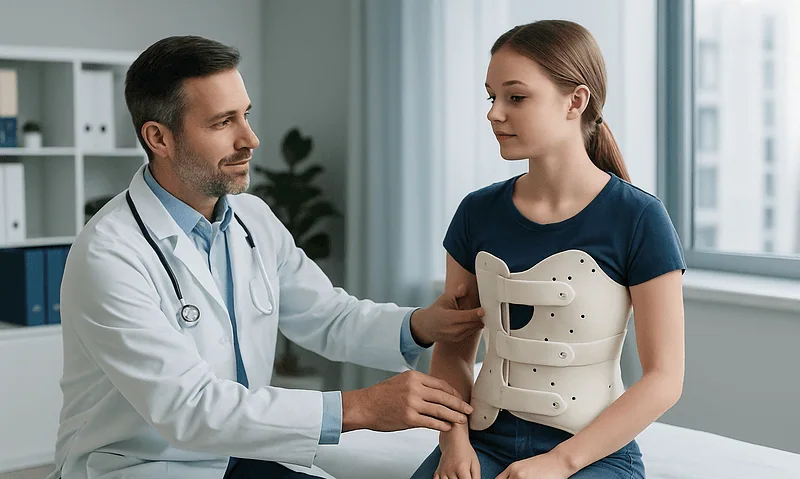
Does a Scoliosis Brace Straighten the Spine? What Bracing Realistically Aims to Do
A scoliosis brace is not designed to straighten the spine permanently. Its realistic aim is to stop a moderate curve from getting worse while…

When Is Spine Surgery Actually Necessary? Red Flags, Failed Conservative Care and Nerve Damage
Spine surgery is usually necessary in three situations: urgent nerve compression with new bladder, bowel or leg weakness (a possible cauda equina syndrome); progressive…

Life After Spinal Fusion: Bending, Lifting, Desk Work and the Movements to Relearn
Life after spinal fusion usually means a few months of protected movement, then a gradual return to most ordinary activities. Bending, lifting and twisting…

Spinal Stenosis Surgery in Your Seventies: How Fitness, Not Age, Guides the Decision
Spinal stenosis surgery is not ruled out by age alone. Surgeons assess physical fitness, heart and lung health, frailty, bone quality and other medical…

Your First Schroth Assessment: X-Rays to Bring, What to Wear and What the Therapist Checks
For a first Schroth appointment, bring your most recent full-spine standing X-ray (the actual images or a digital copy, plus the radiologist's report with…
Spinal Compression Fractures Explained: When Kyphoplasty or Vertebroplasty Is Considered
Most spinal compression fractures are treated without surgery: short-term pain control, gradual return to movement, sometimes a brace, and treatment of the underlying osteoporosis.…