

Can Fat Grafting Improve Scars and Contour Defects? When Surgeons Recommend It

Key Takeaways
- Fat grafting adds living volume beneath depressed or tethered scars and hollows; it does not remove the visible mark on the skin surface.
- Scars keep remodeling for up to two years, so surgeons generally wait until a scar has stopped changing before grafting beneath it.
- Grafted fat survives only where it lies within reach of a blood supply, which is why surgeons place it in thin threads rather than a single clump.
- Some injected fat is always reabsorbed in the first months, retention varies widely between people and sites, and repeat sessions are a planned part of the approach.
- Rolling acne scars can respond to subcision plus fat, while narrow ice-pick scars and raised keloids are poor targets for this technique.
- Sudden vision change, one-sided weakness, chest pain or breathlessness after grafting are rare emergencies that require immediate medical attention.
Fat grafting can improve some scars and contour defects. A surgeon removes a small amount of a person's own fat by liposuction, processes it, and injects it beneath a depressed scar or hollow. Evidence suggests it can add volume and may soften tethered or stiff tissue, but results vary, some fat is reabsorbed, repeat sessions are common, and it does not remove a scar. Suitability is judged individually by the treating team.
She kept a thin scarf in her bag through July. Not for warmth. The tracheostomy scar at the base of her neck had healed well by any nurse’s standard, but it sat in a small dip, and every photograph seemed to find it. Her surgeon had used the phrase “contour deficit” and mentioned that fat grafting for scars was one option worth discussing. She went home and typed the words into her phone, half expecting a miracle and half expecting a sales pitch.
Neither is what the evidence offers. Fat grafting sits in an interesting place in reconstructive surgery: an old idea, refined over the past few decades, with a growing but still uneven body of research behind it. It is neither the filler-in-a-syringe quick fix some clinics imply nor a fringe experiment.
This explainer walks through what actually happens, which scars and hollows tend to respond, what the studies genuinely support, and the questions worth bringing to your own care team before anyone picks up a cannula.
What is fat grafting for scars, in plain language?
Fat grafting, also called autologous fat transfer, means moving fat from one part of your own body to another. “Autologous” simply means the tissue comes from you, which is why there is no risk of the body rejecting it the way it might reject a foreign material.
The procedure has three steps. First, a surgeon performs a small liposuction, usually from the abdomen, flank or inner thigh, drawing out fat through a thin hollow tube called a cannula. Second, that fat is processed to separate the useful fat cells from blood, fluid and the numbing solution used during harvest. Methods include letting the mixture settle, spinning it in a centrifuge, or rinsing and filtering it. Third, the prepared fat is loaded into small syringes and injected in thin threads beneath the scar or into the hollow, layer by layer, so each strand of fat sits close to living tissue that can supply it with blood.
That last point is the heart of the whole technique. Transplanted fat has no blood supply of its own when it arrives. Cells near well-perfused tissue can pick up a new supply within days; cells buried in a thick clump cannot, and they die and are reabsorbed. Surgeons describe good grafting as “sprinkling, not pouring.”
When the target is a scar rather than a simple hollow, a surgeon often adds a fourth step. Using the tip of a cannula or a fine needle, they release the fibrous bands that tether the scar to deeper tissue, a maneuver sometimes called subcision or rigottomy. Freeing the scar creates a pocket, and the fat is placed into that pocket to hold the surface up while it heals.
Which scars and contour defects can fat grafting address?
Not every scar is a candidate. Fat grafting works with volume and texture, so the scars that tend to respond are the ones where something is missing or something is stuck.
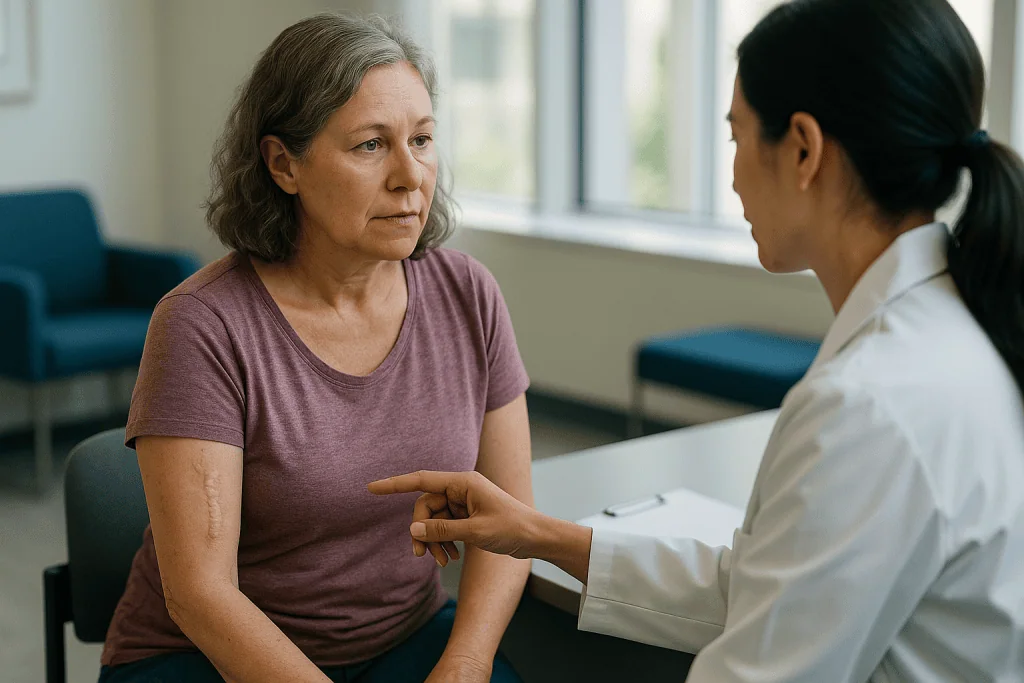
Depressed scars are the clearest example. When a wound heals with less tissue than it started with, the skin dips. Surgical scars that have sunk, indented scars after trauma, and some rolling acne scars fall into this group. Adding fat beneath them lifts the floor of the dip.
Tethered or adherent scars are the second group. Here the scar has fused with the muscle or bone beneath it, so it pulls inward when nearby tissue moves. Freeing the scar and cushioning it with fat gives it a new sliding layer. Burn scars and scars after radiation therapy frequently behave this way, and they are among the most studied targets in the fat-grafting literature.
Contour defects are hollows that may have no visible scar at all. They follow removal of tissue for cancer, breast surgery, facial trauma, congenital conditions in which one side of the face develops less fully, or simply the loss of fat that comes with age or certain medicines.
What fat grafting does not do is remove the mark on the surface. A red line stays a line. A keloid, which is a raised scar that grows beyond the original wound edges, is a fundamentally different problem, and adding volume beneath it makes little sense; keloids are usually managed with steroid injections, silicone, pressure or other approaches described by the Mayo Clinic. Hypertrophic scars, which are raised but stay within the wound edges, are likewise not a natural fit.
Why might fat soften scar tissue, not just fill it?
Volume is the easy part to explain. If a hollow measures a certain depth and you place fat under it, the surface rises. The more intriguing claim, and the one researchers argue about, is that grafted fat changes the scar itself.
Fat is not just fat. Liposuction aspirate contains mature fat cells, small blood vessels, immune cells and a population of adipose-derived stromal cells, sometimes loosely called stem cells, that live in the supporting scaffold of fat tissue. In laboratory work these cells release signaling molecules that encourage new blood vessel growth and appear to calm fibroblasts, the cells that lay down the stiff collagen in a scar. The hypothesis is that grafted fat behaves like a small biologic dressing placed under the skin, improving blood flow and nudging the scar toward a more normal texture.
How much of this actually happens in a living person is less certain. Several clinical series report scars that feel softer, more pliable and less tight after grafting, with patients describing easier movement across joints and less itching or pain. Skin biopsies in a few small studies have shown changes in collagen pattern and blood vessel density. What is largely missing are large, randomized, blinded trials that separate the biologic effect from the mechanical effect of releasing the tether and adding cushion.
A reasonable summary, and the one most reconstructive surgeons would endorse, is this: the volume effect is well established, the softening effect is plausible and repeatedly observed but not conclusively proven, and any promise that fat “regenerates” scarred skin goes beyond the current evidence. Ask any clinician who uses the word “stem cell” in a consultation to explain exactly what is being claimed and where the data come from.
Does fat grafting work on scars? What the research actually shows
The honest answer has three layers.

For contour correction, the evidence is mature and consistent. Fat grafting has been used for decades to restore volume after breast surgery, facial trauma and tissue removal, and it is a standard reconstructive tool in plastic surgery training. The debates here are about technique and durability, not about whether the approach works at all.
For scar quality, most published work consists of case series and small comparative studies, many from burn and radiation settings. These generally report improvements in scar pliability, thickness, color and patient-reported symptoms using standardized scar scales. Systematic reviews of this literature tend to reach the same conclusion: results are encouraging, but study designs are weak, follow-up is often short, and the risk of bias is high because both patient and surgeon usually know what was done. Some of the better-controlled studies have found smaller differences between grafted and untreated scars than the enthusiastic case reports suggest.
For acne scarring specifically, the evidence is thinner still, and much of it involves combined treatments such as subcision plus fat, or fat plus laser, which makes it hard to credit any one component.
What does that mean for someone weighing the procedure? It means fat grafting is a legitimate, widely used option with a plausible mechanism and a reassuring safety profile when performed by trained surgeons, and it means the size of the benefit for any individual scar is genuinely unpredictable. A surgeon who describes it as “likely to help somewhat, with a chance you will need more than one session” is speaking the language of the evidence. A surgeon who promises transformation is not.
Who is usually a candidate, and who is asked to wait?
Suitability starts with the scar and ends with the whole person.
The scar first. Surgeons typically want a scar to be mature before grafting beneath it. Scars remodel for a long time after the skin closes; the NHS notes they can continue to flatten and fade for up to two years. Operating on a scar that is still red, firm and actively changing risks treating a problem that would have improved on its own, and unsettled tissue holds a graft less predictably. Many teams therefore suggest waiting until the scar has stopped evolving, often a year or more after the original injury or surgery, though the exact timing is a clinical judgment.
Then the donor site. There needs to be enough fat to harvest. Very lean people may have limited donor tissue, and this is one situation where a surgeon might suggest a different filler material or a staged plan rather than fat.
Then general health. Fat grafting is surgery, even when performed under local anesthesia, and the same considerations apply as for any elective procedure: control of diabetes, because high blood sugar impairs healing and graft survival; smoking status, because nicotine constricts blood vessels and starves the new graft; bleeding tendencies or blood-thinning medicines, which the prescribing clinician will need to weigh; and any active infection near the site.
People are commonly asked to wait when they are still within active cancer treatment, when radiation changes are still settling, when weight is fluctuating significantly, or when they are pregnant or breastfeeding. Children with congenital contour differences are sometimes treated in stages timed to growth.
A candidate is not someone who wants it; a candidate is someone whose scar, tissue and health align, and that call belongs to the surgical team.
Fat transfer for acne scars: what to expect
Acne scars come in several shapes, and shape decides everything. Dermatologists broadly describe three types: ice-pick scars, which are narrow and deep like a puncture; boxcar scars, which are wider with sharp vertical edges; and rolling scars, which are broad, shallow undulations caused by fibrous bands pulling the skin down from below.
Fat transfer suits rolling scars best. Their problem is tethering plus a mild volume loss across a wide area, which is exactly what subcision and a thin layer of fat address. Ice-pick scars are too narrow for fat to fill meaningfully and are usually treated with other methods. Boxcar scars sit in between and often respond better to resurfacing techniques.
The other thing to know is that acne scarring is rarely treated with one tool. Clinical practice, and most of the published series, combine fat with subcision, microneedling, laser resurfacing or chemical peels, sequenced over months. The NHS lists a range of established scar treatments, and fat grafting is one candidate among them rather than a replacement for all of them.
Someone considering fat transfer for acne scars should expect a frank conversation about which of their scars might respond, an estimate of how many sessions might be reasonable, and an acknowledgment that active acne needs to be quiet first. Grafting under skin that is still breaking out invites both infection and new scars.
Expectations matter more here than almost anywhere else in this field. Smoother is a realistic goal. Skin that looks as though acne never happened is not a goal any honest clinician will put on paper.
Fat grafting for contour defects after surgery, trauma or radiation
This is where fat grafting earns its place in reconstruction, and where the reasoning is most straightforward.
After tissue is removed, whether a tumor from the cheek, a lump from the breast or a skin cancer from the temple, the surface can sink over the gap. Implants and synthetic fillers can fill such spaces, but each brings its own trade-offs: implants are foreign objects that can shift or become surrounded by hard scar tissue, and fillers are temporary and can only be placed in modest volumes. Fat is living tissue that, once it establishes a blood supply, becomes a permanent part of the area and ages with the person.
Radiation adds another dimension. Irradiated skin often becomes thin, tight, discolored and prone to breaking down, because radiation damages the small blood vessels that feed it. Several clinical series in breast reconstruction report that layering fat beneath irradiated skin over one or more sessions is associated with softer, more supple tissue and, in some cases, healing of stubborn small wounds. The mechanism proposed is the same improvement in blood supply discussed earlier. Reviews of this literature judge the evidence promising but still lacking randomized confirmation, so the claim should be held with appropriate caution.
Trauma contour defects, such as a dent left after a fracture or a crush injury, typically respond well because the surrounding tissue is healthy and well perfused, which is precisely what grafted fat needs.
For larger defects, fat grafting may be one stage in a longer plan that also involves flaps, implants or scar revision. Contour restoration is an iterative process, and surgeons often describe a first session as the one that teaches them how a particular patient’s tissue holds fat.
How does fat grafting compare with other scar and contour treatments?
No single treatment addresses every scar. The table below summarizes where fat grafting sits relative to the main alternatives a care team might raise. It is a guide to the conversation, not a ranking.
| Approach | Best suited to | How long it lasts | Main trade-offs |
|---|---|---|---|
| Fat grafting | Depressed, tethered or hollow areas; irradiated or burn scars | Retained fat is long-term; some early loss expected | Requires liposuction; unpredictable retention; repeat sessions common |
| Injectable fillers (hyaluronic acid and similar) | Small depressed scars, minor hollows | Months to a year or two, then reabsorbed | No donor site; temporary; limited volume; product-specific reactions possible |
| Surgical scar revision | Wide, misaligned or poorly positioned scars | Permanent change in scar shape | Creates a new scar that must heal; does not add volume on its own |
| Laser and resurfacing | Surface texture, redness, pigment; shallow acne scars | Variable; several sessions typical | Does not restore lost volume; pigment changes possible in darker skin |
| Steroid injection, silicone, pressure | Raised hypertrophic and keloid scars | Variable; recurrence possible with keloids | Not for depressed scars; skin thinning with repeated steroid use |
Two patterns emerge. First, fat is the only option in this list that permanently restores living volume, which is why it dominates contour reconstruction. Second, fat does little for the surface of a scar on its own, which is why it is so often paired with resurfacing or revision. The NHS and MedlinePlus both describe these established alternatives, and a thoughtful surgeon will usually explain why one, or a sequence, fits your particular scar.
What actually happens on the day of the procedure?
The size of the job sets the setting. A small graft under a facial scar may be done under local anesthesia in a procedure room and take under an hour. A larger contour correction on the body may involve sedation or general anesthesia in an operating room.
You will usually be asked to stop smoking well in advance and to review any medicines and supplements that affect bleeding with the prescribing clinician; the decision to pause or continue anything rests with them. Photographs are taken, and the surgeon marks both the donor site and the target areas while you are standing, because hollows look different when you lie down.
At the donor site, the surgeon infiltrates a dilute solution containing local anesthetic and a medicine that narrows blood vessels to reduce bleeding, then harvests fat gently through small incisions, often only a few millimeters long. Aggressive suction damages fat cells, so this step is slower and more delicate than a liposuction done purely for body shaping. The Mayo Clinic and MedlinePlus describe the general steps of liposuction in more detail.
The fat is then processed and loaded into syringes. At the scar, the surgeon may first release tethering bands, then places fat in many fine passes, often slightly more than the visible deficit seems to need, anticipating some early loss. Incisions are closed with a stitch or simply covered.
Most people go home the same day with dressings on the donor site, a compression garment if the harvest was on the body, and instructions to avoid pressing on or massaging the grafted area. Expect to feel more discomfort at the donor site than at the scar.
Fat grafting recovery time: what the days and weeks usually look like
Recovery is really two recoveries running in parallel, and they feel different.
The donor site behaves like any liposuction. Bruising and swelling peak in the first few days, tenderness eases over a week or two, and firmness or numbness in the area can linger for weeks to months. The Mayo Clinic notes that swelling after liposuction usually settles over several weeks and that the final contour can take months to appear. Compression garments, when prescribed, reduce swelling and help the skin settle.
The grafted area swells too, and this is where expectations are most often misread. In the first week the scar or hollow will look overfilled and puffy, partly from the extra fat placed deliberately and partly from fluid. Over the next several weeks the swelling drains and the fat that did not establish a blood supply is quietly reabsorbed. The area shrinks. Some people panic at this stage, believing the graft has failed, when in fact it is settling into its true result. Surgeons generally avoid judging outcome until at least three months, and many wait six.
Activity restrictions typically include no direct pressure or massage on the graft for a few weeks, no vigorous exercise until the surgeon clears it, and careful sun protection over healing incisions to limit darkening. Light walking from the first day is encouraged, as it is after any surgery, to support circulation.
Bruising on the face is visible for roughly a week or two; on the body it can take longer to fade. Numbness or altered sensation near the scar often improves over months as small nerves recover. All of these timelines are typical ranges, and your own surgeon’s instructions take precedence over anything written here.
Does fat grafting last? Retention, resorption and repeat sessions
Grafted fat that survives the first few months is permanent in the sense that it becomes living tissue with its own blood supply. It will gain and lose volume with body weight like fat anywhere else, and it will age with you. The uncertainty is not whether it lasts but how much of it survives to begin with.
Every graft loses some volume. Fat cells that land too far from a blood supply die within days; the body clears them over weeks. Published retention figures range widely across studies, from well under half of the injected volume to the large majority, depending on the site, the technique, the volume placed, the health of the surrounding tissue and how the fat was processed. That spread is real, and it is why responsible surgeons decline to quote a single percentage for an individual patient. Irradiated or heavily scarred beds tend to retain less than healthy, well-perfused tissue, which is part of the rationale for staging treatment.
Repeat sessions are therefore built into the approach rather than a sign of failure. A first pass establishes a base and often improves blood supply; a second, spaced several months later once swelling has resolved and the surviving volume is clear, refines the result. Some contour reconstructions involve three or more stages. Anyone planning fat grafting should ask early how many sessions the surgeon considers reasonable for their situation and what would prompt a decision to stop.
Two behaviors influence durability in ways you control. Smoking reduces graft survival by constricting the tiny vessels a graft depends on. Large weight changes alter the size of grafted fat along with fat everywhere else, so timing the procedure after weight has stabilized gives a more predictable outcome.
What are the risks of fat grafting for scars?
Fat grafting has a reassuring safety record when performed by trained surgeons, but it is surgery, and the risks divide into three groups.
Donor-site risks are those of liposuction: bruising, swelling, temporary numbness, contour irregularity or a small dent where fat was taken, fluid collection, and, uncommonly, infection or bleeding. The Mayo Clinic lists these along with rarer serious complications that rise with larger-volume procedures, which is one reason scar work, involving small volumes, carries a lower overall risk.
Recipient-site risks include infection, prolonged swelling, asymmetry, under- or over-correction, and lumps. Lumps deserve explanation. When a cluster of fat cells dies, the body can wall off the oily remains, forming a firm nodule called fat necrosis, or a small oil cyst. These are benign and often soften over time, but they can be felt and occasionally need drainage or removal. In the breast, fat necrosis can also create small calcifications on a mammogram; radiologists are familiar with these patterns, but any woman with breast grafting should tell her imaging team.
Rare but serious risks relate to fat entering a blood vessel. In the face, fat injected into or near an artery can travel to the eye or brain, causing vision loss or stroke. This is extremely uncommon and is the reason facial grafting demands detailed anatomical knowledge and blunt, low-pressure injection technique. Fat embolism to the lungs is likewise rare and mostly associated with large-volume body grafting rather than scar work.
Every one of these risks is a reason to choose a surgeon qualified in reconstructive or plastic surgery and to ask how complications are managed. It is not a reason for alarm, but it is a reason for respect.
What people often get wrong about fat grafting for scars
Myths gather around any procedure that touches both medicine and appearance. A few deserve correcting.
“The fat will make the scar disappear.” Fat lifts and cushions from beneath. The surface mark remains, though it may look less noticeable when it is no longer sunken or pulling. Surface color and texture are the province of other treatments.
“It’s just a natural filler.” Fat grafting is a surgical procedure with a donor site, anesthesia and a healing period, not a lunchtime injection. The trade-off for that effort is living, permanent tissue rather than a temporary product.
“Stem cells in fat regenerate the skin.” Fat does contain stromal cells that show promising behavior in the laboratory, and clinical series report softer scars. But controlled human trials proving regeneration are lacking, and no regulatory body has endorsed fat grafting as a stem-cell therapy for scars. Treat any consultation built around that word with healthy skepticism.
“If it shrinks after a month, it failed.” Early shrinkage is expected as swelling resolves and non-surviving fat is cleared. Judgment belongs at three to six months, not three to six weeks.
“More fat means a better result.” Overfilling starves the center of the graft and raises the risk of fat necrosis and lumps. Skilled surgeons place modest volumes in thin layers and stage the work.
“It’s the same as having liposuction for weight loss.” The harvest is deliberately gentle and small in volume. Nobody should expect a meaningful change in body shape from the donor site, and the MedlinePlus liposuction entry is clear that liposuction of any kind is not a weight-loss method.
Getting these right before the first consultation makes the conversation with a surgeon far more productive.
Questions to ask your care team before fat grafting
A consultation goes better when you arrive with questions rather than hopes. These are the ones experienced patients and surgeons tend to consider most useful.
- Which of my scars or hollows do you expect to respond, and which do you expect not to? Why?
- Is my scar mature enough to treat now, or would waiting improve the result?
- What is the realistic goal for me: volume, softness, mobility, appearance, or some combination?
- How many sessions do you think are reasonable, and how far apart? What would make you decide to stop?
- Where would you harvest the fat, and do I have enough donor tissue?
- Will you release the tethering under the scar, and how does that change recovery?
- What anesthesia do you recommend, and where will the procedure take place?
- What complications have you seen with this procedure, and how do you manage them?
- How will fat grafting interact with any imaging I need in future, particularly mammograms?
- Which of my medicines or supplements need to be reviewed beforehand, and who makes that decision?
- What alternatives would you consider for my situation, and why do you prefer this one?
- What are your qualifications in plastic or reconstructive surgery, and how often do you perform fat grafting for scars specifically?
Write the answers down. Then ask one more question of yourself: does this surgeon describe outcomes in ranges and probabilities, or in promises? The evidence base for fat grafting is genuinely encouraging and genuinely incomplete, and a clinician who conveys both halves of that sentence is the one whose judgment you can trust when the decision is made together.
When to call your doctor after fat grafting
Most recoveries are uneventful, marked by bruising that fades and swelling that slowly settles. A small number are not, and knowing the difference protects both your health and your result.
Contact your surgical team the same day if you notice spreading redness, increasing warmth or worsening pain at either the donor site or the grafted area after the first two or three days, since pain should be easing, not building. Fever, chills, a foul-smelling discharge or pus from an incision, or an incision that opens are all signs of possible infection that need prompt assessment. A rapidly enlarging, tense, painful swelling at the donor site can indicate bleeding beneath the skin and should be reported without waiting for a scheduled appointment.
Seek emergency care immediately, by calling emergency services, for any sudden change in vision, severe headache, confusion, weakness or numbness on one side of the body, difficulty speaking, chest pain, sudden shortness of breath, or coughing up blood. These can signal fat or a blood clot traveling to the brain, eye or lungs. They are rare, especially in small-volume scar work, but they are not symptoms to sleep on. Calf pain, swelling or warmth in one leg after any surgery also warrants urgent attention because of the possibility of a deep vein clot.
Less urgent, but worth a call at the next opportunity: a firm lump that persists or grows after the early swelling has gone, skin over the graft that turns dusky or pale, numbness that is not gradually improving after several weeks, or asymmetry that concerns you once the three-month mark has passed.
The Mayo Clinic describes the warning signs after liposuction in general terms. Your own team’s written aftercare instructions and contact numbers override any general guidance, and no question about a change you have noticed is too small to raise with them.
Frequently asked questions
Does fat grafting work on scars?
Yes, for certain scars. Fat grafting reliably restores volume under depressed scars and hollows, and clinical studies report softer, more pliable scars after grafting, especially in burn and radiation settings. The evidence for the softening effect comes mostly from small studies without blinding, so the size of benefit for any individual is uncertain. Your treating team can judge whether your scar type is likely to respond.
Is fat transfer for acne scars a good option?
It can help rolling acne scars, which are broad, shallow dips caused by fibrous tethering, particularly when combined with subcision. Narrow ice-pick scars are poor targets, and boxcar scars often respond better to resurfacing. Acne must be inactive first. Most treatment plans combine several methods over months, and realistic goals are smoother skin rather than skin that shows no history of acne.
What is a contour defect, and can fat grafting fix it?
A contour defect is a hollow or dent in the body surface, often left after surgery, trauma, radiation or uneven development, sometimes with no visible scar. Fat grafting is one of the standard reconstructive tools for these, because surviving fat becomes permanent living tissue. Larger defects may need more than one session or a combination with other surgical techniques, planned by the surgical team.
How long is fat grafting recovery time?
Bruising and tenderness at the donor site usually ease within one to two weeks, while swelling settles over several weeks according to the Mayo Clinic’s liposuction guidance. The grafted area looks overfilled early and shrinks as swelling drains and non-surviving fat is cleared. Surgeons generally assess the final result at three to six months. Your own team’s instructions on activity and pressure take precedence.
Does fat grafting last permanently?
Fat that survives the first few months establishes its own blood supply and is permanent, changing size with your body weight like fat elsewhere. The uncertainty is how much survives; published retention ranges vary widely by site, technique and tissue health. Some early volume loss is expected, which is why surgeons often plan a second session once the surviving volume is clear.
Is fat grafting painful?
Most people report more discomfort at the donor site than at the scar, describing it as similar to a deep bruise for several days. The grafted area typically feels tight and swollen rather than sharply painful. Pain should ease day by day; pain that increases after the first few days, especially with redness or fever, is a reason to contact your surgical team.
Can fat grafting be used on keloid or raised scars?
Generally no. Keloids grow beyond the original wound edges and hypertrophic scars are raised within them; both are problems of too much tissue rather than too little, so adding fat beneath them makes little sense. These scars are usually managed with steroid injections, silicone, pressure or other approaches described by the Mayo Clinic and MedlinePlus, chosen by a dermatologist or surgeon.
Are the stem cells in fat proven to regenerate scarred skin?
Not proven. Fat contains adipose-derived stromal cells that show promising behavior in laboratory studies, and several clinical series report softer scars after grafting. Controlled human trials demonstrating true regeneration are lacking, and no regulatory body endorses fat grafting as a stem-cell therapy for scars. Ask any clinician using the phrase to explain exactly what is being claimed.
Who should not have fat grafting for scars?
Surgeons commonly advise waiting for people whose scars are still actively maturing, who are mid-way through cancer or radiation treatment, who are pregnant or breastfeeding, who smoke, whose diabetes is poorly controlled, whose weight is fluctuating, or who have too little donor fat. An active infection or acne at the site is also a reason to postpone. The final decision rests with the treating team.
What are the warning signs after fat grafting?
Call your surgical team for spreading redness, increasing pain, fever, pus, an opened incision, or a rapidly enlarging tense swelling. Seek emergency care immediately for sudden vision change, severe headache, one-sided weakness, difficulty speaking, chest pain, sudden breathlessness or one-legged calf swelling, which can signal a clot or fat traveling to the brain, eye or lungs. These are rare but urgent.
References
This article is for general information only and is not a substitute for professional medical advice. Please consult a qualified doctor about your individual situation.

More from the Blog

How Thigh Lift Surgery Is Performed: Incision Lines, Tissue Removal and Closure
Thigh lift surgery removes loose skin and some fat from the inner or outer thigh through planned incisions, most often along the groin crease…
What Pectoral Augmentation Results Look Like Over Time: Realistic Expectations for Men
Pectoral augmentation results change for months after surgery. In the first week the chest usually looks swollen, high and tight; over 6 to 12…
What Are the Risks of Aesthetic Genital Surgery? Infection, Wound Healing and Sensation
Aesthetic genital surgery carries the general risks of any operation, including bleeding, infection and reactions to anesthesia, plus risks specific to this area: wound…
How Arm Liposuction Is Performed: Incision Points, Cannula Passes and Time Under Anesthesia
Arm liposuction removes fat from the upper arm through two or three small skin openings, usually near the elbow crease and the back fold…

Laser Liposuction Recovery: Compression Garment Days, Walking Early and Returning to Work
Laser liposuction recovery typically involves wearing a compression garment for several weeks, walking gently from the first day to lower clot risk, and returning…

How BBL and Lipofilling Is Performed: Liposuction, Fat Purification and Careful Transfer
A BBL lipofilling procedure reshapes the buttocks with a person's own fat in three stages. Liposuction removes fat from areas such as the abdomen,…