

Caring for Dental Prosthetics Long Term: Floss Threaders, Interdental Brushes and Check-Ups
Key Takeaways
- Prosthetic teeth cannot decay, but the gum around implants can inflame and lose bone with little or no pain, which is why daily cleaning at the gum cuff matters more than the shine on the porcelain.
- A floss threader lets ordinary floss pass beneath a bridge or implant bar, and the sweep along the underside of the artificial tooth is the stroke that clears the plaque a toothbrush never reaches.
- Interdental brushes must be sized to each gap; one that slides in with no resistance cleans only the centre, and many mouths need two or three sizes.
- Settled dentures come out at night and soak in water or a denture solution, never hot water, because constant wear encourages denture stomatitis and heat warps acrylic.
- NHS guidance sets dental recall anywhere from 3 to 24 months according to individual risk, and prosthesis wearers are often seen toward the shorter end because their problem surfaces are hidden.
- Dentures typically need relining or remaking after roughly 5–10 years because the jawbone beneath keeps remodelling, while implant posts can last decades if peri-implantitis is kept at bay.
Caring for dental prosthetics long term means cleaning them twice a day like natural teeth, reaching under bridges and around implants with floss threaders or interdental brushes, removing dentures at night and soaking them, and keeping the recall interval your dentist sets, typically 3–24 months depending on risk. Regular professional checks catch loose screws, worn fittings and gum inflammation before they threaten the prosthesis.
The cardigan pocket gives it away. A small plastic sleeve, a folded strip of floss threaders, a stubby interdental brush with a bent neck. She has carried this kit for eleven years, ever since a bridge replaced two molars she lost to a cracked filling, and she can clean under it in a supermarket queue without looking. Her dentist, she says, has never once found plaque beneath that bridge.
That is what caring for dental prosthetics looks like when it works: unremarkable, habitual, slightly boring. It is also the part of the story that glossy implant brochures skip. The surgery gets the attention. The next twenty years of brushing, threading and check-ups quietly decide whether the work holds up.
This explainer walks through those twenty years. Which tools reach where, how often the dentist genuinely needs to see you, what wears out first and, just as usefully, which widely repeated tips the evidence does not support.
What caring for dental prosthetics actually covers
A dental prosthesis is any artificial replacement for missing teeth, and the label stretches across some very different objects. A crown is a cap cemented or screwed onto a single tooth or implant. A bridge is a run of joined artificial teeth anchored to neighbours on either side. A dental implant is a titanium post placed in the jawbone that carries a crown, a bridge or a clip for a denture. A denture is a removable plate carrying replacement teeth, either partial or complete.
Each behaves differently in the mouth, and each fails differently. A bridge traps food against the gum beneath its middle tooth. An implant has no root ligament, so the gum around it inflames quietly and the surrounding bone can recede without the warning ache a natural tooth would give. A denture rests on a ridge of bone that slowly remodels away, so the fit loosens even when the plastic looks perfect.
Care therefore has to match the object. The shared principles are simple enough: remove plaque daily from every surface that touches gum, keep the fitting surfaces clean, and let a professional inspect what you cannot see. The tools and the emphasis change with the prosthesis, which is why the sections below take bridges, implants and dentures in turn rather than pretending one routine fits all.
One more thing the umbrella term hides. Prosthetic teeth do not decay, but everything holding them does. Natural teeth under crowns can still rot at the margin. Gum around an implant can still break down. Bone under a denture still thins. Mayo Clinic’s patient guidance on implant surgery makes the point plainly: the implant lasts as long as the tissue and habits supporting it allow.
How plaque, gum and bone respond to a prosthesis over the years
Within hours of any cleaning, a film of saliva proteins coats every surface in the mouth, natural or artificial, and bacteria settle into it. Left for a day or two, that biofilm thickens into plaque, the soft pale deposit you can scrape with a fingernail. Plaque does not care whether it sits on enamel, porcelain, acrylic or titanium. What matters is where it meets living tissue.
Around a natural tooth, the gum attaches through a cuff of fibres into the root surface. Around an implant, that fibre attachment is missing; the gum simply lies against the metal or ceramic. Inflammation therefore spreads toward bone with less resistance, and because the implant has no nerve-rich ligament, the early stages rarely hurt. Peri-implant mucositis is the reversible gum inflammation stage; peri-implantitis is the stage where bone around the post is being lost. The NIH’s National Institute of Dental and Craniofacial Research describes the same bacterial mechanism for gum disease around natural teeth, and the process around implants follows a parallel path.
Under a removable denture, a different slow change happens. Jawbone exists to hold tooth roots, and once the roots are gone it gradually remodels away. The denture, which fitted snugly at delivery, begins to rock, rubbing sore patches and letting food slip beneath. Cleveland Clinic’s denture guidance notes that this loosening is expected over years and is the usual reason a plate needs relining or remaking, not a sign anyone did something wrong.
Bridges sit somewhere between. The supporting teeth remain alive and can decay at the crown margin, while the artificial tooth in the middle creates a sheltered tunnel where plaque thrives unless something reaches under it every day.
Knowing these three mechanisms turns a list of chores into something with a logic: disrupt biofilm daily at the gum line, keep fitting surfaces clean so tissue underneath stays healthy, and have someone measure what is changing.
Who takes over daily care straight away, and who is asked to wait
Most people with a settled prosthesis manage all of their own day-to-day care from the first week. Anyone with a cemented crown, a bridge that has been in place for a while, or a denture they have worn for years falls into this group: the routines described in this article are theirs to run, with the dental team checking the results at recall.
Some people are asked to hold back, at least from parts of the routine, for a defined period. After implant surgery, the gum over the post needs to heal and the bone needs months to knit around the titanium, a process called osseointegration. Mayo Clinic’s patient information describes the whole implant sequence as stretching over several months, with healing intervals between stages. During those intervals the surgical team usually asks for gentle cleaning of the area rather than vigorous flossing or firm interdental brushing, and the instructions are specific to the surgery performed. Follow them over anything printed here.
People with new dentures are often asked to do something that sounds counterintuitive: keep the plate in almost constantly at first, including overnight, so the mouth adapts and sore spots can be identified and adjusted. NHS guidance on dentures notes that this initial period gives way, once the fit is settled, to removing the denture at night. The team decides when that switch happens.
A third group needs more hands-on support than a leaflet can offer. Reduced hand strength from arthritis or stroke, limited vision, memory conditions or a very dry mouth from medicines all make plaque control harder. Here the sensible plan is not to struggle privately but to say so at the appointment; longer-handled brushes, electric brushes, more frequent hygiene visits and a carer’s involvement are all ordinary parts of prosthetic care, not admissions of failure.
The decision about which group you sit in, and when you move between them, belongs to the treating team.
Do you have to brush prosthetic teeth?
Yes, and with the same seriousness as natural teeth. The porcelain will not rot, but the gum it meets will inflame, the cement margin will collect plaque, and a denture left unbrushed grows a film that smells and can inflame the palate beneath it.
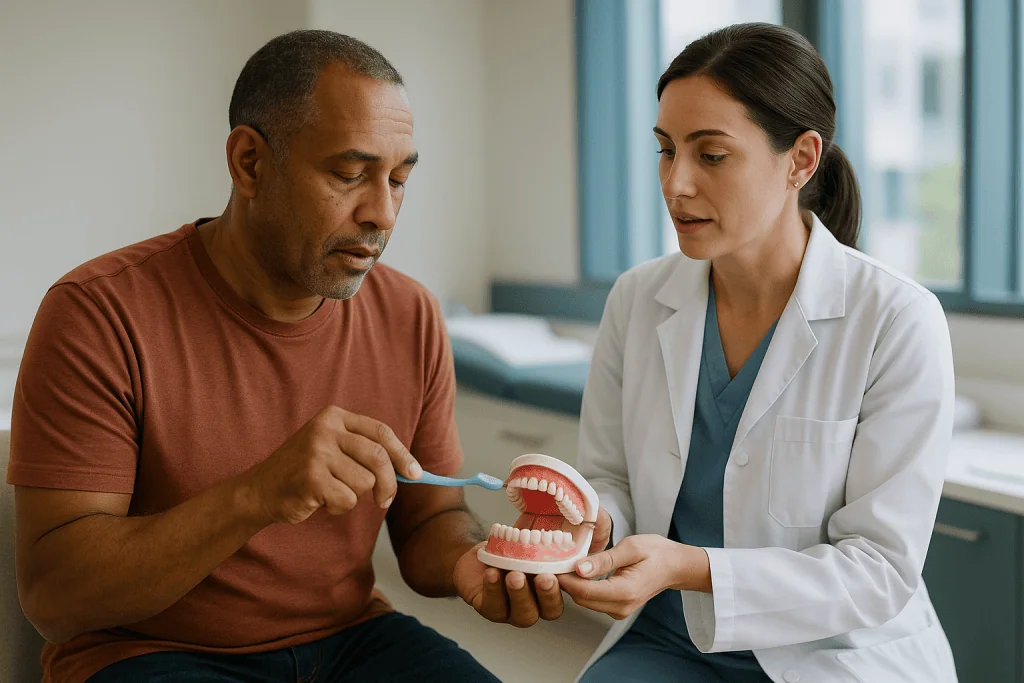
For fixed work, crowns, bridges and implant restorations, the routine is the one the NHS recommends for everyone: brush twice a day for about two minutes with a fluoride toothpaste, paying particular attention to where the restoration meets the gum. A soft brush angled toward that junction lifts plaque without abrading either the ceramic glaze or the gum. Hard bristles and gritty whitening pastes can dull porcelain and scratch acrylic over years, so a standard soft or medium brush and an ordinary paste are the usual advice. Fluoride matters for the natural teeth still present, particularly those supporting bridges, where decay at the crown margin is a common reason a bridge eventually fails.
Electric brushes are not compulsory. Several patient-information sources, including the NHS, note that both manual and powered brushes clean well when used properly; the powered brush helps most when technique or hand strength is the limiting factor.
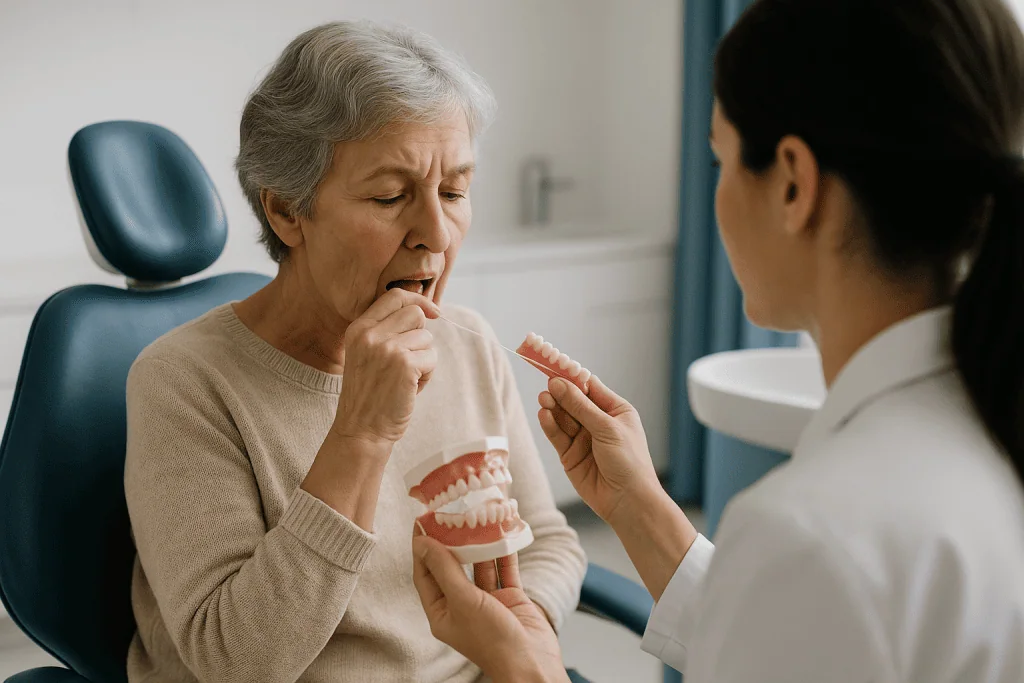
Removable dentures are brushed out of the mouth, over a folded towel or a basin of water so a drop does not end in a crack. Use a soft brush or a dedicated denture brush and either a denture cleaning paste or plain liquid soap. Ordinary toothpaste is often discouraged for acrylic because its abrasives roughen the surface over time and rough acrylic holds biofilm more stubbornly. Brush every surface, including the pink fitting side that sits against the gum, then rinse.
Do not forget the mouth itself. Gums, palate and tongue still need a gentle brush or a soft cloth once the denture is out. Cleveland Clinic’s denture guidance lists this as a daily step, and it is the one most people skip.
Using a floss threader for a bridge or implant bar
A floss threader is a stiff plastic loop, rather like a flexible needle, that lets you pass ordinary floss under a bridge or beneath the bar connecting implants, where floss cannot be dropped in from above because the teeth are joined.
The technique takes a week to feel natural. Thread a length of floss through the loop, slide the pointed end of the threader between the bridge and the gum from the cheek side, catch it on the tongue side and pull the floss through. Drop the threader and work the floss the way you would on natural teeth: hug the surface of one supporting tooth, slide gently to the gum line, then pull the floss along the underside of the artificial tooth to sweep out what has collected there. Repeat against the second supporting tooth before drawing the floss out sideways rather than lifting it, which would snag the bridge.
Around an implant bar or an implant-supported bridge, the same movement applies, with one difference in pressure. The gum against an implant has no fibrous attachment and tears more easily than gum around a natural root, so the sweeping stroke should be firm enough to disturb plaque but not sawing. A mildly tender gum for a few days is common at the start; bleeding that persists beyond a couple of weeks is a reason to have the area checked, since it may signal inflammation rather than clumsy technique.
Some people find floss with a built-in stiffened end, often sold as bridge or implant floss, easier than a separate threader. The evidence does not favour one design over another; what matters is that the underside is cleaned once a day. If the manoeuvre remains impossible after honest practice, say so at the next appointment. A hygienist can usually adjust the technique or swap the tool in ten minutes.
How to clean dental implants with interdental brushes
An interdental brush is a small bottle-brush on a wire or plastic core, sized to fit the gap between two teeth or between a tooth and an implant crown. For many people with implant work it becomes the main daily cleaning tool, because the spaces around implant crowns are often wider than natural gaps and a brush fills them more completely than a strand of floss.
Size is everything. A brush that slides in with no resistance is too small and cleans only the middle of the gap; one that has to be forced will bruise the gum and may fray or break. The hygienist can measure the spaces and note which sizes belong where, and it is normal to need two or three different sizes across one mouth. Gaps also change as gum settles, so the sizing is worth rechecking at each recall.
Insert the brush at gum level, angled slightly toward the gum, and move it in and out a few times without twisting. Bend the neck for back teeth. Rinse it and move to the next gap. Around implants, the same caution as flossing applies: the plastic-coated or nylon-core designs are usually suggested over bare wire, since a wire dragged repeatedly across a titanium abutment can scratch it, and scratched surfaces hold biofilm.
A worn brush with splayed bristles or a kinked core stops cleaning; most people replace each one after a week or so of daily use, though sooner if it looks tired.
Where does this sit alongside floss? For natural teeth with tight contacts, floss still reaches where a brush cannot enter. For open spaces around implants and under some bridges, the NHS oral hygiene guidance and most dental teams treat interdental brushes as at least as effective as floss for the person who will actually use them daily. Adherence, not the tool, predicts the outcome.
Water flossers, single-tuft brushes and other adjuncts: what the evidence shows
Walk past any pharmacy aisle and the message is that prosthetic care needs a small arsenal. The honest picture is narrower. Two tools carry the load: a toothbrush and something that cleans between and beneath. Everything else is optional, helpful for some people, and should be judged by whether it gets used.
A water flosser, also called an oral irrigator, fires a pulsed jet of water between teeth and around restorations. Trials in people with implants and bridges generally find it reduces bleeding and plaque compared with brushing alone, and some find it comparable to string floss for gum health. What the evidence does not show is that it removes mature plaque as thoroughly as a brush or floss physically rubbing the surface. A fair summary: a useful addition, particularly for people who cannot manage threaders or interdental brushes, and a reasonable substitute when the alternative is doing nothing between the teeth. It is not a reason to abandon a routine that already works.
A single-tuft or end-tuft brush is a toothbrush with one small clump of bristles, useful for the tongue-side of implant crowns, the back of a last bridge unit and along the gum edge of a denture-supporting bar. It reaches angles a full brush head cannot. Its value is practical rather than proven in large trials, and hygienists suggest it case by case.
Antiseptic mouth rinses containing chlorhexidine, an antibacterial rinse, are sometimes prescribed for short periods after surgery or during a flare of gum inflammation. Used for long periods they stain teeth, prostheses and tongue and alter taste, so they are not a maintenance tool and should be used only as the dental team directs.
Denture adhesives, tongue scrapers and ultrasonic cleaning baths all have their place for individual people. None replaces the daily mechanical removal of plaque, and none has evidence strong enough to be called essential.
Denture care at night: how many hours a day should you wear dentures?
For a settled denture, the standard advice from the NHS and Cleveland Clinic is to take it out at night. Gum tissue that is covered around the clock stays damp, warm and undisturbed, which favours the yeast overgrowth known as denture stomatitis, a red, sometimes sore inflammation of the palate. Removing the plate for several hours lets saliva bathe the tissue and gives the ridge a rest from pressure. So the usual pattern is wearing the denture through the waking day and sleeping without it.
New dentures are the exception. Many teams ask for near-continuous wear during the first days, sleeping included, so the mouth adapts quickly and pressure spots reveal themselves for adjustment. The switch to nightly removal is a decision the dentist makes once the fit has settled; ask rather than assume.
What happens to the denture overnight matters as much as taking it out. Acrylic that dries warps subtly, so after brushing, the plate goes into a container of water or a denture-soaking solution. Products marketed as effervescent cleansers loosen stains and reduce bacterial load, and they work as an adjunct to brushing rather than a replacement; a denture dropped into fizz without brushing still carries its plaque film in the morning. Hot water is the classic mistake, since it can distort the fit permanently. Bleach solutions are usually discouraged, particularly for partial dentures with metal clasps, because they corrode and discolour the metal.
Rinse the denture before it goes back in. Clean the container. If a soaking product carries a warning about contact time, follow it; overnight soaks in solutions not designed for it can bleach or weaken acrylic.
People who share a bathroom sometimes feel awkward about a denture in a cup on the shelf. A small lidded container solves the social problem; there is no clinical reason to leave the plate in overnight to avoid embarrassment.
Can I eat normally with a dental prosthesis?
Mostly, and often completely, but the honest answer depends on the prosthesis and on the stage you are at.
Fixed implant crowns and bridges, once healed and checked, generally allow an unrestricted diet. Mayo Clinic’s implant guidance describes soft foods during healing after each surgical stage, moving back to normal eating once the team confirms the implant has integrated. After that, the sensible cautions are the same ones that apply to natural teeth: cracking ice, biting hard sweets or opening packets with the teeth can chip porcelain, and porcelain does not heal. A chipped implant crown usually means a repair or a remake rather than a filling.
Removable dentures take longer to feel normal. Biting force is transmitted through gum rather than root, so the sensation is different and the total force people comfortably use is lower. Cleveland Clinic and NHS denture guidance both suggest starting with soft foods cut small, chewing on both sides at once to stop the plate tipping, and gradually reintroducing tougher textures over weeks. Foods that remain awkward for many long-term denture wearers include very sticky toffees, whole apples bitten from the front and tough crusts; most people learn to slice, quarter and choose rather than avoid whole food groups.
Nutrition is the quietly important point. Studies of older adults with tooth loss consistently link poorly fitting or absent prostheses with lower intake of fruit, vegetables and protein, because those are the foods that demand chewing. A prosthesis that fits well is a nutrition tool, and a plate that has become loose enough to steer eating toward soft, processed food is a reason to book a review, not something to endure.
Hot drinks deserve one caution for full-denture wearers: the palate is covered, so the usual warning sensation is dulled and burns from too-hot soup are easier than they used to be.
How long do dental prosthetics typically last, and what wears out first?
People ask this hoping for a single number, and there is not one, because the parts age at different speeds and the answer for a titanium post is not the answer for the acrylic clipped onto it.
Complete and partial dentures carry the shortest typical span. Cleveland Clinic’s patient guidance quotes a working life of roughly 5–10 years before the fit has drifted enough to need relining or remaking, and the NHS advises a check at the usual recall so the dentist can judge fit and wear rather than waiting for soreness. What ages is not the plastic so much as the jaw beneath it, which keeps remodelling; a reline, where new material is added to the fitting surface, restores the seal without a new set of teeth.
Fixed bridges on natural teeth fail most often at the supporting teeth rather than in the bridge itself: decay under a crown margin, a fractured root, or gum disease loosening an anchor. Daily cleaning beneath the bridge and fluoride on the supporting teeth are the two habits that address exactly those failure points.
Implants split into two stories. The post in the bone, once integrated and kept free of peri-implantitis, can stay for decades; Mayo Clinic’s guidance frames the implant as a long-term replacement while noting that smoking and poor oral hygiene are the recognised threats to it. The crown or denture attached to the post is a wearing part. Screws loosen, porcelain chips, clips on implant-retained dentures lose their grip and are swapped at recall. None of these means the implant has failed; they are maintenance, and budgeting some time for them over the years is realistic.
No source can promise an individual span. Bite force, grinding at night, dry mouth, diabetes control, smoking and the thoroughness of daily cleaning all shift the range, and the dentist who sees the wear pattern is the person to ask what your own prosthesis is telling them.
How often should you see the dentist for a check-up with a prosthesis?
The interval is not fixed at six months, whatever the reminder cards say. NHS guidance on dental check-ups, drawing on national clinical recommendations, sets the recall between 3 and 24 months depending on the individual’s risk of dental problems, with the dentist choosing the interval after each examination. People with prostheses often sit toward the shorter end, because the surfaces that go wrong are the ones they cannot see.
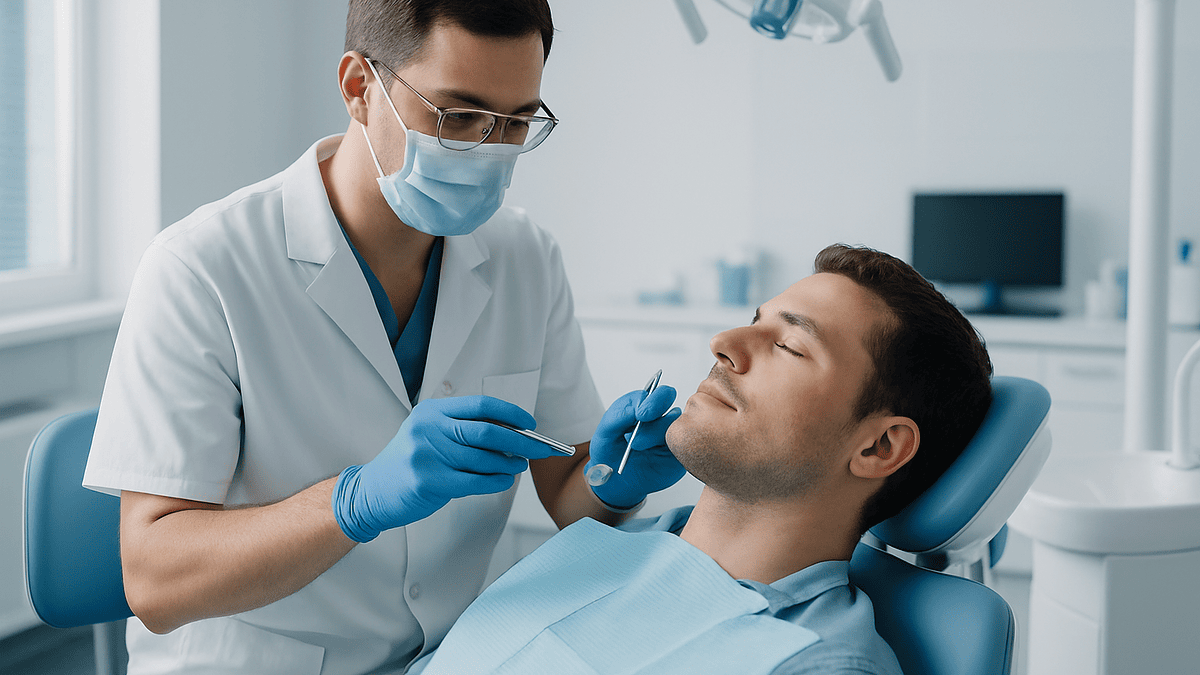
What happens at a prosthetic recall goes beyond a glance at the teeth. Around implants the dentist or hygienist gently probes the gum cuff to measure depth and check for bleeding, compares the readings with earlier visits, and takes periodic X-rays to look at the bone level against the post. Screws holding implant crowns are checked for looseness. Bridges are tested for movement and the margins examined for decay. Dentures are checked for fit, pressure spots, worn teeth and the condition of the tissue beneath, and the mouth as a whole is screened for changes in the soft tissue, which is part of every examination whether or not natural teeth remain.
Professional cleaning around implants uses instruments chosen so they do not scratch titanium, which is one reason to tell any new dental team exactly what work is in your mouth.
| Prosthesis | Daily tools that usually matter most | What the recall visit focuses on |
|---|---|---|
| Single crown or bridge on natural teeth | Soft brush with fluoride paste; floss threader or interdental brush under the bridge | Decay at margins, mobility of anchor teeth, gum health |
| Implant crown or implant bridge | Soft brush; interdental brushes sized to gaps; threader or implant floss under bridges | Probing depths, bleeding, bone level on X-ray, screw tightness |
| Implant-retained removable denture | Brush around posts and bar; clean denture out of mouth; night removal | Clip wear, tissue under plate, peri-implant gum |
| Conventional complete or partial denture | Brush plate over towel; soak overnight; brush gums and palate | Fit and reline need, sore spots, denture stomatitis, oral tissue screen |
Recall intervals shorten when readings change, and they can lengthen after several stable visits. That flexibility is the point of the system.
What the first days and weeks with a new prosthesis usually look like
The first week is about adjustment more than cleaning, and knowing what is ordinary spares a lot of worry.
A new crown or bridge often feels tall or bulky for a few days, and the tongue explores it constantly. Mild sensitivity to cold on a crowned natural tooth is common and usually fades over days to a few weeks. A bite that feels high after the numbness wears off, so that one tooth hits before the others, is worth a quick adjustment appointment rather than waiting; a high spot can make the tooth ache and can loosen cement over time.
After implant surgery, Mayo Clinic’s guidance describes swelling, bruising, minor bleeding and discomfort for a few days, managed with whatever the surgical team advises, with soft foods while the site heals. Cleaning around the site is gentle at first, and the team’s written instructions take precedence over any general routine. The full sequence to a finished crown commonly runs across several months because bone needs time to grow around the post.
New dentures follow their own curve. The NHS describes early soreness, excess saliva, altered speech and a sense that the plate is enormous, all of which settle over days to weeks as muscles learn the new shape. Adjustment visits to relieve pressure points are normal, often more than one. Eating begins soft and small; speech improves with reading aloud. Many teams ask for near-continuous wear at the start and then move to nightly removal.
By the end of the first month, most people have settled into whatever daily routine will carry them for years, and the first proper recall is usually booked around then to confirm fit and coach the cleaning. Timelines vary with the person and the procedure, and the treating team’s plan replaces any general range given here.
What people often get wrong about caring for dental prosthetics
Some misunderstandings are so common that they deserve direct correction.
“Artificial teeth cannot get gum disease.” The teeth cannot; the gum around them can, and around implants it does so with less pain and faster progression toward bone than around natural teeth. Peri-implantitis is the leading reason established implants are lost, and its main driver is plaque left at the gum cuff.
“Dentures should stay in around the clock so the gums do not shrink.” Bone remodels whether or not the plate is worn. Constant wear does not preserve it, but does raise the risk of denture stomatitis. Night removal is the standard recommendation for a settled denture, as noted by the NHS and Cleveland Clinic.
“Ordinary toothpaste is fine for dentures.” Its abrasives roughen acrylic over months, and rough acrylic holds stain and biofilm. Denture paste or liquid soap is the usual advice.
“A soaking tablet cleans the denture on its own.” Soaks help with stain and bacterial load; they do not remove the plaque film. Brushing is the primary step, soaking the supplement.
“Bleeding when I clean around the implant means I am being too rough, so I should stop.” Occasional early bleeding often reflects existing inflammation being disturbed; stopping lets it worsen. Persistent bleeding after two weeks of good technique is a reason for a check, not for abandoning the routine.
“Six-monthly check-ups are the rule.” The NHS recall range runs from 3 to 24 months and is set by individual risk. Many prosthesis wearers are seen more often than six-monthly for a period, and some stable patients less.
“If nothing hurts, nothing is wrong.” Implants lack the ligament that makes natural teeth ache when trouble begins, and a denture ridge changes painlessly. The absence of pain is the reason recalls exist, not a reason to skip them.
Questions to ask your care team about long-term prosthetic care
A ten-minute conversation at the fitting or the first recall can shape years of habit. These are the questions that tend to produce the most useful answers, and jotting the replies on the back of the appointment card is not a bad idea.
- Exactly what is in my mouth? Ask for the types of prosthesis, which teeth or implants carry them, and whether any part is screwed, cemented or clipped. A written summary helps any future dental team clean safely.
- Which interdental brush sizes fit which gaps, and can you mark them for me? Sizing is individual and changes as tissue settles.
- Should I use a floss threader, a stiff-ended implant floss or an interdental brush under this bridge? Ask to be shown once in the mirror rather than told.
- When should I move from wearing my new denture at night to taking it out? The timing is a clinical call.
- What products should I avoid on this particular prosthesis? Metal clasps, acrylic and ceramic each have their own sensitivities.
- What recall interval do you suggest for me and why? Understanding the reasoning makes the interval easier to keep.
- What signs would you want me to phone about between visits, and what can safely wait for the next appointment?
- Which parts of this work are expected to need maintenance over the years, such as clips, screws or relines, so I can plan for them?
- Is there anything about my general health, my medicines or my smoking status that changes the care plan? Dry mouth from medicines and blood sugar control both affect gum health around prostheses.
- If I struggle with any of this at home, who do I contact and what alternatives are there?
The answers will differ from person to person, and the dental team’s specific advice for your mouth takes priority over any general guidance in this article.
When to call your doctor or dentist: red-flag signs with a prosthesis
Most issues with a prosthesis are gradual, which is why recalls matter, but a handful of changes should prompt a call between appointments rather than a wait.
Contact the dental team promptly if the gum around an implant bleeds persistently, looks red or swollen, releases pus, or if the implant crown feels loose or moves when pressed. Loosening can mean a screw has backed off, which is a simple fix, or it can signal bone loss around the post, which is time-sensitive. A bad taste or odour that returns quickly after cleaning around an implant also merits a check.
For bridges and crowns, a restoration that rocks, a sharp edge where porcelain has chipped, new pain on biting, sensitivity that worsens instead of settling, or a crown that comes off entirely all need an appointment. Keep any detached piece; it can sometimes be recemented.
Denture wearers should report sore patches that do not settle within a few days of an adjustment, a plate that suddenly fits differently, a persistently red or sore palate, cracks in the acrylic or a broken clasp. Do not attempt a home repair with household glue.
Some signs warrant urgent care from a dentist or, if one is not available, a doctor or emergency service the same day: rapidly increasing facial swelling, swelling that spreads toward the eye or under the jaw, difficulty swallowing or breathing, fever with a hot swollen area in the mouth, or bleeding after a procedure that does not stop with firm pressure. These can indicate a spreading infection or a bleeding problem and should not wait for routine hours.
Finally, any ulcer, white or red patch, lump or numb area in the mouth that lasts longer than about three weeks needs professional assessment regardless of whether a prosthesis is nearby; the NHS gives that three-week threshold for mouth changes that should be checked. The treating team decides what each sign means and what happens next.
Frequently asked questions
Do you have to brush prosthetic teeth?
Yes, twice a day, exactly as you would natural teeth. The artificial surface does not decay, but plaque on it inflames the gum it touches, collects at crown margins and, on dentures, feeds the yeast that causes a sore palate. Fixed work is brushed in the mouth with a soft brush and fluoride paste; dentures are brushed outside the mouth with denture paste or liquid soap, then the gums and palate are cleaned too.
How do I clean dental implants at home?
Brush twice daily with a soft brush angled at the point where crown meets gum, then clean each side of the implant with an interdental brush sized to the gap or with floss, using a threader where a bridge joins the teeth. Plastic-coated brush cores are usually preferred over bare wire to avoid scratching the titanium. Persistent bleeding after two weeks of good technique should be checked rather than ignored.
How many hours a day should you wear your new dentures?
It depends on the stage. In the first days many teams ask for near-continuous wear, including overnight, so pressure spots show and the mouth adapts quickly. Once the fit is settled, the usual advice from the NHS and Cleveland Clinic is to wear the denture through the waking day and remove it at night to rest the gums. Your dentist decides when to make that switch.
What is the right denture care at night?
Take the denture out, brush every surface including the fitting side over a towel, and place it in a container of cool water or a denture-soaking solution so the acrylic does not dry and warp. Avoid hot water and household bleach, particularly with metal clasps. Brush your gums, palate and tongue gently before bed, then rinse the denture before it goes back in the next morning.
Can I eat normally with a dental prosthesis?
Usually yes, once healing and adjustment are complete. Fixed implant crowns and bridges allow a normal diet with ordinary caution about ice, hard sweets and using teeth as tools, since porcelain chips rather than heals. Denture wearers rebuild toward a full diet over weeks, cutting food small and chewing on both sides; a plate that pushes you toward only soft food is a sign to book a fit review.
How do I use a floss threader for a bridge?
Pass floss through the loop, slide the stiff tip between the bridge and the gum from the cheek side, catch it on the tongue side and pull the floss under. Clean the surface of one supporting tooth down to the gum, sweep the floss along the underside of the artificial tooth, clean the second supporting tooth, then draw the floss out sideways rather than upward so it does not snag.
How long do dental prosthetics typically last?
No single figure applies. Cleveland Clinic quotes roughly 5–10 years for dentures before the fit has drifted enough to reline or remake, because the jaw beneath keeps changing. Bridges most often fail through decay or fracture of the supporting teeth. Implant posts can stay for decades when kept free of peri-implantitis, while the crowns, screws and clips attached to them are wearing parts replaced at recall.
How often should I have a dentist check-up if I have implants or dentures?
NHS guidance sets the recall between 3 and 24 months depending on individual risk, and the dentist chooses the interval after each visit. People with prostheses are frequently seen toward the shorter end, since implant gum measurements, bone X-rays, screw tightness and denture fit cannot be assessed at home. Stable readings over several visits may allow the gap to lengthen.
Is a water flosser as good as floss for dental implants?
The evidence shows water flossers reduce gum bleeding and plaque around implants compared with brushing alone, and some trials find them comparable to string floss for gum health. They do not appear to remove mature plaque as thoroughly as a brush or floss physically rubbing the surface. A reasonable view is that they suit people who cannot manage threaders or interdental brushes, rather than replacing a routine that already works.
What are the warning signs that something is wrong with my prosthesis?
Call the dental team about a loose or moving implant crown, gum that bleeds persistently or releases pus, a rocking bridge, chipped porcelain, denture sore spots that do not settle after adjustment, or a mouth ulcer or patch lasting beyond about three weeks. Seek same-day urgent care for spreading facial swelling, difficulty swallowing or breathing, fever with a hot swollen area, or bleeding that firm pressure does not stop.
References
- NHS: How to keep your teeth clean
- Cleveland Clinic: Dentures
- NIH National Institute of Dental and Craniofacial Research: Gum (Periodontal) Disease
This article is for general information only and is not a substitute for professional medical advice. Please consult a qualified doctor about your individual situation.

More from the Blog
Are Zirconium Teeth Right for You? Bite Force, Smile Goals and When Another Ceramic Fits Better
A good zirconium teeth candidate usually needs a strong restoration for a back tooth, an implant crown, or a bridge, especially with a heavy…

All-on-4 vs All-on-6: When Two More Implants Make Sense
All-on-4 and All-on-6 both anchor a full arch of fixed replacement teeth; the difference is how many implants carry the load. Four implants suit…
What to Ask Before a Dental Crown: Material, Margin Placement and What Happens to the Nerve
Before agreeing to a dental crown, ask what the crown is for, which material is proposed and why, where the edge of the crown…
Dental Implants After Gum Disease: When They Are Possible, and What Comes First
Yes, people with periodontal disease can often get dental implants, but not while the disease is active. Infection and inflammation must be treated first,…

How Long Do All-on-4 Implants Last? Longevity, Care and What Can Go Wrong
With diligent daily cleaning and regular professional maintenance, the four titanium implants supporting an All-on-4 restoration commonly last 20 years or longer, and long-term…

When Removable Dentures Stop Fitting: Relining, Rebasing and When a Remake Is Needed
Removable dentures usually stop fitting because the jawbone and gum underneath slowly shrink, not because the denture itself changes much. Dentists first assess the…