

Chest Strap vs Wrist Heart Rate: Why the Strap Still Wins for Accuracy

Key Takeaways
- Chest straps read the heart's electrical R-wave and typically land within about 1–2 beats per minute of a clinical ECG, while wrist sensors infer pulse from light and blood flow.
- Wrist optical sensors are accurate within roughly 5 percent at rest and steady cardio but can lag 10–30 seconds and miss by 10–30 beats during intervals, lifting and cold weather.
- A 20-beat zone 2 window for a 40-year-old is about 108–126 bpm, so a 10-beat sensor drift can put an entire session in the wrong training zone.
- Cadence lock makes a watch report step or rep rate instead of heart rate, which explains most viral 30-beat gaps better than a faulty device does.
- Neither a strap nor a fitness watch diagnoses heart rhythm problems; rhythm alerts are screening prompts, and a clinical ECG or ambulatory monitor remains the diagnostic tool.
- Water helps heart rate only when you are dehydrated, slow breathing lowers it briefly, and regular aerobic exercise over months is the only well-supported way to lower it for good.
A chest strap heart rate monitor reads the heart's electrical signal through electrodes on the skin, so it typically tracks within about one beat per minute of a clinical ECG, even during sprints and weight training. Wrist sensors read blood flow with light and are usually accurate at rest and during steady cardio, but can drift by ten or more beats when the wrist moves hard, the skin is cold, or intensity changes quickly.
Scroll through any running or cycling feed as of early 2026 and you will find the same side-by-side screenshot: a wristwatch showing 142 beats per minute while the chest strap heart rate monitor paired to the same phone reads 171. The gap looks like a scandal. It is really just physics, and the clip has done what a decade of validation papers could not: it has made ordinary gym-goers ask what their watch is actually measuring.
The timing is not accidental. Zone-based training, where effort is pinned to a narrow heart rate window, has become mainstream, and a plan built on a number that is twenty beats off is a plan that quietly fails. At the same time, more watches now advertise heart rhythm features that sound medical, which blurs the line between a fitness gadget and a diagnostic test.
So this is a good moment to be precise. What each sensor does, where the evidence is solid and where it is thin, and when a strange number on your wrist is a reason to put down the training plan and call a clinician.
How does a chest strap heart rate monitor actually work?
Every heartbeat begins as a tiny electrical pulse that spreads across the heart muscle and leaks, faintly, through the chest wall to the skin. A chest strap heart rate monitor is a stripped-down electrocardiogram, or ECG: a recording of that electrical activity. Two conductive pads sit against the skin just below the chest muscles, one on each side of the breastbone, and the small pod clipped between them watches for the sharpest spike in each cycle, the R-wave.
Because the R-wave is a steep, unmistakable peak, the pod can time the gap between one beat and the next to within a few thousandths of a second. Divide sixty seconds by that gap and you have beats per minute (bpm). Nothing is estimated and nothing is averaged over a long window; the strap is counting actual beats as they happen.
That beat-by-beat timing is also why straps are the usual consumer tool for heart rate variability (HRV), the natural wobble in the interval between beats that many training apps use as a recovery marker. Optical sensors can approximate HRV at rest, but a strap measures the raw intervals the metric is built on.
The signal is sent to a watch, bike computer or phone over Bluetooth or ANT+, two short-range wireless standards. Older straps used analog radio and sometimes picked up a neighbor’s heartbeat on a crowded treadmill row; modern digital pairing has largely ended that.
The weakness is the contact itself. Dry pads on dry skin in the first five minutes of a winter run can produce a wild, implausible reading before sweat closes the circuit. Once contact is good, the strap is about as close to a clinical reading as a consumer device gets, which is exactly why cardiac rehabilitation programs and exercise laboratories have relied on the same principle for decades, as Mayo Clinic’s guidance on measuring exercise intensity reflects.
How does wrist heart rate work, and where does it struggle?
Turn a watch over and you will see green lights flickering against your skin. This is photoplethysmography (PPG), a method that shines light into tissue and measures how much bounces back. Blood absorbs green light, so each time the heart pushes a pulse of blood through the capillaries under the sensor, a little less light returns. The watch counts those dips and infers a heart rate.

Notice the word inferred. The wrist is not reading the heart; it is reading a ripple that reaches the wrist a fraction of a second later, after passing through arteries that stiffen, dilate and constrict for reasons that have nothing to do with the heart. The signal is also faint compared with an electrical spike, so software has to filter it, smooth it and sometimes guess.
Several everyday conditions degrade that guess:
- Movement. Swinging arms, gripping handlebars and lifting weights slide the sensor across the skin and let ambient light leak in.
- Cold. Chilled fingers mean constricted vessels and less blood under the sensor.
- Fit. A loose band floats; an overtight band squeezes blood out of the very tissue being measured.
- Skin factors. Dense tattoo ink and heavy hair absorb light. Evidence on skin pigmentation is mixed: some validation studies found no meaningful heart rate difference across skin tones, while others reported weaker signal quality in darker skin. The honest summary is that the question is still being studied.
None of this makes the wrist useless. At rest or on a smooth, steady jog, independent testing summarized by Harvard Health finds most optical sensors land within a few beats of a reference ECG. The trouble begins when the heart rate changes faster than the smoothing algorithm expects, which is precisely the moment many people care about most.
What changed recently to put this debate back in the spotlight
Three threads knotted together over the past year or so to make a twenty-year-old technology trend again.
First, the training culture shifted. Low-intensity, high-volume “zone 2” sessions, where the target is roughly 60–70 percent of maximum heart rate, moved from endurance coaching circles to mainstream fitness content. The American Heart Association’s target heart rate guidance defines moderate intensity as about 50–70 percent of maximum and vigorous as 70–85 percent. Those bands are only 15–20 beats wide for a typical adult. A sensor that wanders by 10 or 15 beats can place the same workout in the wrong zone entirely, so accuracy stopped being a nerd’s concern and became a practical one.
Second, the comparison videos went viral. Clips showing a watch and a strap disagreeing by 20–30 beats during hill intervals or kettlebell circuits have circulated widely as of early 2026. They are real, but they are also cherry-picked: they rarely show the long steady stretches where both devices agree, and they almost never explain why the gap appears.
Third, watches started talking like medical devices. Several consumer wearables now carry irregular-rhythm notifications and single-lead ECG features, and marketing language around “heart health” grew bolder. Cleveland Clinic’s review of fitness tracker accuracy is careful on this point: these features can flag something worth a conversation, but they are not a diagnosis and do not replace a clinical ECG.
What has not changed is the underlying evidence. The widely cited 2017 study that Harvard Health summarizes, which tested four wrist devices and a chest strap against ECG across walking and running speeds, still describes the picture accurately: the strap tracked the reference almost perfectly, while wrist readings were good at rest and progressively less reliable as intensity rose. Newer sensors have narrowed that gap, not closed it.
Are chest strap heart rate monitors accurate? What the evidence actually says
Grading the evidence matters more than repeating the headline, so here is how strong each claim really is.
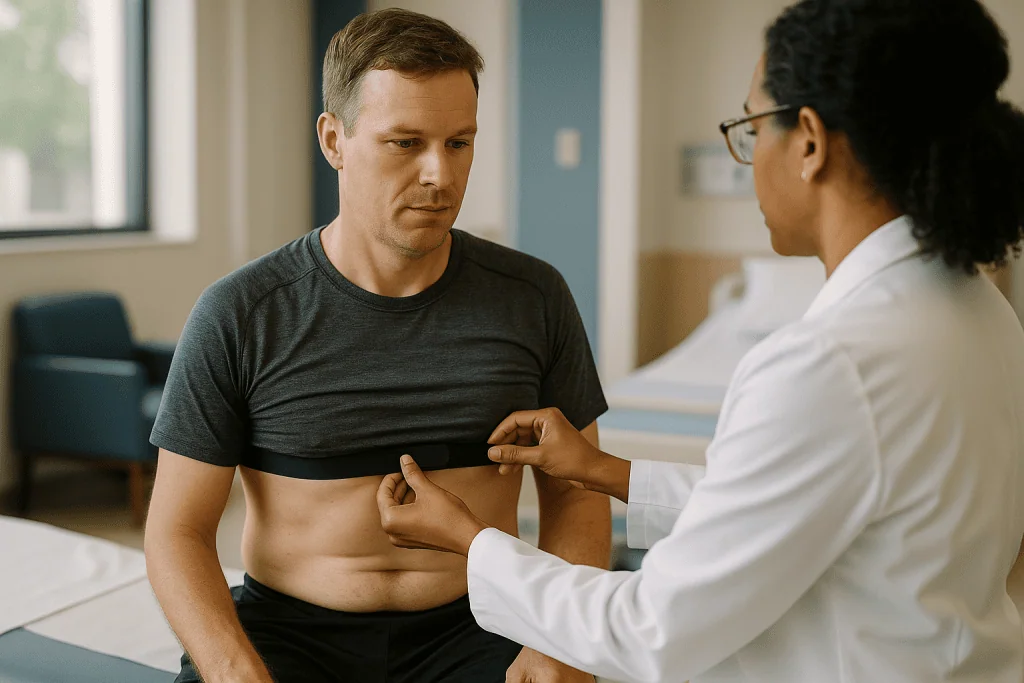
Chest straps track ECG closely: strong and consistent. Across laboratory validation studies, electrode straps typically correlate with a 12-lead ECG at around 0.99 and sit within roughly one to two beats per minute on average. This is observational device-validation data rather than randomized trials, but it is repeated across many independent laboratories and many strap generations, which is about as robust as device evidence gets.
Wrist sensors are accurate at rest and during steady aerobic work: strong. A 2017 Stanford-led evaluation of several wrist devices found heart rate error under about 5 percent for most of them during controlled treadmill and cycling bouts. Harvard Health’s review of the evidence reaches the same conclusion.
Wrist accuracy drops during intervals, resistance training and cold: moderate but consistent. Multiple studies report mean errors climbing into double digits during high-intensity or arm-dominant activity, with individual readings occasionally off by 20–30 bpm. Sample sizes are often small, and results vary by device and generation, so treat this as a reliable pattern rather than a fixed number.
Wrist devices estimate calories poorly: strong. The same Stanford study found energy expenditure errors of 27 percent at best and over 90 percent at worst. That finding is about calories, not heart rate, but it is a useful reminder that a confident number on a screen is not the same as a measured one.
Straps are “medical grade”: overstated. A consumer strap measures heart rate well; it does not produce a diagnostic-quality ECG trace and is not cleared to identify arrhythmias. The honest claim is narrower and still impressive: for counting beats during exercise, a well-fitted strap is the most accurate tool a person can wear outside a clinic.
Chest strap vs smartwatch heart rate: a side-by-side comparison
The table below summarizes what validation data and everyday testing generally show. Figures are typical ranges, not guarantees, because individual devices and users vary.
| Feature | Chest strap (electrical) | Wrist watch (optical) | Upper-arm band (optical) | Clinical ECG |
|---|---|---|---|---|
| What it measures | Heart’s electrical signal | Blood flow under skin | Blood flow under skin | Full electrical trace |
| Typical error vs ECG | About 1–2 bpm | Within ~5% at steady effort; 10–30 bpm during intervals or lifting | Usually closer to strap than wrist; still optical | Reference standard |
| Response to sudden changes | Near instant | Lags 10–30 seconds | Slight lag | Instant |
| Weight training | Reliable | Often unreliable | Generally good | Not practical |
| Cold weather | Needs moist contact to start | Signal weakens | Better than wrist | Not applicable |
| Heart rate variability | Beat-level intervals | Estimated, best at rest | Estimated | Gold standard |
| Rhythm diagnosis | No | Screening alerts only | No | Yes |
| All-day wear | Impractical | Designed for it | Possible | No |
Two things stand out. The first is that the strap’s advantage is not marginal during hard efforts; it is the difference between a measurement and an estimate. The second is that the wrist wins decisively on something no strap can offer: continuous data across sleep, rest and ordinary days, which is where resting heart rate trends and irregular-rhythm alerts live.
The upper-arm band deserves its middle column. Because the arm moves less than the wrist and has a steadier blood supply, optical bands worn on the bicep or forearm narrow much of the gap for people who find straps uncomfortable. They remain optical, so lag and cold still apply, but for weight training they are a reasonable compromise.
Why the gap widens during intervals, weights and cold weather
Picture the two sensors during a set of thirty-second hill sprints. Your heart goes from 120 to 175 bpm in under a minute. The strap sees each new R-wave arrive sooner than the last and updates immediately. The watch, meanwhile, is running an algorithm designed to ignore noise. Rapid change looks like noise, so the software smooths it, and the displayed number trails reality by ten, twenty, sometimes thirty seconds. By the time it catches up, you are already jogging the recovery and the number is wrong in the other direction.
Resistance training adds a second problem called cadence lock. Repetitive arm movement, such as a row or a rhythmic bench press, produces its own pattern of light interference at a steady rate. The algorithm can mistake that rhythm for a pulse and report your rep speed or step rate instead of your heart rate. Runners see the same thing when the watch displays their cadence, often around 170–180, instead of a heart rate of 140. The reading is confident, stable and entirely fictional.
Gripping is a third culprit. Clenching a barbell or handlebar tenses forearm muscles and compresses the vessels under the sensor, starving it of the blood flow it needs to see a pulse at all.
Cold weather compounds everything. Peripheral blood vessels narrow to conserve heat, so there is simply less blood passing under the watch. The strap has its own cold-start issue, since dry electrodes on dry skin conduct poorly, but a little moisture or a few minutes of sweat solves it, and once the signal locks, cold does not degrade an electrical reading the way it degrades an optical one.
Understanding these mechanisms is useful for a practical reason: the errors are predictable. If you know when your watch is likely to lie, you know when to trust it and when to reach for the strap.
Who gets the most from a chest strap heart rate monitor
Accuracy is only valuable when a few beats change a decision. For most people on a moderate walk, they do not. For these groups, they do.
People training by zones. If your plan says “stay under 140” for ninety minutes, a watch that reads 128 while you are actually at 146 means you spent the session in the wrong physiological state. A strap turns a vague target into a reliable one.
Interval and sprint athletes. Hard efforts live and die on how quickly heart rate rises and recovers. Optical lag blurs exactly the data these sessions are designed to produce.
Anyone who lifts. Between grip pressure, cadence lock and wrist flexion, weight rooms are the worst environment for optical sensors. A strap or arm band is the only way to get a believable number.
People tracking heart rate variability for recovery. HRV depends on measuring the precise interval between consecutive beats. Electrical sensing captures those intervals directly; optical estimates at rest are reasonable but noisier.
People exercising under medical supervision. Those in cardiac rehabilitation or with a clinician-set heart rate ceiling benefit from a device that does not drift. This is a conversation to have with the supervising team, who will advise whether and how to use a monitor alongside their own observation, and whose instructions on exercise limits take priority over any device.
Cold-weather and open-water athletes. Winter runners, cyclists and swimmers encounter the exact conditions under which optical sensing weakens. Many straps store data during a swim and sync afterward, since Bluetooth does not travel well through water.
Conversely, if you walk the dog, do a steady thirty minutes on a bike, and mostly want a resting heart rate trend and sleep data, the wrist is the better instrument. It will be with you at 3 a.m. when a strap never would.
Are heart rate chest straps worth it, or is the wrist good enough?
The honest answer is that it depends on what you are trying to learn, and the wrist is good enough for more people than the viral videos suggest.
Start with what the evidence supports about the wrist. For resting heart rate, for a steady jog or ride, and for noticing that your morning pulse has crept up ten beats during a stressful month, optical sensors perform well. Harvard Health’s summary of the research puts most devices within a handful of beats of ECG under those conditions. If that is your use case, a strap adds a step to every workout and little information.
Now consider the costs that are not financial. A strap has to be moistened, positioned, washed and charged or have its battery replaced. Some people find the band irritating or cannot get a stable signal because of body shape or chest hair. Forgetting it at home means no heart rate data at all for that session, whereas the watch is already on. Compliance is a real variable: the most accurate sensor in the drawer records nothing.
The case for a strap becomes compelling under three conditions. You train by heart rate zones and act on the numbers. You do a lot of intervals, strength work or cold-weather exercise where optical error is largest. Or you want HRV data you can trust. In those situations, a strap is not a luxury; it is the difference between a measurement you can plan around and a number that happens to be on the screen.
A sensible middle path many coaches recommend: wear the watch every day for trends and sleep, and add the strap for structured or high-intensity sessions. Most watches will accept the strap’s signal and simply override their own optical reading when it is connected, so you lose nothing in the app.
How to wear a chest strap heart rate monitor for a clean signal
Most complaints about straps trace back to setup, not sensors. A few habits fix nearly all of them.
Wet the electrodes first. The pads need a conductive layer between them and your skin. Water, saliva or a dab of the conductive gel used for ECGs all work. Dry pads in a cold room are the single most common cause of a reading of 200-plus in the first minutes of a workout.
Position it correctly. The pod sits in the center of the chest with the electrodes directly under the chest muscles, roughly at the level of the lower breastbone. Too high and the band slides on the ribs; too low and it rides on the abdomen where contact is poor. People who wear a sports bra generally find the strap sits comfortably just beneath the band.
Snug, not strangling. You should be able to slide two fingers under the band, but it should not shift when you bounce. A strap that creeps downward during a run produces dropouts and spikes.
Watch for interference. Static from synthetic shirts in dry air can create spikes early in a workout; sweat usually resolves it. Standing directly beside another person’s strap or under certain gym equipment occasionally causes a brief glitch with older analog models.
Rinse after every use and wash regularly. Salt from sweat builds on electrodes and corrodes snaps. Most makers advise rinsing the band after each workout and machine-washing it periodically with the pod removed. A gritty, stiff band is a band about to misbehave.
Unclip the pod when done. Many straps stay switched on as long as the electrodes are connected, which drains the battery and produces phantom data on your couch.
Give a new strap three or four workouts before judging it. Skin, band and software all settle, and the implausible readings of the first session rarely return.
Heart rate monitor for zone 2 training: why a few beats really matter
Zone 2 is the band of effort where you can hold a conversation, roughly 60–70 percent of your maximum heart rate, and it is where endurance coaches ask athletes to spend most of their time. The physiological argument is that this intensity trains the body to rely on fat and build mitochondrial capacity without the fatigue of harder work. The practical argument is simpler: it is sustainable, so people keep doing it.
The catch is arithmetic. For a 40-year-old using the common estimate of 220 minus age, maximum heart rate is about 180, which puts zone 2 at roughly 108–126 bpm. That window is 18 beats wide. A wrist sensor that is drifting 10 beats low can show 120 while the true value is 130, which is already into the next zone. Repeat that for a year and the “easy” base phase was never easy.
Two caveats keep this honest. The 220-minus-age formula is itself an estimate with a wide spread; true maximum varies by 10–12 beats either way across healthy people of the same age, as Mayo Clinic’s exercise intensity guidance notes. So some zone-2 error is baked in before any sensor is involved, and a conversation-pace check (the “talk test” the American Heart Association describes) remains a good cross-check. Second, during a steady zone 2 session the wrist is at its best, because heart rate is stable and the arms move gently. Many people find their watch and strap agree within three or four beats under these conditions.
Where the strap earns its place in a zone 2 plan is at the edges: the first ten minutes when the body is warming up and heart rate is climbing, the hills, and the cold mornings. Those are the moments when optical drift pushes a session into the wrong zone, and when having a beat-accurate reading lets you back off before the effort has quietly changed.
Can a strap or watch detect heart problems like atrial fibrillation?
This is where consumer expectations have run ahead of the devices, so it is worth being plain.
A chest strap heart rate monitor counts beats. It does not analyze rhythm, it does not look at the shape of the electrical waveform, and it is not designed or cleared to detect arrhythmias. If it reports an unusual number, that is a prompt to check your pulse and consider a clinical evaluation, not a result.
Some watches do more. Irregular-rhythm notifications use the optical sensor to look for beat intervals that are chaotic in the pattern typical of atrial fibrillation, an irregular and often rapid rhythm in the heart’s upper chambers that raises stroke risk. A few watches also offer a single-lead ECG when you touch the crown or bezel, producing a short tracing that an algorithm classifies. These features have regulatory clearance as screening aids in some countries.
What the evidence shows: in large observational studies, these alerts have reasonably good specificity, meaning a positive alert is often confirmed, but they miss episodes, produce false alarms in people with other rhythm variations, and have not yet been shown in randomized trials to improve outcomes such as stroke prevention. Cleveland Clinic’s guidance frames them as a reason to contact a clinician, who may order a clinical ECG or an extended monitor.
Equally important is what a normal reading cannot tell you. A watch that never flags anything does not rule out heart disease, and an impressive heart rate graph says nothing about blood pressure, cholesterol or coronary arteries. The National Institutes of Health describes atrial fibrillation as frequently silent, which is exactly why a clinician, not a wristband, decides whether screening is warranted for a given person.
Treat training devices as training devices. Treat rhythm alerts as a nudge toward a conversation. Treat neither as a diagnosis.
Common myths about chest strap and wrist heart rate, corrected
Myth: “My watch is medical grade, so it is as good as a strap.” Regulatory clearance for a rhythm notification does not extend to heart rate accuracy during exercise. The two features use different algorithms for different purposes.
Myth: “Chest straps are always right.” They are highly accurate once contact is established. Dry electrodes, a loose band, or static can produce absurd spikes, especially early in a workout. A reading of 220 bpm two minutes into a jog is almost always a contact problem, not a heart problem, but if a high reading persists after moistening the strap and you feel unwell, stop and treat it as real.
Myth: “Wrist sensors are useless.” At rest and during steady aerobic exercise, independent testing summarized by Harvard Health finds most within a few beats of ECG. The failure mode is specific: rapid change, arm-heavy movement and cold.
Myth: “The viral 30-beat gap means the watch is broken.” It usually means cadence lock, where the watch is reporting step or rep rate, or algorithmic lag during an interval. Neither is a defect; both are predictable limits of optical sensing.
Myth: “A strap can tell me if my heart is healthy.” It tells you how fast your heart is beating. Heart health involves rhythm, structure, blood pressure and arteries, none of which a beat counter sees.
Myth: “Skin tone makes wrist sensors unreliable for everyone with darker skin.” Evidence is genuinely mixed. Some studies found comparable heart rate accuracy across skin tones; others reported weaker signal quality. Anyone noticing frequent dropouts should try a snugger fit or an arm band, and researchers are still working on the question.
Myth: “Calories on the watch are as accurate as heart rate.” They are not close. Calorie estimates in the Stanford evaluation were off by 27 to 93 percent, even on devices whose heart rate was good.
What drink calms heart rate? What actually moves the number
Searches for a drink that lowers heart rate spike whenever a wearable shows an unexpectedly high resting pulse, so it is worth separating what is plausible from what is wishful.
Plain water helps in one specific situation: dehydration. When blood volume falls, the heart beats faster to maintain output, and rehydrating gradually brings it back down. This is well established physiology, though the effect is modest in people who are only mildly dry.
Beyond that, the evidence for a calming beverage is thin. Herbal teas such as chamomile are often promoted for relaxation, but controlled trials on heart rate are small and inconsistent; any benefit is more likely the pause and slow breathing that come with a warm cup than the plant itself. Tart cherry, beetroot and other “functional” drinks have limited, mixed data on blood pressure and almost none on resting heart rate. The National Institutes of Health Office of Dietary Supplements is a good reality check for supplement claims generally.
What reliably raises heart rate is easier to list, and avoiding it is the practical answer:
- Caffeine, which in many people adds several beats for a few hours.
- Alcohol, which raises resting and overnight heart rate noticeably, a pattern many watch users spot the morning after.
- Nicotine, energy drinks and some decongestants.
- Fever, poor sleep and illness, which is why a rising resting heart rate is often the first sign a cold is coming.
Slow breathing, around six breaths a minute for a few minutes, has better evidence for a short-term dip in heart rate than any drink. Regular aerobic exercise over months is the most reliable way to lower resting heart rate for good, as Cleveland Clinic’s explainer on heart rate describes.
A persistently high resting pulse is a reason to look at the causes above and, if it does not settle, to see a clinician rather than a beverage aisle.
What is the best wearable device for heart monitoring? It depends on the job
There is no single best device, only the best match between a sensor and a question, so here is how to think about it without a brand name in sight.
If the question is “how hard am I working right now,” an electrode chest strap is the most accurate wearable available, with an optical arm band as a comfortable runner-up for strength training.
If the question is “what is my heart doing across the whole day,” a wrist device is the only practical option. Resting heart rate on waking, overnight averages and gradual trends across weeks are where optical sensors shine, and no one sleeps in a strap.
If the question is “do I have an irregular rhythm,” consumer devices with rhythm notifications or single-lead ECG are screening tools only. The decision about whether you need monitoring, and which kind, belongs to a clinician, who can order a clinical 12-lead ECG, a 24–48 hour ambulatory recorder, or a longer patch monitor, all of which capture rhythm in a way no fitness device can.
If the question is “how am I recovering,” HRV from a strap or a ring or wrist device worn overnight can be informative, provided you compare yourself only with yourself and ignore day-to-day noise.
A few features matter more than the marketing suggests. Look for a strap or band that supports both Bluetooth and ANT+ so it talks to any watch, bike computer or app. Check that your watch will defer to an external sensor when one is connected. Prefer a device whose accuracy claims cite independent validation rather than its own laboratory.
The best setup for many people is not one device but two: a watch for daily trends and a strap for the sessions where accuracy changes what you do. The best medical device, when a medical question arises, is the one your clinician orders.
When to see a doctor about your heart rate readings
Wearables generate a great deal of data and, inevitably, a great deal of worry. Most unusual readings have mundane explanations: a dry strap, a loose watch, caffeine, a poor night’s sleep. Some do not, and these are the signs that should move you from the app to a clinician, with no dose of reassurance from a device substituting for a proper assessment.
Seek emergency care immediately if a fast, slow or irregular heart rate comes with:
- Chest pain, pressure or tightness, especially spreading to the arm, jaw or back
- Shortness of breath at rest or out of proportion to effort
- Fainting or near-fainting
- Sudden weakness, facial drooping or trouble speaking
Make a prompt appointment with your doctor if you notice:
- A resting heart rate consistently above 100 or below 60 that is new for you and not explained by fitness, medication or illness, as MedlinePlus and NHS guidance describe
- Palpitations, the sensation of a pounding, racing or skipping heart, that last more than a few minutes, recur often, or are new
- A wearable’s irregular-rhythm notification, even if you feel fine
- Dizziness, lightheadedness or unusual breathlessness during exercise that used to feel easy
- A heart rate that stays very high long after you stop exercising
Bring the data. A screenshot of the timeline, the device type, and what you were doing when the reading occurred help a clinician decide whether a clinical ECG or a longer monitor is warranted. Equally, say so if you have a known heart condition, take medicines that affect heart rate such as beta-blockers or thyroid hormone, or have been given exercise limits. Never adjust or stop a prescribed medicine because a watch or strap showed a number you did not expect; that decision rests with the prescribing clinician.
A device can tell you something looks different. Only a clinical evaluation can tell you what it means.
Frequently asked questions
Are chest strap heart rate monitors accurate?
Yes, when fitted correctly they are the most accurate consumer heart rate tool available. Validation studies consistently find electrode straps correlating with a clinical ECG at around 0.99 and averaging within one to two beats per minute, including during sprints and weight training. The main failure mode is poor skin contact at the start of a workout, which moistening the electrodes usually fixes within minutes.
Chest strap vs smartwatch heart rate: how big is the difference during exercise?
At rest and during steady aerobic work the two often agree within a few beats. During intervals, strength training or cold weather, wrist readings can lag by 10–30 seconds and miss by 10–30 beats, mainly because the optical sensor is disrupted by arm movement, grip pressure and reduced blood flow. The strap measures electrical beats directly, so it does not suffer those specific errors.
Are heart rate chest straps worth it for casual exercisers?
For most casual exercisers, probably not. If your workouts are steady walks, jogs or bike rides and you mainly want resting heart rate trends and sleep data, a wrist device performs well and is always on. A strap becomes worthwhile when you train by heart rate zones, do frequent intervals or weights, exercise in the cold, or want heart rate variability data you can trust.
How do I wear a chest strap heart rate monitor correctly?
Moisten the electrodes with water or ECG gel, center the pod on your chest with the pads directly below the chest muscles at about the level of the lower breastbone, and tighten until it stays put when you bounce but still allows two fingers underneath. Rinse it after each workout, wash it regularly with the pod removed, and unclip the pod afterward to save the battery.
What is the best heart rate monitor for zone 2 training?
An electrode chest strap, because zone 2 is a narrow window of roughly 60–70 percent of maximum heart rate and small sensor errors can move a session into the next zone. During the steady middle of a zone 2 effort a wrist sensor often agrees closely, so the strap earns its place mostly at the edges: warm-up, hills and cold starts. The talk test remains a useful cross-check.
Why does my watch show a heart rate equal to my running cadence?
This is cadence lock. The repetitive motion of your arms produces a rhythmic light signal under the optical sensor, and the algorithm can mistake it for a pulse, reporting your step rate, often around 170–180, instead of your true heart rate. It is a known limitation of wrist sensing rather than a defect. Tightening the band, moving it slightly up the forearm, or using a chest strap resolves it.
What drink calms heart rate quickly?
No drink reliably lowers heart rate, with one exception: water, if you are dehydrated, because low fluid volume makes the heart beat faster. Evidence for herbal teas and so-called calming drinks is small and inconsistent. Slow breathing for a few minutes has better short-term evidence, and avoiding caffeine, alcohol and nicotine prevents the most common spikes. A persistently high resting pulse is a reason to see a clinician.
What is the best wearable device for heart monitoring?
It depends on the question. For exercise intensity, a chest strap is most accurate, with an optical arm band as a comfortable alternative for lifting. For daily trends, resting heart rate and sleep, a wrist device is the practical choice. For detecting rhythm problems, consumer alerts are only screening prompts; a clinician decides whether a clinical ECG or ambulatory monitor is needed.
Can a chest strap detect atrial fibrillation or other heart problems?
No. A chest strap counts beats; it does not analyze rhythm or waveform shape and is not designed or cleared to detect arrhythmias. Some watches offer irregular-rhythm notifications and single-lead ECG features that can flag a possible problem, but these are screening aids with known false positives and missed episodes. Any alert or persistently unusual reading should be discussed with a clinician.
Does skin tone or a tattoo affect wrist heart rate accuracy?
Tattoos, especially dense dark ink, can block the light the sensor relies on and cause dropouts. Evidence on skin pigmentation is mixed: some validation studies found comparable heart rate accuracy across skin tones, while others reported weaker signal quality in darker skin. If readings drop out frequently, a snugger fit, wearing the watch slightly higher on the forearm, or switching to an arm band or chest strap usually helps.
References
This article is for general information only and is not a substitute for professional medical advice. Please consult a qualified doctor about your individual situation.

More from the Blog

AI Scribes: Why Your Doctor’s Note Is Now Written by Software, and What It Means for You
An AI scribe is software that listens to a medical visit, usually through a phone or room microphone, and drafts the clinical note the…

Apple Watch ECG and AFib Alerts: What a Single-Lead Trace Can and Cannot Detect
The Apple Watch ECG records a single-lead electrocardiogram from the wrist and fingertip in 30 seconds and can classify the rhythm as sinus rhythm,…

AI in Healthcare: What It Already Does in Hospitals, and Where It Falls Short
AI in healthcare currently helps hospitals read medical images, flag patients at risk of deterioration such as sepsis, draft clinical notes from recorded visits,…

Home Blood Pressure Monitors: Wrist vs Arm and How to Take a Reading That Counts
For most adults, the best home blood pressure monitor is an automatic upper-arm cuff that has passed independent validation testing and fits your arm…

Telehealth: What Can Be Diagnosed on a Video Call and What Cannot
Telehealth can reliably assess conditions a clinician diagnoses mostly by history and by looking: many rashes, mental health concerns, medication follow-ups, chronic disease check-ins…

Recovering from Radiotherapy: How Long Until You Feel Better
Most people start to feel noticeably better within a few weeks of their last radiotherapy session, although side effects such as fatigue and skin…