

Clubfoot Myths Corrected: Walking, Sports and Whether Treatment Always Means Surgery

Key Takeaways
- Clubfoot affects about 1 in 1,000 babies and involves both feet in roughly half of cases, according to the NHS.
- The Ponseti method of weekly manipulation and casting, usually started within the first week or two of life and running about 5 to 8 weeks, is the standard first treatment.
- Most babies need only a minor Achilles tenotomy rather than major surgery, which is now reserved for severe, syndromic or non-responding feet.
- The boots-and-bar brace is worn about 23 hours a day for the first three months, then at night until about age four or five, and stopping early is the leading cause of relapse.
- Family history, smoking during pregnancy and low amniotic fluid are the recognized risk factors; posture, activity and how the baby lay are not causes of true clubfoot.
- A treated clubfoot usually keeps a slightly smaller calf and shorter foot, but children typically walk, run and play sports without restriction.
Clubfoot is a congenital foot position in which the foot turns inward and downward, affecting roughly 1 in 1,000 babies. Most children are treated without major surgery, using gentle weekly stretching and casting in the first months, often a minor tendon release, then boots and a bar for several years. With treatment, children usually walk, run and play sports; the care team guides every step.
The sonographer pauses on the screen, measures something near a tiny heel, and says a word most parents have never heard: talipes. By the time the appointment ends, a phone search has delivered a wall of clubfoot myths, half of them frightening and most of them decades out of date. Will the baby walk? Will there be operations? Did something in pregnancy cause this?
The honest picture is calmer than the search results. Clubfoot is one of the most common structural differences a newborn can have, and the way it is treated has changed profoundly within a single generation, moving away from large operations toward patient hands, plaster and a brace. What has not changed is that the result depends on steady follow-through over years, not on a single dramatic fix.
This explainer separates what the evidence supports from what the rumor mill repeats, and it keeps every decision where it belongs: with the team examining your child.
Clubfoot myths begin with the name: what clubfoot actually is
Clubfoot, known clinically as congenital talipes equinovarus, is a condition present at birth in which the foot points downward and the sole turns inward, so the baby appears to be standing on the outer edge or even the top of the foot. The medical name simply describes the shape: equinus means the heel is pulled up like a horse’s hoof, varus means the foot tilts inward.
The foot is not merely bent. The bones of the hindfoot sit in an abnormal relationship to one another, the ligaments and tendons on the inner and back side of the ankle are short and tight, and the calf muscle on that side is smaller. According to the NHS, the affected foot can look as though it has been twisted, and the ankle often cannot be moved into a normal position by hand. That stiffness is the defining feature. A foot that looks turned in but can be gently stretched to a neutral position is usually something different, called positional talipes, which results from how the baby lay in the womb and tends to settle with simple stretching or on its own.
Clubfoot is also not a sign that the baby is otherwise unwell. In the great majority of children it occurs on its own, in an otherwise healthy infant, a pattern doctors call idiopathic, meaning no underlying cause is found. A smaller group has clubfoot as part of a wider condition such as spina bifida or a neuromuscular disorder, which is one reason the first examination after birth looks carefully at the whole child, not just the foot. Mayo Clinic notes that clubfoot is painless in a newborn; the problems come later, if an untreated foot is walked on.
How many children are born with clubfoot?
Roughly 1 in every 1,000 babies is born with clubfoot, a figure cited by both the NHS and Mayo Clinic. That makes it one of the most common congenital conditions affecting the legs, and in practical terms it means that in a city of a million people, hundreds of adults walking past you grew up with a treated clubfoot without anyone noticing.
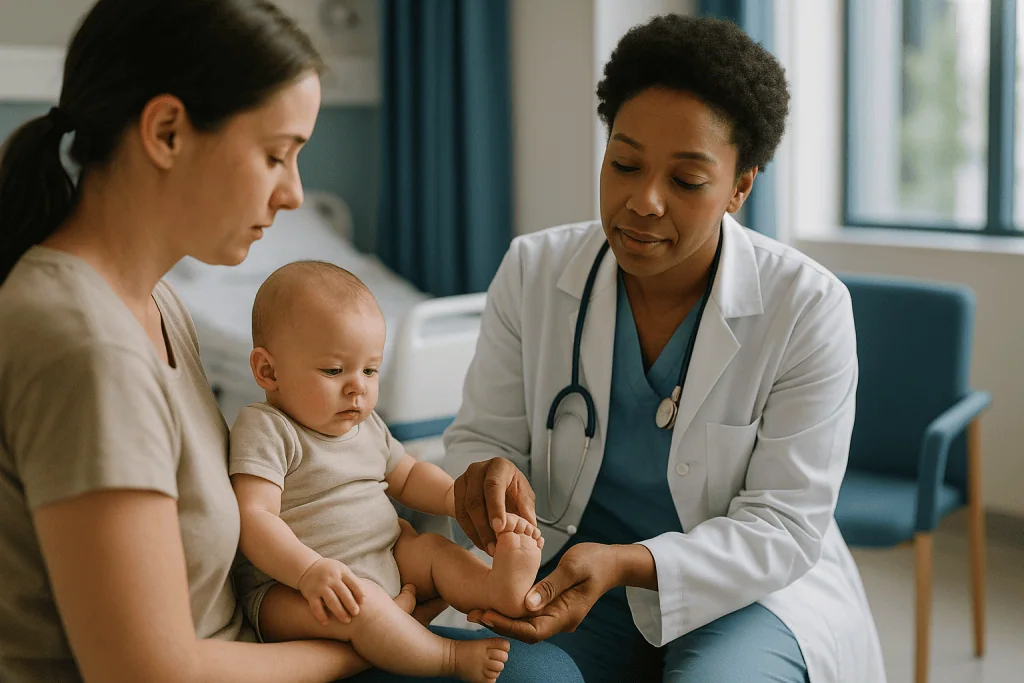
About half of affected babies have both feet involved, according to the NHS. When only one foot is affected, there is no reliable pattern favoring left or right. Boys are affected about twice as often as girls, Mayo Clinic reports, although nobody has yet explained why.
Because the shape is often visible on the mid-pregnancy ultrasound, many parents now learn about it before birth. The NHS states that clubfoot is frequently picked up at the anomaly scan done at around 18 to 21 weeks. A prenatal finding changes nothing about treatment, which cannot begin until the baby is born, but it does buy time to meet the orthopedic team, ask questions and lower the shock of the delivery room. Ultrasound cannot always tell true clubfoot from the flexible positional variety, so the final assessment waits for a hands-on examination after birth.
One number worth holding onto: clubfoot has been recognized for thousands of years and exists across every population studied. Rates vary somewhat between ethnic groups, which supports the idea of a genetic contribution, but no region or lifestyle has ever been shown to be free of it. It is a condition of human development, not a consequence of anything a family did.
Is clubfoot inherited, and did anything in pregnancy cause it?
The straight answer from the evidence is that clubfoot is partly inherited, mostly unexplained, and never caused by a parent’s actions during an ordinary pregnancy. Mayo Clinic lists family history as the clearest risk factor: if either parent or a sibling has had clubfoot, the chance is higher than in the general population. Even so, most babies with clubfoot have no affected relative at all, which tells us that many genes contribute in small ways rather than one gene being passed down in a predictable pattern.
Two environmental associations are consistently reported. Smoking during pregnancy raises the risk, and Mayo Clinic notes that the combination of a family history and smoking raises it further. Reduced amniotic fluid, the liquid cushioning the baby in the womb, is also linked to clubfoot. These are associations found across large groups of births; they do not mean a particular baby’s clubfoot can be traced to a single cause, and the overwhelming majority of children with clubfoot were born to parents who did nothing out of the ordinary.
A persistent myth is that the baby’s position in the womb, or a mother’s activity, posture or sleeping side, molded the foot. The flexible positional form of talipes can relate to crowding late in pregnancy, but true clubfoot involves bone and tendon differences that form much earlier, during the first trimester when the limbs are developing.
Families planning more children often ask what the risk is for a future sibling. The honest reply is that it is raised but still low, and that genetic counseling, rather than a blog, is the right place to get a figure that reflects your particular family history.
How is clubfoot treated in newborns? What actually happens
Modern treatment of clubfoot in newborns is built around the Ponseti method, a technique of gentle manipulation and serial casting that is now standard guidance in the NHS and at major US centers. The word serial simply means repeated: the foot is moved a little, held in plaster, and moved a little more the following week.
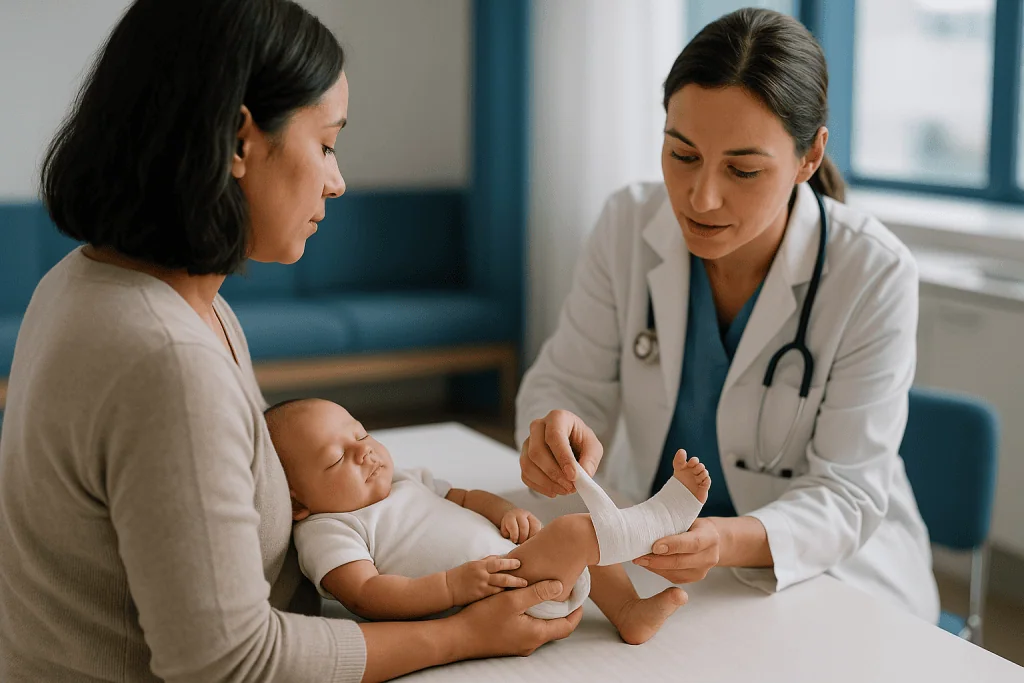
At each visit, a trained clinician holds the baby’s foot and stretches the tight tissues in a specific sequence, correcting the curve of the forefoot first and rotating the whole foot outward around the ankle. The correction is held with a plaster cast that runs from the toes to the top of the thigh, with the knee bent to stop the cast slipping. Babies are usually settled with a feed or pacifier during the process; the manipulation is gentle, and the NHS describes it as not painful for the baby, though the restraint and the cool plaster can prompt grumbling.
The NHS advises that treatment usually starts within the first week or two after birth, when newborn ligaments are at their most pliable, and that casts are typically changed weekly over about 5 to 8 weeks. The last correction, bringing the heel down so the foot can point upward, is the one tight Achilles tendon often cannot allow. For that step, most babies have a tenotomy: a minor procedure in which the tendon behind the ankle is divided through a tiny puncture under local anesthetic, after which a final cast holds the foot while the tendon heals in its longer position.
From there, the work shifts to keeping the correction, which is where the brace enters the story.
Does clubfoot treatment always mean surgery?
No, and this is the single most important correction to make. A generation ago, large operations that released multiple ligaments and tendons were the norm, and long-term follow-up showed those feet often became stiff, painful and arthritic in adulthood. The shift to the Ponseti method happened precisely because casting produced more flexible, functional feet with far less surgery.
It helps to separate three very different things that people lump together as surgery for clubfoot.
- Tenotomy: a minor release of the Achilles tendon through a puncture, often done in a clinic with local anesthetic. The NHS notes that most babies treated with the Ponseti method need this step. It leaves a tiny mark and the tendon regrows at its new length.
- Tendon transfer: an operation sometimes offered to older children, typically from around age three onward, when the foot keeps drifting inward despite bracing. A tendon on the front of the foot is moved to a new attachment so it pulls the foot straighter. It is a planned procedure under general anesthetic with a cast afterward.
- Extensive soft-tissue release: the older style of major surgery, now reserved by Mayo Clinic and others for feet that are severe, syndromic or have not responded to casting.
Most children treated from birth need only the first of these. Whether a tenotomy counts as surgery is partly a matter of language; many teams describe it as a minor procedure. What the evidence does not support is the idea that a diagnosis of clubfoot sets a child on a path to repeated operations. The decision about any procedure, including whether a tenotomy is needed at all, sits with the treating orthopedic team after examining how far the foot has corrected.
Who is treated right away, and who is usually asked to wait
Clubfoot is one of the few orthopedic conditions where speed in the newborn period genuinely matters, and the NHS guidance that treatment begins within a week or two reflects that. The tissues of a newborn foot stretch more easily than those of a six-month-old, and starting early usually means fewer casts and a less complicated path. Babies with typical idiopathic clubfoot, born at term and otherwise well, are the group for whom this early start is standard.
Some babies are asked to wait, for reasons that have nothing to do with the foot itself. A premature infant in a neonatal unit may be too small or too unwell for a thigh-high cast, and the team will usually prioritize breathing, feeding and warmth before starting casting. A baby with clubfoot as part of a wider condition, such as spina bifida or arthrogryposis, may still be treated with casting, but the plan is often slower, the tissues stiffer and the likelihood of needing more than a tenotomy higher. Mayo Clinic notes that these feet are more likely to require surgery later.
A different group is sometimes told not to start at all: babies whose turned-in foot is flexible and can be brought to a neutral position by hand. For this positional variety, a physiotherapist may teach parents simple stretches, and the foot is reviewed again a few weeks later rather than cast.
Older children whose clubfoot was never treated, or whose correction was lost, are not out of options. Casting can still work in toddlers and even school-age children, although it typically takes longer and surgery is more often part of the plan. The treating team weighs age, stiffness and the child’s overall health before recommending a path.
What the first weeks and months usually look like
The rhythm of early treatment is weekly. A typical schedule, drawing on NHS and Mayo Clinic descriptions, runs roughly as follows, with every timeframe a range rather than a promise.
Weeks 1 to 2. A newborn examination confirms the diagnosis, the team explains the plan, and the first cast goes on. Parents learn to check the toes for warmth and color and to keep the plaster dry.
Weeks 2 to 8. Casts come off and go on again each week. Bath time becomes a sponge affair; a cast can be slipped into a plastic bag during a quick top-and-tail wash. Some teams soak the plaster off at home before the appointment, others cut it in clinic. Most babies tolerate it well, and the foot visibly changes shape from one visit to the next.
Around the final cast. If the heel cannot drop enough, a tenotomy is done and a last cast stays on for about three weeks while the tendon heals, per NHS guidance.
Boots and bar. The day the last cast comes off, the baby moves straight into a brace: two soft boots attached to a bar that holds the feet turned outward. The NHS advises wearing it for 23 hours a day for the first three months, then at night and nap time until the child is about four or five years old. Mayo Clinic describes a similar full-time period followed by nighttime use for several years.
The first few nights in the brace are often the hardest stretch of the whole process, as the baby adjusts to the feet being joined. Teams generally encourage parents to keep going through this window rather than take breaks, because consistency in those early weeks sets the habit for the years that follow.
The brace years: why the boots and bar matter most
If there is one evidence-backed opinion worth stating plainly, it is this: the casting corrects the foot, but the brace keeps it corrected, and the brace is where most relapses are lost. Both the NHS and Mayo Clinic identify inconsistent brace wear as the leading reason a treated clubfoot drifts back toward its original position. The tight tissues that were stretched in the first weeks retain a memory of their old shape for years, and the bar’s job is to hold the feet turned out while the child grows past that tendency.
A summary of the typical phases helps families see the shape of the whole journey:
| Phase | What happens | Typical timeframe (NHS, Mayo Clinic) |
|---|---|---|
| Serial casting | Weekly manipulation and thigh-high plaster | About 5 to 8 weeks, starting in the first week or two of life |
| Tenotomy | Minor Achilles release, then a final cast | Final cast about 3 weeks |
| Full-time bracing | Boots and bar day and night | About 23 hours a day for roughly 3 months |
| Night-time bracing | Boots and bar during sleep and naps | Until about age 4 to 5 |
| Follow-up | Clinic checks for relapse and foot development | Periodically through childhood |
Relapse, meaning the foot beginning to turn in again, is most likely in the first few years and is usually spotted at a routine review or by a parent noticing the child walking on the outer edge of the foot. Caught early, it is commonly managed with a short return to casting and renewed bracing. Caught late, a tendon transfer may be discussed. Neither outcome is a failure on the parents’ part, but the pattern is clear enough that experienced teams spend as much time on brace coaching as on casting technique.
Clubfoot and walking: will my child walk on time?
The fear that sits underneath many clubfoot myths is that the child will not walk, or will limp for life. The evidence does not support either. The NHS states that most children treated with the Ponseti method are able to walk, run and play normally, and Mayo Clinic describes treated children as typically able to do the same.
Timing helps here. The casting phase is usually finished within the first few months, long before a baby is anywhere near pulling to stand. By the time a toddler is cruising around furniture, the brace is worn only at night, so daytime movement is unrestricted. The boots and bar can look alarming to visiting relatives, but during waking hours the child is in ordinary shoes, crawling, climbing and falling over like any other toddler.
Some parents report that milestones such as crawling arrive a little later during the full-time bracing months, and a child kicking with both feet joined by a bar certainly moves differently. Most catch up quickly once night-only bracing begins. There is no evidence that correctly treated clubfoot delays independent walking in a lasting way, and a child who is not walking by around 18 months should be reviewed for the same range of reasons as any other child, not assumed to be held back by the foot.
What parents are asked to watch is the pattern of walking rather than the date. A treated child walking with the sole flat and the heel down is doing exactly what the treatment aimed for. Walking on the outside edge of the foot, or on the toes of the affected side, is the earliest visible sign of relapse and the kind of change worth mentioning at the next clinic visit, or sooner if it appears suddenly.
Can a child with clubfoot play sports?
Yes, and the long list of athletes who have competed at high levels after clubfoot treatment, while not a substitute for evidence, matches what guideline bodies say. The NHS explicitly includes running and playing in its description of expected outcomes, and no mainstream guidance restricts sport in a well-corrected foot.
There are a few honest nuances. The affected leg, in children with one-sided clubfoot, usually has a slightly smaller calf and a foot that may be a size or so shorter, a difference Mayo Clinic notes persists even after successful treatment. The calf difference is cosmetic rather than functional; the muscle works normally, it is simply built smaller. The foot size difference occasionally means buying shoes in two sizes, which some retailers accommodate.
Flexibility of the ankle is the quality that most affects sport. Feet treated with casting from birth generally keep good upward and downward ankle movement, which is what the method was designed to preserve. Feet that went through extensive surgery in earlier decades were more often stiff, and stiffness, not the original diagnosis, is what tended to limit adults in running and jumping sports.
Night bracing does not interfere with sport, because it is worn during sleep. Daytime activity is actively encouraged during the bracing years; a child who runs, squats and climbs is stretching the foot in all the right directions.
For a teenager with a treated clubfoot who develops pain during sport, the usual causes are the same as for anyone else, such as growth-related heel pain or footwear, but it is sensible to ask the orthopedic team to take a look rather than assume it must be the clubfoot. Occasionally a mild residual tightness can be addressed with physiotherapy.
Can clubfoot be fully corrected? What corrected honestly means
People search for whether clubfoot can be completely fixed, and the question deserves a careful rather than a cheerful answer. Treatment aims for a foot that is flat on the ground, flexible, pain-free, fits a normal shoe and lets the child do whatever their friends do. Judged by that standard, the evidence from NHS and Mayo Clinic descriptions is that most children treated from birth reach it.
Judged by the standard of a foot identical to the unaffected one, the answer is usually no, and that is not a failure. A treated clubfoot commonly remains slightly smaller, the calf slightly thinner, and the ankle a little less flexible than its partner. These differences are generally noticed by the family and the orthopedic team and by almost nobody else.
Correction is also not a one-time event. Because the underlying tendency persists through early childhood, the foot needs the brace for years and the team needs to see it periodically to catch any drift. A small proportion of children will need further casting or a tendon procedure during the preschool years, and a smaller number, more often those with a syndromic cause, will need more. Mayo Clinic is direct that even with the best treatment, clubfoot is not always fully correctable and some feet need surgery.
Adults who had clubfoot as babies and were treated by casting mostly report ordinary lives. Those treated with extensive surgery in previous decades are more likely to report stiffness or arthritis in middle age, which is one reason older long-term studies look worse than the modern picture. The word to use is manage: clubfoot is a condition that is treated well and watched over, not one that is dealt with in a single afternoon.
What people often get wrong: clubfoot myths, corrected
Here are the beliefs that come up most often, each set against what the evidence actually shows.
- Myth: It was caused by something the mother did. Clubfoot forms in the first trimester as the limbs develop. Smoking during pregnancy and low amniotic fluid are statistical risk factors, but most affected babies have neither, and no posture, exercise or sleeping position has ever been shown to cause it.
- Myth: Casting is a stopgap and surgery is the real treatment. The reverse is closer to the truth. Casting is the primary treatment; most children need only a minor tendon release, and major surgery is the exception.
- Myth: Once the foot looks straight, the brace can be dropped. The foot looks straight within weeks, but the tendency to relapse lasts years. Mayo Clinic and the NHS both identify stopping the brace early as the main cause of relapse.
- Myth: The baby is in pain. Clubfoot itself is painless in infancy, and the manipulation is gentle. Discomfort in casts usually signals a fit problem, which is why parents are taught to check the toes.
- Myth: The child will never run or play sport. Running and play are the expected outcome of treatment, not a bonus.
- Myth: Both feet are always affected. About half of babies have one foot involved.
- Myth: It is rare. At roughly 1 in 1,000 births, it is among the most common structural differences at birth.
- Myth: A prenatal diagnosis means something is wrong with the whole baby. Most clubfoot is isolated, in an otherwise healthy child; the newborn check looks for the uncommon exceptions.
One subtler misunderstanding deserves its own line. Families sometimes hear that treatment ends when casting ends. In reality, the clinic relationship lasts through early childhood, and the quiet years of nightly bracing are where the result is secured.
Questions to ask your care team
Parents often leave the first orthopedic appointment with the plan explained and their own questions unasked. A short written list helps. These are the ones that tend to matter most, grouped by stage.
At diagnosis
- Is this true clubfoot or the flexible positional kind, and how can you tell?
- Is there anything about my baby that suggests a wider condition, and what checks are planned?
- Does my baby have one foot or both affected, and does that change the plan?
During casting
- How many casts do you expect, and what tells you the foot is ready for the next step?
- What should I check on the cast at home, and what would make you want to see us before the next appointment?
- Will my baby need a tenotomy, and how is it done here?
Bracing
- How many hours a day, and for how many years, do you recommend the brace in our case?
- What are the early signs of relapse I should watch for in how my child stands and walks?
- Who do I contact if the boots rub or my child refuses the brace, and how quickly?
Longer term
- How often will you review the foot once bracing stops?
- What differences in foot or calf size should we expect, and do they need anything?
- Are there activities you would want us to avoid, or is everything encouraged?
It is also fair to ask how experienced the team is with the method and whether a physiotherapist or nurse specialist is available for brace coaching between appointments. None of these questions is a challenge to the clinicians; most teams welcome them, because an informed family is the single strongest predictor of a brace that gets worn.
When to call your doctor
Most of clubfoot treatment is routine, but a few situations need a same-day call to the orthopedic clinic or, out of hours, an urgent care service. In every case, the team examining your child decides what happens next.
During casting, contact the team promptly if:
- the toes look pale, blue, dusky or dark, or feel cold compared with the other foot;
- the toes have swollen, or have disappeared back inside the cast, which can mean the cast has slipped;
- there is a bad smell, discharge or a damp patch that does not dry;
- your baby is inconsolable, feeds poorly or seems in pain despite the usual comfort measures;
- the cast has cracked, softened or slid down the leg.
During bracing, contact the team if:
- you find a blister, pressure sore or broken skin on the heel or sides of the foot;
- the foot slips out of the boot repeatedly despite following the fitting instructions;
- your child develops a new limp, begins walking on the outer edge of the foot, or on the toes of the affected side;
- the foot looks as though it is turning inward again when your child stands.
Seek emergency care if a child in a cast has a high fever with a foul-smelling cast, a leg that is markedly swollen above the plaster, or breathing difficulty or unusual drowsiness after any procedure. These are rare, but they are not situations for waiting until the next scheduled appointment.
A practical note: write the clinic’s direct number on the fridge and in your phone on the day of the first cast. Parents who know whom to call tend to call earlier, and earlier is nearly always easier for the foot.
Frequently asked questions
How many children are born with clubfoot?
About 1 in 1,000 babies is born with clubfoot, a figure reported by both the NHS and Mayo Clinic. Roughly half have both feet affected, and boys are affected about twice as often as girls. It occurs in every population studied, and it is frequently visible on the mid-pregnancy ultrasound at around 18 to 21 weeks, although the final diagnosis is made by examining the baby after birth.
Can clubfoot be fully corrected?
Most children treated from birth end up with a flat, flexible, pain-free foot that fits normal shoes and allows running and sport. A treated foot usually stays slightly smaller than the other, with a thinner calf, and a minority of children need further casting or a tendon procedure during early childhood. Clubfoot is best described as managed well over years rather than fixed in one step.
How is clubfoot treated in newborns?
Treatment usually begins within the first week or two using the Ponseti method: the foot is gently stretched and held in a thigh-high plaster cast, changed weekly for about 5 to 8 weeks. Most babies then have a minor Achilles tendon release called a tenotomy, followed by a final cast. After that, a brace of boots joined by a bar holds the correction for several years.
Is clubfoot inherited?
Partly. Having a parent or sibling with clubfoot raises the chance, but most affected babies have no family history, which suggests many genes each contribute a little. Smoking during pregnancy and reduced amniotic fluid are the main environmental associations. No specific posture, activity or position in the womb causes true clubfoot. Families planning more children can ask for genetic counseling to discuss their particular risk.
Does clubfoot always need surgery?
No. Casting is the primary treatment, and most children need only a minor tenotomy, a tendon release done through a tiny puncture. Tendon transfer surgery is sometimes offered to older children whose foot keeps drifting inward despite bracing, and extensive soft-tissue surgery is reserved for severe or syndromic feet that have not responded to casting. The orthopedic team decides which, if any, is appropriate.
Will a baby with clubfoot walk on time?
Usually, yes. Casting is typically complete within the first few months, well before walking age, and by the time a child is cruising and walking the brace is worn only at night. The NHS states that most children treated with the Ponseti method walk, run and play normally. A child not walking by around 18 months should be reviewed for the usual range of reasons rather than assumed to be delayed by the foot.
Can a child with clubfoot play sports?
Yes. No mainstream guidance restricts sport in a well-corrected clubfoot, and running and play are the expected outcome of treatment. The affected calf is usually smaller and the foot may be a size shorter, but these differences are cosmetic rather than functional. Night-only bracing does not interfere with daytime activity, and movement during the bracing years is encouraged because it stretches the foot.
Is clubfoot treatment painful for the baby?
Clubfoot itself is painless in infancy, and the weekly manipulation is gentle; the NHS describes the process as not painful, though babies may fuss at being held still or at cool plaster. The tenotomy is done under local anesthetic. Persistent crying in a cast is more likely to signal a slipped or tight cast, which is why parents are taught to check the toes for warmth and color.
What happens if clubfoot is not treated?
An untreated clubfoot stays rigid and turned inward, so the child eventually walks on the outer edge or top of the foot. Over time this causes thick calluses, pain, infections of the skin, difficulty with shoes and arthritis, according to Mayo Clinic. Treatment can still begin in older children and adults, though it typically takes longer and is more likely to involve surgery than treatment started at birth.
How long does a child with clubfoot wear the brace?
NHS guidance describes wearing the boots and bar for about 23 hours a day for the first three months after casting, then during sleep and naps until the child is around four or five years old. Mayo Clinic describes a similar full-time period followed by several years of night-time use. The exact length is set by the treating team, and stopping early is the most common reason the foot relapses.
References
This article is for general information only and is not a substitute for professional medical advice. Please consult a qualified doctor about your individual situation.
Add us as a Preferred Source to see more of our trusted health content across Google Search, AI Overviews and Discover.

More from the Blog

Lower Back Pain When Sitting: Disc, Posture and Sciatic Causes and When to Seek Care
Lower back pain when sitting most often comes from strained muscles and ligaments, a stiff or irritated disc, or sciatic nerve irritation, all of…
When Can You Fly After Foot Surgery? Clot Prevention, Swelling and Seat Planning
There is no fixed date for flying after foot surgery. Most surgical teams want the wound checked, swelling settling and any cast assessed before…

Pain in the Upper Right Chest or Pectoral Muscle: Common Causes and When It Needs Urgent Care
Pain in the upper right chest most often comes from the chest wall: a strained pectoral muscle, inflamed rib cartilage, or a nerve pinched…

Hand Surgery in Older Adults: How Bone Quality and Health Conditions Shape the Plan
Hand surgery for older adults is planned around bone density, overall health and the person's goals rather than age alone. Thinner bone can change…

Pain in the Fingertips: Nerve, Nail and Infection Causes and How It Differs from Joint Pain
Pain in the fingertips most often comes from the nail fold, the skin pad, a small nerve or the blood supply, while pain in…

Walking, Hiking and Sport After Ankle Replacement: What Is Encouraged and What to Avoid
After ankle replacement, most care teams encourage walking, cycling, swimming, golf and low-impact hiking on even ground once the surgeon has cleared full weight-bearing…