

Lower Back Pain When Sitting: Disc, Posture and Sciatic Causes and When to Seek Care

Key Takeaways
- Slumped sitting raises pressure inside the lumbar discs more than relaxed sitting or standing, which is why the slouch, not the chair, is the usual culprit.
- Pain that is worse sitting and bending points toward a disc, while pain that is worse walking and better sitting points toward spinal stenosis.
- Sciatica usually improves within 4 to 6 weeks according to the NHS, and one-sided leg pain below the knee is its hallmark.
- Most people with back pain do not need a scan, because MRI frequently shows disc changes in adults who have no pain at all.
- NINDS reports that about 20 percent of people with acute low back pain still have symptoms a year later, with inactivity, low mood and poor sleep among the factors linked to persistence.
- Numbness around the genitals or buttocks, new bladder or bowel problems, or weakness in both legs alongside back pain is an emergency that needs care the same day.
Lower back pain when sitting most often comes from strained muscles and ligaments, a stiff or irritated disc, or sciatic nerve irritation, all of which load the lumbar spine more in a slumped seated position. Most episodes ease within weeks with movement and self-care. Seek emergency care if back pain comes with numbness around the genitals or buttocks, loss of bladder or bowel control, or weakness in both legs.
Three hours into a long drive, the first signal is not pain, exactly. It is a restlessness, a wish to arch, shift, pull over and stand. Ignore it and by the next rest stop the lower back has set like plaster, and the first steps out of the car are stiff and cautious. People who search for lower back pain when sitting have usually noticed the same thing from a different chair: the desk, the sofa, the cinema seat, the overnight flight.
The pattern is so common that it is easy to shrug off, and so uncomfortable that it is easy to catastrophize. Neither reaction helps much. The spine has a limited vocabulary, and several different structures produce almost the same complaint in a chair.
What follows separates them the way a clinician does: by what else arrives with the pain, what changes it, and which handful of signs mean the conversation needs to happen today rather than next month.
Why does lower back pain when sitting happen? The short answer
Sitting is not a neutral position for the lumbar spine. When you settle into a chair, the natural inward curve of the lower back (the lumbar lordosis) tends to flatten, the hip flexor muscles shorten, and the weight of the upper body rests on the discs and ligaments rather than being shared with the hips and legs. Anything already irritated in that region, a strained muscle, a sensitized disc or a pinched nerve root, tends to complain more in a chair than on a walk.
Three causes account for most cases. Nonspecific low back pain, the medical label for aching from muscles, ligaments and small joints without a single identifiable injury, is the most common and usually settles within weeks. Disc-related pain, where the cushion between two vertebrae bulges or tears, is classically worse with sitting, bending and coughing. Sciatica, irritation of a nerve root that travels down the leg, adds tingling, numbness or shooting pain below the knee.
One group of symptoms is never a wait-and-see matter. Go to an emergency department now if lower back pain comes with numbness around the genitals, buttocks or inner thighs, new difficulty controlling the bladder or bowels, or weakness in both legs. These can indicate pressure on the nerves at the base of the spinal cord, and timing matters for treatment.
What sits in the lower back, and why a chair changes the load
The lumbar spine is five stacked vertebrae separated by discs, each disc a tough outer ring of fibers around a gel-like center. Behind the discs, small facet joints guide bending and twisting. Nerve roots leave the spinal canal between each pair of vertebrae; the lowest ones bundle into the sciatic nerve, which runs through the buttock and down the back of the leg. Layers of muscle, from the deep multifidus to the long erector spinae, hold the column upright, and the sacroiliac joints connect it to the pelvis.
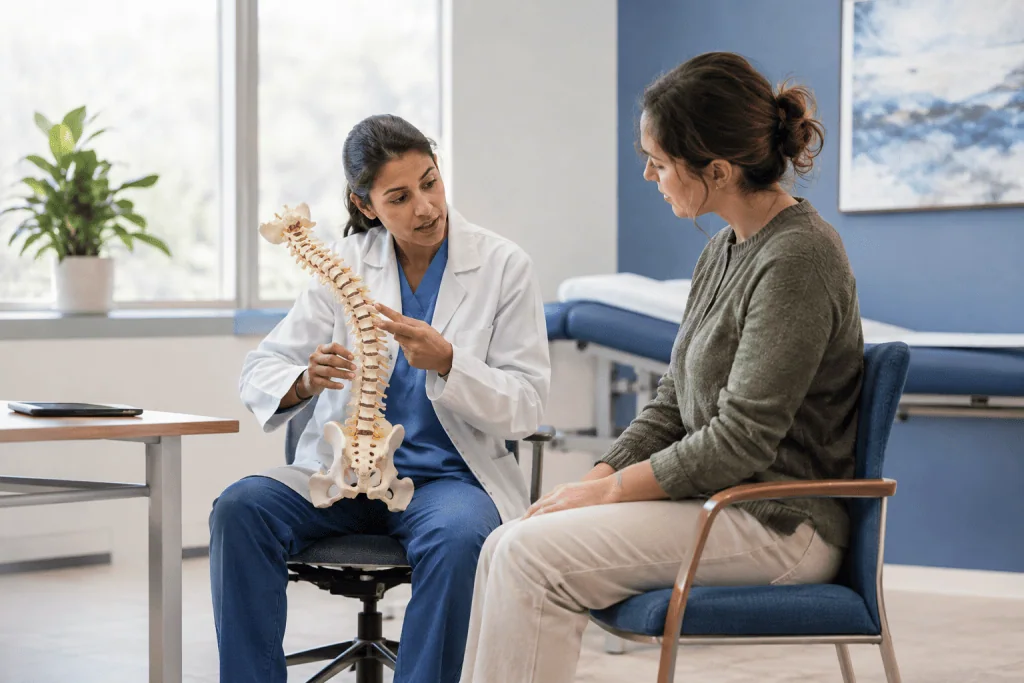
Standing shares the load across all of this. Sitting rearranges it. The pelvis rolls backward, the lumbar curve flattens, and the front of each disc is squeezed while the back is stretched. The large gluteal muscles relax and the hip flexors sit shortened for hours.
How much disc pressure actually rises has been argued for decades. Nachemson’s pressure measurements in the 1960s suggested sitting loads the lumbar discs more than standing. A later in vivo study by Wilke and colleagues in 1999 found relaxed upright sitting roughly comparable to standing, with slumped and forward-leaning sitting clearly higher. The honest summary: it is the slouch and the stillness, rather than the chair itself, that the lumbar spine objects to.
The common causes first: muscle strain, posture and deconditioning
Most lower back pain has no single structural culprit. The NHS and the US National Institute of Neurological Disorders and Stroke (NINDS) both describe nonspecific or mechanical back pain as the usual pattern: an ache from muscles, ligaments and small joints working harder than they are used to. NINDS estimates that about 80 percent of adults experience low back pain at some point in their lives.
In a sitting context the story is usually familiar. A long drive, a new desk, a week of extra screen time, a return to work after vacation. The deep stabilizing muscles tire, posture drifts into a slump, and ligaments at the back of the spine take strain they are not designed to hold for hours. The pain is typically a dull, spread-out ache across the lower back or on one side, worse toward the end of a sitting session and easing within minutes of standing and walking. It does not travel below the knee, and there is no numbness.
Deconditioning matters here. Weak trunk and hip muscles leave the passive structures doing the work, which is why people who sit most of the day and exercise little are overrepresented. NINDS lists fitness level, weight and job demands among the recognized risk factors. The reassuring flip side is that this pattern responds well to movement, and a clinician can usually recognize it from the history and a brief examination without any scan.
Disc-related pain: bulges, herniation and why bending forward hurts
A disc bulge is a disc that has spread slightly beyond its normal edge; a herniation (sometimes called a slipped disc, although nothing slides anywhere) is a tear in the outer ring that lets the inner gel push out. MedlinePlus notes that most herniated discs occur in the lower back. The disc center has few pain fibers, but the outer ring and the ligament behind it do, and the extruded material can press on or chemically irritate a nearby nerve root.

The sitting signature is distinctive. Pain is worse with sitting, forward bending, lifting and getting out of a chair, and often spikes with a cough or sneeze because both raise pressure inside the disc. Standing or lying flat tends to ease it. Many people describe a deep, central or slightly off-center ache with stiffness on first standing.
Two cautions keep this in proportion. First, disc changes on MRI are common in people with no pain at all; a 2015 systematic review by Brinjikji and colleagues found bulges and degeneration frequent in pain-free adults and increasingly so with age, which is why scans are read alongside symptoms rather than on their own. Second, most herniations shrink over months without surgery, and the NHS advises that treatment usually begins with staying active and simple pain management rather than imaging.
Sciatica pain when sitting: what nerve irritation feels like
Sciatica is not a diagnosis so much as a description: pain along the path of the sciatic nerve, caused by irritation of one of the nerve roots that form it. The NHS lists a herniated disc as the usual trigger, with spinal stenosis (narrowing of the canal around the nerves), spondylolisthesis (one vertebra slipping forward on another) and, rarely, injury or growths as other causes.
The pain is usually one-sided and runs from the buttock down the back or side of the thigh, often below the knee into the calf or foot. Tingling, pins and needles, numbness or weakness may travel with it. Many people find the leg symptoms more troubling than the back, and some have little back pain at all. Sitting stretches the nerve and loads the disc, so a car seat or a soft sofa can be far worse than a slow walk. Coughing, sneezing and straining can send a jolt down the leg.
Clinicians look for a pattern that fits a single nerve root: the straight-leg raise test, which reproduces leg pain when the lifted leg passes a certain angle, plus checks of ankle and knee reflexes, calf and big-toe strength, and skin sensation. The NHS states that sciatica usually gets better in 4 to 6 weeks, although it can last longer. Persistent weakness, or symptoms spreading to both legs, moves the conversation from reassurance to investigation.
Less common causes that need a check
A smaller group of conditions can produce lower back pain that feels worse in a chair, and the details around the pain are what separate them.
- Facet joint pain: the small joints behind the discs; typically worse with leaning back and twisting, with a localized ache either side of the spine.
- Sacroiliac joint pain: one-sided pain over the dimple at the top of the buttock, worse on rising from a chair, climbing stairs or lying on that side; common in later pregnancy.
- Spinal stenosis: narrowing around the nerves, usually in older adults. The classic story is the reverse of disc pain: walking and standing bring on leg heaviness, and sitting or leaning on a shopping cart relieves it. Pain that is worse sitting therefore points away from stenosis.
- Inflammatory back pain (axial spondyloarthritis): starts in younger adults, builds slowly, wakes people in the second half of the night, brings prolonged morning stiffness, and improves with exercise rather than rest.
- Vertebral compression fracture: sudden pain in someone with osteoporosis, long-term steroid use or a fall, even a minor one.
- Infection or cancer in the spine: rare; suspected when there is fever, unexplained weight loss, a history of cancer, night pain that does not change with position, or a weakened immune system.
- Referred pain: kidneys, pancreas, pelvic organs and the aorta can all send pain to the lower back, usually without the position-dependence of a spinal cause.
None of these can be ruled in or out from a chair at home. They are the reason a clinician’s questions sometimes sound unrelated to your back.
What could be causing pain on the left side of my lower back?
Sidedness is a clue, not a diagnosis. Musculoskeletal pain is often one-sided because posture rarely is: a wallet in the left back pocket, a car seat that tilts, the habit of leaning on one elbow at a desk, or a leg-crossing preference that loads one sacroiliac joint for hours. Quadratus lumborum, a flat muscle running from the top of the pelvis to the lowest rib, is a frequent source of a deep one-sided ache that tightens after long sitting.
A disc herniation or nerve root irritation is also typically one-sided, which is why sciatica usually affects a single leg. Facet joint and sacroiliac pain favor one side too.
What a clinician listens for is pain that does not behave like the spine. Kidney pain sits higher and more to the flank, is often colicky or constant regardless of position, and may come with fever, nausea or blood in the urine. Pancreatic pain tends to be upper abdominal and bores through to the back, often linked to eating. Pain from the main artery (the aorta) is rare but important: a sudden tearing pain in the back or abdomen, especially in an older adult with high blood pressure or a smoking history, is an emergency.
The practical test is simple. Pain that changes with how you sit, stand, bend and walk is usually mechanical; pain that is indifferent to position deserves a prompt appointment, and a urine sample often forms part of that visit.
Lower back pain when sitting: how clinicians tell the causes apart
The consultation starts with questions rather than scans. Where exactly is the pain, what started it, does it travel into a leg, what makes it better and worse, how is sleep, has there been fever, weight loss or a previous cancer, and, asked directly, any change in bladder, bowel or sensation around the saddle area. The examination then checks how you stand and bend, presses along the spine and sacroiliac joints, performs the straight-leg raise, and tests leg strength, reflexes and sensation.
| Cause | Typical features | Usual next step |
|---|---|---|
| Nonspecific (muscle, ligament, small joint) | Dull ache, worse after long sitting, eases with walking, no leg symptoms | Stay active, simple pain relief, review if not settling in a few weeks |
| Disc bulge or herniation | Worse sitting, bending, coughing; better standing or lying | Same first-line plan; imaging only for red flags or persistent nerve symptoms |
| Sciatica (nerve root irritation) | One-sided pain below the knee, tingling or numbness, positive straight-leg raise | Activity and pain management; neurological review if weakness or progression |
| Sacroiliac or facet joint | Localized one-sided ache, worse rising from a chair or leaning back | Examination-based diagnosis; physical therapy-led rehabilitation |
| Inflammatory back pain | Younger adult, night waking, prolonged morning stiffness, better with exercise | Blood tests for inflammation and referral to rheumatology |
| Fracture, infection, cancer | Trauma, osteoporosis, fever, weight loss, night pain, cancer history | Urgent imaging and blood tests |
| Referred (kidney, pancreas, aorta) | Pain unaffected by position, with urinary, digestive or circulatory symptoms | Urine test, abdominal examination, scans as indicated; aortic symptoms are an emergency |
Imaging is deliberately held back. The NHS states that most people do not need an X-ray or scan, because the pictures rarely change the first-line plan and frequently show age-related changes unrelated to the pain. MRI is reserved for red flags, for nerve symptoms that persist or worsen, or when an injection or surgery is being considered. Blood tests look for inflammation and infection, and a urine dipstick screens for kidney causes.
How to sit with lower back pain, and how to relieve it faster at home
The strongest evidence-backed advice is also the least glamorous: keep moving. The NHS advises against bed rest and against sitting for long periods, because inactivity stiffens the back and weakens the muscles that protect it. Short, frequent walks tend to do more than one heroic gym session.
When you do sit, make the chair work for you. Sit back so the backrest supports the lumbar curve, or place a rolled towel or small cushion in the small of the back. Keep hips level with or slightly above the knees and both feet flat on the floor. Bring the screen to eye level so the neck and lower back are not pulled forward together. Change position often; the best posture is the next one.
Heat or cold packs can ease stiffness and muscle spasm, and both appear in NHS self-care guidance; neither is superior for everyone, so use the one that helps. Gentle movement such as knee-to-chest stretches, pelvic tilts, walking and swimming keeps the spine mobile without loading it.
Medicines have a supporting role. Non-steroidal anti-inflammatory drugs (NSAIDs) reduce the prostaglandins that drive inflammation and pain, and the NHS notes that anti-inflammatory painkillers can help relieve back pain; they are not suitable for everyone, particularly people with stomach, kidney or heart conditions. The NHS also notes that acetaminophen (paracetamol) on its own is not recommended for back pain. Whether any medicine fits your history, and for how long, is a decision for the clinician or pharmacist who knows it.
How long does lower back pain after sitting last, and is daily back pain normal?
Most episodes are short. NINDS describes acute low back pain as lasting from a few days to a few weeks, and the NHS states that most back pain improves within a few weeks. Pain that persists beyond 12 weeks is classed as chronic, and NINDS reports that about 20 percent of people with acute low back pain still have symptoms at one year. Sciatica follows a slightly slower curve, usually settling in 4 to 6 weeks according to the NHS.
Several factors stretch that timeline, and most are modifiable. Fear of movement, low mood and poor sleep are consistently associated with slower recovery; so are prolonged daily sitting, smoking, excess weight and physically demanding or very sedentary jobs, which NINDS lists among the recognized risk factors. People who return to normal activity early, even while sore, tend to recover faster than those who wait for the pain to vanish first.
Is daily back pain normal? Common, yes; inevitable, no. A twinge after a long drive that fades once you walk is within the range of ordinary experience. Pain every day for more than a few weeks, pain that is changing character, or pain that has begun to shape how you sit, sleep or work has crossed into territory worth a review, because the earlier a persistent pattern is examined and a movement plan started, the less likely it is to settle in for the long term.
What people often get wrong about back pain and sitting
Resting it is the most common misstep. A sore back feels as though it wants stillness, but days on the sofa stiffen joints and weaken muscles, and every major guideline now advises staying active.
The scan will show the cause is the second. Disc bulges and wear are so common in pain-free adults that an MRI without a matching clinical picture often raises anxiety more than it clarifies, which is why clinicians order it selectively.
A slipped disc has moved out of place: nothing slips. The outer ring tears and the inner gel protrudes, and that protrusion usually shrinks over months.
There is one perfect posture: the evidence points to variety, not a single correct angle. Sitting rigidly upright all day tires the back as surely as slumping does.
Pain means damage: in nonspecific and most disc-related pain, the intensity of the ache is a poor guide to how much is physically wrong, and movement that hurts a little is usually safe.
A standing desk is the fix: standing all day shifts the load rather than removing it, and people who alternate sitting and standing tend to fare better than those who do either exclusively.
Finally, back pain that eases with sitting is not what this article describes; that pattern, in an older adult with leg heaviness on walking, points toward spinal stenosis and is worth its own appointment.
When to see a doctor: red flags and sudden severe pain
Call emergency services or go to an emergency department now if lower back pain comes with any of the following, which the NHS lists as signs of possible cauda equina syndrome (compression of the nerves at the base of the spine) or another emergency:
- Numbness or tingling around the genitals, buttocks or inner thighs
- New difficulty passing urine, loss of bladder or bowel control, or loss of sensation when you go
- Weakness or numbness in both legs, or weakness that is spreading
- Pain after a serious accident, fall or direct blow
- Sudden tearing pain in the back or abdomen with faintness or a racing pulse
Sudden, severe pain that stops you walking but has none of those features is frightening and usually still mechanical. Stay as mobile as the pain allows, use heat or cold, and seek same-day advice from a doctor or urgent care service if you cannot bear weight, if the pain is unlike anything before, or if you are an older adult, have osteoporosis or take long-term steroids, because a fracture needs to be excluded.
Arrange a routine appointment if pain has not improved after a few weeks, keeps returning, comes with fever, unexplained weight loss or night pain, follows a cancer diagnosis, or wakes a younger adult with prolonged morning stiffness.
In pregnancy and in children, the same red flags apply, and back pain in a child that persists, limits activity or comes with fever always deserves an examination rather than reassurance alone. Treatment choices in both groups are made with the clinician, not from a search result.
Frequently asked questions
How to relieve lower back pain fast?
The fastest reliable relief for mechanical lower back pain is to change what you are doing: stand, walk for a few minutes and let the spine move through its range. A heat pack eases muscle spasm; some people prefer cold. An anti-inflammatory may help if your clinician or pharmacist confirms it suits your history. Lying still for days slows recovery, so keep movement gentle but frequent.
Is daily back pain normal?
Daily back pain is common but not something to accept as normal. The NHS notes most episodes settle within a few weeks; pain that recurs every day beyond that, changes character or starts to limit sleep, work or activity should be assessed. A clinician can confirm it is mechanical, screen for the less common causes and set up a movement plan before the pattern becomes long-term.
What could be causing pain on the left side of my back?
One-sided lower back pain is usually muscular or joint-related, driven by asymmetric sitting habits, or comes from a disc or nerve root on that side. Pain that sits higher in the flank, does not change with position, or arrives with fever, nausea or blood in the urine points toward the kidney and needs prompt review. Sudden tearing pain in the back or abdomen is an emergency.
What should I do if I have sudden, severe lower back pain and can't walk?
Check first for emergency signs: numbness around the genitals or buttocks, bladder or bowel changes, weakness in both legs or a recent serious injury, any of which means emergency care now. Without those, severe pain that stops you walking is usually a muscle spasm or disc flare. Move as much as the pain allows, apply heat or cold, and get same-day advice if you cannot bear weight, are an older adult or have osteoporosis.
Why does lower back pain sitting too long feel worse than standing?
Sitting flattens the lumbar curve, tilts the pelvis backward and shifts the upper body’s weight onto the discs and ligaments, while the gluteal and trunk muscles switch off. Slumped sitting raises pressure inside the discs more than standing, and holding any position for an hour starves tissues of movement. Standing redistributes the load and gets the muscles working, which is why the first steps often bring relief.
Does sciatica pain when sitting mean a herniated disc?
Often, but not always. A herniated disc is the most common cause of sciatica, and sitting is a classic aggravator because it loads the disc and stretches the nerve. Spinal stenosis, spondylolisthesis and a tight piriformis muscle in the buttock can mimic it. A clinician distinguishes them through the pattern of symptoms, the straight-leg raise and a neurological check; imaging is reserved for persistent or worsening nerve symptoms.
Can a standing desk fix lower back pain from sitting?
A standing desk moves the problem rather than removing it. Standing all day loads the facet joints and tires the leg and back muscles, and people who alternate between sitting and standing generally do better than those who do either exclusively. The useful change is frequent position shifts and short walks, whatever the desk height, plus a chair that supports the lumbar curve when you do sit.
Should I get an MRI for lower back pain when sitting?
Usually not at first. The NHS advises that most people with back pain do not need a scan, because MRI often shows disc bulges and wear in people with no symptoms and rarely changes early treatment. Scans are ordered when red flags are present, when nerve symptoms persist or progress despite time and activity, or when an injection or surgery is being planned.
Is it safe to exercise with lower back pain?
Yes for most people, and guidelines actively recommend it. Walking, swimming, cycling and gentle stretching keep the spine mobile and rebuild the muscles that protect it. Some discomfort during movement is expected and does not signal damage. Stop and seek advice if exercise causes leg weakness, numbness or sharply worsening pain, or if any red-flag sign such as bladder or bowel change appears.
How long does a sciatica flare take to improve?
The NHS states that sciatica usually improves within 4 to 6 weeks, although it can last longer, particularly when a larger disc herniation is responsible. Staying active, avoiding long sitting spells and managing pain in the meantime supports recovery. Leg weakness that is new or worsening, symptoms in both legs, or any bladder or bowel change should be assessed urgently rather than waited out.
References
This article is for general information only and is not a substitute for professional medical advice. Please consult a qualified doctor about your individual situation.
Add us as a Preferred Source to see more of our trusted health content across Google Search, AI Overviews and Discover.

More from the Blog

When Can You Fly After Foot Surgery? Clot Prevention, Swelling and Seat Planning
There is no fixed date for flying after foot surgery. Most surgical teams want the wound checked, swelling settling and any cast assessed before…

Pain in the Upper Right Chest or Pectoral Muscle: Common Causes and When It Needs Urgent Care
Pain in the upper right chest most often comes from the chest wall: a strained pectoral muscle, inflamed rib cartilage, or a nerve pinched…

Hand Surgery in Older Adults: How Bone Quality and Health Conditions Shape the Plan
Hand surgery for older adults is planned around bone density, overall health and the person's goals rather than age alone. Thinner bone can change…

Pain in the Fingertips: Nerve, Nail and Infection Causes and How It Differs from Joint Pain
Pain in the fingertips most often comes from the nail fold, the skin pad, a small nerve or the blood supply, while pain in…

Walking, Hiking and Sport After Ankle Replacement: What Is Encouraged and What to Avoid
After ankle replacement, most care teams encourage walking, cycling, swimming, golf and low-impact hiking on even ground once the surgeon has cleared full weight-bearing…
Mid and Upper Back Pain: Thoracic Spine, Muscle and Organ Causes and When to Get It Checked
Mid back pain most often comes from strained muscles, stiff thoracic joints or long hours in one posture, and it usually eases within a…