

CPAP or ENT Surgery for Sleep Apnea: How Do Specialists Decide Which Path Fits Your Airway?
Key Takeaways
- CPAP holds the entire upper airway open with air pressure, which is why it treats collapse at any level and is offered first for moderate and severe obstructive sleep apnea.
- Sleep apnea is graded by the apnea-hypopnea index: 5 to 14 events an hour is mild, 15 to 29 moderate, and 30 or more severe, and that number sets how urgently treatment is offered.
- Surgery only helps when it targets the level that actually collapses, so drug-induced sleep endoscopy, which films the airway under sedation, frequently decides whether an operation is offered.
- In children, enlarged tonsils and adenoids are the usual cause and their removal is commonly the first treatment, the reverse of the adult sequence.
- Nasal surgery rarely treats apnea by itself; its usual role is to make CPAP tolerable by lowering the pressure needed and allowing a smaller mask.
- Hypoglossal nerve stimulation is a second-line implant for people with moderate to severe apnea who cannot use CPAP and whose endoscopy shows a collapse pattern that moving the tongue forward can correct.
Specialists usually offer CPAP first for moderate or severe obstructive sleep apnea because it supports every level of the airway at once and carries no surgical risk. Surgery is considered when a sleep study, an airway examination and often a trial of CPAP show a specific anatomical blockage, or when a person cannot tolerate the mask. The choice rests on where the airway narrows, how severe the apnea is and the individual's health.
The machine sits on the nightstand like a small gray appliance, hose coiled beside it, and most nights it still goes unused. He has tried three masks. One leaked, one left marks across the bridge of his nose, one made him feel he could not exhale. His partner, who first noticed the silences in his breathing, has started sleeping in the spare room. Somewhere in the second month he typed the question many people eventually type: is there an operation for this instead?
The honest answer from an ear, nose and throat specialist usually begins with another question. Not which treatment do you prefer, but where, exactly, does your airway close? The cpap vs surgery for sleep apnea debate is often framed as a contest between a device and a scalpel. In clinic it is nothing of the sort. It is an exercise in matching a treatment to a particular throat, nose and tongue, and to the person attached to them.
This explainer walks through how that matching happens, what each path involves, and the questions worth carrying into your next appointment.
What the cpap vs surgery for sleep apnea question is really asking
Obstructive sleep apnea is a condition in which the soft tissues of the throat relax and narrow or close during sleep, repeatedly interrupting breathing. Each pause lasts at least ten seconds, and the brain briefly rouses the body to reopen the airway, often without the sleeper ever becoming aware of it (Cleveland Clinic). Strung together across a night, those micro-awakenings fragment sleep and strain the heart and blood vessels.
The airway is not a single tube with a single weak point. It can narrow behind the nose, at the soft palate and uvula, at the base of the tongue, along the side walls of the throat, or at the epiglottis, the leaf-shaped flap above the voice box. Many people collapse at more than one level. That anatomical fact is the whole reason the cpap vs surgery for sleep apnea decision cannot be made from a symptom description alone.
Continuous positive airway pressure, or CPAP, is a bedside machine that pushes a steady stream of air through a mask to hold the throat open. Because the pressure fills the entire upper airway, it works regardless of which segment is collapsing. Surgery, by contrast, reshapes or stiffens one specific segment, or stimulates the nerve that controls the tongue. It is precise, and precision only helps when the target is correct.
So the useful reframing is this: CPAP is a treatment you can trial and reverse; surgery is a commitment aimed at a particular site. Specialists weigh three things in roughly this order. How severe is the apnea on testing? Where does the airway fail? And can this person realistically live with a mask every night? Everything that follows unpacks those three questions.
How CPAP actually works: a pneumatic splint for the throat
Think of a soft garden hose that kinks when you step on it. Run water through it under pressure and the kink straightens. CPAP applies the same principle to the airway. A quiet pump draws in room air, filters and often humidifies it, and delivers it through flexible tubing to a mask that seals over the nose, the nose and mouth, or just under the nostrils. The slight positive pressure acts as a pneumatic splint, keeping the relaxed tissues from falling together (Mayo Clinic).
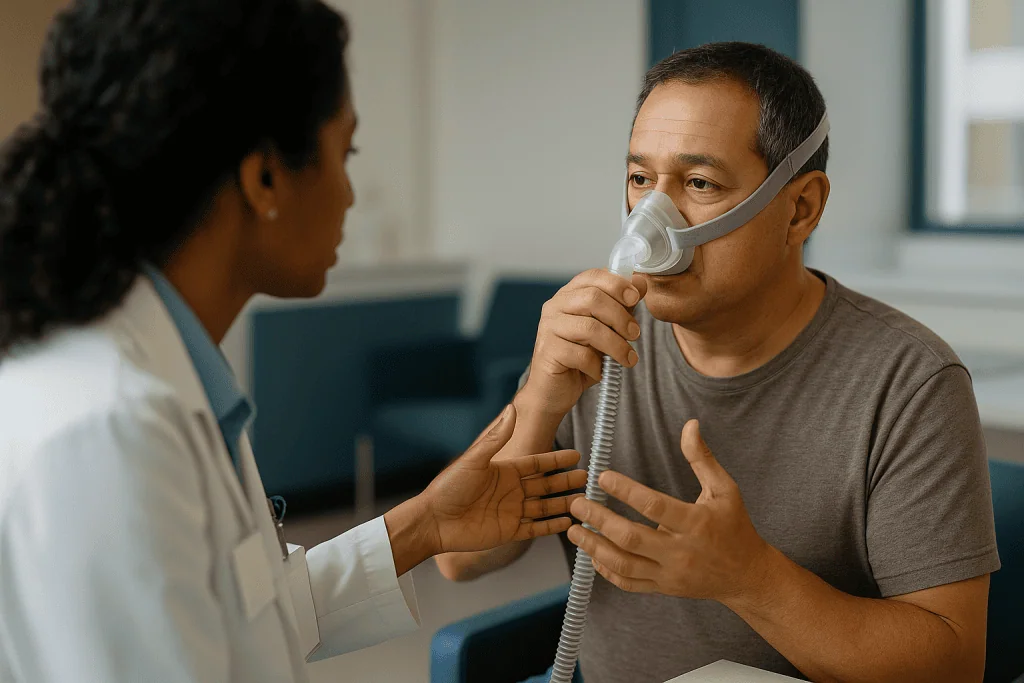
The pressure setting is determined by your sleep team, either during a monitored night in a sleep laboratory or by an automatic machine that adjusts breath by breath within a range they prescribe. Modern devices record how many hours the mask was worn and how many breathing events slipped through, data your team reviews at follow-up (NHS).
CPAP does not change the anatomy. The moment the mask comes off, the airway is exactly as collapsible as before. That is both its limitation and its safety. There is no incision, no anesthesia, and nothing that cannot be undone. The National Health Service describes CPAP as the main treatment for moderate and severe obstructive sleep apnea for exactly this reason: it addresses every level of obstruction at once, in anyone, from the first night.
The trade-off is that it only works while it is being used, and it asks something of the user every single evening. Dry mouth, nasal congestion, skin irritation, a feeling of claustrophobia and air leaks are common early complaints. Most are solvable with a different mask shape, heated humidification, a pressure ramp that starts low, or a short period of simply wearing the mask while awake and reading. Mayo Clinic notes that getting used to CPAP takes time and that persistence, with adjustments from the team, is what usually separates people who settle into it from those who abandon it.
Sleep apnea surgery options: what an ENT operation actually does
There is no single sleep apnea operation. Surgeons choose from a menu of procedures, each targeting one part of the airway, and they often combine two or more. The main sleep apnea surgery options fall into five groups.
Nasal surgery, such as septoplasty (straightening a deviated central wall of the nose) or turbinate reduction (shrinking the shelf-like structures inside the nose), rarely treats apnea on its own. Its usual purpose is to make breathing easier and CPAP more tolerable by lowering the pressure needed and letting a smaller nasal mask work (Mayo Clinic).
Palate surgery includes uvulopalatopharyngoplasty, usually shortened to UPPP, in which excess tissue from the soft palate, uvula and sometimes the tonsils is removed or repositioned to widen the back of the throat. Newer variants reposition rather than cut, aiming to preserve swallowing and speech.
Tongue-base procedures reduce or advance the tissue behind the tongue that falls back during sleep. Hypoglossal nerve stimulation, discussed in its own section below, belongs here too: an implanted device nudges the tongue forward with each breath (Mayo Clinic).
Skeletal surgery, most notably maxillomandibular advancement, moves the upper and lower jaws forward to pull the whole soft-tissue airway with them. It is the most extensive option and is generally reserved for severe cases with a clear jaw-related cause or after other treatments have not worked.
In children, the picture is simpler. Enlarged tonsils and adenoids are the most common cause of obstructive sleep apnea, and removing them is often the first-line treatment rather than CPAP (NHLBI). For adults, the sequence usually runs the other way: a device first, with surgery considered when a specific target has been identified.
The tests behind the decision: sleep study, AHI and a look inside the airway
No specialist chooses between CPAP and surgery on a hunch. Two kinds of evidence drive the decision: how often you stop breathing, and where the blockage sits.
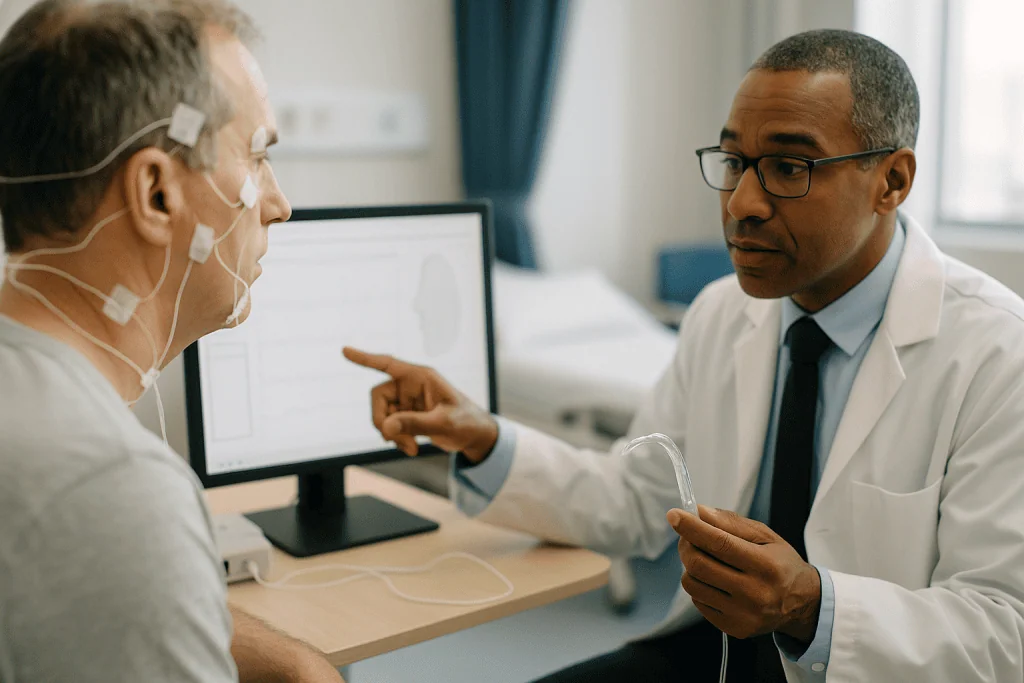
The first comes from a sleep study. A home sleep test records breathing, oxygen levels and heart rate overnight in your own bed. A full laboratory study, called polysomnography, adds brain-wave, eye and muscle recordings so the team can see sleep stages and body position (NHS). The headline result is the apnea-hypopnea index, or AHI: the average number of complete pauses and partial reductions in breathing per hour of sleep. Cleveland Clinic groups results as mild at 5 to 14 events an hour, moderate at 15 to 29, and severe at 30 or more.
The AHI sets the urgency. Moderate and severe apnea carries clearer links to high blood pressure, heart rhythm problems, stroke and type 2 diabetes (Mayo Clinic), which is why CPAP is offered promptly in that range. Mild apnea with few symptoms may be managed with lifestyle change, position training or an oral appliance.
The second kind of evidence is anatomical. In the clinic, an ENT surgeon examines the nose, palate, tonsils and tongue, and may pass a thin flexible camera through the nostril to view the throat while you are awake. The most informative test for surgical planning is drug-induced sleep endoscopy, often abbreviated DISE: under light sedation that mimics sleep, the camera watches the airway actually collapse, revealing which level fails and in what pattern (Johns Hopkins Medicine).
A person whose palate flutters shut is a different surgical candidate from one whose throat squeezes inward from the sides, even if their AHI numbers are identical. CPAP treats both the same way. Surgery cannot, and that is precisely why DISE often decides whether an operation is offered at all.
Who is usually offered CPAP first, and who is asked to wait on surgery
For most adults with moderate or severe obstructive sleep apnea, the first offer is CPAP (NHS). It is fast to start, adjustable, and carries no operative risk, and it provides a benchmark: if symptoms lift on the mask, the team knows the apnea was driving them. If daytime sleepiness persists despite good nightly use, something else is going on, and that is valuable to learn before anyone considers surgery.
Surgery moves up the list in a handful of situations. The clearest is a fixed anatomical cause that pressure alone cannot overcome or that makes the mask unusable, such as a severely blocked nose, very large tonsils, or a jaw structure that leaves little room for the tongue. Another is documented intolerance: a person who has worked through mask changes, humidification and pressure adjustments with their team and still cannot use the device most of the night. Mayo Clinic describes surgery as generally an option after other treatments have failed or have not been tolerated, with the exception of people whose anatomy makes it the obvious first choice.
Who is usually asked to wait? Someone who has not yet had a proper sleep study, because the severity and type of apnea are unknown. Someone with untreated or unstable heart, lung or bleeding conditions, because anesthesia and airway surgery raise the stakes. Someone whose weight is changing rapidly, since the airway changes with it and an operation planned today may fit a different throat in a year. And someone with collapse at several levels that a single procedure would not address, in whom the team may recommend persevering with CPAP or combining approaches.
Children sit outside this sequence. When enlarged tonsils and adenoids cause the apnea, adenotonsillectomy is commonly first-line, with CPAP reserved for children who still have apnea afterward or who are not surgical candidates (NHLBI).
CPAP vs surgery for sleep apnea: a side-by-side comparison
Laid out next to each other, the two paths differ less in how well they can work and more in what they ask of the person and how reversible they are. The table summarizes the dimensions specialists tend to talk through in clinic.
| Dimension | CPAP | ENT surgery |
|---|---|---|
| What it does | Pneumatically splints the whole upper airway open during sleep | Permanently reshapes, stiffens or stimulates one or more specific sites |
| Works for which airway | Any level or pattern of collapse | Only the level the procedure targets; depends on accurate mapping |
| Starts working | From the first night it is worn properly | After healing and swelling settle; confirmed by a repeat sleep study |
| Reversible | Yes, fully | Largely no, apart from switching off an implanted stimulator |
| Nightly effort | Mask every night, cleaning, travel with equipment | None after recovery for tissue surgery; device check and remote use for stimulation |
| Main risks | Skin irritation, dryness, congestion, leaks, poor adherence | Bleeding, infection, pain, swallowing or voice change, anesthesia risk, incomplete response |
| Typical first offer | Adults with moderate or severe apnea (NHS) | Children with large tonsils and adenoids; adults with a fixed blockage or proven CPAP intolerance (NHLBI, Mayo Clinic) |
| Follow-up | Usage and event data reviewed by the sleep team | Wound checks, then repeat sleep testing to measure effect |
One row deserves emphasis: adherence. A CPAP machine that stays in its bag treats nothing, and surgery that targets the wrong site changes little. In both columns, the outcome depends less on the technology than on the fit between the treatment and the individual, which is why the testing described earlier matters more than the choice itself.
CPAP alternatives for sleep apnea when the mask is not working out
Surgery is not the only exit from a frustrating relationship with CPAP, and specialists usually walk through the less invasive cpap alternatives for sleep apnea before scheduling an operation.
Oral appliances are custom mouthpieces, fitted by a dentist trained in sleep medicine, that hold the lower jaw slightly forward during sleep so the tongue and soft tissues sit further from the back of the throat. Mayo Clinic lists them as an option for mild to moderate apnea and for people who cannot use CPAP. They are quieter and more portable than a machine, though they can cause jaw soreness and tooth movement, and their effect should be confirmed with a follow-up sleep study.
Positional therapy suits people whose apnea occurs mostly when lying on the back, a pattern the sleep study reveals. Devices worn on the chest or back vibrate gently when you roll over, training a side-sleeping habit.
Weight management is part of nearly every plan. Fat deposited around the neck and tongue narrows the airway, and the NHLBI notes that losing weight can reduce the number of breathing events, sometimes substantially, though it rarely resolves moderate or severe apnea on its own and takes months rather than weeks.
Alcohol and sedatives relax throat muscles and worsen collapse; cutting back in the evening is a simple lever. Treating nasal allergies with the help of your prescribing clinician can make both CPAP and sleep itself more comfortable.
Finally, there is the hybrid route. A nasal operation to unblock the nose is often performed not to replace CPAP but to make it bearable, lowering the pressure required and allowing a lighter mask. Many people who thought they had failed CPAP discover they had simply failed CPAP through a blocked nose.
Hypoglossal nerve stimulation vs CPAP: how specialists weigh the implant
The hypoglossal nerve is the nerve that controls the muscles of the tongue. Hypoglossal nerve stimulation is a surgically implanted system, placed under the skin of the upper chest with a lead to the nerve beneath the jaw, that senses each breath and delivers a mild electrical pulse so the tongue moves forward and the airway stays open during sleep. The user switches it on with a handheld remote at bedtime and off in the morning (Mayo Clinic).
Comparing hypoglossal nerve stimulation vs CPAP is not a question of which is stronger. It is a question of eligibility. Mayo Clinic describes the implant as an option for people with moderate to severe obstructive sleep apnea who cannot tolerate or do not benefit from CPAP. Candidates also need a drug-induced sleep endoscopy showing a collapse pattern the device can correct; a soft palate that closes in a complete circular pattern, for example, generally does not respond to moving the tongue alone. Body weight within the range used in the device’s regulatory approval, the ability to operate the remote, and the absence of other medical conditions that would complicate the implant all factor into the assessment.
The appeal is obvious: nothing on the face, nothing to clean nightly, nothing to pack. The costs in a medical sense are equally real. It is an operation under general anesthesia with incisions, a healing period before the device is activated, a series of clinic visits to adjust the stimulation level, and a lifelong relationship with an implanted battery that eventually needs replacement. Tongue soreness, abrasion from the tongue rubbing against the teeth, and discomfort from stimulation are the common complaints.
Specialists tend to position the implant as a second-line treatment for a specific, well-mapped group rather than an upgrade on CPAP. For a person who fits that group, it can be transformative. For one who does not, it is surgery in search of a target.
Risks and trade-offs, in plain clinical language
Every path has a downside, and a good consultation names them without drama.
CPAP’s risks are almost entirely about comfort and adherence. Skin pressure marks, dry eyes from mask leak, nasal dryness or congestion, bloating from swallowed air, and difficulty falling asleep with the mask on are the usual issues (Mayo Clinic). None is dangerous, but each erodes nightly use, and apnea that goes untreated because the machine sits idle carries the same cardiovascular consequences as apnea that was never diagnosed. Equipment that is not cleaned can harbor bacteria and mold; the team will explain a maintenance routine.
Tissue surgery such as UPPP carries the risks of any throat operation: bleeding, which can occasionally occur days after surgery as the healing surface sloughs; infection; significant throat pain that makes eating difficult; and the small chance of lasting change to voice or swallowing, including liquids regurgitating into the nose if the palate becomes too short. There is also the risk of an incomplete response, where the sleep study after healing shows the apnea persists. Mayo Clinic is explicit that UPPP may be less effective than CPAP and is not a reliable treatment for everyone.
Jaw advancement surgery adds a longer recovery, temporary numbness of the lip and chin, changes to the bite that may require orthodontic work, and alteration of facial profile that most people welcome but should see simulated beforehand.
Nerve stimulation carries implant risks: infection around the device, lead displacement, tongue weakness, and the need for future battery surgery.
The alternative that is rarely mentioned is doing nothing, and it is not neutral. Untreated moderate and severe apnea is associated with high blood pressure, heart attack, stroke, atrial fibrillation and drowsy-driving accidents (NHS). Weighing surgical risk against that background is part of what the team does when it recommends a path.
What the following days and weeks usually look like on each path
Starting CPAP is an adjustment period rather than a recovery. The first nights often feel strange; some people wear the mask for only part of the night and build up. Follow-up with the sleep team in the early weeks is when mask fit, humidity and pressure settings are refined, using the usage data the machine records (NHS). Mayo Clinic advises that it takes time to grow accustomed to the device and that most early problems have practical fixes. Daytime alertness often improves once the mask is worn through most of the night, though the timeline varies from person to person.
After palate or tongue-base surgery, the pattern is reversed: things get worse before they get better. Throat pain is typically at its most intense in the first several days and may radiate to the ears, which is referred pain from shared nerve pathways. Soft, cool foods and the pain plan your surgical team prescribes carry most people through. Swelling can make breathing feel more obstructed at first, which is one reason some teams ask patients to continue CPAP during healing when it is tolerated. A follow-up visit checks the wound, and a repeat sleep study, usually once swelling has fully settled, is the only way to know whether the operation achieved its aim.
Nerve stimulation has a quieter recovery: incision soreness at the chest and under the jaw, a period of healing before the device is switched on, and then a series of clinic visits over weeks to months to find a stimulation level that opens the airway without waking you. A sleep study with the device active confirms the setting (Mayo Clinic).
Jaw advancement involves the longest road: a liquid then soft diet while the bones heal, facial swelling that resolves gradually, and months before the final result and a confirmatory sleep study.
In every case, your team’s instructions override general descriptions like these.
Is sleep apnea surgery worth it? What the evidence actually shows
People searching is sleep apnea surgery worth it usually want a single number. The honest answer is that the evidence does not supply one, because the operations, the patients and the definitions of benefit vary so much.
What mainstream sources agree on is this. Surgery is generally not a first-line treatment for adult obstructive sleep apnea; CPAP is (NHS, Mayo Clinic). Palate surgery such as UPPP helps some people and not others, may be less effective than CPAP, and its effect can lessen over years as tissues relax and weight changes (Mayo Clinic). Tonsil and adenoid removal in children with enlarged tonsils is well supported and commonly first-line (NHLBI). Hypoglossal nerve stimulation has a defined role for people who meet its anatomical and weight criteria and cannot use CPAP (Mayo Clinic). Jaw advancement is reserved for severe or refractory cases.
Two features make surgical evidence hard to read. First, outcomes are often reported as a reduction in AHI rather than its normalization, so a result described as a response may still leave residual apnea that needs management. Second, the people who do well are those whose anatomy was carefully mapped beforehand; results in unselected patients look worse than results in well-chosen ones. That is not a flaw in the surgery so much as a reminder that the selection process is the treatment.
So is it worth it? For a child with huge tonsils, or an adult with a blocked nose that makes CPAP impossible, the question almost answers itself. For an adult with multilevel collapse who finds the mask annoying but workable, most specialists would say the evidence favors persisting with CPAP and revisiting surgery only if that fails. The decision is individual, and it belongs to you and your treating team with the sleep study and endoscopy findings on the table.
What people often get wrong about CPAP and sleep apnea surgery
Myth: surgery fixes apnea for good so you never need a machine again. Tissue surgery changes one part of the airway permanently, but the airway keeps aging, weight shifts, and other levels can begin to collapse. Mayo Clinic notes that UPPP’s benefit may not be lasting. A repeat sleep study after surgery, and sometimes years later, is standard, and some people end up using CPAP at a lower pressure afterward.
Myth: CPAP is a sign you have given up or that your case is hopeless. The reverse is closer to the truth. CPAP is offered first because it is the most broadly effective option for moderate and severe disease (NHS), not because surgery was ruled out.
Myth: snoring surgery and sleep apnea surgery are the same thing. Procedures that reduce the noise of snoring, including some laser and implant techniques for the palate, do not necessarily reduce the breathing pauses that define apnea. Quieter nights can coexist with ongoing oxygen drops. Only a sleep study measures apnea.
Myth: if you are not overweight, you cannot have apnea, so surgery must be the answer. Apnea occurs in people of every body size, often because of jaw shape, tonsil size or tongue position (Cleveland Clinic). Body weight influences but does not determine which treatment fits.
Myth: the nerve stimulator is just a better CPAP anyone can choose. It is a surgical implant with specific eligibility rules based on severity, anatomy seen on endoscopy and body weight, intended for people who cannot use CPAP (Mayo Clinic).
Myth: nasal surgery alone will treat the apnea. It usually improves nasal breathing and CPAP comfort rather than resolving throat collapse (Mayo Clinic). It is often a step toward successful CPAP, not a replacement for it.
Questions to ask your care team before choosing a path
A short list carried into the appointment turns a confusing consultation into a shared decision. These are the questions ENT surgeons and sleep physicians say they are glad to be asked.
- What was my AHI, and does that put me in the mild, moderate or severe range? Did the study show whether my apnea is worse on my back or in a particular sleep stage?
- Where does my airway collapse? Have you examined it with an endoscope, and would drug-induced sleep endoscopy change your recommendation?
- If you are recommending CPAP, what specific changes can we try if I struggle with the mask, and how long should I persist before we consider something else?
- If you are recommending surgery, which procedure, which level of the airway does it target, and what did you see that makes you think it will help me in particular?
- What are the realistic outcomes for someone with my anatomy and severity, and how will we measure whether it worked?
- What are the risks of this operation for me, given my other health conditions and the medicines I take, and how might it affect my voice, swallowing or appearance?
- What will recovery involve, how much time away from work or driving should I plan, and what pain management will be in place?
- Would a nasal procedure or an oral appliance be a sensible step before, or alongside, the bigger decision?
- If surgery does not fully resolve the apnea, what is the plan afterward? Will I return to CPAP, and would the surgery make it easier to use?
- Do I meet the criteria for hypoglossal nerve stimulation, and if not, which criterion rules it out?
Write the answers down. Decisions about airway surgery are rarely urgent, and the chance to go home, reread the notes and come back with follow-up questions is part of good care rather than an inconvenience to it.
When to call your doctor: red-flag signs on either path
Most of the sleep apnea journey happens at a measured pace, but a few situations warrant a prompt call or emergency care.
After any throat or palate surgery, seek urgent care for bleeding from the mouth or nose that is more than a few streaks or that does not stop with rest and gentle pressure, especially if it occurs several days after the operation when the healing surface separates. Difficulty breathing, noisy or labored breathing that is worsening, a high fever, inability to swallow liquids, signs of dehydration such as very dark urine or dizziness on standing, or pain that is escalating rather than easing despite the prescribed plan all need same-day attention.
After nerve stimulator or jaw surgery, contact the surgical team for spreading redness, swelling or discharge at an incision, new weakness or persistent numbness of the tongue, lip or chin that was not expected, a device that cannot be switched on or that stimulates painfully, or any shift in the position of the implant you can feel under the skin.
On CPAP, call the sleep team rather than stopping on your own if the mask is causing skin breakdown or sores, if you have persistent nosebleeds, ear pain, or chest discomfort when using the device, if you wake gasping despite wearing it, or if daytime sleepiness returns after a period of improvement, which can signal a pressure that no longer fits or a leak.
At any stage of treatment, chest pain, a very irregular or racing heartbeat, sudden weakness or facial drooping, slurred speech, or severe shortness of breath are emergencies; call your local emergency number. Falling asleep at the wheel or near-misses while driving should be reported to your doctor immediately and may require you to stop driving until your treatment is working.
None of these signs means a treatment has failed. They mean your team needs to see you, and seeing you quickly is their job.
Frequently asked questions
Is sleep apnea surgery worth it compared with staying on CPAP?
It depends on where your airway collapses and whether CPAP is genuinely unworkable for you. Mainstream guidance treats CPAP as first-line for moderate and severe adult apnea and positions surgery for people with a fixed anatomical blockage or documented intolerance. Palate surgery helps some people and may be less effective than CPAP, so specialists rely on a sleep study and airway endoscopy before recommending it. Your treating team can tell you what your own anatomy suggests.
What are the main sleep apnea surgery options an ENT surgeon might discuss?
They fall into five groups: nasal surgery such as septoplasty or turbinate reduction, palate surgery such as uvulopalatopharyngoplasty, tongue-base procedures, hypoglossal nerve stimulation with an implanted device, and skeletal surgery that advances the jaws. In children, removal of enlarged tonsils and adenoids is the most common operation. Which option is raised depends on the level of collapse identified during examination and, often, drug-induced sleep endoscopy.
What CPAP alternatives for sleep apnea exist besides surgery?
Custom oral appliances that hold the lower jaw forward, positional therapy for people whose apnea occurs mainly on their back, weight management, and reducing evening alcohol and sedatives are the usual non-surgical alternatives. Treating nasal congestion can also make CPAP itself more tolerable. Oral appliances suit mild to moderate apnea or people who cannot use CPAP, and any alternative should be checked with a follow-up sleep study.
How do specialists compare hypoglossal nerve stimulation vs CPAP?
They compare eligibility rather than power. CPAP works for any collapse pattern and is reversible; the stimulator is an implanted device for people with moderate to severe apnea who cannot tolerate CPAP, whose endoscopy shows the tongue is the main problem, and whose body weight falls within the device’s approved range. It involves surgery, a healing period before activation and lifelong device follow-up, so it is positioned as second-line.
Do I have to try CPAP before being considered for surgery?
Usually, yes, for adults, because CPAP is the standard first treatment for moderate and severe apnea and a trial shows whether apnea is driving your symptoms. Exceptions exist when anatomy makes CPAP impractical, such as a severely blocked nose or very large tonsils, and in children, where tonsil and adenoid removal is often first-line. Your team decides the sequence based on your sleep study and examination.
Can sleep apnea come back after surgery?
It can. Tissue surgery permanently changes one segment of the airway, but weight gain, aging tissues and collapse at other levels can bring breathing events back, and Mayo Clinic notes that palate surgery’s benefit may lessen over time. For that reason teams arrange a repeat sleep study after healing and may repeat it years later. Some people return to CPAP afterward, often at a lower pressure.
Does nasal surgery alone treat sleep apnea?
Rarely. Procedures that straighten the septum or shrink the turbinates improve airflow through the nose, but most apnea involves collapse further back at the palate or tongue. The usual aim of nasal surgery in apnea care is to make CPAP more comfortable by lowering the pressure needed and allowing a lighter mask. It is frequently a step toward using CPAP well rather than a replacement for it.
What is drug-induced sleep endoscopy and why does it matter for the decision?
It is an examination performed under light sedation that mimics sleep, during which a thin camera passed through the nose films the airway as it actually collapses. It shows which level fails, whether the palate, tongue base, side walls or epiglottis, and in what pattern. Because surgery only helps when it targets the right site, this test often determines whether an operation is offered and which one.
How long does it take to get used to CPAP?
It varies widely, and Mayo Clinic describes it as taking time rather than giving a fixed number. Early difficulties with mask fit, dryness, leaks or claustrophobia usually have practical fixes: a different mask style, heated humidification, a pressure ramp, or wearing the mask while awake. Your sleep team reviews usage data at follow-up and adjusts settings. Persisting with those adjustments is what most often leads to comfortable long-term use.
What are the risks of sleep apnea surgery I should ask about?
Throat surgery carries risks of bleeding, including delayed bleeding days later, infection, significant pain, and changes to voice or swallowing. Jaw advancement adds temporary facial numbness and bite changes. Nerve stimulation carries implant infection, tongue discomfort and future battery replacement. Every operation also carries anesthesia risk and the possibility of an incomplete response. Your surgeon should explain how each applies to your health and anatomy.
References
- NHS: Sleep apnoea
- Cleveland Clinic: Sleep apnea
- NIH National Heart, Lung, and Blood Institute: Sleep apnea treatment
- MedlinePlus: Sleep apnea
This article is for general information only and is not a substitute for professional medical advice. Please consult a qualified doctor about your individual situation.

More from the Blog
Cochlear Implant Evaluation: What Do the Hearing Tests, Speech Assessment and Imaging Decide?
A cochlear implant evaluation combines three strands of evidence. Hearing tests measure how much sound the inner ear still detects; speech assessment, done with…

Is Ear Drainage Normal After Tympanoplasty? What Healing Looks Like and When to Call
Yes, some drainage after tympanoplasty is expected. For the first one to two weeks, blood-tinged, pink or yellowish fluid usually seeps from the ear…
Questions to Ask Your Sleep Specialist Before Starting Sleep Apnea Treatment
Before starting sleep apnea treatment, ask your sleep specialist what type and severity of apnea your test showed, how low your oxygen dipped, which…

How Long Does Stapedectomy Recovery Take? Dizziness, Taste Changes and Hearing Milestones
Most people are back to light daily routines within about a week after a stapedectomy, but full recovery unfolds over roughly two to three…

Before Your Vertigo Appointment: Notes, Prior Hearing Tests and Scans Worth Bringing
For a vertigo appointment, bring a dated diary of your spells (how long each lasted, what set it off, whether hearing or balance changed),…
Preparing for a Sleep Study: Why Alcohol, Sedatives and Caffeine Are Off the List Beforehand
To prepare for a sleep study, most sleep labs ask you to skip alcohol and caffeine from around midday on the test day, avoid…