

Cytokine Release Syndrome After CAR-T: Why Fever Is Watched So Closely in Hospital
Key Takeaways
- Cytokine release syndrome after CAR-T is graded on three bedside observations, fever, blood pressure and oxygen need, using a consensus scale that defines fever as 38°C (100.4°F) or higher.
- CRS typically begins within the first week after infusion and, according to published toxicity-management guidance, usually resolves within about one to two weeks.
- The fever of CRS and the fever of infection are indistinguishable at the bedside after lymphodepletion, so blood cultures and antibiotics commonly run alongside CRS assessment.
- The main anti-cytokine treatment blocks the receptor for interleukin-6 rather than killing immune cells, which is why it can calm the reaction without switching off the CAR T cells.
- Neurotoxicity (ICANS) often appears after CRS rather than with it, most commonly within the first two weeks, and is screened with a short bedside test that includes writing a sentence.
- Programs typically ask people to stay within a short distance of the treatment center for about a month and to avoid driving for several weeks because confusion or seizures can arise suddenly.
Cytokine release syndrome after CAR-T is an inflammatory reaction that happens when the infused CAR T cells attack cancer and release large amounts of signaling proteins called cytokines. Fever is usually its first sign, most often within the first week after infusion. Hospital teams watch temperature closely because early recognition allows supportive care and anti-cytokine treatment before blood pressure or oxygen levels fall.
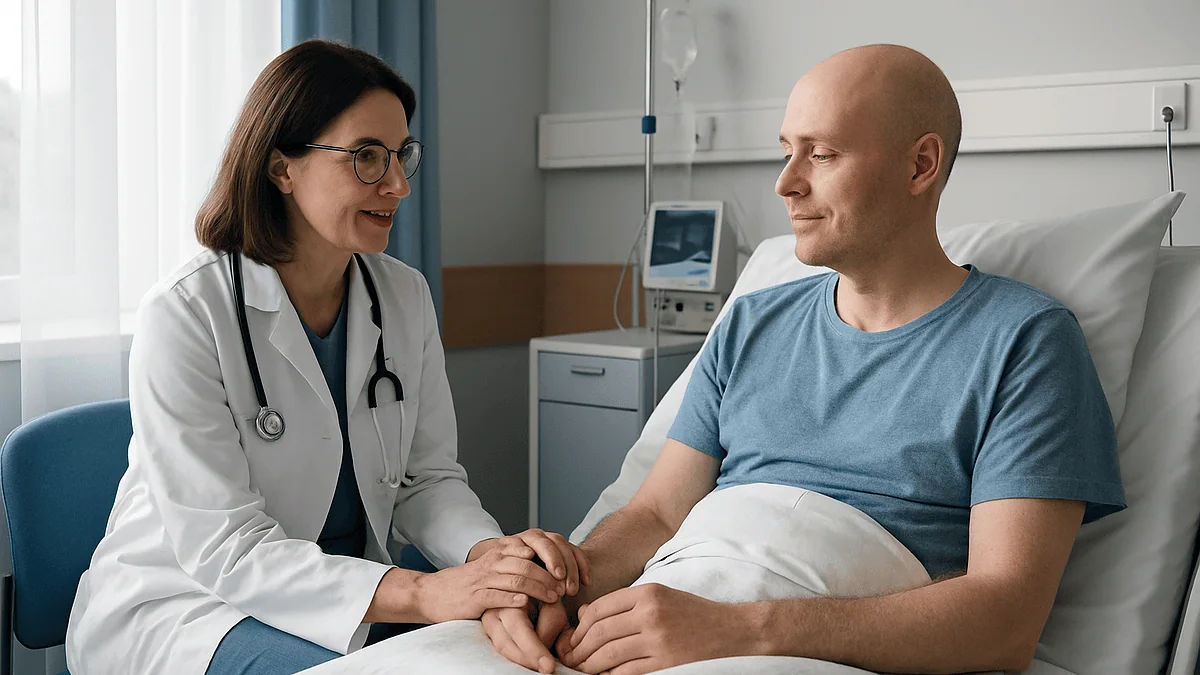
Two days after the infusion, the ward is quiet. A nurse slips in for the fourth temperature check since midnight, reads the thermometer, pauses, and reads it again. The number has crept past the line the team drew on day one. Nothing dramatic follows: a phone call, a blood draw, a physician at the bedside within minutes. Yet everyone in the room knows what that single reading might mean.
For people receiving CAR T-cell therapy, this scene is not an emergency so much as an expected chapter. Cytokine release syndrome after CAR T is the reason those temperature checks come every four hours, the reason the intravenous line stays in, and the reason the hospital asks you to stay close for weeks. It is the body doing exactly what the therapy was designed to make it do, sometimes with more force than is comfortable.
What follows explains why one degree of fever earns so much attention, what the reaction actually feels like, how it is graded and treated, and what the days afterward usually look like, grounded in published guidance rather than ward folklore.
What is cytokine release syndrome after CAR-T, in plain terms?
CAR T-cell therapy takes a person’s own T cells, a type of white blood cell that hunts abnormal cells, and re-engineers them in a laboratory to carry a chimeric antigen receptor, or CAR: a synthetic sensor that locks onto a specific protein on cancer cells. Once those modified cells are returned by infusion, they multiply and begin attacking the tumor.
Cytokines are the small proteins immune cells use to talk to one another, a chemical alarm system that recruits reinforcements and turns up inflammation. In an ordinary infection that alarm sounds locally and fades. In cytokine release syndrome, often shortened to CRS, the alarm goes off across the whole body at once because millions of newly activated CAR T cells and the immune cells they stir up are shouting simultaneously.
The result looks a lot like a severe flu that has decided to involve the heart and circulation: fever first, then possibly a fast heart rate, low blood pressure, low oxygen and, in serious cases, organ strain. The Cleveland Clinic describes CRS as ranging from mild, flu-like illness to a life-threatening condition requiring intensive care, which is precisely why treatment programs are built around catching it early rather than waiting to see how far it goes.
Two points deserve emphasis before going further. CRS is common with this therapy, not a sign that something has gone wrong with the manufacturing or the infusion. In a published review of toxicity management, most people treated in early trials developed some degree of CRS, while severe grades occurred in a much smaller and highly variable share depending on the disease and product (Neelapu et al., 2018). Second, it is treatable, with a sequence of steps that hospitals have refined over the past decade. The fever that starts the sequence is a signal, not a verdict.
How CAR-T works, and why the immune storm follows
The chain of events begins when a CAR T cell meets its target. For blood cancers, that target is usually a surface protein such as CD19 on B-cell leukemias and lymphomas or BCMA on myeloma cells. Contact flips the T cell into attack mode: it releases toxic granules to destroy the cancer cell, then divides to make copies of itself. One infused cell can give rise to many within days.
Each activated T cell also pours out interferon-gamma and related cytokines. These reach bystander immune cells called monocytes and macrophages, the body’s cleanup crew, and switch them on. The bystanders respond with their own flood of signaling proteins, most notably interleukin-6, or IL-6, along with IL-1 and others. Research on this cascade suggests that much of the fever, low blood pressure and leaky blood vessels of CRS is driven by these secondary cells rather than by the CAR T cells directly (Shimabukuro-Vornhagen et al., 2018). That distinction matters for treatment, as a later section explains.
IL-6 in particular acts on the temperature-regulating center in the brain, telling it to raise the body’s thermostat. It also loosens the junctions between the cells lining blood vessels, so fluid seeps into tissue, blood pressure drops and oxygen exchange in the lungs suffers. Picture a garden hose developing hundreds of pinprick leaks: pressure at the nozzle falls even though the tap is fully open.
The intensity of all this depends heavily on how much cancer is present. More tumor means more targets, more activated cells, and a bigger cytokine surge, which is one reason teams look closely at disease burden before the infusion. Understanding the cascade also explains why the pre-infusion chemotherapy, called lymphodepletion, is used: it clears space so the new cells can expand, but that same expansion is the engine of CRS.
Why fever is the signal the ward watches so closely
Fever is almost always the first measurable sign of CRS, and it usually arrives before anything else changes. The consensus grading system used across transplant and cellular-therapy centers defines the threshold as a temperature of 38°C, which is 100.4°F, and makes fever the required entry point for every grade of CRS (Lee et al., 2019). Without fever, by definition, a team does not call it CRS at the outset.
That threshold explains the rhythm of the ward. Temperature checks every few hours are not bureaucracy; they are the earliest warning system available. Blood pressure and oxygen saturation tend to slip hours or a day after the fever appears, and it is far easier to support a person whose pressure is drifting than one whose pressure has collapsed.
There is a second reason fever earns such attention. After lymphodepleting chemotherapy, white blood cell counts are often very low, so an infection can present identically: fever, chills, a racing pulse. The two problems demand different responses, and they can occur together. Standard practice, described in the same consensus paper and in toxicity-management reviews, is to treat a new fever as possible infection until proven otherwise: blood cultures are drawn, antibiotics are commonly started, and a chest X-ray or urine test may follow, while the team simultaneously evaluates for CRS (Neelapu et al., 2018). Blood tests for inflammation markers such as C-reactive protein and ferritin help track the trajectory, though no single lab value confirms the diagnosis.
One practical consequence: fever-reducing medicine can mask the very signal being monitored. The grading guidance notes that once a person has received antipyretics or anti-cytokine therapy, fever can no longer be used to grade severity, and the team relies on blood pressure and oxygen needs instead. This is why you may be asked not to take anything for a temperature on your own, and why the thermometer, humble as it is, becomes the most important instrument in the room.
What does cytokine release feel like? CAR T cytokine release syndrome symptoms explained
People who have been through it often describe the early phase as the worst flu of their lives arriving on a timetable. The fever can climb quickly and bring shaking chills, drenching sweats, aching muscles and joints, headache, and a profound fatigue that makes lifting a phone feel like effort. Appetite usually disappears. Nausea and loose stools are common companions.
As the inflammatory cascade builds, the circulation begins to show it. The heart speeds up to compensate for widened, leaky blood vessels, so a resting pulse that was 70 may sit above 100. Blood pressure can fall, which some people notice as lightheadedness when sitting up, or simply as a heavy, washed-out feeling. If fluid leaks into lung tissue, breathing becomes shallow or effortful, and the team may notice oxygen saturation dropping on the monitor before the person feels short of breath. Swelling in the legs or a sudden weight gain from retained fluid can accompany this.
The Cleveland Clinic lists fever, fatigue, headache, rash, rapid heartbeat, low blood pressure and difficulty breathing among the recognized features, and notes that in severe cases the kidneys, liver and heart can be affected. Blood tests during this period may show strained liver enzymes, a falling platelet count, and disturbances in clotting proteins.
These descriptions are offered so that the experience is not frightening when it arrives, not so anyone can grade themselves. In the hospital, symptoms are read alongside vital signs and laboratory values by clinicians who see this pattern regularly. What feels alarming to the person in the bed, a shaking chill at three in the morning, is often a well-understood grade 1 event to the team standing beside it. The reverse can also be true: a person who feels only tired may have blood pressure numbers that prompt action. That gap between sensation and severity is another argument for continuous monitoring rather than relying on how someone says they feel.
When does CRS start, and how long can cytokine release syndrome last?
Timing is one of the more predictable features of this reaction, even if severity is not. Published guidance describes CRS as typically beginning within the first week after infusion, most often within the first few days, and states that it generally resolves within about one to two weeks (Neelapu et al., 2018). The consensus grading paper likewise anchors the window to the first 14 days for most people, while acknowledging that onset can be earlier or occasionally later depending on the product and disease (Lee et al., 2019).
Within that window, the course tends to follow a recognizable arc. Fever appears, builds over one to three days, and reaches a plateau. If the reaction is going to involve the circulation, that usually shows itself in the days after the fever peaks. Then, either on its own or with treatment, the temperature settles, the heart rate drifts back toward normal, and energy slowly returns. Some people describe a distinct morning when they wake and simply feel like themselves again.
Onset timing carries information. Very early fever, within the first day or two, is more often associated with a larger initial cytokine surge and has been linked in observational studies to a higher likelihood of severe CRS, though this is a risk signal rather than a rule (Shimabukuro-Vornhagen et al., 2018). Fever that begins toward the end of the second week, by contrast, prompts a more careful search for infection or other explanations.
How long any individual episode lasts depends on grade, on how promptly anti-cytokine therapy is given, and on the underlying cancer burden. The one-to-two-week figure is a typical range drawn from published experience, not a promise about any person’s course. Your treating team will tell you where you are on the curve; the question to ask them is not “when will this end” but “what are you watching for that would tell you it is settling.”
Cytokine release syndrome grading: how doctors decide how serious it is
Before 2019, different centers graded CRS differently, which made it hard to compare results or agree on when to treat. The American Society for Transplantation and Cellular Therapy convened a consensus group that produced a single scale built on three observable things: fever, blood pressure, and oxygen (Lee et al., 2019). Laboratory values and how ill a person feels are noted but do not determine the grade. That simplicity is deliberate: a nurse at 3 a.m. can apply it at the bedside.
| Grade | Fever | Blood pressure | Oxygen support |
|---|---|---|---|
| 1 | 38°C (100.4°F) or higher | Normal | None needed |
| 2 | Present | Low, responds to fluids, no pressor drugs needed | Low-flow oxygen by nasal prongs |
| 3 | Present | Low, needs one blood-pressure-supporting medicine | High-flow oxygen or face mask |
| 4 | Present | Low, needs more than one blood-pressure-supporting medicine | Breathing machine support (mask ventilation or intubation) |
Adapted from the ASTCT consensus criteria. Once fever has been suppressed by treatment, the grade is set by the blood pressure and oxygen columns alone.
The scale works like the weather categories for storms: grade 1 is a fever the body is handling with normal circulation, grade 2 means the circulation is wobbling but responds to fluids or a little oxygen, grade 3 requires medicines to hold blood pressure up, and grade 4 involves intensive-care-level breathing or circulatory support. The grade is reassessed continuously, sometimes several times a day, and can move in either direction.
Grading is not a prognosis. It is a shared language that tells the whole team, including the intensive-care physicians who may be consulted early, exactly where things stand and which treatment step comes next. Most protocols link a specific grade to a specific action, so the number on the chart is what drives decisions rather than any one person’s impression of how the patient looks.
Who is more likely to develop CRS, and who is usually asked to wait
CAR T-cell therapy is generally offered to adults and children with certain blood cancers, including some leukemias, lymphomas and multiple myeloma, whose disease has come back or has not responded to earlier treatments, as described by the National Cancer Institute. Because CRS is expected, the evaluation before treatment is as much about predicting and preparing for this reaction as it is about the cancer itself.
Several factors are consistently associated with more severe CRS in published series. The largest is disease burden: a high proportion of leukemia cells in the marrow or bulky lymphoma gives the CAR T cells more to attack and more fuel for the cytokine surge. Higher baseline levels of inflammatory markers, low platelet counts before infusion, and the intensity of the lymphodepleting chemotherapy have also been linked to risk, as has the specific CAR design used (Shimabukuro-Vornhagen et al., 2018). Children and young adults with acute lymphoblastic leukemia have historically shown higher rates of severe CRS than adults with lymphoma, largely reflecting disease burden.
Who is asked to wait? Teams commonly delay or reconsider infusion when there is an active, uncontrolled infection, because the fever of infection and the fever of CRS become impossible to separate and the combination is dangerous. Significant heart, lung or kidney impairment may lead to further testing or a decision that the risk of a grade 3 or 4 reaction outweighs the potential benefit. Very rapidly progressing disease sometimes prompts “bridging” treatment to reduce tumor burden before the cells are given, which can also lower CRS risk.
None of these are automatic disqualifications. They are the reasons the workup before CAR-T involves heart scans, lung function tests, infection screening and a frank conversation about what a severe reaction would mean for a particular person. That decision, weighing the cancer against the anticipated inflammatory response, sits with the treating team and the patient together.
How cytokine release syndrome after CAR-T is treated in hospital
Treatment follows the grade, and the philosophy is to intervene early enough to prevent escalation without switching off the anti-cancer response the cells were infused to deliver. For grade 1, the mainstay is supportive care: fluids by vein, fever control once infection has been evaluated, close monitoring, and often antibiotics while cultures are pending, because low white cell counts make bacterial infection both more likely and harder to detect (Neelapu et al., 2018).
When blood pressure or oxygen begins to falter, most protocols add an anti-cytokine medicine. The most widely used is a monoclonal antibody that blocks the receptor for interleukin-6, the cytokine identified earlier as a central driver of fever and vessel leak. Its mechanism is precise: it does not kill immune cells or stop the CAR T cells from working; it simply prevents IL-6 from delivering its message. Published experience indicates that fever and blood pressure often improve within hours of administration, and that a second administration is sometimes needed if the response is incomplete (Lee et al., 2019). Treatment centers are generally required to have this class of medicine available before any infusion takes place.
If the reaction continues to progress, or if neurological symptoms appear alongside it, corticosteroids are commonly added. These are broad anti-inflammatory hormones that dampen the whole immune response rather than a single cytokine. Because they can in theory blunt the CAR T cells themselves, teams historically reserved them for higher grades, though practice has shifted toward earlier use in some settings as evidence accumulated that short courses appear not to undermine the therapy’s effect.
Grades 3 and 4 typically involve transfer to intensive care for blood-pressure-supporting medicines, high-flow oxygen or ventilation, and close organ monitoring. Rarely, CRS overlaps with a condition resembling hemophagocytic lymphohistiocytosis, an extreme overactivation of macrophages, which may call for additional immune-suppressing approaches. Every one of these steps, including whether and when any medicine is given, is decided by the treating team based on the grade and the individual situation.
CAR T neurotoxicity duration: how long does ICANS last?
Alongside CRS, the same consensus group defined a second syndrome: immune effector cell-associated neurotoxicity syndrome, or ICANS. The name is a mouthful; the idea is simpler. The inflammatory cascade can affect the brain, producing confusion, difficulty finding words, trouble writing, drowsiness, tremor, and in severe cases seizures or brain swelling (Lee et al., 2019).
Timing distinguishes ICANS from CRS. Neurological changes most often begin after the fever has started, commonly within the first week, and can occur either during CRS or after it has settled. Published reviews describe a typical onset within the first one to two weeks after infusion and note that it can occasionally appear later or return in a second wave (Neelapu et al., 2018). ICANS is less common than CRS and rarely occurs without some preceding CRS.
Duration is the question families ask most. The same sources describe ICANS as usually lasting days to a couple of weeks, with most episodes resolving completely, though severe cases can persist longer and demand intensive-care monitoring. Nurses screen for it using a short bedside test called the ICE score, which asks the person to name the month and city, identify objects, write a sentence and count backward. A person who wrote a perfect sentence at breakfast and cannot form one by dinner has told the team something the monitors cannot.
Treatment differs from CRS in one important way. The IL-6 receptor blocker used for CRS penetrates the brain poorly, so it is not the main tool for ICANS. Corticosteroids, which cross into the nervous system, are the usual approach for moderate or severe neurotoxicity, with anti-seizure medicine sometimes added preventively. Because of the risk of sudden confusion or seizures, treatment programs ask people not to drive or operate machinery for several weeks after infusion, as the Cleveland Clinic notes in its patient guidance. Decisions about any of these medicines rest with the treating team.
What the first days and weeks after infusion usually look like
The infusion itself is often anticlimactic: a small bag of cells given through a line over perhaps half an hour, sometimes with medicines beforehand to reduce allergic-type reactions. The days that follow are structured around surveillance. Many programs keep people in hospital for the first one to two weeks and then require them to remain within a short distance of the treatment center, with a caregiver present, for roughly a month, so that any late fever or confusion can be assessed within an hour (Cleveland Clinic).
Days one through three are typically quiet, though blood is drawn daily and vital signs are checked around the clock. If fever comes, it is most likely in this window or shortly after. Days three through seven are when CRS, if it occurs, usually peaks and when neurological screening intensifies. By the second week, fever has generally settled and the focus shifts to recovering blood counts, which remain low from the lymphodepleting chemotherapy and the inflammation itself.
Discharge does not end the watch. Caregivers are usually taught to check temperature at least twice daily, to keep a thermometer and the team’s direct phone number within reach, and to watch for changes in speech, handwriting or alertness. A daily written sentence, the same one each day, is a simple home version of the ICE screen that some programs suggest.
The weeks beyond bring a different set of concerns. B cells, the normal cells that share the CD19 target, are often wiped out along with the cancer, which lowers antibody levels and raises infection risk for months. Blood counts can take weeks to recover fully. Fatigue is common and usually lifts gradually. Follow-up visits track counts, antibody levels and disease response, and some people receive antibody replacement or preventive antimicrobials, decisions that belong to the treating team based on individual test results.
Children and CRS: what families can expect on the ward
Much of the earliest CAR-T experience came from children and young adults with acute lymphoblastic leukemia, and CRS in this group can be pronounced, largely because leukemia burden in the marrow is often high at the time of treatment (Shimabukuro-Vornhagen et al., 2018). Pediatric teams are correspondingly experienced, and the pathway for families is designed around that expectation.
The grading scale for children is the same as for adults, with one adaptation for neurotoxicity: a modified assessment appropriate to age replaces the adult ICE score for children under twelve, since a four-year-old cannot be asked to write a sentence (Lee et al., 2019). Parents are often the most sensitive detectors of change, noticing when a child who was chatting becomes withdrawn, or when a favorite game suddenly seems too hard. Teams rely on that observation and will ask for it directly.
Preparation helps. Explaining to a child beforehand that fever is expected, that many people will come and go, and that a monitor beeping does not mean danger can reduce distress when the reaction arrives. Familiar objects, a consistent routine for meals and sleep as far as the ward allows, and a parent’s presence overnight are the comfort measures most programs encourage. Play specialists and child life staff, where available, can help translate the medical activity into something less frightening.
Physical comfort during CRS in children centers on the same principles as in adults: fluids, temperature management under the team’s direction, and rest. Anti-cytokine and steroid treatment follow the same grade-based logic, with all decisions made by the pediatric oncology team. Recovery tends to be marked by the return of appetite and play, often before blood counts have fully normalized. Families are taught the same home monitoring routine as adult caregivers and given the same instruction: any fever or change in behavior after discharge is a phone call, not a wait-and-see.
What people often get wrong about cytokine release syndrome after CAR-T
“If I get CRS, the treatment is failing.” The opposite is closer to the truth. CRS is a sign that the cells have engaged their target and are multiplying. Whether the reaction predicts a better cancer response is a research question with mixed findings, and a mild or absent reaction does not mean the cells are not working (Neelapu et al., 2018). Severity of CRS is not a scoreboard.
“Treating CRS cancels out the therapy.” The IL-6 receptor blocker used most often does not deplete T cells; it blocks one messenger. Concerns about corticosteroids weakening the CAR T cells drove early caution, but accumulated experience has made teams more willing to use them when needed. Untreated severe CRS is far more dangerous than the theoretical cost of treating it.
“Fever means infection, or fever means CRS.” After lymphodepletion the two look identical and can coexist. That is why cultures and antibiotics run in parallel with CRS assessment, and why no one on the ward will guess which it is from the bedside.
“Once the fever breaks, I’m through it.” Neurotoxicity often follows CRS rather than accompanying it, and can appear after the temperature has normalized (Lee et al., 2019). Low blood counts and infection risk continue for weeks. The month-long stay-nearby rule exists for this reason.
“Taking something for the fever at home is harmless.” It may hide the one signal the team is depending on. Programs give explicit instructions about this, and those instructions come from the treating team, not from general advice.
“CRS only happens with CAR-T.” The same syndrome occurs with certain antibody-based cancer drugs and, occasionally, with severe infections. CAR-T has simply made it common enough to standardize how it is recognized and managed.
Questions to ask your care team before and after infusion
Good questions turn an anxious wait into an informed one. These are the ones clinicians report being glad to be asked, grouped by the moment they matter most.
Before the infusion: How much cancer is present now, and does that change what you expect from CRS in my case? Will I receive bridging treatment first to lower the burden? What grade of reaction would you consider likely for someone in my situation, and what is your plan at each grade? Is the anti-cytokine medicine you would use already on site? Who covers the ward at night, and how quickly can intensive care be involved if needed?
During the hospital stay: What was my temperature and blood pressure at the last check, and what threshold would prompt the next step? Are you treating this fever as possible infection as well, and what did the cultures show? Which grade am I at right now, and which direction is it moving? Has anyone done a neurological screen today, and how did I do? May my caregiver be taught the daily sentence test?
Before discharge: How far away am I allowed to be, for how many weeks, and who exactly do I call at 2 a.m.? What temperature should trigger a call? Which changes in speech, alertness or balance should my caregiver watch for? What should I do about fever-reducing medicine at home? When will my blood counts and antibody levels be checked, and what would low results mean for infections or vaccinations?
Looking further ahead: When can I drive again? How long should I expect fatigue to last, based on your experience rather than a promise? What symptoms in the coming months would you want to hear about even if they seem minor? Writing the answers down, or asking permission to record them, is reasonable; CRS and its treatment can blur memory of the days in hospital.
When to call your doctor: red-flag signs after CAR-T
Every CAR-T program gives patients and caregivers a direct number and expects it to be used. The guidance below reflects what published consensus criteria and patient-education sources identify as warning signs; it does not replace the specific instructions your own team provides, which take precedence (Cleveland Clinic; Lee et al., 2019).
Call the team immediately, at any hour, for a temperature of 38°C (100.4°F) or higher, or for chills and shaking even if the thermometer has not yet crossed the line. Call for dizziness or fainting when standing, a heartbeat that feels rapid at rest, or any new difficulty breathing. Call for confusion, unusual sleepiness, trouble finding words or slurred speech, a change in handwriting, tremor, or any behavior that seems out of character to the people who know you best. A seizure, or a level of drowsiness from which the person is hard to rouse, is a reason for emergency services rather than a phone call.
Seek urgent care for signs that may point to infection during the weeks of low blood counts: a cough with fever, pain on passing urine, redness or discharge at the intravenous line site, mouth sores that prevent drinking, or persistent vomiting or diarrhea leading to dehydration. Unexplained bruising, bleeding gums, blood in urine or stool, or a rash that spreads quickly also warrant same-day contact.
Two practical points bear repeating. Do not take fever-reducing medicine before calling unless your team has told you to, because it can mask the signal they need. And if you are outside the required travel radius when symptoms begin, tell the emergency department that you have recently received CAR T-cell therapy and give them your treatment center’s contact details; the consensus criteria and management pathways are shared knowledge among cancer centers, but the receiving team needs to know what they are looking at.
Frequently asked questions
What are the symptoms of cytokine release syndrome (CRS) in CAR T patients?
Fever is the defining first sign, usually with chills, fatigue, muscle aches, headache and loss of appetite. As the reaction builds, the heart rate rises, blood pressure can fall and oxygen levels may drop, causing lightheadedness or breathlessness. In hospital these are read together with vital signs and blood tests by the treating team, who grade severity and decide on treatment; the description here is for understanding, not self-assessment.
What does cytokine release feel like?
Most people describe it as a severe flu arriving on schedule: high fever with shaking chills, sweats, deep aches and exhaustion, sometimes with nausea. If the circulation is affected, there may be dizziness on sitting up or a heavy, washed-out sensation. Some people feel worse than their numbers suggest, and others feel only tired while their blood pressure needs support, which is why continuous monitoring matters more than how someone says they feel.
How long can cytokine release syndrome last?
Published toxicity-management guidance describes CRS as typically starting within the first week after infusion and resolving within about one to two weeks, with treatment often shortening the course. Individual episodes vary with grade, disease burden and how promptly anti-cytokine therapy is given. The one-to-two-week figure is a typical range from clinical series, not a promise, and your treating team is the right source for where you are on the curve.
How long does neurotoxicity last after CAR T?
Immune effector cell-associated neurotoxicity syndrome (ICANS) usually begins within the first one to two weeks after infusion, often after fever has started, and in published series most episodes resolve over days to a couple of weeks. Severe cases can persist longer and require intensive-care monitoring, and a second wave occasionally occurs. Corticosteroids are the usual treatment because they reach the brain; all decisions rest with the treating team.
How is cytokine release syndrome grading done?
Most centers use the ASTCT consensus scale, which grades CRS by fever, blood pressure and oxygen requirement. Grade 1 is fever alone; grade 2 adds low blood pressure that responds to fluids or a need for low-flow oxygen; grade 3 requires a blood-pressure-supporting medicine or high-flow oxygen; grade 4 requires multiple such medicines or ventilation. Once fever is suppressed by treatment, blood pressure and oxygen alone set the grade.
Why do hospitals check temperature so often after CAR-T?
Fever is the earliest measurable sign of CRS and usually appears before blood pressure or oxygen change. Frequent checks let the team intervene while the reaction is still mild. Fever after lymphodepleting chemotherapy can also signal infection in a person with very low white cell counts, so each new fever triggers cultures and assessment for both possibilities at once.
Does getting CRS mean the CAR-T treatment is working?
Not reliably. CRS indicates that the CAR T cells have engaged their target and are active, but published reviews report mixed findings on whether the severity of CRS predicts how well the cancer responds. A mild or absent reaction does not mean the cells are failing, and a severe reaction is not a sign of extra benefit. Response is judged later by scans and blood or marrow tests.
Can I take fever-reducing medicine at home after CAR-T?
Only if your treating team has told you to. Fever-reducing medicine can mask the one signal the team depends on to detect CRS or infection early, and the consensus grading criteria note that fever can no longer be used for grading once such medicine has been taken. Programs give explicit written instructions on this; call the team before taking anything for a temperature.
Can CRS happen without fever?
By the consensus definition, fever is required to diagnose CRS at onset, so a reaction without fever would not be labeled CRS initially. Fever can be masked if a person has already received fever-reducing or anti-cytokine medicine, in which case low blood pressure or oxygen needs set the grade. Teams also consider that people on corticosteroids or with unusual immune states may show blunted fever.
Why do I have to stay near the treatment center for a month?
Because both CRS and neurotoxicity can begin or recur after discharge, most commonly within the first two weeks but occasionally later, and both need rapid assessment by a team familiar with these syndromes. Patient guidance from major cancer centers describes a stay-nearby period of roughly four weeks with a caregiver present, along with restrictions on driving because confusion or seizures can arise suddenly.
This article is for general information only and is not a substitute for professional medical advice. Please consult a qualified doctor about your individual situation.

More from the Blog

HIPEC Recovery in Hospital: Pain Control, Bowel Recovery, Walking and Returning to Eating
HIPEC recovery in hospital usually means one to two weeks after the operation, often starting with a planned night or two in intensive care.…

Does Radiotherapy Come Before or After Sarcoma Surgery? How the Sequence Is Chosen
Radiation can be given either before or after sarcoma surgery, and both sequences are accepted practice. Giving it before typically means a shorter course…

Can Graft Disease (GVHD) Be Prevented? Donor Matching and Early Medication Plans Explained
Graft-versus-host disease cannot be prevented with certainty, but its risk can be lowered substantially. The two main levers are choosing the closest available tissue…
Nutrition During Liver Cancer Treatment: How Dietitians Support a Working Liver
Nutrition during liver cancer treatment focuses on protecting muscle, keeping calories steady and easing side effects such as nausea, taste changes and fluid buildup,…

What Conditioning Before a Stem Cell Transplant Does and How Those Days Are Planned
Conditioning before a stem cell transplant is the course of chemotherapy, sometimes combined with radiation or antibody treatment, given over roughly a week before…
Thyroid Cancer Treatment for Women Planning Pregnancy: How Timing Is Discussed
Women who have had thyroid cancer treatment can usually plan a pregnancy once the care team confirms two things: enough time has passed since…