

DBS vs Medication Adjustments in Parkinson’s Disease: How Neurologists Weigh the Options

Key Takeaways
- Deep brain stimulation is considered when levodopa still works but its effect has become unpredictable, not when medicines have stopped working altogether.
- Symptoms that do not improve with levodopa, such as balance loss and freezing during good periods, generally do not improve with DBS either.
- Neither DBS nor any current Parkinson's medicine has been shown to slow the underlying loss of dopamine-producing cells.
- Most people continue taking Parkinson's medication after DBS, often in a simplified form set by their prescribing neurologist.
- Significant memory or thinking impairment is a recognized reason to hold back from DBS because stimulation and surgery can worsen cognition.
- Stimulation is usually switched on a few weeks after surgery, and finding the best settings typically takes several months of programming visits.
Deep brain stimulation and medication adjustments are not rivals; DBS is usually considered only after levodopa-based medicines still help but have become unpredictable, with wearing-off periods or involuntary movements that dose changes no longer smooth out. Neurologists weigh how well levodopa still works, the type of symptoms, thinking and mood, overall health, and personal goals. Most people who have DBS continue some medication afterward, and every decision rests with the treating team.
The pillbox is the first thing on the kitchen table now. Four compartments a day, sometimes five, and a phone alarm that goes off in the middle of grocery shopping. For a decade the medicine has worked almost like a switch. Lately the switch has started to stick: an hour of stiffness before breakfast, a good stretch until lunch, then a restless, writhing afternoon that nobody in the family knows how to name.
At the next appointment the neurologist says two words that land heavily: brain surgery. Then, in the same breath, a softer phrase: or we could try changing the timing again.
That fork in the road is what people are searching for when they type dbs vs medication parkinsons into a search bar. The honest answer is less dramatic than the phrase “brain surgery” suggests, and more nuanced than “pills first, surgery later.” This explainer walks through how specialists actually weigh the two, what each can and cannot do, and which questions are worth carrying into the consulting room.
DBS vs medication in Parkinson's: why it is rarely an either/or choice
Start with the framing, because the framing shapes everything else. Deep brain stimulation, usually shortened to DBS, is a procedure in which thin electrodes are placed in specific movement-control areas of the brain and connected to a small pulse generator under the skin of the chest. Medication adjustments mean changing the type, timing or combination of Parkinson’s medicines. Put side by side, they sound like competitors. In practice they are layers.
Nearly everyone who is evaluated for DBS has already been through years of medication fine-tuning. The NHS notes that most people with Parkinson’s will eventually need levodopa, the medicine that the brain converts into dopamine, and that over time its effect can become less consistent. Surgery enters the conversation when that inconsistency starts to dominate daily life despite a well-managed regimen.
Crucially, DBS does not replace medicine. Mayo Clinic and Cleveland Clinic both describe stimulation as a way to smooth out the peaks and troughs of the medication response, often allowing the prescribing neurologist to simplify the regimen afterward, but rarely to remove it altogether. The person who has DBS still has Parkinson’s, still makes less dopamine each year, and still benefits from a medicine plan that is reviewed regularly.
So the real question a neurologist is asking is not “surgery or pills?” It is closer to this: has this person reached the point where the best possible medication plan still leaves too many bad hours in the day, and are they medically and personally suited to add stimulation on top? Everything that follows is a way of unpacking that single question.
How Parkinson's medicines work, and why their effect changes over the years
Parkinson’s disease involves the gradual loss of nerve cells in a small region of the brain called the substantia nigra, which produce dopamine, a chemical messenger that helps coordinate smooth, intentional movement. Medicines do not replace those cells. They compensate for the shortage.

Levodopa is the mainstay. Taken by mouth, it crosses into the brain and is converted into dopamine by the surviving cells. Dopamine agonists are a separate class that mimic dopamine by acting directly on its receptors. Other classes, including MAO-B inhibitors and COMT inhibitors, slow the breakdown of dopamine or levodopa so the effect lasts longer. The NHS treatment overview describes how these are chosen and combined according to symptoms, age and side effects, decisions that sit with the prescriber.
Early on, the brain still has enough dopamine-producing cells to store levodopa and release it steadily, so a person may feel almost continuously well. As more cells are lost, that buffer shrinks. The effect of each dose starts to track the level of medicine in the blood more closely, rising and falling within hours. Neurologists call the result motor fluctuations: “on” periods when movement is good, “off” periods when stiffness, slowness and tremor return, and sometimes dyskinesia, involuntary twisting or fidgeting movements that appear when the dose peaks.
Mayo Clinic describes these fluctuations as the most common reason DBS is considered. The medicine still works; that part is essential. What has changed is the reliability of the response. A neurologist adjusting medication is trying to flatten that curve with timing, longer-acting formulations, or add-on classes. When the curve will not flatten any further, stimulation becomes a serious option rather than a distant possibility.
How deep brain stimulation actually works inside the brain
Think of the brain’s movement circuits as a set of traffic signals. In Parkinson’s, the loss of dopamine causes certain junctions to fire in an abnormal, overly synchronized rhythm, a bit like every light in a district flashing red at once. Deep brain stimulation places a tiny electrical source right at one of those junctions and delivers a steady stream of high-frequency pulses that override the faulty rhythm.
The two junctions most commonly targeted, according to Johns Hopkins and Mayo Clinic, are the subthalamic nucleus and the globus pallidus interna. Both are structures deep in the base of the brain, each roughly the size of a pea or smaller, that regulate the output of the movement system. Stimulating either one can reduce tremor, stiffness and slowness on the opposite side of the body, and can lessen the dyskinesia that medicines provoke.
The mechanism is not fully understood, and mainstream sources say so plainly. The current explanation, described by Cleveland Clinic, is that continuous stimulation disrupts the pathological signaling without destroying tissue, which is the key difference from older lesioning surgeries that permanently burned or froze a small area. Because nothing is destroyed, stimulation can be turned up, turned down, switched off or redirected between contacts on the electrode. That adjustability is what makes DBS a therapy rather than a one-time event.
One more distinction matters. Stimulation acts on symptoms produced by the dopamine shortage, so it helps the same symptoms that respond to levodopa. Problems that do not respond to medicine, such as freezing of gait that persists during good “on” periods, speech difficulties, or balance loss, generally do not improve with DBS either. Neurologists use this rule of thumb constantly when deciding who is likely to benefit.
What the DBS procedure involves, step by step
People often imagine a single long operation. In reality DBS is a process spread over weeks, and each stage has its own purpose.
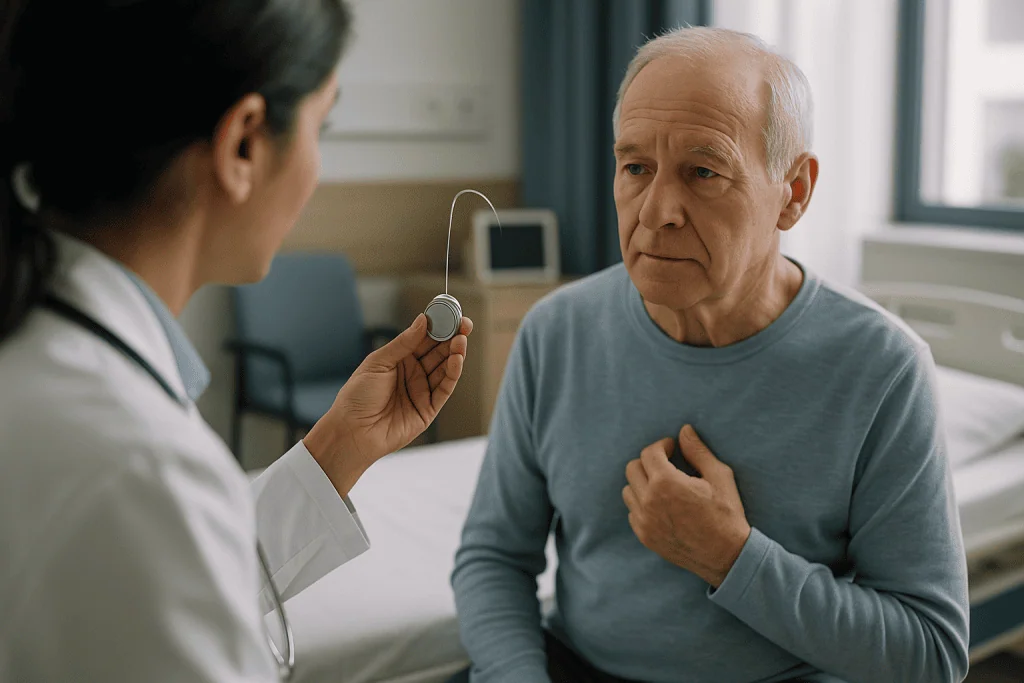
Evaluation comes first. Mayo Clinic describes detailed motor testing while medication is temporarily withheld and again when it is working, so the team can measure how much levodopa still helps. Thinking and memory are assessed, mood is screened, and brain imaging with MRI, a scan that uses magnets rather than X-rays, maps the target structures. Some centers also involve a psychiatrist and a speech therapist. The whole workup is designed to answer one question: will stimulation help this particular set of symptoms in this particular person?
Electrode placement is the surgical part. A small opening is made in the skull, and the electrode is guided to the target using the MRI map and, in many centers, recordings of the brain’s own electrical activity. Cleveland Clinic explains that this may be done with the person awake and speaking so the team can test the effect in real time, or asleep under general anesthesia with imaging to confirm position. Both approaches are standard; the choice depends on the center and the individual.
The pulse generator, a battery-powered device about the size of a stopwatch, is placed under the skin below the collarbone, either the same day or in a second short operation, and connected to the electrode by a wire that runs under the skin of the neck.
Activation and programming follow. Mayo Clinic notes that stimulation is usually switched on a few weeks after surgery, once healing has settled, and that finding the right settings takes repeated visits over several months. The operation places the hardware; the programming appointments are where the therapy is actually built.
When to consider DBS for Parkinson's: who it is usually for, and who is asked to wait
Guideline-level thinking on candidacy is fairly consistent across major sources, and it centers on a handful of features.
The strongest positive signal is a good response to levodopa that has become unreliable. Johns Hopkins describes typical candidates as people who have lived with Parkinson’s for several years, whose symptoms still improve clearly when medicine is working, but who now spend too much of the day in “off” time or troubled by dyskinesia despite medication adjustments. A tremor that medicine never controlled well is another recognized reason, because tremor often responds to stimulation even when it resists levodopa.
Equally important is what is not present. Mayo Clinic and Cleveland Clinic both list significant memory or thinking impairment as a reason to hold back, because surgery and stimulation can worsen cognition in people who already have dementia. Untreated depression or other unstable psychiatric conditions are usually addressed first. Serious heart, lung or bleeding problems raise surgical risk. And symptoms that do not respond to levodopa, as discussed above, are unlikely to respond to DBS.
People asked to wait generally fall into two groups. Some are earlier in the disease than the evidence supports; their fluctuations are mild and their medication plan still has room to improve. Others have a specific issue that needs attention, such as mood, cognition or a medical condition, after which they may be reconsidered.
A third group hears a different message: DBS is unlikely to help, because the dominant problems are ones stimulation does not touch. That conversation is hard, but it protects people from an operation with real risks and little expected benefit. In every case the assessment is individual, and the decision remains with the treating team.
What medication adjustments can still achieve before surgery is on the table
Before anyone reaches a surgical consultation, a neurologist typically works through a series of medication strategies, and it is worth knowing what those look like so the sequence makes sense.
Timing is the first lever. Spreading the same daily amount of levodopa across more frequent intervals can reduce the depth of “off” periods for some people. Longer-acting or extended-release formulations aim for the same steadiness through a different route. The NHS describes how the choice between formulations depends on symptom pattern and tolerability.
Add-on classes are the second lever. COMT inhibitors and MAO-B inhibitors slow the breakdown of levodopa or dopamine, lengthening each dose’s useful window. Dopamine agonists provide a background level of receptor activity that levodopa builds on. Amantadine, an older medicine, is used specifically to dampen dyskinesia. Each has its own side-effect profile, which is why the prescribing clinician weighs them individually rather than by formula.
Delivery method is the third lever, and it is where medication begins to overlap with surgery in complexity. Continuous infusion of a levodopa-based preparation into the small intestine through a surgically placed tube, and continuous under-the-skin infusion of a dopamine agonist, both aim to remove the peaks and troughs of oral dosing. Mayo Clinic lists these among the alternatives discussed alongside DBS for people with advanced fluctuations.
Diet and absorption sit alongside all of this. Levodopa competes with protein for absorption, so meal timing can matter, something the care team can advise on individually.
Only when these approaches have been tried, or judged unsuitable, does most guidance describe DBS as the next logical step. That sequence is not about saving surgery for last; it reflects the evidence on who benefits most.
Deep brain stimulation vs levodopa adjustments: a side-by-side comparison
Laying the two approaches next to each other shows why neurologists think of them as complementary rather than interchangeable. The table draws on descriptions from Mayo Clinic, Cleveland Clinic, Johns Hopkins and the NHS.
| Feature | Medication adjustments | Deep brain stimulation |
|---|---|---|
| What it targets | Dopamine shortage, via replacement or receptor activation | Abnormal firing in movement circuits, via electrical pulses |
| Symptoms it helps | Slowness, stiffness, tremor that responds to levodopa | Same levodopa-responsive symptoms, plus medication-induced dyskinesia and some resistant tremor |
| Symptoms it does not help | Balance loss, freezing during “on” time, speech and swallowing decline, thinking changes | The same non-responsive symptoms; may worsen speech or cognition in some people |
| Invasiveness | None for oral medicines; minor procedure for infusion pumps | Brain surgery with implanted hardware |
| Reversibility | Fully reversible by the prescriber | Stimulation can be turned off or adjusted; hardware can be removed |
| Main risks | Nausea, low blood pressure, hallucinations, impulse-control problems, dyskinesia | Bleeding, infection, stroke, hardware failure, mood or speech changes |
| Ongoing commitment | Multiple daily doses, regular reviews | Programming visits, battery monitoring and replacement, usually continued medication |
| Effect on disease course | None proven | None proven |
Two rows deserve emphasis. Neither approach has been shown to slow the underlying loss of dopamine-producing cells; both are symptomatic treatments. And the list of symptoms each cannot help is nearly identical, which is exactly why a poor response to levodopa is such a strong signal that DBS would also disappoint.
What is the downside to DBS? Risks explained in plain language
Any honest explainer has to sit with this question, because it is the one people type into search engines late at night. The downsides fall into three categories, and separating them helps.
Surgical risks come first. Placing an electrode deep in the brain carries a small chance of bleeding, which can cause a stroke, and of infection at the wound or around the hardware. Mayo Clinic lists these alongside seizure, breathing problems, nausea and confusion in the days after surgery. Most centers quote these risks individually, and the figures depend on the person’s health, so no single number applies to everyone.
Hardware risks are the second group. Wires can break or shift, the generator can malfunction, and the battery eventually depletes. Cleveland Clinic explains that non-rechargeable batteries typically last several years and rechargeable ones longer, and that replacement requires a minor operation. Infection of the hardware sometimes means removing part of the system and reimplanting later.
Stimulation-related effects are the third, and often the least expected. Because the target structures sit near pathways for speech, mood and thinking, stimulation can produce slurred speech, tingling, muscle tightness, changes in mood, apathy, impulsivity or difficulty with word-finding. Many of these can be reduced by adjusting the settings, which is one reason programming takes months. Some people also notice that walking and balance, which stimulation does not reliably help, seem more prominent once tremor and stiffness improve.
The last downside is quieter: expectation. DBS is a symptomatic treatment layered onto a progressive condition. People who expect it to halt Parkinson’s, or to remove the need for medicine, can feel let down even when the procedure has done exactly what the evidence says it does.
What the first days and weeks after DBS usually look like
Because DBS unfolds in stages, recovery does too. Sources such as Mayo Clinic and Johns Hopkins describe a fairly consistent pattern, though individual timelines vary and the care team sets the specifics.
The hospital stay after electrode placement is usually short, often a night or two, according to Cleveland Clinic. Headache, scalp tenderness, fatigue and mild confusion are common in the first few days. Some people notice a temporary improvement in symptoms even before stimulation is switched on, a so-called microlesion effect from the electrode’s placement; it fades over days to weeks and is not a sign of how the therapy will ultimately perform.
Wound care and activity limits dominate the first fortnight. Lifting, bending and vigorous exercise are typically restricted while the incisions heal, and the team will give personal guidance on bathing and hair washing. Medication continues as prescribed, because stimulation is not yet active.
Activation generally happens a few weeks after surgery, as Mayo Clinic describes. The first programming session involves testing each contact on the electrode, noting the benefit and any side effects, and choosing a starting configuration. The effect on tremor can be quick; the effect on stiffness and slowness often builds more gradually.
Over the following months, programming visits and medication reviews alternate. As stimulation takes on more of the work, the neurologist may gradually simplify the medicine plan, a step that belongs entirely to the prescriber. Cleveland Clinic describes this optimization phase as lasting several months for many people, sometimes longer. Patience during this window is not a platitude; it is the mechanism by which the therapy is tuned.
Living with a stimulator: programming, batteries and the medicine plan that stays
Once settings stabilize, life with DBS settles into a rhythm of periodic check-ins rather than constant adjustment. Still, a few practical realities shape the long term.
Programming does not end. Parkinson’s continues to progress, so the settings that work in the first year may need revising later. Many people carry a small handheld controller that lets them check battery status and, within limits set by the clinician, switch between preset programs or turn stimulation off. Johns Hopkins notes that the ability to adjust is one of the main advantages over older lesioning surgery.
Batteries have a lifespan. Cleveland Clinic describes non-rechargeable generators lasting on the order of three to five years and rechargeable versions substantially longer, with replacement done as a minor procedure under local or general anesthesia. Rechargeable systems require the person to charge the device regularly through the skin, a routine some find easy and others find burdensome, which is part of the pre-surgery discussion.
Medication usually continues. This is the point most people underestimate. Stimulation smooths fluctuations and allows many people to take less medicine, but the underlying dopamine shortage remains. The prescribing neurologist decides what stays and what changes, and stopping medicine abruptly is never safe without medical direction.
Everyday life carries a few caveats. Certain medical procedures and imaging, including some MRI scans, require checking device compatibility first, and strong magnets or some security equipment can interact with the generator. The care team provides a device card and specific guidance. None of this is dramatic, but it does mean DBS is a lifelong relationship with a clinic rather than a completed event.
How neurologists weigh the options: the questions behind the decision
Patients often experience the decision as a verdict. Inside the clinic it looks more like a weighing scale with five or six pans, each holding a different kind of evidence.
The first pan holds the levodopa response. How much better is movement when medicine is working than when it is not? A large difference predicts a good response to stimulation, because DBS tends to reproduce the best “on” state more consistently. A small difference predicts disappointment.
The second pan holds the pattern of symptoms. Tremor, stiffness, slowness and dyskinesia weigh in favor. Prominent freezing during good periods, falls, swallowing difficulty and speech decline weigh against, because they are unlikely to improve and may worsen.
The third pan holds cognition and mood. Mayo Clinic and Cleveland Clinic both treat significant cognitive impairment as a reason not to proceed, and unstable depression or anxiety as a reason to pause. The fourth holds general health: anything that raises surgical risk, from bleeding disorders to heart disease, changes the calculation.
The fifth pan is the one clinicians talk about least in public but weigh most heavily in private: what the person actually wants. Someone whose main goal is to keep working full days may accept surgical risk that someone content with a quieter routine would decline. Support at home, ability to attend repeated programming visits, and tolerance for uncertainty all matter.
The sixth pan holds alternatives. Have infusion therapies been considered? Is there a medication strategy not yet tried? Is focused ultrasound, a non-incisional lesioning technique used mainly for tremor, a better fit for this symptom profile? Only when all six pans are visible does the recommendation take shape, and it is a recommendation, offered to the person and family to accept or decline.
Is DBS worth it for Parkinson's? What the evidence shows and what it cannot tell you
The question is fair, and the evidence answers part of it clearly and part of it not at all.
What is well established: randomized trials comparing DBS plus best medical therapy against best medical therapy alone, in people with troublesome motor fluctuations, have consistently found more good-quality “on” time, less dyskinesia and better patient-reported quality of life in the stimulation group. Johns Hopkins and Mayo Clinic summarize this body of research as the basis for regulatory approval and for current candidacy criteria. The benefit is largest for exactly the features described earlier: levodopa-responsive symptoms and disabling fluctuations.
What is also established: the risks are real, and they occur more often in the surgical group. Trials record surgical complications, hardware problems and stimulation-related side effects that people receiving medication alone do not face. “Worth it” therefore always means worth it for this person, given their symptoms and their tolerance for those risks.
What the evidence cannot tell you: whether any individual will respond well. Trials report group averages. Within those groups some people gain enormously and some gain little, and pre-surgical evaluation can shift the odds but not eliminate the uncertainty.
What the evidence does not show: any effect on the progression of Parkinson’s itself. Both Mayo Clinic and the NIH’s neurological institute describe DBS as symptomatic treatment. Symptoms that were never going to respond continue to advance, and new ones emerge over the years.
So the honest framing is this. For a well-selected person, DBS has a strong evidence base for reducing the daily burden of fluctuations. For someone who does not fit that profile, the same operation carries the same risks with far less expected return. Whether that trade is worth making is a judgment the person and their treating team reach together.
What people often get wrong about DBS and Parkinson's medicines
Misunderstandings cluster around a few themes, and clearing them up changes the conversation in the clinic.
“DBS is a last resort.” Guidance describes DBS as a treatment for a specific stage, one in which medicine still works but has become unreliable, rather than a rescue for when nothing else does. People who wait until cognition has declined or balance has failed often no longer qualify, because the risks rise and the expected benefit falls. Timing matters in both directions.
“After DBS you stop taking medicine.” Most people continue medication, often in a simplified form decided by their prescriber. Stimulation adds to the plan; it does not erase it.
“DBS slows down Parkinson’s.” No treatment currently available has been shown to do this. Both medicines and stimulation address symptoms, as the NIH neurological institute and Mayo Clinic make clear.
“Delaying levodopa saves it for later.” The NHS notes that most people eventually need levodopa. Fluctuations are linked mainly to the progression of the disease rather than to how long someone has taken the medicine, and withholding effective treatment can mean years of unnecessary disability. The prescriber weighs this individually.
“If tremor is gone, the surgery worked completely.” Tremor often responds dramatically, which can mask the fact that balance, speech and thinking continue on their own course. Measuring outcomes by tremor alone sets up disappointment later.
“Surgery means the brain is permanently altered.” Stimulation does not destroy tissue. It can be switched off, adjusted or removed, which distinguishes it from older lesioning procedures and from focused ultrasound.
“A famous person had it, so it must be the standard path.” Public figures have described various procedures, some of them lesioning surgeries rather than DBS. Individual stories illustrate possibilities, not prescriptions.
Questions to ask your care team about DBS and medication changes
A good consultation is a two-way exchange, and arriving with specific questions tends to produce specific answers. These are the ones that help most people understand where they stand.
- How much do my symptoms improve when my medicine is working compared with when it is not, and what does that tell you about how I might respond to stimulation?
- Which of my symptoms would you expect DBS to help, and which would you expect it not to help?
- Are there medication strategies, formulations or infusion options we have not yet tried, and why or why not?
- What did my thinking, memory and mood assessments show, and do any results affect the recommendation?
- Which brain target would you propose for me, and what shaped that choice?
- Would the operation be done awake or asleep, and what are the trade-offs in my case?
- What are the specific surgical and hardware risks for someone with my health history?
- How many programming visits should I expect in the first year, and how far would I need to travel for them?
- Would you recommend a rechargeable or non-rechargeable generator, and what would daily life look like with each?
- How would my medication plan likely change after stimulation is optimized, and who manages those changes?
- What symptoms after surgery should prompt me to call urgently?
- If I decide against surgery now, what would you monitor to know whether to revisit the question?
Writing the answers down, or bringing someone who can, is worth the minor awkwardness. Decisions of this size are rarely made in one appointment, and having a record of what was said makes the second and third conversations far more productive.
When to call your doctor
Whether someone is adjusting medicines, recovering from DBS surgery, or living with a stimulator, certain changes should prompt a same-day call to the care team or, in some cases, emergency services.
Seek emergency care immediately for sudden weakness or numbness on one side of the body, sudden confusion or difficulty speaking, a severe headache unlike any before, a seizure, or trouble breathing. In the weeks after DBS surgery, these can signal bleeding or another serious complication.
Call the care team the same day for fever, redness, swelling, warmth or discharge at any incision or along the wire under the skin, which can indicate infection of the hardware. Report a sudden return of symptoms that had been well controlled, or a sudden new side effect such as slurred speech, tingling, muscle pulling or an unusual mood change, because these can point to a device fault, a shifted electrode or settings that need revising. A generator that feels hot, or a controller warning of a battery problem, also warrants a prompt call.
For people on medication alone, contact the prescriber about hallucinations, new compulsive behaviors such as gambling or shopping, fainting or falls related to low blood pressure, or worsening involuntary movements. Never stop or change Parkinson’s medicine on your own; abrupt withdrawal can cause serious illness, and only the prescribing clinician should direct changes.
Finally, call about changes in swallowing, choking on food or liquid, or unexplained weight loss. These are not emergencies in the same way, but they shape the care plan and deserve early attention. When in doubt, the team would rather hear from you than not.
Frequently asked questions
What is the downside to DBS?
The main downsides are surgical risk, hardware problems and stimulation side effects. Placing electrodes carries a small risk of bleeding, stroke and infection. Wires can break, batteries deplete and need replacing, and stimulation can affect speech, mood or thinking in some people. DBS also does not slow Parkinson’s or help symptoms that never responded to levodopa, so expectations need to match the evidence.
Did Michael J. Fox have DBS?
He has spoken publicly about undergoing a thalamotomy, an older lesioning surgery that permanently destroys a small area of brain tissue to reduce tremor, rather than deep brain stimulation. The two procedures target similar circuits but differ fundamentally: lesioning is irreversible, while stimulation can be adjusted or switched off. Any public figure’s choice reflects their individual situation, not a general recommendation.
What is the most promising new treatment for Parkinson's?
No new treatment has yet been proven to slow Parkinson’s. Active research areas include therapies aimed at the protein alpha-synuclein, drugs originally developed for diabetes, gene and cell approaches, and focused ultrasound for tremor. Mainstream sources describe these as under investigation, and results so far are early or mixed. Anyone interested should ask their neurologist about appropriate clinical trials.
Is DBS for Parkinson's worth it?
For a well-selected person with levodopa-responsive symptoms and disabling fluctuations, randomized trials show more good-quality “on” time and better quality of life with DBS plus medication than medication alone. The trade is surgical and hardware risk, months of programming and a lifelong relationship with a clinic. Whether that balance is worth it is an individual judgment made with the treating team.
How does deep brain stimulation vs levodopa work differently?
Levodopa is converted into dopamine in the brain, restoring the chemical messenger that is in short supply. Deep brain stimulation delivers electrical pulses to movement-control structures, overriding the abnormal firing that the dopamine shortage causes. They act at different points in the same circuit, which is why they help largely the same symptoms and are usually used together rather than instead of one another.
When to consider DBS for Parkinson's?
Guidance points to the stage when medication still clearly helps but produces troublesome “off” periods or dyskinesia despite careful adjustment, and when thinking and mood are stable enough for surgery. Waiting too long can mean cognition or balance has declined to the point where risks rise and benefit falls. The timing is individual and is assessed by a movement disorders team.
Can you stop Parkinson's medication after DBS?
Usually not entirely. Stimulation often allows the prescribing neurologist to simplify or reduce medicine once settings are optimized, but the underlying dopamine shortage remains and most people continue some treatment. Any change belongs to the prescriber; stopping Parkinson’s medicine abruptly can cause serious illness and should never be done without medical direction.
What are the main DBS surgery risks for Parkinson's?
The principal surgical risks are bleeding in the brain, which can cause a stroke, and infection at the wound or around the hardware. Seizure, confusion and breathing problems are also listed by major medical centers. Longer-term risks include wire breakage, generator malfunction and stimulation effects on speech, mood or cognition. Individual risk depends on age and general health.
How long does DBS last?
The electrodes are intended to remain in place indefinitely, while the battery-powered generator needs replacing. Cleveland Clinic describes non-rechargeable generators lasting roughly three to five years and rechargeable versions considerably longer, with replacement done as a minor procedure. Benefit for levodopa-responsive symptoms can persist for years, though Parkinson’s itself continues to progress.
Does DBS slow down Parkinson's disease?
No. DBS is a symptomatic treatment; it reduces tremor, stiffness, slowness and dyskinesia but has not been shown to protect dopamine-producing cells or change the course of the disease. Symptoms that stimulation does not help, such as balance loss and thinking changes, continue to develop over time, which is why ongoing neurological care remains essential after surgery.
References
- Cleveland Clinic: Deep Brain Stimulation
- NHS: Parkinson's disease, Treatment
- MedlinePlus: Deep brain stimulation
- NIH National Institute of Neurological Disorders and Stroke: Parkinson's Disease
This article is for general information only and is not a substitute for professional medical advice. Please consult a qualified doctor about your individual situation.

More from the Blog

How Helmet Therapy Completes Endoscopic Craniosynostosis Surgery in the Months That Follow
After endoscopic craniosynostosis surgery, a custom molding helmet guides how the baby's rapidly growing brain reshapes the skull once the fused suture has been…

Caring for a Partner With Parkinson’s Disease: Medication Timing, Fall Safety and Mealtimes
Caring for someone with Parkinson's works best when three routines are protected: medicines taken at the times the prescriber set, because effects fade predictably…

When Is an Unruptured Brain Aneurysm Monitored and When Is Treatment Recommended?
An unruptured brain aneurysm is usually monitored with repeat scans when it is small, smooth, stable and in a lower-risk location, and treatment is…

Deafblindness Care Explained: How Hearing, Vision and Rehabilitation Teams Work Together
How deafblindness is treated depends on the cause and on how much hearing and vision remain. Care usually combines hearing interventions (hearing aids, cochlear…

How Is a Child Followed Up After Congenital Hydrocephalus Surgery? Growth, Milestones and Scans
After surgery for congenital hydrocephalus, a child is followed for years, usually into adulthood. Visits typically combine head measurement, growth and developmental checks, an…

Life After a Craniotomy: Hair Regrowth, Scars, Driving and Long-Term Neurosurgery Follow-Up
Life after craniotomy usually means a hospital stay of several days, a scar hidden under regrowing hair within a few months, fatigue that eases…