

Dead Bug and Bird Dog: The Two Core Exercises Physiotherapists Prescribe Most
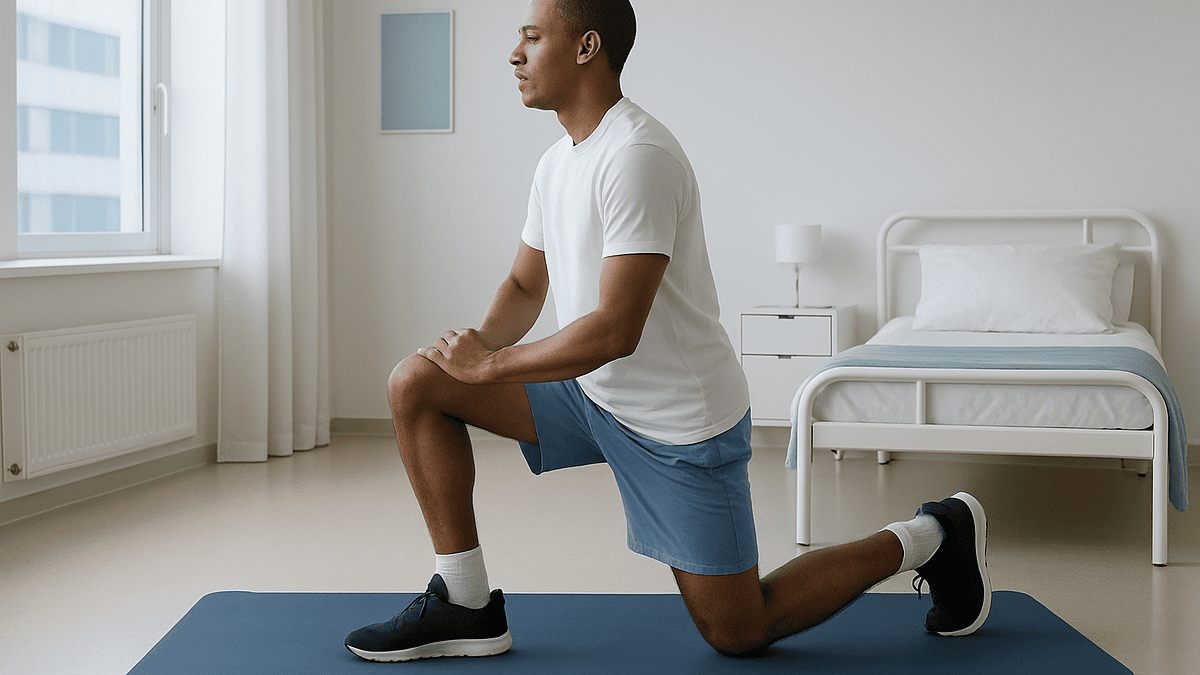
Key Takeaways
- The dead bug trains anti-extension, the ability to stop the lower back arching when limb weight pulls on it, which is the skill a spine uses when you carry and reach.
- Lab studies estimate lumbar compression during dead bugs and bird dogs at low levels, well below full sit-ups, which is why physiotherapists start irritable backs with them.
- No randomized trial has tested either exercise alone; the trial evidence supports core-stabilization programs as a whole, which reduce chronic back pain modestly and about as well as other exercise.
- Spot reduction has failed in controlled studies, so no abdominal exercise, including the dead bug, removes fat from over the abdomen.
- The bird dog leg should stop at hip height, because raising it further arches the back and twists the pelvis, undoing the purpose of the exercise.
- WHO and CDC guidelines call for strengthening all major muscle groups on two or more days a week; these two moves cover the trunk but are not a complete program by themselves.
The dead bug exercise is a floor-based core drill: you lie on your back, arms and knees raised, and slowly lower the opposite arm and leg while keeping your lower back still. Physiotherapists prescribe it, with its face-down partner the bird dog, to train the deep trunk muscles that steady the spine. Evidence for core-stability programs shows modest benefits for back-pain control; neither move flattens the stomach on its own.
Scroll through any physiotherapist’s short-video feed right now and the same two shapes keep appearing: a person on their back waving limbs like an upturned insect, and a person on all fours reaching one arm and the opposite leg into a long line. As of late 2025, searches for the dead bug exercise have climbed alongside a wave of clinician-made clips ranking the “best” and “worst” core moves, with crunches routinely landing in the worst column.
What is notable is what did not trigger this trend. No new trial, no guideline revision, no product launch. The surge is a slow-burning shift in how rehab professionals talk about the trunk: less about a visible six-pack, more about a spine that stays quiet while the arms and legs do the work.
The dead bug and bird dog earned their place in clinic rooms decades before they earned it on your phone. Here is what they do, what they cannot do, and how to tell the difference.
What is the dead bug exercise, and what is it actually good for?
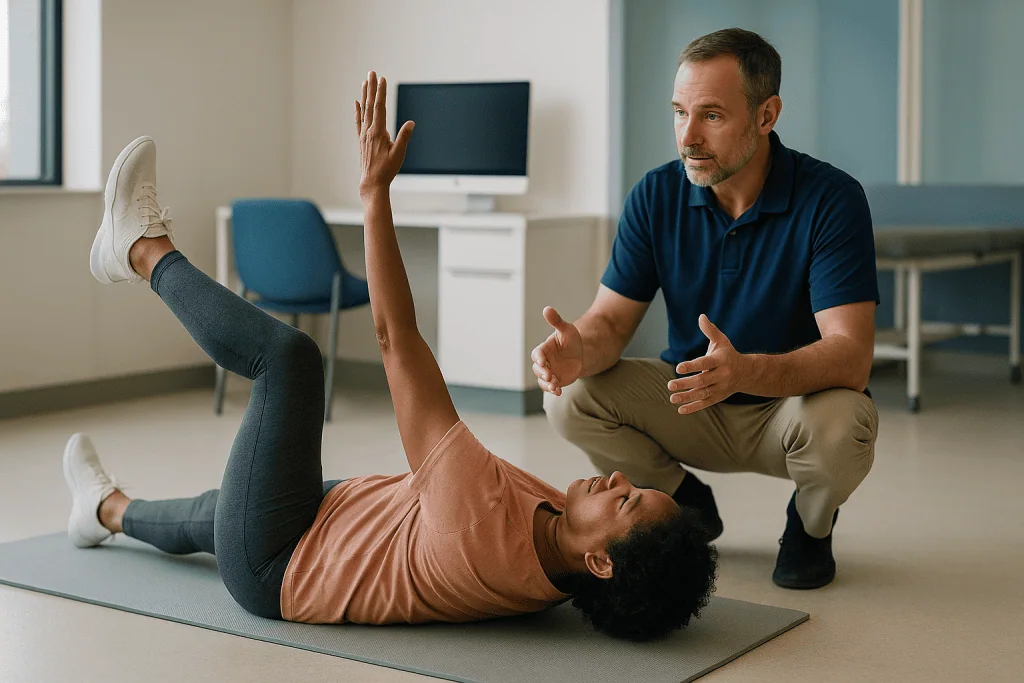
The name comes from the starting position. You lie on your back with hips and knees bent to roughly ninety degrees, shins parallel to the floor, arms pointing at the ceiling. Then one arm drifts overhead while the opposite leg straightens toward the floor, and both return. The trick, and the entire point, is that your pelvis and lower back do not move while your limbs do.
That skill has a name in rehabilitation: anti-extension. Anti-extension means resisting the pull of gravity and limb weight that would otherwise arch your lower back away from the floor. Every time a leg lowers, the weight of that leg tugs the pelvis forward and the spine into an arch. Your abdominal wall has to say no.
Physiotherapists reach for the dead bug for three practical reasons. It teaches people to feel the difference between a braced trunk and a sagging one, which many adults with desk-bound days have genuinely lost. It loads the abdominal muscles without repeatedly flexing the spine, which matters for people whose backs are irritable. And it scales down almost infinitely: a beginner can move only the arms, or only one leg a few inches, and still be doing the real exercise.
Mayo Clinic lists it among its core-strength exercises for exactly these reasons, framing core work as the foundation for reaching, lifting, and balancing in daily life rather than as an appearance goal. Harvard Health makes a similar case, pointing out that a stable trunk protects the back during ordinary tasks such as carrying groceries or getting out of a low chair.
So the honest answer to “what is it good for?” is control. The dead bug builds the kind of quiet, steady midsection that lets the rest of your body move well.
What changed recently to put these two exercises everywhere?
Two dated shifts explain the moment, and neither is a headline.
The first is guideline-level. In November 2020, the World Health Organization released updated physical activity guidelines recommending that adults do muscle-strengthening activity involving all major muscle groups on two or more days a week, in addition to 150 to 300 minutes of moderate aerobic activity. The CDC’s current adult guidelines, drawn from the second edition of the Physical Activity Guidelines for Americans, carry the same two-days-a-week strengthening message. Trunk muscles are a major group, and clinicians have been looking for strengthening options that fit into a living room with no equipment. Floor-based drills such as the dead bug and bird dog fit that brief almost perfectly.
The second shift is cultural rather than scientific. The crunch, for decades the default abdominal exercise, has been steadily displaced in rehab settings by moves that hold the spine still. The bird dog was popularized as one of a well-known trio of spine-sparing exercises taught in university spine laboratories, and that framing has now leaked into mainstream fitness content. When a physiotherapist explains on camera why repeated spinal flexion is not the first thing they would prescribe to someone with a sore back, viewers go looking for the alternative.
What has not changed is the underlying evidence base. There is no fresh randomized trial crowning either exercise, and no professional body has issued a statement naming them. The NHS lower back pain exercise page and MedlinePlus back pain resources continue to recommend general strengthening and staying active rather than any single move.
In other words, the exercises are old, the guidelines are a few years old, and the attention is new. That is worth keeping in mind before anyone tells you a drill is “backed by the latest research.”
How to do the dead bug exercise correctly, step by step
Form matters more here than in almost any other core drill, because a sloppy dead bug quietly becomes a hip-flexor exercise with an arched back.
- Lie on your back on a mat. Bend hips and knees to about ninety degrees so your shins are level with the floor. Point both arms straight up.
- Exhale gently and let your ribs settle. Your lower back should rest lightly against the mat without being jammed into it. Many physiotherapists suggest slipping a hand under the low back at first: you want steady, light pressure on it throughout.
- Lower your right arm overhead toward the floor while straightening your left leg, heel hovering just above the mat. Move slowly, roughly three seconds out.
- Pause, then return both to the start over another three seconds. Repeat with the other pair.
- Breathe the whole time. Holding your breath is the most common way people fake stability.
The signal that you have gone too far is the moment the back arches, the ribs flare upward, or the hand underneath feels pressure vanish. Shorten the movement until that stops. A leg lowered halfway with a still spine is worth more than a heel that touches the floor while the back lifts.
Tempo is the hidden variable. Fast reps let momentum do the bracing for you. Slow reps force the abdominal wall to hold position through the hardest point, which is when the limbs are farthest from your center.
People often ask how they should “feel” it. You should sense work across the front of the abdomen and along the sides, not a pinch in the low back and not a cramp at the front of the hip. If either of those shows up, reset to arms-only or reduce the range.
Why the bird dog exercise is the dead bug's mirror image
Flip the dead bug over and you have the bird dog. Instead of lying on your back, you start on hands and knees, wrists under shoulders, knees under hips. Instead of resisting an arch, you resist the opposite: gravity now wants to round your back, twist your pelvis, and drop your hip on one side.
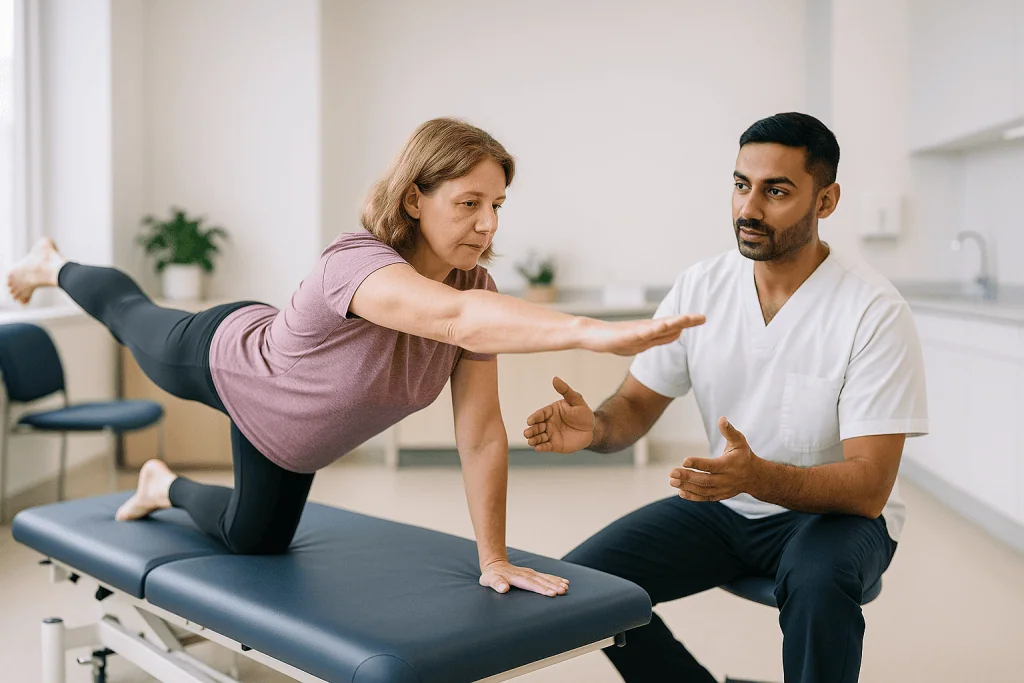
Physiotherapists describe this as anti-rotation and anti-extension combined. Anti-rotation means keeping your trunk from twisting when a load pulls on one side. When you reach your right arm forward and your left leg back, the weight of those limbs tries to rotate your pelvis and shoulders. The muscles along the back of the spine and the deep hip muscles have to hold everything square.
This is why the two drills are so often prescribed together. The dead bug challenges the front of the trunk against gravity. The bird dog challenges the back and sides. Between them, you cover the abdominal wall, the paraspinal muscles that run either side of the spine, and the gluteal muscles that stabilize the pelvis. Neither move is complete without the other, which is part of why the pairing has become a clinical default rather than a fad.
The bird dog also carries a practical advantage for people with back pain. Being on all fours takes the spine out of the fully loaded upright position, and the exercise never asks it to bend. Lab studies measuring muscle activity with surface electrodes, a technique called electromyography, consistently show the bird dog producing solid activation of the back extensors and the hip muscles while placing low compressive load on the lumbar discs. Small studies, but a consistent picture.
Think of it as the exercise that teaches you to stay long and level while your limbs move. That is what a healthy back does when you walk, carry, or reach.
How to do a bird dog correctly (and the cue most people miss)
The bird dog looks simple enough that most people rush it. The version physiotherapists teach is slower and smaller than the one you will see in gyms.
- Start on hands and knees. Stack wrists under shoulders and knees under hips. Imagine a glass of water balanced on your lower back that must not spill.
- Lengthen the back of your neck so your gaze rests on the floor a little ahead of your hands.
- Reach your left arm forward at shoulder height while extending your right leg straight back at hip height. Do not lift either limb above the line of your trunk.
- Hold for a slow count of two or three, then return and switch sides.
- Keep breathing, and keep both hips facing the floor.
The cue most people miss is the height of the leg. Kicking the leg high feels athletic, but it forces the lower back to arch and the pelvis to twist, which is exactly what the exercise is meant to prevent. The leg should stop when your body forms a straight line from fingertips to heel. Filming yourself from the side is genuinely useful here.
The second common fault is the hip. When the right leg lifts, the right hip tends to roll upward and open. Picture your pelvis as a tabletop and keep it flat. If you cannot, lift the leg only a few inches, or keep the toes lightly touching the floor while you slide the leg back.
A useful progression, once the basic version is stable, is to draw the extended hand and knee back toward each other under your body before reaching out again, all without letting the trunk rock. That single addition roughly doubles the control demand without adding any load to the spine.
What the evidence actually says about dead bugs and bird dogs
The claims online run far ahead of the data, so it helps to sort the evidence into tiers.
Randomized trials. No randomized controlled trial has tested the dead bug or the bird dog in isolation against another exercise for a clinical outcome. What exists are trials of core-stabilization programs, in which these moves are common ingredients alongside planks, bridges, and breathing drills. Systematic reviews of those trials, catalogued in the NIH’s PubMed database, generally find that stabilization exercise reduces chronic low back pain and disability modestly, and that it performs about as well as, but not clearly better than, other forms of structured exercise. That is a meaningful finding: exercise helps, and this style of exercise is a reasonable way to deliver it.
Laboratory measurements. Electromyography studies, typically involving a few dozen healthy volunteers, show the bird dog activates the multifidus and erector spinae (the deep and superficial muscles along the spine) at moderate levels, and the dead bug activates the rectus abdominis and obliques (the front and side abdominal muscles) at levels comparable to or slightly below a crunch. These studies also estimate the compressive load on the lumbar spine during each move, and both come out low compared with sit-ups. Small samples, healthy participants, short duration, so treat them as mechanism rather than outcome evidence.
Expert opinion and guidelines. The NHS, Mayo Clinic, and Harvard Health all recommend core strengthening as part of general fitness and back care. None names a single superior exercise. The recommendation is for the category, not the specific drill.
Put plainly: the strongest evidence supports doing regular trunk strengthening; the weakest, and loudest, claims are about one move being uniquely powerful.
Dead bug vs crunches: is dead bug better than crunches?
“Better” depends on the goal, and the two exercises are aiming at different targets.
A crunch trains the abdominal muscles by repeatedly flexing the spine, curling the ribs toward the pelvis. The dead bug trains them by holding the spine still while the limbs move. Both recruit the rectus abdominis; only one teaches the trunk to resist unwanted motion, which is the job it does most often in daily life.
| Feature | Dead bug | Crunch |
|---|---|---|
| Primary skill | Resisting extension and rotation | Producing spinal flexion |
| Spinal movement per rep | None (goal is stillness) | Repeated forward bending |
| Estimated lumbar compression (lab studies) | Low | Moderate; higher for full sit-ups |
| Muscle groups involved | Front and side abdominals, hip flexors, deep stabilizers | Mainly rectus abdominis |
| Scalability for beginners or sore backs | High: reduce range or move one limb | Low: hard to make gentler |
| Outcome evidence (trials) | Only as part of stabilization programs | Only as part of general strengthening |
For someone with an irritable lower back, a physiotherapist will almost always start with the dead bug. The reasoning is straightforward: it loads the muscles without asking a sensitive spine to bend hundreds of times.
For a healthy person who simply wants strong abdominals, the picture is less one-sided. Crunches are not dangerous for most people, and lab studies show they activate the rectus abdominis well. The bigger issue is that crunches leave a gap: they never train the anti-rotation and anti-extension control that carrying a suitcase or holding a toddler on one hip demands.
The mature answer is not “never crunch.” It is “do not let crunches be the only thing you do,” and, if your back complains, start with the version that keeps the spine quiet.
Will dead bugs flatten your stomach?
No exercise flattens a specific area, and the dead bug is no exception. This is the myth that draws the most traffic and deserves the plainest answer.
The appearance of the midsection depends mostly on two things: the amount of fat stored over and inside the abdomen, and the tone and posture of the abdominal wall beneath it. The dead bug can influence the second. It cannot select the first.
Fat loss happens across the whole body in response to an overall energy deficit, and the body decides where it draws from based on genetics and hormones, not on which muscle was working. Harvard Health has addressed this directly: doing abdominal exercises strengthens the muscles underneath but does not preferentially remove the fat on top, a misconception often called spot reduction. Controlled studies in which volunteers trained one limb or one region for weeks found no greater fat loss in the trained area than elsewhere.
What the dead bug can do is improve how your midsection holds itself. People who learn to keep the ribs down and the pelvis level often stand a little taller and appear less rounded through the belly, because they are no longer letting the abdominal wall hang forward. That is a posture change, not a fat change, and it is real but modest.
There is also a health case that has nothing to do with the mirror. Regular strengthening, along with aerobic activity, is associated with lower waist circumference and better metabolic markers over time in observational studies, because it forms part of a more active life. The dead bug contributes to that pattern; it does not shortcut it.
If flattening is the goal, the honest prescription is whole-body activity, sleep, and food quality, with the dead bug as a piece of the strengthening component rather than a targeted tool.
Which muscles do the dead bug and bird dog actually work?
The word “core” gets used so loosely that it helps to name the parts.
The rectus abdominis is the strap of muscle running down the front of the abdomen, the one that forms visible ridges in lean people. The obliques sit on the sides and wrap diagonally around the waist. The transversus abdominis is the deepest abdominal layer, a horizontal band that acts like a natural corset when it tightens. Along the back sit the erector spinae, the long muscles you can feel either side of the spine, and beneath them the multifidus, short segments that control one vertebra against the next. The gluteus medius on the outer hip keeps the pelvis level when you stand on one leg.
In the dead bug, laboratory measurements show the heaviest work falling on the rectus abdominis and obliques, with the transversus contributing to the steady brace and the hip flexors holding the raised legs. The moment the back arches, the erector spinae take over and the abdominals switch off, which is why arching is the fault to watch.
In the bird dog, the balance tips the other way. The erector spinae and multifidus on the side of the extended leg work hardest, the gluteus maximus lifts the leg, and the gluteus medius on the supporting side stops the pelvis from tipping. The obliques work to prevent rotation, and the shoulder stabilizers hold the planted arm.
Neither exercise isolates a single muscle, and that is the point. Physiotherapists prescribe them because they demand coordination across the whole trunk in a way that mimics real tasks. Isolation exercises have their place, but the spine is stabilized by a team, and these two drills train the team.
How often should you do them, and how do you progress safely?
Guidelines give the frame; the details come from how the exercises feel.
Both the WHO and the CDC recommend strengthening all major muscle groups on at least two days per week. For most people, the dead bug and bird dog slot in as part of that strengthening, not the whole of it. Two to four short sessions a week is a reasonable rhythm. They are low-load enough that daily practice is also fine for people who use them as a warm-up, provided the back feels good afterward.
A sensible starting volume is two or three sets of six to eight slow repetitions per side of each exercise, taking about three seconds out and three back. The right stopping point is when your form begins to slip, not when your muscles burn. The hold in the bird dog can start at two seconds and creep toward five or six over several weeks.
Progression should come from control before it comes from load. In order of difficulty, for the dead bug: arms only, then one leg at a time with arms still, then opposite arm and leg, then both legs lowering together with a still spine, then adding a light object between the hands. For the bird dog: knee slides, then full reach, then the hand-to-knee draw-in, then holding a small towel on the low back as a spill detector.
Resist the urge to add ankle weights or resistance bands early. The most common reason people plateau is that they have skipped the control stage and are now grinding out reps with an arched or twisted spine. Going backward for a week to a smaller version is often the fastest way forward.
Mild muscle soreness the next day is expected. Sharp pain during the movement, or back pain that lingers into the next day, is not, and is a reason to shorten range or seek advice.
Common mistakes physiotherapists correct in the first session
Ask any clinician who teaches these moves and they will describe the same handful of errors, in roughly the same order.
The arching dead bug. The leg goes down, the belly rises, and the low back lifts off the mat. The abdominals have let go and the hip flexors and back extensors are running the show. Fix: shrink the range until the back stays down, and use a hand underneath as a pressure gauge.
The breath-hold. Holding air creates a temporary internal brace that feels like stability but disappears the moment you exhale. Fix: breathe out slowly as the limbs move away, in as they return.
The neck strain. In the dead bug, the head lifts and the chin juts; in the bird dog, the head cranes up to look forward. Both pull the spine out of neutral. Fix: rest the head in the dead bug and look at the floor in the bird dog.
The high kick. The bird dog leg soars above hip height, the back arches, and the pelvis opens. Fix: stop the leg at the line of the trunk. Lower is better.
The speed run. Fast reps rely on momentum and skip the hardest part of each movement. Fix: count three seconds each way and treat the pause at full reach as part of the rep.
The wobbling wrist. In the bird dog, weight drifts onto the outside of the planted hand and the shoulder collapses. Fix: spread the fingers, press the whole palm down, and think of pushing the floor away.
Every one of these mistakes has the same root: the limbs are moving more than the trunk can control. The remedy is always to make the move smaller, slower, or both, and to earn the bigger version.
Common myths about the dead bug exercise and bird dog, corrected
Viral fitness content runs on confident claims. Here are the ones that circulate most, tested against what is actually known.
“Crunches destroy your spine; dead bugs are the only safe option.” Lab studies do show higher lumbar compression during sit-ups than during stabilization drills, and clinicians reasonably prefer spine-sparing moves for irritable backs. But there is no trial showing crunches injure healthy people, and calling them dangerous overstates the evidence. The fair statement is that the dead bug is gentler and teaches a skill crunches do not.
“Bird dogs fix back pain.” Exercise programs that include the bird dog help manage chronic low back pain about as well as other structured exercise, according to systematic reviews. That is worth doing. It is not a guarantee, and the benefit comes from consistent activity rather than from this specific shape.
“You need to feel a deep burn for it to work.” These are control exercises. The target is a still spine under limb load, not exhaustion. A burn usually signals the hip flexors or back extensors compensating.
“Dead bugs give you a flat stomach.” Covered above: spot reduction does not exist, and no abdominal exercise removes fat from over the abdomen.
“They activate your core more than any other exercise.” Electromyography studies show moderate activation, often lower than heavy loaded exercises such as squats or carries. Their advantage is safety and teachability, not peak activation.
“Physiotherapists prescribe them to everyone.” They prescribe them often, because they scale well. Someone with a fresh disc injury, a hernia, or late pregnancy may be given something else entirely. Common is not universal.
The pattern across all six is the same: a real kernel, inflated. The exercises are good. They are not magic.
Who should modify these exercises: pregnancy, postpartum, older adults, and back pain
Both moves are low-risk for most people, but several groups need adjustments, and in each case the adjustment should come from a clinician who knows the individual.
Pregnancy. Lying flat on the back for extended periods becomes uncomfortable for many people after the first trimester, and the growing abdomen changes how the abdominal wall braces. The bird dog is often better tolerated than the dead bug in later pregnancy. Watch for coning, a ridge or dome appearing down the midline of the belly during effort, which signals that the load exceeds what the abdominal wall can currently manage. Any exercise program in pregnancy belongs under the guidance of the maternity team.
Postpartum. The gap between the two halves of the rectus abdominis, called diastasis recti, is common after birth and usually narrows over months. Gentle dead bugs with small range and steady breathing are frequently part of recovery programs, but a pelvic health physiotherapist should assess first, especially after a cesarean birth or if there is pelvic floor symptoms such as leaking or heaviness.
Older adults. Getting down to and up from the floor may be the hardest part. Both exercises can be adapted: the dead bug on a firm bed, the bird dog with hands on a bench. Wrist arthritis may make weight-bearing on the palms uncomfortable, in which case forearms or fists on a cushion work. Balance and bone health considerations mean a clinician should be involved if there is a history of falls or osteoporosis.
Acute back pain. In the first days of a flare, even these gentle moves may be too much. The NHS advice is to stay as active as tolerable and return to strengthening gradually. If the exercises provoke pain that spreads down the leg or lingers, stop and seek assessment.
Recent surgery or hernia. Abdominal or spinal surgery, and any known hernia, require clearance from the treating surgeon before loading the trunk. The timing is individual and not something to guess at.
When to see a doctor about back pain or core exercise
Most people can start dead bugs and bird dogs safely without a medical visit. Some situations call for assessment first, and a few call for urgent care.
Seek urgent medical attention if back pain comes with any of the following: new numbness or tingling in the area you sit on, difficulty starting or controlling urination or bowel movements, sudden weakness or heaviness in one or both legs, fever alongside back pain, or back pain following a fall or accident. These signs can indicate pressure on the spinal nerves or another serious cause and are not exercise problems to work through.
Book a non-urgent appointment with a doctor or physiotherapist if pain spreads below the knee or is worse in the leg than in the back, if pain has not eased after a few weeks of staying active, if it wakes you at night or is worst first thing in the morning, if you have unexplained weight loss, a history of cancer, or long-term steroid use, or if you are over sixty-five with a first episode of significant back pain. MedlinePlus and the NHS both flag these as reasons to be assessed rather than self-manage.
Also seek guidance before beginning if you are pregnant, within the first months after birth, recovering from abdominal or spinal surgery, have a hernia, or have been told you have osteoporosis or a disc injury. None of these rule the exercises out; they change how the exercises should be started.
During the exercises themselves, stop and get advice if you feel sharp or shooting pain, pain that travels into a limb, dizziness, or symptoms that persist into the following day rather than fading as ordinary muscle soreness does.
Every decision about whether, when, and how to exercise with a medical condition belongs with the clinician who knows your history. This article explains the evidence; it cannot examine you.
Frequently asked questions
What is the dead bug exercise good for?
The dead bug is good for teaching the trunk to stay still while the arms and legs move, a skill called anti-extension. It strengthens the front and side abdominal muscles without repeatedly bending the spine, which is why physiotherapists often use it for people with sensitive backs. Evidence from stabilization-exercise trials supports modest benefits for back-pain management; the exercise does not target fat or reshape the waist.
Will dead bugs flatten your stomach?
No. Dead bugs strengthen the abdominal wall but do not remove fat from over it, because the body cannot lose fat from one chosen area, a myth known as spot reduction. Controlled studies have repeatedly failed to show localized fat loss from targeted exercise. Better posture and a firmer abdominal brace may change how the midsection appears slightly, but visible flattening depends on whole-body activity, sleep, and diet.
Is dead bug better than crunches?
For people with back pain, usually yes, because it loads the abdominals without flexing the spine and lab studies show lower lumbar compression. For healthy people, crunches are not harmful and activate the rectus abdominis well, but they never train the anti-rotation and anti-extension control the dead bug provides. The most defensible approach is to include stabilization drills and not rely on crunches alone.
How do you do the dead bug exercise correctly?
Lie on your back with hips and knees at ninety degrees and arms pointing up. Keeping your lower back resting lightly on the mat, slowly lower one arm overhead and straighten the opposite leg, then return and switch. Move about three seconds each way, breathe throughout, and shorten the range the moment your back arches or ribs flare. A hand under the low back works as a pressure check.
What does the bird dog exercise work?
The bird dog works the muscles along the spine, the erector spinae and deep multifidus, along with the gluteal muscles that extend the hip and keep the pelvis level. The obliques resist rotation, and the shoulder stabilizers support the planted arm. Electromyography studies show moderate activation of the back extensors with low compressive load on the lumbar discs, making it a common choice in back rehabilitation.
How many dead bugs should a beginner do?
A sensible start is two or three sets of six to eight slow repetitions per side, stopping when form slips rather than when muscles burn. Beginners often do better moving only the arms or one leg at a time before combining them. Two to four sessions a week fits within guideline recommendations for strengthening, and progress should come from better control before any added resistance.
Why does my lower back hurt during dead bugs?
Back discomfort during dead bugs almost always means the spine is arching as the leg lowers, shifting work from the abdominals to the back extensors and hip flexors. Reduce the range so the lower back stays on the mat, slow down, and exhale as the limbs move away. If pain is sharp, travels into a leg, or lingers into the next day, stop and seek assessment from a clinician.
Can I do the dead bug and bird dog every day?
For most healthy people, yes, because both are low-load control exercises that suit daily practice or a warm-up role. Guidelines call for strengthening on at least two days a week, so daily is optional rather than required. Watch for back soreness that persists rather than fades, and remember that these two moves do not replace a fuller strengthening program for the legs, hips, and upper body.
Are dead bugs and bird dogs safe in pregnancy or postpartum?
Often, with modifications and clinical guidance. Lying flat becomes uncomfortable for many people later in pregnancy, so the bird dog is frequently better tolerated. Postpartum, gentle dead bugs are common in recovery programs, but a pelvic health physiotherapist should assess for diastasis recti or pelvic floor symptoms first. Any doming down the midline of the belly during effort is a sign to make the exercise smaller.
Do bird dogs help with lower back pain?
Bird dogs are a regular part of core-stabilization programs, and systematic reviews of randomized trials show those programs reduce chronic low back pain and disability modestly, roughly as well as other structured exercise. No trial has isolated the bird dog itself, so the benefit is best attributed to consistent strengthening. Persistent, spreading, or night-time back pain should be assessed by a doctor before starting any program.
References
- NHS – Lower back pain exercises
- CDC – Adult Activity: An Overview
- WHO – Physical activity fact sheet
- MedlinePlus – Back Pain
This article is for general information only and is not a substitute for professional medical advice. Please consult a qualified doctor about your individual situation.

More from the Blog

Reformer Pilates vs Mat Pilates vs Yoga: What Each Builds and Who It Suits
Reformer Pilates uses a sliding carriage and adjustable springs to add resistance and support to Pilates movements, so it tends to build more measurable…

Resistance Bands vs Weights: What the Research Says About Building Muscle at Home
Resistance bands can build muscle and strength at home, and the best available evidence, a 2019 meta-analysis of randomized trials, found no significant difference…

Full-Body vs Push-Pull-Legs: Choosing a Training Split by How Often You Can Train
Choose a training split by how many days you can reliably lift. With two or three sessions a week, a full body workout lets…

DOMS: Why Muscles Hurt Two Days Later and What Actually Speeds Recovery
DOMS, or delayed onset muscle soreness, is muscle pain that peaks 24–72 hours after unfamiliar or intense exercise, especially movements that lengthen a muscle…

How to Do a Pull-Up: A Progression That Works for Beginners
To do a pull-up, hang from a bar with palms facing away and hands slightly wider than your shoulders, pull your shoulder blades down…

Calisthenics: How Bodyweight Training Builds Strength, and Where It Hits a Ceiling
Calisthenics builds strength by loading muscles with your own body weight and progressing through harder leverage, such as moving from incline push-ups to full…