

Dental Robotics vs Static Surgical Guides: Two Ways to Place Implants by the Plan Compared
Key Takeaways
- A static surgical guide is a printed template with drill sleeves made days before surgery, while a dental robot tracks the drill and jaw live and physically resists drift, so only the robot can adapt the plan mid-procedure.
- In published comparisons, both static guides and robots place implants closer to the plan than freehand drilling, with robots often showing slightly smaller angular error, but the robotic evidence base is small, recent, and lacks long-term follow-up.
- Robotic guidance depends on a tracking marker that must not move and on accurate registration; a shifted marker leads the robot confidently to the wrong spot, which is its most important hidden failure mode.
- Static guides restrict drill cooling through the sleeve and need more mouth opening for long drills, which is why back molars and limited opening are common reasons a team might prefer robotic or freehand placement.
- No guidance technology changes how bone heals; Mayo Clinic notes that fusion of implant to bone takes several months and the full process commonly spans many months, regardless of how the drill was steered.
- Untreated gum disease, uncontrolled chronic conditions, heavy smoking, and immature bone grafts are the usual reasons people are asked to wait, and none of them are resolved by choosing a robot over a guide.
Robotic vs guided implant surgery compares two ways of transferring a digital implant plan into the jaw. A static surgical guide is a 3D-printed template that steers the drill through fixed sleeves; a dental robot holds or guides the drill in real time using tracking cameras. Both aim to reduce drift from the plan. Neither replaces careful planning, healthy bone, or a treating team that decides which approach fits your mouth.
The consultation ends with a question that sounds almost like shopping for a car. “We can do this with a printed guide, or we can do it with the robot,” the surgeon says, sliding a tablet across the desk. On the screen, a cone-beam scan of your jaw glows blue, a single white cylinder floating where a molar used to be. You had expected to talk about bone, healing, maybe pain. Instead you are being asked to pick a technology.
It is a fair question, and a newer one than most people realize. The robotic vs guided implant surgery debate is really about one thing: how faithfully a team can move an implant from a plan on a screen into living bone. Both methods start from the same digital blueprint. They part ways at the moment the drill touches the jaw.
This explainer walks through what each approach actually does, what the evidence can and cannot tell you, who tends to be a candidate, and what the weeks afterward usually look like. The decision, as always, sits with the team treating you.
What does "placing an implant by the plan" actually mean?
A dental implant is a small titanium post placed into the jawbone to act as an artificial tooth root. Before anything is drilled, most modern teams build a plan. That plan begins with a cone-beam CT, a low-dose three-dimensional X-ray that shows bone thickness, the nerve canal in the lower jaw, the sinus floor in the upper jaw, and the roots of neighboring teeth. An optical scan of the teeth and gums is layered on top so the software knows where the future crown needs to sit.
Inside the software, the clinician chooses the implant’s length, width, angle, and depth, then checks it against the anatomy. Is there enough bone on every side? Will the crown emerge where a natural tooth would? Is the nerve a safe distance away? Mayo Clinic describes this evaluation and planning stage as a standard part of implant care, involving imaging and models of the jaw before surgery.
The hard part comes next. A plan on a monitor is perfect; a drill in a wet, moving, sometimes bleeding mouth is not. Freehand placement relies on the surgeon’s eye and experience. Guided approaches try to close that gap between intention and reality. Two tools dominate: the static surgical guide, a printed template with metal sleeves that physically constrains the drill, and the surgical robot, which tracks the drill and the jaw and either holds the handpiece on course or stops it when it strays.
Both promise the same thing in different mechanical languages: the implant ends up where the plan said it would. How closely that promise is kept, and at what cost in time and complexity, is what the rest of this article is about.
How static surgical guide implants work, step by step
A static surgical guide is a custom template, usually printed in clear resin, that snaps onto your remaining teeth, sits on the gum, or is pinned to bone. Embedded in it are one or more metal sleeves. Each sleeve is positioned so that a drill passed through it follows exactly the path, angle, and depth that were set in the software. The word “static” simply means the guide does not move or adapt once it is made.
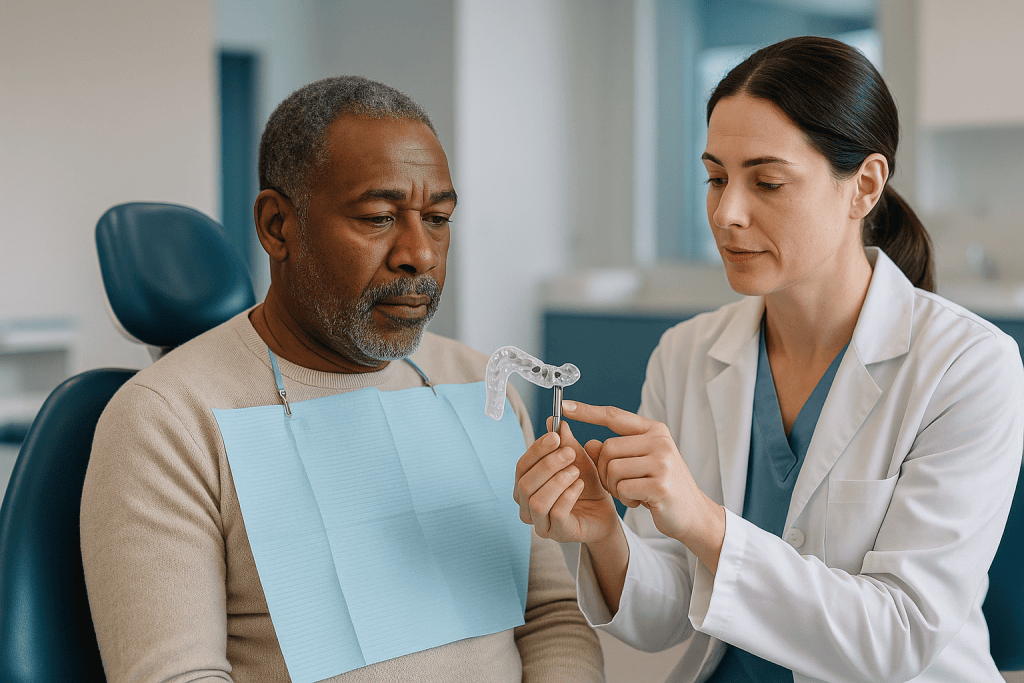
The sequence is straightforward. After planning, the guide is designed digitally and printed or milled, which typically takes days rather than hours, so surgery is scheduled for a later visit. On the day, the surgeon seats the guide, confirms it fits without rocking, and works through a set of drills of increasing diameter. Depth stops on the drills or on the sleeves prevent going deeper than planned. In some workflows the implant itself is delivered through the guide; in others the guide comes off for the final step.
Static guides come in three broad types, named for what they rest on:
- Tooth-supported guides, generally the most stable because teeth do not compress.
- Mucosa-supported guides, used when few or no teeth remain, resting on the gum and often fixed with small pins.
- Bone-supported guides, which require the gum to be lifted so the guide sits directly on bone.
The appeal is its simplicity. There is no camera to calibrate and no console to watch. The limitation is baked into the same word: static. Once printed, the guide cannot respond to a surprise, such as bone that turns out to be softer than expected or a fit that shifts under pressure. Any error in the scan, the design, or the printing is carried silently into the mouth.
How robotic dental implant surgery works in the chair
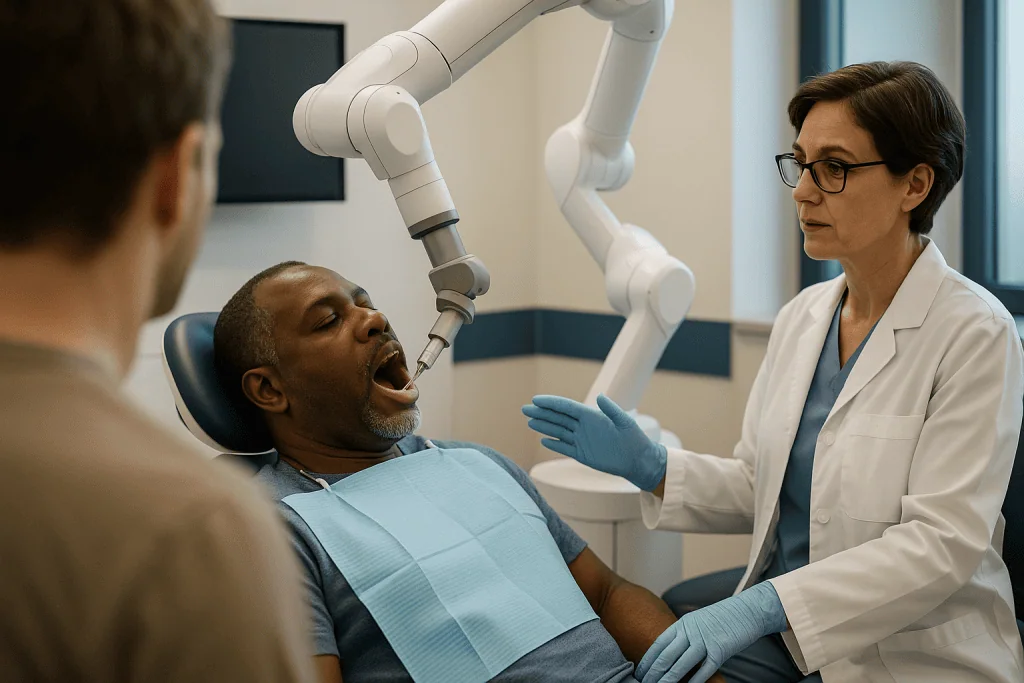
A dental robot does not operate on its own. In every system in clinical use, a human surgeon holds or directs the drill, and the robot acts as a highly disciplined assistant. The technical term is haptic guidance: the robotic arm applies gentle physical resistance to keep the drill on the planned path and prevents it from going deeper or angling further than the plan allows.
Here is what actually happens. A small tracking marker, sometimes called a fiducial, is attached to your teeth or jaw before the cone-beam scan or registered to it afterward. In the operating room, cameras follow that marker and a second marker on the handpiece many times per second. The software continuously compares where the drill is with where the plan says it should be. If your head shifts slightly, the robot updates. If the drill drifts, the arm resists. Some systems will simply stop the drill at the planned depth.
The workflow has extra steps a static guide does not: fixing the marker, registering the scan to the live patient, and calibrating the instruments. Each is a point where things can be done well or poorly, and each adds minutes. The reward is flexibility. Because the guidance is live, the surgeon can adjust the plan mid-procedure if the bone dictates, without printing anything new.
Think of the difference this way. A static guide is a stencil; whatever you draw is confined to its cutouts. A robot is more like a steadying hand on your wrist that knows the picture you are trying to draw and nudges you back when you wander. Both keep the line straighter than drawing freehand. Only one can change the picture halfway through.
Robotic vs guided implant surgery: what actually differs on the day
Patients often imagine the difference will be dramatic, that one is science fiction and the other is old-fashioned. From the chair, the two feel surprisingly similar. You will be numbed the same way, hear the same drill, and go home with the same instructions. The differences are mostly in setup, in what the team can do if something is unexpected, and in how errors are caught.
| Aspect | Static surgical guide | Robotic guidance |
|---|---|---|
| How the plan reaches the jaw | Physical template with drill sleeves | Camera tracking plus a robotic arm that steers or limits the drill |
| Made in advance? | Yes; printing takes days | No template; plan loaded into software |
| Can the plan change mid-surgery? | Only by removing the guide and working freehand | Yes, within the software |
| Extra hardware on the patient | The guide itself, sometimes pins | Tracking marker fixed to teeth or jaw |
| Mouth-opening needed | More, to fit guide plus long drills | Generally less, since no sleeve stack |
| Main failure mode | Poor fit or unnoticed printing error | Registration or calibration error, marker movement |
| Water cooling of the drill | Can be restricted by the sleeve | Unobstructed |
| Team learning curve | Shorter | Longer |
One row deserves emphasis. Drill cooling matters because overheating bone during drilling can harm the cells that later fuse to the implant. A sleeve sitting over the drilling site can limit how well irrigation reaches the bone, which is one reason guided protocols use specific drill sequences. Robots leave the site open.
The other row worth noticing is mouth opening. Molars at the very back of the jaw can be hard to reach with a guide plus a long drill. Robotic systems avoid the stacked sleeve, which some teams find useful in tight spaces. None of this makes one method superior across the board; it makes each better suited to certain mouths.
Guided implant surgery accuracy: what the evidence really shows
Accuracy in this field is measured very specifically. Researchers overlay the post-surgery scan on the pre-surgery plan and record how far the implant moved from its intended position at the top, at the tip, and in angle. Smaller deviations mean the plan was kept more faithfully. Static guides have been studied this way for well over a decade. Robotic systems have a much shorter and thinner track record.
We are deliberately not quoting a headline number here, and the reason is worth understanding. Published comparisons vary in how they measure, whether they use models, cadavers, or live patients, how many implants they include, and who funded them. Studies of robots so far tend to be small and to come from a limited number of centers using early systems. Under those conditions, quoting one figure as “the accuracy of robotic surgery” would overstate what anyone knows.
What can be said with reasonable confidence is this. Both static guides and robots consistently place implants closer to the plan than freehand drilling in the studies that have compared them. Robotic systems often report slightly smaller angular deviations, which fits their design: a live-tracking arm is less affected by a guide flexing or a drill wobbling in a sleeve. Whether that margin changes anything a patient would notice, such as how the crown looks or how long the implant lasts, has not been shown.
The honest summary is that accuracy differences between the two guided methods are measured in fractions of the distance that matters clinically, while the gap between either method and no guidance is larger. If your team is confident and experienced with one approach, that familiarity is likely to count for more than the technology’s brochure figures.
Who is usually a candidate, and who is asked to wait
The candidacy question is mostly about implants, not about robots or guides. Mayo Clinic lists the general prerequisites: a jawbone that has finished growing, enough bone to hold the implant or the ability to have a bone graft, healthy gum tissue, no health conditions that would impair bone healing, and a willingness to commit to a process that spans months. Cleveland Clinic adds that people who smoke heavily or who have uncontrolled chronic conditions may be advised to address those first.
Where the technology choice enters is at the edges. Guided approaches of either kind tend to be considered when:
- The nerve canal, sinus, or a neighboring root sits close to the planned implant, leaving little room for drift.
- Several implants must be placed in parallel to support a bridge or a full-arch prosthesis.
- The team wants to place the implant through a small opening in the gum without lifting a flap, which depends on knowing exactly where the bone is.
- Bone is thin and the implant must be angled precisely to stay inside it.
Robotic guidance specifically may be discussed when mouth opening is limited, when the back molars are involved, or when there are too few teeth to seat a stable static guide. Static guides remain a reasonable choice for many single-tooth sites where teeth on either side hold the template firmly.
People are commonly asked to wait, regardless of method, when active gum disease is present, when a recent extraction site has not healed enough to be scanned reliably, when blood sugar or other conditions are not yet well controlled, or when a bone graft needs time to mature. The National Institute of Dental and Craniofacial Research notes that untreated gum disease damages the very bone an implant depends on. No guidance system can compensate for bone that is not ready.
What are the downsides of robotic implant surgery?
Robots are easy to admire and harder to evaluate. Their downsides are real, and a good team will name them without being asked.
The first is the setup burden. A tracking marker must be secured to your teeth or jaw and must not move during surgery. If it shifts by even a small amount, the robot’s picture of where your jaw is becomes wrong, and it will guide the drill confidently to the wrong place. Registration, the step that matches the scan to your actual anatomy, is another point where error can enter. Static guides have their own failure points, but they are more visible: a guide that rocks or does not seat is usually obvious.
The second is time. Marker placement, registration, and calibration add to the appointment, and the team’s learning curve is longer than for printed guides. Early in a team’s experience, procedures tend to run longer.
The third is evidence. As the previous section explained, robotic literature is young. Long-term outcomes, meaning how implants placed robotically fare years later, simply have not been followed for as long as those placed with guides or freehand. There is no mechanistic reason to expect them to do worse, but absence of evidence is not the same as reassurance.
The fourth is dependence on equipment. Software crashes, camera line-of-sight problems, and hardware faults can interrupt a case. Teams plan for this by having a conventional fallback ready, and you should ask whether yours does.
Finally, marketing. Robotic systems are often promoted with words like “precision” and “confidence.” Those words describe an aspiration, not a measured result in your mouth. The right response is not skepticism about the tool but insistence on being told what it does and does not change for your case.
Where static surgical guides fall short
Static guides have earned their place, but they carry limitations that are worth knowing so the comparison is fair.
The biggest is inflexibility. Everything the guide knows was decided days earlier, from a scan taken in a still, closed-mouth position. If the bone turns out denser or softer than expected, if a hidden defect appears, or if the surgeon decides a slightly different angle would serve the crown better, the guide cannot help. The choice becomes finishing with a plan you no longer prefer or removing the guide and proceeding freehand.
The second is fit. A tooth-supported guide on stable, well-scanned teeth can be very secure. A mucosa-supported guide resting on gum is less so, because soft tissue compresses and the guide can tilt under drilling pressure. Small fit errors are amplified at the tip of the drill, so a guide that is off by a hair at the surface may be off by more at depth.
The third is the sleeve itself. Drills must pass through a metal tube, which means a longer drill, more mouth opening, and less room for cooling water to reach the bone. Sleeve tolerance, the tiny gap that lets the drill turn freely, allows a little wobble, and that wobble contributes to angular deviation.
The fourth is the production chain. The scan, the software design, the print, and the placement of the sleeves are each steps where small errors can accumulate without anyone noticing until the post-surgery scan.
None of these makes static guides a poor choice. They make them a tool best suited to cases where the anatomy is stable, teeth are available for support, and the plan is unlikely to need a mid-course change. A team that uses guides often will know which cases those are.
Is robotic surgery the newest procedure for dental implants, and does newest mean better?
“What is the newest procedure for dental implants” is one of the most searched questions on this topic, and robotic guidance is usually the answer people find. It is fair to call it among the newest tools in routine implant practice. Whether new means better is a separate question, and history in this field suggests caution.
Consider the pattern. Cone-beam imaging was once new and is now routine because it clearly showed anatomy that plain X-rays missed. Static guides were once new and earned their place through years of accuracy studies. Immediate loading, placing a temporary crown on the day of surgery, was once new and is now offered selectively, because the evidence showed it works in some situations and not others. Each innovation settled into a role rather than replacing everything before it.
Robots are likely to follow the same path. The mechanism is sound: live tracking with physical guidance should, in principle, reduce the errors that guides cannot catch. What has not yet accumulated is the long follow-up that turns a plausible advantage into an established one. Implants are judged over years, not at the post-surgery scan.
There is also a human factor. A team that has placed hundreds of implants with printed guides and a handful with a robot may, for now, produce better results with the guides. Skill with a tool matters as much as the tool.
So the honest answer to the search query is this: robotic guidance is new, mechanically promising, and increasingly studied, and it is not yet proven to change long-term outcomes compared with well-executed static guidance. If your team offers it, ask about their experience with it specifically. If they do not, that is not a reason to look elsewhere.
What the following days and weeks usually look like
Recovery depends on the implant, the bone, and you, far more than on whether a guide or a robot steered the drill. Mayo Clinic describes the typical experience after implant placement as some swelling of the gums and face, bruising of the skin and gums, pain at the site, and minor bleeding, all of which usually settle over days. Your team will give instructions on soft foods, cleaning around the site, and any medicines they have prescribed; follow those rather than general advice.
One practical difference may show up early. Guided approaches, of either kind, are often paired with a smaller gum opening because the surgeon knows precisely where the bone is. Smaller openings usually mean less swelling and fewer stitches. This is a benefit of accurate planning generally rather than of one technology.
The longer timeline is governed by osseointegration, the process by which bone cells grow onto the implant surface and lock it in place. Mayo Clinic notes that this fusion takes several months and that the whole process, from first consultation to final crown, commonly spans many months, longer if grafting is needed. Cleveland Clinic gives a similar picture. During that stretch you will typically have a check within the first weeks to confirm healing, then a period of waiting, then a visit to attach the connector and take impressions for the crown.
A few things are worth expecting rather than fearing. Numbness from the anesthetic that persists into the next day can occur and usually resolves. A temporary tooth, if you have one, may feel bulky. Mild tenderness when brushing near the site is common for a week or two. What should not be expected is worsening pain after the first few days, numbness that does not fade, or a fever; those belong in the red-flag section below.
Risks and alternatives, in plain clinical language
Implant surgery carries risks whether the drill is guided by a stencil, a robot, or a steady hand. Mayo Clinic lists infection at the implant site, injury to surrounding structures such as neighboring teeth or blood vessels, nerve damage causing pain, numbness, or tingling in the teeth, gums, lips, or chin, and sinus problems when upper-jaw implants intrude into the sinus space. Cleveland Clinic adds implant failure, meaning the bone does not fuse, and later gum or bone problems around the implant.
Guided approaches exist largely to lower the first three of those risks by keeping the implant where the plan put it, away from the nerve canal and the sinus floor. They do not eliminate the risks, and they cannot prevent failure caused by poor bone quality, smoking, or infection. A guide or a robot can also introduce its own error if the scan or registration was wrong, which is why teams verify with imaging.
Alternatives to guided placement include freehand placement by an experienced surgeon, which remains common and appropriate for many straightforward sites, and dynamic navigation, a system that shows the drill’s position on a screen in real time without a robotic arm to hold it. Alternatives to implants altogether include a fixed bridge supported by neighboring teeth, a removable partial or complete denture, or, in some cases, leaving a gap. The NHS describes bridges and dentures as standard options for replacing missing teeth.
Each alternative trades something. Bridges require shaping healthy neighboring teeth. Dentures rest on gum and can affect bone over time. Leaving a gap may allow neighboring teeth to drift. Your team’s job is to lay these out for your mouth, your health, and your priorities; yours is to ask until the trade-offs are clear.
What people often get wrong about robots and guides
Myths gather quickly around new technology. These are the ones that come up most in consultations.
“The robot does the surgery.” It does not. A surgeon holds the handpiece and makes every decision. The robot constrains and steadies; it does not act alone. Anyone describing a dental robot as autonomous is describing something that does not exist in routine practice.
“A guide makes the implant impossible to misplace.” A guide is only as accurate as the scan and print behind it. If the guide does not seat perfectly, or if the scan was distorted by movement or metal artifacts, the implant will be placed confidently in the wrong spot. Guides reduce error; they do not abolish it.
“Robotic surgery means faster healing.” Healing is governed by the bone, the gum, your general health, and how gently tissue was handled. The steering method has no direct effect on biology. Smaller gum openings, which any accurate approach can allow, may reduce swelling, but that is not a robotic property.
“Guided implants last longer.” No long-term study has shown that implants placed with guides or robots survive longer than well-placed freehand implants. The known drivers of implant longevity are bone quality, hygiene, gum health, smoking status, and bite forces, none of which a guidance tool changes.
“If a clinic has a robot, they must be better.” Owning equipment says nothing about skill with it or about judgment in choosing cases. Experience with the specific approach, and honesty about its limits, are better signals than hardware.
“Static guides are outdated.” They remain the most studied form of guided placement and a sound choice for many sites. Newer is not a synonym for replaced.
Questions to ask your care team before choosing
A good consultation should leave you able to explain, in your own words, why one approach was suggested. These questions tend to draw out the answers that matter.
- Why do you recommend this method for my site specifically, rather than the other, or freehand?
- How many implants have you placed with this method, and how recently?
- What is your plan if the guide does not fit well, or if the robot’s registration fails mid-procedure?
- Will you take a scan afterward to confirm the implant landed where the plan said, and will you show me?
- How close is the planned implant to the nerve canal, sinus, or neighboring roots, and how much margin does the plan leave?
- Will you be able to place the implant through a small gum opening, or will the gum need to be lifted?
- Does my case involve grafting, and how does that change the timeline?
- What would make you stop and postpone on the day?
- How will I be contacted if something on the post-surgery imaging concerns you?
- Are there alternatives to an implant that you would consider reasonable for me, and why did you rank them below this option?
Notice that most of these questions are about judgment and process rather than technology. That is deliberate. The evidence reviewed earlier suggests the choice between a robot and a guide matters less than whether the team plans carefully, verifies its work, and knows when to change course. A team that answers these questions plainly, including “I don’t know yet,” is giving you the most valuable thing a consultation can offer: an honest picture of what is known and what is not.
When to call your doctor
Most recoveries are uneventful. Mild swelling, bruising, and soreness are expected in the first days and gradually ease. Some signs, however, warrant a call to your dental surgeon or, out of hours, urgent care, rather than waiting for your scheduled check.
Contact your team the same day if you notice any of the following:
- Pain that increases after the first two or three days instead of easing, or that is not controlled by what your team prescribed.
- Bleeding that does not stop with firm, steady pressure on gauze, or that restarts heavily after it had settled.
- Swelling that keeps growing after the third day, spreads toward the eye or down the neck, or makes swallowing or breathing feel difficult. Difficulty breathing or swallowing is an emergency; seek immediate care.
- Fever, chills, or a foul taste or discharge from the site, which can signal infection.
- Numbness or tingling in the lip, chin, tongue, or gum that persists beyond the day of surgery once the anesthetic should have worn off. Mayo Clinic identifies nerve injury as a recognized risk, and early assessment matters.
- A feeling that the implant or a temporary crown is loose or moving.
- For upper-jaw implants, air or fluid passing between your mouth and nose, nasal congestion on one side, or nosebleeds.
You should also call if you feel generally unwell in a way that is out of proportion to a minor dental procedure. Teams would rather hear about a false alarm than miss an early problem. Keep the after-hours number they gave you somewhere visible, and if you cannot reach them and symptoms are severe, use emergency services. The decision about what to do next, including whether an implant should be removed or left to heal, always belongs to the treating team.
Frequently asked questions
What are the downsides of robotic implant surgery?
The main downsides are setup complexity, a longer team learning curve, dependence on a tracking marker that must stay perfectly still, and a young evidence base without long-term outcome data. Registration errors can send the drill confidently to the wrong place, and equipment faults can interrupt a case. Robots are promising mechanically, but the claims made in marketing often outrun what studies have measured so far.
What is the newest procedure for dental implants?
Robotic-assisted placement, where a robotic arm steers or limits a surgeon-held drill using live camera tracking, is among the newest approaches in routine implant practice. New does not automatically mean better. Static surgical guides have a longer accuracy record, and no study has yet shown robots improve how long implants last. Ask any team offering it how much experience they have with that specific method.
How much does guided implant surgery cost?
We do not publish prices, because they vary widely and cannot be meaningfully estimated without an examination and scan. What drives the overall cost of implant care is mostly the number of implants, whether bone grafting or sinus work is needed, the type of crown or prosthesis, and the imaging and planning involved. Ask your treating team for a written, itemized plan before agreeing to anything.
What do people wish they knew before getting dental implants?
Most often, how long the process takes. Mayo Clinic describes a timeline spanning many months from consultation to final crown because bone must fuse to the implant. People also say they wish they had understood that gum health, smoking, and daily cleaning matter more to long-term success than any placement technology, and that a temporary tooth may feel bulky while healing proceeds.
Is robotic dental implant surgery more accurate than a static guide?
Studies to date often show robots achieving slightly smaller angular deviations from the plan, but the differences are small, the studies are mostly small and recent, and measurement methods vary. Both guided approaches outperform freehand drilling in the comparisons published. Whether the small margin between robot and guide changes anything a patient would notice has not been demonstrated.
Does the robot perform the surgery by itself?
No. In every system in clinical use, a surgeon holds the handpiece and makes every decision. The robot constrains the drill’s path and depth, resisting movement away from the plan and stopping when the planned depth is reached. It functions as a steadying assistant, not an autonomous operator. Anyone describing dental robots as self-operating is describing technology that is not in routine practice.
Who is a candidate for static surgical guide implants?
Static guides suit people with stable teeth on either side of the gap to hold the template firmly, adequate mouth opening for the guide plus longer drills, and anatomy unlikely to require a mid-course change. General implant requirements still apply: mature jawbone, enough bone volume or a graft, healthy gums, and no uncontrolled conditions that impair healing. Your treating team decides which approach fits.
Does guided or robotic surgery make recovery faster?
Not directly. Healing depends on bone, gum tissue, your general health, and how gently tissue was handled, none of which the steering method changes. Accurate planning of either kind can allow a smaller gum opening, which often means less swelling and fewer stitches. Mayo Clinic notes bone fusion takes several months regardless of technique, so the overall timeline is similar.
What happens if the surgical guide does not fit on the day?
The surgeon should not proceed with a guide that rocks or fails to seat, because errors at the surface grow larger at the drill tip. Options include adjusting the guide, postponing to reprint it, or continuing freehand if the site is straightforward. Ask your team beforehand what their fallback plan is; a clear answer is a good sign of careful practice.
Can guided implant surgery accuracy be checked afterward?
Yes. Many teams take a post-surgery cone-beam scan and overlay it on the plan to measure how far the implant moved in position and angle. This is how research studies measure accuracy, and it is reasonable to ask your team whether they do it and whether they will show you the result. Verification matters as much as the guidance method itself.
References
- Cleveland Clinic: Dental implants
- MedlinePlus: Dental health
- NIH National Institute of Dental and Craniofacial Research: Periodontal (gum) disease
This article is for general information only and is not a substitute for professional medical advice. Please consult a qualified doctor about your individual situation.

More from the Blog

Non-Surgical vs Surgical Peri-Implantitis Treatment: How Dentists Decide Which You Need
Dentists usually try non-surgical peri-implantitis treatment first: cleaning the implant surface below the gum with instruments designed for titanium, followed by re-evaluation. Surgery is…

Maxillofacial Prosthetics After Radiotherapy: Dry Mouth, Tissue Changes and Timing the Fitting
Maxillofacial prosthetics after radiotherapy are custom devices, such as palatal obturators, facial prostheses and implant-retained dentures, that replace parts of the mouth or face…

Zygomatic Implant Surgery Step by Step: Cheekbone Anchoring, Sinus Path and Same-Day Teeth
Zygomatic implant surgery replaces upper teeth when the jawbone is too thin for standard implants. A surgeon plans the route on 3D scans, then…
Does a Cracked Tooth Always Need a Dental Crown? Repair, Monitoring and How Dentists Decide
No. Whether a cracked tooth needs a crown depends on how deep the crack runs, where it sits, whether it causes pain on biting,…
Dental Robotics Myths: Does the Robot Operate Alone, and What Does the Surgeon Still Control?
No, a dental robot does not operate alone. In robot-assisted implant surgery, the surgeon plans the implant position on a 3D scan, then holds…

All On 6 Recovery Timeline: Swelling, Soft Diet and When the Temporary Bridge Is Swapped
All on 6 recovery usually unfolds in stages: facial swelling and bruising peak within the first two to three days and settle over one…