

All On 6 Recovery Timeline: Swelling, Soft Diet and When the Temporary Bridge Is Swapped

Key Takeaways
- Swelling after All-on-6 typically peaks around day two or three, and NHS oral surgery guidance puts cheek bruising at up to two weeks and jaw stiffness at seven to ten days.
- Soft tissue closes within roughly two weeks, but bone bonds to implants over about three to six months according to Cleveland Clinic, which is why diet rules outlast the soreness.
- The provisional bridge is acrylic, splints all six implants together so no single post is rocked by chewing, and is a prototype rather than the final teeth.
- A gap opening under the temporary bridge in weeks three to six is usually gum shrinking to its healed shape, not a sign of implant failure.
- Mayo Clinic lists tobacco use as a contributor to implant failure because nicotine narrows the blood vessels that healing bone and gum depend on.
- Pain that improves and then climbs again after day three or four, particularly around one implant, is the pattern that warrants a call rather than another dose.
All on 6 recovery usually unfolds in stages: facial swelling and bruising peak within the first two to three days and settle over one to two weeks, a soft diet is typically kept for several weeks to months while bone bonds to the implants, and the temporary bridge is usually swapped for the final one after roughly three to six months, once the surgical team confirms healing.
The night before surgery, most people are not thinking about titanium or bone biology. They are wondering how they will look on Tuesday, whether they can manage a conference call by Thursday, and how many weeks of soup lie ahead. The fear is rarely the operation itself. It is the fog of not knowing what the days afterward are supposed to feel like.
All on 6 recovery has a shape, and it is more predictable than the internet suggests. There is a loud first week, a quieter month, and then a long, almost boring stretch in which the real work happens invisibly inside the jawbone. Knowing which stage you are in tells you whether a puffy cheek is normal or a phone call is due.
This guide walks through that arc: swelling, bleeding, the soft-food weeks, the temporary bridge and its eventual replacement. Where the evidence gives a range, we give the range. Where your surgeon’s protocol decides, we say so plainly.
What actually happens during All-on-6 surgery
All-on-6 is shorthand, not a brand: a full arch of fixed replacement teeth held by six dental implants. A dental implant is a small post, usually titanium, placed into the jawbone to act as an artificial tooth root. Six of them, spread along the arch, share the load of a single bridge that spans from molar to molar.
The appointment itself is longer than a routine filling and shorter than most people imagine. Under local anesthesia, often with sedation, the surgeon removes any remaining failing teeth, smooths the bone ridge so the bridge can sit evenly, and places the implants. Some are angled rather than upright; tilting lets a longer implant engage denser bone while avoiding the nerve canal in the lower jaw or the sinus in the upper jaw. Small connectors called abutments are then screwed onto the implants, sitting just above the gum line.
A scan or impression is taken, the gum is stitched, and in many protocols a provisional acrylic bridge is attached the same day or within a few days. This is immediate loading: putting teeth on implants before the bone has fully bonded to them. It works because the six implants are splinted together by the bridge, so no single post is rocked by chewing.
What you leave with is real teeth in function, but not the final product. Underneath, the biology has barely started. Mayo Clinic describes the overall implant process as taking many months, largely because bone needs that time to grow onto the implant surface, a process called osseointegration. Everything in the recovery calendar is built around protecting that quiet bonding.
All on 6 recovery timeline at a glance
Recovery is easiest to picture as overlapping layers: the soft tissue heals fast, the bone heals slowly, and the bridge schedule follows the bone. The ranges below draw on NHS guidance for oral surgery recovery, Mayo Clinic’s dental implant overview and Cleveland Clinic’s estimate that implants take about three to six months to fuse with bone. Your surgeon’s instructions override any general table.
| Stage | What you typically notice | What you typically eat | Care focus |
|---|---|---|---|
| Day 0 to 1 | Numbness wearing off, pink-tinged saliva, tightness | Cool liquids, smooth purees | Rest, cold compresses, no rinsing or spitting |
| Days 2 to 3 | Peak swelling and soreness, bruising appears | Purees, yogurt, blended soups | Pain plan as prescribed, head elevated |
| Days 4 to 7 | Swelling receding, jaw still stiff | Soft foods that need no knife | Gentle salt-water rinses, soft brushing |
| Weeks 2 to 4 | Bruising gone, stitches dissolving, gum settling | Soft diet continues | Cleaning under the bridge as taught |
| Months 1 to 3 | Feels normal; small gaps under bridge as gums shrink | Soft to semi-soft per surgeon | Follow-up visits, avoid hard foods |
| Months 3 to 6 | Bone integration checked | Diet widened on instruction | Impressions and try-ins for the final bridge |
Two things stand out. The uncomfortable part is short, roughly the first week, according to NHS recovery guidance, which puts full recovery from oral surgery at up to two weeks. The restrictive part is long, because chewing forces on an unbonded implant can disturb the bone-to-metal bond. People who understand that distinction tend to cope far better with month two.
How much All on 6 swelling is normal, and when does it peak?
Swelling is not a complication; it is the repair crew arriving. When tissue is cut, blood vessels leak fluid and immune cells into the area, and the face puffs in response. NHS guidance on oral surgery recovery describes swelling of the mouth and cheeks as worst in the first few days before gradually improving. In practice, most people look their puffiest around day two or three and are noticeably better by the end of the first week.
The pattern is asymmetrical and a little alarming if nobody warns you. One side may swell more than the other. Bruising often appears a day or two after swelling and can migrate downward with gravity, so a purple patch on the neck near the end of week one is common. The NHS notes cheek bruising can last up to two weeks and a stiff, sore jaw can take seven to ten days to ease.
Cold helps in the first day or two because it narrows blood vessels and slows fluid leaking into tissue. A wrapped cold pack held to the cheek in short intervals is the standard advice. Sleeping with the head propped on an extra pillow lets gravity drain fluid away from the face. After about 48 hours, warmth is often suggested instead, to increase circulation and clear the bruise, though your team will tell you when to switch.
Light bleeding belongs in the same category of normal. Pink saliva for the first day, or a little oozing at the stitch line, is expected. Firm pressure with gauze controls it. Vigorous rinsing, spitting, sucking through a straw or probing the area with your tongue can dislodge the early clot, which is why the first 24 hours come with a do-not-rinse rule.
Pain after All-on-6: what the medicines do and why the trend matters
Surprise number one for many people: the pain is usually less than they braced for, because the teeth being removed were often already sore, infected or loose. Surprise number two: it can feel worse on day two than day one, once the local anesthetic and the body’s initial stress response fade. Both are typical.
Surgeons usually build a pain plan from two drug classes, and understanding the mechanism makes the schedule easier to respect. Non-steroidal anti-inflammatory drugs reduce production of prostaglandins, the chemical messengers that drive both pain and swelling at the wound. Acetaminophen (paracetamol) works mainly through central pain pathways and does not thin the blood. Many teams alternate or combine the two because they act differently. Stronger analgesics are sometimes prescribed for the first few days only. How much, how often and for how long is entirely a decision for your prescribing clinician, and it depends on your kidneys, stomach, other medicines and medical history.
Mayo Clinic notes that antibiotics are sometimes prescribed after implant surgery. If they are, the course is intended to be finished as directed, even when the mouth feels fine. An antiseptic mouth rinse, typically a chlorhexidine product, may be added to lower the bacterial load around fresh stitches because you cannot brush that area normally yet.
The single most useful thing to track is direction, not intensity. Discomfort that peaks around day two or three and then eases each day is following the expected script. Pain that improves and then climbs again after day three or four, or pain concentrated around one implant, is the pattern that warrants a call rather than another dose.
What can you eat after All-on-6? The soft diet, stage by stage
The soft diet is the part of All on 6 recovery that tests patience most, so it helps to know exactly why it exists. During the first months, the implants are held by friction with bone, not by biological bonding. Repeated heavy chewing forces can create micro-movement at the implant surface, and micro-movement invites soft scar tissue instead of bone. Cleveland Clinic gives the fusion window as roughly three to six months, which is why the food rules outlast the soreness by a wide margin. Mayo Clinic’s advice is simple: eat soft foods while the surgical site heals.
A typical progression, always adjusted by your surgeon, looks like this:
- First 24 hours: cool or lukewarm liquids and smooth purees. Nothing hot, nothing that requires suction, nothing gritty.
- Days 2 to 7: yogurt, blended soups, scrambled eggs, mashed potatoes, oatmeal, protein shakes eaten with a spoon.
- Weeks 2 to 6: anything you could cut with the side of a fork, such as soft fish, pasta, well-cooked vegetables, soft breads without crusts, ripe bananas.
- Until the final bridge: many teams keep hard, crunchy, chewy and sticky foods off the menu, including nuts, raw carrots, crusty bread, steak and caramel.
Protein deserves special attention because tissue repair consumes it, and people on purees often under-eat without noticing. Hydration matters for the same reason. Temperature matters early because heat dilates blood vessels and can restart oozing.
The temporary bridge itself is the second reason for caution. It is made of acrylic, which is lighter and easier to adjust than the final material but far less resistant to fracture. Biting an olive pit with acrylic teeth on unbonded implants risks two things at once.
All on 6 temporary teeth: why the provisional bridge exists
The provisional bridge is the reason most people choose this approach over months of removable dentures. It is a full arch of teeth, usually acrylic reinforced with a metal or fiber framework, screwed directly onto the abutments. You cannot remove it, and neither should you try; only the clinical team unscrews it.
Three jobs justify it. First, appearance and speech: you leave with teeth. Second, function: soft eating is possible from the first days. Third, and least appreciated, splinting. By rigidly connecting all six implants, the bridge spreads any chewing load across the whole arch, so no single implant is wobbled in isolation. This is the mechanical principle behind immediate loading, the practice of placing teeth on implants before osseointegration is complete.
Provisional teeth are deliberately conservative. The bite is often set slightly lighter than a natural one, the back teeth may be shortened, and the shade and shape are close to the final design rather than identical. Some people are surprised that their temporary bridge looks a little bulkier or that speech feels thick for a week or two while the tongue learns the new contours. Both usually settle.
Expect the bridge to feel different against the gums over time. As swelling drops and the gum remodels around the abutments, a small gap can open between the underside of the bridge and the tissue. Food may catch there. This is a sign the gum is healing, not a sign the implants are failing; the final bridge is designed around the settled gum, which is one reason it is not made on day one.
Chips can happen. Acrylic is forgiving to repair, and a chipped provisional is usually a nuisance rather than an emergency, but it should be checked so the bite stays balanced.
When is the All-on-6 temporary bridge swapped for the final one?
Not on a fixed date. The swap follows biology, and the biology is checked, not assumed. Cleveland Clinic gives three to six months as the usual span for implants to fuse with bone; Mayo Clinic describes osseointegration as taking several months and notes that bone grafting, where extra bone is added to strengthen the jaw, extends the timeline further. Upper jaws often sit at the longer end because upper bone is generally softer than lower bone.
At the review visit, the surgeon removes the provisional bridge and examines each implant. Stability may be tested with a small device that measures how firmly the implant resists vibration, alongside X-rays to look at the bone level around each post. If everything is sound, the restorative phase begins: new impressions or digital scans of the settled gums, a wax or printed trial of the final teeth, a check of the bite and speech, and adjustments to shape and shade before the definitive bridge is made.
The final bridge is typically built from zirconia, a strong tooth-colored ceramic, or from a titanium bar overlaid with acrylic or ceramic teeth. It is designed for the full force of normal chewing, which the provisional never was. Fitting it usually takes several appointments spread over a few weeks.
Timelines stretch for understandable reasons: an implant that needs more time, gums still changing shape, a graft still maturing, a smoker whose healing is slower, or a bite that needs refinement. None of that means failure. It means the team is choosing not to build a permanent structure on a foundation that has not finished setting. That decision always rests with the treating clinicians, and it is worth asking them what specifically they are waiting to see.
Who is All-on-6 usually for, and who is usually asked to wait
The typical candidate has lost, or is about to lose, most or all of the teeth in one jaw: advanced gum disease, widespread decay, fracture or years of struggling with a loose denture. Six implants suit a jaw with enough bone volume to place them, and the approach is often considered when someone wants fixed teeth rather than a removable plate. Mayo Clinic frames candidacy around adequate bone, healthy oral tissues and the ability to commit to healing time and daily hygiene.
Being asked to wait is common and rarely permanent. Reasons a team may postpone or stage the surgery include:
- Active infection or untreated gum disease, which is usually controlled first.
- Uncontrolled diabetes or other conditions that impair wound healing until they are better managed.
- Recent radiotherapy to the jaw, or current or past use of certain bone medicines such as bisphosphonates and other antiresorptive drugs, which call for specialist assessment of jawbone healing.
- Heavy smoking, because Mayo Clinic notes tobacco use is linked to higher implant failure.
- Jaws that are still growing, which is why the approach is generally not used in adolescents.
- Pregnancy, when elective surgery is usually deferred.
- Bleeding disorders or blood-thinning medicines, which need coordination with the prescribing physician rather than any change made by the patient.
Bone volume is the most frequent sticking point. Where bone is thin, options include grafting, a sinus lift to add bone under the upper sinus, angling implants into denser areas, or a different implant number. The right route depends on scans, medical history and what you want the end result to do. The decision belongs with the surgical team; the useful role for you is honest disclosure of every medicine, supplement and habit.
Cleaning, smoking and exercise during All on 6 recovery
Hygiene during the first week is a balancing act: keep bacteria down without disturbing stitches. NHS oral surgery guidance advises no rinsing for the first 24 hours, then gentle warm salt-water rinses from the following day, especially after meals. A soft or extra-soft brush is used on the bridge itself from early on; the gum line and stitches are treated gently or left to the antiseptic rinse until the team says otherwise. Chlorhexidine rinses, if prescribed, can stain teeth with prolonged use, which is one reason they are given for a defined period.
Once the gums have settled, cleaning under the bridge becomes the daily habit that protects the implants for decades. Water flossers, floss threaders and small interdental brushes are the usual tools; the hygienist will show which fit your particular bridge. Bacteria that collect under a full-arch bridge can inflame the tissue around implants, a condition called peri-implantitis, which is the long-term threat to any implant.
Smoking is the habit with the clearest evidence against it. Nicotine narrows blood vessels, reducing the oxygen and nutrient supply that healing tissue depends on, and heat and chemicals irritate the wound directly. Mayo Clinic lists tobacco use as a contributor to implant failure. NHS guidance advises avoiding smoking and alcohol for at least the first 24 hours after oral surgery; most implant surgeons ask for considerably longer, and the honest conversation about quitting is best had before surgery, not after.
Exercise is about blood pressure. Strenuous activity in the first few days raises it, which can restart bleeding and worsen swelling; the NHS recommends resting for a few days. Walking is fine. Heavy lifting, running and contact sports usually wait until swelling has clearly turned the corner and your team has given the nod.
All on 6 healing time: what the first weeks and months usually look like
Week one is the loud week. Day one is numb and drowsy; days two and three bring peak swelling and a bruise that seems to grow overnight; by days five to seven the face is visibly deflating and most people are managing on the simpler end of their pain plan. Speech is thick, sleep is propped up, and food is spooned.
Week two is when normal life largely resumes. Bruising is fading to yellow, jaw stiffness is easing within the seven-to-ten-day window the NHS describes, and many people are back at desk work, sometimes earlier. Dissolvable stitches begin to loosen and fall away; if non-dissolving stitches were used, they are removed at a visit around this time. The bridge starts to feel like yours.
Weeks three to six are quietly strange. The gums shrink back as swelling resolves, so the bridge that sat flush now has small spaces beneath it. Food traps there; salt-water rinses and the cleaning tools you were shown handle it. Some people notice the bite feels slightly different as the tissue changes, and a minor adjustment at a follow-up is routine.
Months two and three are almost eventless, which is the point. The soft-to-semi-soft diet continues because bone is still knitting to the implant surface. Follow-up visits check the gums, the bridge screws and the bite.
Months three to six bring the assessment that decides the final bridge. Cleveland Clinic’s three-to-six-month range for bone fusion is the anchor here, with Mayo Clinic noting that grafts push the timeline out. Once the implants are confirmed stable, the restorative appointments begin, and the diet is widened on the team’s instruction rather than on your own judgment of how good things feel.
Risks, complications and alternatives in plain language
Mayo Clinic states that most dental implants are successful, and it also lists the ways things can go wrong. Naming them is not fear; it is the information you need to notice a problem early.
Early risks include infection at the implant site, bleeding, injury to neighboring structures, and nerve irritation in the lower jaw, which can cause numbness or tingling of the lip, chin or tongue. Most numbness is temporary as the nerve recovers from swelling, but persistent numbness must be reported. In the upper jaw, an implant placed near the sinus can cause sinus symptoms. An implant that fails to integrate usually declares itself in the first months as looseness or persistent discomfort; it is typically removed, the bone left to heal, and placement reconsidered later.
Prosthetic problems are more common than biological ones: a chipped provisional, a loose screw, a bite that needs balancing, a temporary lisp. Long term, the main threat is peri-implantitis, the gum-and-bone inflammation driven by plaque, which is why maintenance visits continue for life.
Alternatives exist and are legitimate. A conventional complete denture rests on the gums with no surgery. An implant-retained overdenture uses fewer implants and a removable plate that clips on, easier to clean and less costly in bone. Full-arch bridges on four implants are used where bone and forces allow, and some people are better served by staged individual implants or by periodontal treatment to keep natural teeth. Each option trades stability, surgery, cleaning effort and bone requirements differently. Which trade suits you is a clinical decision made with your treating team, based on scans, health and what you want your teeth to do.
What people often get wrong about All-on-6 recovery
Myth: swelling means infection. Swelling on days two and three is inflammation doing its job. Infection announces itself differently, usually later, with rising pain, heat, pus, a foul taste or fever after things had started to improve.
Myth: if it does not hurt, it is healed. Soft tissue closes within about two weeks, per NHS oral surgery guidance, but bone integration runs on a three-to-six-month clock, per Cleveland Clinic. Comfort is not a green light for crusty bread.
Myth: the temporary teeth are the final teeth. They are a working prototype in acrylic. The final bridge, made once the gums and bone have settled, differs in material, strength, fit and often in shape and shade.
Myth: a gap under the bridge means the implants are failing. The gap is the gum shrinking back to its healed contour. Loose implants feel and behave differently: a rocking bridge, pain on pressure, or a screw that keeps loosening.
Myth: more implants means faster healing. Six posts share load better than fewer, which is a mechanical advantage, but each implant still needs the same months to bond. Implant number does not shorten biology.
Myth: you should not touch the area at all. Neglect lets bacteria colonize stitches. Gentle brushing of the bridge and salt-water rinses from day two are part of healing, not a threat to it.
Myth: numbness means permanent nerve damage. Tingling in the lip or chin after lower-jaw surgery is often temporary swelling around the nerve. It still needs reporting, so the team can document it and track recovery.
Myth: the surgery is the hard part. For most people the hard part is the patience of months two through five, when everything feels fine and the rules still apply.
Questions to ask your care team before and after All-on-6
Good questions turn a vague fear into a plan. These are the ones experienced patients wish they had asked earlier.
- Which of my medicines, supplements or medical conditions could slow healing, and who coordinates any changes with my physician?
- Will I have a bridge fitted on the day of surgery, and if not, what will I have in the interim?
- What is your specific soft-diet schedule, and what foods are off-limits until the final bridge?
- How will I know the difference between expected swelling and swelling I should call about?
- What is the pain plan, in what order do I use each medicine, and what should I do if it is not enough?
- Is an antibiotic or antiseptic rinse part of my plan, and for how long?
- How should I clean the bridge and under it in week one, in month one, and long term?
- What do you expect the timing of the final bridge to be for my jaw, and what findings would make you wait longer?
- What material will the final bridge be made from, and how are chips or fractures handled later?
- What is the maintenance schedule once the final bridge is fitted, and what will hygiene visits involve?
- Who do I call out of hours, and what counts as an emergency?
- If an implant does not integrate, what is the plan?
Write the answers down or ask for them in writing. The days right after surgery are not the time to rely on memory, and a shared document keeps you and the team working from the same script. Bring the list to the review visits too; the questions that matter at month four are different from the ones that mattered on day one, and the team expects them.
When to call your doctor during All on 6 recovery
Most of recovery is watchful waiting, but a short list of signs should move you from waiting to calling. Contact your surgical team the same day if you notice:
- Bleeding that continues despite firm, steady pressure with gauze, or that restarts heavily after the first day.
- Swelling that keeps increasing after day three, or that spreads toward the eye or down the neck rather than shrinking.
- Pain that eased and then worsens, or pain focused on one implant, especially with pressure.
- Fever, chills, pus, a persistent foul taste or smell, or gum tissue that becomes increasingly red and hot.
- Numbness or tingling of the lip, chin or tongue that persists beyond the anesthetic wearing off.
- A bridge that moves, rocks or clicks, a loose screw, or an implant that feels mobile.
- A chipped or fractured provisional bridge.
- Difficulty opening the mouth that worsens rather than improves after the first week.
- A rash, itching or breathing changes after starting a new medicine, which can signal an allergic reaction.
Seek emergency care immediately, rather than waiting for a callback, if swelling makes it hard to swallow or breathe, if bleeding is heavy and will not slow, or if you develop a high fever with a rapidly swelling face. Those situations are rare, and they are precisely why every implant surgery comes with an out-of-hours number.
Do not stop, start or change any prescribed medicine on your own in response to these signs. Describe what you see, including timing and which side, and let the team decide whether it is reassurance, an appointment or something more. Their judgment, informed by your scans and your operation notes, is the only one that can settle the question. Everything in this article is background for that conversation, not a substitute for it.
Frequently asked questions
How long does all on 6 swelling last?
Swelling usually peaks within the first two to three days and then declines steadily over the first week. NHS guidance on oral surgery recovery describes swelling as worst in the first few days, bruising lasting up to two weeks and jaw stiffness easing within seven to ten days. Swelling that grows after day three should be reported to your surgical team.
When can I eat normal food after All-on-6?
Usually not until your surgeon confirms the implants have bonded to bone, which Cleveland Clinic places at roughly three to six months. Most people move from purees to soft foods within the first two weeks, then stay on a soft-to-semi-soft diet until the final bridge. The exact schedule is set by your treating team, not by how comfortable the mouth feels.
When is the all on 6 temporary bridge replaced with the final one?
Typically after three to six months, once implant stability and bone levels are checked at a review visit. Mayo Clinic notes bone grafting extends healing, and upper jaws often need the longer end of the range. The final bridge then takes several appointments for scans, trial fittings and bite adjustment. The timing is a clinical decision based on your healing, not a fixed date.
What is the overall all on 6 healing time?
Think in two layers. Gum and soft tissue healing is largely complete within about two weeks, in line with NHS recovery guidance for oral surgery. Bone integration around the implants takes about three to six months per Cleveland Clinic, longer if grafting was needed. Full recovery, meaning final bridge fitted and normal diet resumed, therefore commonly spans several months.
Can I brush my All-on-6 temporary teeth?
Yes, gently and from early on, with a soft brush on the bridge itself while avoiding the stitch line until your team clears it. NHS guidance advises no rinsing for the first 24 hours, then warm salt-water rinses. Cleaning under the bridge with a water flosser or interdental brushes starts once the gums have settled, as demonstrated by your hygienist.
Why is there a gap under my temporary bridge?
Because the gums are shrinking back to their healed contour as swelling resolves, usually in weeks three to six. The provisional bridge was made against swollen tissue, so a small space opening beneath it is expected and food may catch there. It is one reason the final bridge is made later. A bridge that rocks or moves is a different matter and should be checked.
Is bruising down my neck normal after All-on-6?
It often is. Bruising appears a day or two after swelling and can track downward with gravity, so a purple or yellow patch on the jawline or neck near the end of week one is common. NHS guidance notes bruising can last up to two weeks. Bruising accompanied by rapidly increasing swelling, fever or difficulty swallowing is not routine and needs prompt assessment.
How soon can I go back to work after All-on-6 surgery?
Many people return to desk work within a few days to a week, once peak swelling has passed and the pain plan is manageable. NHS guidance suggests resting and avoiding strenuous activity for a few days after oral surgery. Physically demanding jobs, public-facing roles or anything that raises blood pressure may need longer. Your surgeon can give a range for your case.
What should I do if my temporary bridge chips?
Call your surgical team for an appointment; it is usually a nuisance rather than an emergency. Provisional bridges are acrylic, which chips more easily than the final material but is straightforward to repair. Avoid chewing on that side, keep to soft foods and do not attempt to remove or glue the bridge yourself, since an unbalanced bite can put uneven force on healing implants.
Will I be able to speak normally with All-on-6 teeth?
Speech commonly feels thick or lisped for a week or two as the tongue adapts to the bridge’s new contours, then improves as swelling drops and the tongue learns the shape. Reading aloud speeds the adjustment. The final bridge is refined for speech at try-in appointments. Persistent difficulty should be mentioned so the shape or bite can be adjusted.
References
- Cleveland Clinic: Dental Implants
- NHS: Wisdom tooth removal, recovery (oral surgery aftercare)
- MedlinePlus: Dental Health
This article is for general information only and is not a substitute for professional medical advice. Please consult a qualified doctor about your individual situation.

More from the Blog
Who Benefits Most From Dental Robotics? Tight Spaces, Full-Arch Cases and Limited Bone
Dental robotics most often helps when the margin for error is thin: a single narrow gap between healthy teeth, a full-arch case where several…
How Inlays and Onlays Are Placed: Shaping, Impressions, Lab Fabrication and Bonding Explained
An inlay onlay procedure usually takes two visits. First, the dentist numbs the tooth, removes decay or an old filling, and shapes the cavity…
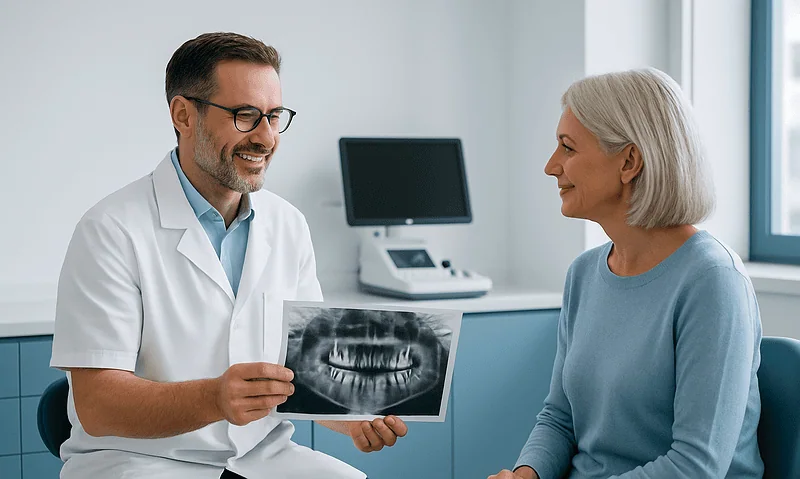
Imaging in Implantology: How Panoramic X-Rays and 3D Scans Guide Implant Position and Depth
Implantology imaging combines two-dimensional dental X-rays, most often a panoramic film, with a three-dimensional cone beam CT (CBCT) scan when the clinician needs to…
Why Jaw Growth Decides When Implantology Can Place an Implant in a Younger Patient
Dental implants for teenagers are usually postponed until the jaw has stopped growing, because an implant fuses to bone and cannot move with the…
How Mini Implants Are Placed: Flapless Insertion, Same-Day Denture Fitting and What to Expect
A mini implant procedure places one or more narrow titanium posts into the jawbone, usually through a small pierce in the gum rather than…

All On 4 Healing Timeline: Soft Diet Weeks, Bone Integration and the Final Bridge Switch
All-on-4 healing usually unfolds in stages. Swelling and soreness peak in the first two to three days and settle over one to two weeks,…