

Dermabrasion vs Dermaplaning: Deep Resurfacing and Surface Exfoliation Are Not the Same

Key Takeaways
- Dermabrasion reaches the upper dermis under anesthesia, while dermaplaning removes only the dead-cell layer and vellus hair with a blade, which is why one needs a wound dressing and the other needs sunscreen.
- Mayo Clinic puts typical dermabrasion wound healing at about two weeks, with redness that can persist up to about three months and sun avoidance for longer.
- Cleveland Clinic reports dermaplaning results last around three weeks and confirms hair regrows at the same thickness and color, because the follicle is never touched.
- Microdermabrasion cannot remove peach fuzz; its abrasion-plus-suction mechanism buffs dead cells but does not cut hair.
- People who have taken oral isotretinoin within roughly the past year, or who have active acne, cold sores, keloid history or facial radiation, are typically asked to wait before dermabrasion.
- There is no evidence-based rule for ordering dermaplaning and microdermabrasion; spacing them across separate visits avoids stacking two exfoliations on already stripped skin.
Dermabrasion and dermaplaning are different procedures that happen to share a name. Dermabrasion is a surgical resurfacing treatment: under anesthesia, a clinician uses a rapidly rotating instrument to remove the outer skin layers and soften scars or deep lines, followed by roughly two weeks of wound healing. Dermaplaning is a gentle cosmetic exfoliation that scrapes away dead cells and fine facial hair with a sterile blade and needs no downtime.
The booking screen offers two treatments a few lines apart. One is described as a thirty-minute add-on you could fit in before lunch; the other comes with a consent form, a mention of anesthesia and a warning about sun exposure for months. They differ by four letters. It is easy to assume they sit on the same spectrum, one simply a stronger version of the other.
They do not. The confusion around dermabrasion vs dermaplaning is one of the more consequential mix-ups in facial aesthetics, because a person hoping to soften an old acne scar may book the wrong one and feel nothing changed, while someone wanting a smoother makeup base may sign up for a procedure that leaves the face raw for weeks.
Both remove skin. The difference is how much, how deep, who is allowed to do it and what your face looks like the next morning. That is what this explainer sorts out, using what mainstream medical sources actually report rather than what a treatment menu implies.
Dermabrasion vs dermaplaning: why the similar names mislead
Skin is built in layers. The epidermis is the thin outer sheet you can see, topped by a film of dead cells that shed on their own schedule. Beneath it sits the dermis, the thicker living layer that holds collagen, the protein scaffolding that gives skin its firmness, along with blood vessels, nerves and hair roots. Almost every exfoliating or resurfacing treatment can be understood by asking one question: which layer does it reach?
Dermaplaning stays on top. A sterile blade, held nearly flat against the skin, skims off that outer film of dead cells and the fine, soft facial hair known as vellus hair, often called peach fuzz. Nothing living is removed. Skin looks brighter because light reflects more evenly off a smoother surface, and makeup sits flatter without hair to catch it. Cleveland Clinic classes it as a cosmetic exfoliation with no downtime.
Dermabrasion goes through the epidermis and into the upper dermis. A clinician uses a motorized handpiece with an abrasive tip to plane the skin down in a controlled way, which is why it needs anesthesia and why Mayo Clinic describes a healing period measured in weeks, not hours. The point is not brightness; it is to remodel the surface so a depressed scar or a deep vertical lip line sits closer to the surrounding skin as new tissue grows back.
So the names share a root, from the Latin for scraping, but one treatment tidies the surface and the other rebuilds it. Every practical difference, from who performs it to how you feel afterward, follows from that depth.
What actually happens during dermabrasion
Dermabrasion is a medical procedure, usually performed by a dermatologist or plastic surgeon in an outpatient setting. Before anything mechanical happens, the skin is numbed. MedlinePlus notes that this may involve a local anesthetic, a numbing spray that briefly firms the skin, or sedation, depending on how large an area is being treated and the clinician’s judgment. Some people have a small test area treated first to see how their skin responds.
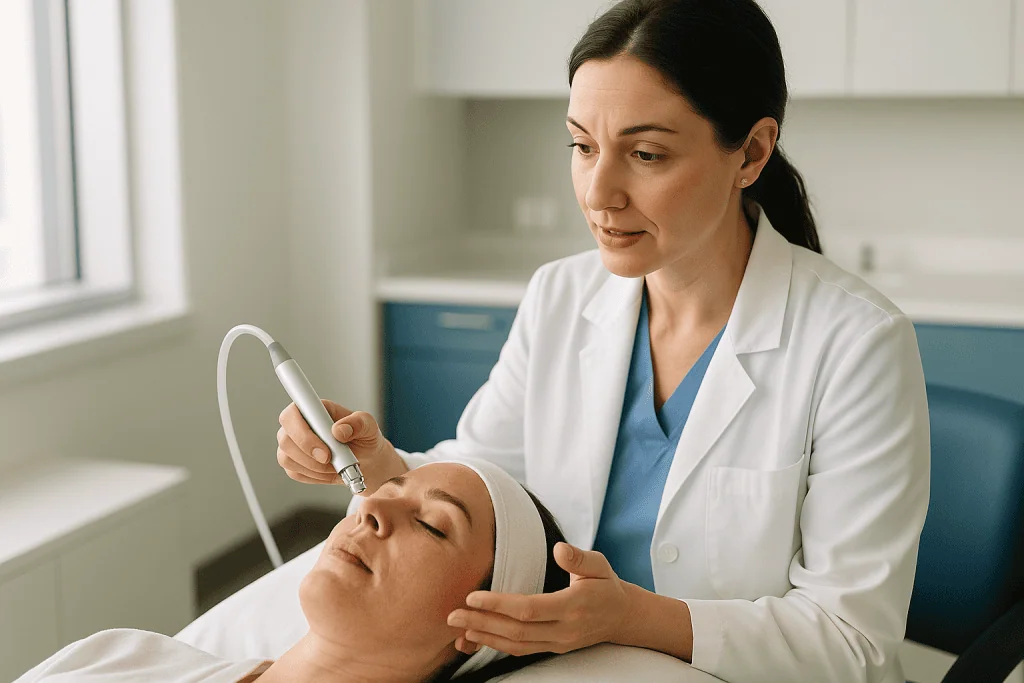
Once the area is numb, the clinician moves a handheld device across the skin. The working end is either a wire brush or a wheel studded with tiny diamond particles, spinning quickly enough to abrade tissue evenly. The operator controls depth by pressure, speed and the number of passes, working feature by feature so the treated zone blends with untreated skin. A small scar might take minutes; a full face takes longer, and Mayo Clinic notes some people have it done in stages.
The immediate result is not a polished face. It is a raw, weeping surface, similar in behavior to a deep graze, and it is dressed with ointment and a wound covering before you leave. Bleeding is expected during the procedure and is controlled as the clinician goes.
What happens next is the real treatment. Over the following days, new epidermis regrows from cells around hair follicles and sweat glands, and the upper dermis lays down fresh collagen. Because the scar or line was planed down first, the rebuilt surface is more level. Dermabrasion does not remove a scar; it reduces the step between scar and skin so the eye reads it less clearly.
What actually happens during dermaplaning
Dermaplaning looks, from across the room, like a very careful shave. The face is cleansed and dried, because the blade works best on skin without oil or product. The practitioner, who may be a licensed aesthetician or a clinician depending on local rules, holds the skin taut with one hand and, with the other, draws a sterile surgical blade across it in short, light strokes. Cleveland Clinic describes the blade being held at about a 45-degree angle, which lets it lift dead cells and vellus hair without cutting into living skin.
There is no anesthesia because there is no pain to block. Most people describe the sensation as a light scratching, closer to the feel of a credit card being drawn across the cheek than to anything sharp. A full face typically takes well under an hour, and there is nothing to dress or bandage afterward. Many practitioners finish with a soothing product and a sunscreen, since freshly exfoliated skin lets more ultraviolet light through.
The visible result is immediate and modest. Skin feels smoother to the touch, looks slightly brighter, and foundation glides on without catching on fine hairs. Skincare products may also absorb a little more readily without a layer of dead cells in the way.
Nothing about this changes the structure of the skin. The dermis is untouched, so dermaplaning cannot lift a depressed scar, soften a deep line or alter pigment in a lasting way. Cleveland Clinic puts the duration of results at around three weeks, which is roughly the time it takes for the dead-cell layer and the vellus hair to return. The treatment is a maintenance step, repeated on a schedule, rather than a one-time correction.
Dermaplaning vs microdermabrasion: where the third option fits
Most people searching this topic are actually weighing three treatments, because microdermabrasion sits in the middle of the name confusion. It is worth defining plainly. Microdermabrasion is a superficial exfoliation in which a handheld device either sprays fine crystals onto the skin and vacuums them back up, or uses a diamond-coated tip with suction, to buff away the outer layer of dead cells.
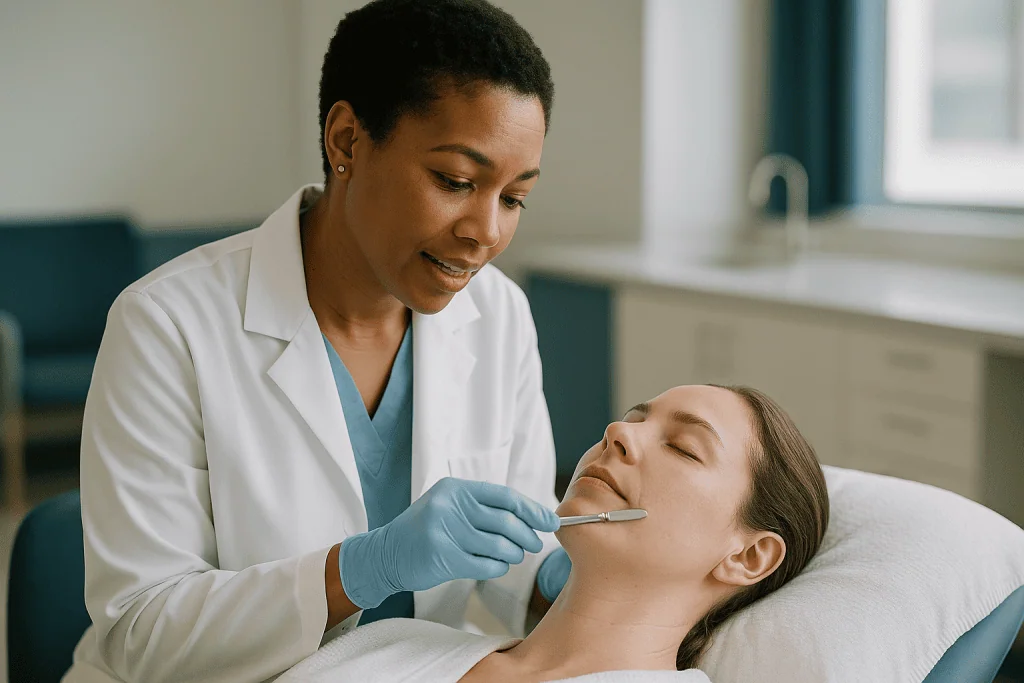
The ‘micro’ is the honest part of the name. Despite the shared root with dermabrasion, microdermabrasion does not reach the dermis and does not create a wound. It belongs with dermaplaning in the category of surface treatments: little to no downtime, mild temporary redness, results that fade as skin turns over. The two differ in method rather than depth. Dermaplaning uses a blade and removes hair; microdermabrasion uses abrasion plus suction and leaves hair in place.
That last point answers one of the most searched questions directly: microdermabrasion does not remove peach fuzz. Crystals and suction do not cut hair. If a hair-free surface is the goal, dermaplaning is the treatment designed to deliver it.
Some people find microdermabrasion slightly more useful for mildly congested skin, because the suction component can help loosen debris at the pore surface, while others prefer dermaplaning’s finish for makeup. Neither has strong evidence for lasting change in wrinkles or scars. Mainstream sources describe both as cosmetic treatments that improve texture and brightness temporarily.
So the mental map is: dermaplaning and microdermabrasion are neighbors on the surface; dermabrasion lives on a different floor of the building. Keeping that picture in mind makes the rest of the comparison much easier to follow.
Dermabrasion vs dermaplaning at a glance
Sometimes the cleanest way to see a difference is side by side. The table below summarizes what mainstream medical sources report about the two procedures, with microdermabrasion included because it so often enters the conversation. Timelines are typical ranges drawn from Mayo Clinic and Cleveland Clinic descriptions, not guarantees for any individual.
| Feature | Dermabrasion | Dermaplaning | Microdermabrasion |
|---|---|---|---|
| Skin depth reached | Through epidermis into upper dermis | Dead-cell layer only | Dead-cell layer only |
| Instrument | Motorized wire brush or diamond wheel | Sterile surgical blade | Crystals or diamond tip with suction |
| Anesthesia | Local, numbing spray or sedation | None | None |
| Who performs it | Dermatologist or surgeon | Aesthetician or clinician (varies by jurisdiction) | Aesthetician or clinician (varies by jurisdiction) |
| Main purpose | Scars, deep lines, some precancerous patches, tattoo remnants | Brightness, smoother makeup base, hair removal | Brightness, mild texture, surface congestion |
| Removes vellus hair | Not the goal | Yes | No |
| Wound healing | About 2 weeks (Mayo Clinic) | None | None |
| Redness | Can last up to about 3 months (Mayo Clinic) | Hours | Hours to a day |
| Result duration | Structural change persists; skin still ages | About 3 weeks (Cleveland Clinic) | Weeks; repeated sessions |
Two rows deserve a second look. The anesthesia row is the clearest tell that these are not the same category of treatment: no one numbs skin for an exfoliation. And the result-duration row explains why expectations go wrong. Dermaplaning is a refresh you repeat; dermabrasion is a one-time or staged correction whose changes remain, even though the skin around them keeps aging normally.
Who is dermabrasion usually for, and who is asked to wait
Dermabrasion earned its place in dermatology on a fairly narrow set of problems. Mayo Clinic and MedlinePlus list acne scars, scars from surgery or injury, fine wrinkles around the mouth, rhinophyma (a thickening of the skin on the nose linked to rosacea), certain precancerous rough patches called actinic keratoses, and residual tattoo pigment. What these share is a surface irregularity that sits deeper than dead cells can account for, which is precisely what a superficial treatment cannot address.
It is generally considered for people whose skin heals predictably and who can commit to weeks of wound care and months of careful sun avoidance. A clinician will also weigh skin tone, because the treated area can heal lighter or darker than surrounding skin; Mayo Clinic notes this risk is higher in people with darker skin, and the discussion about it should be explicit before anything is scheduled.
Several groups are typically asked to wait or to consider alternatives:
- People who have taken oral isotretinoin, a retinoid used for severe acne, within roughly the past year, because of concern about impaired healing (Mayo Clinic).
- Anyone with active acne, cold sores, bacterial infection or an inflammatory condition such as eczema in the treatment area.
- People with a history of keloids or hypertrophic scars, the raised, overgrown scars that can form after skin injury.
- Those with conditions or treatments that weaken immunity or slow healing, including recent radiation to the face.
- People with burn scars from a prior facial procedure.
None of these is a permanent verdict. A retinoid history becomes less relevant with time; an infection clears. What matters is that the person deciding is the treating clinician who has examined the skin, reviewed the history and can compare dermabrasion with the alternatives, including laser resurfacing, chemical peels of varying depth and, for some scars, surgical revision.
Who dermaplaning suits, and who is usually told to skip it
Dermaplaning has a broad audience precisely because it asks so little of the skin. Cleveland Clinic describes it as suitable for most skin types and tones, and its low-risk profile means people who could never safely undergo dermabrasion may be reasonable candidates. The typical person booking it wants smoother texture, a more even canvas for makeup, or simply to be rid of visible fine hair on the cheeks and upper lip without the irritation of waxing.
Those with dry or dull-looking skin often notice the effect most, since a thick layer of dead cells scatters light and makes a complexion look flat. People who wear foundation regularly tend to appreciate the change more than those who do not, because the difference shows most where product meets skin.
Still, a blade is a blade, and there are situations where practitioners generally decline or ask for a pause:
- Active acne, especially inflamed or cystic lesions, which the blade can nick and spread bacteria across.
- An active cold sore, because the virus can be dragged along the skin.
- Flares of rosacea, eczema or psoriasis in the treatment area, where the barrier is already compromised.
- Recent sunburn or any open wound.
- Skin thinned or made fragile by certain treatments, where the practitioner may want to coordinate with the prescribing clinician.
A common worry is thicker regrowth, addressed later in this article. A more legitimate consideration is that dermaplaning offers no structural benefit, so someone whose real concern is a pitted scar or a deep line is being served a pleasant treatment for the wrong problem. A good practitioner will say so, and may redirect the conversation toward a dermatology consultation.
Is there a downside to dermaplaning your face? Dermaplaning side effects explained
The honest answer is that the downsides are real but usually small, and they cluster around three themes: irritation, occasional breakouts, and rare injury from the blade.
Irritation is the most common. Cleveland Clinic lists redness, a mild burning or stinging sensation and a temporary feeling of tightness, typically settling within hours. Skin that has just lost its outer film is more reactive, so strongly scented products, exfoliating acids and retinoid creams applied too soon can sting where they previously did not. Freshly exfoliated skin also lets more ultraviolet light through, which is why sun protection matters more in the days that follow.
Some people notice small whiteheads or a crop of minor breakouts a day or two later. The usual explanation is that oil and debris move more freely across a smoother surface, or that the skin barrier is briefly disrupted. This tends to resolve on its own; if it is a pattern, the treatment interval or aftercare may need adjusting.
Less commonly, the blade can cause a superficial nick, and any break in the skin carries a small risk of infection. Cleveland Clinic also notes the possibility of patchy pigment changes, more relevant for people prone to post-inflammatory hyperpigmentation, the darkening that follows skin irritation, and very rare scarring. Both are more likely when the treatment is done on skin that should have been excluded, such as an active flare.
What dermaplaning cannot do also counts as a downside if you expected it. It will not change scars, wrinkles, pore size or pigmentation in a lasting way. If you leave a session pleased with the smoothness but disappointed that the deeper concern is unchanged, that is not a failure of technique; it is the wrong tool for the job.
What are the disadvantages of microdermabrasion?
Because microdermabrasion keeps turning up in dermabrasion vs dermaplaning searches, it deserves the same scrutiny. Five limitations come up repeatedly in mainstream descriptions, and none should be treated as a reason to avoid it, only as context for deciding whether it fits your goal.
First, results are temporary. Like dermaplaning, microdermabrasion removes cells the skin was going to shed anyway, so the brightening effect fades over a few weeks and the treatment is usually sold as a series. Second, it does not treat depth. Pitted acne scars, deep lines and set-in pigmentation live in the dermis, and a superficial buff does not reach them. Third, it does not remove hair; the mechanism is abrasion and suction, not cutting, so peach fuzz stays where it is.
Fourth, the suction can leave marks. People with fragile or easily bruised skin, or those on medicines that affect clotting, sometimes notice small bruises or a stippled redness, particularly on thinner areas such as around the eyes. Fifth, it can aggravate certain conditions. Active rosacea, inflamed acne, cold sores and broken skin are usually excluded because abrasion and suction can worsen inflammation or spread infection.
A sixth point is really a clarification rather than a disadvantage: crystal-based systems generate a fine grit that must be kept away from the eyes, and some people find diamond-tip devices more comfortable. Neither method has convincing evidence for lasting collagen change.
Where does it sit in the comparison? Microdermabrasion and dermaplaning compete for the same job, a surface refresh, and personal preference about sensation and hair removal usually decides between them. Neither competes with dermabrasion, whose job is to change structure and whose recovery reflects that.
Dermabrasion recovery time: what the days and weeks afterward usually look like
Recovery is where the two procedures separate most starkly, and it is the part treatment menus describe least honestly.
After dermabrasion, the treated skin is an open wound. MedlinePlus and Mayo Clinic describe swelling, oozing and a raw, tender surface in the first days, often with a dressing that is changed on a schedule your team sets. The face may feel as if it has been badly sunburned. Mayo Clinic notes that new skin typically covers the area in about two weeks; during that stretch you will be asked to keep the area clean and moist with ointment, avoid picking at any crust, and skip strenuous activity that raises blood pressure or causes sweating. Many people take time off work or social commitments simply because of how the face looks.
Once the surface has closed, the skin is pink to red and unusually sensitive. Mayo Clinic gives up to about three months for this color to fade, and the new skin’s vulnerability to ultraviolet light is why strict sun avoidance and daily broad-spectrum sunscreen are emphasized for months, not weeks. Makeup can usually be reintroduced once the team confirms healing, and the final texture continues to refine as collagen remodels over several months. Pigment changes, if they occur, may appear in this later phase.
Dermaplaning’s recovery is measured differently. There is no wound, so there is nothing to heal; the skin may be a little pink for a few hours and slightly sensitive for a day or two. Practitioners commonly advise gentle cleansing, a plain moisturizer, sunscreen and a short pause on exfoliating acids and retinoids. Results last around three weeks per Cleveland Clinic, and sessions are usually spaced to match that turnover. The contrast with dermabrasion could hardly be clearer: one recovery is a wound-care project, the other is an afternoon of avoiding harsh products.
Is it better to do dermaplaning or microdermabrasion first?
This question usually comes from people who like both surface treatments and want to know how to stack them. The neutral answer is that there is no guideline establishing a correct order, and the more useful question is whether to combine them at all.
Both remove the same outer layer of dead cells. Doing them back to back in a single session means the second treatment is working on skin that has already been stripped, which raises the odds of stinging, redness and the temporary barrier disruption that leads to breakouts. Many practitioners therefore decline to perform both on the same day, or will do a lighter version of one after the other. Some prefer dermaplaning first when combining, on the logic that the blade clears hair and cells so the suction device contacts skin directly; others reverse it. That is technique preference, not evidence.
Spacing them across separate visits, so that skin has time to rebuild its outer layer between treatments, is the more conservative approach and the one most consistent with how superficial exfoliation is described by mainstream sources. It also lets you learn which treatment your skin tolerates and which result you actually prefer, rather than guessing which of two did the work.
The larger point is that sequencing questions only make sense within the surface category. No one asks whether to do dermaplaning or dermabrasion first, because dermabrasion is followed by weeks of wound healing during which no exfoliation of any kind belongs on the skin. If a scar or deep line is the concern, the sequence is simple: dermatology assessment first, and any surface treatments later, once the team says the skin is ready.
What people often get wrong about dermabrasion vs dermaplaning
The myths here are persistent because the names invite them. A few are worth dismantling with what the evidence actually says.
Dermaplaning makes hair grow back thicker or darker. It does not. Hair thickness and color are set by the follicle, which sits in the dermis and is untouched by a blade skimming the surface. Cleveland Clinic states plainly that regrowth is the same texture and color. The blunt tip of a cut hair can briefly feel coarser than a naturally tapered one, which is where the impression comes from.
Dermabrasion is just an intense facial. It is a surgical procedure with anesthesia, bleeding, a dressed wound and a recovery Mayo Clinic measures in weeks, performed by clinicians trained in wound care and in judging depth. It should never be booked as an add-on.
Microdermabrasion is a milder dermabrasion. The shared root is misleading. Microdermabrasion stays at the dead-cell layer; it cannot achieve, even in many sessions, what one pass of true dermabrasion does structurally.
Deeper always means better. Depth means more change and more risk. For someone whose concern is dullness or makeup texture, dermabrasion would be a poor trade: months of redness for a problem a surface treatment solves.
Any of these will remove a scar. None removes scar tissue. Dermabrasion levels the step between scar and skin; the others do not reach it at all.
Once healed, dermabrasion results are permanent and maintenance-free. The structural change persists, but skin continues to age, sun exposure continues to damage, and pigment shifts can emerge months later. Sun protection is a long-term commitment.
Getting these straight is not pedantry. It is the difference between choosing a treatment for what it does and choosing one for what its name seems to promise.
Questions to ask your care team
A good consultation should leave you with fewer assumptions than you walked in with. The questions below are phrased for the person across the desk, whether that is a dermatologist discussing dermabrasion or a practitioner offering dermaplaning. The NHS guidance on cosmetic procedures stresses checking who is performing a treatment and what their training and registration are, which is a reasonable first question in either setting.
- Which layer of skin does this treatment reach, and is that the layer where my concern actually lives?
- Given my skin tone and history, what is my particular risk of pigment change, and how would we manage it if it happened?
- Have I taken or used anything, including oral or topical retinoids, that changes the timing or safety of this procedure?
- What will my face look like the next morning, at one week and at one month? Can you show me typical stages of healing rather than only final results?
- What exactly will I need to do at home, and for how long? Who do I contact if something looks wrong outside office hours?
- What are the alternatives for this specific problem, including doing nothing for now, and how do their risks and recoveries compare?
- If I am considering both a surface treatment and a resurfacing procedure, how far apart should they be, and in which order?
- How many sessions are usually needed for the result you expect, and how will we judge whether it is working?
- What would make you advise against treating me today?
Notice that none of these ask for a promise. Reputable clinicians will describe likely ranges, name the uncertainties and explain why a particular skin might respond differently from the average. If the answers arrive as guarantees, that in itself is information.
When to call your doctor
Most surface exfoliation causes nothing more than a few hours of pinkness, and most dermabrasion recoveries follow the course your team described. Some signs, though, mean the plan should be reviewed promptly rather than waited out.
After dermabrasion, contact the treating team the same day if you notice spreading redness beyond the treated edge, increasing rather than easing pain after the first days, thick yellow or green discharge, a foul smell from the wound, fever or chills, or new blisters and clustered sores, which can signal a herpes flare on healing skin. Bleeding that does not stop with gentle pressure, or areas that look gray or unusually pale, also warrant a call. Later in recovery, raised, thickening or itchy scar tissue, and patches turning distinctly darker or lighter than surrounding skin, should be assessed while there is still time to intervene.
After dermaplaning or microdermabrasion, red flags are rarer but not absent: a cut that will not close, a hot and swollen area, pus, a rash spreading outward, or cold sores appearing within a few days. People with a history of keloids or cold sores should mention this beforehand so the practitioner can plan accordingly.
Seek urgent care, not just a routine call, for facial swelling that affects breathing or swallowing, rapidly spreading redness with fever, or any sign of an allergic reaction to a dressing, ointment or anesthetic, such as hives or lightheadedness. These are uncommon, but they are the situations where speed matters.
Every decision about whether to proceed, pause or change course belongs with the clinician who examined your skin and knows your history. This article can help you ask better questions; it cannot replace that examination.
Frequently asked questions
What is the main difference between dermabrasion and dermaplaning?
Depth. Dermabrasion is a surgical resurfacing procedure that removes the epidermis and part of the upper dermis with a motorized abrasive tool under anesthesia, used for scars and deep lines. Dermaplaning is a cosmetic exfoliation that scrapes only dead surface cells and fine facial hair with a sterile blade, with no anesthesia and no downtime. The names share a root but describe different categories of treatment.
Is there a downside to dermaplaning your face?
Yes, though usually minor. Common dermaplaning side effects include temporary redness, stinging, tightness and occasional small breakouts as the barrier resets. Less often, the blade can nick skin, which carries a small infection risk, and people prone to post-inflammatory darkening can see patchy pigment. It is generally avoided on active acne, cold sores or flares of rosacea or eczema, and it does not change scars or wrinkles.
Does microdermabrasion remove peach fuzz on the face?
No. Microdermabrasion uses fine crystals or a diamond tip with suction to buff away dead cells; nothing in that mechanism cuts hair, so vellus hair remains. Dermaplaning is the surface treatment designed to remove it, because its blade shears hair at skin level while lifting dead cells. If a hair-free finish for makeup is the goal, that distinction decides the choice.
What are the disadvantages of microdermabrasion?
The recurring microdermabrasion disadvantages are that results are temporary and require repeat sessions, it cannot treat scars or deep lines because it never reaches the dermis, it does not remove hair, its suction can bruise fragile or easily marked skin, and it can aggravate rosacea, inflamed acne or cold sores. None of these makes it unsafe for suitable skin, but they define what it can and cannot deliver.
Is it better to do dermaplaning or microdermabrasion first?
No guideline sets an order, because both remove the same outer layer of dead cells. Doing them back to back means the second treatment works on already stripped skin, which raises irritation and breakout risk, so many practitioners avoid combining them in one session. Spacing them across separate visits, letting the surface rebuild between, is the more conservative approach; any sequence in a single visit is technique preference rather than evidence.
How long is dermabrasion recovery time?
Mayo Clinic describes new skin covering the treated area in about two weeks, during which the surface is raw, swollen and dressed like a wound. Redness can persist for up to about three months, and the new skin remains sensitive to sunlight for longer, so strict sun protection is advised for months. Individual healing varies with depth of treatment, skin type and aftercare, and your team will set your specific timeline.
Does dermaplaning make facial hair grow back thicker or darker?
No. Hair thickness and color are determined by the follicle, which sits in the dermis and is not affected by a blade skimming the surface. Cleveland Clinic states regrowth is the same texture and color as before. A freshly cut hair has a blunt end rather than a tapered tip, which can briefly feel coarser and is the source of the myth.
Who should not have dermabrasion?
Dermabrasion is typically deferred for people who have taken oral isotretinoin within roughly the past year, those with active acne, cold sores or skin infection in the area, anyone with a history of keloid or hypertrophic scarring, people with conditions or treatments that impair healing including facial radiation, and those with prior burn scars. Darker skin tones carry higher pigment-change risk that needs explicit discussion. The treating clinician makes the final call.
Can dermaplaning or microdermabrasion remove acne scars?
Not in a meaningful way. Depressed acne scars are formed in the dermis, and both treatments stop at the dead-cell layer, so they may make skin look brighter without changing the scar itself. Dermabrasion, deeper chemical peels, laser resurfacing or surgical revision are the approaches clinicians consider for scar depth. A dermatology assessment is the right first step when scarring is the real concern.
How is dermaplaning vs microdermabrasion different from true dermabrasion in who performs it?
Dermabrasion is performed by dermatologists or surgeons because it involves anesthesia, bleeding and a wound that must heal correctly. Dermaplaning and microdermabrasion are superficial and, depending on local regulations, may be performed by licensed aestheticians or clinicians. NHS guidance on cosmetic procedures recommends confirming the practitioner’s training and registration before any treatment, and that check matters most as depth increases.
References
This article is for general information only and is not a substitute for professional medical advice. Please consult a qualified doctor about your individual situation.

More from the Blog
How to Prepare for Microneedling: Sun, Retinoids and the Two Weeks Before Your Session
Preparing for microneedling usually means keeping the skin out of strong sun and free of sunburn or tan for the two weeks beforehand, pausing…
IPL Photorejuvenation Results: Why Spots Darken Before They Fade and How Sessions Build
IPL photorejuvenation results usually appear gradually. Treated brown spots often turn darker and coffee-ground-like for several days before flaking away over one to two…

Surface Reconstruction Recovery: Early Supervised Walking, Physical Therapy and Milestones
Surface reconstruction recovery after ocular surface surgery usually unfolds in stages: the corneal surface layer re-covers over days, comfort and light sensitivity settle over…

Before Aesthetic Filling: Blood Thinners, Alcohol and Supplements Your Doctor Will Review
Before dermal fillers, clinicians typically review anything that increases bruising or bleeding: prescribed anticoagulants and antiplatelet drugs, over-the-counter anti-inflammatory painkillers, supplements such as fish…

Reconstruction After Cancer or Infection: How Grafts, Flaps and Staged Surgery Are Planned
Reconstructive surgery after cancer or infection rebuilds tissue removed by a tumor operation or destroyed by infection, using skin grafts, flaps of tissue moved…

Why Hands Show Age Early: Volume Loss, Visible Veins and Sun Spots and How Each Is Treated
Hands show age early because their skin is thin, has very little fat beneath it, and spends decades in sunlight without protection. Over time…