

Does Laser Resurfacing Hurt? Numbing Options and How Comfort Changes With Laser Depth
Key Takeaways
- Non-ablative lasers heat the dermis under intact skin and are usually managed with topical anesthetic cream and cooled air, with redness lasting hours to a few days.
- Fully ablative resurfacing removes the entire outer skin layer and is commonly performed under local anesthesia with sedation or general anesthesia, with the surface taking about one to two weeks to heal.
- Nerve blocks numb an entire facial region with a few injections near a sensory nerve trunk, which is why they are often reserved for sensitive zones such as the upper lip and around the eyes.
- The strongest discomfort after fractional ablative treatment is a sunburn-like burning that peaks over the first few hours as anesthetic fades, then gives way to itching around days two to five.
- Darker skin carries a higher risk of post-inflammatory hyperpigmentation after resurfacing, which typically shifts the plan toward gentler settings rather than ruling treatment out.
- Sun protection is part of healing itself: the Mayo Clinic advises avoiding unprotected sun exposure for up to a year after ablative resurfacing because new skin darkens easily.
Laser resurfacing is usually uncomfortable rather than severely painful, and the sensation scales with depth. Light non-ablative treatments feel like brief heat or a rubber-band snap under numbing cream. Deeper fractional treatments typically add injected local anesthetic, and fully ablative resurfacing is done under local anesthesia with sedation or, for large areas, general anesthesia. Afterward, a sunburn-like burning is common for several hours.
The consent form is two pages long, and she has read the word “discomfort” four times without finding out what it means. Her friend described her light laser session as “a hot rubber band.” A video she watched showed a woman with a bandaged face who looked, frankly, like she had lost a fight. Same word on both forms. Different planets.
That gap is the whole story. Asking does laser resurfacing hurt is a bit like asking whether swimming is cold: it depends entirely on how deep you go, how the water is prepared, and what happens in the hour after you climb out. A laser that warms the upper skin without breaking it and a laser that removes the surface layer entirely share a name and almost nothing else.
What follows is the honest, evidence-based version of that conversation: what each depth actually does to tissue, which numbing methods clinicians commonly use at each level, and what the burning, tightness and itching of the following days usually look like. The decisions stay with your treating team. The understanding can start here.
Does laser resurfacing hurt? The honest short version
Most people who have had a laser treatment describe the same three sensations, just at different volumes: heat, a sharp snapping or prickling, and afterward a tight, sunburned feeling. Which of those dominates, and how loud each one gets, depends far more on the depth of the treatment than on the brand of the machine or the reputation of the room you sit in.
At the gentle end, a non-ablative laser heats tissue beneath an intact surface. With a topical anesthetic cream applied beforehand, people commonly report brief stings and a spreading warmth that is tolerable without medication. At the deep end, a fully ablative laser vaporizes the outer skin over an entire region. Nobody is expected to feel that awake and unmedicated; the Mayo Clinic describes local anesthetic with sedation, and general anesthesia for extensive work.
The middle ground, fractional ablative resurfacing, is where most of the anxious searching happens, because comfort there depends heavily on preparation. Numbing cream alone may feel adequate on the cheek and inadequate on the upper lip. Clinicians often add injected local anesthetic or nerve blocks, sometimes an oral sedative, and cooled air blown across the skin during the pass. With that combination, many people describe the procedure itself as manageable and the first evening as the hardest part.
So the truthful answer has three parts. During the treatment, pain is controlled to a level your team judges acceptable for the depth chosen. Immediately afterward, expect a strong burning sensation that peaks over hours, not days. In the healing week or weeks, discomfort turns into itching and tightness rather than pain. The rest of this article unpacks each of those, and explains why depth is the variable that matters most.
What actually happens to your skin during laser resurfacing
A laser is a beam of light of one specific wavelength, and skin absorbs particular wavelengths in particular structures, mostly water. When that light hits tissue, energy becomes heat. Resurfacing lasers are designed so that heat lands where the clinician wants it: the epidermis, the thin outer layer you can see and touch, or the dermis, the thicker layer beneath it that holds collagen, the structural protein that gives skin its firmness.
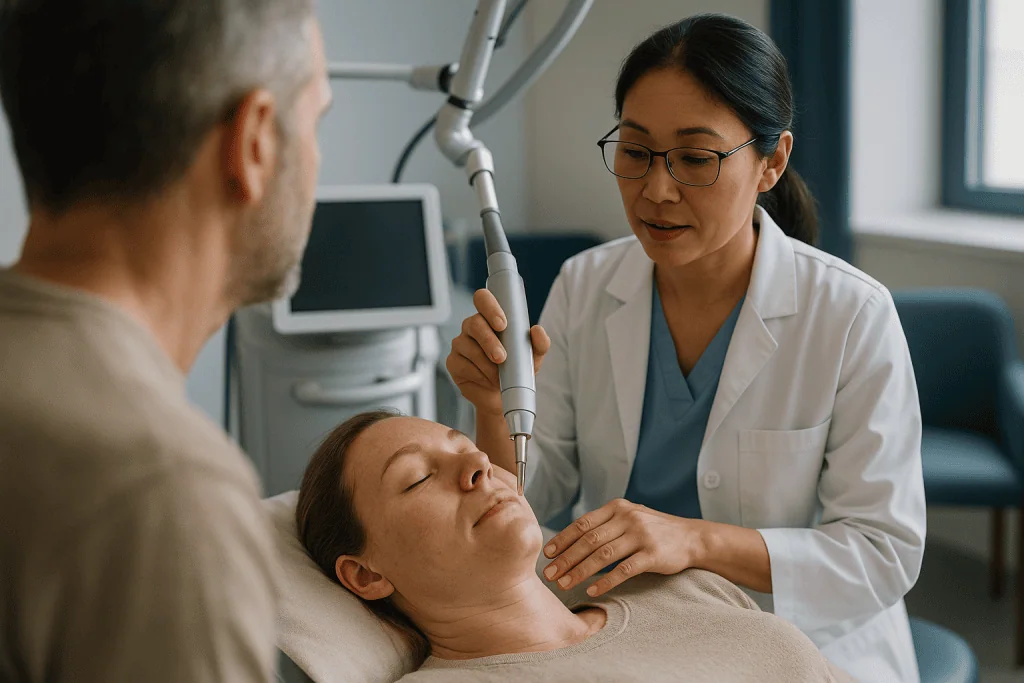
Heat in the dermis does two things. It causes immediate tightening of existing collagen fibers, and, more usefully, it signals the skin to repair. Over the following weeks, the body lays down new collagen as part of ordinary wound healing. That controlled injury and repair cycle is the mechanism behind resurfacing, whether the surface is broken or not. The Cleveland Clinic describes the goal as removing damaged outer skin, stimulating collagen, and letting smoother skin form during healing.
The sensation you feel is that heat arriving faster than your nerves would like. Skin nerve endings respond to temperature and to tissue disruption; a laser pulse delivers both in a fraction of a second, which is why people often describe a “snap” rather than a burn during the pass itself. Cooling devices exist for exactly this reason. Forced-air coolers or chilled handpieces lower the surface temperature so the pain signal from the epidermis is blunted while heat still reaches the target below.
Procedure length varies with area and depth. The Mayo Clinic gives roughly 30 minutes to two hours for ablative resurfacing of the face, while non-ablative sessions tend to be shorter and are commonly repeated in a series. That time includes numbing, which for topical creams means waiting long enough for the cream to work before a single pulse is fired.
Why depth matters: ablative, non-ablative and fractional explained
Three words do most of the work in any conversation about laser comfort. Ablative means the laser removes tissue, vaporizing the epidermis and heating the dermis beneath. Non-ablative means the laser heats the dermis while leaving the surface intact. Fractional means the beam is split into a grid of tiny columns, treating a fraction of the skin and leaving untreated bridges between, which speeds healing because healthy cells migrate in from the sides.
Each word changes what you feel. A non-ablative treatment produces heat with no open wound, so the nerve signal is mainly thermal and short-lived; redness and swelling may last hours to a few days according to the Mayo Clinic. A fully ablative treatment creates a raw surface across the whole zone, like a controlled second-degree burn. That is why sedation or general anesthesia enters the picture and why aftercare involves dressings and ointments. Fractional ablative sits between: thousands of microscopic wounds rather than one large one, more discomfort than a non-ablative pass, considerably less recovery than a fully ablative one.
Depth also determines the setting where the treatment happens. Light treatments are done in an examination-style room with a topical anesthetic. Deeper treatments require monitoring, resuscitation equipment for sedation, and a clinician trained to manage anesthesia, not because pain is the only concern but because sedated patients need airway and blood-pressure monitoring.
Two lasers of the same category can still differ. Energy settings, pulse duration and how densely the fractional columns are packed all raise or lower the injury and therefore the sensation. This is why the same “fractional CO2” treatment can be a lunchtime appointment for one person and a week off work for another. The name on the device tells you the category; the settings your clinician chooses tell you the experience.
How much does laser resurfacing hurt at each depth? A side-by-side comparison
The table below pulls the pieces together. Timeframes are typical ranges drawn from the Mayo Clinic and Cleveland Clinic patient guidance; individual experience varies with settings, treated area and personal pain sensitivity, and none of it is a guarantee.
| Depth | What the laser does | Numbing commonly used | How it typically feels | Typical surface healing |
|---|---|---|---|---|
| Non-ablative | Heats dermis; surface intact | Topical anesthetic cream, cooled air | Warmth, brief snaps; mild sunburn feeling afterward | Redness and swelling for hours to a few days |
| Fractional ablative | Vaporizes a grid of micro-columns | Topical cream plus injected local anesthetic or nerve blocks; sometimes oral sedative | Sharp heat during pass; strong burning for several hours after | Raw or crusted surface for several days, then peeling |
| Fully ablative | Removes entire epidermis in treated zone | Local anesthesia with sedation, or general anesthesia | Little felt during procedure; significant soreness and swelling after | One to two weeks for surface to heal; redness for months |
Two patterns stand out. First, the more the surface is disrupted, the more numbing is layered on, so the procedure itself is not necessarily more painful at greater depth. What grows with depth is the aftermath: the duration of burning, the amount of swelling, and how long the skin stays raw.
Second, the face is not one surface. Skin over bone, such as the forehead and cheekbones, generally feels lasers more sharply than fleshier areas. The upper lip, nose and area around the eyes are dense with nerve endings, which is why clinicians often reserve injected anesthetic for those zones even in a treatment that is otherwise handled with cream. The Mayo Clinic notes the eye area requires protective shields regardless of depth, since the laser can injure the eye directly.
Numbing options for laser resurfacing: creams, blocks and sedation
Comfort planning starts with the skin surface. A topical anesthetic is a cream containing a local anesthetic, typically of the lidocaine family, that temporarily blocks nerve signaling in the top layers. It works by preventing sodium from entering nerve cells, which stops the electrical impulse that would register as pain. Creams take time to penetrate, so they are applied in the clinic well before the first pulse, often under an occlusive wrap that helps absorption. They dull the surface sting but reach only so deep, which is why they are the backbone of non-ablative treatments and a first layer for deeper ones.
The next layer is injected local anesthetic. This can be placed directly into the treated area or, more elegantly, as a nerve block: a small injection near the trunk of a facial sensory nerve, which numbs the whole territory that nerve supplies. Blocks around the infraorbital nerve beneath the eye or the mental nerve in the chin can quiet large regions with a few injections. The injection itself stings briefly, which some people find the most uncomfortable moment of the day.
Cooling is not an anesthetic, but it matters. Chilled air directed at the skin during each pass lowers surface temperature and competes with the pain signal, a mechanism sometimes called gate control, in which non-painful sensation reduces the transmission of painful ones.
For deeper or more extensive treatments, clinicians may add an oral sedative to reduce anxiety and blunt awareness, or move to monitored intravenous sedation. Fully ablative resurfacing of the whole face is commonly performed under general anesthesia, according to the Mayo Clinic. Which combination is right for you is a clinical decision that weighs depth, area, your medical history and any medicines you already take, and it belongs to the treating team. Your job is to describe your pain tolerance and anxiety honestly so that plan fits.
What laser resurfacing feels like afterward: the sunburn phase
The pulse stops, the numbing wears off, and this is the part people wish someone had described more plainly. After a non-ablative session, the skin feels like a moderate sunburn: warm, pink, a little swollen, easily calmed with cool compresses and time. Most people describe it as an annoyance rather than pain, and the Mayo Clinic notes swelling and redness are usually short-lived at this depth.
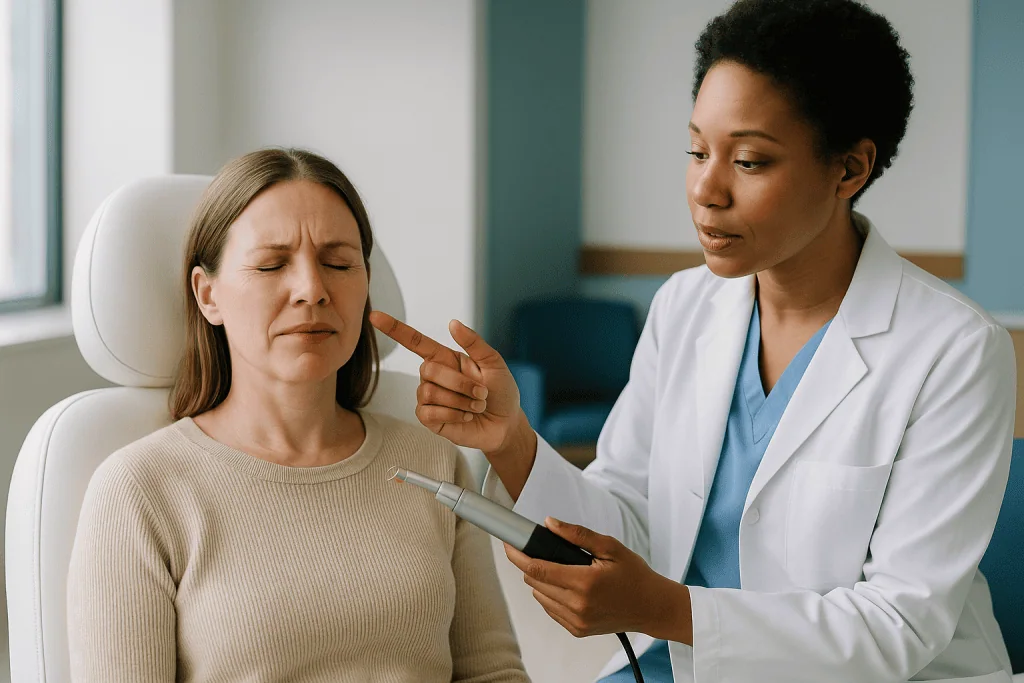
After fractional ablative treatment, the sensation is stronger and more insistent. People commonly describe intense burning that builds over the first hour or two as local anesthetic fades, then gradually eases across the evening. Cooling fans, cold compresses over a barrier and lying with the head elevated to limit swelling are the standard comfort measures. Your team may discuss over-the-counter or prescription pain relief; the choice and timing rest with them and depend on your other medicines and health conditions.
Fully ablative resurfacing produces the most swelling. Eyes can puff shut for a day or two, and the raw surface weeps fluid, which is why dressings or thick ointments are used to keep it moist. Wound care itself, gently cleansing and reapplying, often feels stranger than painful. The Mayo Clinic describes the treated skin at this stage as raw, swollen and itchy.
Itching deserves its own mention. Somewhere between day two and day five for most deeper treatments, the burning gives way to itching as new epidermis forms. It is a normal healing signal, and scratching is the enemy, because it can lift healing skin and open a door to infection. Keeping the skin moisturized as your team directs is usually the main defense.
What people rarely expect is how quickly the acute discomfort passes relative to the visible healing. The face may look dramatic for a week while feeling largely fine by day three.
Who laser resurfacing is usually for, and who is usually asked to wait
Resurfacing is most often discussed for fine lines around the eyes and mouth, sun damage, uneven texture, certain acne scars and blotchy pigmentation. The Cleveland Clinic and Mayo Clinic both describe these as common reasons people seek treatment. It is a tool for surface and near-surface concerns; it does not lift sagging tissue or replace volume, and a clinician who suggests it for jowls or deep folds is describing a different conversation than the one this article covers.
Some people are usually asked to wait, or steered toward a different approach. Active acne in the treatment area raises infection risk and is generally treated first. Anyone who has taken oral isotretinoin, a retinoid medicine for severe acne, within roughly the past year is commonly asked to wait, because the Mayo Clinic lists it among factors linked to impaired healing after resurfacing. A history of keloids, which are raised scars that grow beyond the original wound, is a caution flag, since resurfacing is itself a controlled wound.
Skin tone shapes the conversation too. Darker skin contains more active pigment cells, and the heat of resurfacing can trigger them to overproduce melanin, causing dark patches known as post-inflammatory hyperpigmentation. The Mayo Clinic notes this risk is higher in people with darker skin. It does not rule treatment out, but it typically shifts the choice toward gentler settings or non-ablative approaches, and toward clinicians experienced with the full range of skin tones.
Other reasons a team may pause include a weakened immune system, autoimmune or connective tissue conditions, prior radiation to the face, pregnancy, and a history of cold sores, which can flare across freshly treated skin. In that last case, clinicians often prescribe an antiviral medicine to take around the procedure; the mechanism is suppression of the herpes simplex virus during the healing window, and the specifics belong to the prescriber.
Is laser good for older skin? What changes with age
Age itself is not a barrier, and older skin is frequently where sun damage and fine lines are most visible. What changes with age is the biology of healing, and that shifts both the comfort conversation and the expectation conversation.
MedlinePlus describes how skin thins with age, loses collagen and elasticity, and repairs more slowly, while blood vessels in the dermis become more fragile. Thinner skin means less cushion between the laser’s heat and the nerve endings, so some older adults find lighter settings feel sharper than expected. Slower repair means the healing timelines quoted for a 35-year-old may run longer for a 70-year-old, and the redness phase after ablative work can persist toward the longer end of the Mayo Clinic’s “several months” range.
Medication matters more with age. Blood thinners increase bruising and bleeding from the raw surface. Diabetes can impair wound healing and raise infection risk. Medicines that suppress the immune system change the calculation entirely. None of these is automatically disqualifying, but each is a reason the pre-treatment history should be thorough and honest, and any adjustment to a prescribed medicine is a decision for the prescribing clinician, never something to do on your own before an appointment.
Expectations deserve the same honesty. Laser resurfacing can improve texture and pigment; it does not tighten loose skin along the jaw or restore lost fat in the cheeks, which are the changes that often prompt older adults to seek help. A frank consultation should separate what a laser addresses from what it does not.
The encouraging part is that comfort tools work regardless of age. Nerve blocks, cooling and sedation are chosen for the depth of treatment and the individual, and there is no evidence-based reason an older adult should tolerate more discomfort than a younger one.
What is the downside of laser resurfacing? Risks in plain language
Every controlled injury carries the risks of an uncontrolled one, and pretending otherwise does readers no favors. The Mayo Clinic and Cleveland Clinic list the same core set, and they are worth walking through without alarm and without minimizing.
Redness, swelling and itching are expected, not complications, but their duration surprises people. After ablative resurfacing, pinkness can persist for months. Acne flares and small white bumps called milia can appear during healing, partly from the thick ointments used on raw skin; these usually settle.
Infection is the risk that turns a routine recovery into a difficult one. Bacterial infection of the raw surface, or reactivation of cold-sore virus across the treated area, can delay healing and raise scarring risk. This is why wound-care instructions are precise and why antiviral prophylaxis is discussed for those with a herpes history.
Pigment changes cut both ways. Hyperpigmentation, darkening, is more common in deeper skin tones and after sun exposure during healing. Hypopigmentation, lightening, can appear months later and is more associated with deeper ablative treatments; it can be permanent. The Mayo Clinic advises avoiding unprotected sun exposure for up to a year after ablative work, a figure that reflects how long the healing skin remains vulnerable.
Scarring is uncommon with appropriate settings but not zero, and the risk rises with depth, infection, keloid history and picking at healing skin. Ectropion, a turning outward of the lower eyelid, is a rare complication of aggressive treatment near the eye.
The final downside is quieter: results are neither guaranteed nor permanent. Skin continues to age and sun continues to shine. A treatment explainer that promises otherwise is not describing medicine.
How many days does it take for laser resurfacing to heal? Recovery time by depth
Healing runs on two clocks: the visible surface and the deeper remodeling. The surface clock is what people mean when they ask about days off work, and it tracks depth closely.
After non-ablative treatment, the Mayo Clinic describes redness and mild swelling lasting hours to a few days, with most people returning to ordinary activity almost immediately. Makeup is often permitted quickly, and the skin does not crust or peel in any dramatic way.
Fractional ablative recovery follows a recognizable arc. The first two days bring burning, swelling and a pinpoint-crusted or bronzed surface. Around days three to five the skin flakes and peels as the micro-columns close from the sides, and itching peaks. By roughly a week the surface has usually re-formed, leaving pinkness that fades over the following weeks. Individual settings shift this considerably, so treat it as a shape rather than a schedule.
Fully ablative resurfacing is the slowest. The Mayo Clinic places surface healing at about one to two weeks, during which the skin is raw, weeps and requires dressings or ointment several times a day. Redness after that phase can last several months. Most people plan a genuine period away from social and work commitments for this depth.
The second clock is collagen. New collagen is deposited and reorganized over weeks to months after any depth of treatment, which is why clinicians ask people to judge results well after the skin looks healed. Non-ablative treatments are commonly given as a series precisely because each session adds a modest stimulus rather than a single large one.
Two practical notes. Sun protection is part of healing, not an add-on, since ultraviolet exposure on new skin is the most common trigger for dark patches. And swelling behaves like swelling anywhere: it is worst in the mornings after lying flat, and sleeping with the head elevated for the first nights helps.
Making laser resurfacing more comfortable: what you can do before and after
Comfort is partly the clinician’s plan and partly what you bring to the appointment. A few evidence-grounded habits change the experience more than any single product.
Before the day, tell your team everything: every prescription, every supplement, every history of cold sores, keloids, autoimmune conditions or recent acne treatment. This is not paperwork. Blood-thinning medicines and supplements increase bleeding from raw skin; a missed cold-sore history can mean a painful viral flare across the treated area; recent isotretinoin changes healing. Never stop or adjust a prescribed medicine on your own before the appointment; ask the prescriber and the treating team to coordinate.
Arrive rested and fed unless told to fast for sedation. Anxiety amplifies pain perception through the same nervous pathways that carry the signal, so a calm morning genuinely lowers what you feel. Ask what numbing plan is intended and how long the cream will sit before treatment starts, so you are not surprised by a wait.
During the session, say something. Clinicians can pause, add cooling, top up anesthetic in a sharp zone or adjust the pace. Silent endurance helps no one, and a treatment that hurts more than expected is information your team needs.
Afterward, the plan is simple and dull, which is exactly why people abandon it. Keep the skin cool with compresses over a clean barrier as directed. Keep it moist with the ointment or moisturizer your team specifies; dry, cracked healing skin hurts and heals worse. Keep the head elevated the first nights. Keep hands away from the face, because picking is the most common self-inflicted cause of scarring and infection. Keep out of the sun and use the sunscreen your team recommends once the surface has closed.
Comfort medication, if needed, is a decision made with your treating team based on your health and other medicines, not on what a forum recommends.
What people often get wrong about laser resurfacing pain
Myth: the more it hurts, the better it works. Pain during a laser pass reflects nerve stimulation, not collagen production. Deeper treatments do tend to produce larger changes and also more discomfort, but that is a shared cause, not a dose-response between suffering and results. Excellent numbing does not weaken the treatment.
Myth: numbing cream means you feel nothing. Topical anesthetics dull the surface. They do not reach the deeper heat of ablative treatment, which is why injected anesthetic, blocks or sedation are added at those depths. Expecting total numbness from cream alone sets people up for a hard hour.
Myth: “laser” is one thing. A non-ablative session and a fully ablative one share a word, not an experience. Reviews and videos online rarely specify which was done, which is why they contradict each other so wildly.
Myth: darker skin cannot be treated. Darker skin carries a higher risk of pigment change, as the Mayo Clinic notes, which shifts the choice of depth and settings and makes clinician experience with a range of skin tones important. It is a caution, not a prohibition.
Myth: once the skin looks healed, you are done. Collagen remodeling continues for months, and healing skin remains vulnerable to sun-induced darkening for up to a year after ablative work. The visible finish line comes long before the biological one.
Myth: it hurts less at a well-known clinic. Comfort comes from the depth chosen, the anesthetic plan and the settings used, none of which are properties of a name on a door. The right questions matter more than the right address.
Myth: pain after the procedure means something went wrong. A strong sunburn sensation for hours is expected. What warrants a call is pain that worsens after the first day or two, or arrives with the signs described below.
Questions to ask your care team before laser resurfacing
A good consultation should leave you able to answer these yourself. If you cannot, ask.
- Which depth are you recommending for me, and why that depth rather than one lighter or deeper?
- Is this treatment ablative, non-ablative or fractional, and what does that mean for how my skin will look on day one, day three and day seven?
- What numbing plan do you intend, and what is the backup if I find it more painful than expected?
- Will any part of the treatment involve sedation or general anesthesia, and who will monitor me?
- Given my skin tone and history, what is my particular risk of pigment change, and what are we doing to reduce it?
- Do I have any history, such as cold sores, keloids, recent acne medicines or immune conditions, that changes the plan or means I should wait?
- Should any of my current medicines or supplements be discussed with the clinician who prescribes them before the procedure?
- Exactly what will I do for wound care, how often, and for how many days?
- How will I reach you after hours if something looks wrong, and what would make you want to see me urgently?
- How many sessions are you anticipating, and when would we realistically judge the result?
- What would you consider a reason to stop partway through or choose a different treatment altogether?
Write the answers down or bring someone who will. Sedation and nerves both erode memory, and the wound-care instructions in particular are worth having in writing before you leave, along with a direct contact number. The decision to proceed, and at what depth, sits with you and the treating team together; the questions above simply make sure it is an informed one.
When to call your doctor after laser resurfacing
Ordinary healing is uncomfortable but follows a direction: worst in the first day or two, then steadily better. Anything that reverses that direction deserves a call to your treating team, and some signs deserve one the same day.
Contact your team promptly if pain increases after the second day rather than easing, if the treated area becomes hot, increasingly red or swollen beyond the expected pattern, or if you see yellow or green discharge, thick crusting or a foul smell, all of which suggest bacterial infection. Clusters of small blisters, especially around the mouth, may indicate a cold-sore flare spreading across healing skin and are treated more effectively the sooner they are recognized. Fever or feeling generally unwell after a skin procedure is never a normal part of recovery.
Around the eyes, call if you develop eye pain, changes in vision, or a lower eyelid that appears to be pulling downward or outward. Any bleeding that does not stop with gentle pressure, or areas of skin that look gray, white or unusually dark rather than pink and healing, should also be reported.
Seek emergency care immediately for signs of a severe allergic reaction to anesthetic, ointments or medicines: difficulty breathing, swelling of the lips or tongue, widespread hives, or faintness. If sedation was used, sudden confusion, persistent vomiting or chest pain in the hours afterward also warrant emergency evaluation.
In the longer term, let your team know about new dark or pale patches, raised or thickened scars, or texture that seems to worsen rather than improve over weeks. Some pigment changes respond better when addressed early.
The threshold for calling should be low. Clinicians who perform these procedures expect questions during healing, and a reassuring five-minute conversation is a far better outcome than a missed infection.
Frequently asked questions
Does laser resurfacing hurt more than a chemical peel?
It depends on depth in both cases rather than on the technology. A light non-ablative laser and a superficial peel both produce brief stinging and warmth. A fully ablative laser and a deep peel both create a controlled wound that requires anesthesia or sedation and a week or more of raw-skin care. Comparing a light version of one with a deep version of the other is the source of most confusion. Ask which depth is being proposed for each.
Is laser resurfacing recovery time longer for older adults?
Often somewhat, because skin repairs more slowly with age and has less collagen and thinner structure, as MedlinePlus describes. Redness after ablative work may sit toward the longer end of the typical range, and medicines common in later life, such as blood thinners or diabetes treatments, can affect bleeding and healing. Age alone is not a barrier; a careful medical history and realistic timeline matter more than the number.
Who is not a good candidate for laser resurfacing?
People with active acne in the treatment area, a history of keloid scarring, isotretinoin use within roughly the past year, a weakened immune system, autoimmune or connective tissue disease, or prior facial radiation are commonly asked to wait or consider alternatives, according to Mayo Clinic guidance. Pregnancy and a history of cold sores also change the plan. Darker skin tones are a caution for pigment change rather than an exclusion.
What are the main laser resurfacing downsides I should weigh?
The realistic downsides are prolonged redness that can last months after ablative work, infection of the raw surface, cold-sore reactivation, dark or light pigment patches, rare scarring or eyelid changes near the eye, and the fact that results are neither guaranteed nor permanent. Time away from normal life during healing is the downside people most often underestimate. Your team should walk through each in relation to your skin and history.
Can I drive myself home after laser resurfacing?
After a light treatment with topical numbing only, many people can, but if you receive an oral sedative, intravenous sedation or general anesthesia you must not drive and will need someone to take you home and ideally stay with you. Sedative medicines impair judgment and reaction time for hours after you feel alert. Confirm the plan with your team beforehand so transport is arranged.
How long does the burning last after fractional laser resurfacing?
Most people describe intense burning building over the first hour or two as local anesthetic wears off, then easing across the evening, with cool compresses and head elevation as the main comfort measures. By the next morning it has usually turned into tightness and swelling rather than burning. Itching typically takes over between days two and five as new skin forms. Burning that worsens after day two is a reason to call.
Will numbing cream be enough for fractional CO2 laser resurfacing?
Often not on its own for sensitive areas. Topical anesthetic dulls the surface but does not fully reach the deeper heat of ablative treatment, so clinicians commonly add injected local anesthetic or nerve blocks around the mouth, nose and eyes, sometimes with an oral sedative and cooled air. The right combination depends on settings and your history and is decided by your treating team, ideally after you describe your pain tolerance honestly.
Is it normal for my eyes to swell shut after ablative laser resurfacing?
Significant swelling, including eyelids that puff nearly closed for a day or two, is a recognized part of recovery after deeper ablative treatment, particularly when the area around the eyes is treated. It is usually worst in the mornings and improves with head elevation and cool compresses. Eye pain, vision changes, or a lower lid that pulls outward are different from swelling and should be reported promptly.
Why does my clinician want to know about cold sores before laser treatment?
The herpes simplex virus that causes cold sores lies dormant in nerves and can reactivate when the skin is injured, including by a laser. On freshly treated skin, a flare can spread widely, is painful, and can delay healing or leave scars. Clinicians therefore often prescribe an antiviral medicine to suppress the virus around the procedure. Whether and how that applies to you is decided by the prescriber.
Does laser resurfacing hurt less if the settings are lower?
Generally yes, because lower energy and less dense fractional coverage create less tissue injury and therefore less nerve stimulation and less post-treatment burning. The trade-off is a smaller change per session, which is why gentler treatments are often planned as a series. Lower settings are also one of the main ways clinicians reduce pigment risk in darker skin. The balance between comfort, recovery and result is a shared decision with your team.
References
This article is for general information only and is not a substitute for professional medical advice. Please consult a qualified doctor about your individual situation.

More from the Blog
How to Prepare for Microneedling: Sun, Retinoids and the Two Weeks Before Your Session
Preparing for microneedling usually means keeping the skin out of strong sun and free of sunburn or tan for the two weeks beforehand, pausing…
IPL Photorejuvenation Results: Why Spots Darken Before They Fade and How Sessions Build
IPL photorejuvenation results usually appear gradually. Treated brown spots often turn darker and coffee-ground-like for several days before flaking away over one to two…

Surface Reconstruction Recovery: Early Supervised Walking, Physical Therapy and Milestones
Surface reconstruction recovery after ocular surface surgery usually unfolds in stages: the corneal surface layer re-covers over days, comfort and light sensitivity settle over…

Before Aesthetic Filling: Blood Thinners, Alcohol and Supplements Your Doctor Will Review
Before dermal fillers, clinicians typically review anything that increases bruising or bleeding: prescribed anticoagulants and antiplatelet drugs, over-the-counter anti-inflammatory painkillers, supplements such as fish…
Reconstruction After Cancer or Infection: How Grafts, Flaps and Staged Surgery Are Planned
Reconstructive surgery after cancer or infection rebuilds tissue removed by a tumor operation or destroyed by infection, using skin grafts, flaps of tissue moved…

Why Hands Show Age Early: Volume Loss, Visible Veins and Sun Spots and How Each Is Treated
Hands show age early because their skin is thin, has very little fat beneath it, and spends decades in sunlight without protection. Over time…