

Does Bursitis Come Back? Why Flares Recur and What Long-Term Results Usually Look Like

Key Takeaways
- Bursitis usually settles within a few weeks, but the Mayo Clinic notes recurrent flare-ups are common, largely because the original trigger is often still present.
- The NHS advises seeing a GP if symptoms have not improved, or are worsening, after about two weeks of home care such as rest, ice and pressure relief.
- The body has roughly 150 bursae, and the shoulder, elbow and hip are the sites most often affected, each with a different recurrence pattern.
- Persistent outer hip pain labeled as bursitis frequently involves the gluteal tendons, which is why many specialists use the broader term greater trochanteric pain syndrome.
- Superficial bursae at the elbow and front of the knee are the most prone to infection through the skin; redness, warmth, fever or a wound over the area needs prompt assessment.
- Corticosteroid injections reduce local inflammation and can bring rapid relief, but they do not change the mechanics that irritated the bursa, so long-term results depend on addressing the cause.
Yes, bursitis can come back. Most flares settle within a few weeks with rest, ice and reduced pressure on the area, but recurrence is common when the original driver is still present, such as repetitive movement, kneeling or leaning on a joint, awkward mechanics, or a condition like gout or rheumatoid arthritis. Long-term results are usually good once that driver is addressed, and persistent or repeated flares deserve a clinician's review.
The ceiling looked great. Two coats of paint, a weekend of reaching overhead, and by Monday the shoulder that had been quiet for eight months was aching again in exactly the same spot. The first thought is rarely medical. It is closer to betrayal: I thought this was over.
That moment, when an old pain returns and you start typing does bursitis come back into a search bar, is the moment this article is written for. The short version is that bursitis has a well-earned reputation for reappearing, and the reason is not that your body failed to heal. It is that a bursa is a shock absorber, and shock absorbers wear when the same load keeps landing on them.
What follows is an honest look at why flares recur, how long a typical episode lasts, which joints are most prone to repeat visits, what tends to get confused with bursitis, and what long-term results usually look like when the underlying cause is finally dealt with rather than just quieted.
Does bursitis come back? What the evidence actually says
Start with the plain answer. Bursitis can and often does return. The Mayo Clinic describes pain from bursitis as typically fading within a few weeks with appropriate care, then adds a sentence many people skip: recurrent flare-ups are common. Those two facts sit together comfortably once you understand what a bursa is and why it becomes irritated in the first place.
A bursa (plural: bursae) is a thin, fluid-filled sac that sits between bone and the soft tissues that slide over it, letting tendons, muscles and skin glide without friction. The body has roughly 150 of them, according to Cleveland Clinic, clustered around the shoulders, elbows, hips, knees and heels. Bursitis simply means one of those sacs has become inflamed and swollen with extra fluid.
Inflammation of a bursa is almost always a response to something: pressure, repetition, a knock, an infection, or a body-wide inflammatory condition. When that something stops, the bursa usually calms down. When it does not stop, or resumes after a pause, the bursa is asked to absorb the same insult again. That is the whole story of recurrence in one sentence.
The evidence base here is practical rather than dramatic. There are no large trials tracking thousands of people for decades to give a precise recurrence rate, so any website quoting a confident percentage for how often bursitis returns is guessing. What mainstream sources agree on is the pattern: single episodes usually resolve; repeat episodes cluster in people whose trigger persists; and long-term outlook depends far more on addressing that trigger than on which pain reliever or injection was used during the flare.
Hold onto that framing. It is the thread running through everything below.
What a bursa does, and what actually happens during a flare
Picture a small water balloon, nearly flat, tucked between the point of your elbow and the skin over it. Rest your elbow on a desk and the balloon spreads the pressure so bone does not grind against skin. Swing a tennis racket and a similar sac between the top of your shoulder blade and the rotator cuff tendons lets those tendons slide under bone without catching.
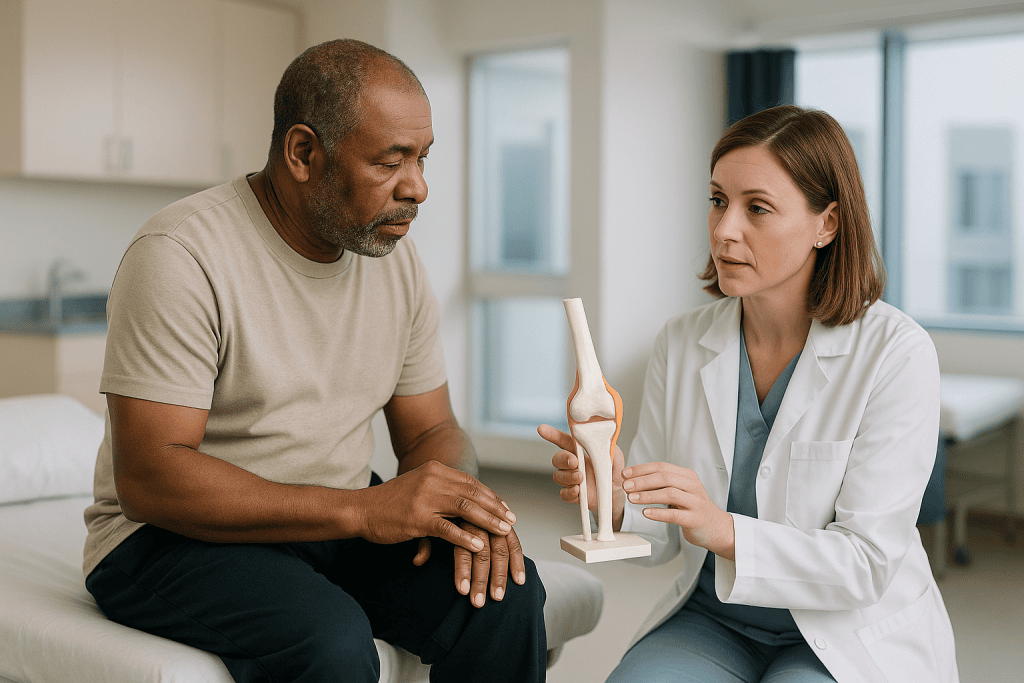
A healthy bursa holds only a film of lubricating fluid. When its lining is irritated, the cells there release inflammatory signals and produce more fluid than the sac can comfortably hold. The result is the textbook picture that MedlinePlus and the NHS describe: a joint that feels achy or stiff, hurts more when you press on it or move it, and looks swollen and sometimes red.
Irritation reaches the lining in a handful of ways. Repetitive motion, such as throwing, painting or gardening, makes tendons rub across the bursa hundreds of times an hour. Sustained pressure, such as kneeling on hard floors or leaning on elbows, compresses it for long stretches. A direct blow can inflame it in a single moment. Crystals from gout, or the autoimmune activity of rheumatoid arthritis, can inflame a bursa from the inside without any mechanical cause at all. Bacteria can enter through a cut or scrape near a superficial bursa and set off an infection, called septic bursitis, which behaves differently and needs prompt medical care.
Once the stimulus is removed, the excess fluid is gradually reabsorbed and the lining settles. There is no scar to heal in the way a torn tendon must heal. That is why a first flare can feel like it vanishes completely. It also explains why the same stimulus, reintroduced, can bring it straight back.
Why does bursitis keep coming back for some people and not others?
Two people develop elbow bursitis from the same desk job. One never has it again. The other gets a flare every winter. What separates them is rarely luck.
The first difference is whether the load actually changed. Reducing pressure for two weeks and then resuming the identical habit resets the clock rather than stopping it. The person who moved the monitor, padded the armrest or stopped propping their chin on a fist has removed the driver; the person who simply waited for the pain to fade has not.
The second difference is what sits around the bursa. A bursa is a bystander to the tendons and muscles it cushions. If the rotator cuff is weak or the tendon that runs over the outer hip is degenerating, the bursa nearby is repeatedly squeezed by movement patterns that a stronger, better-coordinated joint would spread more evenly. This is why many clinicians treat recurrent shoulder or hip bursitis as a mechanics problem rather than a bursa problem, and why a rehabilitation program aimed at the surrounding muscles is often central to keeping flares away.
The third difference is systemic. The Mayo Clinic lists rheumatoid arthritis, gout and diabetes among conditions that raise bursitis risk, along with increasing age and occupations or hobbies involving repetitive motion or pressure. Someone with poorly controlled gout can have a bursa inflamed by urate crystals no matter how carefully they pad their knees; their recurrence question is really a gout-control question. Higher body weight also increases load on hip and knee bursae, which is one of several reasons weight comes up in these conversations, always as a mechanical factor to discuss with a clinician, never as a judgment.
Recurrence, in other words, is usually a sign that one of these three layers has not been addressed.
What triggers a bursitis flare-up? The usual suspects
People often describe a flare as arriving out of nowhere. Walk back through the preceding week and a trigger usually appears. The most common ones fall into predictable groups, drawn from the causes listed by the Mayo Clinic, NHS and Cleveland Clinic.

- A sudden spike in repetition. A weekend of overhead painting, a first week back at tennis, a long drive with an arm resting on the window ledge, a burst of spring gardening on the knees. The bursa was fine at the usual dose of movement; the surge overwhelmed it.
- Sustained pressure. Kneeling on tile to lay flooring, leaning elbows on a hard desk for hours of video calls, sitting for long periods on a firm surface with the hip pressed against it. Occupations such as carpet laying, plumbing and roofing feature heavily in bursitis descriptions for exactly this reason.
- A knock or fall. Landing on the point of the elbow or the side of the hip can inflame the bursa directly, and a bruised bursa is more easily irritated in the weeks afterward.
- A change in footwear or terrain. New running shoes, a shift to hills, or a return to walking after time off changes how force travels through the hip and knee.
- Flares of an underlying condition. A gout attack or a period of active rheumatoid arthritis can light up a bursa alongside the joint.
- Infection. A scrape or insect bite over a superficial bursa, especially at the elbow or front of the knee, can allow bacteria in. This is the one trigger that changes the urgency entirely.
Keeping a brief note of what you did in the three or four days before each flare is one of the most useful things a patient can bring to an appointment. Patterns that are invisible in the moment become obvious on paper.
How long does bursitis last, and how long is too long?
Most people want a number, and the honest range is wider than they would like. The NHS describes bursitis as usually getting better on its own within a few weeks, and advises seeing a GP if symptoms have not improved, or are getting worse, after two weeks of home care. The Mayo Clinic gives the same broad timeline: a few weeks with treatment, with flares that may return.
That two-week checkpoint is a sensible line to hold in your head. A bursa that is improving by day ten, even if not fully settled, is usually behaving as expected. A bursa that is no better, or worse, at two weeks deserves a clinician’s eyes, both to confirm the diagnosis and to look for a driver that home care cannot fix.
Several things stretch the timeline. Continuing the triggering activity is the obvious one. Deep bursae, such as the one under the rotator cuff or on the outer hip, cannot be iced or padded as directly as a superficial elbow bursa, so they often take longer to calm. Bursitis that sits alongside a tendon problem tends to follow the slower rhythm of tendon healing, measured in months rather than weeks. Inflammatory conditions add their own tempo.
Duration also depends on what is being counted. A single episode that lasts six weeks is different from six one-week episodes spread over a year, yet both people might say they have had bursitis for a year. The first pattern points toward a stubborn driver or an alternative diagnosis; the second points toward a trigger that keeps being reintroduced. Clinicians will want to know which pattern is yours.
So how long is too long? Pain that has lasted beyond a few weeks despite genuinely resting the area, or that returns more than a couple of times a year, has moved beyond the simple category and warrants a proper assessment rather than another round of waiting it out.
Chronic bursitis: what changes when a bursa stays irritated for months
Clinicians sometimes divide bursitis into acute and chronic forms, and the distinction matters for expectations. Acute bursitis is the sudden, swollen, often tender episode described above. Chronic bursitis refers to a bursa that has been repeatedly or continuously inflamed over a long period, and it behaves a little differently.
With prolonged irritation the bursa lining can thicken. The sac may hold fluid more persistently, so a soft lump over the elbow or knee lingers even when pain has faded. Some people notice the joint feels less acutely painful than during a first flare but is never quite right: stiff in the morning, aching after activity, sensitive to pressure. Cleveland Clinic and Johns Hopkins both describe this longer-running picture as more common when repetitive motion or pressure has continued for extended periods.
Chronic bursitis is also where the question of what is really being treated becomes sharpest. A thickened bursa on the outer hip that has ached for a year is, in many people, sitting on top of a gluteal tendon that has itself become worn. Treating the bursa alone in that situation tends to give short-lived relief. This is one reason many specialists now prefer the broader term greater trochanteric pain syndrome for persistent outer hip pain, acknowledging that tendon and bursa are usually both involved.
The practical consequence is that chronic cases are less about calming a flare and more about a structured program: reducing the offending load, progressively strengthening the muscles that control the joint, and correcting the movement patterns that overload the area. Imaging such as ultrasound or MRI may be used to see what else is going on. Injections and, rarely, surgery enter the conversation here, but as parts of a plan rather than as fixes in themselves.
What gets mistaken for bursitis? Why the label is not always right
Bursitis is a convenient diagnosis because the bursae sit in exactly the places people hurt. That convenience cuts both ways. Several conditions produce pain in the same spots, and when bursitis keeps coming back the first question worth asking is whether it was ever bursitis at all.
Tendinopathy is the most frequent look-alike. Tendons and bursae are neighbors, and a rotator cuff tendon problem in the shoulder or a gluteal tendon problem at the hip produces pain that overlaps almost exactly with bursitis in those areas. The two frequently coexist, and the tendon is often the slower-healing and more important half.
Arthritis of the underlying joint is another. Hip osteoarthritis can refer pain to the outer thigh; shoulder arthritis can mimic subacromial bursitis. Deep, aching pain that worsens with weight-bearing or is felt in the groin rather than the outer hip points more toward the joint than the bursa.
Gout and pseudogout can inflame a bursa directly, which technically is bursitis, but treating it as a mechanical problem misses the point. Rheumatoid arthritis can do the same.
Referred pain from the spine, particularly the lower back to the outer hip or the neck to the shoulder, fools many people. Nerve-type pain that shoots, tingles or follows a line down a limb is a clue.
Finally, septic bursitis is not so much mistaken for bursitis as mistaken for ordinary bursitis. An infected bursa is red, hot, increasingly painful and often accompanied by fever or feeling unwell. It needs medical assessment quickly, because infection can spread.
A clinician distinguishes these with a careful history, an examination that presses and moves the joint in specific ways, and sometimes imaging or a sample of the bursal fluid. If your bursitis has returned repeatedly without a clear mechanical trigger, that re-examination is the most valuable next step.
Which joints tend to recur, and why: shoulder, hip, elbow and knee
Recurrence is not spread evenly across the body. The Mayo Clinic lists the shoulder, elbow and hip as the most common sites, with the knee, heel and base of the big toe also affected. Each has its own recurrence logic, and a short comparison makes the differences clear.
| Site | Bursa most often involved | Typical drivers | What tends to shape recurrence |
|---|---|---|---|
| Shoulder | Subacromial bursa, under the tip of the shoulder blade | Overhead work, throwing, swimming, painting | Rotator cuff strength and tendon health; overhead activity that resumes without conditioning |
| Hip (outer) | Trochanteric bursa, over the bony point on the side of the hip | Walking and running load, side-lying on a firm surface, leg-length or gait differences | Gluteal tendon condition; hip and pelvic muscle control; often labeled greater trochanteric pain syndrome |
| Elbow | Olecranon bursa, over the point of the elbow | Leaning on desks, direct knocks | Superficial position makes it easy to re-injure and more prone to infection through the skin |
| Knee (front) | Prepatellar bursa, in front of the kneecap | Kneeling on hard surfaces | Occupational kneeling; also a common site for septic bursitis |
| Heel | Retrocalcaneal bursa, between the heel bone and Achilles tendon | Footwear rubbing, running, tight calves | Achilles tendon health and shoe fit |
Notice a pattern in the right-hand column. The superficial bursae at the elbow and knee recur because they are easy to knock and lean on, and their skin-level position makes infection the concern to watch. The deep bursae at the shoulder and hip recur because they sit beneath tendons whose condition dictates how much friction the bursa endures. Two very different recurrence problems hide behind the same word.
How treatment works, and why relief is not the same as removing the cause
Treatment for bursitis operates on two levels, and confusing them is the single biggest reason people feel stuck in a cycle of flares.
The first level calms the inflamed bursa. Rest from the aggravating activity gives the lining a chance to settle. Ice, which the NHS suggests applying wrapped in a cloth for around ten minutes at a time, several times a day, narrows local blood vessels and dulls pain. Padding a superficial bursa, or changing how you sit and lie, removes direct pressure. Over-the-counter anti-inflammatory medicines in the NSAID class reduce the chemical signals driving swelling; whether they are appropriate for you depends on your health history and is a question for a pharmacist or clinician. When a flare is severe or slow to settle, a clinician may offer a corticosteroid injection into or near the bursa. Steroids work by suppressing the inflammatory response locally, and the Mayo Clinic notes this generally brings rapid relief. If the bursa is infected, antibiotics and sometimes drainage are needed, and the plan is entirely different.
The second level addresses why the bursa was irritated. This is slower, less dramatic and far more decisive for long-term results. It might mean a physical therapist assessing your shoulder mechanics and prescribing progressive strengthening for the rotator cuff; a change in how you kneel at work, with padded knee protection; a review of running load and footwear; or better control of gout or another inflammatory condition with your physician.
An injection that quiets the bursa but leaves a weak, poorly controlled shoulder in place buys time. Time is valuable, especially when it allows rehabilitation to begin without pain in the way. Mistaking that time for a permanent fix is where the disappointment comes from. Every treatment decision, including whether an injection or a rehabilitation program comes first, belongs with the clinician who has examined you.
Who is usually offered injections or surgery, and who is asked to wait
Because bursitis so often settles on its own, the ladder of treatment is deliberately conservative, and where you sit on it depends on how the condition is behaving rather than how much it hurts today.
People with a first or occasional flare, a clear mechanical trigger and no signs of infection are usually asked to manage at home first: rest, ice, pressure relief, and simple pain relief if appropriate. Cleveland Clinic and the NHS both frame this as the expected starting point, with review if things have not improved at around two weeks.
People whose flares recur despite genuinely modifying the trigger, or whose pain limits daily function, are more often referred for physical therapy and, where needed, imaging to look at the surrounding tendons and joint. A corticosteroid injection may be considered when pain is preventing rehabilitation or when a deep bursa has not responded to other measures. Clinicians tend to limit how often steroid injections are repeated in the same area because of concerns about effects on nearby tendon and tissue, so an injection is generally a bridge rather than a routine maintenance step. The judgment about timing and frequency rests with the treating clinician.
Surgery to drain or remove a bursa is uncommon. It is usually reserved for chronic bursitis that has failed a sustained course of conservative care, for a bursa that repeatedly fills with fluid and interferes with function, or for infected bursae that need drainage. Because the surrounding tissues generate the friction, removing a bursa does not remove the mechanical problem, and surgeons and patients weigh that carefully.
People asked to wait, in the sense of holding off on invasive options, are typically those who have not yet given load modification and a structured rehabilitation program a fair trial, or whose diagnosis is not yet clear. Waiting in that context is not neglect; it is the evidence-based sequence.
What the following weeks usually look like after a flare settles
The first week of a typical flare is about noise reduction. Pain is at its sharpest, swelling is most visible, and the job is to stop the irritant, apply ice, avoid pressure and keep the joint moving gently within comfort so it does not stiffen. Complete immobility is rarely advised; gentle range of motion helps.
By the second week, most uncomplicated cases are clearly improving, which is why the NHS sets its check-in point there. Swelling recedes, the joint tolerates ordinary daily use, and the temptation to declare victory arrives. This is the most important fortnight for recurrence, because what happens next decides whether the bursa stays quiet.
Weeks three to six are typically when a graded return to activity happens. Graded is the key word. A painter who took two weeks off and then does a full day of ceilings has reproduced the original trigger at full strength. A more durable path is a partial return, shorter sessions, more frequent breaks, and attention to the mechanics that overloaded the area. If a physical therapist is involved, this is also when strengthening work moves from gentle activation to progressive load.
Beyond six weeks, most single episodes are a memory. For deep bursae with associated tendon involvement, and for chronic cases, improvement continues over several months, and the rehabilitation program often runs that long. Setbacks are common and not a sign of failure; a small flare after a new activity is information about what the joint can currently tolerate.
Timelines here are typical ranges drawn from NHS and Mayo Clinic descriptions, not promises. Age, the specific bursa, tendon health and any underlying condition all shift them. The one constant is that the weeks after pain fades matter at least as much as the weeks when it is present.
Can you permanently get rid of bursitis, or does bursitis come back no matter what?
This is the question underneath every other question, so it deserves a careful answer rather than a cheerful one.
Bursitis is not a disease that lives in the bursa waiting to reactivate. It is a response. That means the honest goal is not to eliminate something inside you but to stop the conditions that keep provoking it. Framed that way, long-term results are generally encouraging. People whose bursitis was driven by a specific pressure or repetition, and who changed that pressure or repetition, frequently have no further episodes. People whose bursitis sat on top of a tendon problem and who completed a strengthening program often find both improve together, with flares becoming rarer and milder. People whose bursitis was a feature of gout or rheumatoid arthritis see the bursa follow the course of the underlying condition.
Where the picture is more guarded is when the driver cannot be fully removed. A roofer will keep kneeling. An older shoulder with a degenerated rotator cuff will not become twenty again. In those situations the realistic aim is control: fewer flares, shorter flares, and a clear plan for what to do when one starts. Mainstream sources are consistent that with attention to the cause, most people manage bursitis well over the long term; none of them promise it will never return, and this article will not either.
Two things distinguish people who do well from people who cycle. The first is diagnostic accuracy, because a tendon or joint problem mislabeled as bursitis will keep behaving like a tendon or joint problem. The second is persistence with the unglamorous part, the padding, the ergonomics, the strengthening, after the pain has gone. The bursa cannot tell that you have lost interest. It only knows whether the load has changed.
What people often get wrong about recurrent bursitis
Some beliefs about bursitis are so common they pass unchallenged. Several of them quietly sabotage recovery.
Myth: if it came back, the first treatment failed. A flare that settled and then returned after the same activity is evidence the treatment worked and the trigger was reintroduced. The fix was fine; the follow-through was missing.
Myth: rest means stopping everything. Prolonged immobility stiffens joints and weakens the very muscles that protect the bursa. Rest in this context means rest from the aggravating movement or pressure, while keeping the joint gently mobile.
Myth: an injection is a permanent fix. Corticosteroid injections reduce inflammation locally and can bring rapid relief, but they do not change the mechanics that irritated the bursa. They are most useful as a window in which rehabilitation can happen.
Myth: hip bursitis is a bursa problem. Persistent outer hip pain frequently involves the gluteal tendons, which is why many specialists prefer the term greater trochanteric pain syndrome. Treating only the bursa often disappoints.
Myth: swelling without pain is nothing to worry about. A painless fluid-filled bursa at the elbow or knee is often harmless, but any change toward redness, warmth or increasing pain, or a wound over the area, needs assessment for infection.
Myth: pushing through it toughens the joint. Bursae do not adapt to friction the way muscles adapt to load. Continuing to irritate one tends to produce a thicker, more persistently inflamed bursa, not a more resilient one.
Myth: it only happens to athletes or older people. The Mayo Clinic lists age and repetitive occupations as risk factors, but kneeling tradespeople, desk workers who lean on elbows, and new parents lifting and carrying all appear regularly in clinic.
Correcting these is not pedantry. Each one changes what a person does in the weeks after a flare, and those weeks are where recurrence is decided.
Questions to ask your care team when bursitis keeps returning
A good consultation for recurrent bursitis is a detective exercise, and you are the primary witness. Arriving with specific questions makes the time count. These are the ones that most often change the plan.
- Is this definitely bursitis, or could a tendon, the joint itself, or my spine be contributing? This single question reframes many stubborn cases.
- What do you think is driving it? Ask for the mechanical, positional or systemic cause in plain language. If the answer is unclear, ask what would help clarify it.
- Would imaging change what we do? Ultrasound or MRI can be useful when tendons or the joint are suspected, and unnecessary when the picture is clear.
- Should I be checked for gout, rheumatoid arthritis or another inflammatory condition? Especially relevant if flares arrive without an obvious mechanical trigger or affect more than one area.
- What exactly should I change at work or in training, and for how long? Vague advice to take it easy is hard to act on. Ask for specifics.
- Would physical therapy help, and what would the program target? Understanding whether the aim is strength, movement control or flexibility helps you commit to it.
- If you are suggesting an injection, what is its role in the overall plan, and how many times is it reasonable to repeat?
- What signs should make me contact you sooner rather than waiting for the next appointment?
- How will we judge whether the plan is working, and over what timeframe?
Bring a brief timeline of past flares and what preceded each. Note which measures helped and which did not. If you have had injections, know roughly when and where. None of this replaces the clinician’s examination, but it gives them the pattern that a single snapshot cannot show, and it keeps the decisions where they belong: with the team that has assessed you.
When to call your doctor
Most bursitis can be safely managed at home in its early days, but a short list of signs should move you from waiting to calling, and a few should send you for same-day care.
Contact your doctor promptly if the area becomes red, hot to the touch, or increasingly painful, if you develop a fever or feel generally unwell, or if there is a cut, scrape, bite or other break in the skin over a swollen bursa. These raise the possibility of septic bursitis, an infection inside the sac. The Mayo Clinic lists fever alongside disabling joint pain, sudden inability to move a joint, excessive swelling, redness, bruising or rash, and sharp or shooting pain, particularly with exertion, as reasons to see a clinician. Infection can spread to surrounding tissue or the bloodstream and is treated very differently from ordinary bursitis, so this is not a wait-and-see situation.
Also make an appointment, without urgency but without delay, if pain has not improved after about two weeks of genuine home care, in line with NHS guidance; if flares are returning more than a couple of times a year; if pain wakes you at night or limits everyday tasks; if you notice weakness, numbness or tingling in the limb; or if you have gout, rheumatoid arthritis, diabetes or a weakened immune system, since these change both the likely cause and the risk of infection.
Seek emergency care if a red, swollen joint is accompanied by high fever, confusion, rapid heartbeat or spreading redness up the limb.
Trust the trend more than any single day. A joint that is slowly improving is usually fine to keep managing. A joint that is heading the wrong way, or standing still past two weeks, has earned an examination. Your clinician can tell the difference between a bursa that needs more time and one that needs a different plan, and that judgment is theirs to make with you.
Frequently asked questions
Can you permanently get rid of bursitis?
Often, yes, in the practical sense that many people never have another episode once the cause is removed. Bursitis is a response to pressure, repetition, injury, infection or inflammatory disease rather than a condition that lives in the bursa. If the driver is fully addressed, flares frequently stop. Where the driver cannot be eliminated, such as an occupation that involves kneeling or an aging tendon, the realistic aim is control with fewer, shorter flares.
Why does bursitis keep coming back in the same joint?
Because the same load keeps landing on the same shock absorber. A bursa calms down when irritation stops and reactivates when it resumes, so returning to the identical habit or activity after a rest typically brings it back. Recurrence in one joint also points to local factors: weak or poorly coordinated muscles around a shoulder or hip, a worn tendon rubbing over the bursa, or a posture or piece of equipment that compresses it.
What triggers a bursitis flare-up most often?
A sudden increase in repetitive movement, such as a weekend of overhead painting or a return to sport, and sustained pressure, such as kneeling on hard floors or leaning on elbows, are the most common triggers described by mainstream sources. Direct knocks, new footwear or terrain, flares of gout or rheumatoid arthritis, and infection through a skin break over a superficial bursa also set off episodes. Reviewing the few days before each flare usually reveals the pattern.
How long does bursitis last before it should be checked?
Most episodes improve within a few weeks, and the NHS suggests seeing a GP if symptoms have not improved or are getting worse after about two weeks of home care. Deep bursae at the shoulder and hip, and bursitis alongside a tendon problem, can take longer. Pain persisting beyond a few weeks despite genuine rest, or returning several times a year, has moved beyond a simple flare and warrants assessment.
What gets mistaken for bursitis?
Tendon problems are the most common look-alike, because tendons and bursae sit side by side at the shoulder, hip and heel and often hurt in exactly the same place. Osteoarthritis of the underlying joint, referred pain from the neck or lower back, and gout or rheumatoid arthritis inflaming the bursa from within are also frequently confused with mechanical bursitis. A careful examination and sometimes imaging or fluid analysis separate them.
Is chronic bursitis different from a regular flare?
Yes. Chronic bursitis describes a bursa that has been repeatedly or continuously inflamed over months, often with a thickened lining and persistent fluid. It tends to ache rather than scream, feels stiff after rest and sensitive to pressure, and is more likely to sit alongside a worn tendon. Management shifts from calming a flare toward a structured program of load reduction and progressive strengthening, with imaging, injections or rarely surgery considered by the treating team.
Does a steroid injection stop bursitis from coming back?
Not by itself. A corticosteroid injection reduces inflammation locally and, according to the Mayo Clinic, generally brings rapid relief, but it does not change the pressure, movement pattern or tendon condition that irritated the bursa. Its most useful role is creating a pain-free window in which rehabilitation and activity changes can happen. Clinicians usually limit repeat injections in the same area, and decisions about timing rest with them.
Can bursitis come back as an infection?
An ordinary flare does not turn into an infection on its own, but the superficial bursae at the elbow and front of the knee can become infected if bacteria enter through a cut, scrape or bite over the area. Septic bursitis looks different from a mechanical flare: the skin is red and hot, pain increases rather than settles, and fever or feeling unwell may develop. It needs prompt medical care and a different treatment approach.
Should I keep exercising if my bursitis keeps returning?
Usually yes, with modification rather than complete rest. Prolonged inactivity stiffens joints and weakens the muscles that protect the bursa, which tends to make recurrence more likely. The aim is to avoid the specific movement or pressure that irritates the area while keeping the joint gently mobile and, often, working with a physical therapist on strengthening the surrounding muscles. Your clinician or therapist can tailor which activities to pause and which to continue.
What long-term results do most people with bursitis see?
Mainstream sources describe the outlook as generally good when the underlying cause is addressed, with most people managing bursitis well over time. Single episodes with a clear mechanical trigger often do not return once the trigger is changed. Cases tied to tendon wear or an inflammatory condition tend to follow the course of that underlying problem, with the goal of fewer and milder flares. No reputable source promises it will never recur.
References
This article is for general information only and is not a substitute for professional medical advice. Please consult a qualified doctor about your individual situation.

More from the Blog

Soft Tissue Injury Healing Stages: Why Sprains, Strains and Bruises Heal at Different Rates
Soft tissue injury healing time depends on what was damaged and how well it is supplied with blood. Bruises usually fade within about two…

What Happens Years After Meniscus Surgery? Cartilage Wear and Realistic Expectations
Years after meniscus surgery, the knee's future depends mainly on how much meniscus tissue was removed and how healthy the cartilage was beforehand. Partial…

Does a Sprain or Strain Need an MRI? When Imaging Adds to a Soft Tissue Injury Exam
Most sprains and strains do not need an MRI. Clinicians usually diagnose them by asking how the injury happened and examining the joint or…
Does a Torn ACL Always Need Surgery? Who Copes Without Reconstruction and Who Does Not
Not always. Many people with a torn ACL, particularly those who do not play pivoting sports, regain a stable, working knee through structured rehabilitation…

Is Swelling After Ankle Arthroscopy Normal? What Helps and When to Call Your Team
Some swelling after ankle arthroscopy is expected and usually peaks in the first few days before easing over several weeks, because the joint is…
Preparing for Meniscus Surgery: The MRI Review, Fasting Rules and Medicine Checklist
Preparing for meniscus surgery usually involves three strands: an MRI review with your surgeon that clarifies whether the tear is likely to be trimmed…