

Does Urine Flow Improve After Prostate Surgery? How Uroflowmetry Tracks the Result Over Time

Key Takeaways
- Uroflowmetry measures urine speed in milliliters per second, and MedlinePlus lists typical peak flow for men falling from about 21 mL/sec in early adulthood to about 9 mL/sec after age 65.
- Flow readings taken in the first weeks after TURP often underestimate the final result because swelling and bladder irritation narrow the channel temporarily.
- The most useful comparison after BPH surgery is your own pre-operative tracing at a similar voided volume, not the population average for your age.
- A post-void residual scan shows how much urine stays behind, and a good peak flow with a large residual is a more concerning combination than a modest flow with an empty bladder.
- Persistent slow flow months after surgery usually traces to scar tissue at the bladder neck or urethra, regrowth of prostate tissue, or a bladder muscle weakened by years of obstruction.
- Home flow apps and portable funnels can track trends but cannot measure residual volume, so clinicians use them alongside, not instead of, the clinic test.
For most people who have surgery to relieve a blockage from an enlarged prostate, urine flow does improve, and uroflowmetry is the standard way to measure that change. The test records how many milliliters you pass per second into a special funnel. Early readings can be misleading because of swelling and irritation, so urologists usually compare results taken weeks to months apart rather than judging a single number.
Six weeks after his prostate operation, a retired schoolteacher stands in a small room off the urology corridor, staring at what looks like a plastic commode with a wire coming out of it. A nurse has told him to relax and go when he is ready. He has never had performance anxiety about anything, he jokes, until now.
That machine is a uroflowmeter, and the few seconds he spends over it will produce a graph his surgeon can hold up next to the one taken before surgery. A urine flow test after prostate surgery is not a pass or fail exam. It is a way of putting a number on something that used to be a feeling: the sense that the stream is stronger, or is not yet where it should be.
This explainer walks through what uroflowmetry measures, what a normal result looks like at different ages, why the first readings after an operation can look worse than expected, and how the pattern over months tells the fuller story.
What is a urine flow test after prostate surgery, and why is it repeated?
Uroflowmetry is a test that measures how fast urine leaves the body, recorded in milliliters per second. You urinate into a funnel connected to an electronic sensor, and the machine draws a curve showing the rate of flow from the first drop to the last. According to MedlinePlus, the test also records the total volume passed and how long the void took, which together describe the strength and pattern of your stream.
Before an operation for benign prostatic hyperplasia (BPH, the non-cancerous enlargement of the prostate that squeezes the urethra), a low peak flow helps confirm that the gland is genuinely obstructing the outflow. After surgery, the same test asks a different question: has the channel actually opened, and is the bladder able to use it?
The reason the test is repeated rather than done once is simple. The urinary tract does not settle into its new state on day one. Swelling at the operation site, irritation from the catheter, and a bladder muscle that spent years straining against resistance all change the reading in the early weeks. A single flow measured at two weeks may bear little resemblance to one measured at three months. Urologists therefore look at the trajectory, not the snapshot.
There is another practical reason. Flow rate depends heavily on how much urine is in the bladder when you start. A void of a small volume produces a low peak even in a wide-open urethra. Clinics usually ask for a comfortably full bladder and may repeat the test on the same visit if the first attempt was too small to interpret. The best comparison is between voids of similar volume, taken under similar conditions, months apart.
How uroflowmetry actually works: what happens in the room
The setup is deliberately low-tech from the patient’s side. You arrive with a full bladder, ideally the kind of fullness you would normally act on rather than an uncomfortable urge. The nurse shows you the funnel, explains that you should stand or sit exactly as you would at home, and leaves the room. Privacy matters more than most people expect; a self-conscious void produces a jerky, artificially weak curve, which is why staff step out and why the machine is usually in a quiet side room.
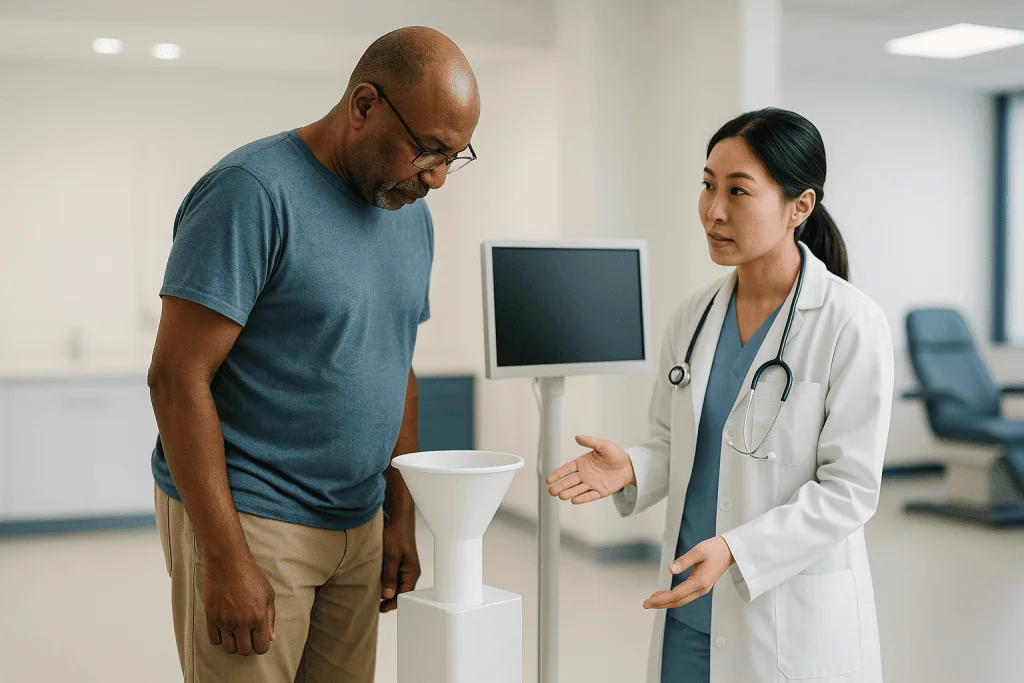
Inside the funnel, a sensor measures the weight or volume of urine arriving over time, typically several readings per second. The software converts that into a flow curve. Three features get the most attention. The maximum flow rate, often written Qmax, is the highest speed reached during the void. The voided volume is the total amount passed. The shape of the curve shows whether the stream rose smoothly to a peak and tailed off, or stuttered, plateaued, or dragged on.
A healthy void looks like a bell: a quick rise, a clear summit, and a steady fall, all finished in a matter of seconds. A void through a narrowed urethra looks flattened, as if someone pressed the bell down with a hand, often with a long, low tail. A bladder that has lost some of its squeeze can produce a wavering, interrupted pattern even when the channel itself is open.
Many clinics follow the flow test with a bladder scan, a painless ultrasound over the lower abdomen that estimates how much urine remains. That post-void residual, defined in one sentence as the amount left behind after you finish, tells the team whether the bladder is emptying as well as the flow suggests. Together, flow and residual give a two-dimensional picture that neither provides alone.
What is a normal male urine flow rate?
The honest answer is that normal is a range that slides with age, and that context changes what the number means. MedlinePlus lists typical maximum flow rates for men by age band, and the pattern is worth seeing side by side with the values usually quoted for women, because it makes the point that men’s flow declines through adult life as the prostate grows.
| Age (men) | Typical maximum flow (mL/sec) |
|---|---|
| 14–45 | About 21 |
| 46–65 | About 12 |
| 66–80 | About 9 |
Source: MedlinePlus, Uroflowmetry. These are averages, not cutoffs; individual results vary widely.
Several things complicate a straight reading. Volume comes first: a peak flow measured on a small void is not comparable to one on a generous void, and most laboratories will tell you the minimum they need before they trust the number. Effort matters too. Some men, especially those who spent years pushing to empty, keep straining out of habit, which can inflate the peak briefly and then let the curve collapse.
Then there is the question of what you are comparing against. After surgery for BPH, the meaningful comparison is your own pre-operative value. A man in his seventies whose peak flow doubles from a low starting point may have had an excellent result even if his new number sits below the average for a man of thirty. Conversely, an unchanged flow in someone whose bladder was already weak before surgery may reflect the bladder rather than the operation. Your urologist reads the figure against your history, your residual volume, and how you feel, not against a poster on the wall.
How long does a urinary flow test take?
The measuring part is quick. According to MedlinePlus, the actual test simply involves urinating into the device, which for most people means a matter of seconds to a minute or two, depending on how much is in the bladder and how freely it flows. The longer part of the appointment is often the waiting beforehand while your bladder fills, and the scan afterward to estimate the residual.
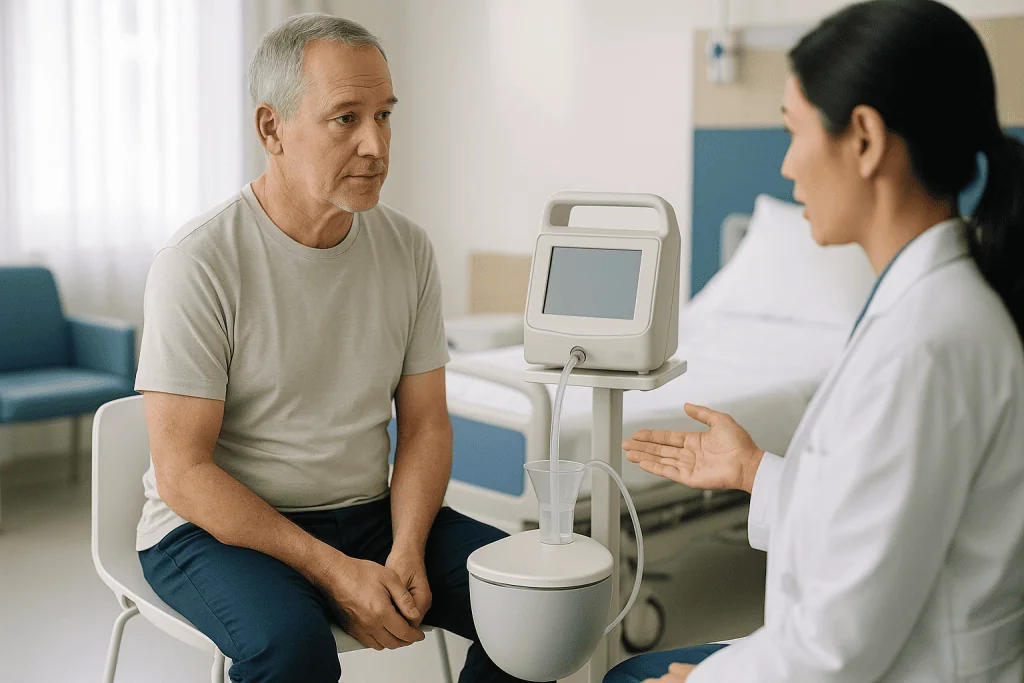
Plan for the whole visit, not just the void. Clinics commonly ask you to arrive with a reasonably full bladder and may offer water if you are not ready. Some run the flow test alongside a symptom questionnaire, a urine dipstick to check for infection, or a bladder ultrasound. If your first attempt produced too little urine to interpret, staff may ask you to drink and try again after a wait. It is worth clearing an hour or so even though the machine time is brief.
Preparation is minimal and mostly about avoiding a misleading result. Tell the nurse if you have symptoms of a urinary infection, since inflammation itself can weaken flow. Mention any medicines you take that act on the bladder or prostate, because alpha-blockers (a class of medicine that relaxes muscle at the bladder neck) and others can influence the curve; your clinician will decide whether anything needs to change, and you should never stop or alter a prescribed medicine on your own for the sake of a test.
You can expect no needles, no dye, and no recovery period. The main risk is embarrassment, and experienced staff are well practiced at making that fade. If you are prone to stage fright, tell them; a few extra minutes, running water, or simply being reassured that a poor attempt can be repeated usually solves it.
Which prostate operation did you have? Why it changes what improvement means
Prostate surgery is not one procedure, and the expected flow story differs by type. The distinction that matters most is between operations that remove obstructing tissue for BPH and operations that remove the whole gland for cancer.
Transurethral resection of the prostate (TURP) uses an instrument passed through the urethra to shave away the inner part of the gland that is pinching the channel. MedlinePlus describes it as the most common surgery for an enlarged prostate. Laser procedures, including enucleation and vaporization techniques, remove or dissolve the same tissue using laser energy through a similar scope. Several minimally invasive options lift, implant into, or heat the tissue rather than cutting it. All of these aim to widen the passage, so a rising flow rate is a direct measure of whether the target was hit.
Radical prostatectomy is the operation for prostate cancer in which the entire gland is removed and the bladder is reconnected to the urethra. Here the goal is cancer control, not a stronger stream, and many people had normal flow beforehand. After this operation, flow testing is used more selectively, often when a surgeon suspects that scar tissue has formed at the new join between bladder and urethra. The more prominent recovery topics are leakage and continence, which the Mayo Clinic notes can take weeks to months to settle.
Keep the difference in mind when reading forums or comparing notes with a neighbor. A man recovering from TURP who worries that his flow is not yet strong is asking a fair question about the operation’s purpose. A man after prostatectomy whose flow is powerful but who leaks when he coughs is dealing with an entirely different physiology. The same machine reports on both, but the meaning of the graph depends on what was done.
Who is usually asked to have the test, and who is usually asked to wait
Not everyone gets a flow test at every follow-up, and the timing is deliberately individual. In general, uroflowmetry after prostate surgery is offered to people whose operation was intended to relieve obstruction and who are far enough along in recovery for the reading to mean something. It is also used when symptoms return after an initial improvement, when someone reports a stream that never picked up, or when a surgeon wants objective evidence before considering a second procedure.
Several situations usually lead to a delay. If you still have a catheter, there is nothing to measure. If the urine remains bloody or you have signs of infection, the result would reflect irritation rather than anatomy, and testing waits until the bladder is calm. Very early after surgery, even without complications, swelling at the operation site narrows the channel temporarily; the Mayo Clinic notes that irritative symptoms such as urgency and frequency are common in the weeks after TURP and settle as healing progresses. Testing during that window tends to produce a pessimistic picture that later improves without anyone doing anything.
Some people are not the right candidates for flow testing at all, or the test is interpreted with extra caution. A bladder that was badly stretched before surgery, or one affected by nerve conditions such as diabetes or spinal problems, may generate a low peak flow regardless of how open the outlet is. In those cases urologists may lean on the residual volume, a bladder diary, or occasionally pressure-flow studies, which are more detailed tests that measure bladder pressure and flow together.
The pattern across guidelines is consistent: the test is a tool the treating team chooses when it will change understanding or decisions, not a ritual applied at fixed intervals. If you have not been offered one and wonder why, ask. The answer is usually about timing rather than oversight.
The first days and weeks: what urine flow after prostate surgery usually looks like
The early timeline is where expectations most often collide with reality. After TURP, the Mayo Clinic describes a catheter left in place for at least a day or two until swelling settles and urine can drain. Once it comes out, many people notice an immediately different sensation: the stream starts more readily and empties faster than they remember. Others notice burning, urgency, and a stream that is strong for a moment and then stings. Both experiences are common in the first days.
Blood in the urine, sometimes on and off for weeks, is expected as the raw surface of the resected area heals. Small clots can transiently interrupt the stream, which feels alarming and is usually nothing more than debris on its way out. Frequency and urgency, the sense of needing to go often and suddenly, reflect a bladder that is irritated and a muscle that has not yet learned it no longer needs to fire so hard. The Mayo Clinic notes these irritative symptoms generally improve over the following weeks.
Full recovery is slower than the hospital stay suggests. The Mayo Clinic advises avoiding strenuous activity and heavy lifting for around four to six weeks after TURP, mainly to reduce bleeding risk while the surface heals. Sexual function commonly returns during that period, though many people notice retrograde ejaculation, in which semen travels backward into the bladder rather than out, a frequent and usually permanent effect of surgery through the bladder neck.
After radical prostatectomy the pattern differs. The Mayo Clinic describes a catheter typically in place for one to two weeks, followed by a period of leakage that improves gradually for most people over the months that follow. Flow, when tested, is often already adequate; the harder work is regaining control. In both cases, the realistic frame is months, and a curve measured at three months usually looks quite different from one measured at three weeks.
Reading the curve over time: a summary table of common patterns
Flow curves have personalities, and experienced clinicians recognize them at a glance. The table below summarizes the patterns most often discussed at follow-up after prostate surgery, what they tend to suggest, and how the team usually responds. None of these is a diagnosis on its own; the shape prompts a question, and other tests answer it.
| Curve pattern | What it often suggests | Usual next step |
|---|---|---|
| Smooth bell, high peak, low residual | Open channel, bladder emptying well | Routine follow-up |
| Flattened, plateau-shaped curve | Persistent narrowing, possibly scar tissue at bladder neck or urethra | Examination of the urethra with a small camera (cystoscopy) |
| Wavering or interrupted curve with straining | Weak or overactive bladder muscle, or habit of pushing | Bladder scan, diary, sometimes pressure-flow study |
| Reasonable peak but high residual | Bladder not fully emptying despite open outlet | Repeat scan, review of medicines and fluids |
| Early good curve that later flattens | Regrowth of tissue or late scarring | Reassessment, comparison with earlier tracings |
Two points about using this well. First, the direction of travel matters more than any single reading. A curve that improves visit by visit is reassuring even if the number is still below an age-matched average; a curve that peaks at three months and then declines is a signal worth investigating even if the number remains acceptable. Second, the volume passed at each test should be similar, or the comparison is not fair. Ask the nurse to note the voided volume on each report so that future readings can be lined up properly.
Urologists also weigh how you feel. A person whose curve looks middling but who sleeps through the night for the first time in years has had a meaningful result. The graph is evidence, not verdict.
Why a urine flow test after prostate surgery can look worse before it looks better
People expect surgery to be a switch: obstruction on, then obstruction off. The tissue sees it differently. When the inner prostate is removed, the surrounding gland and bladder neck swell in response to the injury, exactly as an ankle swells after a sprain. For a period the channel can be narrower than it was before, and the flow test records that faithfully. This is why testing in the first days after catheter removal is rarely informative and often unsettling.
The bladder has its own adjustment to make. Years of pushing against resistance thicken the bladder wall and make the muscle twitchy. Remove the resistance and the muscle does not immediately relax; it can contract too eagerly, giving urgency and a stop-start curve, or it can be underpowered from long overstretching, giving a low, flat stream despite a wide-open outlet. The Mayo Clinic notes that irritative symptoms after TURP are common early and usually ease with time as healing completes.
Small pieces of healing tissue and blood clots can also interrupt flow transiently. A single test that catches one of these moments will show a dip that has nothing to do with the operation’s long-term success. Repeating the void, or repeating the test a few weeks later, usually resolves the ambiguity.
Finally, there is the matter of how the test itself is performed. A hurried void with a half-full bladder in an unfamiliar room, with a nurse waiting outside, will underperform the same person’s real-world stream at home. Clinicians know this and discount a single poor reading accordingly. If your first post-operative result disappoints, the most evidence-based response is usually patience and a repeat, not alarm. Persistent or worsening results over months are a different matter and are addressed in the sections that follow.
What the bladder scan adds: post-void residual and other checks read alongside
Flow tells you how fast the urine came out. It does not tell you how much stayed behind, and that second number can matter more. The post-void residual, measured by a handheld ultrasound placed on the lower abdomen right after you void, estimates the leftover volume in milliliters. The NHS describes it as one of the standard checks for people with prostate enlargement, and it is equally useful after treatment.
Why it matters is a question of consequences. Urine that sits in the bladder for long periods gives bacteria time to multiply and raises infection risk. Chronic retention can also stretch the bladder further and, over a long period, put pressure back toward the kidneys. A person with a modest flow but a near-empty bladder is in a better position than one with a superficially good peak who leaves a large volume behind each time.
Other pieces of the picture often accompany the flow test. A symptom score, usually a short questionnaire about frequency, urgency, night-time waking, and the sense of incomplete emptying, records the subjective side. A urine dipstick or culture rules out infection as a cause of a poor reading. A frequency-volume chart, in which you note the time and amount of each void over a few days at home, reveals patterns that a single clinic visit cannot, such as large night-time volumes that point to fluid handling rather than obstruction.
When flow, residual, and symptoms disagree, urologists look harder. A good flow with troubling symptoms suggests an irritable bladder rather than blockage. A poor flow with a large residual and a plateau-shaped curve points toward a physical narrowing. A poor flow with a small residual and a wavering curve suggests the bladder muscle itself is the weaker partner. Each combination leads down a different path, which is why the tests are ordered together rather than in isolation.
How do you fix a slow urine flow that persists after prostate surgery?
When flow remains poor months after surgery, the question is why, and the answer determines the response. Three broad explanations account for most cases, and the treating team works through them rather than assuming the operation failed.
The first is scar tissue. Healing at the bladder neck or along the urethra can occasionally produce a ring of fibrous narrowing, called a bladder neck contracture or urethral stricture depending on its location. The Mayo Clinic lists narrowing of the urethra or bladder neck as a possible complication of TURP that can require further treatment. Typically the diagnosis is confirmed by cystoscopy, a look inside with a slim camera, and management may involve stretching or cutting the narrowed segment in a short procedure. The decision rests with the surgeon after seeing the anatomy directly.
The second is residual or regrown tissue. Some procedures remove less tissue by design, and the prostate continues to grow with age. MedlinePlus notes that prostate tissue can grow back after TURP, sometimes years later. Options in that situation range from watchful monitoring to medicines that relax the bladder neck or shrink the gland, to a repeat procedure. Alpha-blockers work by relaxing smooth muscle at the outlet; 5-alpha-reductase inhibitors work by lowering the hormone that drives prostate growth and act over months rather than days. Whether either is appropriate is a decision for the prescribing clinician, weighed against your other medicines and conditions.
The third is the bladder itself. A muscle weakened by years of obstruction may not recover fully even once the outlet is open. Here the approach shifts from opening the channel to helping the bladder empty: timed voiding, double voiding (waiting a moment and trying again), reviewing fluids and medicines that dull bladder function, and in some cases intermittent self-catheterization taught by a specialist nurse. It is a less dramatic answer than another operation, but for the right person it is the one that works.
Can I perform a uroflow test at home?
Home flow measurement exists, and interest in it is growing, but the evidence base is younger than the clinic version and the results are not interchangeable. Two approaches are in use. The first is a portable electronic funnel that records flow much like the clinic device and stores or transmits the readings. The second is a smartphone application that estimates flow from the sound of urine hitting water in a toilet bowl. Both aim to capture many voids under natural conditions rather than one self-conscious void in a side room, which is a genuine advantage in principle.
The limitations are worth stating plainly. Sound-based methods are sensitive to bowl shape, water level, distance, and background noise, and their accuracy compared with laboratory uroflowmetry varies between studies. Portable devices are closer to the clinic standard but still require correct positioning and consistent technique. Neither can measure post-void residual, so the second half of the picture is missing unless paired with a clinic scan. Results are also easy to misread without training; a low peak on a small void means very little, and a nervous user can over-interpret a single bad reading.
Where home measurement earns its place is in tracking trends between clinic visits, particularly for someone whose surgeon wants to know whether an early improvement is holding. Several urology services now accept home recordings as supplementary information, but they interpret them alongside standard tests rather than instead of them.
The simplest home tool remains the frequency-volume chart: a measuring jug and a notebook, recording the time and volume of each void for three days or so. It costs nothing in equipment, requires no technology, and the NHS and other bodies use it routinely. If you want to bring data to your appointment, ask your team which method they would find useful before buying anything. A device that produces numbers nobody will read is not a diagnostic tool; it is a source of worry.
What people often get wrong about urine flow after prostate surgery
The first misconception is that a strong stream on day one means success and a weak one means failure. Swelling, irritation, and a bladder still learning its new circumstances all distort early readings. Urologists judge flow over months, and a person who worries at week two is usually reassured by month three.
The second is that a normal flow number equals a normal bladder. Peak flow and emptying are separate things. A respectable peak with a large residual volume still leaves someone at risk of infection and retention, and a modest peak with a near-empty bladder may be perfectly acceptable for someone in their late seventies.
The third is that the age-based averages in tables are targets. They are population averages, not thresholds you must reach. MedlinePlus lists them as typical values by age band, and the meaningful comparison after BPH surgery is with your own pre-operative tracing.
The fourth is that surgery for an enlarged prostate protects against prostate cancer or reduces the need for further checks. TURP and laser procedures remove the inner part of the gland; the outer part remains, and standard follow-up with your clinician continues as before. Conversely, radical prostatectomy for cancer is not a treatment for flow, and a weak stream after it deserves its own evaluation.
The fifth is that a poor result means the surgeon did something wrong. Scar tissue, regrowth, and a bladder weakened by years of obstruction are recognized biological outcomes, described in mainstream sources including the Mayo Clinic and MedlinePlus, and they occur across skilled hands and modern techniques.
The last is that home apps can replace the clinic test. They can add information about trends, but they cannot measure residual volume and their accuracy varies. Treat them as a supplement your team may choose to use, not as a verdict you deliver to yourself.
Questions to ask your care team about your flow results
A follow-up appointment moves quickly, and it helps to arrive with the questions that will matter afterward. These are the ones that tend to unlock the most useful conversation.
- What was my peak flow and residual volume before surgery, and what are they now? Can I have a copy of the tracings so I can compare future results?
- How much urine did I pass during today’s test, and was that enough for the reading to be reliable? Would you want to repeat it?
- Given the operation I had, what pattern of improvement would you expect over the next few months, and at what point would a lack of change concern you?
- Are my symptoms more consistent with residual narrowing, with a bladder that is still irritable, or with a bladder muscle that has weakened? How would you tell the difference?
- If my flow does not improve, what would the next investigation be, and what are the realistic options after that, including doing nothing for now?
- Are any of my current medicines affecting my bladder or my stream, and is there anything you would want to review? (Never change a prescribed medicine yourself; ask the prescriber.)
- Should I keep a frequency-volume chart before the next visit, and would you find home flow recordings useful, or would they add noise?
- What symptoms should prompt me to call before my scheduled appointment rather than wait?
- How will my prostate be monitored in the long term, and does the operation change any routine checks?
Write the answers down or bring someone who will. Flow numbers are easy to misremember, and the reassurance a clinician gives in person tends to evaporate by the time you reach the parking lot. Having the previous tracing in hand at each visit turns a series of isolated tests into the story they are meant to tell.
When to call your doctor
Most of what happens to urine flow after prostate surgery is slow, benign, and best handled at a scheduled visit. A short list of situations should not wait. Contact your surgical team or urgent care the same day if you cannot pass urine at all, or can pass only drops while the bladder feels painfully full; this is acute retention and needs prompt drainage. Do the same if you pass heavy bleeding or large clots that keep coming rather than tapering off, since MedlinePlus and the Mayo Clinic both list bleeding as a complication that can require treatment.
Seek care promptly for a fever, shaking chills, or feeling suddenly unwell together with burning, cloudy or foul-smelling urine, or pain in the back or side. These can signal an infection that has moved beyond the bladder toward the kidneys. Severe pain in the lower abdomen, a stream that abruptly becomes markedly weaker than it was the day before, or new inability to control urine when you had previously regained control also warrant a call rather than a wait.
After radical prostatectomy, add to this list any swelling, redness or discharge at incision sites, calf pain or swelling in one leg, or sudden breathlessness or chest pain, which the Mayo Clinic notes as reasons for urgent assessment because of the risk of blood clots after pelvic surgery.
Less dramatic changes still deserve a conversation, just not an emergency one. A stream that improved and then gradually declines over weeks, persistent dribbling after you finish, a rising number of night-time trips, or a home chart showing you are passing much less than you drink are all worth reporting before the next routine test. Your treating team knows your operation and your anatomy; they, not a general article, decide what your particular pattern means and what, if anything, should happen next.
Frequently asked questions
Does urine flow improve after prostate surgery for everyone?
No, though most people whose surgery was for a genuine blockage do notice a stronger stream once healing settles. Improvement depends on how much obstruction was present beforehand, how well the bladder muscle recovers, and whether scar tissue forms during healing. People whose bladder was already weakened by years of straining may see a smaller change even with a fully opened channel. Your urologist compares your new tracing with the one taken before surgery.
How long does a urinary flow test take?
The void itself takes seconds to a minute or two, according to MedlinePlus. The appointment is longer because you need a comfortably full bladder before starting, and many clinics add a bladder ultrasound afterward to measure how much urine remains. If the first attempt produced too little urine to interpret, staff may ask you to drink and try again. Allow roughly an hour for the whole visit.
What is a normal male urine flow rate?
It varies with age. MedlinePlus lists typical maximum flow for men of about 21 mL/sec between ages 14 and 45, about 12 mL/sec between 46 and 65, and about 9 mL/sec between 66 and 80. These are averages rather than cutoffs. Flow also depends on how much urine you pass, so a low reading on a small void means little. After surgery, your own earlier result is the more meaningful benchmark.
How do you fix slow urine flow that persists after surgery?
The first step is finding the cause, because the remedy depends on it. Scar tissue at the bladder neck or urethra may be treated with a short procedure to widen it. Regrown prostate tissue may be managed with observation, medicines that relax or shrink the gland, or repeat surgery. A weakened bladder is helped by emptying techniques rather than another operation. Each of these decisions sits with your treating team after examination.
Can I do a uroflow test at home?
Home options exist, including portable electronic funnels and smartphone apps that estimate flow from sound, but their accuracy compared with clinic uroflowmetry varies and they cannot measure residual urine. They are best used to track trends between visits if your urologist wants that information. A simpler and well-established home tool is a frequency-volume chart recording the time and amount of each void for a few days.
Why did my flow test look worse two weeks after TURP than I expected?
Early readings are often misleading. The operated area swells as it heals, temporarily narrowing the channel, and the bladder is irritated and may contract erratically. The Mayo Clinic notes that urgency and frequency are common in the weeks after TURP and settle with time. A single early reading taken in a clinic room on a half-full bladder underestimates real-world flow. Repeat testing weeks later usually gives a truer picture.
Is a flow test useful after radical prostatectomy for cancer?
Sometimes, but for a different reason. The operation removes the whole prostate to treat cancer, not to improve flow, and many people had normal flow beforehand. Surgeons use uroflowmetry after prostatectomy mainly when they suspect scar tissue has narrowed the new join between bladder and urethra. The more common recovery issue after this operation is leakage, which the Mayo Clinic notes improves gradually over weeks to months for most people.
What is post-void residual and why is it measured with the flow test?
Post-void residual is the amount of urine left in the bladder after you finish, measured by a quick ultrasound over the lower abdomen. It matters because urine that sits in the bladder raises infection risk and can stretch the muscle further. Flow rate alone cannot show this; a decent peak flow with a large residual is a more concerning pattern than a modest flow with an almost empty bladder.
Can prostate tissue grow back after surgery and slow the flow again?
Yes. MedlinePlus notes that prostate tissue can regrow after TURP, sometimes years later, because the outer gland remains and continues to enlarge with age. Procedures that remove less tissue by design may see this sooner. A flow that improved and then gradually declines over time is the usual sign. Reassessment with uroflowmetry, a bladder scan and sometimes cystoscopy helps distinguish regrowth from scar tissue.
Do I need to stop my medicines before a uroflowmetry test?
Do not stop or change any prescribed medicine on your own. Some medicines, including alpha-blockers that relax the bladder outlet and others that affect bladder muscle, can influence the flow curve, so tell the clinic what you take. Your urologist or prescriber will decide whether anything should be adjusted for the test or interpreted around. The result is read in the context of your current treatment.
References
- MedlinePlus: Uroflowmetry
- MedlinePlus: Transurethral resection of the prostate
- NHS: Benign prostate enlargement
This article is for general information only and is not a substitute for professional medical advice. Please consult a qualified doctor about your individual situation.

More from the Blog

Is Tiredness After Hemodialysis Normal? Cramps, Low Blood Pressure and What to Report
Yes, feeling tired after hemodialysis is common and expected for many people, because a session removes fluid and waste quickly and shifts salts and…

Shockwave Therapy or Endoscopic Removal: Which Kidney Stone Treatment Fits Your Stone?
Shock wave lithotripsy breaks a kidney stone from outside the body using focused sound waves, while ureteroscopy passes a thin scope up the urinary…

Orchiopexy Recovery for Children: Swelling, Incision Care and When Rough Play Can Resume
Most children recover from orchiopexy, the operation that moves an undescended testicle into the scrotum, over roughly two to four weeks. Expect scrotal swelling…

UTI Warning Signs: Fever, Flank Pain and the Moment to Seek Urgent Care
A UTI that brings fever, chills, or pain in the side or back (flank pain) may mean the infection has reached a kidney. Seek…

Who Is a Candidate for Robotic Urology? Prior Surgery, Body Weight and Heart Health Considered
A candidate for robotic urologic surgery is usually someone who needs an operation on the prostate, kidney, bladder or ureter, is fit enough for…

When Is VUR Surgery Considered? Watchful Waiting, Endoscopic Injection and Reimplantation
VUR surgery is usually considered when watchful waiting is no longer working or is unlikely to work: repeated febrile urinary infections despite preventive antibiotics,…