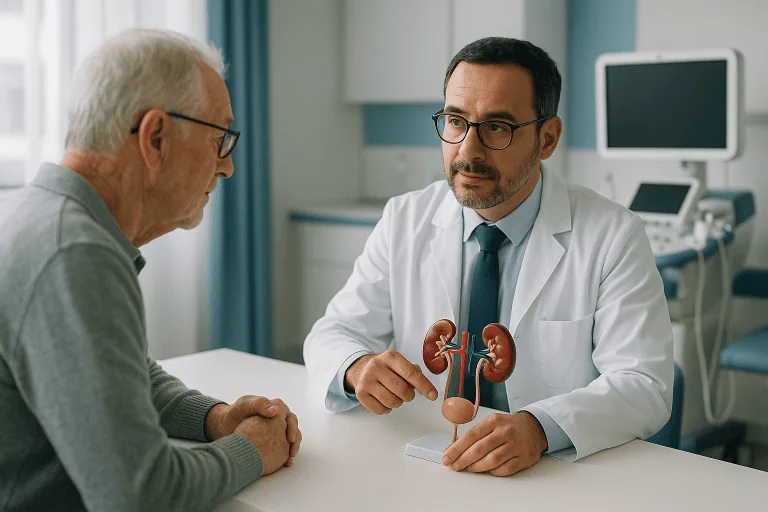
Urine Flow Test
A urine flow test, or uroflowmetry, measures the speed and volume of urination to help assess urinary obstruction, bladder function, or prostate-related symptoms.
Quick answer
A urine flow test (uroflowmetry) is a non-invasive measurement of how fast, how long and how much you urinate. You pass urine into a measuring device, which records your flow rate and the shape of your stream over time. It helps distinguish between a blocked urinary outlet and a weak bladder muscle, and it is often the first stage of a fuller urodynamic study.
Urine Flow Test and the Urodynamic Study: The Essentials
A urine flow test, also called uroflowmetry, is a non-invasive test that measures how quickly, how long and how much you urinate. You pass urine into a measuring device, and the machine records the speed and pattern of your stream from start to finish. It is one of the simplest ways to check whether urine is leaving the bladder normally, and it is often the first stage of a fuller urodynamic study when your urologist needs more detail about how the bladder stores and releases urine.
Changes in urination are easy to dismiss at first. A weaker stream, frequent night-time urination, difficulty getting started, sudden urgency, or a feeling that the bladder has not emptied can each creep in gradually. Over time, these symptoms affect sleep, travel, work, intimacy and confidence in daily life. Many people also worry about what the symptoms might mean: an enlarged prostate, a urinary blockage, bladder dysfunction, infection, or a more complex urologic condition. The honest answer is that similar symptoms can have very different causes, which is exactly why objective measurement matters.
Uroflowmetry requires no anaesthesia, no needles and no imaging radiation. It measures the pattern, speed and volume of urination, giving the urologist objective information that symptoms alone cannot provide. Where the flow test raises questions it cannot answer on its own, for example, whether a slow stream comes from obstruction or from a weak bladder muscle, pressure-flow urodynamics adds the measurements that resolve the ambiguity.
At Acibadem, the purpose is not only to perform the test but to interpret it in the context of your full picture: your history, age, medications, prior surgeries, neurologic health, prostate status and quality-of-life concerns. A flow curve on its own is a number and a shape. Read alongside a careful history, a physical examination, urine tests, blood tests, prostate evaluation where relevant, ultrasound assessment of residual urine, and, when needed, cystoscopy or urodynamic testing, it becomes a genuinely useful piece of evidence.
Urinary symptoms are common, but they should not be normalised if they are persistent, worsening or affecting daily life. Early evaluation can identify treatable causes before complications develop, and it can spare you unnecessary medication or procedures when your symptoms are not caused by obstruction. Uroflowmetry is a practical starting point because it answers an essential question: is urine passing normally, or is there evidence that the bladder outlet or bladder muscle function may be impaired?
What Is a Urine Flow Test?
A urine flow test is a non-invasive diagnostic test that measures how urine flows during natural urination. You urinate into a specially designed collection device connected to a measuring system. The system records the amount of urine passed, the time it takes, the maximum flow rate, the average flow rate and the overall flow pattern. Nothing touches you during the measurement; the device simply records the stream.
The most commonly discussed measurement is the maximum urinary flow rate, often referred to as peak flow. A reduced peak flow may suggest an obstruction in the urinary pathway, a weak bladder muscle, or a combination of both. The shape of the flow curve matters just as much. A smooth, bell-shaped curve is generally considered a more typical pattern, while interrupted, prolonged, flattened or irregular curves provide clues about the underlying problem. An experienced urologist reads the curve the way a cardiologist reads a tracing: the pattern often says more than any single number.
What is a urine flow rate test?
A urine flow rate test is the same investigation described by its main output: the rate at which urine leaves the body, expressed as volume passed over time. The report typically includes the peak flow rate, the average flow rate, the time taken to reach peak flow, the total voiding time and the total volume voided. Each value adds context to the others. A brief, strong void with a clean bell-shaped curve tells one story; a long, flat, straining pattern with pauses tells another. Because the test reflects a real act of urination rather than a laboratory value, it captures function, what your urinary tract actually does, rather than only anatomy.
What is a urine flow test for men?
For men, a urine flow test is most often used to assess symptoms linked to benign prostatic enlargement, also known as benign prostatic hyperplasia or BPH. As the prostate grows, it can narrow the channel through which urine passes, creating resistance and reducing flow. The test helps quantify that resistance, monitor how symptoms evolve, and support decisions about observation, medication or procedural treatment. It is also used in men with suspected urethral narrowing or after previous urinary tract procedures. The test is not only for men, however. Women with voiding dysfunction, urethral narrowing, pelvic floor dysfunction, neurologic bladder problems or symptoms after pelvic surgery may also be tested, and children and adolescents may undergo uroflowmetry when there are concerns about dysfunctional voiding or congenital urinary tract issues.
The test does not diagnose every condition by itself, and it is honest to say so. It provides a functional measurement that guides the next steps. If the flow is normal and the bladder empties well, the urologist may look at causes such as overactive bladder, fluid intake patterns, medication effects or sleep-related factors. If the flow is low or the pattern abnormal, further evaluation can distinguish between obstruction, bladder muscle weakness, or a coordination problem between the bladder and the sphincter during urination.
Because the test reflects real-time urination, accuracy depends on you being comfortably full and able to urinate in a natural way. A very small urine volume limits interpretation. For this reason, you are usually asked to arrive with a comfortably full bladder, but not to the point of pain or severe urgency, which can distort the result in the other direction.
Who May Need a Urine Flow Test?
A urine flow test may be recommended when symptoms suggest that the bladder is not emptying normally or that the flow of urine is obstructed. It is commonly requested during a urology consultation when symptoms have persisted, progressed or become disruptive: the point at which watching and waiting stops being informative and measurement becomes useful.
Men often undergo uroflowmetry when they report a weak stream, hesitancy, straining, intermittent flow, dribbling at the end of urination, or a feeling of incomplete emptying. These symptoms may be related to prostate enlargement, urethral stricture, bladder neck obstruction, previous urinary tract procedures, or changes in bladder muscle function. In men with known prostate enlargement, the test helps assess how much the enlargement is actually affecting flow and supports decisions about medication, minimally invasive treatment or surgery.
Women may need a urine flow test when they experience difficulty emptying the bladder, frequent urination, recurrent urinary infections, pelvic pressure, or symptoms suggesting the pelvic floor muscles do not relax properly during voiding. It can also be useful after pelvic organ prolapse surgery or anti-incontinence procedures, if urination becomes slow or incomplete afterwards.
Patients of any sex may be evaluated with uroflowmetry if they have a history of neurologic conditions affecting the bladder, such as spinal cord injury, multiple sclerosis, Parkinson’s disease, diabetes-related nerve dysfunction, stroke or previous spinal surgery. In these situations, urinary symptoms may result from altered communication between the brain, nerves, bladder and sphincter muscles, and the flow curve often shows patterns that point towards this mechanism.
Children may be referred for uroflowmetry when they have urinary urgency, daytime wetting, recurrent urinary tract infections, abnormal voiding habits or suspected dysfunctional voiding. In paediatric care, the test is often paired with pelvic floor muscle activity measurement or ultrasound, depending on the clinical question being asked.
Diagnosis begins with a detailed history. The physician may ask how often you urinate, whether symptoms occur during the day or at night, whether there is pain or burning, whether urine leakage occurs, and whether medications or prior surgeries may be contributing. A bladder diary may be recommended in selected cases. Physical examination, urinalysis, urine culture, kidney function tests, prostate-specific antigen testing when appropriate, ultrasound of the kidneys and bladder, and post-void residual urine measurement may also be included.
Uroflowmetry is especially helpful when symptoms alone cannot distinguish between obstruction and bladder dysfunction. Two patients may describe near-identical difficulty urinating and have entirely different causes: one a narrowed urinary channel, the other a bladder muscle that contracts weakly. Treating the second patient for the first patient’s problem helps no one. A urine flow test moves the conversation from subjective description to measurable data, which is precisely where good treatment decisions begin.
Conditions Uroflowmetry Helps Evaluate
Uroflowmetry is used across a broad range of urinary conditions. It is almost always part of an assessment rather than a stand-alone answer, and its value lies in showing how the lower urinary tract performs during actual voiding.
One of the most common indications is benign prostatic hyperplasia. BPH can compress the urethra and slow urinary flow. Uroflowmetry helps quantify the effect of this narrowing and may be used to monitor the response to medication or to determine whether procedural treatment, surgical or one of the non-surgical procedures available for suitable patients, should be discussed.
The test may also help identify signs of a urethral stricture, a narrowing of the urethra that can develop after injury, infection, catheterisation, surgery or inflammation. Patients with strictures often describe a weak, prolonged, spraying or interrupted stream, and the flow curve frequently shows a characteristic flattened plateau. Uroflowmetry cannot always locate the narrowing, but it can indicate clearly that further evaluation is needed.
Another indication is bladder outlet obstruction, which can occur at the prostate, the bladder neck or the urethra, or arise from functional sphincter problems. In women, obstruction may follow certain anti-incontinence surgeries, accompany pelvic organ prolapse, or result from pelvic floor muscle overactivity. In men, prostate enlargement and urethral narrowing are the common culprits.
Uroflowmetry is also used in patients with a neurogenic bladder, where nerve-related conditions affect bladder storage or emptying. The test may reveal slow flow, intermittent voiding or prolonged urination, prompting more detailed urodynamic evaluation when the flow pattern alone cannot explain the mechanism.
Patients with recurrent urinary tract infections may undergo uroflowmetry if incomplete bladder emptying is suspected. Residual urine creates an environment where bacteria are more likely to persist, so a bladder that never fully empties can drive infection after infection. Similarly, patients with bladder stones, kidney swelling or unexplained elevated residual urine may need flow testing as part of a broader evaluation.
After urologic procedures, the test is used to monitor recovery or detect persistent obstruction. It may be performed after prostate surgery, urethral reconstruction, bladder neck procedures or stricture treatment. It is also commonly performed before surgery to establish a baseline, so that objective improvement afterwards can be demonstrated rather than assumed.
In many patients, uroflowmetry helps prevent both undertreatment and overtreatment. If flow is significantly reduced and residual urine is high, timely intervention may matter. If flow is adequate and the bladder empties normally, the care plan can concentrate on lifestyle, bladder training, medication review by the treating doctor, or treatment for storage symptoms, rather than a procedure aimed at an obstruction that is not there.
How the Urine Flow Test Is Performed
The test itself is straightforward, but careful preparation and interpretation make the difference between a useful result and a misleading one. The goal is to measure urination under conditions that resemble your normal voiding as closely as possible.
How do you prepare for a urine flow test?
You prepare by arriving with a comfortably full bladder, full enough to urinate naturally, but not painfully overfilled. This usually means drinking water before the appointment and avoiding urination for a period beforehand, following the clinic’s instructions and your own comfort. Severe urgency can produce an abnormal pattern; too little urine can make the result uninterpretable. You do not normally need to fast for uroflowmetry; if your visit combines several investigations, the clinical team will tell you whether any of the other tests involve specific preparation.
Tell the clinical team about your medications, especially those that affect urination. These may include prostate medications, bladder-relaxing drugs, diuretics, antidepressants, antihistamines, decongestants, or medications used for neurologic conditions. In most cases routine medications are continued, and any adjustment is a decision for the treating physician alone. The team may also ask about recent urinary tract infection, catheter use, bleeding, pelvic surgery or pain during urination, because each of these can shape how the result is read.
It also helps to bring prior test results, imaging, medication lists, prostate evaluations, previous operation reports and any symptom questionnaires you have completed, so the visit can focus on the clinical question rather than on reconstructing your history from memory.
During the test
You are shown to a private testing area. The uroflowmetry device may resemble a specialised toilet or funnel connected to a measuring unit. You urinate normally into the device, without straining and without trying to alter the stream. Privacy matters here: anxiety or discomfort can genuinely affect the ability to void, and a distorted attempt produces a distorted curve. You feel nothing from the equipment itself: it measures the stream, nothing more.
The system records the flow continuously and produces a graph. The physician or trained urology team reviews the voided volume, maximum flow rate, average flow rate, time to maximum flow, total voiding time and the shape of the curve. The pattern is then set alongside your symptoms and the rest of your assessment.
Post-void residual measurement
A post-void residual urine measurement often follows immediately after the flow test. This is usually done with ultrasound: a non-invasive scan over the lower abdomen that estimates how much urine remains in the bladder after urination. Residual urine is clinically important because the two measurements answer different questions. A patient may have a slow flow yet still empty reasonably well; another may have a less dramatic flow curve but retain a significant amount of urine after every void. The combination tells the urologist far more than either measurement alone.
Technology used in the evaluation
The core technology is a calibrated uroflowmetry system that measures urine flow over time and converts it into numeric values and a curve. Modern systems capture small changes in flow, record voiding duration precisely, and help standardise interpretation. They may be integrated with electronic medical records or urology reporting systems so results can be compared across visits, useful when the question is whether treatment is working.
Ultrasound may be used immediately after the test to assess residual urine and, when needed, to evaluate the bladder, kidneys or prostate. This helps the physician understand whether slow flow is associated with incomplete emptying, bladder wall changes, kidney swelling, stones or prostate enlargement. In selected cases, additional investigations, cystoscopy, pressure-flow urodynamic testing, urine laboratory analysis or advanced imaging, may be recommended. These are not part of every urine flow test; they belong to cases where symptoms are complex or where surgery is being considered.
How long does a urine flow test take?
The urination itself takes only as long as you need to empty your bladder: a matter of moments. The appointment as a whole takes longer, because it includes registration, waiting for the bladder to fill, review by the clinical team, the ultrasound residual measurement, and consultation with the urologist. If the bladder is not full enough at the first attempt, you may be asked to drink more water and wait before trying again. And because a single void may not represent your usual urination, particularly if you are anxious or pass only a small amount, the urologist may repeat the test or interpret it alongside other findings rather than treating one curve as the final word.
After the test
There is no recovery period in the usual sense. You return to normal activities immediately. Uroflowmetry itself does not cause discomfort, bleeding or difficulty urinating: the equipment only records the stream and never touches the body.
The most important part of the process is interpretation. A low flow does not automatically mean surgery is needed. A normal flow does not always rule out a bladder problem. The physician reviews the results in context and may discuss lifestyle changes, medication, further diagnostic tests or procedural options, depending on the complete picture rather than a single number.
When Is a Urodynamic Study the Next Step?
A urodynamic study is a more detailed set of measurements that shows not only how urine flows but what pressures the bladder generates while filling and emptying. It becomes the logical next step when uroflowmetry and residual measurement cannot settle the central question, obstruction or weak bladder muscle, when a neurologic cause is suspected, when previous treatment has not worked as expected, or when surgery is being planned and the surgeon needs certainty about the mechanism before operating. Uroflowmetry is, in effect, the screening layer; pressure-flow testing is the deeper analysis reserved for cases where the answer will change the plan.
How is a urodynamic study performed?
A urodynamic study is performed in stages, usually beginning with the same uroflowmetry and post-void residual measurement described above. In the pressure-measurement phase of the urodynamics procedure, thin catheters with sensors are placed to record pressure inside the bladder, and usually in the rectum or vagina, to separate bladder muscle pressure from abdominal pressure, while the bladder is slowly filled with sterile fluid. You are asked to report sensations of filling and urgency, and finally to urinate with the sensors in place. This pressure-flow phase is the urodynamic test that most directly distinguishes a blocked outlet from a weak bladder muscle, because it shows whether high pressure is producing low flow (obstruction) or low pressure is producing low flow (weak muscle).
Is a urodynamic study painful?
Most people find a urodynamic study uncomfortable rather than painful. The catheters used are thin, and the moments most patients notice are catheter placement and the sensation of the bladder filling. Discomfort levels vary between individuals, and it is fair to say the test is more awkward than distressing for the majority. Telling the team about pain during the test matters clinically, because pain can alter the pressures being measured.
Do they numb you for urodynamics?
General anaesthesia is not used for urodynamics, because the test depends on your bladder behaving naturally and on you reporting what you feel. A local anaesthetic lubricating gel is commonly applied before catheter placement to reduce discomfort at the urethra. Sedation would defeat the purpose of the study, which is to observe the bladder’s real behaviour while you are awake and able to describe sensation.
Is urodynamic testing worth it?
Urodynamic testing is worth doing when its answer will change the treatment plan, and not otherwise. If a man with classic prostate symptoms, a reduced flow and elevated residual urine is already a clear candidate for treatment, an invasive study may add little. If the diagnosis is genuinely uncertain, if surgery is proposed and the mechanism is unclear, or if a neurologic condition complicates the picture, the study can prevent an operation that would not have helped. A candid urologist will explain which of these situations applies to you before recommending it.
Why Acting Early Matters
Many urinary symptoms develop gradually, and patients adapt without realising how much the condition is shaping their lives. They limit fluids, avoid travel, wake repeatedly at night, or plan daily activities around access to a toilet. Some urinary symptoms are mild and can reasonably be monitored. Persistent changes, however, deserve evaluation rather than accommodation.
Delay can allow treatable obstruction or incomplete emptying to progress. When the bladder works against resistance for a long time, it may thicken, become less flexible, or eventually weaken. Some patients develop increasing residual urine, recurrent urinary tract infections, bladder stones, worsening urgency, leakage, or episodes of acute urinary retention: a sudden inability to urinate at all. In more advanced situations, sustained high bladder pressure or chronic retention can affect the kidneys.
Early uroflowmetry does not mean early aggressive treatment; often it means the opposite. If symptoms are mild and flow is acceptable, observation or medication may be entirely appropriate, and the test provides a baseline for comparison later. If flow is poor or the bladder is not emptying, further evaluation can happen before complications occur rather than after.
Another reason to act early is diagnostic clarity. Frequency and urgency in men are sometimes assumed to be prostate-related when they are not. Women with difficulty voiding are sometimes treated repeatedly for infections when the underlying issue is incomplete emptying or pelvic floor dysfunction. A urine flow test redirects care towards the actual cause, which is the whole point of testing before treating.
Benefits of a Urine Flow Test
The benefits of uroflowmetry come from its ability to provide objective information quickly, comfortably and with minimal burden on you as the patient.
| Benefit | What It Means for You |
|---|---|
| Non-invasive assessment | The test requires natural urination into a measuring device, without needles, anaesthesia or radiation. |
| Objective measurement of urine flow | Your symptoms can be compared with measurable data, helping the urologist understand how well urine is actually passing. |
| Helps identify obstruction or weak bladder function | A low or abnormal flow pattern may point towards prostate enlargement, urethral narrowing, bladder outlet obstruction or bladder muscle weakness. |
| Supports personalised treatment planning | Results help determine whether observation, medication, further testing or procedural treatment should be considered. |
| Useful for monitoring over time | Repeat testing can show whether symptoms and flow are improving, stable or worsening after treatment or during follow-up. |
What to Expect After Uroflowmetry
Because a urine flow test is non-invasive, most patients resume normal life immediately. The timeline below explains what is typically expected after the test and during follow-up.
| Time Period | What Patients Can Expect |
|---|---|
| Day 1 | You can return to routine activities right away. The urology team may review the flow curve, residual urine measurement and next steps during the same visit. |
| First Week | If additional tests are needed, urine studies, ultrasound, cystoscopy or urodynamic testing, they may be scheduled based on your symptoms and results. |
| First Month | If medication, bladder training or lifestyle changes are recommended, symptom response may begin to be assessed. Some patients keep a bladder diary during this period. |
| Longer Term | Repeat uroflowmetry may be used to monitor prostate symptoms, recovery after a procedure, recurrent obstruction, or bladder emptying over time. |
Factors That Influence Results and a Good Clinical Outcome
A good result depends on both accurate testing and thoughtful interpretation. The test should be performed when the bladder is adequately full. If the voided amount is too small, the flow may appear falsely low or may simply not reflect your usual pattern. If the bladder is painfully overfull, urgency can also distort the result. Comfort, privacy and clear instructions all matter more than they might seem.
Your behaviour during the test influences the curve. Straining, stopping intentionally, holding back, or trying to “perform well” changes the measurement. The most useful result comes from urinating as normally as possible. Anxiety, unfamiliar surroundings, pain, or difficulty voiding in a clinical environment can all affect the outcome: this is well recognised, and when a result does not match the symptoms, the physician simply repeats the test rather than over-reading a single attempt.
Hydration status is another factor. Dehydration may reduce bladder volume and make interpretation harder; excessive fluid intake immediately before the test can create abnormal urgency. The care team will guide you towards a comfortable middle ground rather than either extreme.
Medications can influence urinary flow in both directions. Drugs used for prostate enlargement may improve flow by relaxing the bladder outlet. Diuretics increase urine production. Some cold medications, antihistamines, antidepressants and neurologic medications can make urination more difficult. None of this means you should adjust anything yourself: it means a complete, honest medication list is one of the most valuable things you can bring, because it lets the urologist interpret the curve accurately, especially where prescription names and formulations differ between countries.
The underlying condition strongly shapes what happens next. A patient with mild prostate enlargement may respond well to medication and monitoring. A patient with a urethral stricture may need imaging, endoscopic evaluation or reconstructive treatment. A patient with bladder muscle weakness will not benefit from an obstruction-focused procedure unless obstruction is genuinely present, one of the clearest examples of why a urodynamic assessment before surgery can matter more than the surgery itself. A urine flow test is most valuable when it is integrated into a complete urologic assessment rather than read in isolation.
Good outcomes also depend on communication. Describe your symptoms honestly, including night-time urination, leakage, pain, sexual side effects, medication concerns, previous catheterisation and the impact on daily life. Urology care is not only about the flow number; it is about matching the plan to your anatomy, function, health status and goals.
In some patients, the best step after uroflowmetry is reassurance and observation. In others, it is medication, additional testing or a procedure. A careful diagnostic pathway avoids unnecessary interventions while reducing the risk of missing a significant obstruction or emptying problem, both errors are real, and a good pathway guards against each.
How Acibadem Approaches Urologic Evaluation
Patients often seek a clear diagnosis or a second opinion when urinary symptoms have persisted despite previous treatment. For urinary symptoms this matters particularly, because the right treatment depends on distinguishing between conditions that feel similar but require different approaches.
At Acibadem, uroflowmetry sits within a broader urology framework. The test is interpreted by physicians who consider the full clinical picture: symptom history, prior treatments, imaging, laboratory results, prostate evaluation when relevant, neurologic conditions and previous surgeries. In complex cases, multidisciplinary input may be involved, particularly where urinary symptoms overlap with oncology, neurology, nephrology, gynaecology, pelvic floor disorders or reconstructive urology.
The diagnostic pathway may include modern uroflowmetry systems, ultrasound assessment of residual urine, laboratory testing, endoscopic evaluation, urodynamic studies and imaging where needed. Technology is used to answer practical questions: Is the bladder emptying? Is the prostate or urethra creating resistance? Are the kidneys affected? Is there evidence of infection, stones or neurologic bladder dysfunction? The aim is tests that are appropriate, not exhaustive.
A second opinion typically starts from what already exists: prior uroflowmetry curves, ultrasound reports, prostate measurements, cystoscopy findings, urodynamic results, laboratory work and operative notes all carry weight in the assessment. Where repeat testing is clinically necessary, it is done to confirm the current situation and support a more confident recommendation, not to duplicate what is already known.
Personalised planning is central to urology because urinary symptoms have so many possible causes. A patient with BPH, a patient with a urethral stricture and a patient with pelvic floor dysfunction may all report a weak flow, yet their care plans differ substantially. The approach here is to combine objective results with individual clinical judgement, evidence-based protocols and the patient’s own preferences and goals.
A Sensible Way Forward with Urinary Symptoms
Urinary symptoms can be frustrating, private and difficult to talk about. They are also among the most common reasons people seek urologic care, and many of their causes are manageable once properly identified. A urine flow test is a simple, non-invasive way to begin understanding whether the bladder is emptying normally and whether obstruction or a functional bladder problem may be present.
For some people, that single measurement, read together with a residual urine scan and a careful history, is enough to settle the question. For others, it is the doorway to a urodynamic study that explains precisely why the flow looks the way it does. Either way, the sequence is the same everywhere good urology is practised: measure first, interpret in context, and treat only what the evidence actually shows.
Preparation
- You may be asked to arrive with a comfortably full bladder so the test can measure a natural urine stream. Inform your doctor about urinary symptoms, medications, previous surgeries, or infections. Avoid urinating just before the appointment unless instructed otherwise.
Aftercare
- You can usually resume normal activities immediately after the test. Results are reviewed with your urologist and may be combined with urine tests, ultrasound, or other evaluations if needed. Contact your doctor if you develop pain, fever, or worsening urinary symptoms.
Frequently Asked Questions
What affects the cost of a urine flow test?
The main factors are whether the test is performed alone or as part of a urology consultation, whether additional tests are needed, the hospital or clinic setting, specialist fees and any international patient services such as translation or medical report coordination.
How can I get a personalised quote?
You can request a free consultation and share your symptoms, previous test results, medical history and any current medications. A urology team can then advise which assessments may be needed and provide a personalised quote.
Is uroflowmetry usually enough to diagnose the problem?
Uroflowmetry is helpful but it does not always identify the exact cause of urinary symptoms by itself. A specialist may combine it with examination, ultrasound, urine tests or other investigations before recommending treatment.
What is typically included in an international patient package?
A package may include urologist consultation, uroflowmetry, review of results and a written care plan. Depending on the hospital, assistance with scheduling, translation and travel coordination may also be available, while extra diagnostics are usually confirmed separately.
Will insurance cover uroflowmetry abroad?
Coverage depends on your insurer, policy terms, referral requirements and whether the hospital is accepted by your plan. It is advisable to request written confirmation from your insurer before travel and ask the hospital for documentation needed for reimbursement.
Medically reviewed by the Acıbadem International Medical Board September 1, 2026
See our medical review board →
Update history
- PublishedJune 8, 2026
- Medical review approvedSeptember 1, 2026
- Last content updateSeptember 1, 2026
References2
- Urine Flow Rate Test medlineplus.gov
- Urodynamic testing ncbi.nlm.nih.gov
Trusted care for international patients
From the Acibadem Blog
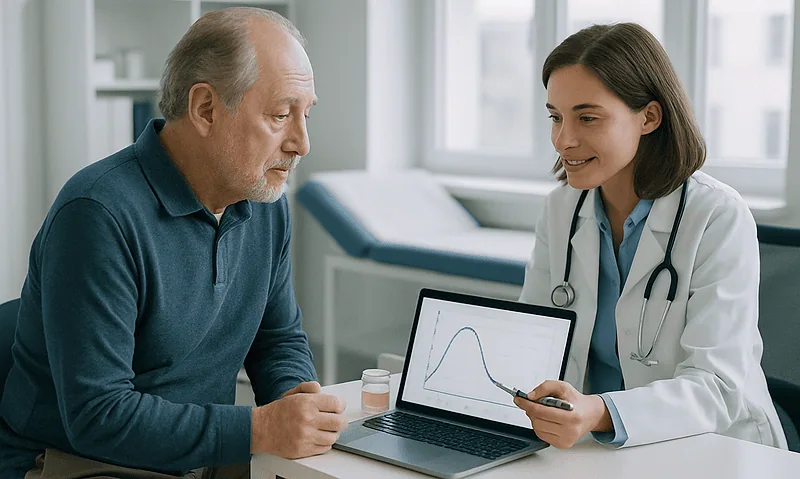
How to Read a Urine Flow Test Curve: Peak Flow, Voided Volume and What Shapes Suggest
A uroflowmetry curve plots how fast urine leaves the body, second by second. Readers look at three things together: the peak flow rate (Qmax),…

Does Urine Flow Improve After Prostate Surgery? How Uroflowmetry Tracks the Result Over Time
For most people who have surgery to relieve a blockage from an enlarged prostate, urine flow does improve, and uroflowmetry is the standard way…