

Exercise Before Bed: Does Evening Training Ruin Sleep? What the Trials Say
Key Takeaways
- A 2019 meta-analysis of 23 controlled trials found evening exercise slightly increased deep slow-wave sleep and did not change total sleep time or awakenings.
- The one consistent penalty in those trials was vigorous exercise ending within about one hour of bedtime, which lengthened the time to fall asleep.
- Core body temperature stays elevated for roughly 30 to 90 minutes after exercise, and the steeper drop that follows is the likely reason exercise deepens sleep.
- A 2025 wearable analysis of about four million nights linked strenuous exercise within four hours of bedtime to later, shorter sleep, but as observational data it cannot prove cause.
- Caffeine has a half-life of roughly five to six hours, so a pre-workout drink at 7 p.m. is often still half active at midnight and is a more likely sleep thief than the workout.
- Chronic insomnia is defined as sleep difficulty on at least three nights a week for three months, and persistent symptoms warrant a doctor's assessment regardless of exercise timing.
For most healthy adults, exercise before bed does not ruin sleep. Randomized trials show moderate evening workouts leave total sleep time and deep sleep unchanged or slightly improved. The exception is vigorous, all-out training that ends within about an hour of lights-out, which can delay falling asleep. Finishing hard sessions roughly 90 minutes to two hours before bed, and cooling down properly, avoids that problem.
The gym near my office stays open until midnight, and lately the 9 p.m. crowd has been arguing with itself. One lifter swears his sleep tracker punishes him for every late squat session. The woman on the next rack says her evening run is the only reason she sleeps at all. Both are quoting the same headlines.
The argument is trending for a reason. In 2025 a large analysis of wearable data from roughly 15,000 people, covering about four million nights, reported that strenuous workouts in the four hours before bedtime were linked to later sleep onset and a faster overnight heart rate. The finding spread quickly, often stripped of its caveats, and collided with a decade of controlled trials that found the opposite for ordinary evening exercise. As of September 2026, searches for exercise before bed have surged, and most of what people find is either alarm or dismissal.
Neither is quite right. The trials, the wearable data and the physiology actually agree on more than the headlines suggest. Here is where they meet.
What changed recently: the data behind the exercise before bed debate
For years the sleep-and-exercise conversation rested on a 2019 systematic review and meta-analysis published in Sports Medicine and indexed in PubMed. Its authors pooled 23 controlled studies in healthy adults and asked a simple question: does evening exercise, measured in a sleep laboratory, make the night worse? The pooled answer was no. Evening sessions were associated with a small increase in slow-wave sleep (the deepest, most physically restorative stage) and a small decrease in light stage 1 sleep. Sleep onset, total sleep time and the number of awakenings were essentially unchanged. One caveat stood out even then: when vigorous exercise ended within about an hour of bedtime, participants took longer to fall asleep and spent less of the night actually asleep.
That picture held until 2025, when a research group published an observational analysis of commercial wearable data in Nature Communications. Instead of a few dozen volunteers in a lab for one night, it tracked thousands of ordinary device owners for a year. The headline association was that strenuous exercise within four hours of bedtime went with falling asleep later (by roughly half an hour after the hardest sessions), sleeping somewhat less, a higher resting heart rate overnight and lower heart rate variability, the beat-to-beat variation that reflects nervous-system recovery. Light and moderate activity earlier in the evening showed little or no such effect.
Harvard Health and Johns Hopkins had already published consumer summaries of the 2019 review, both concluding that timing matters far less than whether you exercise at all. Neither institution has reversed that position. What changed in the past year is not the science so much as the scale of the data and the volume of the online reaction. The 2025 study is real and worth reading; it is also observational, meaning it can show patterns but cannot prove that the late workout caused the shorter night.
Does exercise before bed ruin sleep? What the evidence actually says
Grading the evidence is the only honest way through this. Three tiers are in play, and they do not carry equal weight.
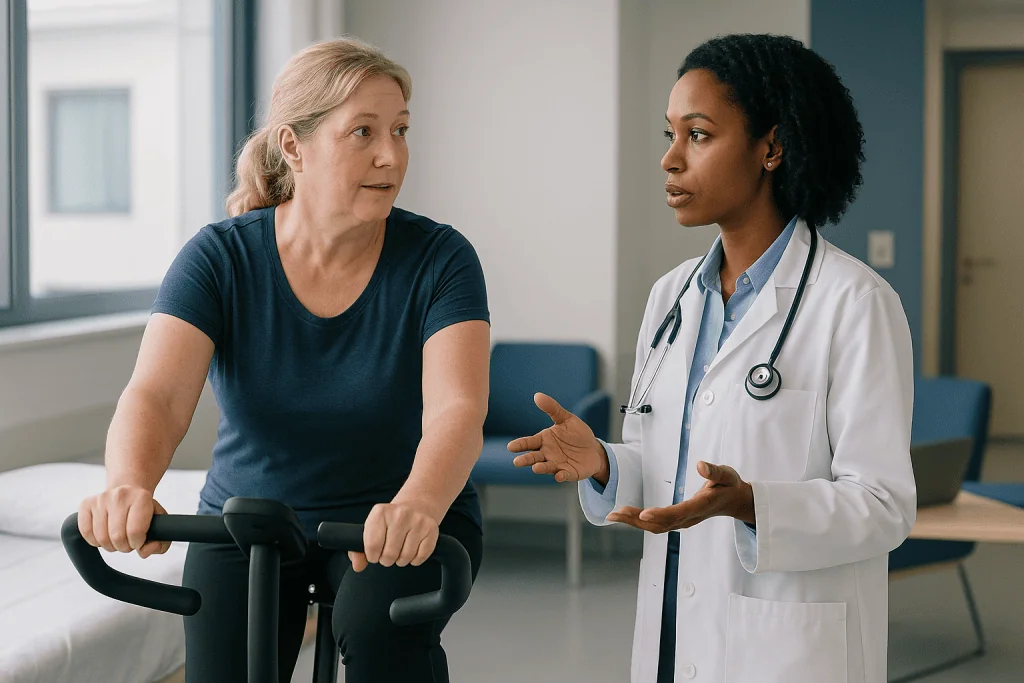
The strongest tier is randomized, controlled crossover trials with polysomnography, the full overnight recording of brain waves, eye movements, muscle tone and breathing that sleep laboratories use. Participants exercise on one evening and rest on another, in random order, and the two nights are compared. The 2019 meta-analysis is built from this kind of study. Its verdict: moderate evening exercise is neutral to mildly positive for sleep architecture, and only vigorous exercise ending within roughly 60 minutes of bedtime shows a measurable cost. The trials are small, mostly in young, fit volunteers, and typically test a single night, so they tell us little about habitual late training over months.
The middle tier is observational cohort data, including the 2025 wearable analysis. Its strengths are enormous sample size and real-world conditions. Its weaknesses are the classic ones: people who train hard at 10 p.m. may also eat late, drink more caffeine, stare at brighter screens or simply be night owls whose clocks run late anyway. Wearables also estimate sleep from movement and heart rate rather than measuring it directly, and they tend to overestimate sleep in some people and underestimate it in others.
The weakest tier is expert opinion and anecdote, which is where most viral claims live.
Put together, the evidence supports a measured conclusion. Exercise before bed, in the ordinary sense of a brisk walk, a moderate jog, a cycling class or a strength session finished with time to spare, does not harm sleep for most people and may deepen it. Very hard training right up to lights-out probably does delay sleep onset for many people, and the size of that effect varies from person to person. Nobody has shown that evening training damages long-term health through its effect on sleep.
Why timing matters at all: body heat, adrenaline and the slow cool-down
Sleep onset is partly a thermal event. In the evening your core body temperature, the temperature of the organs deep inside the trunk, begins to fall by about half a degree Celsius, and that decline is one of the signals the brain reads as permission to sleep. Blood vessels in the hands and feet widen, heat radiates away, and you grow drowsy.
Exercise reverses that for a while. A hard 45-minute session can lift core temperature by one to two degrees, and Johns Hopkins sleep specialists note that it typically stays elevated for 30 to 90 minutes afterward. Alongside the heat come adrenaline and noradrenaline, the stress hormones that quicken the heart and sharpen attention, plus a transient rise in cortisol. None of this is harmful; it is simply the opposite of a wind-down.
The flip side is why exercise helps sleep in the first place. Once the post-workout surge passes, temperature falls further and faster than it would have at rest, and that steeper descent appears to promote deeper slow-wave sleep. This is the mechanism behind the small increase in deep sleep seen in the trials. The body also clears adenosine, a chemical that builds sleep pressure across the day, more readily when it has been physically active.
So the question was never whether evening exercise affects sleep physiology. It plainly does. The question is whether the cool-down window finishes before you need to be asleep. For a moderate workout that window closes within about an hour. For a maximal interval session or a heavy competitive match, it can take two hours or more, particularly in a warm room. Timing matters because biology has a clock on it, not because exercise and sleep are enemies.
Is working out at night bad for sleep, or only hard workouts?
Intensity is the hinge on which this whole topic turns, and it is worth being concrete about what the words mean. Moderate exercise is effort you could sustain while speaking in full sentences but not singing: a brisk walk, easy cycling, a relaxed swim, most yoga, a strength session with normal rest between sets. Vigorous exercise leaves you able to manage only a few words at a time: running at pace, high-intensity intervals, hard spinning, competitive sport. The talk test is crude, but it maps well onto the categories the trials used.

Across the controlled studies, moderate evening exercise was consistently neutral or helpful. People fell asleep as quickly as on rest nights and often logged a little more deep sleep. Working out at night in this register appears to be safe for sleep, full stop.
Vigorous evening exercise splits by timing. When it ended two or more hours before bed, the trials found no penalty. When it ended within an hour, sleep onset latency, the time between lights-out and actually falling asleep, stretched by several minutes on average, and sleep efficiency, the share of time in bed spent asleep, dropped slightly. The 2025 wearable data extended that window to roughly four hours for the most strenuous sessions, though in observational data that long tail may partly reflect who chooses to train that late rather than the training itself.
Strength training deserves its own note. Heavy lifting raises heart rate in bursts rather than continuously and heats the body less than sustained cardio of similar effort. The few trials that isolated resistance exercise in the evening found no harm to sleep, and some found improved sleep quality over several weeks. If your preferred night session is weights, the evidence is on your side.
How long before bed should you exercise? A realistic cutoff
People want a number, and the trials allow a reasonable one. For vigorous exercise, finish at least 90 minutes before you intend to be asleep, and two hours is more comfortable. For moderate exercise, an hour of buffer is usually plenty, and many people need less. Gentle movement such as stretching, mobility work or a slow walk can run right up to bedtime.
Why 90 minutes rather than the 60 that the meta-analysis flagged? Because the threshold in the trials describes when exercise ended, not when the cool-down ended. Showering, eating, checking messages and getting into bed all take time, and most people underestimate how long they spend doing them. Building the buffer around sleep time rather than gym-exit time keeps you on the right side of the line without a stopwatch.
Individual variation is wide, and the research says so plainly. Some people fall asleep easily 30 minutes after a hard run; others need the full two hours even after a moderate one. Age plays a part, since the drop in core temperature after exercise can be slower in older adults. So does chronotype, the built-in tendency to be a morning lark or a night owl. Night owls, whose temperature rhythm runs later, often tolerate late training better than larks do.
The practical approach is a two-week experiment. Keep your usual routine but note three things each night: when your workout ended, how hard it was, and roughly how long it took to fall asleep. Most people find their own cutoff quickly, and it tends to be more lenient than the headlines imply. If the only training slot you have is late and hard, shifting the final 10 minutes to an easy spin or walk shortens the cool-down window measurably.
Evening exercise and insomnia: can a late workout actually help?
Insomnia is the persistent difficulty falling asleep, staying asleep or waking too early despite enough opportunity to sleep, and it is called chronic when it happens at least three nights a week for three months or more. For people living with it, the exercise question is not academic. Several small randomized trials have tested moderate aerobic exercise, often in the late afternoon or early evening, in adults with chronic insomnia. Over periods of eight to sixteen weeks, participants typically fell asleep faster, woke less often and rated their sleep quality higher than non-exercising controls.
The effect is not immediate. A single session rarely transforms the same night, and some trials found that improvements built gradually over weeks, suggesting that the benefit comes from the cumulative effect of regular activity on mood, body-clock stability and daytime energy rather than from any one workout. The NHS and Mayo Clinic both list regular physical activity among the lifestyle measures that support sleep, alongside consistent wake times, a cool dark bedroom and limiting caffeine and alcohol in the evening.
A sensible caution applies. People with insomnia often have a nervous system that is already on high alert at bedtime, a state sleep researchers call hyperarousal. For them, a very vigorous late session can add fuel rather than release it. The trials that showed benefit used moderate intensity, and the evening timing was early evening rather than the last hour before bed.
What the evidence does not support is the idea that exercise alone treats insomnia. Cognitive behavioral therapy for insomnia, a structured program that retrains sleep habits and thoughts, remains the first-line recommendation in major guidelines, and exercise works best as a companion to it. Anyone whose insomnia persists despite good habits should raise it with their doctor rather than keep adjusting workout times.
Which evening workouts fit which bedtime? A quick comparison
The table below distils the trial findings and the physiology into practical categories. Cutoffs are counted back from the time you plan to be asleep, not from when you leave the gym, and they describe the typical healthy adult. Treat them as starting points for your own two-week experiment rather than rules.
| Evening activity | Intensity (talk test) | What the trials found | Suggested gap before sleep |
|---|---|---|---|
| Stretching, mobility, slow yoga | Light: can talk and sing | No effect on sleep onset; may aid relaxation | None needed |
| Brisk walk, easy cycle, gentle swim | Light to moderate | Neutral or small gain in deep sleep | About 30–60 minutes |
| Steady jog, moderate spin class, Pilates | Moderate: sentences, no singing | Neutral to mildly positive | About 60 minutes |
| Strength training, normal rest periods | Moderate | No harm; some trials report better sleep quality over weeks | About 60 minutes |
| Tempo run, hard spin, circuit class | Vigorous: a few words at a time | No penalty if finished 2 hours out; delayed sleep onset if within 1 hour | 90 minutes–2 hours |
| Maximal intervals, competitive match | Very vigorous: cannot speak | Longest cool-down; wearable data links late sessions to later, shorter sleep | 2 hours or more |
Two patterns are worth noticing. First, the gap grows with intensity, not with duration; a long easy walk needs less buffer than a short brutal interval set. Second, the categories where the trials found possible benefit are also the ones most people can realistically fit into a weekday evening. The question is rarely whether to exercise at night but whether the last ten minutes need to be the hardest.
Late night workout and sleep: what wearable data can and cannot tell you
Fitness trackers have turned millions of people into amateur sleep scientists, and the 2025 wearable study is the most ambitious use of that data so far. It deserves a fair reading, because both the alarmists and the dismissers have misrepresented it.
What it found: across about four million nights, the later and harder the evening exercise, the later people fell asleep, the less they slept, and the higher their overnight resting heart rate. The associations were strongest for strenuous sessions ending within four hours of bedtime and were graded, meaning each step up in intensity or lateness went with a slightly bigger shift. For light and moderate activity, especially earlier in the evening, the differences were small enough to be practically irrelevant.
What it could not show: that the exercise caused the change. Device owners choose their own training times, and those who train hardest latest differ in many ways from those who do not. The study adjusted for several factors, but no observational analysis can adjust for everything. Nor could it measure sleep directly; wearables infer sleep from wrist movement and pulse, which is good enough for trends across millions of nights but imperfect for any single one.
How to use your own tracker without being misled: look at averages across weeks rather than reacting to one night, compare like with like (same bedtime, same caffeine, different workout timing), and pay more attention to how you feel at 10 a.m. than to a sleep score. A late night workout that costs you fifteen minutes of sleep onset but leaves you energized the next day is a reasonable trade for many people. One that leaves you wired until 2 a.m. is a signal to move it earlier or ease the final stretch. The device is a notebook, not a verdict.
Is morning exercise better for sleep than evening exercise?
Morning exercise has a strong reputation for sleep, and part of it is deserved. Outdoor activity soon after waking delivers bright light to the eyes at the moment the body clock is most responsive, which anchors the circadian rhythm, the roughly 24-hour cycle that governs alertness, hormone release and temperature. A stable clock makes bedtime sleepiness more predictable. Morning sessions also sidestep the cool-down problem entirely.
The direct comparisons, however, are less decisive than the reputation. A handful of small trials have assigned people to morning versus evening training and measured sleep. Some found slightly earlier sleep onset with morning exercise; others found no difference; a few found that evening exercisers reported better sleep quality, possibly because they arrived at bedtime with more accumulated physical fatigue. None found that evening exercise, done with a sensible buffer, produced worse sleep than no exercise at all.
Performance physiology complicates the picture further. Muscle strength, reaction time and body temperature all peak in the late afternoon and early evening for most people, which is one reason so many athletic records fall in evening competitions. Training when the body performs best is not a sleep problem; it is a scheduling preference.
The CDC guideline for adults, at least 150 minutes of moderate or 75 minutes of vigorous aerobic activity a week plus two days of muscle strengthening, says nothing about time of day, and for good reason. The largest determinant of whether exercise helps your sleep is whether you do it consistently. Observational studies repeatedly show that regular exercisers of every schedule sleep better than sedentary adults. If a 6 a.m. alarm means you skip the workout three days out of five, the 7 p.m. slot you actually keep is better for your sleep, not worse.
Shift workers, new parents and night owls: when evening is the only option
Much of the published research involves people with conventional schedules, and much of the online advice assumes a free afternoon. Real lives are messier. For a nurse finishing at 8 p.m., a parent whose only child-free hour arrives after bedtime stories, or a night owl who does not feel awake until noon, the question is not whether evening training is ideal but how to do it well.
Night owls have the easiest case. Their body temperature rhythm runs later, so the post-exercise cool-down and the natural evening temperature drop line up later too. A 9 p.m. workout for someone who sleeps at midnight sits in roughly the same physiological slot as a 6 p.m. workout for someone asleep by nine. The usual cutoffs apply, counted from actual sleep time rather than from a socially approved bedtime.
Shift workers face a harder problem, because the body clock and the schedule disagree. For those coming off an evening shift, a brief moderate session can help discharge the stress of the shift, but it is worth keeping it genuinely moderate and following it with the same wind-down a day worker would use: dim light, a cooler room, no late caffeine. Those rotating onto nights sometimes find exercise before a night shift improves alertness through the shift, which is a separate benefit.
New parents often have fragmented sleep regardless of exercise, and the research on sleep debt suggests that physical activity improves mood and daytime function even when total sleep stays short. A short strength circuit or a brisk walk with the stroller in the early evening is unlikely to cost sleep and may buy some resilience.
The thread running through all three is the same: match intensity to the time you have, protect the final hour, and judge the result by how you feel across weeks.
Common myths about exercise before bed, corrected
The viral version of this topic contains several claims that the evidence simply does not support. Here are the ones that circulate most.
Myth: any exercise after 6 p.m. disrupts sleep. The controlled trials found no such thing. Moderate evening exercise, including sessions ending an hour before bed, left sleep onset and total sleep unchanged and nudged deep sleep upward. The time-of-day rule is folklore; the intensity-and-buffer rule is what the data show.
Myth: evening workouts spike cortisol and keep you awake all night. Cortisol does rise during hard exercise, but the rise is transient and settles within an hour or two. Trials that measured sleep after evening exercise found no lasting effect on how long people stayed asleep. The real culprit when people lie awake after late training is usually the cool-down window, bright light or caffeine, not a hormone that has long since returned to baseline.
Myth: the 2025 wearable study proved night training is harmful. It showed an association in self-selected device users and could not establish cause. Its own authors framed it as a reason to time strenuous sessions earlier, not a reason to stop exercising in the evening.
Myth: if you exercise at night you will not get deep sleep. The opposite is closer to the truth. Slow-wave sleep rose slightly after evening exercise in the pooled trials, consistent with the steeper post-workout temperature drop.
Myth: a late workout is as bad for sleep as skipping sleep. Nothing in the literature supports this. Even the most pessimistic estimates describe sleep onset delayed by minutes, not hours. For most people, an evening workout followed by a short night still beats a sedentary day followed by a short night.
Caffeine, pre-workout drinks, screens and bright gyms: the real sleep thieves
When someone reports that their evening session leaves them staring at the ceiling, the workout often takes the blame for a crime committed by its companions.
Caffeine is the chief suspect. It has a half-life, the time the body needs to clear half of it, of roughly five to six hours in most adults and longer in some. A pre-workout drink or an espresso taken at 7 p.m. for a 7:30 session can therefore still be half active at midnight. Pre-workout formulations typically contain substantial caffeine along with other stimulants, and their effect on sleep is far better documented than the effect of the exercise they precede. Mayo Clinic and the NHS both advise limiting caffeine in the hours before bed; for evening trainers that means a caffeine-free session or a much earlier cutoff.
Light is the second suspect. Bright overhead lighting in gyms, phone screens between sets and a lit-up kitchen afterward all signal daytime to the brain and suppress the evening rise in melatonin, the hormone that signals darkness to the body clock. The exercise itself does not do this; the environment does. Dimming lights after training and leaving the phone in the bag for the final stretch are small changes with a disproportionate payoff.
Late eating is the third. A large post-workout meal just before bed can cause reflux and raise core temperature through digestion, extending the very cool-down window you are trying to close. A light protein-and-carbohydrate snack is reasonable; a full dinner at 10:30 p.m. is a sleep problem of its own.
Alcohol, sometimes used to unwind after a late session, fragments the second half of the night even though it hastens sleep onset. None of these is an argument against evening exercise. They are an argument for isolating variables before blaming the one that improves your health.
A practical evening wind-down that the trials support
The research points to a routine that most people can follow without buying anything or changing their training plan. It works backward from sleep time.
Finish the hard part early. If the session includes intervals, heavy compound lifts or competitive play, schedule them in the first two thirds and let the final ten to fifteen minutes be genuinely easy: a slow spin, a walk, a few mobility drills. This shortens the time your heart rate and temperature stay elevated and, in the trials, is the difference between a session that ends vigorously and one that ends moderately.
Cool down literally. A lukewarm rather than hot shower helps shed heat; so does a cooler bedroom, which Mayo Clinic lists among the fundamentals of good sleep hygiene. Some athletes find a brief warm shower followed by a cool room works best, because the warmth widens skin blood vessels and accelerates the subsequent temperature drop.
Dim the lights on the way out. Lower the overhead lights at home, switch screens to their dimmest setting or put them away, and give the brain the darkness cue it was waiting for.
Eat lightly and early. A modest snack within the first hour after training supports recovery without taxing digestion at bedtime.
Keep the wake time fixed. A consistent morning alarm, even after a late session, is the single most powerful anchor for the body clock, more powerful than any evening adjustment.
Give it two weeks. Sleep responds to patterns, not single nights. Judge the routine by how you feel across a fortnight, and adjust the cutoff rather than abandoning the workout. For most people the result is the one the trials predicted: sleep that is at least as good, often deeper, with the training they actually enjoy kept intact.
When to see a doctor
Evening exercise is safe for the vast majority of adults, and sleep that is occasionally disrupted after a hard session is not a medical problem. Some patterns, though, deserve a clinician’s attention rather than another round of schedule tinkering.
See your doctor promptly if you experience any of the following during or after exercise at any time of day: chest pain or pressure, pain spreading to the arm, jaw or back, unusual breathlessness out of proportion to effort, fainting or near-fainting, or a racing or irregular heartbeat that does not settle within a few minutes of stopping. These are not sleep issues and should never be waited out.
Make an appointment if sleep trouble is persistent rather than occasional: difficulty falling or staying asleep at least three nights a week for three months, regardless of when you exercise, meets the definition of chronic insomnia and benefits from proper assessment. The same applies if a partner reports loud snoring with pauses in breathing, gasping or choking during sleep, or if you wake unrefreshed and fight sleepiness through the day despite enough hours in bed; these can signal obstructive sleep apnea, a condition in which the airway repeatedly narrows during sleep, and it is diagnosed by a sleep study, not a fitness tracker.
Other reasons to seek advice include an irresistible urge to move the legs at night that eases with movement, new or worsening night sweats, unexplained weight change, persistent low mood, or sleep problems that began after starting a new medicine. Anyone taking prescribed medication for heart rhythm, blood pressure, diabetes or a sleep or mood condition should discuss exercise timing with the prescribing clinician before making changes, and should never adjust or stop a medicine on the basis of an article. Decisions about your treatment belong to you and your doctor together.
The bottom line: what matters most about exercise before bed
If the evidence has a single message, it is that consistency beats clock time. Across randomized trials, observational cohorts and expert guidance from Johns Hopkins, Harvard Health, Mayo Clinic and the CDC, the people who sleep best are the people who exercise regularly, and the hour they choose is a detail that matters mainly at the extremes.
Those extremes are specific. Vigorous or maximal training that ends within about an hour of sleep, and probably somewhat longer for the hardest sessions, delays sleep onset for many people. That finding appears in the controlled trials and is echoed, with the usual caveats about cause and effect, in the 2025 wearable data. Everything short of that extreme, from a brisk walk to a solid strength session to a moderate run, is neutral or mildly beneficial for sleep, and the trials suggest it may deepen the slow-wave sleep that does the heavy lifting of physical recovery.
The mechanism explains why. Sleep rides on a falling core temperature and a quieting nervous system, and hard exercise pushes both the other way for a while. Give the cool-down its time, keep caffeine and bright light out of the final hours, and the pendulum swings back with extra momentum.
My own opinion, grounded in that evidence, is that the trending fear is misplaced and the trending dismissal is slightly too glib. A late, all-out session right before bed is a real, if modest, trade-off. A late moderate session is not a trade-off at all. If your only window is the evening, take it, soften the last ten minutes, protect the hour before sleep, and judge the results over weeks. That is what the trials say, and it is more reassuring than the headlines.
Frequently asked questions
Is working out at night bad for sleep?
For most people, no. Controlled trials show that moderate workouts in the evening leave sleep onset and total sleep unchanged and may slightly increase deep sleep. The exception is very vigorous training that finishes within about an hour of bedtime, which can delay falling asleep. Finishing hard sessions 90 minutes to two hours before sleep, and keeping the final minutes easy, avoids the problem for most people.
How long before bed should you exercise?
Count back from the time you plan to be asleep rather than from when you leave the gym. Vigorous exercise is best finished 90 minutes to two hours beforehand; moderate exercise needs roughly an hour; gentle stretching or a slow walk can run right up to bedtime. Individual variation is wide, so a two-week log of workout end time, intensity and time to fall asleep will reveal your own cutoff.
Does a late night workout affect deep sleep?
Not negatively, according to the pooled trials. Evening exercise was associated with a small increase in slow-wave sleep, the deepest and most physically restorative stage, and a small decrease in light stage 1 sleep. The likely mechanism is the steeper fall in core body temperature after the post-workout rise. The one measured cost of very late vigorous exercise was a longer time to fall asleep, not a loss of deep sleep.
Can evening exercise help with insomnia?
Small randomized trials in adults with chronic insomnia found that moderate aerobic exercise over eight to sixteen weeks improved time to fall asleep, night awakenings and self-rated sleep quality. The benefit built gradually and used moderate rather than maximal intensity, timed in the early evening. Exercise supports but does not replace cognitive behavioral therapy for insomnia, which remains first-line; persistent insomnia should be discussed with a doctor.
Why do I feel wired after an evening workout?
Hard exercise raises core body temperature by one to two degrees and releases adrenaline and noradrenaline, which quicken the heart and sharpen attention. These effects fade over roughly 30 to 90 minutes, longer after maximal efforts or in a warm room. Caffeine from pre-workout drinks and bright gym or screen light often prolong the wired feeling and are easier to fix than the workout itself.
Is morning exercise better than evening exercise for sleep?
Direct comparisons are small and mixed. Morning outdoor exercise helps anchor the body clock through early bright light, which can make bedtime sleepiness more predictable. Evening exercise, with a sensible buffer, has not been shown to produce worse sleep than morning exercise or than no exercise at all. The strongest predictor of better sleep in observational research is exercising regularly, whichever time of day you can keep.
Does strength training before bed disturb sleep?
The limited evidence suggests not. Resistance training raises heart rate in bursts and heats the body less than sustained cardio at a similar effort, and the trials that isolated evening weight sessions found no harm to sleep, with some reporting better sleep quality over several weeks. Allowing about an hour between the end of a normal strength session and sleep is a reasonable buffer for most people.
What did the 2025 wearable study on evening exercise actually find?
Analyzing about four million nights from roughly 15,000 device users, it found that strenuous exercise within four hours of bedtime was associated with later sleep onset, somewhat shorter sleep, a higher overnight resting heart rate and lower heart rate variability. Light and moderate activity earlier in the evening showed little effect. Because it was observational, it shows a pattern, not proof that the late workout caused the change.
Should I skip my workout if I can only do it late at night?
For most healthy adults, a late moderate workout is better for sleep and health than no workout. If the only slot is late and the session is hard, move the most intense work to the first two thirds, finish with ten easy minutes, avoid caffeine beforehand, dim lights afterward and keep a fixed wake time. Judge the effect over two weeks rather than one night.
When should sleep problems after exercise be checked by a doctor?
See a doctor promptly for chest pain, fainting, marked breathlessness or a racing or irregular heartbeat during or after exercise. Make an appointment if sleep difficulty occurs three or more nights a week for three months, if a partner notices loud snoring with pauses in breathing, or if you are excessively sleepy by day despite enough time in bed. Anyone on prescribed medicines should discuss exercise timing with their prescribing clinician.
References
This article is for general information only and is not a substitute for professional medical advice. Please consult a qualified doctor about your individual situation.

More from the Blog
Blue Light and Sleep: How Much Screens Really Matter, According to the Research
Blue light from screens can delay melatonin release and shift the body clock, but the effect of typical evening phone use is modest. Laboratory…

Mattress Firmness and Back Pain: What the Evidence Says About Medium-Firm
The best-studied answer is medium-firm. In a randomized trial of 313 adults with chronic low back pain, people given a medium-firm mattress reported less…
Sleep Restriction Therapy: The Counterintuitive Insomnia Treatment That Works
Sleep restriction therapy is a structured part of cognitive behavioral therapy for insomnia that temporarily limits time in bed to roughly the hours a…
Sleep Positions Explained: Back, Side or Stomach: What Each Does to Breathing, Spine and Reflux
No single sleep position is best for everyone. Side sleeping suits most adults: it keeps the upper airway more open, reduces snoring and, on…
Sleeping Too Much: When Long Sleep Is a Symptom Rather Than a Luxury
Sleeping too much is usually defined as regularly needing more than nine hours a night and still feeling unrefreshed. It can be a normal…
Cognitive Shuffling: The Fall-Asleep Trick Backed by a Small Study
Cognitive shuffling is a bedtime technique in which you picture a random series of unrelated, emotionally neutral objects, often by working through the letters…