

Family Support During Spinal Cord Injury Rehabilitation: Transfers, Home Set-Up and Rest

Key Takeaways
- The World Health Organization estimates 250,000 to 500,000 people sustain a spinal cord injury each year, most from trauma, and most return to a private home rather than an institution after rehabilitation.
- Mayo Clinic describes the fastest neurological recovery in the first six months, with smaller gains possible for up to one to two years, while functional ability can keep improving long after that.
- Autonomic dysreflexia, a sudden blood pressure spike usually triggered by a full bladder or bowel, mainly affects injuries at T6 and above and requires sitting the person up and removing the trigger immediately.
- The NHS notes pressure ulcers can develop over hours or days in someone who cannot move, which is why twice-daily skin checks and scheduled repositioning are treated as non-negotiable.
- Injuries at C1 to C3 can impair breathing because the nerves driving the diaphragm leave the cord between C3 and C5, so families at those levels are trained in equipment and emergency routines before discharge.
- Caregiver fatigue is a safety hazard for both people, which is why rehabilitation teams treat respite, shared night duties and the caregiver's own medical care as part of the discharge plan.
Family support during spinal cord injury rehabilitation means learning safe transfer techniques from the therapy team, preparing the home for wheelchair access and pressure-relief equipment, following daily skin, bladder and bowel routines, and recognizing emergencies such as autonomic dysreflexia. Caregivers also need planned rest and respite, because fatigue raises the risk of injury to both people. The rehabilitation team tailors every task to the person's injury level.
The first time a physiotherapist hands over the slide board and says, “Your turn,” most relatives feel their stomach drop. The person on the bed is someone they love. The wheelchair looks far away. Everybody in the room knows that a slip could mean a fall, a skin tear, or worse.
That moment is the heart of spinal cord injury caregiver support. It is not an abstract idea about being there for someone. It is hands, hips, timing and breath, repeated until it feels ordinary. It is also the spare bedroom that becomes a ground-floor sleeping space, the alarm set for a bladder routine, and the quiet question of who is looking after the person doing the looking after.
This explainer walks through what families are usually taught during inpatient rehabilitation, what the first weeks at home tend to look like, and where the evidence is honest about limits. Nothing here replaces the instructions from the treating team, who know the specific injury, equipment and home.
What spinal cord injury caregiver support actually involves
A spinal cord injury is damage to the bundle of nerves running inside the spine that carries signals between the brain and the body. When those signals are interrupted, movement, sensation and automatic functions such as bladder control and blood pressure regulation can all change below the level of the injury. The World Health Organization estimates that between 250,000 and 500,000 people sustain a spinal cord injury every year worldwide, and most of these are traumatic, from falls, road crashes and violence.
Rehabilitation usually begins in hospital once the spine is stable, then continues in a specialist unit and finally at home. Family members are drawn into that process deliberately. Occupational therapists, physiotherapists, nurses and psychologists teach relatives alongside the injured person, because the techniques only work if everyone uses the same method. A transfer done one way by a nurse and another way by a spouse is a recipe for strain and confusion.
What families are typically asked to learn falls into four groups. The first is physical: transfers, repositioning in bed, pressure relief and, for some, assisting with breathing equipment. The second is routine care: bladder and bowel programs, skin checks and medication reminders. The third is recognizing trouble early, especially autonomic dysreflexia, pressure injuries and urinary infections. The fourth, and the one most often skipped, is sustaining the caregiver’s own health.
Rehabilitation teams generally describe this as a partnership rather than a hand-off. The injured person remains the decision-maker about their own body wherever they can be. A caregiver’s role is to make independence possible, not to replace it, and that distinction shapes almost every technique described in the sections that follow.
How the level of injury shapes what a family does each day
Doctors describe spinal cord injuries by the lowest level of the spine that still works normally, using letters for the region (C for cervical or neck, T for thoracic or chest, L for lumbar or lower back) and a number for the vertebra. They also grade the injury as complete, meaning no movement or sensation is preserved below the level, or incomplete, meaning some signals still get through. Tetraplegia (also called quadriplegia) affects arms, trunk and legs; paraplegia affects the trunk and legs while the arms work.
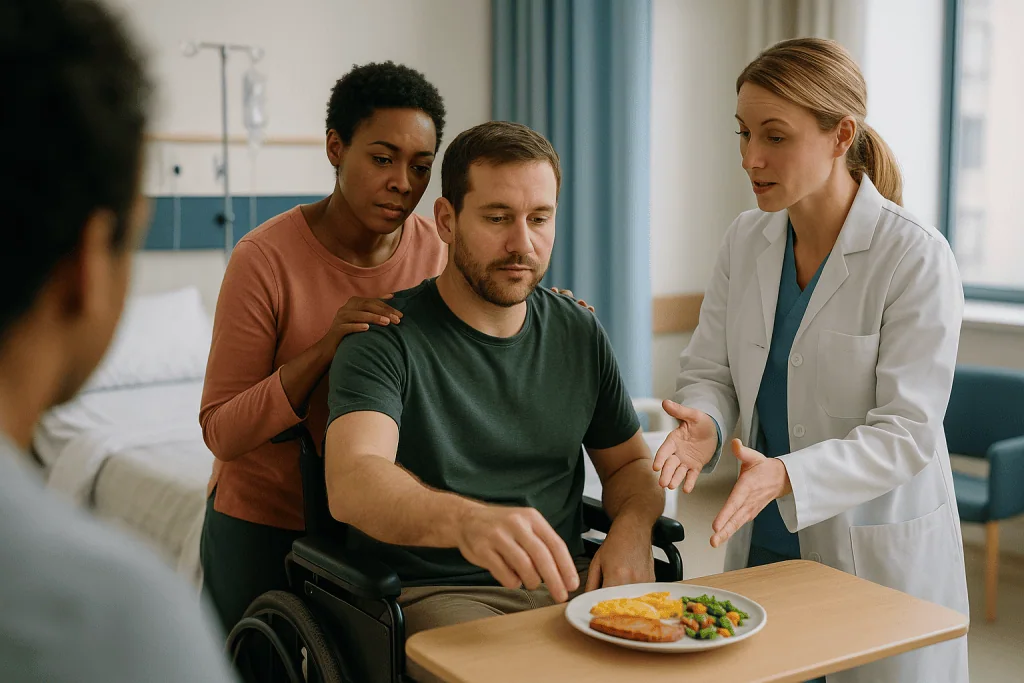
This matters enormously for families, because the injury level predicts the kind of help needed. The table below summarizes typical patterns described by Mayo Clinic and Cleveland Clinic; individual function varies widely, especially with incomplete injuries.
| Injury level | Typical movement | What family support often looks like |
|---|---|---|
| C1–C4 | Little or no arm movement; breathing may be weak or require a ventilator at the highest levels | Mechanical lift transfers, full assistance with care, training in airway and equipment routines |
| C5–C8 | Shoulder and some arm or hand function, often with weak grip | Assisted or slide-board transfers, help with dressing and bladder care, set-up for self-care tasks |
| T1–T6 | Full arm function, weak trunk; higher risk of autonomic dysreflexia | Many transfers done independently; family backs up, monitors blood pressure signs |
| T7–L1 | Better trunk control, no leg movement | Mostly independent with wheelchair; help with heavier tasks and skin checks |
| L2 and below | Some hip or knee movement possible; braces may allow standing | Standby assistance, practice with braces or walking aids as directed |
Injuries at C1 and C2 sit at the very top of the cord. Because the nerves that drive the diaphragm leave the cord between C3 and C5, damage above that point can stop independent breathing; Mayo Clinic notes that such injuries may require a ventilator. Families in that situation are trained in equipment care and emergency steps before any discharge is considered.
How to transfer a paraplegic or tetraplegic safely, step by step
A transfer is any movement from one surface to another: bed to wheelchair, wheelchair to toilet, car seat to chair. It is the single most physical thing most caregivers do, and the most common source of back strain for them and skin injury for the person being moved.
The method depends on the injury. People with paraplegia or lower tetraplegia often learn to transfer themselves using a slide board, a smooth plank that bridges the gap between surfaces, with a caregiver standing by. People with higher injuries usually need a mechanical lift, a sling-and-hoist device that does the lifting so no one has to.
The sequence therapists typically teach for an assisted slide-board transfer runs like this:
- Position the wheelchair at a slight angle to the bed, brakes locked, armrest removed on the near side, footplates swung away.
- Bring the surfaces to the same height where possible, because moving downhill is easier and moving uphill invites a drag across the skin.
- Place the board under the thigh, not under bare skin against a hard edge, and check that the far end rests securely on the target surface.
- The caregiver stands or kneels in front, knees bent, back straight, hands on the person’s hips or a transfer belt, never pulling on arms or under the armpits.
- Move in two or three short scoots rather than one long slide, pausing to check balance each time.
- Once seated, reposition the hips fully back in the chair and check that no skin was caught or scraped.
For mechanical lifts, the key lessons are sling placement, checking the clips before lifting, and never leaving the person suspended while fetching something. Every unit has its own equipment, so the written instructions from the therapy team should always override a general description like this one.
Who is usually taught home transfers, and who is asked to wait
Not every willing relative is cleared to do every transfer, and that caution protects both people. Therapists look at three things: the injured person’s size and ability to help, the caregiver’s strength and health, and the home environment.

Families are usually trained when the injured person can bear some weight or follow directions, the caregiver can safely bend and brace without pain, and the home allows the wheelchair to approach the bed from the right side. A spouse with a healthy back, a teenager with good coordination, or a parent who already lifts for work will often be taught slide-board or pivot transfers during the inpatient stay, practicing under supervision until the therapist signs them off.
Therapists tend to ask people to wait, or to use equipment instead of manual lifting, in several situations:
- The caregiver has a history of back injury, heart disease or balance problems.
- The injured person is much heavier than the caregiver or cannot help stabilize their trunk.
- The injury is high cervical and the person depends on breathing equipment that could be dislodged.
- Spinal precautions are still in place, meaning the surgeon has not yet cleared bending or twisting at the injury site.
- Skin over the sacrum or sitting bones is broken, since dragging across a pressure injury can deepen it quickly.
Being asked to wait is not a judgment about commitment. It usually means a mechanical lift, a paid care aide for the heaviest tasks, or a few more sessions of practice before discharge. Rehabilitation teams generally prefer a slower start to a hurried one, because a fall in the first week at home can undo weeks of progress and shake everyone’s confidence.
Spinal cord injury home modifications to sort out before discharge
The home visit is a standard part of discharge planning in many rehabilitation programs. An occupational therapist, who specializes in making daily tasks possible, walks through the house with a tape measure and a critical eye, and the family often sees their home differently for the first time.
The non-negotiables usually come first. A wheelchair needs a level or ramped entrance, doorways wide enough to pass without scraping knuckles, and a clear turning circle in at least one room. If the bedroom and bathroom are upstairs, many families convert a ground-floor room temporarily rather than wait for a stair lift. A hospital-style adjustable bed makes transfers and repositioning far easier and allows the head to be raised quickly, which matters in autonomic dysreflexia.
The bathroom is where most of the thinking happens. A roll-in shower or a tub transfer bench, a raised toilet seat or commode chair, grab bars anchored into studs rather than drywall, and a hand-held shower hose are the common recommendations. Floor surfaces should be non-slip, because water plus a transfer is an obvious hazard.
Smaller changes add up. Removing loose rugs, re-routing power cords, lowering frequently used shelves, swapping round doorknobs for lever handles, and placing a phone within reach of the bed all reduce daily friction. Families with a person on a ventilator or using a pressure-relieving mattress also need to confirm electrical supply and a plan for power cuts.
Equipment is usually specified by the therapy team rather than chosen off the shelf, because a cushion or mattress of the wrong type can cause rather than prevent a pressure injury. Where a home cannot be modified in time, programs typically arrange a short transitional stay or additional in-home care rather than discharge into an unsafe space.
Protecting skin: why pressure injuries are the caregiver's quiet enemy
A pressure injury, also called a pressure sore or pressure ulcer, is damage to skin and underlying tissue caused by sustained pressure or friction, usually over a bony point such as the tailbone, hips, heels or shoulder blades. After a spinal cord injury the usual warning system fails: the person cannot feel the discomfort that would normally make them shift, and the skin below the injury heals more slowly because circulation and muscle bulk change.
The NHS notes that pressure ulcers can develop over hours or days in someone who cannot move. That timeline is why rehabilitation nurses treat skin checks as a twice-daily ritual rather than an occasional glance. The caregiver’s job is to look, with a mirror or a phone camera if needed, at every bony area and to press lightly on any red patch. Skin that stays red after the pressure is released, feels warmer or firmer than its neighbor, or shows a blister or open area needs prompt attention from the care team.
Prevention rests on a few repeated actions. Rehabilitation teams typically teach repositioning in bed on a regular schedule through the night, and pressure-relief maneuvers in the chair, such as leaning forward or side to side, several times an hour; the exact timing is set individually based on skin tolerance. Moisture control matters as much as pressure, so bladder and bowel accidents are cleaned promptly and the skin is dried gently. Nutrition, particularly adequate protein and fluids, supports skin resilience, and smoking undermines it.
Cushions and mattresses prescribed by the therapy team are part of the system, not a substitute for movement. A pressure-relieving cushion that has lost air or been replaced with a sofa pillow for convenience is one of the most common reasons a sore appears in the first months at home.
Bladder, bowel and the routines nobody warns you about
Few conversations in rehabilitation are as awkward at the start, or as routine by the end, as the ones about bladder and bowel. Spinal cord injury usually disrupts the nerves that signal fullness and control emptying, a condition called neurogenic bladder and bowel. Left unmanaged, this leads to infections, kidney damage, skin breakdown and, for people with higher injuries, dangerous blood pressure spikes.
Bladder management is tailored to the person. Many people use intermittent catheterization, inserting a thin tube to drain the bladder on a schedule and removing it afterward. Others have an indwelling catheter that stays in place, or a suprapubic catheter inserted through the lower abdomen. Caregivers of people with limited hand function are often trained to perform catheterization using clean technique, which means thorough hand washing, clean supplies and avoiding touching the tip of the catheter. The nursing team sets the schedule and fluid targets; changing either without advice can cause overfilling or dehydration.
Bowel programs work on timing and reflex. Most people establish a regular schedule, often after a meal when the gut is naturally more active, and use techniques such as digital stimulation or prescribed suppositories to trigger emptying. Consistency is the whole point: a predictable program means fewer accidents, less skin exposure to moisture and more confidence leaving the house.
Caregivers are taught to watch for signs of urinary tract infection, which can present differently after spinal cord injury. Cloudy or strong-smelling urine, new leaking between catheterizations, increased muscle spasms, fever, chills, or a general sense of feeling unwell are the signals rehabilitation teams typically describe. Any of these warrants a call to the care team rather than waiting to see.
Autonomic dysreflexia warning signs every family at T6 and above should know
Autonomic dysreflexia is a sudden, dangerous rise in blood pressure triggered by an irritating stimulus below the level of injury, most often a full bladder or bowel, but also a pressure injury, tight clothing, an ingrown toenail or any painful problem the person cannot feel. According to MedlinePlus, it mainly affects people with injuries at T6 or above, because the nerves controlling blood vessels in the lower body are cut off from the brain’s braking system.
The mechanism explains the symptoms. Below the injury, blood vessels clamp down and blood pressure climbs. Above the injury, the body tries to compensate: the heart may slow, the face flushes, the skin above the level sweats. The person often reports a pounding headache, blurred vision, nasal stuffiness or a feeling of dread. Goosebumps may appear below the level while the skin above is red and damp.
Caregivers are usually taught a fixed sequence, which the treating team will tailor and write down:
- Sit the person upright and lower their legs if possible, which uses gravity to bring pressure down.
- Loosen anything tight: clothing, straps, leg bag tubing, shoes.
- Check the bladder first. Is the catheter kinked, blocked or the bag full? Empty or catheterize as trained.
- Check the bowel next if the bladder is not the cause, following the care team’s instructions.
- Look for skin problems, pressure points or anything else irritating below the injury.
- Call emergency services if the cause cannot be found quickly or symptoms do not settle, and tell responders the person has a spinal cord injury and suspected autonomic dysreflexia.
Some people carry a wallet card describing the condition, because many emergency clinicians see it rarely. Medicines may be prescribed for episodes that do not respond to removing the trigger; the prescribing clinician decides when and how those are used.
What the first weeks at home usually look like
Discharge day often feels like the finish line. Families who have been through it tend to describe it instead as the start of a second, messier phase, where the routines that ran smoothly in a unit with call bells and three shifts of staff have to survive contact with real life.
The first few days are typically consumed by logistics. Equipment arrives in boxes. The bed that was promised turns out to be the wrong height. The bathroom that looked fine on the home visit has a threshold nobody noticed. Most rehabilitation programs anticipate this and schedule an early follow-up call or visit from a community therapist or nurse; using it to list every snag is time well spent.
By the end of the first week or two, a daily rhythm usually emerges. Mornings are long: bowel program, skin check, washing, dressing, transfers. Many families find the morning routine takes two to three times longer at home than it did with trained staff, and that it shortens steadily as hands learn the work. Catheterization schedules structure the day. Evenings bring repositioning and the first attempts at the night-time turning routine, which is where sleep deprivation starts for caregivers.
Emotionally, this period is uneven for everyone. The injured person may feel their loss more sharply at home, surrounded by stairs they used to climb and a car they used to drive. Caregivers often describe a mix of competence and dread. Mood changes, withdrawal and sleep problems in either person are worth raising with the team, because depression after spinal cord injury is common and treatable, and it responds better when it is caught early.
Outpatient therapy usually continues for months. Goals shift from basic safety toward community skills: getting into a car, managing a kerb, returning to work or school.
How long does a spinal cord injury take to heal, and what recovery honestly means
This is the question families ask most, and it deserves a straight answer. The spinal cord does not regenerate the way skin or bone does. Recovery, when it happens, comes from swelling subsiding, bruised but intact nerve fibers resuming function, and the brain and body learning to do more with what remains.
The pattern described by Mayo Clinic is that the fastest improvement tends to occur in the first six months, with smaller gains possible for one to two years. A person graded as having a complete injury in the first days is sometimes regraded as incomplete once swelling settles, and that early reassessment, usually around 72 hours and again at several weeks, is a meaningful marker. Beyond the first year or two, change in neurological function is uncommon, although functional ability, meaning what a person can actually do, often keeps improving with training, equipment and confidence.
Can someone with a complete spinal cord injury walk again? The honest answer is that functional walking after a confirmed complete injury is rare with current treatments. Research into electrical stimulation, exoskeletons, cell-based therapies and drugs that reduce early damage is active, and the National Institute of Neurological Disorders and Stroke summarizes several lines of investigation. None of these are established standard care for restoring walking in complete injuries, and families should treat any program promising otherwise with caution.
For incomplete injuries the picture is more varied. Some people regain significant movement; others plateau early. The most useful stance a family can take is to pursue every realistic gain through rehabilitation while building a life that does not depend on further neurological recovery. Both things can be true at once, and the rehabilitation team can help translate the person’s current grade into likely goals without false hope or unnecessary gloom.
Caregiver burnout after spinal cord injury: rest is a safety measure, not a luxury
Night-time turning every few hours, a morning routine that eats three hours, and the constant background vigilance for a blood pressure spike add up. Caregivers of people with spinal cord injury commonly report chronic sleep loss, back pain, anxiety and a shrinking social world. Burnout is not a character flaw; it is the predictable result of an unsustainable load.
The safety argument is the one that persuades reluctant caregivers. A tired person lifts badly, misses a red patch on the sacrum, forgets a catheterization time, or snaps at the person they love. Rest protects the injured person as directly as any piece of equipment does.
Practical steps that rehabilitation social workers typically discuss include:
- Sharing the night. If two adults are in the house, alternating nights for turning duties makes a real difference; if not, a paid overnight aide even one or two nights a week can be the difference between coping and collapse.
- Mapping the day into tasks that genuinely need the caregiver and tasks that a friend, neighbor or hired aide could do, such as shopping, driving to appointments or sitting with the person while the caregiver sleeps.
- Asking the team about respite care, meaning short planned stays in a facility or scheduled in-home relief so the caregiver can rest, travel or simply stop.
- Joining a peer group, in person or online, where other families share solutions to problems that seem unique until someone else describes them.
- Keeping the caregiver’s own medical appointments, including for back pain and mood.
Signs that the load has tipped too far include persistent exhaustion that sleep does not fix, resentment or guilt that colors every interaction, frequent illness, or thoughts of walking away. These are reasons to call the team’s social worker or a primary care clinician, not to push harder. The people who sustain this role for years are usually the ones who built rest into the plan from the start.
Where do most people with tetraplegia live, and how spinal cord injury caregiver support changes over the years
Families often assume that a high injury means a nursing home. In most high-income countries that is not what typically happens. Rehabilitation programs describe the majority of people, including many with tetraplegia, returning to a private home after their inpatient stay, usually with a combination of family care, paid personal assistance and equipment. Long-term institutional care tends to be reserved for people with very high injuries who depend on ventilators and have no available home support, or for those whose medical needs exceed what can be managed at home.
Living at home over the long term changes what caregiving looks like. The first year is dominated by learning and by medical vigilance. Over time, many people with paraplegia and lower tetraplegia become fully independent in transfers, bladder care and daily routines, and the family role shifts toward partnership: helping with heavy tasks, backing up during illness, sharing the driving. For people with higher injuries, hands-on care remains, but it becomes more efficient, more shared and more predictable.
Secondary health problems shape the later years. The WHO notes that people with spinal cord injury face a higher risk of premature death than the general population, largely from preventable complications such as pressure injuries, urinary infections and respiratory illness. That is why the routines learned in the first weeks remain the most important long-term intervention: skin checks, bladder hygiene, vaccination against respiratory infections, and regular follow-up.
Caregiver roles also change. Parents age, spouses change jobs, children grow up and move away. Rehabilitation programs that offer periodic reassessment can help families redesign the support plan rather than let it drift. Spinal cord injury caregiver support, in other words, is not a single training session before discharge. It is a relationship with a care team that gets revisited as life does.
What people often get wrong
Spinal cord injury attracts myths, partly because it is rare enough that most families have never met anyone living with it, and partly because popular culture leans heavily on miracle recovery stories. A few corrections help.
“If they can’t feel it, it doesn’t hurt them.” Lack of sensation does not mean lack of damage. A scalded foot in a too-hot bath, a skin tear during a hurried transfer, or a fractured bone from a fall can all happen silently. Caregivers learn to check water temperature with their own hand and to inspect skin precisely because the usual alarm is off.
“Exercise will bring back movement if they try hard enough.” Effort cannot reconnect severed nerve pathways. Exercise is still essential, for heart health, bone density, spasticity, mood and function, but framing it as the key to walking again sets up disappointment and sometimes shame.
“A complete injury is final from day one.” Early grading can change as swelling settles; some injuries labeled complete in the emergency department are later found to be incomplete. Equally, an incomplete grade is not a promise of walking.
“Doing everything for them is the kindest approach.” Over-helping removes the independence that rehabilitation is trying to build. Therapists usually ask families to let the person struggle a little with tasks they are learning, and to step in only when safety is at stake.
“Autonomic dysreflexia only happens in hospital.” It happens anywhere, often triggered by a blocked catheter at home. Every caregiver of a person with a T6 or higher injury should know the response sequence.
“The caregiver’s health can wait.” It cannot, for the safety reasons described earlier. A caregiver with an injured back or untreated depression is a risk to both people.
Questions to ask your care team before and after discharge
Rehabilitation teams expect questions, and the families who do best tend to arrive with a written list. The ones below are drawn from what people commonly wish they had asked earlier; the answers will be specific to the injury and the home.
- What is the current injury level and grade, and when will it be reassessed?
- Which transfers am I cleared to do, and which should always use the lift or a second person?
- Can you write down the exact repositioning and pressure-relief schedule, including overnight?
- What does our autonomic dysreflexia plan say, step by step, and should we carry a wallet card?
- What are the signs of a urinary tract infection in this person, and who do I call if I see them?
- Which parts of the bladder and bowel program can I adjust myself, and which need a call first?
- How do I check the cushion and mattress are working, and how often should they be reviewed?
- Who comes to the house after discharge, how soon, and how do I reach them between visits?
- What respite options exist, and how do we arrange them before we are desperate?
- Is there a peer support group for families, and can you connect us?
- What vaccinations and routine screenings matter more because of this injury?
- How will we know when to move from hands-on help toward more independence?
After discharge, keep a simple notebook or phone note of skin changes, catheterization times, bowel results, blood pressure episodes and anything that worried you. Bringing that record to follow-up appointments turns vague concern into useful data, and it helps the team spot patterns before they become emergencies. Where answers feel uncertain, asking the team what the evidence actually shows for this person’s grade is a fair question, and a good team will tell you plainly.
When to call your doctor
Most days in spinal cord injury care are routine. The skill lies in recognizing the handful of situations that are not, and in acting early rather than waiting to see how the evening goes. The treating team should give a written list; the signs below reflect what rehabilitation guidance commonly includes.
Call emergency services immediately for suspected autonomic dysreflexia that does not settle after sitting the person up and relieving the bladder and bowel: a pounding headache, flushing and sweating above the injury, blurred vision or a markedly high blood pressure reading. Do the same for new difficulty breathing, blue lips, chest pain, a seizure, a fall with a possible fracture or head injury, or sudden confusion.
Call the care team the same day for signs of urinary tract infection, including fever, chills, cloudy or foul-smelling urine, new leaking or a sudden increase in spasms; for any red area over a bony point that does not fade within a short time after pressure is relieved, or any blister, open skin or drainage; for a swollen, warm or discolored leg, which can indicate a blood clot; for new or worsening pain, numbness or weakness above the injury level; and for vomiting, abdominal distension or no bowel result for longer than the team has advised.
Caregivers have their own red flags. Back pain after a transfer, exhaustion that sleep does not fix, persistent low mood, or thoughts of harming yourself or the person you care for are all reasons to contact a clinician promptly. These are not failures; they are signals that the plan needs adjusting.
When in doubt, the rehabilitation team would rather take an unnecessary call than miss a necessary one. Every decision about treatment, medicines and when to escalate rests with them, and a good partnership is built on calling early.
Frequently asked questions
How long does a spinal cord injury take to heal?
The spinal cord does not regenerate like skin or bone, so healing means swelling settling and surviving nerve fibers recovering function. Mayo Clinic describes the fastest improvement in the first six months after injury, with smaller gains possible for one to two years. After that, neurological change is uncommon, although what a person can do often keeps improving with therapy, equipment and practice. The treating team can explain what is realistic for a specific grade.
Where do most quadriplegics live?
Most people with tetraplegia, the medical term for quadriplegia, return to a private home after inpatient rehabilitation rather than moving to a nursing facility. They typically live with a combination of family support, paid personal assistance and adapted equipment. Long-term institutional care is more common for people with very high injuries who depend on ventilators and lack available home support. Discharge destination is planned individually with the rehabilitation team.
Can someone with a complete spinal cord injury walk again?
Functional walking after a confirmed complete spinal cord injury is rare with current treatments. A complete injury means no movement or sensation is preserved below the level, and research into stimulation, exoskeletons and cell-based approaches, summarized by the National Institute of Neurological Disorders and Stroke, is ongoing but not established standard care for restoring walking. Early grades sometimes change to incomplete as swelling resolves, which is why reassessment in the first weeks matters.
What are the symptoms of a C1 and C2 vertebrae spinal cord injury?
Injuries at C1 and C2, the top of the neck, can cause paralysis of arms, trunk and legs, loss of sensation below the neck, and loss of bladder and bowel control. Because the nerves that drive the diaphragm leave the cord between C3 and C5, damage above that level can stop independent breathing, and Mayo Clinic notes a ventilator may be required. Blood pressure instability and autonomic dysreflexia are also common at this level. Any suspected neck injury is a medical emergency.
How do you transfer a paraplegic from bed to wheelchair?
Most assisted transfers for someone with paraplegia use a slide board between a locked wheelchair, armrest removed, and a bed set to similar height. The caregiver stands in front with bent knees and a straight back, hands on the person’s hips or transfer belt, and the person scoots across in two or three short moves. Arms and armpits are never used as handles. The exact method must come from the person’s own therapy team.
What are the autonomic dysreflexia warning signs caregivers should watch for?
The classic signs are a sudden pounding headache, flushing and sweating above the level of injury, blurred vision, nasal stuffiness, goosebumps below the injury, and a slow pulse with very high blood pressure. MedlinePlus notes it mainly affects injuries at T6 or above. The immediate response is to sit the person upright, loosen tight clothing, check the bladder and bowel, and call emergency services if symptoms do not settle quickly.
What spinal cord injury home modifications are needed before discharge?
Common changes include a ramped or level entrance, doorways wide enough for the wheelchair, a ground-floor sleeping space if stairs are an issue, an adjustable bed, a roll-in shower or tub bench, grab bars fixed into studs, a raised toilet or commode, lever door handles and removal of loose rugs. An occupational therapist usually assesses the home and specifies equipment such as cushions and mattresses, which should not be substituted with household items.
How can I prevent caregiver burnout after a family member's spinal cord injury?
Build rest into the plan from the start rather than waiting for exhaustion. Share night-time turning duties where possible, hire help for the heaviest or least skilled tasks, arrange respite care before you need it, join a peer support group and keep your own medical appointments. Signs the load has tipped too far include constant fatigue, resentment, frequent illness or low mood; these are reasons to contact the team’s social worker or a primary care clinician.
How often should a person with a spinal cord injury be repositioned?
The schedule is set individually by the rehabilitation team based on skin tolerance, the mattress and cushion in use, and the person’s ability to shift their own weight. The NHS notes pressure ulcers can develop over hours or days in someone who cannot move, which is why teams teach regular overnight turning and frequent pressure-relief lifts or leans while seated. Written instructions from the team should be followed rather than general rules.
What is the difference between a complete and an incomplete spinal cord injury?
A complete injury means no movement or sensation is preserved below the level of injury, while an incomplete injury means some signals still pass through the damaged area, so partial movement or feeling remains. Doctors grade this using a standard examination, often repeated over the first days and weeks as swelling resolves. Incomplete injuries have more varied recovery, but neither grade is a guarantee of a particular outcome, and the care team interprets what it means for goals.
References
- Spinal cord injury (WHO fact sheet)
- Autonomic dysreflexia (MedlinePlus Medical Encyclopedia)
- Pressure ulcers (pressure sores) (NHS)
- Spinal Cord Injury (National Institute of Neurological Disorders and Stroke)
This article is for general information only and is not a substitute for professional medical advice. Please consult a qualified doctor about your individual situation.

More from the Blog

Before Your First Vestibular Rehabilitation Visit: Symptom Diary, Hearing Tests and Medicines
Before a vestibular rehabilitation first appointment, most teams ask for three things: a short symptom diary recording when dizziness happens, how long it lasts…

Skin Checks and Pressure Relief After Spinal Cord Injury Rehabilitation: A Daily Routine
Pressure sore prevention after spinal cord injury rests on a daily routine: inspect skin over bony areas at least once or twice a day,…

What a Pulmonary Rehabilitation Session Involves: Exercise, Breathing Training and Education
Pulmonary rehabilitation is a supervised program for people with chronic lung disease that combines exercise training, breathing techniques and education. A typical session includes…

Daily Life After Vision Rehabilitation: Practicing Contrast Strategies and Orientation Skills
Living with low vision after rehabilitation works best when contrast and orientation skills become daily habits: use dark-on-light or light-on-dark pairings for food, stairs,…

Shockwave Therapy for Plantar Fasciitis: What the Trials Show
Shockwave therapy shows moderate evidence of benefit for chronic plantar fasciitis. Randomized trials and meta-analyses find it relieves heel pain better than sham treatment…

Inside a Bobath Treatment Session: Guided Handling, Positioning and Task Practice
A Bobath therapy session is a hands-on neurological rehabilitation appointment, usually with a physiotherapist or occupational therapist, in which the therapist guides your movement,…