

Fibroblast Plasma Skin Tightening Results: What Changes, How Gradually and How Long It Lasts
Key Takeaways
- Fibroblast plasma treatment vaporizes the top layer of skin and heats the layer beneath, so it heals like a pattern of tiny superficial burns, with crusts typically lifting in one to two weeks.
- Tightness seen on the day of treatment is largely heat contraction and swelling; any lasting firmness from new collagen develops gradually over roughly three months.
- No large or long-term trial has measured how long plasma pen results last, and estimates borrowed from ablative laser resurfacing suggest years rather than a lifetime, with aging continuing throughout.
- Post-inflammatory hyperpigmentation is the most common complication and is markedly more likely in medium and deeper skin tones, which is why many practitioners decline to treat higher Fitzpatrick types.
- The procedure cannot remove excess skin, so eyelids or necks with true surplus will not achieve a surgical-type change from any resurfacing method.
- Daily broad-spectrum SPF 30 or higher for months afterward, and leaving crusts to fall away untouched, are the two aftercare steps most consistently linked to avoiding scarring and pigment marks.
Fibroblast plasma treatment results tend to be modest and gradual rather than dramatic. Small dark crusts usually lift within one to two weeks, pinkness fades over weeks to months, and any tightening from new collagen appears slowly over roughly three months. Long-term durability is not well studied; changes are not permanent because skin keeps aging, and results, healing and risks vary widely between individuals.
She is standing in front of the bathroom mirror, phone in one hand, gently pulling the skin beside her eye toward her temple with the other. The lines flatten. She lets go and they return. Somewhere in a search tab a video promises that a pen-shaped device can do that pulling for her, permanently, in one afternoon. She is not sure whether to be hopeful or suspicious. Both, it turns out, are reasonable.
Fibroblast plasma treatment results are a genuinely confusing subject to research, because the loudest voices are marketing and the quietest are small clinical studies with short follow-up. What actually changes in the skin, how quickly, and for how long, are three separate questions with three different answers.
This explainer walks through all three, using what mainstream dermatology knows about skin healing and collagen, and being honest where the plasma-specific evidence runs thin. It is written to help you ask better questions of a qualified medical practitioner, not to replace that conversation.
What is fibroblast plasma skin tightening, and what actually happens during treatment?
Plasma, in this context, is not the liquid part of blood. It is the fourth state of matter: a gas that has been electrically charged until it glows and conducts energy. A plasma pen creates a tiny arc of this ionized gas between its metal tip and the skin, without the tip ever touching the surface.
That arc delivers a brief pulse of heat to a spot roughly the size of a pinhead. The very top layer of skin, the epidermis, is turned directly from solid to vapor in a process called sublimation. Underneath, in the dermis (the deeper layer that holds collagen and elastin fibers), the heat causes a controlled injury. Collagen is the protein scaffolding that gives skin firmness; elastin is the protein that lets it snap back after stretching. Both decline with age, and Cleveland Clinic notes that collagen production falls by roughly 1% a year from the mid-twenties onward.
The name comes from fibroblasts, the cells in the dermis whose job is to manufacture collagen and elastin. The theory is that a controlled thermal injury signals fibroblasts to lay down fresh fibers as the wound heals, and that the tissue contracts slightly as it does so.
A treatment session looks less dramatic than it sounds. A numbing cream is usually applied first, then the practitioner works across the area in a grid or along the edge of a fold, leaving a pattern of small brown dots a millimeter or two apart. The eyelids, the crow’s feet region, the upper lip and the neck are the areas most often treated. Sessions typically last well under an hour for a small zone.
Nothing is injected and nothing is cut. That is often presented as a reason the procedure is gentle. It is more accurate to say it is a superficial burn delivered in a deliberate pattern, and it heals like one.
What fibroblast plasma treatment results actually look like
Set the promotional images aside for a moment and picture what the skin is physically capable of doing after a shallow thermal injury.
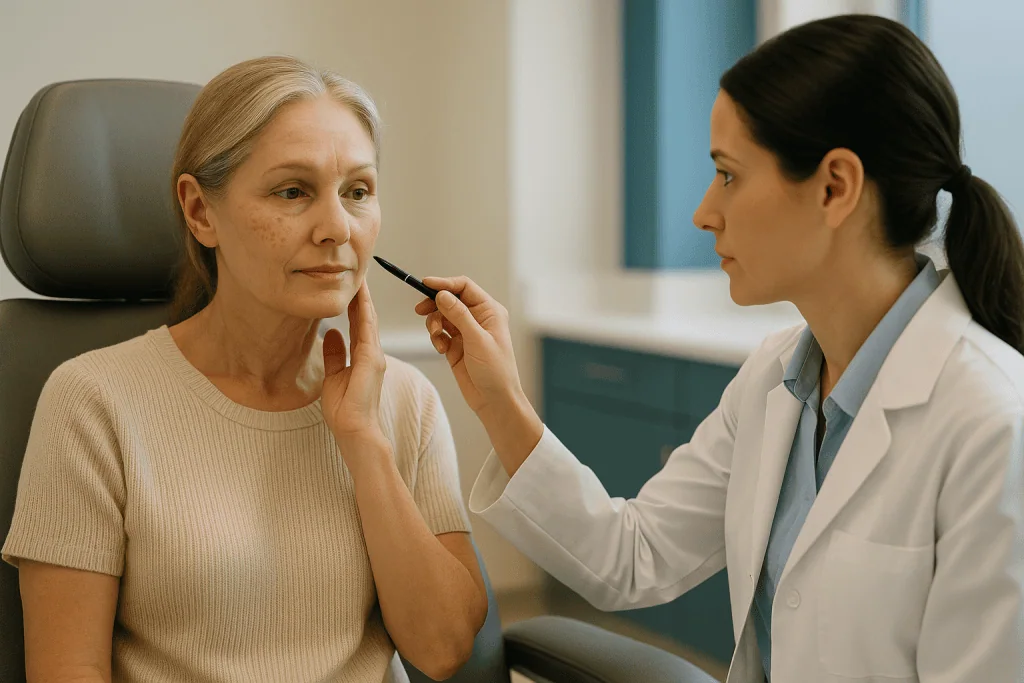
The most reliable visible change is at the surface. Where the epidermis was vaporized, new skin grows in over the following one to two weeks, a resurfacing effect that can soften fine crepe-like texture in the same way that other superficial resurfacing procedures do. Mayo Clinic describes this surface renewal for laser resurfacing, and the biology of re-epithelialization (the regrowth of the top skin layer over a wound) does not change because the heat source is different.
The second change is subtler: a small amount of tissue contraction. Heated collagen fibers shorten immediately, which is why practitioners can sometimes show a tightening effect on the treatment couch. That instant effect is partly swelling and partly heat contraction, and it settles. Any lasting firmness depends on how much new collagen the fibroblasts actually produce over the following months, which cannot be predicted for an individual.
What the procedure realistically addresses is mild laxity: a hooded upper eyelid that has lost a little crispness, fine lines at the outer eye, a soft upper lip. What it does not do is lift heavy skin folds, replace lost fat volume in the cheeks, or produce the kind of change a surgical procedure is designed to achieve. When an eyelid has enough excess skin to rest on the lashes, no superficial resurfacing method changes that meaningfully.
A fair mental model is this: think of ironing a slightly rumpled sheet, not shortening it. The fabric looks smoother, the sheet is not smaller.
How gradually do fibroblast plasma treatment results appear?
Gradually is the honest word, and the timeline runs in three overlapping phases that many people conflate.
The first phase is the apparent result, which is misleading. Immediately after treatment the area is swollen and the collagen has contracted with heat, so the skin can look tighter on the day. Over the next 48 to 72 hours swelling often increases before it eases, particularly around the eyes, where tissue is loose and fluid collects easily. Do not judge anything during this window.
The second phase is surface healing. The small dark dots are crusts of dried, heat-treated skin. In general wound healing, superficial skin regrows within one to two weeks, matching the surface recovery period Mayo Clinic describes after ablative laser treatment. When the crusts lift on their own, the skin beneath is new, pink and often a shade lighter or darker than the surrounding area. Many people are briefly disappointed here: the texture may look better, but the tightening effect from day one has faded with the swelling.
The third phase is remodeling, and it is slow. Fibroblasts continue to lay down and reorganize collagen for months after a wound closes. Mayo Clinic notes that improvement after resurfacing procedures develops gradually and may take several months to become apparent. Practitioners usually suggest waiting around 8 to 12 weeks before assessing a plasma result for the same reason, and before deciding whether a second session is even worth discussing.
The practical consequence: a photograph taken at two weeks tells you about healing, not about results. A photograph at three months, in the same light and at the same angle, tells you something closer to the truth.
Plasma pen healing stages: what the first days and weeks usually look like
People are rarely warned enough about the look of the healing period, so here it is plainly, as a typical pattern rather than a promise.
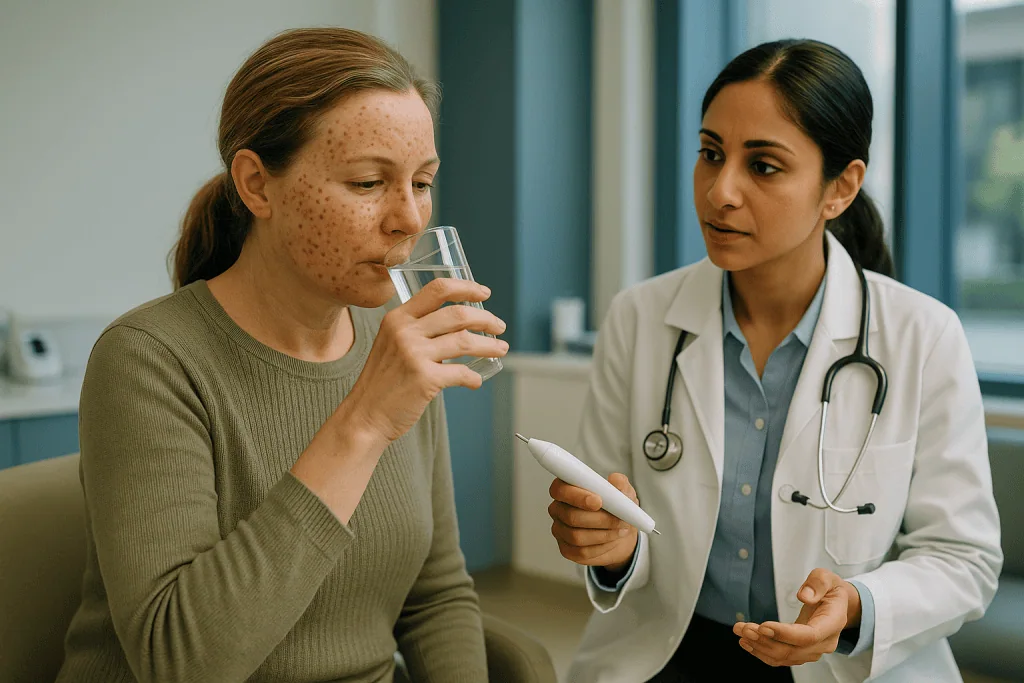
Day of treatment: a grid of small brown or black dots, surrounding redness, mild stinging or a sunburn-like heat. Swelling begins.
Days one to three: swelling is often at its peak, especially with eyelid treatment, where eyes can feel puffy on waking. The dots darken as they dry. Itching is common and scratching is the single most reliable way to turn a good outcome into a poor one.
Days four to ten: crusts loosen and fall away on their own, usually starting where the skin is thinnest. Underneath is smooth, shiny, pink skin. Picking a crust early removes the biological dressing before the new skin is ready and is a well-described route to scarring and pigment change.
Weeks two to six: redness or pinkness persists and slowly settles. In people with darker skin tones, the treated dots may instead darken, a pattern called post-inflammatory hyperpigmentation, meaning excess pigment produced in response to inflammation. Cleveland Clinic notes this response is more common in deeper skin tones and can take months to fade.
Weeks six to twelve and beyond: the skin tone evens out and any collagen-related firming becomes assessable. Mayo Clinic cautions that redness after ablative resurfacing can last several months in some people, and plasma treatment, being a heat injury to the same layers, should be expected to follow a similar range rather than a shorter one.
Most practitioners advise planning a week or so away from social events for facial treatment. Anyone telling you there is no visible downtime is describing a different procedure.
How long does plasma pen tightening last?
This is the question with the least satisfying evidence, and any specific figure quoted to you deserves to be asked for its source.
There are no large, long-term controlled trials of plasma pen skin tightening. Most published reports are small case series with follow-up measured in months, not years. That does not mean the effect is short; it means nobody has measured it properly over a long span.
The best available frame is what is known about comparable thermal resurfacing. Mayo Clinic states that improvement after ablative laser resurfacing can last for years, while nonablative approaches produce more modest, shorter-lived change, and that in every case the skin continues to age. Plasma treatment sits somewhere between those two in depth of injury, so it is reasonable to expect a durability somewhere in that range, but that is an inference, not a measurement.
Three facts about duration are solid. First, nothing about the procedure stops the ongoing loss of collagen that MedlinePlus describes as a normal part of aging, so the baseline keeps moving. Second, a result cannot outlast the habits that damage collagen: ultraviolet exposure and smoking both accelerate breakdown, and Mayo Clinic identifies sun exposure as the leading avoidable cause of wrinkles. Third, repeat treatment is limited by the risk side of the ledger, since each session is a fresh burn to the same area.
So the honest answer to how long plasma pen results last is: the surface smoothing is real but the skin continues to change; any firming is likely to fade gradually over a period of one or more years rather than disappear on a fixed date; and the word permanent has no place in the conversation.
Who is plasma fibroblast skin tightening usually for, and who is usually asked to wait?
Suitability is a clinical judgment, but the pattern across mainstream guidance on cosmetic skin procedures is consistent enough to describe.
The people most often considered reasonable candidates share a few features: mild rather than pronounced skin laxity, lighter skin tones that are less prone to pigment change after injury, realistic expectations about subtle results, and the ability to protect the area from sun for several months afterward. The procedure is a resurfacing tool for early changes, not a substitute for surgery in advanced ones.
Several groups are commonly advised to wait, or to consider other options. Darker skin tones (the higher categories on the Fitzpatrick scale, a six-point classification of how skin responds to sun) carry a substantially greater risk of post-inflammatory hyperpigmentation and of lighter patches called hypopigmentation, both described by Cleveland Clinic and Mayo Clinic as more frequent after resurfacing in deeper skin tones. Anyone with a personal or family history of keloids, which are raised scars that grow beyond the original wound edge, is generally steered away from any deliberate skin injury.
Active skin disease at the site, such as eczema, psoriasis, acne or a cold sore, is a reason to postpone. So is a recent tan or sunburn. People who have recently used oral retinoid medicines for acne are often asked to wait a period of months, because that class of medicine is thought to alter wound healing; the timing of any such interval is a decision for the prescribing clinician, not something to work out alone.
Pregnancy and breastfeeding are usually treated as reasons to defer purely elective procedures. Conditions that impair healing, including poorly controlled diabetes, immune suppression and smoking, raise the risk of poor outcomes and belong in the pre-treatment conversation.
Plasma fibroblast skin tightening compared with other options
Choosing between resurfacing and tightening methods is really a choice about depth of injury, downtime and the strength of evidence behind each. The table below summarizes typical patterns described by Mayo Clinic and the NHS for common approaches; individual experience varies.
| Approach | What it targets | Typical surface healing | Strength of evidence |
|---|---|---|---|
| Plasma pen (fibroblast) | Fine lines, mild laxity in small zones | Crusts lift in about 1–2 weeks; pinkness for weeks to months | Small studies, short follow-up |
| Ablative laser resurfacing | Deeper lines, texture, sun damage | Raw skin for 1–2 weeks; redness may last months | Established, widely studied |
| Nonablative laser or radiofrequency | Mild texture and laxity | Minimal; redness for hours to days | Established; results modest |
| Chemical peel (medium depth) | Texture, pigment, fine lines | Peeling for about a week | Established |
| Surgical eyelid lift or facelift | Excess skin and tissue descent | Weeks; bruising and swelling | Established; different risk profile |
Two things stand out. Plasma treatment is the newest entry and the least studied, which is not a reason to dismiss it but is a reason to weigh claims carefully. And the alternatives with the strongest track records are not necessarily gentler; ablative laser and surgery both involve more recovery. The right comparison is not which is best, but which matches the degree of change you are seeking, your skin type and how much downtime and risk you are prepared to accept. That conversation belongs with a qualified medical practitioner who can examine your skin rather than a screen.
Plasma fibroblast side effects and risks: what the evidence shows
Because the procedure creates hundreds of small burns, its risk profile is the risk profile of a burn, scaled down and repeated.
Expected effects are not complications. Redness, swelling, crusting, itching and temporary pink or dark spots are part of the process for nearly everyone, and their typical duration is described above.
Complications are the outcomes that were not intended. The most frequently reported is pigment change. Post-inflammatory hyperpigmentation, dark marks where the dots were, is the leading concern in medium and deeper skin tones and can persist for many months; Cleveland Clinic notes that it may fade slowly and sometimes needs its own treatment. Hypopigmentation, pale dots or patches where pigment cells were damaged, is less common but harder to reverse, and Mayo Clinic lists permanent lightening as a recognized risk of ablative resurfacing in general.
Scarring can occur when energy is delivered too deeply, dots are placed too close, crusts are picked, or the person is prone to abnormal scarring. Textured, pitted or grid-patterned marks have been reported, particularly on thinner skin such as the eyelid and neck.
Infection is possible whenever the skin barrier is broken. Reactivation of cold sores around the mouth is a known problem after any lip-area resurfacing, and people with a history of them are usually offered preventive antiviral medicine by a prescriber, a decision that sits with that clinician.
Eye injury is a specific concern with eyelid treatment, which is why the area is treated with protective measures and by people trained to work near the eye. Finally, dissatisfaction from under-correction is common and is not a complication so much as an expectation problem, which is why the next section exists.
What does the research actually say about plasma pen effectiveness?
Evidence-first means saying clearly how strong the evidence is, so here is the grading.
Plasma as a medical technology is not new; controlled plasma devices have been studied for skin resurfacing for well over a decade in the dermatology literature indexed by the NIH National Library of Medicine, with early work using larger nitrogen-plasma systems rather than handheld pens. Those studies were mostly small, uncontrolled and short in follow-up, and they reported improvements in texture and fine lines with a side-effect profile similar to other resurfacing methods.
Handheld plasma pens for fibroblast tightening have a thinner record. The published work consists largely of case series and small before-and-after cohorts, often without a comparison group, without blinded assessors and with follow-up of a few months. Improvements are usually reported, but the study designs cannot separate the treatment effect from swelling, observer bias or the natural variability of photographs.
What is missing is the kind of evidence that would settle the three questions in this article’s title: a randomized comparison against an established treatment, standardized measurement of skin laxity rather than subjective grading, and follow-up of two years or more to establish durability. Until that exists, statements about percentage improvement or years of longevity are extrapolations.
Regulatory status also varies by country, and the training required to operate these devices varies even more. The NHS advises anyone considering a nonsurgical cosmetic procedure to check that the practitioner is properly trained, qualified and insured, and to be cautious of anyone who cannot explain the evidence for what they offer.
Graded honestly: plausible mechanism, consistent low-quality evidence of modest benefit, well-characterized risks, and no reliable data on how long results last.
What people often get wrong about fibroblast plasma treatment results
Several beliefs circulate widely enough to deserve direct correction.
The first is that the procedure is non-invasive because nothing pierces the skin. It is more accurate to call it minimally invasive: the top layer of skin is vaporized and the layer beneath is heated. A treatment that requires a week of crusting is not the same category as a moisturizer.
The second is that results are permanent. No treatment that works by stimulating collagen can be permanent, because MedlinePlus and Mayo Clinic both describe collagen loss and elastin damage as continuing processes of aging and sun exposure. The result is a point on a moving line, not a fixed destination.
The third is that more sessions produce proportionally more tightening. Each session is a new burn to the same tissue, and repeated injury raises the chance of pigment change and scarring. The relationship between sessions and results is not linear, and the risk curve rises faster than the benefit curve.
The fourth is that the day-one appearance predicts the outcome. It does not; that tightness is heat contraction and swelling, and it fades before the real remodeling begins.
The fifth is that plasma is a safe substitute for surgery in someone with pronounced excess skin. It cannot remove skin. An eyelid with true excess will look like an eyelid with true excess after any resurfacing procedure.
The sixth is that darker skin simply needs a gentler setting. Pigment change after injury in deeper skin tones is a biological tendency, not a settings error, and Cleveland Clinic describes it as a predictable response to inflammation. Some practitioners decline to treat higher Fitzpatrick types for that reason, and that caution is evidence-based rather than exclusionary.
How aftercare shapes the result, especially sun protection
If one variable within your control decides whether the outcome is good or disappointing, it is what happens in the weeks after the pen is put down.
The crusts are the priority in the first week. They are the body’s own dressing over new skin, and the instruction to leave them alone until they release on their own is not fussiness; picking is one of the most consistently described routes to scarring and pigment change in wound care. Gentle cleansing and a bland barrier product as directed by the practitioner are the usual approach. Heavy makeup over open crusts is generally discouraged until the surface has closed.
Heat and sweat matter for the same reason. Vigorous exercise, saunas and hot showers directed at the face are commonly restricted for a period while the skin is raw, because heat increases swelling and moisture softens crusts prematurely.
Sun is the long game. Newly healed skin has little pigment protection and inflamed skin over-produces pigment when exposed to ultraviolet light, which is the mechanism behind post-inflammatory hyperpigmentation. Mayo Clinic recommends broad-spectrum sunscreen with SPF 30 or higher as a daily measure against wrinkles in general, and after any resurfacing procedure strict protection for several months is standard advice. A wide-brimmed hat is not a fashion suggestion here; it is part of the treatment.
Active skincare ingredients such as retinoids and acids are usually paused until the skin has fully recovered, then reintroduced on the practitioner’s advice. Smoking impairs wound healing and accelerates collagen breakdown, so the weeks around treatment are, at minimum, a poor time for it.
None of this guarantees a result. It does remove the most common self-inflicted reasons for a poor one.
Why results differ so much from person to person
Two people can have the same area treated with the same device on the same afternoon and see quite different outcomes. That variability is not random; it tracks a handful of biological factors.
Skin thickness is one. The eyelid has some of the thinnest skin on the body, which is why it responds visibly to small changes and also why it is unforgiving of excess energy. The neck heals more slowly and scars more readily than the face, a pattern seen across resurfacing methods.
Baseline collagen is another. Cleveland Clinic describes collagen declining steadily with age and more sharply after menopause, and MedlinePlus notes that skin thins and loses elasticity with age. A person in their forties with early changes has more fibroblast reserve to respond to a stimulus than a person in their seventies with long-standing sun damage. The procedure asks the skin to build; it cannot supply the materials.
Skin tone shapes both risk and appearance of healing, as discussed, because pigment cells respond to inflammation.
Sun history matters twice: once because ultraviolet damage has already degraded collagen and elastin, and again because sun-damaged skin is more prone to uneven pigment after injury. Mayo Clinic identifies ultraviolet exposure as the primary cause of early wrinkling.
General health sets the ceiling on healing. Smoking, uncontrolled blood sugar, nutritional deficiency and certain medicines all slow wound repair. Genetic tendency to keloid or hypertrophic scarring is a hard limit rather than a variable.
The practical lesson is that someone else’s outcome is a poor predictor of yours, in either direction. A practitioner who examines your skin, asks about your history and explains which of these factors apply to you is offering something a testimonial cannot.
Questions to ask your care team before agreeing to treatment
A good consultation should feel like an exchange of information, not a closing. These questions help you tell the difference, and the answers should be specific rather than reassuring.
- What is your training and qualification for this procedure, and are you insured to perform it? The NHS advises confirming both for any nonsurgical cosmetic treatment.
- Looking at my skin, what degree of change do you realistically expect, and what would you consider a disappointing result?
- What is my skin type on the Fitzpatrick scale, and how does that change my risk of dark or light marks?
- Have you treated people with my skin tone, and what did their healing look like at three months?
- What is the regulatory status of this device for skin tightening where we are?
- What is your plan if I develop hyperpigmentation, scarring or infection, and who would I contact after hours?
- Would another approach, including doing nothing for now, suit my goals better?
- How long should I wait before judging the result, and when would you consider a second session?
- Which of my current medicines, skincare products or health conditions could affect healing? (Any change to a prescribed medicine is a decision for the prescriber, not the aesthetic practitioner.)
- Can I see the written aftercare instructions and consent form before the day of treatment?
Notice what is missing from this list: questions about how many sessions to buy or whether a package is available. Those are commercial questions. The clinical ones come first, and a practitioner who is comfortable with all of them is telling you something useful about how they work.
Bring a photograph of yourself in flat daylight to the consultation. It anchors the conversation in what your skin actually looks like rather than how it feels on a bad morning.
When to call your doctor after fibroblast plasma treatment
Most healing after plasma treatment is uneventful, but the procedure creates open wounds, and some signs need prompt medical assessment rather than a message to the practitioner the following week.
Contact a doctor or the practitioner urgently, or seek same-day care, if you notice any of the following:
- Spreading redness, warmth or swelling beyond the treated area, or pus, yellow crusting or a foul smell, which can indicate bacterial infection.
- Fever, chills or feeling generally unwell in the days after treatment.
- Increasing pain after the first few days rather than steady improvement.
- Clusters of small blisters, tingling or burning around the mouth or treated area, which may signal a cold sore virus flare that can spread across healing skin.
- Any change in vision, eye pain, persistent light sensitivity, or a feeling that something is in the eye after eyelid treatment.
- Swelling around the eyes severe enough to prevent them from opening, or swelling of the lips, tongue or throat, or difficulty breathing, which requires emergency care.
- Bleeding that does not stop with gentle pressure.
Less urgent, but worth an appointment: crusts that have not lifted after two weeks; dark or pale marks that are not improving after eight to twelve weeks; raised, thickened or itchy scar tissue forming at the site; or a grid pattern that persists once redness has faded. Post-inflammatory pigment change and early scarring both respond better to assessment sooner rather than later.
A dermatologist or the prescribing doctor is the right person to advise on any medicine, including whether a topical or oral treatment is appropriate; do not start, stop or adjust anything on the basis of an online forum. Every decision about managing a complication sits with the treating team.
Frequently asked questions
How long does plasma pen skin tightening last?
Nobody has measured this in a large long-term study, so any specific number is an estimate. Comparable thermal resurfacing methods produce improvement that can persist for years, but collagen loss continues with age and sun exposure, so the skin keeps changing. Expect a gradual fade rather than a fixed expiry, and treat the word permanent as a warning sign in any consultation.
What are the plasma pen healing stages day by day?
Day one brings small dark dots, redness and swelling; swelling often peaks by day two or three. Crusts loosen and fall away on their own between roughly days four and ten, leaving pink new skin. Pinkness or, in darker skin, dark marks then fade over weeks to months. Collagen remodeling continues quietly for around three months before the result is fairly assessable.
What are the most common plasma fibroblast side effects?
Redness, swelling, crusting and itching are expected in nearly everyone. The most frequent complication is post-inflammatory hyperpigmentation, dark marks that can persist for months and are more likely in deeper skin tones. Less common problems include pale patches, textured or grid-pattern scarring, infection and cold sore reactivation near the mouth. Eye injury is a specific concern with eyelid treatment.
Is plasma fibroblast skin tightening the same as a facelift or eyelid surgery?
No. Surgery removes excess skin and repositions tissue; plasma treatment resurfaces the skin and may stimulate a modest amount of new collagen. It can soften fine lines and mild laxity but cannot remove surplus skin. Someone with pronounced eyelid hooding or a heavy neck fold will not achieve a surgical-type result from any resurfacing procedure, plasma included.
When will I see fibroblast plasma treatment results?
Judge nothing in the first two weeks, when swelling and crusting dominate. Surface smoothing becomes visible once the new skin has grown in, but any firming from collagen takes longer; practitioners usually suggest assessing at eight to twelve weeks, in line with the months-long remodeling period described for other resurfacing methods. Photographs at three months in consistent light are the fairest comparison.
Can people with darker skin have plasma pen treatment?
It depends on individual assessment, and many practitioners are cautious or decline. Deeper skin tones have a markedly higher tendency to produce excess pigment after inflammation, and to lose pigment where cells are damaged, both well described after resurfacing procedures. A test patch and a frank discussion of risk are the minimum; the decision belongs with a practitioner experienced in treating your skin type.
Does the plasma pen hurt?
Most people describe a hot, prickling or stinging sensation during treatment after numbing cream has been applied, followed by a sunburn-like feeling for a day or two. The eyelid and upper lip tend to be more sensitive. Pain that increases after the first few days rather than easing is not typical and should be assessed for infection.
How many plasma fibroblast sessions are usually needed?
There is no evidence-based number. Some people see the change they want after one session; others are offered a second after the full healing period of around three months. Each session is a fresh thermal injury to the same skin, and the risk of pigment change and scarring rises with repetition faster than the benefit does, so more is not straightforwardly better.
Can I wear makeup or exercise while the crusts are healing?
Makeup over open crusts is generally discouraged until the surface has closed, usually within one to two weeks, because it introduces bacteria and encourages picking. Sweat, heat and steam soften crusts and increase swelling, so vigorous exercise, saunas and hot showers directed at the face are commonly restricted for a period. Follow the written aftercare from your practitioner.
What should I do if dark marks appear after plasma treatment?
Protect the area strictly from sun with broad-spectrum SPF 30 or higher and avoid picking or scrubbing. Post-inflammatory hyperpigmentation often fades over months, but marks that are not improving by eight to twelve weeks warrant review by a dermatologist or your doctor, who may discuss treatment options. Do not start any lightening product or prescription without that assessment.
References
- MedlinePlus: Aging changes in skin
- NHS: Cosmetic procedures
- Cleveland Clinic: Collagen
- Cleveland Clinic: Hyperpigmentation
This article is for general information only and is not a substitute for professional medical advice. Please consult a qualified doctor about your individual situation.

More from the Blog
Is Surgical Tattoo Removal an Option for You? Size, Location and Skin Elasticity Explained
Yes, tattoos can be surgically removed, but excision suits a narrow group: small to medium tattoos on areas with loose, elastic skin, in people…
How Masseter Botox Is Injected: Locating the Chewing Muscle and What the Session Involves
In a masseter botox procedure, a clinician first asks you to clench your teeth so the masseter, the thick chewing muscle at the back…

How Long Does a Thread Lift Last? Honest Longevity and Who It Suits
A thread lift typically lasts one to three years, depending on the suture material, your age, skin quality, and how much lift was attempted.…
Preparing for Microsurgery: Imaging, Fitness for Anesthesia and Specialist Consultations
Preparing for microsurgery usually means three things running in parallel: imaging such as CT angiography or Doppler ultrasound to map the tiny blood vessels…

Recovery After Retinal or Glaucoma Laser Treatment: Blurry Hours, Follow-Up and Milestones
After most retinal or glaucoma laser treatments, vision is blurry or dazzled for a few hours, mainly because of dilating drops, the bright treatment…
Flap or Graft? How Reconstructive Surgeons Choose Between the Two Ways to Rebuild Tissue
A skin graft is tissue detached completely from one site and laid onto a wound, where it must grow a new blood supply from…