

Fibroids After 40: How Age and Approaching Menopause Change the Treatment Discussion

Key Takeaways
- Fibroids are hormone-dependent, so most shrink after menopause, but reputable sources do not promise they disappear or specify by how much.
- The average age of menopause is around 51, and it is only confirmed after 12 months without a period, so "wait for menopause" can mean one year or ten.
- Submucosal fibroids, which bulge into the uterine cavity, are the type most likely to cause heavy bleeding and anemia, while subserosal fibroids on the outer wall mainly cause pressure symptoms.
- Cleveland Clinic estimates the chance that a presumed fibroid is actually a sarcoma at under 1 in 1,000, and Mayo Clinic notes fibroids almost never become cancerous.
- GnRH medicines shrink fibroids within months but are time-limited because of bone density effects, and fibroids typically regrow when they are stopped.
- Hysterectomy is the only treatment that guarantees fibroids will not return, but the ovaries can be left in place so that surgical menopause does not follow.
Fibroids after 40 are usually treated according to symptoms, not age alone. Because fibroids depend on estrogen and progesterone, many shrink after menopause, so some women with mild symptoms can reasonably monitor them. Heavy bleeding, anemia, pressure symptoms, or rapid growth still warrant treatment, which ranges from hormonal and nonhormonal medicines to embolization, myomectomy, or hysterectomy. The right choice depends on symptoms, fibroid size and location, and how close menopause actually is.
The ultrasound report comes back with a line that reads almost like a weather forecast: “multiple intramural and subserosal fibroids, largest 6 cm.” You are 46. Your periods have gone from predictable to flooding, you have started carrying a spare change of clothes to work, and the first thing a friend says is, “Just wait it out. Menopause will fix it.”
That advice is not wrong, exactly. It is incomplete. The conversation about fibroids after 40 treatment is genuinely different from the one a 32-year-old has, because the hormonal tide that feeds fibroids is about to turn. But “about to” can mean two years or ten, and a lot can happen to your iron levels, your bladder and your sleep in that window.
This article walks through what the evidence actually says about fibroids as menopause approaches: when waiting is sensible, when it is not, and how each treatment option changes once the finish line is in sight.
Why fibroids after 40 treatment is a different conversation
Fibroids are extremely common. The Cleveland Clinic estimates that 40 to 80 percent of people with a uterus will develop them, and the NHS notes they appear most often between the ages of 30 and 50. By the mid-forties, then, a fibroid diagnosis is less a surprise than a statistical likelihood.
What changes after 40 is the time horizon. In your thirties, a treatment plan has to account for possible pregnancies, decades of future periods and the chance that fibroids left behind will keep growing. After 40, three questions move to the front of the discussion. How close is menopause, realistically? Are the symptoms damaging your health right now, for example through iron-deficiency anemia? And does the pattern of bleeding or growth look like ordinary fibroids, or does it need a closer look?
That last question matters because the forties are also when other causes of heavy or irregular bleeding become more common, including thickening of the uterine lining and, less often, precancerous or cancerous changes. Guidelines from the NHS and Mayo Clinic both emphasize that new or changing bleeding in this age group should be evaluated rather than assumed to be fibroids or “just perimenopause.” Perimenopause is the transition phase before periods stop, when hormone levels swing unpredictably.
The honest framing is this: age does not decide the treatment, but it reshapes the trade-offs. A woman at 52 with light symptoms and a shrinking fibroid has a very different calculation from a woman at 41 with a hemoglobin level that keeps dropping. The sections below take those trade-offs one at a time, starting with why fibroids respond to hormones in the first place.
How fibroids work: hormones, growth and why age matters
A fibroid, also called a leiomyoma or myoma, is a noncancerous growth of muscle and fibrous tissue that develops in or on the wall of the uterus. It starts, as far as researchers can tell, from a single muscle cell that begins dividing abnormally. Mayo Clinic notes that genetic changes within the fibroid cells are common, and that the growths contain more estrogen and progesterone receptors than the surrounding normal muscle.
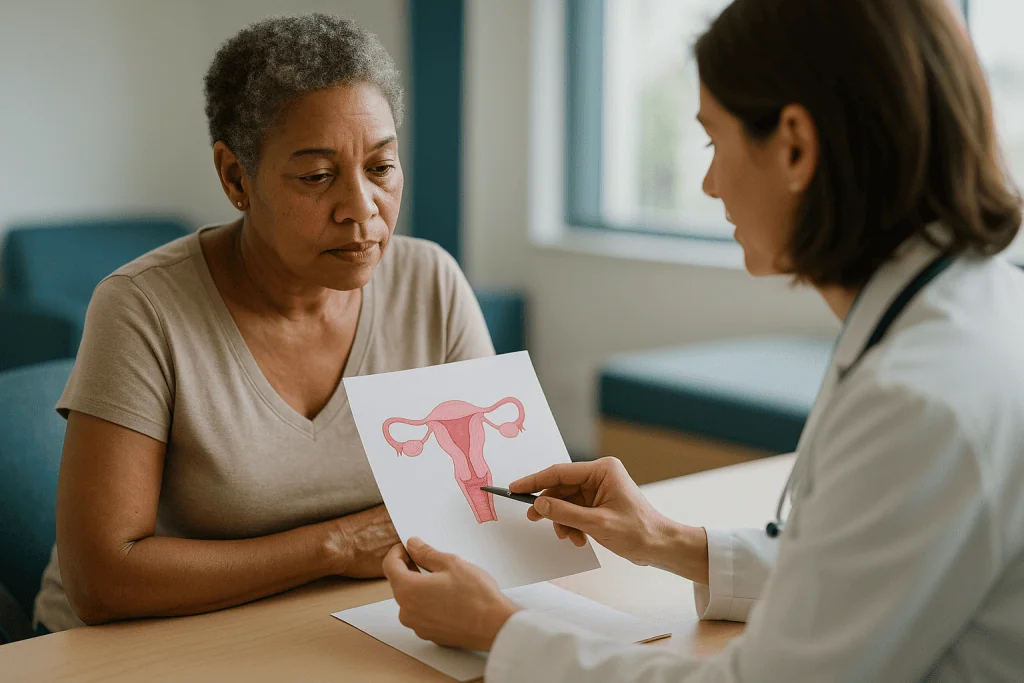
Those receptors are the whole story when it comes to age. Estrogen and progesterone, the two hormones that drive the menstrual cycle, act as fertilizer. During the reproductive years, when both are abundant, fibroids tend to enlarge. During pregnancy, when hormone levels soar, some grow quickly. After menopause, when the ovaries stop producing significant amounts of either hormone, the fertilizer supply dries up and fibroids typically shrink, according to both the NHS and Mayo Clinic.
Perimenopause sits awkwardly in the middle. Hormone levels do not fall in a tidy line; they lurch. Some cycles produce more estrogen than usual, which is one reason bleeding can become heavier in the mid-forties even as periods grow less regular. This is why “wait for menopause” can feel like a cruel joke to someone whose symptoms are peaking.
Growth also varies enormously between fibroids, even within one uterus. Mayo Clinic describes fibroids ranging from seedlings invisible to the eye to masses that distort and enlarge the uterus. Some stay the same size for years; some grow in spurts; a few shrink on their own well before menopause. Imaging is the only reliable way to track which pattern yours are following, which is why repeat ultrasound is often part of a watchful-waiting plan rather than guesswork.
Will fibroids shrink after menopause? What the evidence shows
Usually, yes. The NHS states plainly that fibroids often shrink after menopause, and Mayo Clinic describes them as tending to shrink once the ovaries stop producing reproductive hormones. For many women, bleeding symptoms resolve because periods stop altogether, and bulk symptoms such as pelvic pressure ease over the following months and years as the tissue slowly loses volume.
Two caveats deserve honest airtime. First, “shrink” does not always mean “disappear.” Large fibroids may lose a portion of their size and still be large enough to press on the bladder or bowel. The degree of shrinkage varies from person to person, and reputable sources do not promise a particular percentage because the research does not support one.
Second, the timing is uncertain. The average age of menopause is around 51, according to the NHS and Mayo Clinic, but the normal range spans the mid-forties to mid-fifties. Menopause is only confirmed in retrospect, after 12 consecutive months without a period. A 44-year-old told to “wait for menopause” might be waiting a year or a decade, and nobody can tell her which.
Hormone therapy for menopausal symptoms adds a wrinkle. Because it replaces some of the estrogen and progesterone that fibroids feed on, it can slow or prevent the expected shrinkage in some women, Mayo Clinic notes. That does not make hormone therapy off-limits for women with fibroids, but it is a factor the prescribing clinician will weigh and monitor.
Fibroids that grow after menopause, or new bleeding after menopause has been established, break the expected pattern. Both are considered signals for prompt evaluation, not reassurance, because postmenopausal bleeding has causes other than fibroids that need to be ruled out.
What causes an enlarged uterus, and when it isn't fibroids
An “enlarged uterus” on an exam or scan report sounds alarming, but it is a description, not a diagnosis. Fibroids are the most common cause in women over 40, and MedlinePlus lists them among the leading reasons a uterus grows beyond its usual size. A clinician will sometimes describe the enlargement in pregnancy terms, such as “12-week size,” simply because that is a familiar yardstick.

Fibroids are not the only explanation. Adenomyosis, a condition in which the tissue that normally lines the uterus grows into the muscular wall, also enlarges the uterus and typically causes heavy, painful periods. It is more common in the forties and can coexist with fibroids, which is one reason symptoms sometimes persist after fibroids alone are treated. The two conditions can look similar on ultrasound; MRI, a detailed scan using magnets rather than radiation, is often used when the distinction matters for planning.
Thickening of the uterine lining, called endometrial hyperplasia, can also contribute, and in a small number of cases enlargement reflects cancer of the lining or, very rarely, of the muscle itself. Cleveland Clinic puts the chance that a presumed fibroid is actually a leiomyosarcoma, a rare cancer of uterine muscle, at less than 1 in 1,000. Mayo Clinic adds that fibroids are not associated with an increased risk of uterine cancer and almost never turn into cancer.
Why does this matter for the treatment discussion? Because the plan depends on knowing what is doing the enlarging. A woman whose heavy bleeding comes mostly from adenomyosis will respond differently to a hormonal IUD or to fibroid embolization than one whose bleeding comes from a submucosal fibroid. Good imaging before any decision, and sometimes a biopsy of the lining in the over-40 group, is how the care team avoids treating the wrong thing.
What is a subserosal fibroid? Why location shapes symptoms
Fibroids are classified by where they sit in the uterine wall, and location predicts symptoms far better than size does. A subserosal fibroid grows on the outer surface of the uterus, pushing outward toward the pelvis rather than into the cavity where bleeding originates. Some hang from a stalk, in which case they are called pedunculated.
Because subserosal fibroids point away from the lining, they tend not to cause heavy periods. Their signature is pressure. Mayo Clinic describes fibroids pressing on the bladder and causing frequent urination or difficulty emptying, pressing on the rectum and causing constipation, or producing a dull backache or leg pain. A large subserosal fibroid can make the lower abdomen feel firm or look slightly rounded.
The other two main types behave differently:
- Intramural fibroids grow within the muscular wall itself. They are the most common type and can cause both heavy bleeding and bulk symptoms as they enlarge.
- Submucosal fibroids bulge into the uterine cavity. Even small ones can cause disproportionately heavy or prolonged bleeding because they distort the lining that sheds each month.
For the over-40 discussion, type matters in two ways. First, submucosal fibroids are the ones most likely to drive anemia, which argues against indefinite waiting. Second, subserosal fibroids are often the easiest to leave alone if they are not pressing on anything, because they are unlikely to cause bleeding and will probably shrink after menopause. A pedunculated subserosal fibroid is the exception that occasionally twists on its stalk, causing sudden severe pain, which is one of the rare fibroid situations treated as an emergency.
Knowing your fibroid type, which your imaging report should state, lets you ask far more specific questions about what waiting would realistically look like.
Who is usually asked to wait, and who usually isn't
Watchful waiting, sometimes called expectant management, means monitoring fibroids with periodic exams or ultrasound rather than treating them. Both the NHS and Mayo Clinic describe it as a reasonable option for fibroids that cause no symptoms or only mild ones, and it becomes more attractive the closer a woman is to menopause.
The women most often offered waiting share a few features. Their periods are heavier than they would like but are not causing anemia. Any pressure symptoms are tolerable. Their fibroids are stable in size on repeat imaging. And they are in their late forties or early fifties, with other signs of the menopausal transition already under way, such as irregular cycles or hot flashes.
Waiting is usually not the first suggestion when any of the following applies:
- Blood tests show iron-deficiency anemia, which Mayo Clinic flags as a complication of heavy fibroid bleeding, or bleeding is severe enough to disrupt work, sleep or daily life.
- A fibroid is pressing on the ureter, the tube from kidney to bladder, or causing significant urinary or bowel symptoms.
- Fibroids have grown noticeably between scans, or growth occurs after menopause.
- Pain is severe or sudden, suggesting a fibroid is degenerating (outgrowing its blood supply) or twisting.
- The imaging or bleeding pattern is atypical enough that the team wants a diagnosis confirmed first.
Waiting is also a legitimate active choice, not a failure to decide. Many women in this age group manage symptoms with iron supplementation under medical guidance, menstrual products designed for heavy flow, and a plan for when they will reconsider. The key is that the plan is explicit: what symptom or test result would prompt a return visit, and how often imaging will be repeated. Anemia, in particular, has a way of creeping up quietly, so periodic blood counts are often part of a sensible waiting strategy.
Medicines for fibroids after 40: how they work and typical timelines
Medicines do not remove fibroids, but several can control the symptoms, and a few can shrink them temporarily. For a woman who expects menopause within a few years, that temporary effect may be all she needs. Decisions about any of these belong with the prescribing clinician; what follows describes mechanism and typical behavior, not recommendations.
Hormonal intrauterine devices release a progestin directly into the uterus, thinning the lining so that less tissue sheds each month. Mayo Clinic describes them as effective at reducing heavy bleeding, with the caveat that they do not shrink fibroids and are less suitable when a fibroid distorts the uterine cavity. Bleeding often takes several months to settle after placement.
Tranexamic acid is a nonhormonal medicine that helps blood clot and is taken only on heavy-flow days; it reduces bleeding volume without affecting fibroid size, according to Mayo Clinic. Nonsteroidal anti-inflammatory drugs can ease period pain and modestly reduce bleeding but also leave fibroids unchanged.
Gonadotropin-releasing hormone (GnRH) agonists and antagonists work differently. They switch off the signal from the brain that tells the ovaries to make estrogen and progesterone, creating a temporary, reversible menopause-like state. Fibroids typically shrink within a few months, Mayo Clinic notes, and heavy bleeding often stops. The trade-off is menopausal side effects and loss of bone density with prolonged use, which is why these medicines are generally time-limited, sometimes paired with low-level “add-back” hormones to protect bone. Fibroids usually regrow once the medicine stops, so GnRH drugs are often used to shrink fibroids before surgery or to bridge the gap to natural menopause.
Combined hormonal contraceptives can lighten periods but may be unsuitable for some women over 40 depending on blood pressure, smoking status and clot risk. Every one of these choices involves a conversation about the full medical picture, not just the fibroid.
Uterus-sparing procedures: embolization, myomectomy and ablation
Several procedures treat fibroids while leaving the uterus in place. After 40, their appeal often has less to do with preserving fertility and more to do with avoiding major surgery when menopause may finish the job anyway.
Uterine fibroid embolization (UFE), also called uterine artery embolization, is performed by an interventional radiologist. A thin catheter is threaded through a blood vessel, usually at the wrist or groin, to the arteries feeding the uterus, and tiny particles are injected to block blood flow to the fibroids. Starved of blood, the fibroids soften and shrink over the following months. Mayo Clinic lists it as an option for women who want to avoid surgery; it is generally not favored for those planning pregnancy, which matters less in this age group.
Myomectomy is surgical removal of the fibroids themselves. It can be done hysteroscopically (through the cervix, for submucosal fibroids), laparoscopically or robotically (through small abdominal incisions), or through an open abdominal incision for large or numerous fibroids. Because the uterus remains, new fibroids can form later, a point Mayo Clinic makes explicitly. For a woman close to menopause, that risk shrinks with each passing year.
Radiofrequency ablation uses heat delivered through a needle, guided by ultrasound, to destroy fibroid tissue from within; the treated fibroid then shrinks. Focused ultrasound surgery uses sound waves guided by MRI to do the same without incisions, though it suits only certain fibroid sizes and positions.
Endometrial ablation is different in kind. It destroys the lining of the uterus to reduce bleeding and does not treat fibroids directly. The NHS notes it may be considered for heavy bleeding when fibroids are small, and it is intended only for women who are certain they do not want future pregnancies.
Each option has its own profile of risks, including infection, bleeding, injury to nearby organs and the possibility of incomplete symptom relief. The treating team matches procedure to fibroid type, size, number and personal priorities.
Hysterectomy after 40: what changes in the decision
Hysterectomy, surgical removal of the uterus, is the only treatment that guarantees fibroids will not return, a point both the NHS and Mayo Clinic make. It also ends periods permanently and rules out pregnancy. For a woman in her mid-forties who has completed her family and is exhausted by years of heavy bleeding, that permanence can feel like relief rather than loss. For another woman the same age, it can feel like a disproportionate response to a condition that may fade on its own.
Neither reaction is wrong. The decision rests on how much the symptoms are costing, how far off menopause appears to be, whether other treatments have been tried or are suitable, and personal values about surgery and the uterus.
A few technical points shape the over-40 discussion:
- The ovaries are not automatically removed. Mayo Clinic notes that hysterectomy can be performed with the ovaries left in place, in which case natural hormone production continues and surgical menopause does not occur. Removing the ovaries is a separate decision with its own reasoning.
- Approach varies. Hysterectomy can be vaginal, laparoscopic or robotic, or open abdominal. The NHS describes recovery from an abdominal hysterectomy as taking around 6 to 8 weeks, with less invasive approaches typically shorter. Large fibroids sometimes dictate an open approach.
- Risks include bleeding, infection, blood clots, injury to the bladder or bowel, and the general risks of anesthesia. Longer-term effects such as pelvic floor changes are the subject of ongoing research.
An honest clinician will present hysterectomy as one option among several, not as a default for anyone past childbearing. An equally honest one will not withhold it from a woman who has weighed the alternatives and wants a definitive answer. The role of age here is to add information, not to make the choice.
Fibroids after 40 treatment options at a glance
The table below summarizes how the main approaches compare on the questions women over 40 most often ask. Recovery ranges are typical figures drawn from NHS, Mayo Clinic and Cleveland Clinic patient information; individual experience varies, and your team’s estimate for your situation takes priority.
| Option | Treats fibroids directly? | Uterus kept? | Typical return to usual activity | Often considered when |
|---|---|---|---|---|
| Watchful waiting | No; monitors them | Yes | Not applicable | Mild symptoms, stable size, menopause likely near |
| Hormonal IUD or tranexamic acid | No; controls bleeding | Yes | Not applicable | Heavy bleeding without cavity distortion; bridging to menopause |
| GnRH agonists or antagonists | Yes, temporarily | Yes | Not applicable | Short-term shrinkage before surgery or to bridge a short gap |
| Uterine fibroid embolization | Yes | Yes | About 1–2 weeks (Cleveland Clinic) | Bulk or bleeding symptoms; wish to avoid surgery |
| Hysteroscopic myomectomy | Yes | Yes | Days (Mayo Clinic) | Submucosal fibroids driving heavy bleeding |
| Laparoscopic or open myomectomy | Yes | Yes | About 2–6 weeks depending on approach (Mayo Clinic) | Larger fibroids; strong wish to keep uterus |
| Endometrial ablation | No; destroys lining | Yes | Days (NHS) | Heavy bleeding with small fibroids; no future pregnancy |
| Hysterectomy | Yes, permanently | No | About 6–8 weeks for abdominal; shorter for minimally invasive (NHS) | Severe symptoms, failed other options, or preference for a definitive answer |
Two patterns stand out. Every uterus-sparing option carries some chance that fibroids persist, regrow or that new ones form, though that chance falls as menopause approaches. And the medicine-based options suit a shorter horizon better than a longer one: a woman at 50 with early menopausal signs may need only a bridge, while a woman at 41 may face a decade of bridging and reasonably prefer something more durable. Neither pattern decides anything on its own; both are worth raising explicitly with your team.
What the following days and weeks usually look like
Recovery depends almost entirely on which route you and your team choose, so it helps to picture each one.
After starting a medicine, the first weeks are often about side effects rather than benefits. Hormonal IUDs commonly cause irregular spotting that can take several months to settle before bleeding lightens. GnRH medicines usually bring hot flashes and sometimes mood changes within the first weeks, with fibroid shrinkage becoming apparent on imaging over the following few months, according to Mayo Clinic. Tranexamic acid and anti-inflammatory medicines work within the cycle they are taken, so their effect, or lack of it, is apparent quickly.
After uterine fibroid embolization, Cleveland Clinic describes a period of cramping and pelvic pain that is typically most intense in the first day or two and is managed with prescribed pain relief, followed by fatigue and sometimes a low-grade fever for several days. Most people return to usual activities within about one to two weeks. Fibroid shrinkage continues gradually for months, so bulk symptoms ease slowly rather than overnight.
After hysteroscopic myomectomy or endometrial ablation, there is usually no abdominal incision. Watery or bloody discharge for days to weeks is expected, and return to normal activity is often a matter of days, per Mayo Clinic and NHS guidance.
After laparoscopic surgery, whether myomectomy or hysterectomy, shoulder-tip pain from the gas used to inflate the abdomen is common for a day or two, incision soreness lasts about a week, and most people resume light activity within two to four weeks. Open abdominal surgery stretches that to roughly six to eight weeks, with lifting restrictions throughout.
Across every procedure, the basics are the same: move early and often to lower clot risk, follow the specific instructions you are given about driving, lifting and bathing, and keep every follow-up appointment, because that is where the team confirms healing and checks that the treatment is doing what it should.
What people often get wrong about fibroids and menopause
Myths cluster around fibroids in the forties, partly because so many women are quietly comparing notes. A few deserve direct correction.
“Menopause will make them vanish.” Shrinkage is the norm, disappearance is not. Large fibroids often remain detectable for years, and pressure symptoms can persist even when bleeding stops.
“Heavy bleeding at 45 is just perimenopause.” Sometimes it is. But the NHS and Mayo Clinic both advise evaluating heavy, prolonged or irregular bleeding in this age group rather than assuming a cause, because fibroids, adenomyosis, lining changes and, uncommonly, cancer all become more frequent at the same time.
“Fibroids turn into cancer if left alone.” Mayo Clinic states that fibroids are not linked to an increased risk of uterine cancer and almost never become cancerous. Cleveland Clinic puts the chance that a presumed fibroid is in fact a sarcoma at under 1 in 1,000. Rapid growth, especially after menopause, is the pattern that prompts closer scrutiny, not fibroids in general.
“If you’re over 40, hysterectomy is the obvious answer.” It is one answer. Guidelines list medicines, embolization, myomectomy and ablation as alternatives, and the choice rests on symptoms and preferences, not a birth date.
“Fibroids removed by myomectomy never come back.” Mayo Clinic is explicit that new fibroids can develop after myomectomy. The risk is lower the closer you are to menopause, which is one reason age shifts the calculation toward uterus-sparing options for some women.
“Diet or supplements can shrink fibroids.” Research on vitamin D, green tea extract and other supplements is preliminary and inconsistent; none is established as a treatment, and the NIH Office of Dietary Supplements cautions that supplements can interact with medicines. A balanced diet supports overall health and iron status, which is real and useful, but it is not fibroid treatment.
Questions to ask your care team
The most useful appointments are the ones where you arrive knowing what you want to understand. These questions are designed to surface the information that actually changes the decision for someone over 40.
- What type, size and number of fibroids do I have, and which ones are most likely responsible for my symptoms?
- Based on my age, cycle pattern and any blood tests, how close to menopause do you think I am, and how confident can anyone be about that?
- Do my blood counts show anemia, and if so, how are we going to correct it regardless of which fibroid treatment I choose?
- Is there anything about my bleeding pattern or imaging that means we should rule out other causes before deciding, for example with a biopsy of the uterine lining?
- If I choose to wait, what would we monitor, how often, and what specific finding would make you recommend treatment?
- For each treatment you are suggesting, what are the chances fibroids persist or come back, and how does my age affect that?
- Which options are realistic for my particular fibroid locations, and which are ruled out by size or position?
- What does recovery typically involve for each option, and how long before I would know whether it worked?
- If I ever need hormone therapy for menopausal symptoms, how would that interact with my fibroids and with the treatment we choose now?
- Would a second opinion from a different specialty, such as interventional radiology or gynecologic surgery, add anything to this discussion?
Write the answers down or bring someone to listen. The point is not to challenge your team but to make sure the plan you leave with is one you understand well enough to live with, and to revisit if your symptoms change.
When to call your doctor
Most fibroid symptoms are chronic rather than urgent, which makes it easy to normalize them. Certain patterns, however, should prompt a same-week appointment or, in some cases, immediate care.
Contact your care team promptly if you notice any of the following:
- Bleeding heavy enough to soak through a pad or tampon every hour for several hours in a row, or passing large clots repeatedly.
- Symptoms of anemia such as unusual fatigue, shortness of breath on ordinary activity, dizziness, a racing heartbeat or pale skin.
- Any vaginal bleeding after you have gone 12 months without a period; postmenopausal bleeding always needs evaluation.
- Bleeding between periods or after sex that is new for you.
- Pelvic pain that is sudden and severe, which can signal a fibroid twisting on its stalk or outgrowing its blood supply.
- Difficulty emptying your bladder, or pain in the flank or side, which can suggest pressure on the urinary tract.
- A noticeable increase in abdominal size over weeks rather than years.
After any procedure, call the team that treated you if you develop a fever, worsening rather than improving pain, foul-smelling discharge, redness or pus at an incision, or heavy bleeding. Seek emergency care without waiting for a callback if you have chest pain, sudden breathlessness, a swollen or painful calf, or feel faint, because these can indicate a blood clot, a recognized risk after pelvic surgery and after prolonged bed rest.
None of these signs means something is definitely wrong. They mean the situation has moved outside the range where waiting is sensible, and your treating team is the right place to take it. They have your imaging, your blood results and your history; what they need from you is the call.
Frequently asked questions
Will fibroids shrink after menopause?
Most fibroids shrink after menopause because the estrogen and progesterone that feed them fall sharply, according to the NHS and Mayo Clinic. Shrinkage is gradual over months to years and often partial rather than complete, so large fibroids may still cause pressure. Hormone therapy for menopausal symptoms can slow this process in some women. Fibroids that grow after menopause, or any bleeding after menopause, should be evaluated promptly.
What causes an enlarged uterus?
Fibroids are the most common cause of an enlarged uterus in women over 40, but adenomyosis, in which uterine lining tissue grows into the muscle wall, is another frequent cause and can coexist with fibroids. Thickening of the lining and, rarely, cancer can also contribute. Because treatments differ, clinicians usually rely on ultrasound, sometimes MRI, and occasionally a biopsy of the lining to pin down what is responsible before recommending a plan.
What is a subserosal fibroid?
A subserosal fibroid grows on the outer surface of the uterus and pushes outward into the pelvis. Because it sits away from the uterine lining, it rarely causes heavy periods; instead it tends to cause pressure symptoms such as frequent urination, constipation or backache if it becomes large. Some hang from a stalk and are called pedunculated. Subserosal fibroids that are not pressing on anything are often reasonable candidates for monitoring.
What were your first signs of uterine fibroids?
Many women report that periods gradually became heavier or longer, or that they began feeling pelvic fullness or needing to urinate more often. Others have no symptoms at all and learn of fibroids incidentally on a scan done for another reason, which Mayo Clinic notes is common. These experiences are not a self-diagnosis tool; new or changing bleeding or pressure symptoms, especially after 40, are a reason to see a clinician for proper evaluation.
How do fibroids and menopause interact when I am still in perimenopause?
Perimenopause can temporarily make fibroid symptoms worse before they improve. Hormone levels swing rather than decline smoothly, and cycles with higher estrogen can produce heavier bleeding even as periods become irregular. This is why symptoms often peak in the mid-forties. Treatment during perimenopause is usually aimed at bridging the gap to menopause with the least intervention that controls bleeding and protects against anemia, a decision made with your care team.
Can fibroids grow back after surgery?
After myomectomy, which removes fibroids but keeps the uterus, new fibroids can develop over time, and Mayo Clinic states this explicitly. Tiny fibroids missed during surgery can also enlarge later. The risk falls as menopause approaches because hormone levels decline. Hysterectomy, which removes the uterus, is the only option that guarantees fibroids will not return. After embolization or ablation, treated fibroids shrink but untreated ones can still grow.
Should I wait to treat my fibroids if I am close to menopause?
Waiting is reasonable when symptoms are mild, fibroids are stable on imaging and menopause appears near, and both the NHS and Mayo Clinic list monitoring as a legitimate option. It is usually not advised when bleeding is causing anemia, fibroids are pressing on the bladder or ureter, growth is rapid, or the bleeding pattern needs other causes ruled out. The decision rests with you and your treating team.
Does hormone therapy for menopause make fibroids grow?
It can slow the shrinkage that would otherwise occur after menopause, because hormone therapy replaces some of the estrogen and progesterone that fibroids respond to, as Mayo Clinic notes. It does not necessarily make fibroids grow, and having fibroids is not an absolute barrier to hormone therapy. The prescribing clinician weighs menopausal symptoms, fibroid size and any bleeding, and may monitor with ultrasound. Any change to hormone therapy should be made with that clinician.
Is uterine fibroid embolization suitable for women over 40?
Often, yes. Embolization blocks the arteries feeding fibroids so they shrink, and Mayo Clinic lists it as an option for those who want to avoid surgery. It is generally not favored for women planning pregnancy, which is less often a concern after 40. Suitability depends on fibroid type and size, overall health and symptoms. Recovery to usual activity typically takes about one to two weeks, according to Cleveland Clinic, with shrinkage continuing for months.
Can fibroids become cancerous as I get older?
Fibroids themselves almost never become cancerous, and Mayo Clinic states they are not associated with increased uterine cancer risk. Cleveland Clinic estimates that fewer than 1 in 1,000 presumed fibroids turn out to be leiomyosarcoma, a rare muscle cancer. What does rise with age is the chance that heavy or irregular bleeding has another cause, including changes in the uterine lining, which is why bleeding after 40 and any postmenopausal bleeding should be evaluated.
References
This article is for general information only and is not a substitute for professional medical advice. Please consult a qualified doctor about your individual situation.

More from the Blog
Hysteroscopic Fibroid Removal: Treating Fibroids Inside the Uterine Cavity Without Incisions
Hysteroscopic fibroid removal, also called hysteroscopic myomectomy, treats fibroids that grow into the uterine cavity by passing a thin camera and cutting instrument through…

Ovarian Cysts and Back Pain: Why the Lower Back Hurts
Yes, ovarian cysts can cause back ache. A cyst on an ovary can press on nearby tissue or send pain along shared nerve pathways,…

Period Pain Relief: Evidence-Ranked Options Beyond Just Rest
The best-supported options for period pain relief are over-the-counter anti-inflammatory pain relievers started at the first sign of cramps, continuous low-level heat on the…

Preparing for Ovarian Cyst Surgery: Pelvic Exam, Fasting and the Medicines to Pause
Preparing for ovarian cyst surgery usually means a pre-operative assessment with a pelvic exam and ultrasound, blood tests, and a review of every medicine…

Prolapse Treatment in Older Women: How Health, Activity and Goals Guide the Options
Prolapse treatment in older women is chosen by weighing three things together: how much the prolapse bothers daily life, the woman's overall health and…

Who Is a Candidate for Robotic Hysterectomy? Fibroids, Endometriosis and Uterus Size
Robotic hysterectomy candidates are usually people with a benign condition such as fibroids, endometriosis, adenomyosis or heavy bleeding that has not settled with other…