

Flat Feet, Bunions and Cavus Foot: When Foot Deformities Are Treated Without Surgery First
Key Takeaways
- A flexible flat foot that shows an arch on tiptoe is usually a normal variant, while a rigid flat foot or one that has newly appeared on one side warrants investigation.
- Adult-acquired flatfoot most often stems from a weakened posterior tibial tendon behind the inner ankle, which insoles and calf work aim to protect rather than reshape.
- No splint, spacer or shoe makes a bunion go away; conservative bunion care relieves pressure and inflammation, and only surgery alters the bone alignment.
- A high arch is the shape most likely to signal something beyond the foot, with Charcot-Marie-Tooth disease affecting roughly 1 in 2,500 people in the US according to the NIH.
- Insoles only work inside shoes with a firm heel counter and enough depth, so footwear is the first and most neglected step in every conservative plan.
- Surgery for these deformities is generally discussed for persistent pain and lost function after conservative care, not for appearance, and the decision rests with the treating team.
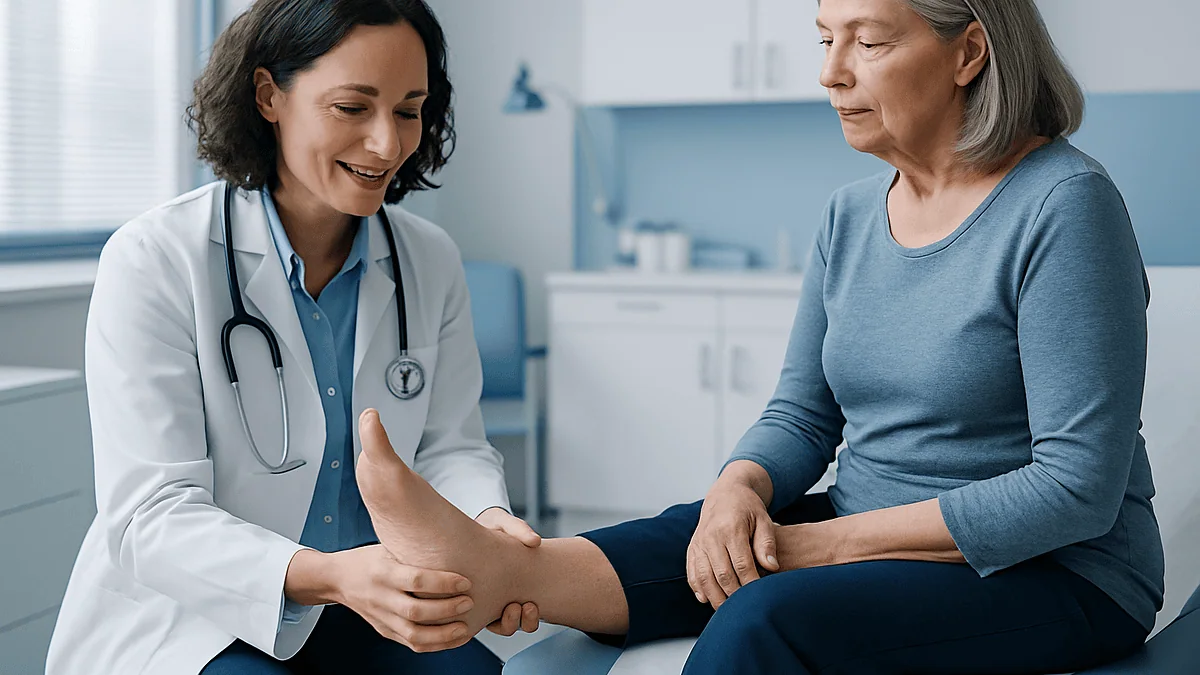
Most flat feet, bunions and cavus (high-arched) feet are managed without surgery first. Typical flat feet treatment options include supportive footwear, over-the-counter or custom insoles, calf and foot strengthening, activity adjustments and weight management; bunions are eased with wider shoes, padding and toe spacers; cavus feet with cushioning and bracing. Surgery is usually considered only when pain or function fails to improve, a decision made with the treating team.
The shoe store mirror is where many people first meet their feet honestly. A man in his fifties notices that his left ankle rolls inward far more than his right. A woman trying on sandals sees the big-toe knuckle she has been hiding under closed shoes for a decade. A teenager’s parent frowns at a heel that barely touches the ground. None of them are in an emergency, yet each is quietly asking the same thing: does this need fixing, and does fixing mean an operation?
Usually not, at least not as a first step. Orthopedic guidance for the three most common foot shapes people worry about, low arches, bunions and high arches, starts with what clinicians call conservative care. Flat feet treatment options such as insoles, strengthening and footwear changes come first, and the same logic applies to the other two.
This article walks through what that conservative pathway involves, who is asked to wait on surgery and why, and the moments when a foot problem stops being cosmetic and needs a phone call.
How do nonsurgical flat feet treatment options actually work?
Every conservative treatment for a foot deformity does one of three jobs: it changes the load going through a sore structure, it strengthens or lengthens the tissue that controls the shape, or it protects a painful spot from friction. That is the whole toolkit. Insoles, shoes, exercises, padding, braces and pain relief are simply different ways of doing those three things.
Take the low arch. A flat foot is one in which the inside edge of the sole sits close to or on the ground when you stand. In many adults the arch is supported by a tendon running behind the inner ankle bone, the posterior tibial tendon, which the Mayo Clinic identifies as the structure most often weakened or torn in adult-acquired flatfoot. An insole with a firm medial (inner) post shifts weight slightly toward the outside of the foot, so the overworked tendon does less. A calf stretch lengthens the muscle that pulls the heel up and inward. Neither changes the bone; both change what the bone and tendon have to cope with each step.
Bunions follow the same principle. The bump is bone that has drifted out of line, and no shoe pushes it back. A wider toe box stops the shoe rubbing the bump, a gel pad cushions it, and a spacer between the first and second toes can ease the pull on the joint.
The high-arched, or cavus, foot concentrates pressure on the heel and the ball of the foot. Cushioned insoles spread that pressure over a larger area, and an ankle brace can steady a foot that tends to roll outward.
Nonsurgical care therefore treats symptoms and function rather than the shape itself. When the shape is not the cause of the pain, that distinction matters far less than people expect.
Flat feet, bunions and cavus foot: three shapes, one shared question
Grouping these three together looks odd at first. One is an arch that has dropped, one is a toe that has drifted, and one is an arch that is too high. Clinically they belong in the same conversation because they share an underlying question: is this a shape, or is this a symptom?
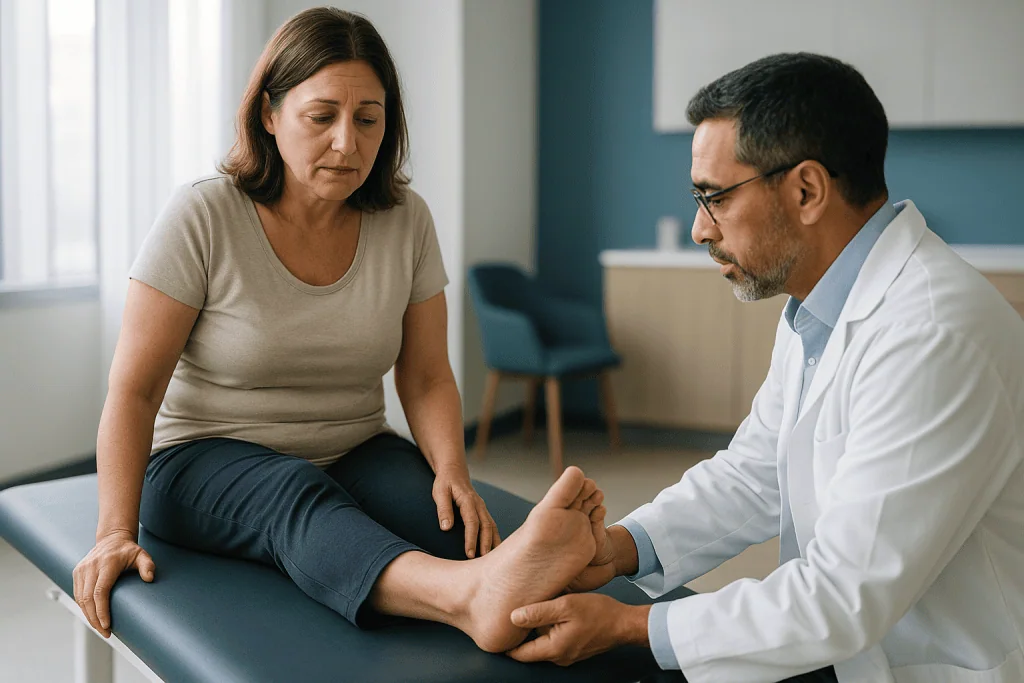
A shape is a foot that looks different but works. Plenty of people have flat feet and never think about them; the NHS notes that flat feet are common and usually painless, with treatment reserved for those who have discomfort. A bunion that has been the same size for twenty years and fits into ordinary shoes is a shape. A modest high arch in someone who runs without trouble is a shape.
A symptom is a foot that hurts, that is changing, or that is stopping someone doing what they want. Pain along the inner ankle after walking, a bunion that reddens and throbs by evening, a high arch that keeps rolling into ankle sprains: these are feet that have started to fail at their job.
The distinction shapes the whole pathway. Shapes are usually watched. Symptoms are treated, and treatment starts conservatively. Surgery enters the discussion when a symptom has not responded to conservative care over a period the treating team judges reasonable, or when a deformity is worsening quickly.
The three deformities also share an anatomical fact worth holding onto. The foot is an arch built from 26 bones, held together by ligaments and steered by tendons that arrive from the calf. When one element weakens, the others compensate and eventually complain. A bunion can develop partly because a flattening arch rolls weight onto the big toe. A high arch can tighten the tissue under the sole and stiffen the toes. Treating one shape often means paying attention to the whole foot.
Are flat feet always a problem, or just a shape?
Not always, and this is the single most useful thing to know before any appointment. Clinicians divide flat feet into two broad groups, and the split matters more than the height of the arch.
A flexible flatfoot has an arch that appears when the person sits or stands on tiptoe and disappears when they stand flat. According to the Mayo Clinic, this is the common variety, often present from childhood and frequently painless. It is a variation of normal in much the same way that people have different nose shapes.
A rigid flatfoot stays flat whatever the position. This is less common and is more likely to have a cause worth finding: bones in the back of the foot that fused abnormally during development, arthritis, a previous injury, or a tendon that has torn. Rigid flat feet are more often stiff, painful and worth imaging.
A third pattern is the adult who was not flat-footed and gradually becomes so, usually on one side. The Mayo Clinic links this adult-acquired flatfoot most often to a failing posterior tibial tendon, the structure described earlier that holds the arch up from the inside. Risk factors it lists include age, obesity, diabetes and high blood pressure. This is the version that most often ends up in an orthopedic clinic, and also the one where early conservative care has the clearest rationale, because a tendon under strain can sometimes be protected before it stretches further.
So the first question a clinician asks is rarely “how flat?” It is “flexible or rigid, lifelong or new, one foot or both, painful or not?” The NHS advises seeing a GP for flat feet that are painful, affect only one foot, or make walking difficult. Those four answers, more than any measurement, decide whether the pathway is reassurance, insoles, or investigation.
Flat feet exercises: what strengthening can and cannot change
People often arrive hoping that exercises will rebuild an arch. The honest answer is that flat feet exercises rarely change the resting shape of an adult foot in a way that shows in a mirror, but they can change how the foot behaves under load, which is what governs pain.
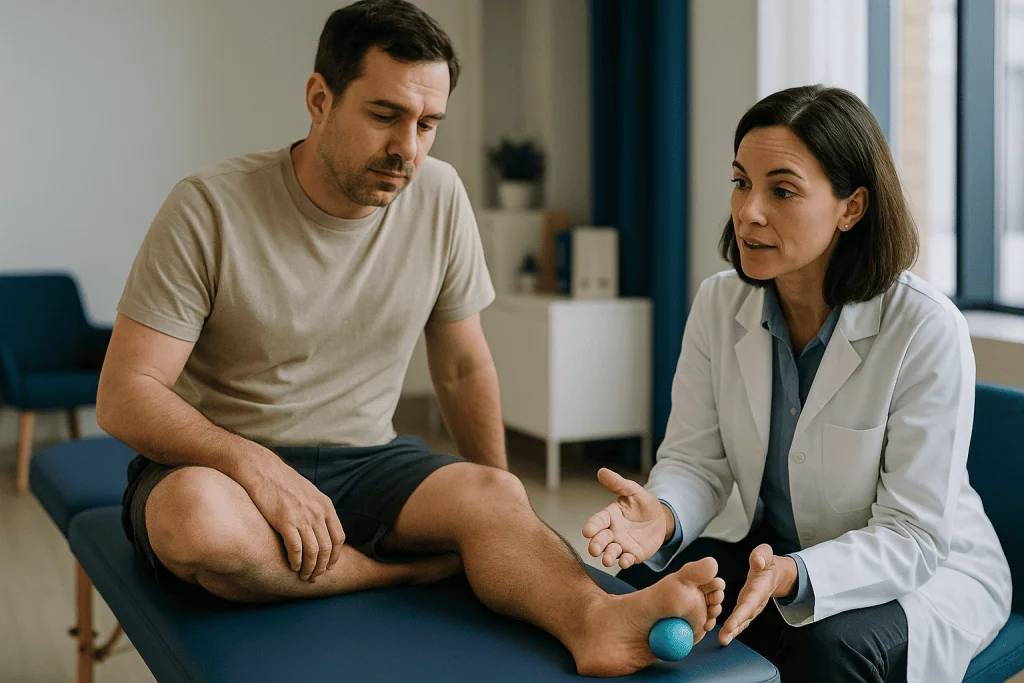
The muscles involved come in two groups. The extrinsic muscles live in the calf and send tendons down into the foot; the posterior tibial tendon is one of these. The intrinsic muscles live entirely within the foot and fine-tune the arch and toes. Exercise programs used by physical therapists typically address both, along with calf flexibility, because a tight calf pulls the heel into a position that flattens the arch further.
Common components include:
- Heel raises, progressing from two legs to one, to load the tendon behind the inner ankle in a controlled way.
- “Short foot” work, drawing the ball of the foot toward the heel without curling the toes, to activate the small intrinsic muscles.
- Calf stretches against a wall with the knee straight and then bent, to address both calf muscles.
- Balance practice on one leg, since the foot’s stabilizing muscles work hardest when the body wobbles.
What the evidence supports is modest but real: strengthening and stretching, combined with insoles, are listed by both the NHS and the Mayo Clinic as first-line management for painful flat feet. What the evidence does not support is the idea that any exercise program reverses a torn tendon or a bony fusion. For those, exercise is one part of a plan rather than the whole plan.
Frequency and progression should come from a therapist who has watched you move, because the same exercise can help one person’s tendon and overload another’s. If an exercise increases pain the day after rather than during, that is worth reporting rather than pushing through.
Do orthotics for flat feet work, and which kind?
An orthotic, or orthosis, is any device worn in or around the shoe to change how the foot bears weight. For flat feet, orthotics for flat feet range from soft cushioned insoles sold in pharmacies to rigid custom-molded shells made from a cast or scan of the foot.
The question of whether they work has a two-part answer. For painful flexible flat feet, both the NHS and the Mayo Clinic list arch-supporting insoles among standard treatments, and many people find symptom relief. For painless flat feet, there is no established reason to wear them; a shape that does not hurt does not need correcting.
The custom-versus-prefabricated question is asked in almost every clinic. Custom devices fit the individual foot precisely and can incorporate specific corrections, such as a wedge under the heel, that off-the-shelf products cannot. Prefabricated insoles are cheaper to trial and quicker to obtain, and for many people with mild symptoms they are a sensible starting point. What the research literature does not show clearly is that custom devices relieve pain better than well-chosen prefabricated ones in uncomplicated flexible flatfoot. Where custom devices earn their place is in feet with significant deformity, in adult-acquired flatfoot where the tendon needs firm support, and in feet with neurological conditions or diabetes where pressure must be redistributed precisely.
Bracing sits one step beyond insoles. For a weakening posterior tibial tendon, a clinician may suggest an ankle brace or a molded ankle-foot orthosis that controls the heel from the sides rather than just supporting the arch from below.
Two practical points recur. First, an insole only works inside a shoe with enough depth and a firm heel counter to hold it in place; slipping it into a soft, flexible shoe wastes it. Second, insoles are worn most of the day to have an effect, not just for exercise. The prescribing clinician or podiatrist should set the wearing schedule.
Bunion treatment without surgery: what actually relieves pain
A bunion, known medically as hallux valgus, is a bony bump at the base of the big toe that forms when the toe drifts toward its neighbors and the joint behind it pushes outward. The NHS is unusually direct on one point: nothing except surgery makes a bunion go away. Every form of bunion treatment without surgery therefore aims at comfort and slowing progression rather than reversal.
That is a more useful goal than it sounds, because most bunion pain does not come from the bone itself. It comes from the shoe pressing on the bump, from the inflamed fluid-filled sac (bursa) that develops over it, and from the second toe being crowded and rubbed. Remove those three irritants and many bunions become quiet.
The approaches the NHS and Cleveland Clinic describe are practical rather than high-tech:
- Shoes with a wide, deep toe box and a low heel, so the bump is not compressed and body weight is not thrown forward onto the toes.
- Bunion pads, usually gel or felt, placed over the bump to reduce friction.
- Toe spacers or splints that hold the big toe straighter while worn; the Cleveland Clinic notes these may ease symptoms but do not correct the alignment permanently.
- Ice after a long day on your feet to settle the bursa.
- Over-the-counter anti-inflammatory pain relief when needed, taken as directed by a pharmacist or clinician; these medicines work by reducing the chemical signals of inflammation around the joint.
Insoles have a role here too. Because a flattening arch can roll weight onto the big-toe joint, a supportive insole sometimes reduces bunion pain indirectly.
What none of these do is shrink the bump. Night splints marketed for that purpose lack convincing evidence of lasting correction. The Cleveland Clinic and NHS both frame surgery as an option when pain persists despite conservative care and interferes with daily life, not as a response to appearance alone.
Cavus foot causes: why the high arch gets a different work-up
A cavus foot, or pes cavus, is a foot with an unusually high arch that does not flatten when weight goes through it. Of the three deformities in this article, it is the one clinicians treat with the most caution, and the reason lies in cavus foot causes rather than the shape itself.
Some high arches are simply inherited, run in families and never cause trouble. MedlinePlus notes, however, that a high arch is often linked to a neurological condition, and that when it develops or worsens it can be an early sign of a problem affecting the nerves or muscles. The most frequently cited is Charcot-Marie-Tooth disease, a group of inherited disorders of the peripheral nerves that the NIH estimates affects about 1 in 2,500 people in the United States. As the nerves supplying the small foot muscles weaken unevenly, stronger muscles pull the arch up and the toes into a clawed position. Other causes include cerebral palsy, spina bifida, stroke, spinal cord problems and old injuries to the leg.
That is why the first visit for a high arch often involves questions that seem unrelated to feet: any family history of foot shape or walking difficulty, any change in balance, numbness, weakness in the hands, or frequent tripping. A clinician may test reflexes and sensation and, if anything is unusual, refer for nerve studies.
Symptom-wise, the cavus foot concentrates load on the heel and the ball of the foot, so the common complaints are calluses in those places, metatarsal pain, clawed toes rubbing on shoes, and repeated ankle sprains because the heel tilts outward.
Conservative care mirrors the mechanics: cushioned insoles that spread pressure, extra-depth shoes that accommodate clawed toes, lateral wedging or ankle bracing to steady the heel, and stretching of the tight tissue under the sole. When a neurological cause is found, the foot plan becomes part of managing the broader condition rather than a standalone fix.
Who is offered conservative care first, and who is asked to wait on surgery
Almost everyone starts here. Guidance from the NHS, Mayo Clinic and Cleveland Clinic consistently places footwear, insoles, exercise and pain management before surgery for all three deformities, and for a straightforward reason: surgery carries risks of infection, nerve injury, stiffness, prolonged swelling and, for bunions in particular, recurrence, while conservative care carries almost none. If the lower-risk option relieves the pain, the higher-risk one is unnecessary.
People most clearly suited to conservative care first include those with flexible flat feet and mild to moderate pain, those with bunions whose main complaint is shoe pressure, adults with early tendon-related flatfoot where the arch still corrects on tiptoe, and anyone with a high arch that is stable and has no neurological findings. Children with painless flexible flat feet are usually offered reassurance rather than treatment at all.
Some groups are asked to persist with conservative measures even when they feel ready for an operation. Smokers and people with poorly controlled diabetes heal bone and skin more slowly, so surgeons often ask for those risks to be addressed first. People whose only concern is appearance are generally advised against surgery, because the trade-off between operative risk and cosmetic gain rarely favors it and the NHS specifically frames bunion surgery around pain and function. Someone who has not yet tried appropriate footwear and insoles will usually be asked to do so, because a meaningful proportion of people improve and no longer want surgery.
Then there are people for whom surgery is discussed sooner. A rigid flatfoot from fused bones that is painful despite insoles, a posterior tibial tendon that has torn, a bunion that has pushed the second toe out of joint, or a cavus foot causing repeated fractures or unstable ankles may reach that conversation earlier. Even then, the decision is made jointly with the treating team after imaging and discussion of alternatives, never on shape alone.
Side by side: nonsurgical options for the three deformities
Seeing the three conditions in one place makes the shared logic obvious and the differences easier to remember. Each row below describes what mainstream guidance from the NHS, Mayo Clinic, Cleveland Clinic and MedlinePlus lists as usual first-line care, what that care is realistically expected to achieve, and what typically prompts a discussion about going further.
| Deformity | Main conservative measures | Realistic goal | What usually triggers a surgical discussion |
|---|---|---|---|
| Flat feet (flexible) | Supportive shoes with firm heel counter; arch-supporting insoles; calf stretching and tendon strengthening; weight management where relevant | Less pain and fatigue; protection of the inner-ankle tendon | Persistent pain despite months of consistent care; rigid deformity; tendon tear on imaging |
| Bunion (hallux valgus) | Wide, deep, low-heeled shoes; pads over the bump; toe spacers; ice; short-term anti-inflammatory pain relief as advised | Comfort in shoes; less inflammation; slower progression | Pain that limits daily activity despite footwear changes; second toe displaced; ulceration over the bump |
| Cavus foot (high arch) | Cushioned, pressure-spreading insoles; extra-depth shoes for clawed toes; ankle bracing or lateral wedging; sole stretching; neurological assessment | Fewer calluses and sprains; stable ankle; early detection of any nerve cause | Recurrent sprains or stress fractures despite bracing; progressive deformity; fixed clawed toes that ulcerate |
Two things stand out. Footwear appears in every row, and it is the intervention people most often skip because it feels too simple. Second, only the cavus row includes an assessment step, which reflects the point made earlier: a high arch is the shape most likely to be a clue to something else.
None of the goals in the third column say “corrected shape.” That is deliberate. Conservative care is judged on whether you can walk, work and exercise more comfortably, not on what the foot looks like in a photograph.
What the first weeks of conservative treatment usually look like
Conservative care is rarely dramatic, and its early weeks can feel underwhelming to someone hoping for a quick fix. Knowing the shape of that period helps people stick with it long enough to judge it fairly.
The first visit usually produces three things: an explanation of which structure is driving the pain, a footwear conversation, and either a prefabricated insole to try or a referral for a custom device or physical therapy. For bunions the conversation is largely about shoes and padding; for cavus feet it may include a neurological check or referral.
New insoles commonly feel strange at first. A firmer arch under a foot that has never had one can ache for a while, and most podiatrists suggest building wearing time gradually rather than wearing them all day from the outset. Any sharp pain, blistering or numbness is a signal to stop and get the device checked, not a sign to persevere.
Exercise programs follow a similar curve. Muscles that have not been asked to work in years feel it. Mild next-day soreness in the calf or arch is expected; increasing pain at the original sore spot is not and should be reported.
Pain relief, when used, is typically short-term and intended to make movement and exercise possible rather than to mask a problem indefinitely. Both the NHS and the Cleveland Clinic describe over-the-counter anti-inflammatory medicines in this supporting role, with the pharmacist or prescribing clinician deciding what is appropriate for the individual.
Review usually happens after a period long enough to tell whether the plan is working, with the treating team judging that interval based on the condition and how quickly symptoms change. At that review, the honest questions are simple: is the pain less, is walking easier, and are you doing more? A yes to those, even a partial yes, is the plan working. A no leads to adjustment first, and only later, if needed, to a conversation about imaging and further options.
Do flat feet treatment options differ for children?
They differ mainly in how little is usually done. The Mayo Clinic notes that flat feet are common in infants and toddlers because the arch has not yet developed, and that most children form an arch as they grow, with the fat pad under the foot thinning and the ligaments tightening. A flat-footed four-year-old is not a problem to solve.
The NHS advises that treatment is generally unnecessary for children with flat feet unless the feet are painful or causing difficulty. Insoles for a painless pediatric flatfoot have not been shown to change how the arch develops, and clinicians are generally cautious about prescribing devices to a child who is not complaining.
Where flat feet treatment options do come into play for children is in a smaller group: those with pain in the foot or ankle after activity, those whose feet are rigid rather than flexible, those with a flatfoot on one side only, and those with a tight calf that keeps the heel from touching the ground comfortably. Rigid or one-sided flat feet in a child are more likely to reflect abnormally joined bones in the back of the foot or another structural cause and usually warrant imaging.
Preparation for a child’s appointment is straightforward. A short video of the child walking barefoot, a note of when the pain occurs and which activities they avoid, and their usual shoes help the clinician more than a long description. Children are examined standing, walking and on tiptoe, which is where a flexible arch reveals itself.
Comfort measures for symptomatic children typically involve supportive, well-fitting shoes, calf stretching that can be made into a game, and occasionally a soft prefabricated insole to see whether it eases activity-related pain. Any medication for a child’s foot pain is a decision for the child’s clinician, not something to work out at home.
Bunions in adolescents and cavus feet in children follow the same conservative-first principle, with cavus feet in particular prompting a neurological look because Charcot-Marie-Tooth disease often first shows in childhood or adolescence.
What people often get wrong about foot deformities
Foot myths travel well because feet are hidden and the people repeating the myths sound confident. A few deserve a direct correction.
“Flat feet need to be corrected.” Painless flexible flat feet do not. The NHS describes them as common and often symptom-free, and there is no evidence that supporting a painless arch prevents future problems. Treatment follows symptoms, not shape.
“Going barefoot will fix a flat foot.” Barefoot time may strengthen intrinsic foot muscles in some people, but it does not rebuild a torn tendon or reshape fused bones, and on hard floors it can aggravate an already painful heel or arch. It is neither the villain nor the hero it is made out to be.
“Bunion splints straighten the toe.” They hold it straighter while worn. The Cleveland Clinic and NHS both state that only surgery changes bunion alignment. Splints and spacers earn their place through comfort, not correction.
“Bunions come from tight shoes.” Shoes can worsen and irritate them, and the Mayo Clinic lists narrow footwear as a risk factor, but the underlying tendency is largely inherited foot structure. People who have never worn heels get bunions.
“A high arch is the healthy kind of foot.” Sometimes. But MedlinePlus is clear that a high arch, especially one that is new or worsening, can be the first visible sign of a nerve or muscle condition. A high arch that keeps spraining the ankle is not a badge of good structure.
“If insoles haven’t worked in a week, they don’t work.” Insoles take time to settle, may need adjusting, and only work inside suitable shoes. Judging them after a few days is like judging glasses before the prescription is checked.
“Surgery gives you a normal foot.” Surgery aims to relieve pain and improve function, and it carries risks of stiffness, swelling, nerve irritation and recurrence. It is a serious tool for a persistent problem, not an upgrade.
Questions to ask your care team
A foot appointment goes better when you know what you want to leave with. These questions, drawn from what patients most often wish they had asked, work for all three deformities and can be adapted to a child’s visit.
- Which structure do you think is causing my pain: bone, tendon, joint, skin or nerve? Understanding this explains why a particular treatment is being suggested.
- Is my flat foot flexible or rigid, and does that change the plan?
- Is anything about my foot a clue to a wider condition, especially if the arch is high or has changed recently?
- Do I need imaging now, or is it reasonable to try conservative care first and image only if I do not improve?
- What exactly should I look for in a shoe, and can you show me what a firm heel counter and a suitable toe box feel like?
- Should I start with a prefabricated insole or go straight to a custom device, and what would make you choose one over the other for me?
- How should I build up wearing time, and what symptoms mean I should stop and come back?
- Which exercises matter most, how will I know I am doing them correctly, and what does normal soreness feel like compared with a warning sign?
- How long should I give this plan before we review it, and what will we measure at that review?
- If conservative care does not help, what are the next steps and what are the realistic risks and recovery demands of each?
- Is there anything about my general health, weight, blood sugar or smoking that would change how you approach my feet?
Write the answers down or ask permission to record them. Foot anatomy is easy to nod along to in the room and hard to reconstruct at home, and the plan only works if you can remember it well enough to follow it.
When to call your doctor
Most foot deformities change slowly and can be managed at ordinary appointments. A small number of situations should not wait for the next scheduled review, and they are worth knowing because the foot, being far from the eyes and often in a shoe, can hide trouble.
Contact your doctor promptly if you notice any of the following:
- An arch that has flattened noticeably over weeks or months on one side, particularly with pain or swelling behind the inner ankle bone, which can signal a failing or torn tendon.
- Sudden inability to stand on tiptoe on one foot when you previously could.
- A bunion or any bony prominence that becomes hot, red and increasingly painful, or where the skin over it breaks down, because infection or ulceration can develop quickly.
- A high arch that is new, worsening, or accompanied by tripping, weakness, numbness, tingling or changes in balance, since MedlinePlus notes these may point to a nerve or muscle disorder needing assessment.
- Repeated ankle sprains or a suspected stress fracture: pain in the foot that started without injury and worsens with each day of walking.
- Any foot deformity, swelling, warmth or redness in someone with diabetes or reduced sensation, even without pain, because nerve damage can mask serious joint or bone problems.
- Fever alongside a swollen, painful foot.
- In a child: a flatfoot that is rigid, painful, or affects only one side, or a child who limps or avoids walking.
Seek urgent care the same day for a foot that is cold, pale or blue, for numbness that comes on suddenly, or for an inability to bear weight after an injury.
Outside these situations, the right call is still a call rather than a guess. If your conservative plan is not helping, if pain is spreading to the knee, hip or back, or if you are simply unsure whether what you are feeling is expected, your treating team would rather adjust the plan early than hear about a problem months later.
Frequently asked questions
What are the main flat feet treatment options without surgery?
Supportive footwear, arch-supporting insoles, calf stretching, strengthening of the tendon and small foot muscles, activity adjustment and weight management where relevant. The NHS and Mayo Clinic list these as standard first-line care for painful flat feet. Painless flat feet usually need no treatment at all. Surgery is considered only when pain persists despite consistent conservative care, and that decision is made with your treating team.
Can flat feet exercises rebuild my arch?
Usually not in a visible way for an adult, but they can change how the foot handles load, which is what governs pain. Heel raises, short-foot activation, calf stretches and balance work strengthen the muscles and tendons that support the arch during walking. They cannot repair a torn tendon or separate fused bones. A physical therapist should set the program and progression based on your specific foot.
Are custom orthotics for flat feet better than shop-bought insoles?
Not clearly, for uncomplicated flexible flat feet. Well-chosen prefabricated insoles relieve symptoms for many people and are a reasonable first trial. Custom devices are more useful when the deformity is significant, a tendon needs firm support, or precise pressure redistribution matters, as in diabetes or neurological conditions. Your podiatrist or orthopedic clinician can advise which makes sense for your foot.
Is there any bunion treatment without surgery that actually works?
Yes, for pain, though not for the bump itself. Wide, deep, low-heeled shoes, pads over the bump, toe spacers, ice and short-term anti-inflammatory relief as advised by a pharmacist or clinician all reduce pressure and inflammation. The NHS is explicit that only surgery removes a bunion. Most bunion pain comes from friction and an inflamed bursa, so addressing those often makes the bunion tolerable.
What are the most common cavus foot causes?
Inheritance without any disease is one cause, but MedlinePlus notes that high arches are often linked to neurological conditions. Charcot-Marie-Tooth disease, an inherited disorder of the peripheral nerves, is the most frequently cited; others include cerebral palsy, spina bifida, stroke and spinal cord problems. Because of this, a new or worsening high arch usually prompts a neurological examination alongside the foot assessment.
Do bunion splints straighten the toe over time?
No. Splints and spacers hold the big toe in a straighter position while they are worn and can ease discomfort, but the Cleveland Clinic and NHS both state that they do not permanently correct alignment. Once removed, the toe returns to its drifted position. They are a comfort measure, not a correction, and are best thought of alongside footwear changes rather than as an alternative to them.
My child has flat feet. Do they need insoles?
Usually not. The Mayo Clinic notes that flat feet are normal in infants and toddlers and that most children develop an arch as they grow. The NHS advises treatment only when a child’s flat feet are painful or causing difficulty. Insoles have not been shown to change how a painless arch develops. A rigid, painful or one-sided flatfoot in a child is different and should be assessed.
How long should I try conservative treatment before considering surgery?
Long enough for a fair trial, judged by your treating team rather than a fixed number. Insoles need time to settle and may need adjustment, exercise programs build gradually, and footwear changes must be consistent to be judged. Clinicians generally review after an agreed period and ask whether pain is less and function better. Surgery enters the conversation when a genuine, well-followed conservative plan has not helped.
Can a high arch cause ankle sprains?
Yes. A cavus foot often tilts the heel outward, which makes the ankle roll more easily on uneven ground, and it concentrates pressure on the heel and ball of the foot, causing calluses and metatarsal pain. Cushioned insoles, lateral wedging and ankle bracing aim to steady the heel and spread load. Recurrent sprains despite bracing are one of the situations that prompt a specialist discussion.
Is adult-acquired flatfoot an emergency?
Not usually, but it should not be ignored. A gradually flattening arch on one side with pain or swelling behind the inner ankle bone suggests the posterior tibial tendon is under strain, and early support with insoles or bracing may protect it. Sudden inability to stand on tiptoe on that foot, or rapid change over weeks, warrants a prompt appointment rather than waiting for a routine review.
References
- NHS – Flat feet
- NHS – Bunions
- Cleveland Clinic – Bunions (Hallux Valgus)
- NIH NINDS – Charcot-Marie-Tooth Disease
This article is for general information only and is not a substitute for professional medical advice. Please consult a qualified doctor about your individual situation.

More from the Blog

NHS Hip Replacement Waiting Times: What They Mean and What You Can Do
In England, the NHS aims to start hip replacement treatment within 18 weeks of GP referral, but many patients currently wait longer, often several…

How Arthritis Wears a Joint Down: When Damage Reaches the Point Where Replacement Is Discussed
Arthritis wears a joint down by thinning the cartilage that cushions the bone ends, roughening the bone beneath, and inflaming the joint lining, until…
How X-Rays and CT Scans Guide Trauma Surgery Decisions After a Serious Injury
After a serious injury, X-rays and CT scans give trauma surgeons a map of what is broken, bleeding or displaced before anyone decides to…

Preparing for Hand Surgery: Nerve Tests, Imaging and the Medicines Your Team Reviews
To prepare for hand surgery, most people complete nerve tests such as a nerve conduction study or EMG, imaging such as X-ray, ultrasound or…

Hip Flexor Pain: Tight, Strained or Something Else, and the Exercises That Help
Hip flexor pain is soreness at the front of the hip or groin where the iliopsoas and rectus femoris muscles lift the thigh. Most…
Does the Robot Operate on Its Own? Robotic Knee Replacement Myths, Corrected
No. In robotic knee replacement, the surgeon performs the operation and the robotic arm acts as a precision tool. The surgeon plans the implant…