

Flying Home After Joint Replacement: Timing, Clot Precautions and Airport Metal Detectors

Key Takeaways
- The CDC counts surgery within the previous three months as a significant risk factor for travel-related blood clots, and flights over about four hours raise that risk further.
- Many surgical teams consider short flights once a patient walks independently with a dry wound, and defer long-haul journeys to around the six-week review that the NHS uses for first follow-up.
- Calf muscles act as a pump for the deep leg veins, which is why hourly aisle walks and seated ankle exercises are the core in-flight precaution after joint replacement.
- Hip and knee implants frequently trigger airport magnetometers; the screening does not affect the implant, and an extra wand or pat-down check typically adds only a few minutes.
- Clot-prevention medicines after joint replacement usually run for several weeks, and any change to that course around a flight is a decision for the prescribing clinician alone.
- Deep vein clot symptoms such as one-sided calf pain, swelling and warmth can appear days after landing, so vigilance continues through the first fortnight at home.
Most people can fly after joint replacement once they are walking independently, their wound is settled and their surgical team has cleared them, which for many patients falls somewhere between the first few weeks and the six-week review. Longer flights are usually deferred longer because recent surgery and journeys over about four hours both raise clot risk. Implants often trigger metal detectors, which is expected and harmless.
The discharge folder is on the kitchen table, the walker is parked by the door, and the question nobody answered clearly at the hospital keeps circling: when is it actually safe to get on a plane? Perhaps your surgery happened in a city two states away from home. Perhaps a daughter’s graduation is on the calendar. Either way, flying after joint replacement is one of the most common questions orthopedic teams hear in the first fortnight, and the honest answer is more nuanced than a single number.
Three things matter. The first is your body’s clotting biology, which is temporarily tilted toward forming clots after any major operation. The second is the cabin itself: cramped legs, dry air, hours of sitting. The third is purely practical, from aisle seats to the metal in your new hip or knee setting off a security arch.
This explainer walks through all three, with the evidence behind each recommendation and a clear line drawn wherever the science is thinner than the folklore.
How soon can you fly after joint replacement?
There is no law, no single cutoff and no large trial that settles this. What exists is a mix of clot biology, guideline-level risk factors and the judgment of the surgeon who knows how your operation went. That is why two people with the same implant can be given different advice.
The biology is the fixed part. The CDC lists recent surgery, particularly within the previous three months, among the factors that raise the chance of a travel-related blood clot, and flags journeys longer than about four hours as the point at which risk climbs further. Those two facts shape nearly every recommendation you will hear: the earlier the flight and the longer the sector, the more cautious the advice.
In practice, many surgical teams split the decision into two tiers. A short hop of an hour or two, with you walking independently and the wound dry, is often considered acceptable once the first couple of weeks have passed. A transcontinental or international flight is frequently deferred to around the six-week review, the same milestone the NHS uses for first follow-up and for a return to driving after hip replacement, because by then most people have regained the mobility that makes a long journey tolerable.
Treat those windows as typical ranges, not promises. Your team may shorten them if you had a minimally complicated procedure and move freely, or lengthen them if you have a clotting history, a lung condition or a wound that is still weeping. Ask the specific question, “How long is my flight, and when would you be comfortable with it?” rather than the general one.
What actually happens to your body in an aircraft cabin
A pressurized cabin feels ordinary, but it is a different environment from your living room, and a healing body notices. Understanding the mechanisms makes the precautions feel less like superstition.

Start with the air. Cabin pressure is typically set to the equivalent of a mountain altitude of roughly 6,000 to 8,000 feet, so the oxygen available to your blood drops modestly. Healthy passengers barely register this; someone with anemia from surgical blood loss or a chronic lung condition may feel more breathless or tired than expected.
Then the humidity. Cabin air is very dry, and dry air encourages fluid loss through breathing and skin. Mild dehydration thickens the blood slightly and nudges it toward clotting, which is exactly the direction a post-surgical body is already leaning.
Finally, stillness. The calf muscles act as a second heart for the legs, squeezing the deep veins with every step and pushing blood back toward the chest. Sitting with knees bent for hours switches that pump off. Blood pools behind the knee and in the calf, and pooled blood clots more readily. The CDC’s travel guidance names this immobility as the core reason long journeys of any kind, by plane, car or train, carry a clot risk.
Add the cabin to a body that has just had a joint cut, reamed and replaced. Surgery triggers inflammation and releases clotting factors; the new joint itself is sore and stiff, so you move it less. None of this makes flying dangerous in itself. It does mean the margin for complacency is narrower than on an ordinary vacation.
DVT risk flying after surgery: why clots are the main concern
A deep vein thrombosis, or DVT, is a blood clot that forms in one of the deep veins, usually in the calf or thigh. A pulmonary embolism, or PE, happens when part of that clot breaks free and lodges in the lungs. Together they are the complication orthopedic teams worry about most in the weeks after hip and knee replacement, and they are the reason almost every patient leaves the hospital on some form of clot prevention.
Why joint replacement specifically? Three contributors line up at once. The operation injures the vessel walls near the joint. Blood flow in the leg slows while you are on the table and during the days of reduced walking afterward. And surgery itself shifts the blood toward a more coagulable state for several weeks. Clinicians call this trio the classic set-up for thrombosis, and Mayo Clinic lists major surgery on the hip or knee among the strongest provoking factors.
Air travel layers a second risk on top. The CDC notes that most travel-associated clots occur in people who already carry another risk factor, and recent surgery is one of the biggest. The combination is additive: a healing leg, a cramped seat, dry air and hours of immobility.
What the evidence does not support is panic. The absolute risk for any one passenger remains low, and the measures described later in this article, from frequent walking to prescribed prevention, are precisely designed to keep it that way. The practical takeaway is simple: in the first months after surgery, treat every flight as a long flight and behave accordingly.
Who is usually cleared to fly, and who is usually asked to wait
Teams rarely use a calendar alone. They look at a cluster of functional and medical markers, and it helps to know what they are checking.
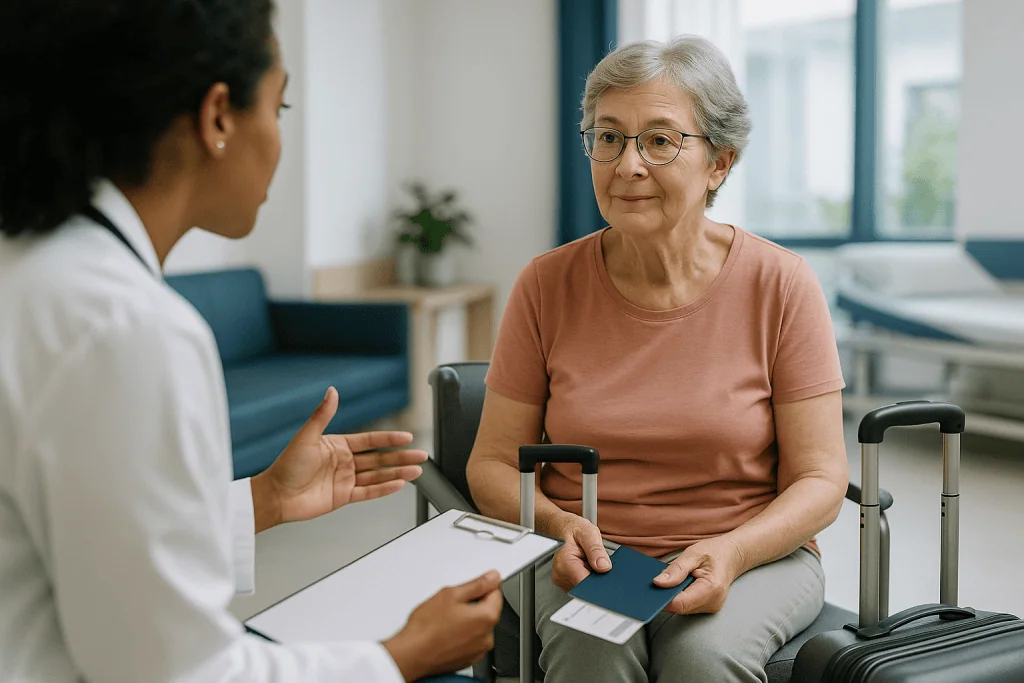
People commonly cleared for a short flight share a profile. They walk household distances with a cane or without help, can climb a few steps, and can get in and out of a car seat unaided. The wound is dry with no redness spreading from its edges. Pain is manageable without round-the-clock strong painkillers. They can bend the operated knee or hip enough to sit in an aircraft seat for a stretch without distress. Blood counts have recovered enough that mild cabin hypoxia is unlikely to matter.
People usually asked to wait, or to fly only with extra precautions, include:
- Anyone with a previous DVT or pulmonary embolism, or a known inherited clotting tendency.
- Those still fully dependent on a walker, who could not reach the lavatory on a moving aircraft.
- Patients with a wound that is leaking, reddened or being watched for infection.
- People with significant heart failure, severe lung disease or recent pneumonia, because cabin oxygen levels are lower.
- Anyone whose surgery was complicated by heavy bleeding, a fracture around the implant or a return to theatre.
Body weight, active cancer, smoking and hormone-containing medicines also appear on the CDC’s list of travel clot risk factors; none is a ban, but each shifts the conversation toward waiting longer or planning more carefully.
The decision belongs to the treating team. Their clearance is not a formality; it is the point at which someone who saw the inside of your joint weighs your particular risks against the journey you need to make.
Flying after knee replacement vs hip replacement: is there a difference?
Both operations carry a similar clot risk and similar early mobility limits, so the broad advice overlaps. The differences are practical rather than dramatic, and they mostly concern how each joint tolerates a seat.
A replaced knee dislikes being bent at 90 degrees for hours. Early knee replacement patients are usually working hard on regaining both bend and straightening, and a cramped seat can leave the joint stiff and swollen on landing. An aisle seat with room to straighten the leg into the walkway during quiet moments, or a bulkhead seat, makes a real difference.
A replaced hip, particularly in the first weeks, may come with movement precautions depending on the surgical approach: avoiding deep bending past the hip, crossing the legs or twisting the trunk. Low aircraft seats and narrow lavatories can challenge those rules. A seat cushion to raise the hips and an aisle position on the operated side so the leg can extend outward are common workarounds.
| Consideration | Knee replacement | Hip replacement |
|---|---|---|
| Main seating challenge | Prolonged knee bend, stiffness and swelling | Low seat height and hip-flexion precautions |
| Helpful seat choice | Aisle or bulkhead to extend the leg | Aisle on operated side; cushion to raise hips |
| Walking mobility milestone | Independent with cane, can straighten leg | Independent with cane, can manage steps |
| Typical first-follow-up timing (NHS) | About 6 weeks | About 6 weeks |
| Clot risk window (CDC) | Highest within 3 months of surgery | Highest within 3 months of surgery |
For both joints, swelling in the operated leg on arrival is common and usually settles with elevation. New calf pain, sudden breathlessness or a hot, tense calf are a different matter and are covered in the red-flag section below.
Clot precautions during the flight itself
Most of what protects you in the air costs nothing and fits in a sentence: move, drink water, and keep the blood flowing in your calves. The details are worth spelling out because they are easy to let slide once the cabin lights dim.
Walk the aisle whenever the seatbelt sign is off, aiming for a short stroll at least every hour or so; this mirrors the CDC’s advice to get up and move frequently on long journeys. Between walks, pump the ankles up and down, press the toes into the floor and lift the heels, and tighten and relax the calf muscles for a minute at a time. These exercises are the same ones most physiotherapists teach on the ward, and they work the calf pump even when you cannot stand.
Hydration is the second pillar. Sip water steadily through the flight rather than relying on the trolley service, and go easy on alcohol and heavily caffeinated drinks, both of which increase fluid loss. Dehydration thickens the blood, and the dry cabin is already working against you.
A few seating habits help. Avoid crossing the legs. Keep the under-seat space clear so you can stretch. Do not wedge a bag against your calves. If your team recommended graduated compression stockings, wear them for the whole journey, from the morning you leave home until you are back on your feet at the destination; the CDC and NHS both note these can reduce clot risk in people with elevated risk when correctly fitted.
Sleep is fine, but set an alarm. Four hours of unbroken sleep in a window seat is exactly the stillness the precautions are designed to interrupt.
Blood thinners and compression stockings: what they do and why timing matters
Nearly everyone leaving the hospital after hip or knee replacement is sent home with a clot-prevention plan. It typically combines a medicine that reduces the blood’s tendency to clot with mechanical measures such as stockings and early walking. Knowing the mechanism helps you understand why your team may want your flight to fall inside, not outside, the course.
The medicines fall into a few classes. Low-molecular-weight heparin is an injectable anticoagulant that interferes with the clotting cascade. Direct oral anticoagulants are tablets that block a specific clotting factor. Aspirin, an antiplatelet, is used in some protocols because it makes platelets less sticky. Each lowers clot risk during the weeks when the body is most prone to thrombosis; none removes it entirely.
Timelines vary by joint and by local protocol, but prophylaxis after joint replacement commonly runs for several weeks, often longer after hip replacement than after knee replacement. Many surgeons prefer a long flight to happen while this protection is still active, or will discuss whether to extend it around the journey. That is a prescribing decision, and it belongs entirely to the clinician who knows your bleeding and clotting history.
What you should never do is start, stop, skip or double a prescribed medicine to suit a flight, or borrow a dose of anyone else’s. If a flight falls near the end of your course, ask before you travel, not after.
Compression stockings work differently: graduated pressure, tightest at the ankle, keeps the deep veins from distending and speeds blood back toward the heart. Fit matters more than brand. A stocking that rolls or bunches behind the knee can act as a tourniquet, so have the size checked by a nurse or pharmacist rather than guessing.
Joint replacement airport security: will the metal detector go off?
Very often, yes, and it is nothing to worry about. Modern hip and knee implants are made from cobalt-chromium alloys, titanium and medical-grade stainless steel, bonded to polyethylene bearing surfaces. The metal components are substantial, and a walk-through magnetometer frequently detects them, especially with knee implants, which sit closer to the surface than a hip.
Here is what usually happens. The arch alarms. An officer asks you to step aside and tells you about the extra check. You may be directed through a full-body scanner, which uses millimeter-wave imaging rather than magnetism and typically shows the implant as an anomaly on the screen, or you may be offered a hand-held wand and a pat-down of the area. The process adds a few minutes, nothing more.
Some useful habits:
- Tell the officer before you walk through that you have a joint replacement and which side. Being upfront speeds the process and avoids confusion.
- Ask for a private screening if you would rather the pat-down happen away from the queue; this is routinely available.
- Carry any implant identification card your hospital gave you. Security agencies in most countries do not require one, but it can smooth the conversation, especially abroad.
- Allow extra time, particularly at airports where your mobility aid also has to be screened.
Two reassurances. The scanners do not affect the implant, loosen it or heat it; there is no interaction between airport screening technology and orthopedic metal. And a fresh scar does not need to be shown; officers can screen the area without uncovering it, and a brief explanation that the surgery is recent is usually enough.
Planning the journey: seats, mobility aids and the airport itself
A good flight after joint replacement is mostly arranged before you leave the house. Small logistical choices decide whether the day is manageable or exhausting.
Request assistance when you book. Airlines provide wheelchair support from check-in to the gate and from the aircraft to baggage reclaim, and it is far better to accept it and not need it than to discover the walk from security to a distant gate is half a mile. Pre-boarding gives you time to settle without a queue pressing behind you.
Choose the seat deliberately. An aisle seat lets you stand and walk without disturbing anyone; placing the operated leg on the aisle side gives room to stretch. Bulkhead rows add legroom but often have fixed armrests, which make sliding in and out harder for a stiff hip, so weigh both. Avoid seats near the lavatories if you want quiet, but not so far from them that the walk feels daunting.
Pack with your limits in mind. Crutches, canes and walkers are carried free of charge by most airlines and can usually go in the cabin. Keep your prescribed medicines, any compression stockings, the hospital discharge summary and your surgeon’s contact details in your hand luggage, never in the hold. A small cushion for the hip, a water bottle to fill after security, and loose clothing that does not press on the wound round out the kit.
Build slack into the day. Rushing is when people fall, and a fall onto a new hip or knee is the one thing that can undo weeks of recovery. A car to the airport, a dropped-off bag and an unhurried pace are not luxuries in the first weeks; they are part of the medical plan.
What the first days and weeks at home usually look like after the flight
Landing is not the end of the risk window. The clot-prone period after joint replacement runs for weeks, and the CDC’s travel guidance notes that symptoms of a travel-related clot can appear days after the journey, not only on the aircraft. So the first fortnight at home deserves the same attention you gave the flight.
Expect the operated leg to be more swollen for a day or two after travel. Elevate it above heart level for short periods, keep walking at the frequency your physiotherapist set, and continue any stockings or prescribed prevention exactly as before. Swelling that eases with elevation and overnight rest is the ordinary kind.
Rehabilitation picks up where it left off. Most people after hip or knee replacement are walking with a cane or without support by around six weeks and continue to gain strength and range of movement over the following months; Mayo Clinic describes a return to most normal activities within a few months, with full recovery taking up to a year. A flight should not change that trajectory, provided the exercises continue the day after you arrive rather than the week after.
Practical rhythms matter. Short, frequent walks around the house beat one long outing. Sleep with the leg supported, not dangling. Keep the wound clean and dry, and resist the urge to inspect under dressings more often than instructed.
Fatigue is normal and often underestimated. A long travel day pulls from the same energy reserve the body is using to heal, so plan a quiet two or three days afterward rather than a full social calendar. People who rest deliberately in that window tend to describe the following weeks as smoother, which is not a promise, simply a pattern clinicians see repeatedly.
Arranging follow-up and wound care when you land
If your surgery happened far from home, the most important thing to settle before you fly is who looks after the joint afterward. Joint replacement is not a one-visit procedure; it is a program of wound checks, physiotherapy, X-rays and reviews that typically runs for a year and then continues at longer intervals. The NHS schedules a first review around six weeks, and most systems follow a similar pattern.
Ask the operating team for three things in writing. First, a discharge summary stating the implant type and size, the surgical approach, any complications and the clot-prevention plan, including when it ends. Second, the wound care instructions: when dressings come off, whether there are stitches or clips to remove and by whom, and what the scar should and should not look like. Third, a named contact, with a phone number and an email, for questions that arise once you are home.
Then arrange the receiving side. Your primary care physician needs the summary so they can take over prescribing and monitoring. A local physiotherapist needs the protocol, especially for a knee, where regaining range of movement in the first six to twelve weeks is time-sensitive. If the operating surgeon cannot see you for the routine review, agree who will, and whether images need to be sent back.
Keep every document in one folder and carry copies on your phone. Being able to show an emergency department the implant record and your anticoagulant plan can save hours if something goes wrong at midnight in an unfamiliar town.
None of this is pessimism. It is the ordinary scaffolding of a safe recovery, and it is the part most easily forgotten in the relief of being cleared to go home.
What people often get wrong about flying after joint replacement
Folklore gathers around orthopedic recovery, and some of it is harmful. Here are the myths clinicians most often have to unpick, and what the evidence actually shows.
“Short flights are completely safe, so timing only matters for long ones.” Shorter flights carry lower risk, but the risk from recent surgery does not switch off at the gate. The CDC’s travel guidance treats the combination of immobility and surgery within three months as meaningful at any duration; the four-hour threshold is where risk climbs further, not where it begins.
“The metal detector can loosen or damage the implant.” There is no mechanism by which airport screening affects orthopedic metal. The alarm is a detection event, not an interaction.
“I feel fine, so I can skip the stockings and the walking.” Most deep vein clots form silently. Symptoms appear after the clot exists, sometimes days later. Precautions are not a response to feeling unwell; they are what prevents it.
“One alcoholic drink helps me relax, so it is good for the flight.” Alcohol increases fluid loss and deepens sleep, which means longer stretches of stillness. Neither helps a healing leg.
“If I can bear the pain, I am ready to fly.” Pain tolerance is a poor proxy for readiness. Independent walking, a dry wound, recovered blood counts and a clear clot-prevention plan matter more, and only your team can weigh them.
“An implant card is mandatory at security.” It is helpful, not required, in most countries. A verbal explanation and a short extra screening is the usual experience.
What matters most, and what the myths obscure, is simple: movement, hydration, prescribed prevention and a clearance conversation with the people who did the surgery.
Questions to ask your care team before you book
A ten-minute conversation before you book can prevent a week of worry. Bring the flight details, including duration, connections and whether you will be alone, and ask directly. The questions below are the ones orthopedic nurses and surgeons say they wish patients raised more often.
- Given my operation and my history, what is the earliest point you would be comfortable with a flight of this length?
- Will my clot-prevention medicine still be active on the travel day, and should the course be adjusted or extended around the journey?
- Do you recommend graduated compression stockings for me, and who can check the fit?
- Are there movement precautions for my hip or knee that affect how I sit, get up or use an aircraft lavatory?
- Is my blood count back to a level where cabin oxygen is not a concern?
- What should the wound look like on the day I travel, and what would make you want me to delay?
- Who do I contact if something happens at the destination, and what should I tell an emergency department about my implant and medicines?
- When and where will my six-week review happen, and who will do it if I am no longer near you?
- Should I avoid lifting my own luggage, and for how long?
- Can you give me a brief letter describing the implant and my current medicines to carry on the journey?
Write the answers down. Post-surgical fatigue and a busy clinic make it easy to misremember, and the person meeting you at the other end will want the same information. If the answers include “not yet,” treat that as data rather than disappointment; it usually means the team has seen something specific in your recovery that makes a short delay the safer path.
When to call your doctor: red-flag signs during and after travel
Most discomfort after a flight is the ordinary kind: a stiff joint, a heavier leg, tiredness that lifts after a night’s sleep. A few signs are different and need prompt medical assessment, whether they appear in the air, at the airport or several days after you reach home. Do not wait for a scheduled review if any of the following occur.
Seek urgent care, calling emergency services if severe, for:
- Sudden shortness of breath, chest pain that worsens with a deep breath, a racing heartbeat, coughing up blood or feeling faint. These can indicate a pulmonary embolism and are a medical emergency.
- New pain, tenderness or cramping in the calf or thigh, especially in one leg, with swelling, warmth or a reddish or darker discoloration of the skin. Mayo Clinic lists these as the typical signs of a deep vein thrombosis; they can appear days after travel.
Contact your surgical team or primary care physician the same day for:
- Fever, chills or feeling generally unwell, particularly with a wound that has become redder, hotter, more painful or is leaking fluid or pus.
- Bleeding, extensive bruising, black stools or blood in the urine while taking a clot-prevention medicine.
- A sudden increase in joint pain, a sense that the joint has given way or shifted, a leg that looks shorter or rotated, or inability to bear weight after a stumble.
- Numbness, tingling or weakness in the operated leg that was not there before.
Tell whoever assesses you that you have had a recent joint replacement, how many weeks ago, and what anticoagulant you are taking. Carry that information in your hand luggage for exactly this reason. Every decision about scans, medicines and whether to continue the journey rests with the clinicians in front of you, not with the advice in any article.
Frequently asked questions
How soon can you fly after hip replacement?
There is no fixed rule; most teams consider a short flight once you walk independently with a dry wound, and defer long flights to around the six-week review. The CDC flags surgery within three months and journeys over four hours as clot risk factors, so earlier and longer flights call for more caution and a specific conversation with your surgeon.
Is flying after knee replacement different from flying after a hip replacement?
The clot risk and clearance milestones are similar, but the practical issues differ. A replaced knee stiffens and swells when bent for hours, so an aisle or bulkhead seat helps. A new hip may carry bending precautions that make low seats and narrow lavatories awkward, so a cushion and an aisle seat on the operated side are often suggested.
Will my joint replacement set off airport security?
Often, yes. Implants contain enough metal to trigger a walk-through magnetometer, particularly knee implants. Officers will usually direct you through a body scanner or use a hand-held wand and a pat-down, which adds a few minutes. The screening has no effect on the implant. Telling the officer in advance and carrying any implant card you were given smooths the process.
What is the DVT risk flying after surgery, and how do I lower it?
Recent joint replacement and long-haul sitting are both recognized clot risk factors, and they add together. You lower the risk by walking the aisle roughly every hour, doing seated ankle and calf exercises, drinking water rather than alcohol, wearing properly fitted compression stockings if advised, and taking your prescribed clot-prevention medicine exactly as directed.
Should I wear compression stockings on the plane after joint replacement?
Many surgical teams recommend graduated compression stockings for flights in the weeks after surgery, since both the CDC and NHS note they can reduce clot risk in people at elevated risk. Fit is the critical point; a stocking that rolls or bunches behind the knee can obstruct flow. Have the size checked by a nurse or pharmacist before you travel.
Can I fly while still taking blood thinners after joint replacement?
Usually, and many surgeons prefer a flight to fall while clot prevention is still active. The medicine reduces the blood’s tendency to clot during the weeks of highest risk. Whether the course should be adjusted around your journey is a decision for the prescribing clinician; never alter, skip or extend a prescribed medicine on your own to suit travel.
What seat is best after a knee or hip replacement?
An aisle seat, with the operated leg on the aisle side, is the most practical choice because you can stand, walk and stretch without disturbing others. Bulkhead rows add legroom but often have fixed armrests that make sliding in and out harder. Request airline assistance and pre-boarding so you can settle without a queue behind you.
Is it safe to fly home the day after joint replacement surgery?
Most surgical teams would consider that too early, because the first days are when pain, swelling, blood loss and clot risk are at their peak and mobility is most limited. Decisions are individual, but the common pattern is at least a couple of weeks for a short flight and longer for long-haul. Ask your surgeon rather than assuming.
What symptoms after a flight mean I should call my surgeon?
Sudden breathlessness, chest pain or coughing blood need emergency care. Same-day contact is warranted for new one-sided calf pain, swelling or warmth, fever with a reddening or leaking wound, unusual bleeding on blood thinners, a sudden change in joint pain or shape, or new numbness in the leg. Mention your recent surgery and current medicines when you call.
How do I arrange follow-up if I had surgery far from home?
Before you fly, get a written discharge summary with implant details, wound instructions, the clot-prevention plan and a named contact. Send it to your primary care physician and a local physiotherapist, and agree who will do the six-week review and any X-rays. Keep copies on your phone so an emergency department can see them quickly if needed.
References
- CDC: Blood Clots and Travel: What You Need to Know
- NHS: Hip replacement, recovery
- MedlinePlus: Knee Replacement
This article is for general information only and is not a substitute for professional medical advice. Please consult a qualified doctor about your individual situation.

More from the Blog

What Does Foot Deformity Surgery Recovery Involve? From Cast to Special Shoe to Walking
Foot deformity surgery recovery usually moves through stages: a cast, splint or boot that protects healing bone for the first weeks, then a stiff…

Diaper Changes, Bathing and Dressing With a Pavlik Harness: A Daily Care Guide for Parents
During Pavlik harness diaper changes, the harness stays on and the diaper goes underneath the leg straps. Lift your baby by sliding a hand…
How Is Hip Replacement Surgery Performed? The Operation Explained From Incision to Closure
Hip replacement surgery is done by removing the worn ball-and-socket joint and fitting an artificial one. Under spinal or general anesthesia, the surgeon makes…

Recovery After Trauma Surgery: Why Physiotherapy Starts Early and How Milestones Are Set
Trauma surgery recovery usually begins within a day of the operation, when a physiotherapist helps the patient sit, breathe deeply and, where the repair…

Total vs Partial Shoulder Replacement: Which Joint Surfaces Are Replaced and Why
A total shoulder replacement resurfaces both sides of the ball-and-socket joint: the rounded top of the upper arm bone and the shallow socket on…
Who Is a Candidate for Robotic Knee Replacement? What Orthopedic Surgeons Weigh
A robotic knee replacement candidate is generally an adult with advanced knee arthritis whose pain and stiffness limit daily life despite non-surgical care such…