

Food Poisoning in Pregnancy, Older Adults and People With Chronic Illness: Why Care Differs

Key Takeaways
- The CDC reports pregnant women are about 10 times more likely than other people to develop invasive Listeria infection, even though the mother usually feels only mildly unwell.
- Listeria symptoms can appear one to four weeks after eating contaminated food, and occasionally up to 70 days later, so a fever in pregnancy deserves a food history going back months.
- Older adults often develop serious dehydration or infection without fever; new confusion, drowsiness or a fall can be the first and only sign.
- Oral rehydration solution works because a gut transporter moves sodium and glucose together and pulls water with them, which is why it is absorbed when plain water is not.
- Antimotility medicines should not be used when there is blood in the stool or fever, and bismuth subsalicylate contains a salicylate related to aspirin, so it is generally avoided in pregnancy.
- Most people, including many pregnant and older adults, feel better within about a week, but the NHS advises anyone pregnant, over 60 or immunosuppressed to contact a clinician early rather than waiting that long.
Food poisoning in pregnancy, older age or chronic illness is managed more cautiously because the same germ behaves differently: Listeria can cross the placenta, older adults dehydrate faster and show fewer warning signs, and conditions such as diabetes or kidney disease complicate fluid balance and daily medicines. Guidelines advise earlier medical contact for these groups, with rehydration first and any antibiotic or antidiarrheal decision left to the treating clinician.
The chicken salad looked fine. It tasted fine. Twelve hours later, at two in the morning, a woman who is 29 weeks pregnant is kneeling on the bathroom floor wondering whether this is the ordinary misery everyone gets from a bad meal, or the moment the pregnancy books told her to call someone. Two streets away, her father-in-law ate the same salad at the same barbecue. He feels a little off, has not had a fever, and has decided not to bother anyone.
Both of them have food poisoning. Only one of them is worried, and it is arguably the wrong one. That gap is the whole subject of this article. Food poisoning in pregnancy or elderly people, and in anyone living with a long-term condition, is not a different disease. It is the same illness landing on a body with less margin for error, and sometimes on a germ that takes advantage of exactly that.
What follows is what actually happens inside the gut, why each of these groups is watched more closely, which parts of the pharmacy shelf are not as harmless as they look, and the specific signs that should move you from waiting to calling.
Why food poisoning in pregnancy or elderly people gets a different playbook
Nobody sets out to have two standards of care for the same illness, yet with food poisoning that is exactly what mainstream guidance does, and for good reason. Food poisoning, the illness caused by eating food contaminated with bacteria, viruses, parasites or their toxins, is usually self-limiting: the NHS notes that most people feel better within a week without treatment. That reassurance is written for a healthy adult. It does not transfer cleanly to a woman at 30 weeks, a man of 82 living alone, or someone whose kidneys or immune system already work near the edge of their capacity.
Three things change. The first is the germ’s behavior. Listeria monocytogenes, a bacterium that keeps growing even in refrigerated food, causes little more than a flu-like illness in most adults but can cross the placenta; the CDC reports that pregnant women are about 10 times more likely than other people to develop the invasive infection called listeriosis. The second is the body’s reserve. An older adult starts with less total body water, a blunted sense of thirst and kidneys that are slower to conserve fluid, so the same six hours of vomiting cost more. The third is the surrounding medicine list: diuretics, blood pressure tablets and some diabetes drugs behave differently in a person who cannot eat or drink.
Because of these three shifts, the NHS advises people who are pregnant, over 60, immunosuppressed or living with a long-term condition to contact a clinician for symptoms a healthy adult would simply ride out. This article walks through what actually happens, why each group is watched more closely, and where the decisions genuinely belong: with the team treating you, not with a search result.
What actually happens in your body during food poisoning
Think of the gut as a long, sealed corridor lined with cells whose job is to pull water and nutrients inward. Food poisoning is what happens when something in the corridor makes those cells do the opposite.

There are three broad routes. Some bacteria, notably Staphylococcus aureus and Bacillus cereus, make their toxin in the food before you ever eat it. The poison is already assembled, which is why these illnesses can strike within an hour or two and often burn out within a day. Other bacteria, including Salmonella, Campylobacter and Escherichia coli, arrive alive and must multiply, attach to the lining and either invade it or release toxin on site. That takes time, so symptoms appear after days rather than hours. Viruses such as norovirus follow a third path: they hijack the lining cells themselves, and a very small number of particles is enough.
Vomiting and diarrhea are the body’s flush cycle. The gut normally reabsorbs several liters of fluid a day; when it stops doing so, that water leaves the body instead, taking sodium and potassium with it. Fever is the immune system raising the thermostat. Blood or mucus in the stool usually means the lining itself has been damaged, a pattern clinicians call dysentery.
Most of the time the infection stays in the corridor. The exceptions are what worry doctors in the groups this article is about. Listeria is built to leave the gut and travel through the bloodstream, a state called bacteremia, and from there to the placenta or the membranes around the brain. Salmonella can do the same in people whose immune defenses are weakened or who are in later life. Understanding that distinction, gut-only versus gut-and-beyond, explains almost every difference in how these patients are treated.
How long does food poisoning take to kick in?
The honest answer is anywhere from half an hour to ten weeks, and the gap matters because it tells you which germ you are likely dealing with and which meal to think about. People almost always blame the last thing they ate. For toxin-driven illness that instinct is often right. For Salmonella it usually points to yesterday or the day before. For Listeria the culprit may be a soft cheese eaten before you knew you were pregnant.
| Cause | Typical time to first symptoms | Why the timing looks like this |
|---|---|---|
| Staphylococcus aureus toxin | 30 minutes–8 hours | Toxin already formed in food; no growth needed |
| Bacillus cereus | 30 minutes–15 hours | Toxin in cooked rice or pasta left warm |
| Clostridium perfringens | 6–24 hours | Grows in large batches of meat cooled slowly |
| Norovirus | 12–48 hours | Virus must enter lining cells and replicate |
| Salmonella | 6 hours–6 days | Bacteria multiply and invade the lining |
| Campylobacter | 2–5 days | Slow-growing; often undercooked poultry |
| E. coli (including O157) | 3–4 days, range 1–10 | Toxin produced in the gut after colonization |
| Listeria (gut illness) | 9–48 hours | Early, usually mild stomach upset |
| Listeria (invasive) | 1–4 weeks, up to 70 days | Bacteria spread beyond the gut |
These windows come from the Mayo Clinic and CDC overviews listed in the references and are ranges, not promises. Two people who share a meal can fall ill a day apart because dose, stomach acid and existing immunity all vary. What the table is useful for is the conversation with your clinician: if a pregnant woman has an unexplained fever three weeks after eating deli meat, the long Listeria window is precisely why that food history is worth mentioning even though it feels ancient.
Food poisoning while pregnant: what changes for you and the baby
Pregnancy rearranges the body in ways that happen to favor certain germs. The immune system is deliberately dialed down so that it does not reject the fetus, which is exactly the shift that lets an intracellular organism like Listeria establish itself. Progesterone slows the gut, so contaminated food sits longer. Blood volume expands, the kidneys filter faster, and the whole system runs closer to its fluid limits before a single episode of vomiting.
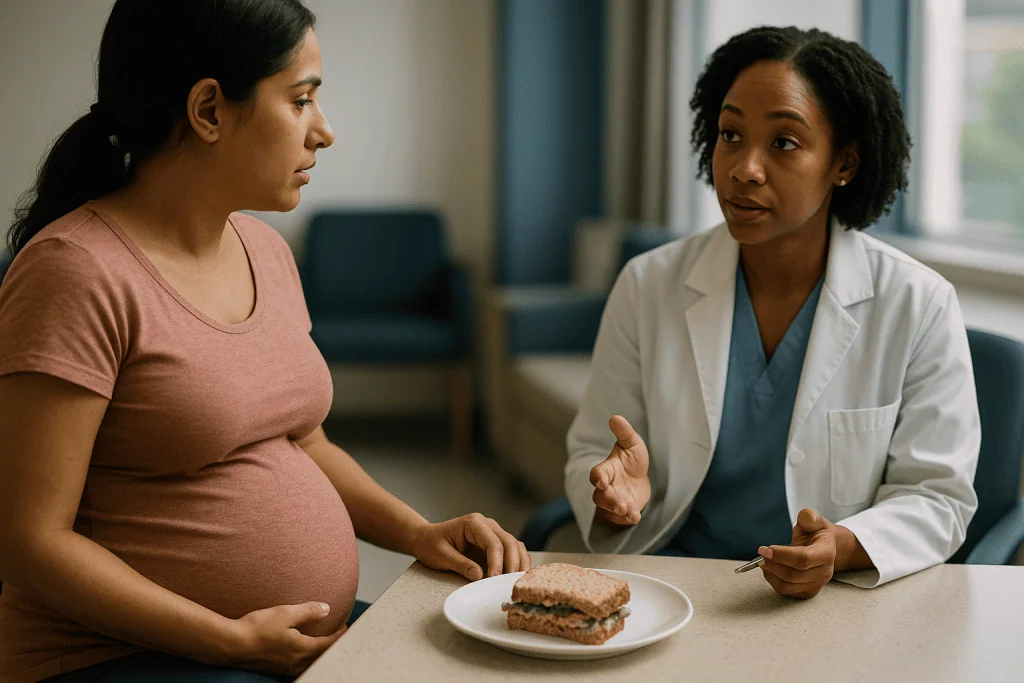
For most bacterial and viral food poisoning, the baby is not directly infected. The risk is indirect. Dehydration and fever reduce the mother’s circulating volume, which is the same volume that supplies the placenta. Prolonged vomiting in early pregnancy can tip into ketosis, a state in which the body burns fat for fuel and produces acids that show up in urine, and persistent high fever is something obstetric teams prefer to bring down and investigate rather than watch.
A different set of germs does cross to the baby, and they are the reason pregnancy food advice exists at all. Listeria is the best known. Toxoplasma, a parasite found in undercooked meat and unwashed produce, and Salmonella in rare invasive cases are the others. The CDC and NHS both single out unpasteurized milk and soft cheeses, refrigerated pâtés and smoked seafood, cold deli meats, raw sprouts and undercooked meat or eggs as the foods that carry the most risk, and the reasoning in each case is that the germ either survives refrigeration or is only reliably destroyed by thorough cooking.
None of this means every stomach upset in pregnancy is an emergency. It means the threshold for picking up the phone is lower, and that a clinician will ask about specific foods, fever and fetal movements rather than simply how many times you have been sick.
Listeria in pregnancy symptoms: why a mild illness gets urgent attention
Listeriosis is uncommon. The CDC estimates roughly 1,600 people in the United States develop it each year, and about 260 die, most of them older adults, newborns or people with weakened immunity. Those are small numbers next to the millions of ordinary food poisoning episodes, so why does it take up so much space in pregnancy care?
Because of a mismatch between how the mother feels and what is happening to the baby. In pregnancy, listeriosis usually produces a vague, flu-like illness: fever, aches, tiredness, sometimes a mild stomach upset that has already passed. Many women describe it as “a bit run down.” Meanwhile the bacteria can reach the placenta and the amniotic fluid. The CDC lists miscarriage, stillbirth, preterm birth and life-threatening infection of the newborn as the recognized consequences, and notes that the mother herself rarely becomes seriously ill.
The long incubation, one to four weeks and occasionally up to 70 days, compounds the problem. By the time symptoms arrive the offending meal is forgotten, so the illness looks like a random viral infection. This is why obstetric guidance asks pregnant women to report any fever, even without gut symptoms, and to mention high-risk foods eaten in the previous couple of months.
Diagnosis rests on a blood culture, a test in which a sample of blood is incubated to see whether bacteria grow, and sometimes on cultures of amniotic fluid or the placenta after delivery. Treatment, when the infection is confirmed or strongly suspected, is with antibiotics from the penicillin family, which work by breaking down the bacterial cell wall; the choice, route and duration are decided by the obstetric and infection teams together, and often started before the culture result returns because waiting carries its own risk. The mother’s job is simpler and just as important: report the fever, name the foods, and let the team decide.
Food poisoning in elderly adults: why dehydration arrives faster
The father-in-law from the opening scene is the patient clinicians quietly worry about most, and not because his germ is worse. His body simply has less to give.
Total body water falls with age as muscle is replaced by fat, so the same volume of diarrhea represents a larger share of what he has. The thirst signal weakens; older adults can be substantially dehydrated and not feel thirsty. Kidneys lose some of their ability to concentrate urine and hold on to water. Then there is the medicine cabinet. Diuretics keep pulling fluid out regardless of what is happening in the bathroom. Blood pressure medicines that relax blood vessels can drop pressure sharply once volume is low, which is how a stomach bug ends in a fall. Some diabetes medicines and anti-inflammatory painkillers are harder on kidneys that are already under-perfused.
Presentation is different too. Fever may be absent even with serious infection. The first sign may be new confusion, unusual sleepiness, unsteadiness or simply “not himself,” which families often attribute to age. The Mayo Clinic lists confusion and dizziness among the dehydration signs that warrant medical attention, and in an older adult they can appear before the classic dry mouth and dark urine.
Specific germs also shift. Norovirus spreads quickly in care settings. Salmonella is more likely to move into the bloodstream in later life. The CDC notes that adults aged 65 and over are about four times more likely than the general population to develop listeriosis. Antibiotics, when they are needed, bring a further hazard in this group: Clostridioides difficile, a bacterium that overgrows when normal gut flora are wiped out, causing a second and often worse diarrheal illness.
The practical consequence is that guidance treats age itself as a reason for earlier contact, and that a relative who says “I’m fine, just tired” deserves a second look.
Chronic illness, weakened immunity and the medicines that complicate a stomach bug
Long-term conditions change the calculation in two ways: some make infection more likely to spread, and some make the ordinary treatment, drinking a lot of fluid, more complicated than it sounds.
Immune suppression sits in the first group. People on chemotherapy, biologic drugs for arthritis or bowel disease, long-term steroids, transplant medicines, or living with advanced HIV lose the defenses that normally keep Salmonella and Listeria inside the gut. Invasive infection is more common and can be quieter. Liver disease adds a particular risk from raw oysters: Vibrio vulnificus, a bacterium in warm coastal water, can cause a rapidly progressive bloodstream infection in people with cirrhosis, which is why the CDC advises them to avoid raw shellfish altogether. Stomach acid is itself a defense, and medicines that reduce it lower the number of bacteria needed to cause illness.
Diabetes straddles both groups. High glucose impairs immune function, and the illness itself sends blood sugar swinging. Vomiting means fewer carbohydrates in, yet infection pushes glucose up through stress hormones. In type 1 diabetes, and with some newer glucose-lowering tablets, the combination of poor intake and dehydration can lead to ketoacidosis, a dangerous build-up of acid in the blood. Most diabetes services issue written “sick day” guidance for exactly this situation; it is worth knowing where yours is before you need it.
Kidney disease and heart failure belong in the second group. Both often come with instructions to limit fluid, and both make electrolyte shifts, especially potassium, more hazardous. “Drink plenty” and “restrict fluids” cannot both be right, and the person who resolves that conflict is the treating team, ideally by phone on the first day rather than in an emergency department on the third.
The common thread is that chronic illness rarely makes food poisoning itself worse. It removes the safety net that lets a healthy adult get it wrong for a day or two without consequence.
Who is usually asked to come in, and who can usually manage at home
Most food poisoning is managed in the kitchen and the bathroom, not the hospital, and that remains true for many people in higher-risk groups. The difference is where the line sits and how early the phone call comes.
Home management is generally reasonable for a healthy adult, and for a pregnant woman or older person with mild symptoms, when fluids are staying down, there is no blood in the stool, fever is absent or low, urine is still being passed in normal amounts and things are improving by the second day. The NHS frames this as: rest, drink, eat when you can, and expect to feel better within about a week.
Early clinical contact, usually a same-day call to a general practitioner, maternity unit or nurse line, is advised when the person is pregnant, over 60, immunosuppressed or living with diabetes, kidney or heart disease, and has any of the following: vomiting that prevents keeping fluids down, diarrhea lasting beyond a few days, fever, or a known exposure to a high-risk food. For a pregnant woman the maternity unit is often the right first call rather than the emergency department, because the team can check the baby as well as the mother.
Emergency assessment is for signs that the illness has left the gut or that dehydration is severe: confusion or extreme drowsiness, fainting, no urine for many hours, bloody diarrhea with fever, a stiff neck or severe headache, or symptoms such as blurred vision and difficulty swallowing that suggest botulism, a rare toxin that paralyses muscles.
Who is asked to wait? Realistically, the healthy adult with a straightforward 24-hour illness. Clinics prefer to see that person only if things drag on or change. For everyone else in this article, the invitation to call early is genuine and should be taken at face value.
Fluids first: what rehydration really means
Every guideline, whether NHS, CDC or Mayo Clinic, puts the same thing at the top of treatment: replace what is being lost. What people often miss is that this means replacing salt and sugar as well as water, and doing it in a way the stomach will tolerate.
The mechanism is elegant. The gut lining carries a transporter that moves sodium and glucose across together, and water follows. This transporter keeps working even when the lining is inflamed, which is why an oral rehydration solution, a pre-measured powder of glucose and salts dissolved in water, is absorbed when plain water alone would simply pass through. Sports drinks are too sugary and too low in sodium to do the same job; diluted juice and salted broth are closer but less precise.
Technique matters more than volume. A tablespoon every few minutes stays down when a full glass comes straight back. Older adults may need to be reminded and offered fluid rather than asked whether they want it, because the thirst signal is unreliable. Pale urine passed at roughly normal intervals is the simplest home marker that intake is keeping pace.
Two groups need tailoring. People with diabetes should check glucose more often and may need sugar-containing fluids even while nauseous; those with heart or kidney failure should ask their team how much to drink, because the usual restriction may be relaxed during illness but rarely abandoned. Breastfeeding mothers can and should continue; the infection does not pass through milk, and the mother’s own intake simply needs to rise.
When fluids will not stay down, or dehydration signs appear despite effort, intravenous fluids in a clinical setting are the standard next step. That is not a failure. For a pregnant woman or a frail older adult it is often the safest place to be for a few hours.
Antidiarrheals, antibiotics and the pharmacy shelf: what the evidence says
The over-the-counter aisle looks neutral. For the groups in this article it is not, and the differences come down to mechanism.
Antimotility drugs, of which loperamide is the common example, slow the muscular contractions of the gut so that stool stays inside longer. That helps with an inconvenient watery diarrhea on a workday. It is unhelpful, and possibly harmful, when the diarrhea is doing the job of clearing an invasive bacterium or its toxin. The NHS and Mayo Clinic both advise against these medicines when there is blood in the stool or a fever, and they are not given to young children. In pregnancy and in frail older adults, whether to use them at all is a question for a pharmacist or prescriber.
Bismuth subsalicylate, the pink liquid sold for upset stomach, contains a salicylate, the same chemical family as aspirin. That is why it is generally avoided in pregnancy, in people taking blood thinners and in anyone told to avoid aspirin. It can also turn stool black, which muddies the picture if a clinician later needs to know whether there was bleeding.
Antibiotics are the biggest misconception. Most food poisoning is viral or is caused by bacteria the body clears on its own; antibiotics do nothing for the former and, in uncomplicated Salmonella, can prolong the time bacteria are carried in the stool. In E. coli O157 infection, antibiotics are generally avoided because they may raise the risk of hemolytic uremic syndrome, a complication in which damaged red cells clog the kidneys. Antibiotics are, however, central to treating listeriosis and invasive infection in immunosuppressed or older patients. That decision belongs to the prescriber, and so does any change to your existing medicines during the illness: never stop a prescribed tablet without asking, but do ask, because sick-day adjustments to some diabetes and kidney medicines are routine.
Food poisoning in pregnancy or elderly adults: what the following days usually look like
The shape of a typical episode is front-loaded. The first one to three days carry most of the vomiting and the worst of the diarrhea; appetite returns before energy does; and the NHS observation that most people are better within a week holds for the majority, including many pregnant women and older adults. The differences show up at the edges.
In pregnancy, a maternity team that has been contacted will usually want a fever documented and, depending on gestation, a check of the baby’s heartbeat or movements. If Listeria is suspected, blood cultures take a few days to grow, and treatment often begins while waiting. A woman who has recovered from ordinary food poisoning does not need extra scans unless her team advises them, but reduced fetal movements at any point after the illness should be reported the same day, not saved for the next appointment.
Older adults tend to have a longer tail. Strength and steadiness can lag behind gut recovery by a week or more, and a fall in that window is a real risk. Family members can help by keeping fluids in reach, watching for confusion, and checking whether any medicine that was paused during the illness has been restarted on the clinician’s instruction.
A few complications announce themselves after the gut has settled. Hemolytic uremic syndrome after E. coli typically appears five to ten days into the illness, often as pallor, reduced urine and unusual tiredness. Reactive arthritis, a joint inflammation triggered by Salmonella or Campylobacter, can appear weeks later. Post-infectious irritable bowel, a period of altered bowel habit after the infection has cleared, is common and usually settles over months. Guillain-Barré syndrome, a rare nerve disorder following Campylobacter, presents as tingling or weakness starting in the legs. None of these is likely; all are worth knowing so that a late symptom is not dismissed as unrelated.
What people often get wrong about food poisoning
Myths around food poisoning are stubborn because they contain a grain of truth. Here are the ones that cause the most harm in higher-risk groups.
“It must have been the last thing I ate.” Only for toxin-type illness. Salmonella points to a day or two back; Listeria may point to a meal from last month. Give your clinician the whole week, not the last plate.
“If it smelled and tasted fine, it was safe.” Listeria, Salmonella and norovirus do not change the look, smell or taste of food. Spoilage bacteria do, and they are rarely the ones that cause serious illness.
“Vomiting means I should stop drinking.” The opposite. Small, frequent sips of an oral rehydration solution are the treatment, precisely because you are losing fluid. Stopping intake is how a manageable illness becomes an admission.
“Starve the bug.” There is no evidence that fasting shortens food poisoning. Eat when you can face it; the gut recovers faster with fuel.
“Morning sickness cannot be food poisoning.” Nausea in pregnancy is common, but diarrhea, fever and a sudden onset after a specific meal are not typical of pregnancy sickness. When the pattern changes, treat it as new rather than assuming it is the same old thing.
“No fever, no problem.” Older and immunosuppressed adults frequently run serious infections without fever. Confusion, drowsiness or a fall are the signs to watch instead.
“Antibiotics will clear it faster.” Usually they will not, and in some infections they add risk. The exceptions, chiefly listeriosis and invasive infection in vulnerable patients, are identified by a clinician, not by the patient.
“An antidiarrheal is always fine.” Not with blood in the stool, not with fever, and in pregnancy or frailty not without asking. Slowing the gut can keep the problem inside.
Questions to ask your care team
A phone call or clinic visit about food poisoning is short, and the useful questions are easy to forget when you feel dreadful. These are the ones that most often change what happens next, grouped by situation.
If you are pregnant
- Given my symptoms and what I ate, do you want to test for Listeria, and how long will the result take?
- Should I be checked at the maternity unit today, or is a phone review enough for now?
- What level of fever, or what change in the baby’s movements, should bring me straight in?
- Are there any medicines I am already taking that I should pause or continue while I cannot keep food down?
If you are caring for an older adult
- Which of their regular medicines should be paused while they are not drinking normally, and who will tell us when to restart?
- What signs of dehydration or confusion should prompt an emergency call rather than waiting for the next appointment?
- Do they need a stool sample, and how should we collect and deliver it?
- If they have been in a care setting, does anyone else need to be informed?
If you live with a long-term condition
- How much should I be drinking given my fluid or salt restrictions?
- How often should I check my glucose, and at what reading should I call?
- Does my immune-suppressing medicine change whether I need antibiotics or a blood test?
- Is this illness something I should report to the specialist team as well as to you?
For everyone
- What is the one symptom that, if it appears, means I should not wait?
- When should I expect to feel better, and what would make you want to see me again?
Write the answers down, or have someone do it for you. The advice given at hour six is hard to recall at hour thirty.
When to call your doctor
For a healthy adult, the NHS threshold for seeking help is diarrhea lasting more than seven days, vomiting beyond two days, or signs of dehydration. For the people this article is written for, the threshold is deliberately lower, and the sensible rule is: call on the first day if you are pregnant, over 60, immunosuppressed or managing diabetes, kidney or heart disease, and describe your situation. A clinician can then decide between reassurance, review and urgent assessment.
Contact your doctor, maternity unit or nurse line the same day if any of the following apply:
- You are pregnant and have a fever, muscle aches or flu-like illness, with or without stomach symptoms, or you ate a high-risk food in recent weeks.
- You cannot keep fluids down for more than a few hours, or you are passing much less urine than usual.
- Diarrhea or vomiting continues into a third day, or symptoms improve and then return.
- You take diuretics, blood pressure medicines, insulin or other glucose-lowering drugs, or immune-suppressing medicines and are unsure whether to adjust them.
- An older relative seems newly confused, unusually sleepy, unsteady or “not themselves,” even without fever.
Seek emergency care without delay for:
- Blood in the stool together with fever, or large amounts of blood at any time.
- Fainting, a racing heart, extreme drowsiness, or no urine for eight hours or more.
- Severe headache with a stiff neck, or new sensitivity to light.
- Blurred or double vision, difficulty swallowing or speaking, or muscle weakness, which can indicate botulism.
- In pregnancy: reduced or absent fetal movements, contractions, vaginal bleeding or leaking fluid.
- Signs of severe dehydration in an older adult: sunken eyes, cold hands and feet, confusion or collapse.
Trust the instinct that made you look this up. Clinicians would far rather take a call that turns out to be nothing than meet a patient who waited.
Frequently asked questions
Should I go to the hospital for food poisoning while pregnant?
Not always, but you should contact your maternity unit or doctor the same day rather than waiting it out. Many pregnant women manage mild food poisoning at home with rehydration. Go to hospital or the maternity unit promptly if you have a fever, cannot keep fluids down, notice reduced fetal movements, have contractions or bleeding, or ate a high-risk food such as soft cheese or deli meat in recent weeks. The team will decide whether Listeria testing or monitoring is needed.
How long does food poisoning take to kick in?
Anywhere from 30 minutes to several weeks, depending on the cause. Toxin-type illnesses from Staphylococcus or Bacillus cereus can start within hours. Norovirus typically appears at 12 to 48 hours, Salmonella between six hours and six days, and Campylobacter after two to five days. Invasive Listeria infection may take one to four weeks and occasionally up to 70 days. These ranges from the Mayo Clinic and CDC explain why the responsible meal is often not the most recent one.
Can bismuth subsalicylate, the pink stomach liquid, be used for food poisoning?
For a healthy adult with mild symptoms it is sometimes used, but it contains a salicylate related to aspirin, so it is generally avoided in pregnancy, in people on blood thinners, in those told to avoid aspirin and in children. It can also turn stool black, which can hide signs of bleeding. It does not treat the infection itself. Anyone in a higher-risk group should ask a pharmacist or prescriber before using it.
How do I know if I'm pregnant or have food poisoning?
A pregnancy test is the only reliable way to tell, and it is worth taking if there is any chance. Nausea in early pregnancy tends to come and go over days or weeks and is not usually accompanied by diarrhea, fever or a sudden onset after a specific meal. Food poisoning typically arrives abruptly and often affects others who shared the food. If you are pregnant and have these symptoms, contact your clinician; the two can coexist.
How long does food poisoning last in older adults?
The gut symptoms usually follow the same pattern as in younger adults, with most people improving within about a week according to the NHS. Recovery of strength, appetite and steadiness often takes longer in later life, sometimes an extra week or more, and the risk of falls is raised during that period. Diarrhea lasting beyond seven days, vomiting beyond two, or any confusion or reduced urine should prompt a call to the doctor.
Can food poisoning harm my baby if my symptoms were mild?
For most causes, such as norovirus or Salmonella confined to the gut, a mild illness in the mother does not directly infect the baby; the concern is dehydration and fever, which are treatable. Listeria is the exception because the mother often feels only mildly unwell while the infection reaches the placenta. That is why obstetric teams ask pregnant women to report any fever or flu-like illness, particularly after eating soft cheeses, deli meats or refrigerated smoked seafood.
Why is food poisoning in elderly people more dangerous?
Older adults have less total body water, a weaker thirst signal and kidneys that conserve fluid less efficiently, so dehydration develops faster. Medicines such as diuretics and blood pressure tablets can worsen the drop in circulating volume. Infection may present without fever, showing up instead as confusion or a fall. The CDC also notes adults aged 65 and over are about four times more likely to develop listeriosis, and Salmonella is more likely to spread into the bloodstream.
Should I stop my blood pressure or diabetes tablets while I have food poisoning?
Do not stop or change any prescribed medicine on your own, but do call your clinician or pharmacist on the first day of illness to ask. Some diuretics, blood pressure medicines, anti-inflammatory painkillers and certain glucose-lowering drugs are commonly paused during vomiting or diarrhea because dehydration changes how they act on the kidneys and blood pressure. Many diabetes services provide written sick-day guidance; if you have it, follow it and keep the team informed.
Is it safe to keep breastfeeding with food poisoning?
Yes, in almost all cases. Common food poisoning germs do not pass into breast milk, and continuing to feed helps the baby and protects your supply. The practical issues are hand hygiene, since norovirus and many bacteria spread by contact, and your own fluid intake, which needs to rise to cover both feeding and the losses from illness. If you are prescribed a medicine, mention that you are breastfeeding so the clinician can choose accordingly.
Do I need antibiotics for food poisoning?
Usually not. Most food poisoning is viral or is caused by bacteria the body clears on its own, and antibiotics can prolong Salmonella carriage or, in E. coli O157, increase the risk of a kidney complication. Antibiotics are important in specific situations: confirmed or suspected listeriosis, infection that has spread to the bloodstream, and some cases in immunosuppressed or older patients. Those decisions rest with the prescribing clinician after assessment and, often, stool or blood tests.
References
- Food poisoning: symptoms, treatment and when to get help (NHS)
- About Listeria Infection (CDC)
- Listeriosis (NHS)
- Foodborne Illness (MedlinePlus)
This article is for general information only and is not a substitute for professional medical advice. Please consult a qualified doctor about your individual situation.

More from the Blog

Low Stomach Acid and Betaine HCl: A Popular Theory Meets the Evidence
Betaine HCl is a supplement that releases hydrochloric acid in the stomach. A small randomized study in healthy volunteers showed it can briefly lower…

Endoscopy and Colonoscopy on the Same Day: How Combined Procedures Are Planned
An endoscopy and colonoscopy on the same day means a gastroenterologist examines the upper digestive tract and the large bowel during one sedated session,…

Cirrhosis Complications: Swelling, Confusion or Bleeding and Why They Need Urgent Care
Swelling of the abdomen or legs, new confusion or drowsiness, and any bleeding or black stools are the main cirrhosis complications warning signs. Each…

The Bristol Stool Chart: What Your Stool Type Says About Your Gut
The Bristol stool chart sorts stool into seven types by shape and firmness. Types 1 and 2 (hard lumps or lumpy sausages) usually signal…

Do All Hepatitis B Patients Need Antiviral Medicine? How Specialists Decide
Not everyone with hepatitis B needs antiviral medicine. Most adults who catch it acutely clear the virus on their own, and many people with…

Will Diverticulitis Come Back? What Follow-Up Care Does to Lower the Odds of Another Attack
Diverticulitis can return, but most people who recover from a first uncomplicated attack never have another. Consumer health summaries put the chance of a…