

From Surgery to Switch-On: The Cochlear Implant Activation Timeline and Early Sound Mapping

Key Takeaways
- The implant is tested during surgery but not switched on; first sounds come at the activation visit, commonly about two to four weeks later once the skin over the receiver has healed.
- The wait before activation exists to protect the healing incision from magnet pressure and to let the electrical environment inside the cochlea stabilize before levels are set.
- Early maps drift because tissue resistance around the electrodes changes and the brain becomes more tolerant of loudness, which is why visits cluster in the first months.
- Beeps, robotic voices and cartoon-like speech on activation day are expected; electronic impedance checks, not first impressions, are how audiologists confirm the device is working.
- Reviews of early activation find it feasible in selected patients but have not shown better long-term hearing than a conventional timeline.
- Cochlear implant recipients have a raised risk of bacterial meningitis, so the CDC recommends staying current with pneumococcal vaccination and knowing the warning signs.
After cochlear implant surgery, the device is usually switched on at a first programming visit a few weeks later, commonly around two to four weeks, once the incision has healed. Early sound mapping then continues through several follow-up visits over the first months. Sounds often seem odd at first and typically become clearer with daily use and practice, at a pace that varies from person to person.
The envelope from the surgeon’s office held two dates. The first was for surgery. The second, several weeks later, was labelled simply “activation,” and that was the one she kept turning over in her hands. Would she hear her daughter’s voice straight away? Would it sound like it used to? Would it sound like anything at all?
Most people facing a cochlear implant arrive with a version of those questions, and most of what they have read comes from video clips of a single emotional moment in a quiet room. The reality is longer, quieter and, in many ways, more interesting. The cochlear implant activation timeline runs from the operating room to switch-on and then through months of careful adjustment, with the brain doing a surprising amount of the work.
This explainer walks that route in order: what the device does, why there is a wait, what the first session really involves, and how early sound mapping unfolds. It leaves every decision where it belongs, with you and the team looking after you.
What the cochlear implant activation timeline actually covers
When clinicians say “activation,” they mean something narrower than most patients expect. It is the first appointment at which the external part of the system is fitted, switched on and programmed so that the internal implant begins stimulating the hearing nerve. It is not the end of the process and, for many people, it is not even the most important appointment.
Think of the timeline in three stretches. The first runs from the decision to proceed through surgery and the healing period that follows. The second is activation day itself, usually a long visit with an audiologist, a hearing specialist trained to test hearing and program hearing devices. The third is early sound mapping, a series of follow-up visits in which the device settings are adjusted as the ear recovers and the brain adapts.
Why does this framing matter? Because people who expect a single switch-on moment to deliver finished hearing are often disappointed, while people who understand the arc tend to approach the first weeks with patience. The National Institute on Deafness and Other Communication Disorders describes the implant as a device that bypasses damaged parts of the inner ear and sends signals to the hearing nerve, and it notes that learning to interpret those signals takes time and therapy.
A practical consequence follows. The calendar you are handed will list the surgery and the activation visit, but the stretch that shapes your results most is the months after that, when settings are refined and listening practice builds. If you are planning time off work, arranging a driver, or lining up family support, that longer window deserves at least as much attention as the day of surgery.
How a cochlear implant works, in plain language
Normal hearing depends on tiny sensory cells inside the cochlea, the snail-shaped organ of the inner ear. Those hair cells convert vibrations into electrical signals that the hearing nerve carries to the brain. In severe to profound sensorineural hearing loss, meaning loss caused by damage to the inner ear or the nerve, many of those cells no longer work, and no amount of amplification from a hearing aid can make a missing cell fire.

A cochlear implant steps around the problem. The system has two parts. The internal part, placed under the skin behind the ear during surgery, holds a receiver and a slim electrode array, a flexible strand with a row of contacts that is threaded into the cochlea. The external part, worn on or behind the ear, carries a microphone, a sound processor and a transmitting coil that sits over the implant, held in place by a magnet.
The processor converts sound into a coded pattern of electrical pulses, sends that code through the skin to the receiver, and the receiver delivers it to the electrodes. Each electrode sits at a slightly different position along the cochlea, and the cochlea is arranged like a piano keyboard, with high pitches near the entrance and low pitches deeper inside. Stimulating different contacts therefore gives the brain a rough sense of pitch.
Rough is the operative word. According to the NIDCD, an implant does not restore normal hearing; it provides a useful representation of sounds that helps a person understand speech. The number of contacts on an array is small compared with the thousands of hair cells in a healthy ear, so the brain receives a sketch rather than a photograph. Early sound mapping is largely about making that sketch as legible as possible for one individual ear.
Who is usually offered a cochlear implant, and who is asked to wait
Candidacy is a team decision, and it rests on more than a hearing test. Mayo Clinic describes implants as an option for adults and children with severe hearing loss in one or both ears who receive limited benefit from hearing aids. The NHS similarly frames implants as suitable when hearing aids are not helping enough, after a specialist assessment.
That assessment typically includes hearing tests with and without well-fitted hearing aids, speech understanding tests, imaging of the inner ear, a medical review and, for children, a developmental and communication review. Teams also consider realistic expectations and the person’s willingness to attend follow-up visits, because the mapping and rehabilitation stretch of the timeline depends on showing up.
Some people are asked to wait or are steered toward other options. Common reasons include hearing that still responds reasonably well to properly adjusted hearing aids, an active ear infection that must be treated first, imaging that shows the cochlea or nerve is not formed in a way that allows implantation, or medical conditions that make anesthesia unsafe at that moment. For very young children, teams balance the benefits of early access to sound against the need for a confirmed diagnosis and a stable medical picture.
You may also encounter the “60/60” shorthand. In the otology literature, this is a screening guideline suggesting that adults whose unaided hearing threshold averages about 60 decibels or worse and whose unaided word recognition is about 60 percent or lower should be referred for a formal implant evaluation. It is a prompt to refer, not a diagnosis and not a promise of candidacy; the full assessment decides. If you suspect you meet that description, the appropriate step is a conversation with an audiologist or ear, nose and throat specialist, who can confirm where you stand.
Surgery day and the healing that comes before switch-on
The operation itself is routine for the teams that do it regularly, although it rarely feels routine to the person on the table. It is performed under general anesthesia. The surgeon makes an incision behind the ear, creates a shallow seat in the bone for the receiver, opens a small path to the middle ear and the cochlea, and gently inserts the electrode array. The incision is closed and a dressing applied. Mayo Clinic notes that many people go home the same day or after one night.
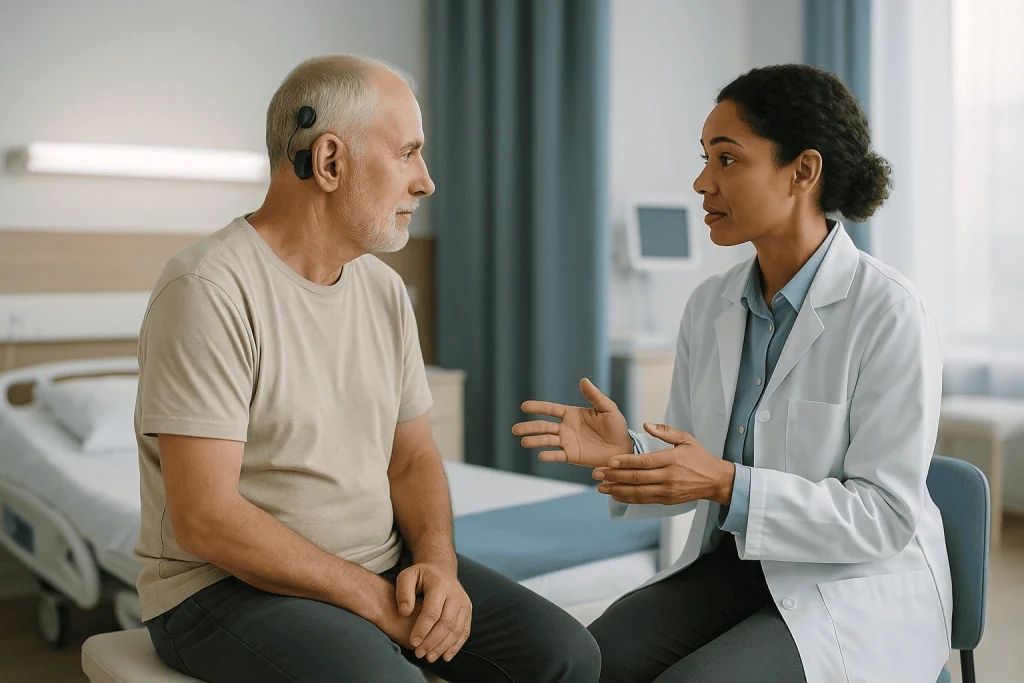
The implant is tested in the operating room before you wake. Electrical checks confirm that the contacts are responding, and some teams record early nerve responses. None of this is audible to you, and the device is not left switched on. You leave the hospital hearing exactly as you did before, or slightly less in that ear if any natural hearing was present.
Early recovery is mostly about the wound and the inner ear settling. MedlinePlus lists common short-term effects such as soreness, swelling around the incision, mild dizziness or unsteadiness, and changes in taste or a numb patch of skin near the ear, which usually improve. Your team will give wound-care instructions, limits on hair washing or swimming, and guidance on when to return for a check.
Many people are surprised by how little there is to do during this gap. There are no settings to adjust and no listening practice yet. It is reasonable to use the time to arrange the practicalities of the next stage: transport to activation day, a quiet listening environment at home, and someone who can accompany you to the first sessions and remember what was said when you are tired or overwhelmed. If you use a hearing aid in the other ear, keep wearing it as advised.
Why there is a wait between surgery and activation
Patients often ask why a device that was tested in the operating room cannot simply be switched on before they go home. The answer is partly surgical and partly electrical.
Surgically, the skin over the receiver needs time to heal and the swelling beneath it to subside. The external coil is held to the head by a magnet, and placing a magnet over a fresh, swollen incision risks pressure on healing tissue and poor coil contact. Teams wait until the flap of skin has settled so that the magnet strength can be chosen safely and the coil stays put.
Electrically, the environment inside the cochlea changes in the first days and weeks. Tissue responses around the array alter the resistance each contact meets, and that affects how much current is needed to produce a comfortable sound. Settings chosen very early can drift quickly, which is one reason the first mapping visits are scheduled close together.
There is genuine debate about how short the wait can safely be. Some programs activate earlier than the traditional interval, in some cases within the first week, and published reviews in the surgical literature have examined whether this is safe and whether it shortens the overall adjustment period. The honest summary is that early activation appears feasible in selected patients at experienced centers, that most of the evidence comes from relatively small studies, and that the long-term hearing results do not appear to differ much from those of a conventional timeline. In other words, a shorter wait is a scheduling convenience with possible emotional benefit, not a route to better hearing.
Your own interval will be set by your surgeon based on how your wound is healing, your medical history, local practice and clinic logistics. A slightly longer wait is not a sign of a problem; it is usually simply how that team works.
Cochlear implant activation timeline: typical ranges at a glance
Timelines vary by clinic, by age and by individual healing, so every figure below is a typical range rather than a target. Sources such as Johns Hopkins Medicine and MedlinePlus describe activation at roughly two to four weeks after surgery, with programming visits continuing over the following months and at least yearly thereafter.
| Stage | Typical timing | What usually happens |
|---|---|---|
| Candidacy assessment | Weeks to months before surgery | Hearing and speech tests, imaging, medical review, counselling on expectations |
| Surgery | Day 0 | Implant placed under general anesthesia; device tested while you are asleep; same-day or overnight stay is common |
| Wound check | About 1–2 weeks after surgery | Incision reviewed, stitches or glue checked, activity advice updated |
| Activation (switch-on) | Commonly about 2–4 weeks after surgery; earlier at some programs | External processor fitted, first map created, first sounds heard |
| Early mapping visits | Several visits over the first 3–6 months | Levels adjusted as the ear settles; programs refined; rehabilitation guidance |
| Ongoing follow-up | Roughly yearly once stable | Map checked, hearing tested, equipment reviewed |
Two patterns in that table deserve comment. First, the visits cluster early and then thin out, because most of the drift in settings happens in the first weeks. Second, the stage with the widest range is the last one, because by that point the schedule depends on how stable your hearing has become and what your clinic recommends.
If your own schedule looks different, that is not unusual. Children are often seen more frequently, people with additional medical needs may have extra checks, and some clinics bundle mapping with speech therapy on the same day. The table is a map of the territory, not a route you must follow.
What to expect on cochlear implant activation day
Set aside most of a day, and bring someone with you. The appointment is often long, because fitting, programming and counselling happen in one sitting, and because the audiologist will want to see how you respond over an hour or more rather than in a single moment.
The session usually begins with the hardware. The audiologist fits the processor behind your ear, selects a magnet strength that holds the coil comfortably without pressing hard on the skin, and connects the processor to a computer. The internal device is checked electronically to confirm each contact is working, a step called impedance testing that measures electrical resistance at every electrode. You feel nothing during this.
Then comes the part people remember. The audiologist sends small pulses to each electrode in turn and asks you to report when you first notice something and when it becomes comfortably loud. Those responses set the lower and upper limits of your first map, the personalized set of instructions the processor uses to turn sound into stimulation. For adults, this is a conversation; for young children, the team relies on behavioral cues and objective measurements instead.
Finally the microphone is switched on. This is the moment captured in videos, and it is worth knowing in advance that your reaction may be anything from tears to laughter to a shrug. Many adults report beeps, buzzes, cartoon-like or robotic voices, or a strange sense that sound is arriving but not meaning. All of these are common and expected in the first session.
Before you leave, you will be shown how to put the processor on and take it off, charge or change batteries, keep it dry, and use any extra programs or volume controls. Expect to be sent home with instructions to wear the device during all waking hours, because consistent input is what allows the brain to start sorting signal from noise.
Why early sounds seem strange, and what that says about the brain
The sound of a cochlear implant on day one is frequently described as unmusical. Voices may sound high-pitched, flat, echoey or mechanical. Footsteps and running water can seem absurdly loud while speech feels like a stream of chirps. Understanding why helps people stay calm through it.
Part of the explanation is physical. An array with a handful of contacts is standing in for thousands of hair cells, so pitch is delivered in coarse steps. The array often cannot reach the deepest part of the cochlea where the lowest pitches are normally sensed, so low sounds may be shifted upward. The first map is also deliberately conservative, with loudness kept within a comfortable range while the ear settles.
The larger part of the explanation is neural. The hearing pathway in the brain has been receiving little or no input, sometimes for years, and it must relearn which patterns mean “s,” which mean “sh,” and which mean the refrigerator. The NIDCD is clear that learning to use an implant takes time and practice, and that is a statement about the brain’s adaptability rather than about the device.
Adults who lost hearing after learning language usually have an advantage here, because they carry a memory of what speech should sound like and can match the new signal to it. People who have been without usable hearing for a very long time, or who were born deaf and receive an implant as adults, often adapt more slowly and may rely more on lip-reading alongside the implant. Neither path is wrong; they are different starting points.
A useful mental model is a foreign accent. On day one every speaker sounds strongly accented. Over weeks the accent fades, not because the speaker changes but because the listener does. That is the trajectory most people are on, even when individual days feel like no progress at all.
The first days and weeks after activation: what life usually looks like
The week after switch-on tends to be tiring. Listening through a new signal requires concentration, and many people describe a kind of mental fatigue by mid-afternoon that eases over subsequent weeks. Short, frequent listening sessions in quiet surroundings are generally recommended early on, building toward longer and noisier environments as tolerance grows.
Changes often arrive in small, specific ways rather than as a sudden breakthrough. A person may notice the kettle click off before they see it, recognize their own name from another room, or realize the dog’s nails on the floor have a sound. Speech understanding typically improves in stages: first awareness that someone is speaking, then rhythm and syllables, then words in context, then conversation. Background noise and group settings remain hard for longest.
Practically, the first weeks involve returning to the clinic more than once. Early maps tend to need adjusting as the electrical environment in the cochlea stabilizes and as you become able to tolerate more loudness. Many people find that the levels set on day one feel quiet within a week or two, and the audiologist raises them at the next visit. This is the normal shape of early sound mapping, not a sign that something has gone wrong.
Day-to-day habits also need settling. The processor must be kept dry, removed for swimming and bathing unless you have a specific waterproof accessory, and stored safely overnight. Static electricity and strong magnets deserve a conversation with your team. If you use a hearing aid in the other ear, the clinic will advise on whether to wear both together from the start or to spend some listening time with the implant alone.
Family members play a role too. Clear speech at a normal pace, facing the listener, in good light and without exaggerated mouth movements, helps far more than shouting. A family that treats the first month as a shared project tends to make it easier.
How early sound mapping and cochlear implant mapping sessions work
Mapping is the programming of the processor so that sound is delivered within a range that is audible but comfortable on every electrode. Each contact needs two key values: the softest level of stimulation you can detect, often called the threshold or T level, and the loudest level that is still comfortable, usually called the comfort or M level depending on the manufacturer’s terminology. Between those two points the processor fits the full range of everyday sound.
Why does this need repeating across several visits? Because the ear and the brain both move. In the first weeks after surgery, the resistance at each electrode shifts as tissue responses develop, so the same programmed level may deliver a different sensation. At the same time, the brain becomes more tolerant of stimulation, so a level that felt startling on day one may feel quiet later. Audiologists expect this and schedule accordingly.
A typical mapping session includes a repeat of the impedance check, a review of how the current program has felt, re-measurement of threshold and comfort levels on some or all electrodes, loudness balancing so that no single electrode stands out, and a listening check with live speech or recorded words. Some clinics measure nerve responses objectively, which is especially helpful for infants and for adults who find the subjective judgements difficult.
Many processors can hold more than one program. Early on, an audiologist may load a slightly quieter and a slightly louder version of the same map so that you can step up at home as you become comfortable. Later programs may be tuned for noisy rooms, music or telephone use. These choices depend on the device you have and the clinic’s approach, and the right person to explain them is your own audiologist rather than an online forum.
Over months the maps change less, and visits spread out. Johns Hopkins Medicine notes that ongoing adjustments and periodic checks continue for life, because the equipment, the ear and your listening needs all evolve.
Auditory rehabilitation: what the evidence supports after switch-on
If mapping sets the stage, rehabilitation is the rehearsal. Auditory rehabilitation means structured listening practice designed to help the brain learn the new signal, and it is the part of the cochlear implant activation timeline most often undersold on activation day.
For adults, practice usually combines everyday listening with deliberate exercises: following along with an audiobook while reading the printed text, having a family member read short sentences without lip-reading cues, listening to familiar songs with lyrics in hand, or using structured training programs recommended by the clinic. The point is to pair sound with meaning repeatedly until the pairing becomes automatic.
For children, rehabilitation is woven into language development itself. Speech and language therapists, teachers of the deaf and parents work together so that the child is bathed in meaningful sound throughout the day. The NHS emphasizes that children who receive implants need ongoing support to learn to listen and talk, and families should expect regular therapy alongside mapping visits.
How quickly does it work? The honest answer is that progress varies widely and depends on how long the person was without useful hearing, whether they developed spoken language before losing it, the health of the hearing nerve, consistent device use, and the amount of practice. The NIDCD describes most people as making gains over months to a year or more rather than days. Clinics do not promise a particular level of speech understanding, and any source that does is overstating what the evidence allows.
Two practical pieces of advice carry the weight of experience across many programs. Wear the device during all waking hours, because intermittent use slows adaptation. And keep practising in quiet before expecting success in noise, because noisy listening is the last skill to arrive, even for people who eventually do well with it.
What people often get wrong about cochlear implant activation
Misunderstandings cluster around a few themes, and clearing them up early saves distress later.
“The implant is switched on in surgery.” It is tested in surgery, not activated. You wake up hearing no better in that ear than before, and the first sounds come at the activation visit weeks later.
“Switch-on is the moment hearing returns.” Activation is the moment stimulation begins. Understanding comes with mapping and practice over months. The viral videos capture an emotional first second, not the typical sound quality of that day, which many adults describe as beeps or distorted voices.
“If it sounds bad on day one, the surgery failed.” Strange early sound is the norm. Device problems are uncommon and are detected by the electronic checks your audiologist runs at every visit, not by how pleasant the first session feels.
“The sooner it is activated, the better the result.” Reviews of early activation suggest it is feasible in selected patients but have not shown better long-term hearing. The interval is a healing and logistics decision.
“Once the map is set, it is set.” Maps change, especially in the first months, and periodic checks continue for life.
“An implant restores normal hearing.” The NIDCD and Mayo Clinic are both explicit that it does not. It provides a useful representation of sound that most recipients learn to use for speech, with music and noisy settings remaining harder.
“The 60/60 rule tells me I qualify.” It is a referral prompt from the otology literature, not a candidacy decision. Only a full assessment can determine that.
“A newer model will hear for me.” Processors do improve over time, and some upgrades can be applied to an existing internal implant, but no model removes the need for mapping and practice, and no product should be chosen on marketing claims. Discuss specific devices with your team.
How the pathway differs for children receiving an implant
Children follow the same broad timeline, surgery followed by activation and mapping, but almost every step is adapted. Candidacy often begins with newborn hearing screening, followed by diagnostic testing, a period of hearing aid use to confirm how much benefit the child receives, imaging and a team review that includes speech and language specialists. Mayo Clinic notes that implants can be considered for infants and young children when hearing aids do not provide adequate access to sound, and that earlier access to sound supports spoken language development in children who use it.
Surgery is similar to the adult operation, performed under general anesthesia, and preparation focuses on comfort: familiar toys, a parent present until the child is asleep where the hospital allows it, and clear explanations pitched to the child’s age. Recovery advice centers on protecting the incision, watching for fever or discharge, and keeping the child from bumping the site during active play.
Activation looks different because a toddler cannot report when a beep is soft or loud. Audiologists rely on behavioral observation, such as a pause in play or a turn of the head, and on objective nerve-response measurements recorded through the implant. The first session is often brief and gentle, with levels set conservatively and raised over frequent early visits.
Families should expect more appointments than adults have, and a therapy schedule running alongside. The NHS describes ongoing support from speech and language therapy and educational services as part of the package, because the aim is not just hearing but listening and language. Parents are coached to narrate daily life, respond to every vocal attempt and keep the processor on during all waking hours, which for a two-year-old is a project in itself.
Decisions about communication approach, whether spoken language, sign language or a combination, belong to the family with guidance from the team. An implant is a tool within that choice, not a replacement for it.
Risks, alternatives and realistic expectations in neutral terms
Any honest timeline includes the possibility of detours. Mayo Clinic and MedlinePlus list risks that include bleeding or infection at the wound, temporary dizziness or balance disturbance, ringing in the ear, changes in taste from a nerve that runs near the surgical path, numbness around the ear, injury to the facial nerve causing weakness on that side of the face, leakage of inner-ear or spinal fluid, device failure requiring further surgery, and loss of any natural hearing that remained in the implanted ear. Serious complications are uncommon, but your surgeon will discuss the specific likelihoods relevant to you.
One risk deserves separate mention. People with cochlear implants have a higher risk of bacterial meningitis, an infection of the lining around the brain, than the general population. The CDC recommends that recipients be up to date with pneumococcal vaccination and that families know the warning signs. Your team will advise on timing of vaccines relative to surgery; vaccination decisions sit with your prescribing clinician.
Alternatives depend on the pattern of hearing loss. Well-fitted and recently adjusted hearing aids remain the first option for most degrees of loss. Bone-conduction devices suit certain conductive or single-sided losses. Assistive listening technology, captioning and communication strategies help regardless of device. For some people, the right answer after assessment is to continue with hearing aids and reassess later.
Expectations are the other half of risk. Most adults with post-lingual loss who use the device consistently gain useful speech understanding in quiet, and many do well on the telephone, but outcomes range widely and no clinic can promise a particular result. Music, accents, group conversation and noisy restaurants are the hardest listening situations and may remain so. Choosing to proceed is a judgement that balances these uncertainties against what hearing aids are currently offering you, and that judgement is made together with the team that will see you through the mapping months.
Questions to ask your care team before surgery and switch-on
A good consultation leaves you with answers to the questions that will matter in week three, not just on the day. Bring a written list and someone to take notes. The following prompts are a starting point; your own situation will add others.
- How long after surgery do you usually schedule activation, and what would lead you to move it earlier or later for me?
- Will I stay overnight, and what wound-care and activity limits apply in the first two weeks?
- How many mapping visits do you expect in the first six months, and how long is each?
- What should the first weeks sound like, and what would make you concerned?
- How will you measure my levels if I find it hard to judge loudness, and do you use objective nerve-response measurements?
- What rehabilitation support do you provide, and what should I practise at home?
- Should I keep wearing a hearing aid in the other ear, and when?
- What natural hearing do I have in the implanted ear now, and how likely is it to change?
- Which vaccinations do you recommend before or after surgery, and when?
- How do magnets, MRI scans, airport security and static electricity affect this device, and what card or documentation will I carry?
- What are the signs of a device problem, and how do you check for one?
- How are repairs, replacements and future processor upgrades handled through this service?
- Who do I contact between visits if something feels wrong, and how quickly will someone respond?
Notice that several of these questions are about logistics rather than medicine. That is deliberate. The cochlear implant activation timeline succeeds or stalls on attendance, consistent device use and timely contact when something changes, and knowing exactly who to call removes one of the main reasons people delay reporting a concern.
When to call your doctor: red-flag signs during the activation timeline
Most of the sensations in the weeks after surgery and switch-on are expected and settle on their own. A small number are not, and they should be reported promptly rather than saved for the next scheduled visit.
Seek urgent care the same day if you notice:
- Fever with a severe headache, stiff neck, sensitivity to light, confusion or drowsiness. These can indicate meningitis, which the CDC flags as a specific risk for implant recipients, and it is a medical emergency.
- New weakness or drooping on one side of the face, or difficulty closing the eye on the operated side.
- Clear, watery fluid draining from the ear or nose, or a salty taste at the back of the throat, which can suggest a fluid leak.
- Sudden severe dizziness with vomiting that does not settle.
Contact your surgical or audiology team within a day or two if you notice:
- Increasing redness, swelling, warmth, pain or pus at the incision, or the wound opening.
- Skin over the implant becoming thin, sore or broken, or the coil no longer staying in place.
- Sound suddenly stopping, becoming intermittent, or changing sharply in character after a period of stability, which may indicate an external fault or, less often, an internal one.
- Any uncomfortable sensation such as a facial twitch, a jolt or pain when the processor is on; audiologists can switch off the responsible electrode.
- Persistent loud ringing, a feeling of fullness, or new loss of natural hearing in either ear.
When in doubt, call. Teams would far rather hear about a false alarm than find a treatable problem late. Keep your clinic’s contact details and the number for out-of-hours advice somewhere visible, and if you have a device identification card, carry it so that emergency staff know an implant is present before any imaging or treatment.
Frequently asked questions
How long does it take for a cochlear implant to start working?
The implant begins delivering sound at the activation visit, usually a few weeks after surgery, but useful understanding builds gradually over the following months. Many adults notice environmental sounds within days and speech in quiet within weeks, while group conversation and music take longer. The NIDCD describes adaptation as a process of months to a year or more, varying with how long a person was without hearing and how consistently they practise.
How long after cochlear implant surgery is activation scheduled?
Most programs schedule activation about two to four weeks after surgery, according to patient information from Johns Hopkins Medicine and MedlinePlus, with some clinics activating earlier in selected patients. The interval depends on wound healing, swelling over the receiver and clinic practice. A slightly longer wait does not affect long-term results and is not a sign of a problem; your surgeon sets the date based on how you are recovering.
What is the 60-60 rule for cochlear implants?
The 60/60 rule is a screening guideline from the otology literature suggesting that adults with an unaided hearing threshold averaging about 60 decibels or worse and unaided word recognition of about 60 percent or lower should be referred for a cochlear implant evaluation. It prompts a referral; it does not decide candidacy. The full assessment, including aided testing, imaging and a medical review, determines whether an implant is appropriate for an individual.
What happens on cochlear implant activation day?
The audiologist fits the external processor, chooses a magnet strength, runs electronic checks on every electrode, and then measures the softest and most comfortable levels of stimulation to build your first map. The microphone is switched on, often producing beeps or distorted voices at first. You learn to handle, charge and care for the device and are usually asked to wear it during all waking hours. Plan for a long visit and bring a companion.
What should I expect after cochlear implant activation in the first week?
Expect odd, mechanical or high-pitched sound, listening fatigue by mid-afternoon, and small daily discoveries such as hearing a tap running or a door closing. Levels set on day one often feel quiet within a week or two, which is why an early follow-up is scheduled. Quiet, short listening sessions with speech paired to text or a familiar voice help most. Soreness around the ear should be easing rather than worsening.
How many cochlear implant mapping sessions are needed?
There is no fixed number. Visits are typically frequent in the first three to six months while levels stabilize, then spread out to roughly yearly checks once hearing is steady, as Johns Hopkins Medicine describes. Children are usually seen more often than adults. Each session rechecks electrode function, re-measures threshold and comfort levels, balances loudness across electrodes and tests speech understanding, with the schedule adjusted to how quickly your map settles.
Why does everything sound robotic or like beeps after switch-on?
A small number of electrode contacts is standing in for thousands of damaged hair cells, so pitch arrives in coarse steps and the first map is kept conservative for comfort. The hearing pathway in the brain has also been without clear input and must relearn which patterns mean which sounds. Both factors improve with consistent use and practice, and the NIDCD notes that learning to interpret implant signals takes time and therapy.
Does early activation give better results than waiting a few weeks?
Current evidence does not show that. Published reviews of early activation report that it appears feasible and safe in selected patients at experienced centers, and some people value hearing sooner, but long-term speech understanding has not been shown to differ from a conventional timeline. The interval is mainly a healing and logistics decision, so follow the schedule your surgeon recommends rather than seeking the shortest possible wait.
What is the newest cochlear implant expected to be released?
This magazine does not comment on specific products or release plans, and no manufacturer claims appear here. Processors and internal devices do evolve, and some external upgrades can be used with an existing implant, but no model removes the need for surgery, mapping and listening practice. If a particular feature matters to you, ask your implant team how it fits your candidacy, your anatomy and the service you will rely on for follow-up.
Can a cochlear implant restore normal hearing?
No. The NIDCD and Mayo Clinic both state that an implant does not restore normal hearing; it provides a useful representation of sound that many recipients learn to use for speech, especially in quiet. Music, accents and noisy settings tend to remain harder. Results vary widely with the duration of deafness, nerve health, consistent device use and practice, and no clinic can promise a specific level of understanding.
References
- NIH NIDCD: Cochlear Implants
- MedlinePlus Medical Encyclopedia: Cochlear implant
- NHS: Hearing loss, Treatment
This article is for general information only and is not a substitute for professional medical advice. Please consult a qualified doctor about your individual situation.

More from the Blog

Tympanoplasty vs Myringoplasty: Which Eardrum Repair Do You Need?
Myringoplasty repairs only the torn eardrum membrane, usually with a small graft of the patient's own tissue. Tympanoplasty repairs the eardrum and also lets…

Recurrent Sinusitis and Daily Life: Irritants, Fluids and Habits Your ENT Will Ask About
For recurrent sinusitis, the most useful things to avoid are inhaled irritants such as tobacco smoke and strong fumes, prolonged use of decongestant nasal…

Ear Tube Surgery Step by Step: What Happens in the Operating Room and How Long It Takes
Ear tube surgery (myringotomy with tympanostomy tube placement) is one of the shortest common operations. The procedure itself usually takes about 15 minutes per…

How Do ENT Specialists Find the Cause of Vertigo? Timing, Triggers and Hearing Clues
Vertigo is diagnosed mainly through a careful history and a hands-on examination rather than a single test. Clinicians ask how long spells last, what…

Earwax Build Up With Hearing Aids or a Perforated Eardrum: Why Removal Needs an ENT
If you wear hearing aids or have a perforated eardrum, earwax removal is usually best done by an ENT clinician or trained ear specialist…

Stapedectomy Surgery Explained: How a Tiny Prosthesis Replaces the Fixed Stapes Bone
A stapedectomy treats hearing loss from otosclerosis, a condition in which the stapes, the smallest bone in the middle ear, becomes fixed and cannot…