

Gastric Balloon vs Gastric Sleeve: Temporary Device or Surgery, and How Doctors Compare Them

Key Takeaways
- A gastric balloon is usually removed after about six months, while a sleeve gastrectomy permanently removes roughly 80 percent of the stomach, according to Mayo Clinic and NIDDK.
- Mayo Clinic summarizes typical balloon results as about 7 to 15 percent of total body weight lost over six months, versus about 60 percent or more of excess weight within two years after a sleeve.
- The sleeve removes the stomach portion that produces most ghrelin, a hunger hormone, which is why its effect exceeds what restriction alone would predict.
- NHS guidance generally considers weight-loss surgery for a BMI of 40 or more, or 35 to 40 with a weight-related condition, after other approaches have been tried.
- New or worsened acid reflux is one of the sleeve's best-documented long-term trade-offs, and significant pre-existing reflux often steers surgeons toward a different operation.
- After a sleeve, lifelong vitamin and mineral supplementation and regular blood tests are standard; after a balloon, nutrition typically returns to normal once the device is removed.
A gastric balloon is a temporary, saline-filled device placed in the stomach through the mouth and usually removed after about six months, while a gastric sleeve is permanent surgery that removes roughly 80 percent of the stomach. Doctors compare them on durability of weight loss, risk, reversibility and body-mass-index thresholds; the sleeve generally produces larger, longer-lasting results, the balloon a smaller, time-limited effect.
The two brochures sit side by side on the kitchen table. One shows a soft silicone sphere no bigger than a grapefruit; the other, a cross-section of a stomach trimmed to the shape of a banana. The person reading them has already tried the meal plans, the walking program, the app that counted every bite. What they want now is a straight answer: which of these two paths is actually right for me, and how do doctors decide?
That is the honest heart of the gastric balloon vs gastric sleeve question. It is not a contest between a gentle option and a drastic one. It is a comparison between a device with a built-in expiry date and an operation that changes the anatomy of the stomach for life, each with its own evidence, its own risks and its own kind of patient.
This explainer walks through what each procedure involves, what the research actually shows about results and complications, and the questions worth bringing to the team who will ultimately make the recommendation with you.
What a gastric balloon actually is, and what happens on the day
An intragastric balloon is a soft silicone sphere placed inside the stomach to take up space, so smaller meals feel filling sooner. Nothing is cut and nothing is stapled. The device works purely by occupying volume and, some researchers believe, by slowing the rate at which the stomach empties.
Placement is an endoscopic procedure, meaning a thin flexible tube with a camera is passed through the mouth and down the esophagus. You are sedated, not put under general anesthesia in most programs. The deflated balloon travels down alongside the scope, and once the doctor confirms it is sitting in the stomach, it is filled with sterile salt water. Mayo Clinic describes the whole procedure as taking about half an hour, with most people going home the same day.
The first days are often the hardest part. Mayo Clinic notes that roughly one in three people has pain and nausea soon after insertion; the stomach is reacting to a foreign object, and antinausea medicines prescribed by the team usually help settle it over several days. Eating begins with liquids, moving to soft foods and then a regular texture over the following weeks under a dietitian’s guidance.
Newer balloon designs exist, including swallowable capsules that inflate in the stomach and versions that can be adjusted after placement. Regardless of type, the defining feature is the same: the balloon is temporary. It is designed to be removed, again endoscopically, after a fixed period. What remains afterward is whatever eating habits and activity patterns were built while it was in place. That is why every reputable program pairs the device with structured lifestyle coaching; the balloon is the scaffolding, not the building.
What a gastric sleeve involves inside the operating room
Sleeve gastrectomy, commonly called a gastric sleeve, is surgery that permanently removes a large portion of the stomach, leaving a narrow tube about the size and shape of a banana. Mayo Clinic and the NIH’s NIDDK both describe the removed portion as roughly 80 percent of the organ. The part taken out is the stretchy outer curve, the section that expands most when you eat a large meal.
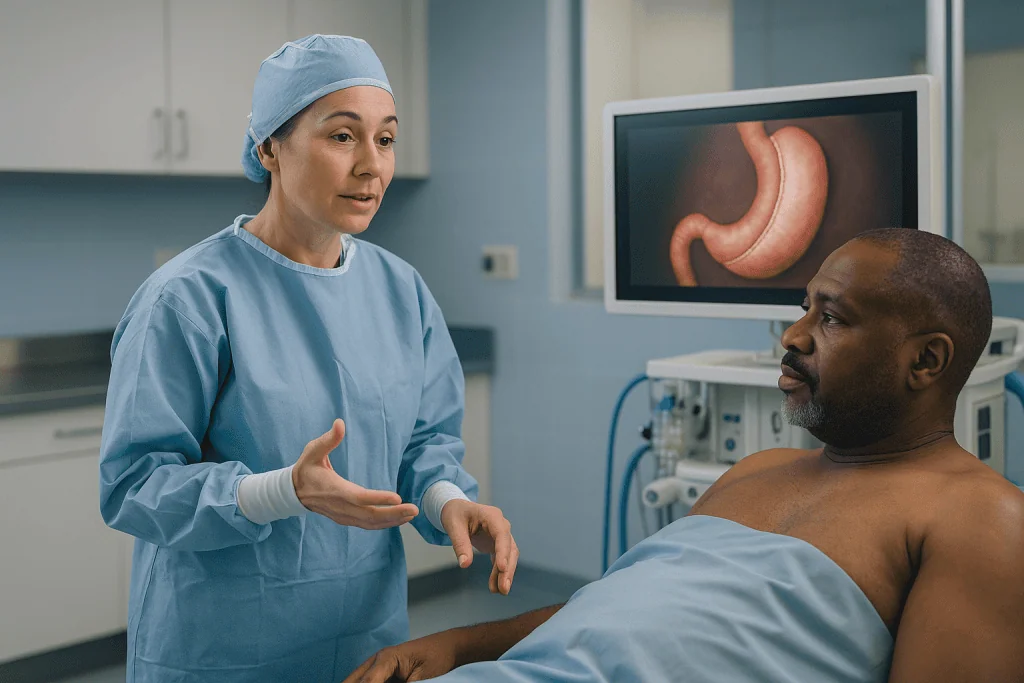
The operation is almost always laparoscopic, meaning it is performed through several small incisions in the abdomen using a camera and long instruments rather than one large cut. The surgeon lifts the stomach, divides it along a stapling line that seals the tissue as it cuts, and removes the excess portion through one of the incisions. The intestines are not rerouted, which is a key difference from gastric bypass and the reason the sleeve is often described as the simpler of the two major bariatric operations.
You are under general anesthesia throughout. The NHS advises that people typically stay in hospital for two or three days afterward and return to normal activities within about four to six weeks, though your team will give ranges specific to your recovery.
The sleeve works in two ways. The obvious one is restriction: the new stomach simply holds far less. The less obvious one is hormonal. The removed portion of the stomach produces most of the body’s ghrelin, a hormone that signals hunger to the brain. With that tissue gone, many people report a noticeable drop in appetite in the months after surgery, an effect the StatPearls chapter on sleeve gastrectomy highlights as part of why results tend to exceed what restriction alone would predict.
Unlike the balloon, none of this can be undone. The stomach does not grow back.
Gastric balloon vs gastric sleeve: the core differences at a glance
Set the two procedures next to each other and the contrast is stark. One is a device; the other is an operation. One is reversible by design; the other is permanent. The table below draws on Mayo Clinic, NHS and NIH descriptions to summarize how doctors typically frame the comparison for patients.
| Feature | Gastric balloon | Gastric sleeve |
|---|---|---|
| What it is | Temporary saline-filled device in the stomach | Surgical removal of about 80% of the stomach |
| How it is done | Endoscopy through the mouth, sedation | Laparoscopic surgery, general anesthesia |
| Incisions | None | Several small abdominal cuts |
| Typical duration | Removed after about 6 months (Mayo Clinic, NHS) | Permanent |
| Reversible | Yes, by removal | No |
| Usual hospital stay | Same-day discharge (Mayo Clinic) | 2 to 3 days (NHS) |
| Main mechanism | Space-filling, earlier fullness | Restriction plus reduced hunger hormone |
| Typical weight loss | About 7% to 15% of total body weight over 6 months (Mayo Clinic) | About 60% or more of excess weight within 2 years (Mayo Clinic) |
| Lifelong supplements | Not usually required | Usually required |
A third option often gets confused with both: endoscopic sleeve gastroplasty, sometimes called an endoscopic sleeve. Here the surgeon uses a device passed through the mouth to place sutures that fold the stomach inward, making it smaller without removing anything. It sits conceptually between the balloon and the surgical sleeve, and much of the research appearing in search results under “sleeve” is about this newer technique rather than the operation. If your team mentions it, ask which sleeve they mean.
Who is usually offered a balloon, who a sleeve, and who is asked to wait
Eligibility is where the two paths separate most clearly, and it is driven less by preference than by body mass index, a measure of weight relative to height, and by what else is going on with your health.

Surgical sleeve criteria are set by national guidance. The NHS describes weight-loss surgery as generally considered for adults with a BMI of 40 or more, or a BMI between 35 and 40 alongside a condition such as type 2 diabetes or high blood pressure that might improve with weight loss. Two further conditions apply: other approaches such as supervised diet and exercise have been tried without lasting success, and the person is fit enough for anesthesia and committed to long-term follow-up. Programs also screen for untreated eating disorders, active substance misuse and unmanaged mental-health conditions, not to exclude people permanently but because these need support first.
Balloons sit in a different space. Mayo Clinic describes them as an option for people whose BMI is roughly between 30 and 40, particularly those who do not qualify for surgery or would prefer not to have it, and always as part of a program with dietary and behavioral support. People with prior stomach surgery, large hiatal hernias, active ulcers or inflammatory bowel disease are usually not candidates, because the device could worsen these conditions or be harder to place safely.
Who is asked to wait? Anyone actively planning a pregnancy, since neither procedure is performed during pregnancy and both change nutrition in ways that need planning. People with recent heart events or unstable medical conditions. And, for the sleeve, those who have not yet completed the pre-operative program, which commonly includes dietitian visits and sometimes a supervised period of weight loss before surgery.
None of these thresholds are decisions you make alone. They are the starting point for a conversation with a bariatric team.
Gastric balloon vs sleeve results: what the evidence actually shows
Here is where honesty matters most, because the two procedures are measured on different scales and marketing often blurs them.
Balloon studies usually report total body weight loss, the percentage of your starting weight that comes off. Mayo Clinic summarizes the evidence as a loss of about 7 to 15 percent of body weight during the six months the device is in place. For someone weighing 220 pounds, that is roughly 15 to 33 pounds. The same source notes that when expressed as excess weight, the amount above a healthy range, studies report losses in the range of about 30 to 47 percent.
Sleeve outcomes are more often reported as excess weight loss. Mayo Clinic notes that people may lose about 60 percent or more of their excess weight within two years. For a person carrying 100 pounds above a healthy weight, that would be 60 pounds or more. The StatPearls chapter published through the NIH describes the sleeve as producing durable weight loss that compares reasonably with gastric bypass in many series, with some regain over the years being common.
The gap is real and it widens over time. The balloon’s effect is concentrated in the months it is present. Whether weight stays off afterward depends almost entirely on habits built during that window, and research summarized by Mayo Clinic acknowledges that some regain after removal is common. The sleeve’s anatomical and hormonal changes persist, which is why its results hold better, though they too can erode if the small stomach is gradually stretched by frequent grazing or calorie-dense liquids.
Two cautions. First, averages hide wide individual variation in both directions. Second, weight on a scale is not the only outcome that matters; blood sugar, blood pressure, joint pain and sleep apnea are tracked too, and those effects are discussed later in this article.
How long does a gastric balloon last, and what happens at removal
Most balloons are designed for a six-month stay. Both Mayo Clinic and the NHS describe removal at around that point, because silicone weakens with prolonged exposure to stomach acid and the risk of spontaneous deflation rises the longer it remains. Some newer designs are approved for longer periods, and your team will tell you the specific timeline for the device they use.
Removal mirrors placement. You are sedated, an endoscope is passed through the mouth, the doctor punctures the balloon and drains the fluid, then grasps the empty shell and withdraws it. It is typically done as a day procedure. Many people feel an odd sense of emptiness for a few days, both physically and psychologically, because the constant fullness signal disappears at once.
What happens next is the part patients most often underestimate. The device’s job was to make a reduced portion feel satisfying while new routines took hold. After removal, the stomach’s capacity returns to normal. If meal sizes drift upward, weight tends to follow. This is why balloon programs typically continue dietitian and behavioral support for months after the device is gone, and why the NHS frames the balloon as a temporary aid rather than a standalone treatment.
A minority of people have the balloon removed early. The most common reason is intolerance: nausea, vomiting or abdominal pain that does not settle within the expected first week or two. Less commonly, the device is removed because it has deflated. Balloons are often filled with a small amount of harmless blue dye so that deflation announces itself through green or blue urine, a signal to contact the team promptly, since a deflated balloon can move into the intestine and cause a blockage.
Can it be repeated? Some programs place a second balloon after a rest period. The evidence on repeat placement is thinner, and the decision belongs with your team.
Gastric sleeve vs balloon risks: complications compared honestly
Every treatment that changes how you eat carries risk. The two procedures simply distribute that risk differently: the balloon front-loads discomfort with a low chance of serious harm, while the sleeve carries the risks of any major operation followed by a set of long-term considerations.
For the balloon, Mayo Clinic lists nausea, vomiting and abdominal pain as common in the first days. Rarer but serious problems include deflation with the balloon migrating into the bowel and causing obstruction, stomach ulcers from the device rubbing the lining, and, very uncommonly, perforation of the stomach wall, which requires surgery. Regulators have also investigated reports of acute pancreatitis and unexpected overinflation with some designs, which is why manufacturers and clinicians monitor closely and why early symptoms are taken seriously.
For the sleeve, short-term surgical risks include bleeding, infection, blood clots in the legs or lungs, reactions to anesthesia and, the complication surgeons worry about most, a leak along the staple line where the stomach was divided. The NIH StatPearls chapter describes staple-line leak as the most serious early complication, occurring in a low single-digit percentage of cases in reported series, and one that can require drainage, further endoscopy or reoperation. Longer term, Mayo Clinic lists narrowing of the sleeve, new or worsened acid reflux, hernias at incision sites, low blood sugar episodes, malnutrition and vomiting if eating habits outpace the stomach’s new capacity.
Reflux deserves a special mention because it is the sleeve’s signature trade-off. Removing the stretchy part of the stomach raises pressure inside the remaining tube, and a meaningful number of people develop heartburn who never had it before. Anyone with significant pre-existing reflux is often steered toward a different operation for exactly this reason.
Neither list is meant to frighten. It is meant to be the same list your surgeon will walk through during informed consent, so nothing there is a surprise.
What the first days and weeks look like after each procedure
The recovery arcs could hardly be more different, and knowing them in advance helps set expectations for work, family and mood.
After a balloon, you are typically home within hours. The first three to seven days are usually dominated by nausea, cramping and a heavy sensation in the upper abdomen as the stomach adjusts to a permanent guest. Mayo Clinic describes this settling period as lasting several days for most people, with prescribed antinausea and antacid medicines from the team easing the transition. Diet starts with clear fluids, advances to thicker liquids and then to soft, moist foods over one to two weeks, arriving at a regular texture around week three or four, always in small portions. Most people return to desk work within a few days, though energy and appetite can be unpredictable for the first fortnight.
After a sleeve, the hospital stay is two to three days according to NHS guidance. You will be walking within hours of surgery to reduce clot risk, sipping fluids in tiny amounts, and learning that a few tablespoons now register as a full meal. Pain at the incision sites is managed with medicines the team prescribes and generally eases over the first week. The diet progression is longer and more structured: liquids for roughly the first two weeks, pureed foods for the next two, soft foods for two more, then a gradual return to regular textures around week six, though program schedules vary and your dietitian’s plan takes precedence over any general timeline. The NHS notes a return to normal activities in about four to six weeks; heavy lifting is typically restricted for longer.
Emotionally, both groups describe a strange adjustment. Food had a role, and that role is suddenly different. Bariatric teams treat this as expected, not as weakness, and many include psychological support as a standard part of aftercare.
Eating, vitamins and follow-up for life: how the long game differs
The balloon and the sleeve diverge sharply once the initial recovery is over, and the divergence is about permanence.
With a balloon, nutrition returns to normal once the device is removed. During the six months it is in place, the priority is learning: eating slowly, stopping at the first sign of fullness, separating fluids from meals so liquid does not push food past the balloon uncomfortably, and building a plate around protein and vegetables. Supplements are not usually required long term, though your team may recommend a multivitamin while intake is reduced.
With a sleeve, the smaller stomach and reduced acid production change how nutrients are absorbed for life. NIDDK guidance on bariatric procedures describes the need for lifelong vitamin and mineral supplementation after sleeve gastrectomy, with the nutrients most often affected including vitamin B12, iron, vitamin D, calcium and folate. Blood tests at regular intervals become part of the routine; the NHS describes follow-up appointments continuing long term, often indefinitely, precisely because deficiencies can develop quietly years later.
Eating patterns after a sleeve have their own rules. Protein comes first at each meal because the volume is limited. Carbonated drinks are usually discouraged because gas stretches the sleeve. Alcohol is absorbed faster and hits harder, and several studies summarized in the StatPearls chapter note a higher risk of alcohol-related problems after bariatric surgery generally, so many programs advise caution or avoidance.
One point applies to both: weight-management medicines, including the newer glucagon-like peptide-1 receptor agonists that mimic a gut hormone to reduce appetite, are sometimes used alongside or after either procedure. Whether that is appropriate, and when, is a decision for the prescribing clinician based on your health history; it is not something to start, stop or adjust on your own.
Effects beyond the scale: diabetes, reflux, blood pressure and sleep
Doctors do not choose between a balloon and a sleeve on weight alone. They look at what else the weight is doing to the body, and here the sleeve’s evidence base is considerably deeper.
Type 2 diabetes is the clearest example. The NHS lists it among the conditions that can improve after weight-loss surgery and that may lower the BMI threshold for eligibility. Mayo Clinic notes that sleeve gastrectomy can improve or lead to remission of type 2 diabetes in many people, partly through weight loss and partly through hormonal shifts that appear within days of surgery, before much weight has come off. Remission is not the same as permanent resolution; blood sugar can climb again if weight returns, and monitoring continues.
High blood pressure, obstructive sleep apnea, high cholesterol and joint pain from osteoarthritis are also listed by Mayo Clinic and the NHS as conditions that commonly improve after substantial surgical weight loss. Fatty liver disease is another, and it is one reason liver health is often assessed before surgery.
Balloon evidence on these outcomes is more modest and more time-limited. Because the weight loss is smaller and the device is temporary, improvements in blood sugar and blood pressure tend to track with the weight and may fade after removal unless the loss is maintained. Mayo Clinic frames the balloon’s health benefits as following from weight loss rather than from any independent metabolic effect.
Then there is reflux, which cuts the other way. As noted earlier, the sleeve can worsen or trigger heartburn, and for some people this becomes a persistent problem needing long-term acid-suppressing medication or, occasionally, conversion to gastric bypass. A balloon can also aggravate reflux while in place, but the effect ends when it is removed.
The takeaway for a person weighing options: ask your team not just how much weight each might remove, but what each is likely to do to the specific conditions you already have.
Is a gastric balloon worth it? How doctors frame the question
This is the question people actually type, and the honest clinical answer is: it depends what job you are asking the balloon to do.
Bariatric teams generally see the balloon as appropriate in three situations. The first is the person whose BMI falls below surgical thresholds but whose weight is already affecting health, and for whom a moderate loss over six months with structured support could be meaningful. The second is the person who qualifies for surgery but is not ready for it, whether because of medical fitness, personal circumstances or preference, and who wants a lower-risk intervention now. The third is a bridge: some people with very high BMI use a balloon to lose enough weight to make a subsequent operation safer, an approach discussed in surgical literature though not universally adopted.
Where the balloon tends to disappoint is when it is expected to do the work of surgery. Mayo Clinic’s own summary is candid that weight regain after removal is common. A person who needs to lose a large amount and keep it off, and who meets surgical criteria, is usually counseled that the balloon’s six-month window is unlikely to deliver that on its own.
There is also the question of what the balloon reveals. Six months of living with reduced capacity is, in a sense, a rehearsal. Some people discover they can sustain the habits and never need more. Others learn that restriction alone does not address the drivers of their eating, and that information shapes what comes next, whether that is surgery, medication managed by a clinician, psychological support or a combination.
What the balloon is not: a quick fix, a cosmetic shortcut or a replacement for the program around it. Every reputable source, from the NHS to Mayo Clinic, describes it as one component of a supervised plan. Judged on those terms, it can be worthwhile. Judged as a standalone solution, the evidence says it usually is not.
What people often get wrong about balloons and sleeves
Misconceptions cluster around both procedures, and several of them lead people toward the wrong option or unrealistic hopes.
“The balloon is the safe version of the sleeve.” Safer in the sense of avoiding general anesthesia and surgical incisions, yes. But it is not risk-free. Mayo Clinic lists deflation with bowel obstruction, ulcers and perforation among its potential complications, and early intolerance leads a minority of people to have it removed ahead of schedule. Lower risk is not the same as no risk.
“The sleeve is just a smaller stomach.” The hormonal change matters as much as the size. Removing the ghrelin-producing portion of the stomach reduces hunger signaling, which is a large part of why the sleeve outperforms what restriction alone would predict, according to the NIH StatPearls chapter. It is a metabolic operation, not simply a mechanical one.
“Once the balloon comes out, the weight stays off.” It can, but only if habits changed. Mayo Clinic is explicit that regain is common after removal. The device does not train the body; the program around it trains the person.
“The sleeve is permanent, so the weight loss is permanent.” The anatomy is permanent. The result is not guaranteed. The remaining stomach can stretch over years with frequent large meals or high-calorie liquids, and some regain is documented in long-term series.
“A sleeve means no more heartburn.” Often the opposite. New or worsened reflux is one of the sleeve’s best-documented long-term effects, listed by Mayo Clinic among its risks.
“Endoscopic sleeve and surgical sleeve are the same thing.” They are not. The endoscopic version folds the stomach with sutures from the inside and removes nothing; the surgical version removes most of the organ. Their evidence bases, durability and risk profiles differ, and much of what appears online under “sleeve” refers to the endoscopic technique.
“You can eat whatever you want, just less of it.” Neither procedure suspends nutrition. Protein, vitamins and hydration all need more attention afterward, not less.
Questions to ask your care team before choosing
A good consultation is a two-way exchange. Bariatric teams expect questions, and arriving with a list signals that you are engaging with the decision rather than being carried along by it. These are the ones that tend to surface the most useful answers.
- Based on my BMI and health conditions, which of these do I actually qualify for under the guidance you follow, and why?
- If you are recommending a sleeve, do you mean surgical sleeve gastrectomy or endoscopic sleeve gastroplasty? How do they differ in your program?
- What weight loss do people with a starting point like mine typically see with each option, and how does that hold up at two years and five years?
- How would each option affect the specific conditions I have, such as diabetes, reflux, sleep apnea or joint pain?
- What are the most serious complications you see with each, how often do they occur in your program, and how are they managed?
- If I have a balloon, what support continues after it is removed, and for how long?
- If I have a sleeve, what does lifelong follow-up look like, which blood tests are needed and how often?
- Will I need supplements, and what happens if I struggle to take them consistently?
- How do you handle reflux that develops after a sleeve?
- What is the pre-operative preparation, and is there a required period of supervised weight loss beforehand?
- How long will I be off work, and what activity restrictions apply?
- Are weight-management medicines part of your approach before, alongside or after either procedure, and how is that decided?
- What would make you advise waiting or choosing neither option right now?
- Who do I contact, day or night, if something feels wrong afterward?
Write the answers down or bring someone who will. Consultations are dense, and the details that matter most, thresholds, timelines and who to call, are easy to lose once you leave the room.
When to call your doctor: red-flag signs after a balloon or a sleeve
Most recovery discomfort is expected and settles. Some symptoms are not, and both procedures have a short list that warrants an immediate call to your team or emergency care rather than waiting for the next appointment.
After a gastric balloon, contact your team urgently if you notice green or blue urine, which can signal that the balloon has deflated and its dye has been absorbed; a deflated balloon can migrate and block the intestine. Seek care for severe or worsening abdominal pain, vomiting that persists beyond the first week or prevents you from keeping fluids down, signs of dehydration such as dizziness or very dark urine, vomiting blood or passing black stools, which may indicate an ulcer, and any sudden severe upper abdominal pain radiating to the back, which can suggest pancreatitis. Fever with abdominal pain is always worth a same-day call.
After a gastric sleeve, the early red flags center on leak, bleeding and clots. Call immediately or go to emergency care for a rapid heartbeat, especially above roughly 120 beats per minute at rest, fever, worsening abdominal pain, shoulder-tip pain, or a general sense of being very unwell; the StatPearls chapter notes that a fast heart rate is often the earliest sign of a staple-line leak. Shortness of breath, chest pain, or a painful swollen calf may indicate a blood clot. Vomiting blood, black stools, incision sites that are red, hot, leaking or opening, and inability to keep fluids down for more than a day all need prompt assessment. Later on, persistent trouble swallowing, severe heartburn that does not respond to prescribed treatment, episodes of shakiness or confusion after meals suggesting low blood sugar, or ongoing fatigue and numbness that may point to vitamin deficiency should be raised at follow-up rather than tolerated.
When in doubt, call. Bariatric teams would far rather hear about a symptom that turns out to be nothing than miss one that mattered.
Frequently asked questions
How long does a gastric balloon last before it has to come out?
Most intragastric balloons are designed to stay in place for about six months, after which they are removed endoscopically, according to both Mayo Clinic and the NHS. Silicone weakens with prolonged acid exposure, so leaving a balloon in longer raises the risk of deflation. Some newer designs are approved for longer periods; your team will tell you the timeline for the specific device used.
Gastric balloon vs sleeve results: which produces more weight loss?
The sleeve produces substantially more and longer-lasting weight loss in the evidence summarized by Mayo Clinic: about 60 percent or more of excess weight within two years, compared with roughly 7 to 15 percent of total body weight over six months with a balloon. The balloon’s effect is concentrated while it is in place, and regain after removal is common unless habits have changed durably.
Is a gastric balloon worth it if I qualify for surgery?
It can be, but usually for a specific purpose rather than as a substitute for surgery. Teams may suggest a balloon for someone not yet ready for an operation, as a bridge to make later surgery safer, or as a six-month rehearsal of new habits. If your goal is large, sustained weight loss and you meet surgical criteria, most clinicians would explain that a balloon alone is unlikely to deliver it.
Gastric sleeve vs balloon risks: which is safer?
The balloon avoids general anesthesia and incisions, so its serious-complication rate is lower, but it is not risk-free; Mayo Clinic lists deflation with bowel obstruction, ulcers and perforation among its rarer risks. The sleeve carries surgical risks, most notably staple-line leak, bleeding and clots, plus long-term issues such as reflux and nutrient deficiency. Which is safer for you depends on your health profile, which is why the decision rests with your team.
Can a gastric sleeve be reversed?
No. Sleeve gastrectomy permanently removes a large portion of the stomach, and that tissue does not regrow. If problems such as severe reflux or inadequate weight loss develop, the sleeve can sometimes be converted to a different operation such as gastric bypass, but the original anatomy cannot be restored. This permanence is one of the central differences from a balloon, which is removed by design.
Will I need vitamins for life after a gastric sleeve?
Usually, yes. NIDDK guidance describes lifelong vitamin and mineral supplementation as standard after sleeve gastrectomy, because the smaller stomach and reduced acid change how nutrients are absorbed. The nutrients most often affected include vitamin B12, iron, vitamin D, calcium and folate. Regular blood tests help catch deficiencies early. Your team will specify what you need; this is not something to decide independently.
Does a gastric balloon hurt when it is placed?
Placement itself is done under sedation and is not usually painful, but the days afterward often are uncomfortable. Mayo Clinic notes that about one in three people experiences pain and nausea soon after insertion as the stomach adjusts to the device. This typically settles within several days with medicines prescribed by the team. Pain that worsens or persists beyond the expected window should be reported promptly.
Can I have a gastric sleeve after a gastric balloon?
Yes, in many cases. Some programs deliberately use a balloon first to help people with very high BMI lose enough weight to make surgery safer, and others move to surgery when a balloon alone proves insufficient. The balloon must be removed before any operation, and a rest period is common. Whether this sequence is appropriate for you is a decision for your bariatric team.
What is the difference between an endoscopic sleeve and a surgical gastric sleeve?
A surgical gastric sleeve removes about 80 percent of the stomach through small abdominal incisions under general anesthesia. Endoscopic sleeve gastroplasty, by contrast, uses a suturing device passed through the mouth to fold the stomach inward, removing nothing. The endoscopic version is less invasive and newer, with a smaller evidence base on long-term durability. If your team mentions a sleeve, ask which one they mean.
Will either procedure fix my type 2 diabetes?
Neither procedure is described as a guaranteed fix, but the evidence differs. Mayo Clinic and the NHS list type 2 diabetes among conditions that commonly improve, and sometimes go into remission, after sleeve gastrectomy, partly through hormonal changes independent of weight. Balloon-related improvements tend to track with weight loss and may fade after removal. Blood sugar monitoring continues in both cases, and medication decisions stay with your prescribing clinician.
References
- NHS: Weight loss surgery
- NIH StatPearls: Sleeve Gastrectomy
- NIH NIDDK: Types of Weight-loss Surgery
- MedlinePlus: Vertical sleeve gastrectomy
This article is for general information only and is not a substitute for professional medical advice. Please consult a qualified doctor about your individual situation.

More from the Blog
Gastric Band vs Gastric Sleeve: Reversible Device or Lasting Reshaping, Compared Honestly
An adjustable gastric band is a removable silicone ring fitted around the upper stomach and tightened through a port under the skin; a gastric…
Robotic Bariatric Surgery: What the Robotic Arms Change Inside the Operating Room
Robotic bariatric surgery uses a surgeon-controlled console and wristed instruments to perform standard weight-loss operations, such as sleeve gastrectomy or gastric bypass, through small…

Preparing for an Obesity Clinic Appointment: Weight History, Medicines and Questions to Bring
To prepare for an obesity clinic appointment, bring a written weight history (your weight at key life stages, past attempts, what helped and what…

Gastric Sleeve Results Over the Years: What Realistic Long-Term Expectations Look Like
Gastric sleeve results long term typically show the largest weight loss in the first one to two years, with a partial regain for many…

Does Metabolic Syndrome Change After Menopause? What Doctors Watch in Midlife Women
Yes. After menopause, the pattern of metabolic syndrome shifts even when weight stays steady: fat moves toward the waist, LDL cholesterol and triglycerides tend…

Inside a Sleeve Gastrectomy: Stapling the Stomach, Checking for Leaks and Closing Up
A sleeve gastrectomy removes roughly 80% of the stomach through several small keyhole incisions. Under general anesthesia, the surgeon frees the stomach's outer curve,…