

Gum Graft vs Bonding for Gum Recession: Covering the Root or Protecting It

Key Takeaways
- A gum graft rebuilds lost gum and can cover the root with living tissue; bonding shields the root with resin and leaves the gum line exactly where it is.
- Gum tissue does not grow back on its own, so any real gain in gum height requires surgery, while bonding, varnish and gentler brushing manage the consequences of recession rather than reversing it.
- Whether a graft can fully cover a root depends heavily on whether the gum and bone between the teeth are still intact, which is why asking about the papillae predicts your result better than any average.
- Cleveland Clinic describes most people returning to normal activity within one to two weeks of a gum graft, with the tissue continuing to mature for months, whereas bonding allows normal eating the same day.
- Composite bonding on a root typically needs repair or replacement within several years, and a poorly polished margin at the gum line can itself trap plaque and irritate the gum.
- A gum graft is not a bone graft: one adds soft tissue to cover roots, the other rebuilds the bony foundation, usually for implants or advanced periodontal defects.
A gum graft and dental bonding address gum recession differently. A graft moves or places soft tissue to cover the exposed root and rebuild the gum, while bonding places tooth-colored resin over the root surface to reduce sensitivity and wear without restoring gum. Dentists usually weigh the amount of recession, remaining attached gum, symptoms and oral hygiene before recommending one, the other, or neither.
It usually starts with a cold drink. One upper canine zings, you glance in the mirror, and the tooth looks a little longer than it did a year ago. The hygienist confirms it: the gum has pulled back, and a strip of yellowish root is showing. Then come two very different suggestions. One dentist mentions a gum graft. Another says a small bonding could settle it.
If you are weighing gum graft vs bonding for recession, you are not choosing between a good option and a bad one. You are choosing between two philosophies. A graft tries to put gum back where it belongs. Bonding leaves the gum where it is and shields the root with resin. Each has a sensible place, and each has limits that are easy to gloss over in a short appointment.
This explainer walks through what actually happens in both procedures, what the evidence does and does not show, and which questions help you have a sharper conversation with your dental team.
Why gums recede, and why the exposed root is the real problem
Gum recession is the gradual loss of the gum tissue that normally hugs the neck of a tooth, so that part of the root becomes visible. The crown of a tooth is covered by enamel, the hardest substance in the body. The root is not. It is covered by cementum, a thin, softer layer, and underneath that sits dentin, a tissue riddled with microscopic tubes that lead toward the nerve.
Once the gum retreats, that cementum wears away quickly under a toothbrush. The dentin beneath is then open to the mouth, which explains the sharp, short jolt from cold, sweet or even air. Mayo Clinic describes this exposed dentin as the usual mechanism behind sensitive teeth, and it is why recession is more than a cosmetic matter.
The causes cluster into a few groups:
- Plaque-driven gum disease, which NHS and the National Institute of Dental and Craniofacial Research describe as inflammation that, left untreated, destroys the fibers and bone anchoring the tooth.
- Mechanical trauma, most often a stiff brush used with a scrubbing stroke, or a lip or tongue piercing rubbing the gum.
- Anatomy: thin gum tissue, a tooth sitting slightly outside the bony arch, or a high muscle attachment tugging at the gum margin.
- Orthodontic movement that pushes a root toward the thin outer bone.
- Clenching and grinding, which some clinicians believe contributes, though the evidence is weaker here than for plaque and brushing.
This matters for the graft-versus-bonding decision because neither treatment removes the cause. A graft placed over a tooth that is still being scrubbed with a hard brush, or still sitting in inflamed gums, is asking a great deal of the new tissue. The first step in every pathway is figuring out why the gum left in the first place.
How a gum graft works: what actually happens in the chair
A gum graft, also called gingival or soft tissue grafting, is a minor surgical procedure in which tissue is placed over or beside the exposed root to rebuild the gum. It is usually performed by a periodontist, a dentist who specializes in the gums and supporting bone, under local anesthetic in an ordinary dental chair.
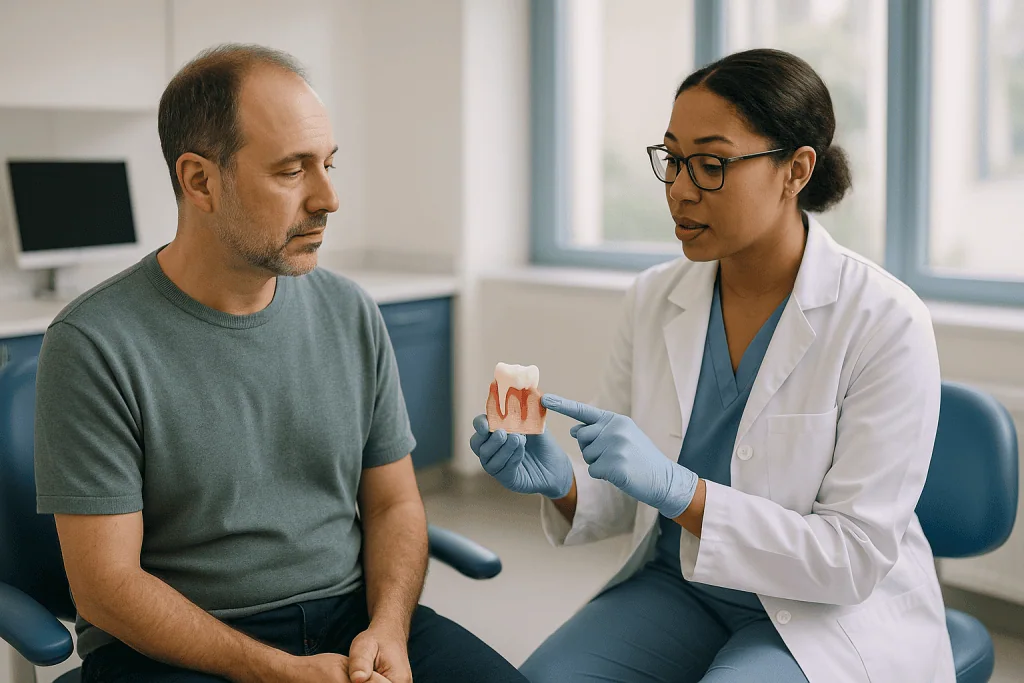
Cleveland Clinic describes three common approaches, and knowing their names helps you follow the conversation:
- Connective tissue graft. A small flap is lifted in the roof of the mouth, a sliver of the deeper tissue is removed, the flap is stitched closed, and the harvested tissue is tucked under the gum around the recession. This is the most widely used technique for root coverage.
- Free gingival graft. A thin layer of surface tissue is taken directly from the palate and stitched onto the area. It thickens thin gums well but tends to look paler than surrounding tissue, so it is often chosen where appearance is less critical.
- Pedicle or lateral graft. Gum next to the recession is partly cut, swiveled across the exposed root while still attached at its base, and secured. This avoids a second wound, but only works when there is generous gum beside the tooth.
Donor tissue from a tissue bank or a collagen-based matrix may be used instead of palate tissue in some cases, sparing the second surgical site. Whether that is appropriate depends on the defect and the surgeon’s judgment.
Before any tissue is placed, the root is cleaned and smoothed so that plaque, calculus and softened cementum do not sit between the root and the graft. The whole visit for one or two teeth commonly takes around an hour, according to Cleveland Clinic, though multiple sites take longer. You will leave with stitches, sometimes a protective dressing, and a very specific set of instructions about not disturbing the area.
How bonding for an exposed tooth root works
Dental bonding is a restorative procedure in which a tooth-colored composite resin is applied to the tooth, shaped, and hardened with a curing light. On an exposed root, it serves a protective purpose: it seals the open dentin tubules, replaces lost root structure if a notch has worn in, and gives the brush something hard to glide over.
Here is the typical sequence, as described by Cleveland Clinic:
- The dentist selects a shade to match the tooth, bearing in mind that root surfaces are naturally more yellow than enamel.
- The surface is cleaned and lightly roughened, then a conditioning gel and a bonding agent are applied so the resin can grip the dentin.
- Putty-like resin is layered on, sculpted to follow the root contour, and hardened in seconds with a blue light.
- The result is trimmed, checked against the bite, and polished.
Anesthetic is often unnecessary unless the root is very sensitive or decay needs to be removed. Many root bondings are completed in under an hour per tooth, and you can eat the same day.
The crucial point is what bonding does not do. It does not move gum. The gum margin stays exactly where it is, and the resin sits on the root below it. If the gum continues to recede, fresh root appears below the bonding edge. Bonding also has to be shaped carefully at the gum line; a bulky margin can trap plaque and inflame the very tissue you are trying to protect, so this is finer work than it sounds.
Bonding is sometimes combined with other measures: a desensitizing varnish, a softer brush, a bite guard for grinders. It is best understood as part of a maintenance plan rather than a standalone fix.
Gum graft vs bonding for recession: covering the root versus protecting it
Strip away the technical vocabulary and the comparison comes down to one question: do you want the gum rebuilt, or the root shielded?

A graft is regenerative in intent. It aims to restore the band of firm, attached gum that acts as a seal around the tooth and to cover the root with living tissue. When it takes, the tooth looks shorter again, the root is no longer exposed to the brush, and the thicker tissue is better able to resist future recession. The trade is a surgical procedure, a healing period, a second wound if palate tissue is used, and an outcome that depends on the shape of the defect and the biology of the patient.
Bonding is protective. It accepts the recession as it stands and manages its consequences: sensitivity, abrasion, an unsightly notch. It is quick, reversible in the sense that resin can be removed and replaced, and requires no surgery. The trade is that nothing has changed underneath. The gum is still thin, the tooth still looks long, and resin on a root surface wears, stains and chips over time.
Neither is a shortcut to the other’s result. People sometimes hope bonding will make the tooth look as it once did; it cannot, because the color and position of the gum are what the eye reads as a healthy smile. Others assume a graft will instantly end sensitivity; often it reduces it substantially, but exposed dentin that has been bonded before grafting, or a root that remains partly uncovered, can still react to cold.
So the honest framing is not which is better, but what problem you are trying to solve. If the gum itself is the problem, that is a gum conversation. If the root surface is the problem and the gum is stable, that is often a restorative conversation.
Does a gum graft stop recession? What the evidence actually shows
A graft can halt recession at a treated site, but only in the sense that it changes the conditions that allowed the gum to retreat. It is not a force field. If the original cause continues, the new tissue is exposed to the same pressures as the old.
What grafting reliably does, according to Cleveland Clinic and the periodontal literature summarized by Mayo Clinic, is increase the thickness and the width of attached gum. Thick, keratinized tissue, the tough pale-pink band next to the teeth, is more resistant to brushing trauma and inflammation than the thin, mobile lining tissue below it. Thickening it is the most durable part of the procedure’s benefit.
Root coverage itself is more variable. Periodontists classify recession by whether the bone and gum between the teeth are still present. Where they are intact, complete coverage is a realistic goal. Where the papillae, the little triangles of gum between teeth, have been lost, full coverage is usually not achievable regardless of technique, and a surgeon who says so is giving you an accurate picture rather than a pessimistic one. Published systematic reviews report a range of coverage outcomes depending on technique and defect type; your periodontist can show you what applies to your tooth rather than a headline average.
Two things determine whether the result lasts. The first is plaque control around the graft, because inflamed tissue shrinks. The second is removing the trigger: switching to a soft brush and gentle technique, addressing a grinding habit, managing a piercing, or completing active gum disease treatment first. NHS guidance on gum disease is blunt that good daily cleaning is the foundation of every other treatment, and that applies to grafts as much as to anything else.
In short, a graft can stop recession at that site when the cause is addressed. It does not inoculate the rest of the mouth.
Gum graft pros and cons, weighed honestly
People searching for gum graft pros and cons usually want the version a candid friend who happened to be a periodontist would give. Here it is.
What it offers. It is the only option on this list that actually replaces lost gum. It can cover the root with living tissue, so the yellow stripe disappears and the tooth regains a more natural proportion. It thickens thin gums, which is thought to reduce the chance of further recession at that tooth. It can reduce cold sensitivity because the dentin is no longer exposed. For teeth planned for orthodontic movement, thickening the gum beforehand may protect it during treatment. And unlike resin, healthy grafted tissue does not stain, chip or wear.
What it asks of you. It is surgery. Local anesthetic, stitches, a healing window during which the site is tender and must not be brushed. If tissue comes from the palate, that donor site is frequently the sorer of the two for the first week; many patients describe it as similar to a pizza burn. Swelling and light bleeding are common, as Cleveland Clinic notes. There is a small risk of infection, of the graft partly failing to integrate, or of a color mismatch, particularly with free gingival grafts. The result is not fully judged for months, because grafted tissue continues to remodel.
Where it is weaker. It cannot restore the gum between teeth once that is gone. It performs less predictably in smokers, in uncontrolled diabetes, and in mouths where plaque control is poor. It treats the site, not the habit; the trigger must be addressed separately.
Weighed together, grafting is the more complete solution when the gum is the problem and the patient can commit to the healing and the hygiene. It is the wrong tool when the recession is stable, the gum is already thick, and the complaint is purely sensitivity.
When bonding is the more sensible choice, and where it falls short
Bonding earns its place in several specific situations, and dentists reach for it more often than patients expect.
The first is a worn notch at the gum line. When years of brushing have carved a wedge into the root, the problem is as much lost tooth as lost gum. Grafting over a deep notch is technically harder because the tissue has to drape over a hollow. Filling the notch with resin, sometimes before a graft is even considered, restores the contour and protects the dentin.
The second is stable recession in an older adult or anyone for whom surgery is unappealing or medically complicated. If the gum has not moved in years, the attached tissue is adequate, and the only complaint is sensitivity, bonding manages the symptom without a surgical wound.
The third is appearance in a low-visibility area. On a lower molar nobody sees, color is irrelevant, and sealing the root is the entire goal.
Where bonding falls short is predictable. Resin on a root surface sits in a wet, flexing, acidic environment and takes a beating from the brush. Cleveland Clinic gives bonded restorations a typical lifespan of roughly three to ten years before repair or replacement, and root-surface bonding often sits toward the shorter end. The margin where resin meets gum is a plaque trap if not polished precisely, and a rough or overhanging edge can inflame the gum and nudge it further down. Bonding also does nothing about thin tissue, so if the underlying biology is unstable, recession can continue beneath and beyond the resin.
A fair way to think about it: bonding is excellent at protecting what is left. It is poor at getting anything back. When the dentist is confident the gum will stay put, that limitation matters very little. When the gum is actively retreating, it matters a great deal.
Who is usually offered a graft, and who is usually asked to wait
Candidacy is rarely about the size of the recession alone. Periodontists look at the whole picture: the thickness of the remaining gum, whether the tissue between teeth is intact, how clean the mouth is, whether gum disease is active, and what the patient actually wants.
A graft is more commonly recommended when:
- The recession is progressing, documented over successive visits or photographs.
- The band of attached gum is thin or absent, leaving mobile lining tissue at the margin.
- The exposed root is in a visible area and appearance matters to the patient.
- Orthodontic treatment is planned that will move roots toward thin bone.
- Sensitivity persists despite desensitizing toothpaste and gentler brushing.
- A tooth needs a crown with its edge below the gum, and thicker tissue would help it stay healthy.
People are often asked to wait, or to do something else first, when:
- Gum disease is active. NHS and Mayo Clinic describe treating infection and inflammation with professional cleaning before any surgical work, because grafts placed into inflamed tissue do poorly.
- Plaque control is not yet consistent. Most periodontists want to see a stable, clean mouth over a few visits.
- The patient smokes. Smoking narrows blood vessels and impairs the early blood supply a graft depends on; many surgeons ask for a period of cessation before and after.
- Blood sugar is poorly controlled, or a medical condition affects healing or bleeding. The treating team coordinates with the physician here.
- The recession is longstanding, symptom-free and not worsening, in which case monitoring plus bonding or varnish may be entirely reasonable.
Being told to wait is not a rejection. It is usually the surgeon protecting the result. A graft placed into a mouth that is ready has a far better chance of being the last procedure that tooth needs.
Gum graft vs bonding for recession at a glance
Numbers and lists help, but a side-by-side view makes the trade-offs clearer. Timeframes below are typical ranges drawn from Cleveland Clinic’s descriptions of each procedure, not promises for any individual.
| Question | Gum graft | Dental bonding |
|---|---|---|
| What it treats | Lost gum tissue and exposed root | Exposed, sensitive or notched root surface |
| Changes the gum line? | Yes, aims to move it back toward the crown | No, gum stays where it is |
| Surgical? | Yes, under local anesthetic, with stitches | No, usually no anesthetic needed |
| Second wound? | Often, if palate tissue is used | None |
| Typical visit length | About an hour for one or two teeth | Often under an hour per tooth |
| Initial recovery | Tenderness for around one to two weeks; tissue matures over months | Normal eating the same day |
| Appearance | Tooth looks shorter; color usually natural, free grafts can look paler | Root looks smoother; tooth still looks long |
| Durability | Healthy tissue is long-lasting if the cause is controlled | Resin typically lasts several years before repair or replacement |
| Reversible? | No | Resin can be removed and redone |
| Main risks | Pain at donor site, swelling, infection, partial failure, color mismatch | Chipping, staining, plaque at the margin, gum irritation |
| Stops future recession at the site? | Can, by thickening tissue, if the cause is addressed | No |
One row deserves emphasis: reversibility. Bonding is a decision you can revisit. Grafting is not, in the sense that tissue once moved cannot be un-moved, though a disappointing graft can sometimes be revised. That asymmetry is a legitimate reason for a cautious patient to try the conservative route first when the gum is stable, and a legitimate reason to act sooner when it is not, because recession that progresses can close the window for a good graft result.
What the days and weeks after treatment usually look like
Recovery is where the two options diverge most sharply, and it is worth knowing in advance what you are signing up for.
After a gum graft. The first two or three days are the most uncomfortable. Expect swelling, a dull ache, light oozing and, if tissue was taken from the palate, a raw spot there that stings with hot or acidic food. Over-the-counter pain relief is usually enough; your surgeon will tell you what suits your medical history. You will be asked not to brush or floss the grafted area at all for a period, using a prescribed antiseptic rinse instead, and to eat soft, cool foods: yogurt, eggs, smoothies without a straw, well-cooked pasta. Vigorous exercise, pulling the lip to look at the site, and smoking are all discouraged because they disturb the fragile early blood supply. Cleveland Clinic describes most people returning to normal activities within one to two weeks, with stitches removed or dissolving around that time. The graft itself keeps maturing for several months; it may look red, bumpy or slightly oversized at first and then settle. Final appearance is usually judged at a review months later.
After bonding. There is almost nothing to recover from. The tooth may feel slightly different to the tongue for a day. If anesthetic was used, wait until numbness wears off before chewing. You can brush and floss normally that evening, though the dentist may ask you to floss by pulling the floss out sideways rather than snapping it back up past the margin. Coffee, tea and red wine stain composite more readily than enamel, particularly in the first couple of days before the surface fully hardens and polishes in.
Both pathways end in the same place: a review appointment, a candid look at your brushing technique, and a plan for professional cleaning intervals. Whatever was done to the tooth, the gum around it will only stay healthy if the mouth does.
Is a gum graft the same as a bone graft? Gum graft vs bone graft explained
No, and the confusion is understandable because both are called grafts, both are done by periodontists or oral surgeons, and both can be part of the same treatment plan.
A gum graft deals with soft tissue. It moves or adds gum to cover roots and thicken the margin. The material is either your own tissue, usually from the palate, or a processed donor or collagen-based substitute. The goal is a healthier, thicker, better-positioned gum.
A bone graft deals with the hard foundation under the gum. Bone around teeth is lost to advanced gum disease, to the healing socket after an extraction, or to long-standing missing teeth. A bone graft places granules or a block of bone, which may be your own, donor, animal-derived or synthetic, into the deficient area so that your body can rebuild it. The usual reasons are to support a planned dental implant, to preserve the ridge after an extraction, or to regenerate bone in a deep periodontal defect. Mayo Clinic lists bone grafting among the surgical treatments for periodontitis for exactly this reason.
Where the two meet is in the sequence of care. Bone supports gum; gum protects bone. A tooth that has lost bone between the roots will not regain full gum coverage no matter how skilled the soft tissue surgery, which is why a periodontist may discuss bone regeneration before, or instead of, a gum graft in advanced cases. Conversely, an implant placed into good bone may still need a gum graft to give it a thick, cleanable collar of tissue.
For the recession question in this article, bone grafting is usually off the table. Typical recession on an otherwise healthy tooth is a soft tissue problem, and the realistic comparison is gum graft versus bonding, not gum graft versus bone graft. If someone has mentioned bone, ask what they have seen on your x-rays that prompted it.
What people often get wrong about grafts and bonding
A handful of beliefs come up again and again, and correcting them changes decisions.
“Gums grow back on their own.” They do not. Gum tissue that has receded does not regenerate upward, which is why a true gain in gum height requires surgery. Inflamed, swollen gums can shrink back down to a healthier position after cleaning, which some people mistake for recession appearing; that is different from lost tissue returning.
“Bonding is a cheap version of a graft.” They are not versions of each other. Bonding protects a root; a graft rebuilds a gum. Choosing bonding because it is simpler is a reasonable decision for stable recession, but it should be made knowing it will not change how long the tooth looks.
“A graft fixes it forever.” A graft can produce a long-lasting result, but it is not immune to the forces that caused the recession. Hard brushing, inflammation or grinding can undo it. The procedure buys thicker tissue; your habits keep it.
“Recession means I have gum disease.” Sometimes, but often not. Plenty of recession is purely mechanical, caused by brushing technique on thin tissue in a scrupulously clean mouth. Your dentist can tell the difference by probing for pockets and checking for bleeding, as NHS and NIDCR describe.
“Sensitivity means the nerve is dying.” Short, sharp sensitivity to cold from exposed dentin is a different pattern from the lingering, throbbing or spontaneous pain that suggests nerve inflammation. The first often responds to desensitizing toothpaste, varnish or bonding. The second needs a different assessment.
“Electric toothbrushes cause recession.” The brush is rarely the culprit; the pressure and the bristle stiffness are. Several powered brushes include pressure sensors precisely because overbrushing, not the technology, is the problem.
Getting these right will not make the decision for you, but it strips out the fear and the false hope that most often push people toward the wrong one.
Questions to ask your care team before deciding
A good consultation is a two-way exchange. These questions tend to surface the information that actually matters, and a clinician who welcomes them is usually one worth listening to.
- What do you think caused this recession, and has it moved since my last visit? Ask whether measurements or photographs exist from earlier appointments.
- Is the gum between my teeth intact at this site? This single answer predicts more about how much root coverage is realistic than almost anything else.
- How thick is the attached gum around this tooth, and is the margin stable or still retreating?
- Is there active gum disease that needs treating first?
- If you recommend a graft, which technique, and why that one for this defect? Will tissue come from my palate or from a substitute, and what are the trade-offs?
- What is a realistic outcome for my tooth specifically, rather than an average? What would partial coverage look like?
- If you recommend bonding, how will you shape and polish the margin to keep plaque off the gum, and how often would you expect to repair it?
- Could we try bonding or desensitizing varnish first and monitor, and what would make you want to move to surgery later?
- How should I change my brushing, and could you watch me do it?
- Do I grind or clench, and would a night guard help protect either result?
- What is the recovery plan in detail, and when is the first review?
- What signs after the procedure should prompt a call?
Bring a written list, and consider asking whether the dentist and periodontist have discussed the tooth with each other if two offices are involved. The best outcomes tend to come from a shared plan, where the restorative dentist, the surgeon and the hygienist all know what the others intend. The decision itself remains with you and your treating team; these questions simply make it a better-informed one.
When to call your doctor or dentist
Most recovery after either procedure is uneventful, and most recession progresses slowly enough to be managed at routine visits. A few situations should not wait.
After a gum graft, contact your surgeon the same day if you notice:
- Bleeding that does not stop after twenty to thirty minutes of firm, steady pressure with clean gauze.
- Pain that worsens after the third day rather than easing, or that is not controlled by what you were advised to take.
- Swelling that spreads toward the eye, down the neck, or makes swallowing or breathing feel difficult. Difficulty breathing or swallowing is an emergency; seek urgent care.
- Fever, foul taste or pus from either the graft site or the palate.
- The graft appearing loose, grayish or clearly detached, or the dressing coming away with tissue attached.
- Numbness in the lip, chin or palate that persists well beyond the expected wearing-off of anesthetic.
After bonding, call if the resin chips or falls off, if the bite feels high or the tooth aches when you chew, or if the gum beside the bonding becomes red, swollen or bleeds easily, which can signal a rough margin.
Regardless of treatment, book an appointment promptly, rather than waiting for your next cleaning, if you develop spontaneous or throbbing toothache, pain that lingers long after cold is removed, a loose tooth, gums that bleed with light brushing, persistent bad breath, or a swelling or pimple on the gum. NHS guidance identifies bleeding, swollen or painful gums and loosening teeth as signs that gum disease may be advancing and needs professional assessment.
None of this is meant to alarm. It is meant to make the uncommon problems easy to recognize early, when they are simplest to manage. Your dental team would far rather hear from you about something that turns out to be normal healing than miss something that is not.
Frequently asked questions
Do gum grafts stop recession?
A gum graft can halt recession at the treated tooth by thickening thin tissue and covering the exposed root, but it does not protect against the cause. If hard brushing, inflammation or grinding continues, new tissue is exposed to the same forces as the old. Long-term stability depends on addressing the trigger and keeping plaque off the area, which is why surgeons usually insist on good hygiene and a soft brush before and after the procedure.
What are the pros and cons of gum grafting?
The main advantages are that grafting actually replaces lost gum, can cover the root with natural-looking tissue, often reduces sensitivity, and produces a durable result when the cause is controlled. The disadvantages are that it is surgery with stitches and a one to two week recovery, a sore donor site if palate tissue is used, a small risk of infection or partial failure, and no ability to restore gum between teeth once that has been lost.
Can bonding for an exposed tooth root replace a gum graft?
Bonding can replace the need for a graft when the recession is stable and the only problems are sensitivity or a worn notch, because it seals and protects the root effectively. It cannot replace a graft when the goal is to move the gum line back, thicken thin tissue or stop active recession, since resin changes nothing about the gum itself. Many dentists use bonding as a first, reversible step and reserve surgery for progressing cases.
Is a gum graft the same as a bone graft?
No. A gum graft adds or moves soft tissue to cover exposed roots and thicken the gum margin, typically for recession. A bone graft rebuilds the hard foundation beneath the gum after it has been lost to advanced gum disease or extraction, most often to support an implant or regenerate a deep periodontal defect. The two can be used in sequence, but ordinary recession on a healthy tooth is a soft tissue problem.
How long does a gum graft take to heal?
Cleveland Clinic describes the initial recovery as around one to two weeks, during which the site is tender, swollen and must not be brushed. Stitches are removed or dissolve in that window. The grafted tissue keeps remodeling for several months, often looking red, raised or slightly oversized before it settles, so the final appearance is usually assessed at a review months later rather than in the first few weeks.
How long does bonding on a receding gum line last?
Cleveland Clinic gives bonded restorations a typical lifespan of roughly three to ten years, and bonding on root surfaces often sits toward the shorter end because the area is wet, flexes under chewing and takes the brunt of brushing. Staining from coffee, tea and tobacco, chipping, and plaque collecting at the margin are the usual reasons for repair. Resin can be smoothed, topped up or replaced at a routine visit.
Does a gum graft hurt?
The procedure itself is done under local anesthetic and should not hurt. Afterward, most people describe a dull ache and swelling at the grafted site for a few days, and the palate donor site, when used, is often the sorer of the two, with a sensation many compare to a burn from hot food. Discomfort usually eases over the first week. Pain that worsens after day three should be reported to the surgeon.
Can receding gums grow back without surgery?
Gum tissue that has genuinely receded does not regenerate upward on its own, and no toothpaste, rinse or oil pulling has been shown to restore it. What can change without surgery is inflammation: swollen gums shrink down to a healthier level after cleaning, and gentler brushing can stop further loss. Those measures protect what remains. Only grafting has evidence for actually regaining gum height over an exposed root.
Why are my gums receding if I brush and floss every day?
Recession in a clean mouth is usually mechanical or anatomical rather than disease-driven. A stiff brush, a horizontal scrubbing stroke or heavy pressure wears thin gum away over years, and teeth that sit slightly outside the bony arch have less tissue to begin with. Grinding, a piercing or past orthodontic movement can contribute. A dentist can distinguish this pattern from gum disease by probing for pockets and checking for bleeding.
Which should I try first, bonding or a graft?
That depends on whether the gum is stable. When recession has not changed over time, the tissue is adequately thick and the complaint is sensitivity or a notch, many clinicians start with the reversible option, bonding or desensitizing varnish, and monitor. When recession is progressing, the gum is thin, or appearance in a visible area matters, delaying a graft can let the defect worsen. Your periodontist and dentist should make this call together with you.
References
- Cleveland Clinic: Dental Bonding
- NHS: Gum Disease
- NIH National Institute of Dental and Craniofacial Research: Periodontal (Gum) Disease
- MedlinePlus: Gum Disease
This article is for general information only and is not a substitute for professional medical advice. Please consult a qualified doctor about your individual situation.

More from the Blog
What Laser Assisted Dental Procedures Can and Cannot Do: Realistic Results by Treatment Type
Laser dental treatment results depend on the procedure. For soft-tissue work such as gum reshaping, tongue-tie release and small biopsies, lasers cut precisely with…

How Often Should You Change Your Toothbrush? Sooner Than You Think
Replace your toothbrush, or your electric brush head, every three to four months, and sooner if the bristles look frayed, splayed, or discolored. Worn…

What Happens During SRP: Numbing, Cleaning Below the Gumline and Smoothing the Roots
Scaling and root planing is a deep cleaning for gum disease performed by a dentist or dental hygienist. After the gums are numbed with…

After Bleeding Gums Treatment: Brushing, Flossing and Mouthwash Routine That Protects Healing
After bleeding gums treatment, the routine that protects healing is gentle but complete: brush twice a day for about two minutes with a soft…

Planning Laminate Veneers Abroad: Visits, Temporary Veneers and Follow-Up
Laminate veneers usually require at least two clinical visits spaced about one to two weeks apart: one to prepare the teeth and fit temporary…
How to Keep Teeth Clean During Orthodontics: Brushing Around Brackets and Aligners
Cleaning teeth with braces means brushing for about two minutes twice a day with fluoride toothpaste, angling the brush above and below each bracket,…