

What to Do When the Jaw Locks: TMJ Locking in the Moment and When It Needs Urgent Care

Key Takeaways
- A jaw that opens partway but can still close is a closed lock, usually from a displaced cartilage disc, and most of these improve with relaxation, warmth and time.
- A jaw stuck wide open is a dislocation and needs a clinician to guide the bone back; pushing on it yourself rarely works and can cause injury.
- The 3 finger test is a rough screening measure in which three stacked fingers normally fit between the front teeth; fitting fewer suggests restricted opening.
- A jaw click that suddenly stops can signal the disc has slipped too far to catch, which is how many closed locks begin.
- MedlinePlus advises avoiding wide mouth opening for at least six weeks after a jaw dislocation because the stretched ligaments make recurrence most likely early.
- True lockjaw from tetanus clenches the jaw shut with spreading stiffness and often fever after a wound, and is an emergency, unlike a disc lock.
If your jaw locks, stop forcing it, let the muscles relax, and apply warmth to the cheek if the mouth is stuck partly closed; gentle side-to-side movement sometimes frees a closed lock. A jaw stuck wide open is a dislocation and needs same-day care. Seek urgent help after an injury, or with fever, numbness, swelling, or trouble breathing or swallowing.
It usually happens over something ordinary. A wide yawn in the car, a bite of a bagel, a long dental appointment. The jaw travels partway and simply stops, as if someone slid a bolt across the hinge. The first instinct is to push through it. The second is panic, because a mouth that will not move feels far more frightening than its actual medical seriousness, most of the time.
If you are searching for tmj jaw locking what to do, you are probably reading this with one hand on your cheek. Take a slow breath first. The good news is that the most common kind of lock, the one where the mouth opens only partway, is rarely dangerous and often eases with patience and a few calm steps.
The less common kind, where the mouth is stuck open and cannot close, is a different problem with a different answer. This guide separates the two, explains what is physically going on inside the joint, and is honest about the moments when home measures are the wrong tool and a clinician is the right one.
First question: is the jaw locked closed or locked open?
Everything that follows depends on one observation you can make in the mirror. Can you close your teeth together, or not?
A closed lock means the mouth opens only partway and will not go further. The teeth can still meet. This is the common pattern in temporomandibular disorders, a group of conditions affecting the jaw joint and the chewing muscles, which the National Institute of Dental and Craniofacial Research estimates affects roughly 5 to 12 percent of adults. Most closed locks involve the small cartilage disc inside the joint slipping out of place and blocking the hinge from gliding forward.
An open lock is the reverse. The mouth is stuck wide open, the teeth cannot touch, and speech comes out slurred because the tongue has nothing to work against. That pattern usually means a dislocation: the rounded knob at the top of the jawbone has slipped forward past the bump of skull bone that normally holds it in place, and the muscles have clamped it there.
The distinction matters because the right response is nearly opposite for each:
- Closed lock: slow down, relax, warm the muscles, try gentle movement, and give it time.
- Open lock: do not keep trying; the muscles need a clinician’s hands, and sometimes medicine to relax them, before the joint will seat again.
There is a third, rare possibility that sits behind the old word “lockjaw.” Tetanus, an infection of the nervous system, causes the jaw muscles to clench shut rather than the joint to catch. It comes with a wound history, stiffness spreading beyond the face, and sometimes fever. If that description fits better than the other two, the next stop is an emergency department, not a warm compress.
TMJ jaw locking: what to do in the first ten minutes
For a closed lock, the single most useful thing you can do is nothing forceful. The jaw muscles are among the strongest in the body for their size, and when they sense the joint catching they tighten protectively. Every shove against that guarding makes the clamp firmer.

Start by letting the jaw hang. Rest the tongue on the roof of the mouth, drop the shoulders, and breathe out slowly for a minute or two. Many people notice the opening increases slightly just from this.
Warmth helps next. A towel soaked in warm water and held against the cheek in front of the ear for ten to fifteen minutes loosens the masseter and temporalis, the two big chewing muscles. The NHS and Mayo Clinic both list heat, and sometimes cold, among first-line comfort measures for jaw joint problems; warmth tends to suit a lock, ice suits a sore, swollen joint.
Then move gently. With the muscles warm, slide the jaw a few millimeters left, then right, then forward, without trying to open wider. Some people feel the disc shift back with a soft click, and the hinge frees. If it does not, do not escalate to prying with fingers or a spoon. Those maneuvers can bruise the joint and occasionally turn a nuisance into a longer problem.
Skip anything that demands a wide mouth for the rest of the day: large sandwiches, apples, chewing gum, yawning without a hand under the chin. Eat soft foods cut small. Speak normally; talking does not require a full opening and the small movements can help.
If the mouth is stuck open rather than closed, this section does not apply. Keep a cloth under the chin for drool, support the jaw loosely with one hand, and arrange same-day care.
What actually happens inside the joint when it locks
The temporomandibular joint is unusual. Most hinges in the body rotate. This one rotates for the first part of opening, then the whole jawbone slides forward along a slope of skull bone to let the mouth open wide. Picture a door that swings, then rolls on a track.
Sitting between the jawbone and the skull is a thin oval disc of fibrous cartilage. It acts as a cushion and a guide, moving forward with the jaw during the sliding phase so that bone never grinds on bone. Ligaments and a small muscle attachment hold the disc in position.
In many people with a clicking jaw, that disc has slipped slightly forward. On opening, the jawbone catches up and pops back onto the disc, producing the click. This is called disc displacement with reduction, where “reduction” simply means the disc goes back where it belongs. The Mayo Clinic notes that clicking alone, without pain or restriction, usually needs no treatment.
A closed lock occurs when the disc has moved far enough forward that the jawbone can no longer get back onto it. The displaced disc now sits like a wedge in front of the sliding surface. The jaw can rotate, which gives a limited opening, but it cannot slide. Clinicians call this disc displacement without reduction. The click often disappears at this stage, which surprises people who assume silence means improvement.
An open lock, or dislocation, involves the opposite end of the track. The jawbone slides so far forward that it passes over the bump at the front of the slope and drops into a hollow beyond it. Muscle spasm then pulls upward, pinning it there. The jaw is not broken; it is parked in the wrong spot with the handbrake on.
What is the 3 finger test for TMJ?
Dentists and physical therapists often use a rough screening measure for mouth opening: stack the index, middle and ring fingers of one hand vertically and see whether they fit between the upper and lower front teeth. Most adults with a normally functioning joint can fit three fingers. Fitting only one or two suggests restricted opening, which is one of the features clinicians look for in a closed lock.
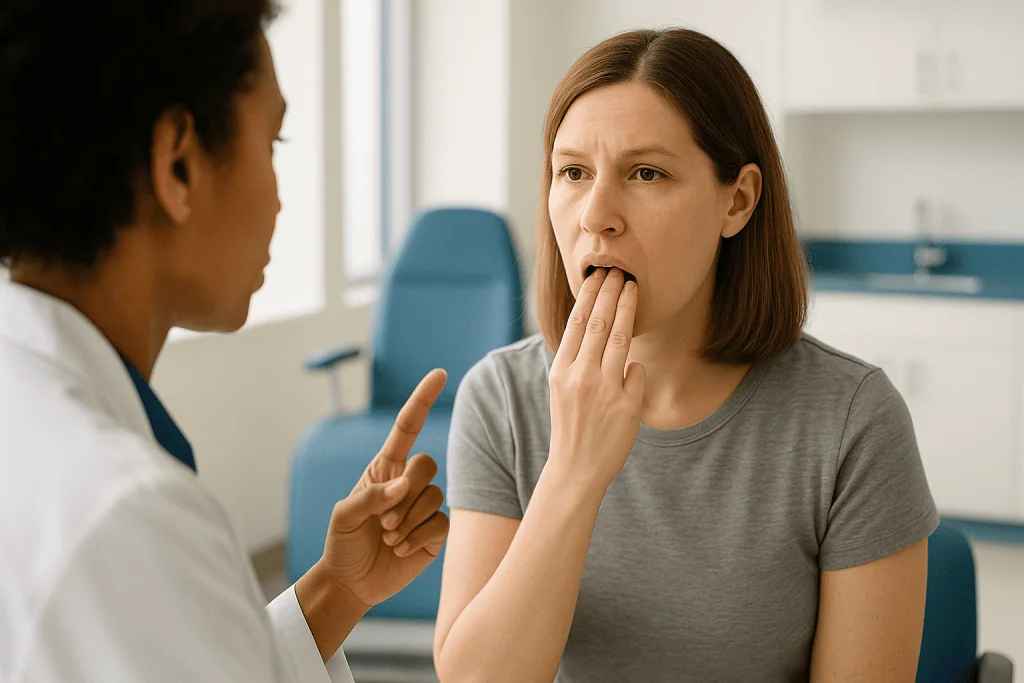
It is a screening tool, not a diagnosis. Finger width varies, jaw size varies, and an opening that looks limited on the day of a flare may be perfectly normal a week later. In a clinic, the same question is answered with a small ruler measuring the gap between the incisors in millimeters, alongside checks on side-to-side movement, joint sounds, tenderness of the chewing muscles and whether the jaw deviates to one side on opening. The NHS describes limited mouth opening and a jaw that locks as hallmark features of temporomandibular disorder, and that clinical assessment is how the feature is confirmed.
Where the test earns its keep is tracking. If you have a tendency to lock, checking your opening each morning gives an early signal that the joint is tightening before a full lock arrives. A drop from three fingers to two over a few days is worth noting, especially if it coincides with a stressful week, a cold that has you clenching, or a new dental appliance.
A few cautions. Do not force the third finger in to “pass.” Do not use the test on a jaw that is stuck open; it is irrelevant there. And do not treat a comfortable three-finger opening as proof the joint is fine if there is pain, swelling, numbness or a recent injury. Those symptoms override the measurement.
What causes pain in the TMJ, and what causes a tight jaw?
Jaw joint pain rarely has one cause. The MedlinePlus overview of temporomandibular joint dysfunction lists several that commonly overlap: muscle strain from clenching or grinding, disc displacement, arthritis within the joint, and injury. Stress sits underneath many of them, not as a vague idea but as a measurable increase in daytime clenching and nighttime grinding, called bruxism.
A tight jaw, the feeling of muscles that will not let go, is usually a muscle problem rather than a joint problem. The masseter can generate enormous force, and when it is held in low-grade contraction for hours, it develops tender knots and fatigue much like a shoulder muscle after a long day at a laptop. Many people are unaware they clench until a partner mentions the sound at night or a dentist points out worn tooth edges.
Other recognized contributors include:
- Posture that pushes the head forward, which changes the resting position of the jaw and loads the chewing muscles.
- Habits such as gum chewing, nail biting, cradling a phone with the shoulder, or playing certain wind or string instruments.
- Dental work that requires prolonged wide opening, which can strain ligaments and provoke a lock in someone whose disc was already unstable.
- Osteoarthritis or inflammatory arthritis affecting the joint surfaces, more common with age or alongside conditions such as rheumatoid arthritis.
- A direct blow, whiplash, or a fall onto the chin.
The Mayo Clinic is candid that in many individual cases the exact cause cannot be pinned down. That uncertainty is normal and does not mean the problem is imagined. It does mean that treatment usually targets the muscle tension and joint loading that keep symptoms going, rather than chasing a single culprit. Pain, tightness and locking tend to improve together once the overall load on the joint comes down.
Jaw stuck open: what jaw dislocation reduction involves
When the mouth is locked open, the fix is a procedure called reduction, which simply means guiding the dislocated bone back into its socket. It is usually done in an emergency department, an urgent care setting, or a dental or oral surgery office by a clinician trained in the maneuver.
In the classic technique, the clinician wraps their thumbs in gauze, places them on the lower back teeth, grips the outside of the jaw with the fingers, and applies steady pressure downward and then backward. The downward push stretches the clenched muscles enough for the jawbone to clear the bony bump it slipped over; the backward guidance returns it to the socket. People often describe a dull pressure followed by sudden, almost anticlimactic relief as the teeth meet again.
Muscle spasm is the main obstacle. If the jaw has been open for a long time or the muscles are very tight, the clinician may use a local anesthetic injection into the joint, or a medicine from the sedative or muscle-relaxant class, to reduce resistance before trying again. Which option is used, and whether it is needed at all, is a decision for the treating clinician based on how long the jaw has been dislocated and the person’s overall health.
Before reduction, an x-ray is sometimes taken to rule out a fracture, particularly if there was a blow to the face. MedlinePlus notes that a dislocated jaw and a broken jaw can look similar from the outside, and the treatment differs.
Afterward, the joint is vulnerable. MedlinePlus advises against opening the mouth wide for at least six weeks following a dislocation, which in practice means supporting the chin during yawns, choosing soft foods cut small, and avoiding anything that stretches the mouth. Some people are given a soft bandage or strap to limit opening for a short period.
Who usually manages a lock at home, and who is asked to be seen first
The home-first group is large. The NHS states that temporomandibular disorder symptoms get better on their own in most cases, and self-care is the first line in its guidance. If your lock is a closed lock, it is not your first episode or it closely resembles previous clicking, there has been no injury, and pain is manageable, the measures in this article are the standard starting point. A dentist or physician appointment within the coming week or two is sensible if the restriction persists, but an emergency visit is not usually necessary.
The be-seen-first group is smaller but important:
- Anyone whose jaw is stuck open and cannot close it. This is not a wait-and-see situation.
- Anyone whose lock followed a blow, fall or road collision, because fracture must be excluded.
- People with severe pain, visible swelling, numbness of the chin or lip, or a change in how the teeth meet, any of which can signal a structural injury.
- Anyone with fever, neck stiffness, a recent wound, or muscle rigidity elsewhere, because tetanus, though rare in countries with routine vaccination, is a medical emergency.
- People whose closed lock has not improved at all after several days of gentle care, or who cannot eat or drink adequately.
A third group is often asked to wait, in the sense of holding off on invasive options. Joint surgery, joint flushing and injections are generally reserved for people whose symptoms have persisted despite conservative treatment and whose imaging confirms a mechanical problem. The Mayo Clinic describes surgery for jaw joint disorders as a last resort after other approaches have failed. Someone three days into a first lock is not a candidate, and most will never need to be.
Closed lock, open lock, or tetanus: a side-by-side comparison
When the mouth will not move, three very different conditions can produce that one sensation. The table below sets out the features clinicians use to tell them apart and the action that fits each. It is a guide for deciding how quickly to seek help, not a substitute for examination.
| Feature | Closed lock (disc displacement) | Open lock (dislocation) | Tetanus (lockjaw) |
|---|---|---|---|
| Mouth position | Opens partway, teeth can meet | Stuck wide open, teeth cannot meet | Clenched shut by muscle spasm |
| Typical trigger | Yawn, chewing, waking up, dental visit | Very wide yawn, vomiting, laughing, intubation, blow | Wound days to weeks earlier, often in someone not up to date on vaccination |
| Pain | Variable, often an ache in front of the ear | Aching, with muscle cramping | Painful spasms, spreading to neck and trunk |
| Speech and swallowing | Mostly normal | Slurred, drooling | Difficult, may be dangerous |
| Other signs | History of clicking; click may have stopped | Hollow felt in front of the ear; chin looks pushed forward | Fever, sweating, stiffness, irritability |
| First step | Relax, warmth, gentle movement, soft diet | Same-day reduction by a clinician | Emergency department immediately |
| Usual setting | Home, then dentist or doctor if persistent | Emergency or urgent care, oral surgery | Hospital |
Two patterns deserve emphasis. A jaw that is stuck open is almost never a closed lock misread; the open mouth is unmistakable. And a jaw that is clenched shut with no ability to open at all, rather than opening partway, should raise the question of tetanus or another neurological cause rather than a disc problem, especially with a wound history. The CDC and MedlinePlus both list jaw stiffness among the earliest signs of tetanus.
What the following days and weeks usually look like
A closed lock rarely resolves in a single dramatic moment, though some do. More often the opening creeps back over days. The jaw feels stiff first thing in the morning, loosens with warmth and a few minutes of talking, and tightens again with fatigue or stress by evening. That daily rhythm is typical and not a sign of failure.
Within the first week, most people can expect the ache to settle and the opening to improve noticeably if they keep the load off the joint: soft food, no gum, no wide yawning, hand under the chin when a yawn cannot be stopped. Warmth two or three times a day, followed by gentle movement, remains the backbone.
The NHS advises that temporomandibular disorder symptoms usually improve within a few months with self-care, and that a dentist or doctor should be consulted if they are not improving or are affecting daily life. That is a reasonable frame for a lock: measurable improvement over the first couple of weeks, substantial recovery over a few months, with a professional check if the trajectory is flat.
Some closed locks do not fully reduce. The disc stays forward, but the ligaments and tissues behind it gradually adapt, allowing the jaw to open further over time even though the disc has not returned. Clinicians sometimes describe this as the joint “settling.” It is one reason surgery is used so sparingly; many joints find a functional new normal on their own.
After a dislocation that has been reduced, the timeline is different and more cautious. The joint ligaments have been stretched, and the risk of a repeat dislocation is highest in the early weeks. MedlinePlus advises avoiding wide mouth opening for at least six weeks. Soft foods, supported yawns and avoiding dental procedures that require prolonged opening, unless the treating team says otherwise, are standard precautions during that window.
Treatments beyond self-care, and what the evidence actually shows
When a lock keeps returning or self-care has not shifted it, the usual next layer is conservative and reversible.
Oral appliances. A custom splint worn over the teeth, often at night, spreads clenching forces and can reduce muscle strain. The Mayo Clinic lists these among common treatments while noting that the precise reason they help is not fully understood. The evidence supports them as a reasonable option for pain and muscle symptoms; it does not show they reposition a displaced disc permanently.
Physical therapy. Guided jaw exercises, manual therapy and posture work aim to restore smooth movement and reduce guarding. A therapist can also teach a controlled stretching program that is safer than improvised prying.
Medicines, by class only. Anti-inflammatory pain relievers reduce joint inflammation and ache. Muscle relaxants, used short term, target the spasm component. Certain antidepressants are sometimes prescribed for chronic pain and nighttime clenching through effects on pain pathways and sleep rather than mood. Whether any of these is appropriate, and for how long, belongs to the prescribing clinician, who weighs the lock against your other conditions and medicines.
Procedures. Arthrocentesis, a plain-language name for flushing the joint with sterile fluid through fine needles, can free a stuck disc and wash out inflammatory debris. Corticosteroid injections into the joint are used selectively. Botulinum toxin injections into the chewing muscles are offered in some settings, though the Mayo Clinic describes the evidence for this use as still uncertain. Arthroscopy and open surgery exist for structural problems that have not responded to anything else, and carry real risks of joint stiffness and nerve irritation that the surgical team will discuss.
The honest summary: most of the benefit for most people comes from the unglamorous end of this list.
What people often get wrong about a locked jaw
“If I push hard enough it will pop back.” For a closed lock, force usually makes the protective muscle guarding worse. For an open lock, untrained force can bruise the joint or, in rare cases, chip bone. The successful reduction maneuver works because of direction and steadiness, not strength.
“The click stopped, so the joint is healing.” Often the opposite. A click means the jaw is still getting back onto the disc. When the disc moves too far forward to catch, the click disappears and the lock begins. Silence after years of clicking deserves attention if opening has reduced.
“Lockjaw means tetanus.” Historically yes, and the term still appears on vaccine information. In everyday use, people now say lockjaw for any stuck jaw, which causes confusion in both directions: unnecessary alarm over a disc problem, and occasionally a dangerously delayed response to genuine tetanus. The distinguishing features are in the comparison table above.
“I need a scan right away.” The NHS and Mayo Clinic both describe diagnosis as primarily clinical. Imaging is reserved for suspected fracture, a joint that is not improving, or planning a procedure. A first closed lock without injury does not usually require it.
“Surgery will fix it for good.” Surgery is a last resort with its own complications, and outcomes vary. Many people who are offered conservative care first never reach that conversation.
“Chewing gum will exercise the joint back to health.” Gum loads the joint continuously and is on most guideline lists of things to avoid during a flare.
“Stress is just an excuse.” Clenching is a measurable behavior with measurable consequences on muscle tension and joint loading. Addressing it is treatment, not reassurance.
TMJ jaw locking: what to do when it keeps happening
A jaw that locks repeatedly is sending a message about load. The joint and its disc are being asked to do more than they can tolerate, usually from clenching, grinding, habit or posture, and sometimes from ligaments that have become lax after a dislocation.
Start with the pattern. Keep a short note for two weeks: when the lock happened, what you were doing, how you slept, whether you noticed clenching. Many people discover that locks cluster after poor sleep, during deadline weeks, or on mornings after alcohol, all of which increase nighttime grinding.
Then reduce the load where it is highest. The NHS self-care list is a good template: soft foods during flares, no gum, small bites, no biting nails or pens, no resting the chin on a hand, and a conscious “lips together, teeth apart” resting position during the day. A phone reminder every hour to check whether the teeth are touching catches daytime clenching that most people never notice.
Protect the yawn. A hand under the chin during every yawn limits the opening without stopping the reflex. People prone to dislocation are often taught this as a lifelong habit.
Address sleep and stress directly. Relaxation techniques, regular sleep timing and, where a clinician agrees, a night splint all reduce the hours the muscles spend clamped.
Ask for assessment. A dentist or physician can confirm whether the recurring lock is a disc problem, a muscle problem or a loose joint after dislocation, because each points to a different plan. Recurrent dislocation in particular may lead to a conversation about procedures that tighten or alter the joint, which is a specialist decision made on imaging and history, never from an article.
Finally, notice what is not on the list: forcing the jaw, chewing through pain, or ignoring a lock because it has always resolved before.
Questions to ask your care team
A short appointment goes further with a prepared list. These questions are phrased so the answers will be specific to you rather than general.
- Is this a closed lock from the disc, a muscle problem, or a joint that is dislocating, and how did you tell the difference?
- Do I need any imaging, and if not, what would change that?
- Which of my habits are most likely loading the joint, and what is the single most useful one to change first?
- How should I handle yawning, dental cleanings and long appointments while this is settling?
- Is a splint appropriate for me, and what should it feel like if it is working?
- Are there jaw exercises I should do, and are there any I should avoid?
- If you are suggesting a medicine, what is it for, how long would I typically use it, and what should make me stop and call?
- What is a realistic timeline for improvement in my case, and at what point should I come back if things are flat?
- If this is a dislocation, what is my risk of it happening again, and is there a technique I should learn for an early recurrence?
- Which signs would mean I should seek urgent care rather than wait for the next appointment?
- Who coordinates my care if more than one specialty is involved, for example a dentist, a physical therapist and a physician?
Write the answers down or ask a companion to. Jaw problems are easier to manage when the plan is clear and the thresholds for escalation are agreed in advance rather than guessed at in the middle of the night. If a procedure is proposed, it is reasonable to ask what the alternatives are, what the common complications look like, and what happens if you decide to wait. The decision rests with you and the treating team together.
When to call your doctor
Most closed locks can be managed at home for a few days before a routine appointment. Some situations should not wait. Seek same-day or emergency care if any of the following apply:
- The jaw is stuck open and cannot be closed.
- The lock followed a blow to the face, a fall, or a vehicle collision, or there is visible deformity, bruising or a change in how the teeth meet.
- There is numbness or tingling of the chin, lower lip or cheek, which can indicate nerve injury.
- You have fever, a stiff neck, muscle spasms elsewhere, or a recent wound, especially if tetanus vaccination is not up to date.
- You cannot swallow saliva, are drooling heavily, or have any difficulty breathing.
- Pain is severe and not eased by rest, warmth and the measures described here.
- There is rapidly increasing swelling in front of the ear or along the jaw, or the skin is hot and red, which may suggest infection.
Arrange a routine appointment with a dentist or doctor, rather than emergency care, if:
- A closed lock has shown no improvement after several days of self-care.
- Locking is happening repeatedly, even if each episode resolves.
- You are struggling to eat enough or to maintain fluid intake.
- Jaw pain is disturbing sleep or affecting work and daily life.
- A long-standing click has recently stopped and opening has reduced.
When in doubt, call. A clinician would rather hear about a jaw that turned out to need reassurance than miss a fracture or a dislocation that has been stuck for a day. Whatever the outcome, decisions about imaging, medicines, appliances and procedures sit with the treating team, who can see what no article can: your joint, your history and the way your jaw actually moves.
Frequently asked questions
What should I do first when my jaw locks and will not open?
Stop trying to force it. Let the jaw hang with the tongue resting on the palate, breathe slowly, and hold a warm, damp towel against the cheek in front of the ear for ten to fifteen minutes. Then try small side-to-side and forward movements without opening wider. Eat soft food cut small for the rest of the day and keep a hand under your chin if you yawn.
My jaw is stuck open and will not close. Is this an emergency?
It needs same-day care, usually in an emergency department, urgent care, or an oral surgery office. A jaw stuck open is almost always a dislocation, where the jawbone has slipped forward past its socket and muscle spasm holds it there. A clinician performs a reduction maneuver, sometimes with medicine to relax the muscles. Support the jaw gently and keep a cloth for saliva while you travel.
What is the 3 finger test for TMJ?
It is a quick screening measure of mouth opening. Stack the index, middle and ring fingers vertically and see whether they fit between the upper and lower front teeth. Most adults with normal joint movement can fit three. Fitting only one or two suggests restricted opening. Clinicians confirm this with a ruler measurement and a full examination; the finger test alone does not diagnose anything.
What is jaw dislocation reduction?
Reduction is the procedure of guiding a dislocated jawbone back into its socket. The clinician places protected thumbs on the lower back teeth, grips the jaw, and presses steadily down and then back so the bone clears the bony ridge it slipped over. Local anesthetic or a muscle-relaxing medicine may be used if spasm is strong. An x-ray sometimes precedes it to exclude a fracture.
What causes pain in the TMJ?
The most common causes overlap: strained chewing muscles from clenching or grinding, a cartilage disc that has slipped out of position, arthritis within the joint, and injury. Stress, posture and habits like gum chewing add load. The Mayo Clinic notes that in many individual cases a single cause cannot be identified, which is why treatment focuses on reducing muscle tension and joint loading rather than chasing one culprit.
What are the causes of a tight jaw?
A tight jaw is usually muscle, not joint. The masseter and temporalis muscles held in low-grade contraction for hours, typically from daytime clenching or nighttime grinding, develop fatigue and tender knots. Contributing factors include stress, poor sleep, forward head posture, nail biting, resting the chin on a hand, and recent dental work. Arthritis or a displaced disc can add stiffness on top of the muscle component.
What are closed lock TMJ symptoms?
The typical picture is a mouth that opens only partway, often with the jaw drifting toward the affected side, an ache in front of the ear, and difficulty taking large bites. Many people recall years of clicking that recently stopped. Speech and swallowing are usually normal. Severe pain, numbness, swelling, or a lock after injury are not typical closed lock features and should prompt prompt medical assessment.
How long does a locked jaw usually last?
There is no fixed duration. Some closed locks release within minutes or hours; others ease gradually over days to weeks as muscles relax and tissues adapt. The NHS states that temporomandibular disorder symptoms usually improve within a few months with self-care. If a closed lock shows no improvement after several days, or keeps returning, a dentist or doctor should assess it rather than waiting further.
Is a locked jaw the same as lockjaw from tetanus?
No. Tetanus lockjaw is muscle spasm that clenches the jaw shut, caused by a bacterial toxin after a wound, and it spreads to the neck and body, often with fever. A TMJ closed lock is a mechanical catch in the joint that allows partial opening and no other systemic signs. Tetanus is rare where vaccination is routine but is a medical emergency when it occurs.
Can I eat and drink normally while my jaw is locked?
Drinking is usually fine with a closed lock; use a straw if opening is limited. For eating, choose soft foods cut into small pieces, such as yogurt, eggs, well-cooked vegetables and soups, and avoid anything that requires a wide bite or prolonged chewing, including gum. If you cannot take in enough fluid or food, or the jaw is stuck open, seek care the same day.
References
- NHS: Temporomandibular disorder (TMD)
- MedlinePlus: Temporomandibular Joint Dysfunction
- MedlinePlus Medical Encyclopedia: Broken or dislocated jaw
- NIH National Institute of Dental and Craniofacial Research: TMD (Temporomandibular Disorders)
This article is for general information only and is not a substitute for professional medical advice. Please consult a qualified doctor about your individual situation.
Add us as a Preferred Source to see more of our trusted health content across Google Search, AI Overviews and Discover.

More from the Blog

When Bad Breath Needs a Dentist: Halitosis That Outlasts Brushing and Mouthwash
Bad breath that persists for more than a couple of weeks despite brushing twice a day, cleaning between teeth and cleaning the tongue is…
After Laser Assisted Dental Procedures: Short-Lived Sensitivity vs Swelling That Needs a Call
Mild gum tenderness, tooth sensitivity to cold, slight seepage of blood-tinged saliva and a little puffiness are common in the first two or three…

When a Night Guard Is Not Helping Bruxism: Adjustment, Replacement and Next Steps
A night guard that is not working usually means one of three things: it fits poorly or has worn out, it is the wrong…

What an Oral Health Therapy Visit Involves: Cleaning, Gum Checks and a Personal Plan
An oral health therapy appointment is a preventive dental visit led by a hygienist or oral health therapist. It usually includes a review of…

Root Canal vs Extraction and Implant: What Keeping the Natural Tooth Changes Long Term
A root canal removes infected pulp and keeps your natural tooth, root and surrounding ligament in place; extraction and implant replace the whole tooth…
What Periodontal Measurements Reveal About Gum Recession: Pocket Depths and Bone Support
Periodontal measurements translate gum recession into numbers a dental team can track. A probe measures pocket depth, the gap between gum and tooth, and…