

Hair and Scalp Care With Alopecia Areata: Sun Protection, Gentle Styling and What to Avoid
Key Takeaways
- In alopecia areata the follicle is paused by immune cells, not destroyed, which is why patches can regrow and why surface products cannot switch the process on or off.
- Scalp hair grows about half an inch a month, so even a fully recovered follicle needs months before coverage is visible (Cleveland Clinic).
- Bare scalp has no tan and no hair shade; the CDC advises a wide-brimmed hat plus broad-spectrum SPF 15 or higher, reapplied at least every two hours outdoors.
- Tight ponytails, braids and glued extensions can add traction alopecia on top of alopecia areata, so loose styles and soft ties protect the hair you keep.
- Janus kinase inhibitors are the newest systemic treatments for severe alopecia areata; they control immune signaling while taken and require monitoring, with regrowth that can fade on stopping (NIH NIAMS).
- Redness, scale, pus or pain in a patch are not features of alopecia areata and should prompt a prompt dermatology review to rule out scarring or infectious causes.
Hair care with alopecia areata is about protecting the scalp and the hair you still have, not forcing patches to regrow. Wash gently with a mild shampoo, skip tight styles, high heat and harsh chemicals, and shield bare areas from the sun with a hat or broad-spectrum sunscreen. No shampoo or routine changes the underlying immune process; regrowth treatments, when used, are chosen with a dermatologist.
The patch is about the size of a quarter, and she found it by accident, running her fingers through wet hair after a shower. Smooth skin where there should be roots. By the time the hairdryer is unplugged, she has already typed “hair care alopecia areata” into her phone and landed on a page selling a miracle oil.
That moment, the private discovery followed by the public scramble for answers, is where most people meet this condition. Alopecia areata is an autoimmune form of hair loss in which the body’s own defenses interrupt hair growth at the follicle. It is common, it is unpredictable, and the internet is full of confident advice about it that the evidence does not support.
What follows is a calmer guide: how to wash, dry, style and protect a scalp that is losing hair in patches, what genuinely helps, what can cause harm, and where the real decisions belong, which is with you and the clinician who examines your scalp.
What is actually happening in the scalp with alopecia areata?
Picture a hair follicle as a tiny factory that runs on a schedule. In its growing phase, called anagen, it builds a hair shaft for roughly two to seven years before resting and shedding, which is why a healthy scalp loses some strands every day without going bald (Cleveland Clinic). In alopecia areata, that schedule is interrupted from the outside.
Normally the base of a growing follicle enjoys a kind of immune privilege: the body’s T cells leave it alone. In alopecia areata that privilege collapses. T cells gather around the follicle, signaling molecules of the interleukin and interferon families accumulate, and the follicle is pushed out of anagen early. The hair breaks off or falls out, usually leaving a round or oval patch of smooth skin (NIH NIAMS).
The detail that matters most for everything else in this article is this: the follicle is not destroyed. The factory is paused, not demolished. That is why hair can and often does regrow, and why the condition is classed as non-scarring. It is also why no shampoo, oil or brushing technique can start or stop it; the switch sits in the immune system, not on the surface.
Some other features follow from the same mechanism. Short, tapered hairs that look like exclamation marks sometimes sit at a patch edge, a sign the process is active. Regrowing hair may come in white or fine at first, because pigment cells recover more slowly than the follicle itself. Nails can show pitting or ridging in a proportion of people, since the same immune activity can affect nail growth (Mayo Clinic). None of these are things you did; they are what the disease looks like.
Hair care for alopecia areata: washing, drying and brushing without harm
Good hair care for alopecia areata is unglamorous. It does not grow hair back. Its job is narrower and still worth doing: avoid adding breakage, irritation or traction on top of an immune process you cannot control.

Washing frequency can stay whatever it was. A common fear is that shampooing “washes hair out,” but the strands that leave in the shower were already released by the follicle; the water simply moved them. Use lukewarm rather than hot water, a mild fragrance-light shampoo, and fingertip pressure rather than nails. Scrubbing a bare patch does not stimulate anything and can leave it sore.
Conditioner belongs on the lengths, not massaged into bald skin, where it can leave residue and itch. Rinse thoroughly. If the exposed scalp feels dry or tight, a plain fragrance-free moisturizer is reasonable; it will not change regrowth, but comfort counts.
Drying is where damage usually sneaks in. Wet hair stretches and snaps more easily, so pat with a soft towel instead of rubbing, let hair air-dry when you can, and if you use a dryer keep it on a low setting held away from the scalp. Patches have no hair to insulate them and can burn surprisingly fast.
Brushing should be gentle, from the ends upward, with a wide-tooth comb or soft bristles. Tugging through knots pulls on neighboring follicles that are already under stress. Detangle on damp, conditioned hair rather than dry.
Think of the routine as maintenance rather than treatment. The NHS and Mayo Clinic both note that hair in alopecia areata frequently regrows on its own, sometimes within months to a year, and that it may also fall out again. A kind routine simply means the hair you keep looks and feels its best while the immune system does what it will.
Sun protection for bald patches on the scalp
Hair is a built-in sunshade. Remove it from a patch and that circle of skin is suddenly as exposed as the back of your hand, except it has never seen the sun before and has no tan or thickening to show for it. Scalp sunburn is painful, and repeated ultraviolet exposure raises long-term skin cancer risk on any skin, including the scalp (CDC).
The practical hierarchy is the same one public health agencies use for everyone. Shade and clothing first; sunscreen for what is left uncovered. The CDC advises seeking shade, wearing a wide-brimmed hat, and using a broad-spectrum sunscreen of SPF 15 or higher, reapplied at least every two hours and after swimming or sweating. Ultraviolet exposure is highest between about 10 a.m. and 4 p.m. in the continental United States.
For patchy loss where hair still covers most of the head, a hat works better than cream. Sunscreen on a small patch surrounded by hair tends to migrate into the surrounding strands and feel greasy; if you do use it, a stick or clear gel formula applied with a fingertip to the bare skin only is easier to manage. For larger or total loss, apply sunscreen to the whole scalp the way you would to your face, and remember ears and the back of the neck.
Some people find sunscreen stings on newly bare skin. Mineral formulas with zinc oxide or titanium dioxide are often better tolerated, though this is individual, and no product has evidence specific to alopecia areata. A ring of pale, soft regrowth is also fragile and burns easily; keep protecting it.
Wigs, scarves and caps double as sun protection, with one caveat: thin or loosely woven fabric lets ultraviolet light through. A tightly woven dark cap blocks far more than a sheer scarf, so on long outdoor days layer sunscreen underneath.
How to style hair with alopecia areata
Styling is the part people search for most and the part clinicians discuss least. There is no medical reason to hide patches, and there is no medical reason not to. The scalp does not care whether it is covered. What matters is that whatever you choose does not pull, overheat or chafe.

Where remaining hair is long enough, placement does most of the work. A side part moved an inch or two can lay hair across a patch; loose layers and a bit of volume at the roots disguise thinning at the crown. Texturizing spray or a light mousse adds grip so the hair stays where it is placed. Avoid stiff gels on the patch itself, which can flake and itch.
Camouflage products exist for in-between stages. Scalp-colored tinted powders and keratin fibers that cling to existing hairs can reduce the contrast between skin and hair. They wash out, carry no evidence of changing regrowth, and should be kept off any area that is irritated or being treated with a prescribed topical, unless your clinician says otherwise.
Shorter cuts often look fuller than long hair stretched thin across bare areas, and they shed weight that would otherwise tug on follicles. Some people with extensive loss shave what remains for an even look; the hair underneath is unaffected either way.
Head coverings deserve a comfort check. Wig caps and scarves should sit without pressure points, be washed regularly, and be removed at night to let the scalp breathe. Silicone-lined wigs grip well on smooth skin but can trap sweat, so a breathable liner helps in warm weather. Clip-in extensions and glued pieces concentrate tension on small groups of hairs and are generally best avoided during an active phase.
Whatever you pick, pick it for you. A dermatologist can advise on what is safe for the scalp; what looks right is your call.
What to avoid: heat, traction, bleach and the products that promise too much
If the follicle is paused rather than broken, the aim is simple: do nothing that breaks it. A short list of habits does most of the damage.
- High heat. Flat irons and curling wands operate well above the temperature at which the protein in hair weakens. Weakened hair snaps, which thins the strands you still have. Bare patches can also burn on contact.
- Tight traction. Ponytails, braids, buns and extensions that pull at the roots can cause a separate problem called traction alopecia, a hair loss from mechanical pulling (Cleveland Clinic). Stacking it on top of alopecia areata is avoidable. Loose styles and soft fabric ties are kinder.
- Harsh chemical services. Bleach, relaxers and perms change the hair shaft and can irritate the scalp. They do not trigger alopecia areata, but an inflamed scalp is uncomfortable and can complicate topical treatment. Many clinicians suggest pausing these during active loss and discussing timing with your dermatologist.
- Scratching and picking. Patches can itch or tingle. Nails break skin, and broken skin can get infected.
Then there are the products. Oils, serums, lasers sold for home use, and supplements promising to “stop alopecia spreading naturally” fill the search results. The honest summary is that none has good evidence in alopecia areata. Supplements are only worth considering if a blood test shows a deficiency, and high-dose vitamin or biotin use can interfere with some laboratory results (NIH Office of Dietary Supplements). Essential oils applied to the scalp can cause allergic contact dermatitis, which is one more inflamed patch you did not need.
A fair test for any product is whether its claim appears in guidance from a dermatology body or in a controlled trial. If the only support is a before-and-after photo, treat the claim as marketing, not medicine.
Alopecia areata scalp care during treatment
Once a dermatologist is involved, hair care has a second job: not interfering with whatever has been prescribed. The common treatments each come with a small set of scalp-care implications.
Topical corticosteroids, anti-inflammatory creams, lotions or foams applied to the patch, work by damping the immune activity around the follicle. They are typically applied to clean, dry skin, so washing before rather than after makes sense, and camouflage powders or oils on the same area can block absorption. Prolonged use can thin the skin or cause small visible blood vessels, so follow the schedule your prescriber sets and report redness or soreness.
Intralesional corticosteroid injections, in which a clinician injects a small amount of steroid directly into the patch, are a frequent option for a few patches in adults (Mayo Clinic). The scalp may be tender for a day or two; gentle washing is fine, but avoid pressing, scrubbing or tight coverings over the injected area until it settles. Small dents in the skin can occur and usually fill in over time, something to mention at review if they persist.
Topical minoxidil, a solution or foam that prolongs the growth phase, is sometimes used alongside other treatment. It can cause scalp dryness or flaking; a mild shampoo and avoiding other leave-on products on the same area reduce that. It also needs to stay on for hours, which shapes when you wash.
Contact immunotherapy, used in some specialist settings for extensive loss, deliberately creates a mild allergic rash on the scalp to redirect the immune response. Sun exposure and washing timing around applications are set by the clinic protocol; ask before changing either.
For any of these, the rules are consistent: keep the area clean and uncovered by cosmetics when the treatment goes on, protect it from sun, and never adjust frequency or stop on your own. If a treatment is stinging, flaking or not fitting your life, that is a conversation, not a reason to quietly abandon it.
What are the newest treatments for alopecia areata?
For decades the toolkit for extensive alopecia areata was limited. That changed with a class of oral medicines called Janus kinase inhibitors, usually shortened to JAK inhibitors. A Janus kinase is an enzyme inside immune cells that passes along the signals, including interferon and interleukin messages, that drive the attack on the follicle. Block the enzyme and the signal weakens, which in trials allowed hair to regrow in a meaningful proportion of people with severe disease (NIH NIAMS).
Several JAK inhibitors, including baricitinib and ritlecitinib, have regulatory approval in the United States for severe alopecia areata, and more are under study. They are not creams; they act throughout the body, which is why they are reserved for extensive loss and prescribed only after a discussion of risks that include infections, changes in blood counts and lipids, and, for some agents, cardiovascular and clotting warnings carried over from use in other conditions. Monitoring blood tests are usual.
Two honest caveats belong next to the enthusiasm. First, regrowth is not universal, and it takes time: trial endpoints were typically measured at several months, and benefit can fade if the medicine is stopped. Second, approval and eligibility are not the same thing. Age, disease pattern, other health conditions and insurance criteria all shape whether a dermatologist considers one appropriate, and that decision sits with the prescriber.
Older options remain in use and are still first-line for limited disease: topical and injected corticosteroids, topical minoxidil, and in specialist centers contact immunotherapy. Short courses of oral corticosteroids are sometimes used for rapidly spreading loss, weighed against their well-known side effects.
What has not arrived, despite headlines, is a treatment that fixes the immune fault permanently. Current medicines control activity while they are taken. Hair care, sun protection and styling therefore stay relevant whether or not you are on any of them.
Who is usually offered treatment, and who is usually asked to wait?
Not everyone with a patch needs a prescription, and a good dermatologist will say so. The decision usually turns on four things: how much hair is gone, how fast it is going, how long it has been present, and how much it is affecting you.
A single small patch of recent onset is the situation most often managed with observation. Hair in alopecia areata frequently regrows without treatment, and the NHS notes that many patches recover within about a year, so watchful waiting is a legitimate choice rather than neglect. During that time, the care described in this article is the whole plan, with a review booked rather than left open-ended.
Treatment is more likely to be offered when patches are multiple or enlarging, when the loss involves eyebrows or eyelashes, when it has persisted for many months, or when the pattern is extensive: alopecia totalis, meaning loss of all scalp hair, or alopecia universalis, meaning loss of all body hair. People with a long history of relapses, onset in childhood, or nail changes tend to have a more stubborn course and may be offered treatment sooner.
Who is asked to wait, or offered gentler options first? Young children, because injected steroids are painful and systemic medicines carry more weight in a growing body. People who are pregnant or planning pregnancy, because several treatments are not studied in pregnancy. Those with infections, certain cancers, or cardiovascular risk factors, where the systemic options need extra caution. Anyone whose loss is stable and not troubling them, because treatment side effects are a poor trade for a patch you have made peace with.
None of this is a scoring system you can run on yourself. It is the shape of a conversation, and the point of listing it is so you walk in knowing which questions are on the table.
What are the 7 types of alopecia?
“Alopecia” simply means hair loss; it is a symptom word, not a single disease. The number seven comes from a popular grouping rather than a formal classification, but it captures the main patterns a clinician considers when a patch appears. Telling them apart matters because their causes, and therefore the right care, differ sharply (Mayo Clinic, NHS).
| Type | Mechanism | Typical pattern | Scarring? |
|---|---|---|---|
| Alopecia areata | Autoimmune attack on the follicle | Smooth round patches; can become total or universal | No |
| Androgenetic (pattern) alopecia | Hormone and genetic follicle miniaturization | Receding hairline or crown in men; widening part in women | No |
| Telogen effluvium | Stress, illness, childbirth or medicines push follicles into resting phase | Diffuse shedding 2–3 months after a trigger | No |
| Anagen effluvium | Toxic injury to growing follicles, classically chemotherapy | Rapid widespread loss | No |
| Traction alopecia | Chronic mechanical pulling | Thinning at hairline and temples | Can scar if prolonged |
| Tinea capitis | Fungal infection of the scalp | Scaly, broken-off patches, mainly in children | Can scar if untreated |
| Cicatricial (scarring) alopecia | Inflammation destroys the follicle (e.g., lichen planopilaris, lupus) | Shiny patches, redness, scale, pain | Yes, permanent |
The column that should draw your eye is the last one. Non-scarring types leave the follicle intact and the potential for regrowth open. Scarring types replace the follicle with fibrous tissue, and lost hair there does not return, which is why early assessment of any patch with redness, scale or pain is worth pursuing.
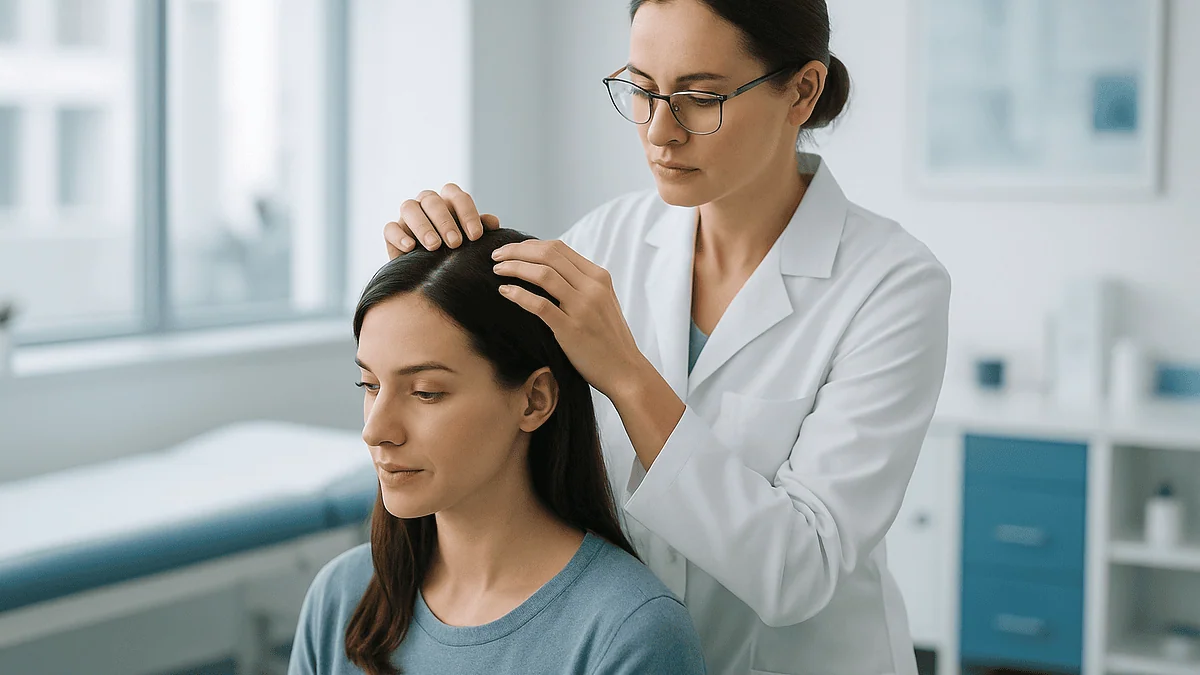
Two patterns can coexist. A person with pattern thinning can develop alopecia areata; a stressed scalp can shed diffusely while a patch is active. A dermatologist uses a handheld magnifier called a dermatoscope, the history, and occasionally a small scalp biopsy to sort them out.
What could be causing a sudden bald spot on my head as a woman?
This is one of the most searched questions about hair loss, and the word “sudden” is the useful clue. Pattern thinning in women creeps in over years and widens the part. A patch that appears over days or a few weeks points elsewhere, and alopecia areata is high on that list.
Alopecia areata affects women and men at similar rates and can begin at any age, with onset often in the teens through thirties (Cleveland Clinic). A smooth, skin-colored, non-tender oval with sharp borders and no scale is its signature. It may itch or tingle beforehand; it does not usually hurt.
Other causes a clinician will consider in a woman with a new bald spot include traction alopecia from a tightly pulled style or extensions, which favors the hairline and temples; tinea capitis, a fungal infection that produces scaling and broken hairs and is more common in children but not exclusive to them; and the scarring alopecias such as lichen planopilaris or discoid lupus, which tend to show redness, scale, bumps around follicles or pain. Trichotillomania, a hair-pulling behavior, produces irregular patches with hairs of different lengths.
Diffuse shedding is a different story. Telogen effluvium after childbirth, a febrile illness, major surgery, rapid weight loss or starting certain medicines causes handfuls of hair to fall two to three months after the event, without a defined bald spot (Cleveland Clinic). Thyroid disease and iron deficiency can thin hair diffusely and are commonly checked with blood tests.
Alopecia areata also keeps company with other autoimmune conditions. Thyroid disease, vitiligo and atopic eczema occur more often in people who have it, which is why a clinician may ask about fatigue, weight change, skin color changes or family history even when you came in about hair (NIH NIAMS).
The takeaway is not a self-diagnosis. It is that a sudden patch, particularly one with redness, scale or pain, deserves an in-person look rather than a wait-and-see.
What the following weeks and months usually look like
Alopecia areata does not run on a schedule, but it does have a recognizable rhythm, and knowing it spares some anxiety.
In the first weeks a patch may enlarge, and new patches may appear nearby; hairs at the edge sometimes come out with light traction while the process is active. This phase can last weeks to a few months. It is the window when gentle handling matters most, since neighboring follicles are the ones most likely to be pulled into the process.
Then, for many people, the edge stabilizes. Fine, often white or pale hairs begin to show in the center of the patch before the border. Because scalp hair grows roughly half an inch a month (Cleveland Clinic), visible coverage takes months even when the follicle has fully restarted. Pigment usually returns on later cycles, so early white regrowth is not a sign it has gone wrong.
The NHS and Mayo Clinic both describe spontaneous regrowth as common, with many single patches recovering within about a year, and also describe relapse as common. A patch can regrow, stay quiet for years, then reappear during an illness or a stressful period. Repeated episodes, extensive loss, nail changes and childhood onset make a longer course more likely.
If you are on treatment, expectations shift by type. Injected corticosteroids are usually reviewed after several weeks to see whether regrowth has begun. Topical treatments and minoxidil are typically judged over a few months, since nothing can outrun the growth rate of hair itself. Trials of JAK inhibitors measured outcomes at several months, and regrowth that appears can recede if the medicine is stopped (NIH NIAMS).
Plan your hair care around this reality. A style that works at month one may not at month four, and that is fine. The rhythm belongs to the follicle, not the calendar.
What people often get wrong about hair care and alopecia areata
Most of the misinformation around hair care for alopecia areata is well meant. It still sends people down expensive or harmful paths, so it is worth naming the common errors plainly.
“Washing less will save hair.” Shed hairs were already released; shampoo does not pull living hair from a healthy follicle. Leaving the scalp unwashed can let oil and product build up, which irritates bare skin.
“Oils and scalp massage regrow patches.” Massage feels pleasant and oil can soften dry skin, but neither reaches the immune cells around the follicle. No oil has controlled-trial evidence in alopecia areata. Some essential oils cause contact allergy.
“Biotin fixes it.” Biotin deficiency is rare in people eating a varied diet, and supplementing without a deficiency has no demonstrated benefit for hair; high doses can also distort thyroid and heart blood tests (NIH Office of Dietary Supplements).
“Stress caused this, so relaxing will reverse it.” Stress can precede a flare in some people, but alopecia areata is driven by genetics and immune signaling, not by a bad week. Managing stress is good for you; it is not a treatment plan.
“It will spread to my whole head.” Most people with alopecia areata have limited, patchy disease. Progression to total or universal loss happens in a minority, and clinicians can discuss individual risk factors rather than leaving you with the worst-case scenario (NIH NIAMS).
“Wearing a wig stops regrowth.” Coverings do not affect the follicle. Only excessive tension or an occlusive, sweaty fit that irritates the scalp is worth avoiding.
“If it regrew, it is gone for good.” Relapse is common, which is not a failure of care. It is the nature of the condition, and it is why a relationship with a dermatologist is more useful than a one-off visit.
Questions to ask your care team
A dermatology appointment for hair loss is often short, and patches do not look dramatic in a bright clinic room. Arriving with specific questions turns a quick look into a plan. Photographs of the scalp taken at home every few weeks, in the same light, are worth more than any description.
- Is this definitely alopecia areata, or could it be a scarring type or an infection that needs different treatment?
- How much of my scalp is affected now, and is the edge active or stable?
- Is watchful waiting reasonable for me, and if so, when should we review?
- Which treatment options fit my pattern, age and other health conditions, and what side effects should I expect from each?
- How long should I give a treatment before we judge whether it is working?
- Should I have blood tests for thyroid function, iron or other autoimmune conditions?
- Are there hair services, such as color, relaxers or extensions, that you would pause while my scalp is active?
- How should I protect bare areas from the sun, and will sunscreen interfere with a topical treatment?
- Can I use camouflage powders or fibers, and should I keep them off treated areas?
- If the patch regrows and then returns, what is the plan?
- Is there a support group or a psychologist you work with for people adjusting to hair loss?
That last question is not an afterthought. Alopecia areata carries no physical danger in itself, yet studies consistently find higher rates of anxiety and depression among people living with it (NIH NIAMS). A clinician who treats the scalp and ignores the person has done half the job. If you leave an appointment with a prescription but no sense of what to expect, it is fair to book a follow-up and ask again.
When to call your doctor
Alopecia areata itself is not a medical emergency, and most changes can wait for a routine dermatology visit. A few situations deserve a prompt call rather than another month of watching.
Seek care soon if hair loss is spreading rapidly over days or weeks, if eyebrows or eyelashes are involved, or if patches are appearing in several places at once. Fast progression is one of the factors that changes a treatment conversation, and some options are considered earlier when loss is accelerating.
Call promptly for any of the following on the scalp, because they point away from alopecia areata and toward conditions that can scar or need specific treatment:
- Redness, scaling, crusting or pus in or around a patch
- Pain, burning or marked tenderness of the scalp
- Pustules or bumps clustered around follicles
- Patches that look shiny, pale and thinned rather than smooth and skin-colored
- Swollen lymph nodes in the neck alongside scalp changes
Hair loss accompanied by fatigue, unexplained weight change, feeling unusually cold or hot, palpitations, or new white patches on the skin should prompt a general medical review, since thyroid disease and other autoimmune conditions travel with alopecia areata more often than chance would predict (NIH NIAMS).
If you are taking a prescribed treatment, contact the prescriber for fever, a persistent cough, shortness of breath, unusual bruising, severe headache, chest pain or calf swelling, as some systemic medicines used for alopecia areata carry warnings about infection and clotting. Do not stop or change the medicine on your own; the decision about how to adjust belongs to the team that prescribed it.
Finally, if the loss is affecting your mood, sleep or willingness to leave the house, say so. Distress is a legitimate reason to call, and it changes what a care team can offer.
Frequently asked questions
What is the best shampoo for alopecia areata?
No shampoo treats alopecia areata, so the right one is simply mild, fragrance-light and comfortable on bare skin. The condition is driven by immune cells around the follicle, which a wash cannot reach. Choose a gentle formula, use lukewarm water and fingertip pressure, and avoid medicated or exfoliating shampoos on patches unless a dermatologist recommends one for a separate scalp problem.
Can I dye or bleach my hair if I have alopecia areata?
Color does not cause or worsen alopecia areata, but bleach and relaxers can irritate exposed scalp and weaken remaining hair. Many clinicians suggest pausing harsh chemical services while patches are actively spreading or being treated topically, then discussing timing at review. Gentler semi-permanent color applied away from bare skin is usually less of a concern; ask your dermatologist about your specific plan.
How should I wear my hair with alopecia areata?
However you like, as long as nothing pulls, overheats or chafes. Moving a part, adding root volume or choosing a shorter cut can lay hair across patches. Tinted scalp powders and hair fibers reduce contrast temporarily. Wigs, scarves and caps are fine and double as sun protection. Avoid tight braids, glued pieces and high-heat tools, which strain the follicles still growing.
Does sun protection matter for bald patches on the scalp?
Yes. A patch has no hair to shade it and no prior sun exposure to toughen it, so it burns easily and accumulates ultraviolet damage over time. The CDC recommends shade, a wide-brimmed hat and broad-spectrum sunscreen of SPF 15 or higher, reapplied at least every two hours. Fine white regrowth is especially fragile and should be protected too.
What are the newest treatments for alopecia areata?
Oral Janus kinase inhibitors are the most significant recent addition. They block an enzyme inside immune cells that relays the signals attacking the follicle, and in trials allowed regrowth in a meaningful proportion of people with severe disease. They are systemic medicines with infection, blood count and clotting warnings, require monitoring, and are prescribed only after a specialist assessment weighs benefit against risk.
What are the 7 types of alopecia?
A common grouping lists alopecia areata, androgenetic or pattern hair loss, telogen effluvium, anagen effluvium, traction alopecia, tinea capitis and cicatricial or scarring alopecia. The first six are non-scarring, meaning follicles survive and regrowth remains possible; scarring types destroy the follicle permanently. A dermatologist distinguishes them by pattern, scalp examination with a dermatoscope and sometimes a small biopsy.
What could cause a sudden bald spot on my head as a woman?
A sudden smooth, round, painless patch is most often alopecia areata, which affects women and men equally. Other causes include traction from tight styles, fungal infection, hair-pulling and scarring conditions such as lichen planopilaris, which tend to show redness, scale or pain. Diffuse shedding after illness or childbirth is a different pattern. Any new patch deserves an in-person examination rather than self-diagnosis.
Can stress or diet stop alopecia areata from spreading naturally?
There is no diet, supplement or relaxation technique shown to halt alopecia areata. Stress may precede flares in some people, and good sleep and nutrition support overall health, but the process is driven by genetics and immune signaling. Supplements are worth considering only when a blood test shows a deficiency; high-dose biotin can distort thyroid and heart laboratory results.
Will the hair that grows back be white or a different texture?
Often, at first. Early regrowth in alopecia areata is frequently fine and white or pale because the follicle restarts before pigment cells fully recover. Color and normal texture usually return over later growth cycles. Because scalp hair grows about half an inch a month, a visibly covered patch takes months even when the follicle is working well.
How do I care for my scalp during steroid injections or topical treatment?
Apply topicals to clean, dry skin and keep powders, oils and camouflage products off the treated area so they do not block absorption. After injections, wash gently and avoid pressure, scrubbing or tight coverings over the site for a day or two. Report thinning skin, persistent dents, stinging or redness to the prescriber, and never change the schedule without discussing it first.
References
- Alopecia Areata: Overview, Symptoms, Causes and Treatment (NIH NIAMS)
- Hair loss (NHS)
- Alopecia Areata (Cleveland Clinic)
- Sun Safety (CDC)
This article is for general information only and is not a substitute for professional medical advice. Please consult a qualified doctor about your individual situation.

More from the Blog

When Does Cellulitis Need Hospital Care? How Doctors Decide Between Tablets and IV Antibiotics
Most cellulitis is treated at home with oral antibiotics, usually for about a week. Doctors move to hospital care and intravenous antibiotics when the…

Dandruff Myths Corrected: Hygiene, Dryness and Why Washing Less Often Rarely Helps
Dandruff is not caused by poor hygiene or a dry scalp. It is a mild form of seborrheic dermatitis, driven by scalp oil, a…

Vitiligo Treatment After You Fly Home: Planning Phototherapy and Follow-Up Across Borders
Vitiligo treatment usually continues for months, so anyone who starts phototherapy or topical treatment while away from home needs a written plan before flying.…

What Happens During Molluscum Lesion Removal: Numbing, the Procedure and Aftercare
A molluscum removal procedure is a short outpatient visit in which a clinician either scrapes the bumps off with a small spoon-shaped tool (curettage),…

How Is Chronic Urticaria Treated When Antihistamines Are Not Enough? The Next Steps Explained
When antihistamines are not enough for chronic urticaria, international guidelines describe a stepwise pathway: the prescriber first reviews the antihistamine choice and timing, then…
Before Your First Acne Appointment: Products to Pause and What Your Dermatologist Will Ask
Before a first acne appointment, most dermatologists prefer to see your skin as it usually looks, so avoid starting new products, skip harsh scrubs…