

Before Your First Acne Appointment: Products to Pause and What Your Dermatologist Will Ask
Key Takeaways
- No guideline requires stopping products before an acne consultation; the goal is to avoid adding new irritants so the clinician sees your everyday skin.
- Non-prescription retinol, adapalene, benzoyl peroxide and salicylic acid can usually stay in use; bring the labels so the clinician knows what your skin has already tolerated.
- Never stop a prescribed medicine, including hormonal contraception, before the visit, because several acne treatments require pregnancy prevention and interrupting existing therapy resets the clock.
- The NHS reports that about 95 percent of people aged 11 to 30 have some acne, with the peak typically between 14 and 17 in girls and 16 and 19 in boys.
- Acne treatments can take up to three months to show their effect according to the NHS, so early dryness or redness is not proof a plan is failing.
- Deep nodules, cysts, early scarring, persistent dark marks or acne that affects your mood are each sufficient reason to see a dermatologist, regardless of how much skin is involved.
Before a first acne appointment, most dermatologists prefer to see your skin as it usually looks, so avoid starting new products, skip harsh scrubs and at-home peels for a few days, and arrive without heavy makeup if you can. Do not stop any prescribed medicine. Bring a list or photos of everything you use, note when breakouts began, and expect questions about your history, cycle, stress and past treatments.
The night before, Priya stood at the bathroom sink holding two tubes and a question she felt silly asking anyone: should she wash it all off so the doctor could see the real thing, or keep going so it did not look like she had given up? Her calendar said 9:40 a.m. Her forehead said something less polite.
That small standoff plays out in a lot of bathrooms before a first acne appointment, and it deserves a straight answer rather than a shrug. Dermatologists are not grading your effort. They are trying to read your skin, and everything you have been putting on it is part of the story they need.
This guide walks through what is genuinely worth pausing in the days before your visit, what you should keep using no matter what, and the questions you will almost certainly be asked, so you can spend the appointment getting a plan instead of trying to remember the name of that serum.
What actually happens at a first dermatologist visit for acne
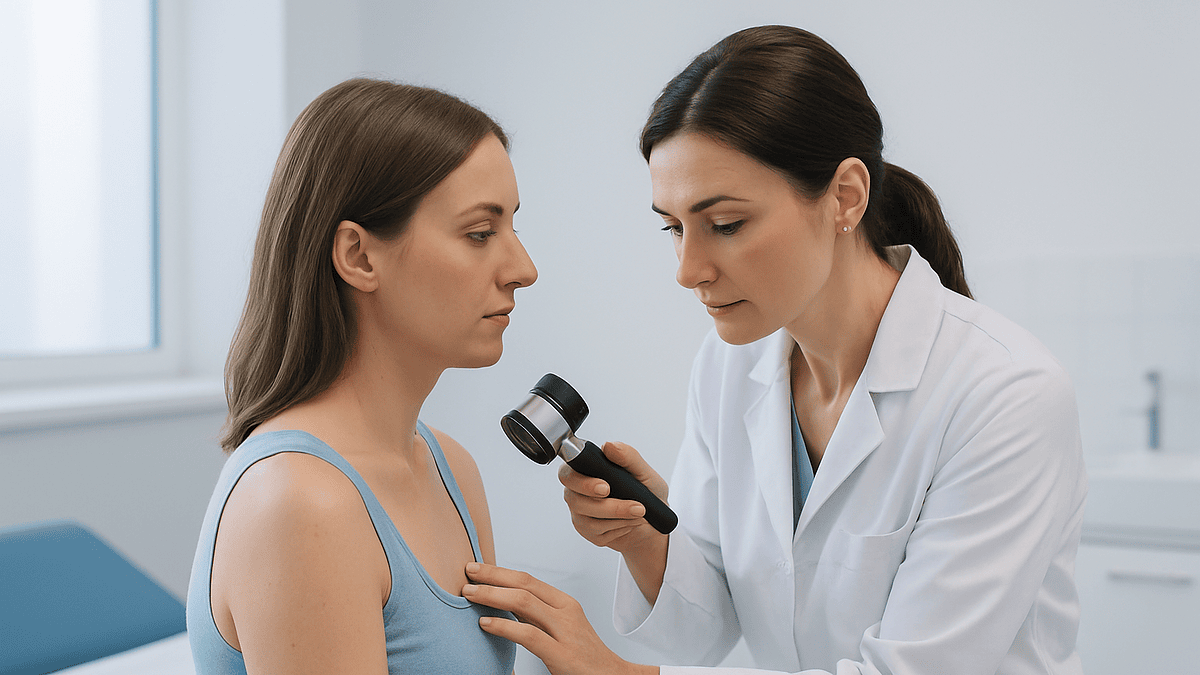
A dermatologist is a physician who specializes in conditions of the skin, hair and nails, and a first acne visit is mostly two things: talking and looking. There is no test that diagnoses acne. The diagnosis is made by examining the skin, which is why so much of this article is about arriving with your skin, and your history, easy to read.
Expect a conversation first. The clinician will want to know when breakouts began, how they have changed, what you have tried and how the acne affects your life. Then comes the examination, usually of the face, but often the chest, shoulders and back too, because acne follows oil glands and those areas are rich in them. Good lighting matters here more than anything you could do at home. Some clinicians photograph the skin with your consent so that later visits can be compared honestly rather than by memory.
Blood tests are not part of a routine acne visit. The Mayo Clinic notes that testing may be considered when there are signs pointing to a hormonal cause, such as irregular periods or unusual hair growth in women, or before certain oral medicines are started. If the picture does not quite fit acne, the clinician may look for lookalikes such as rosacea or folliculitis, an inflammation of hair follicles that can mimic pimples.
Most people leave a first appointment with a plan and a review date. The plan is a starting point, not a verdict. Acne care is iterative: the first regimen is chosen to fit your skin type, lesion pattern and daily life, and it gets adjusted at follow-up based on what the skin actually did.
Before your first acne appointment: products worth pausing
Let us be honest about the evidence first. No guideline instructs you to stop anything before an acne consultation. The reasoning behind pausing certain products is practical, not medical: the clinician needs to see your baseline skin, and fresh irritation from a product used yesterday muddies the picture.
With that in mind, these are the categories most worth setting aside in the few days before your visit:
- Anything new. A product started within the past couple of weeks makes it hard to tell whether redness or new bumps belong to the acne or to the product. Hold off on trial-running that new serum until after you have a plan.
- Physical scrubs and cleansing brushes. Grit and bristles inflame active lesions and can spread inflammation. The Mayo Clinic advises against scrubbing acne-prone skin in general.
- At-home chemical peels and high-strength acid masks. These leave temporary redness and flaking that looks like a reaction rather than your everyday skin.
- Kitchen remedies. Toothpaste, lemon juice, baking soda and undiluted essential oils are irritants, not treatments, and they can cause burns and dark marks that complicate the exam.
- Pore strips and extraction tools. They leave marks and micro-injuries the clinician then has to read around.
- Self-tanner and heavy foundation on the day. Both can hide lesion color and texture. If you feel more comfortable arriving with makeup on, wear it; you can remove it in the office, and many people do.
Pausing, in this sense, means not adding. It is not a detox, and it will not change your diagnosis. Its only job is to make sure the skin the clinician sees is the skin you live with.
Should you stop retinol before the dermatologist?
This is the question behind Priya’s two tubes, and the answer is usually no. A retinoid is a vitamin A derivative that helps skin cells shed normally so pores are less likely to clog; retinol is the milder non-prescription form, and adapalene is a retinoid available without a prescription in the United States. If you are using one of these, keep using it and tell the clinician. Knowing your skin has already been on a retinoid for weeks tells them something about tolerance and about what to try next.
The same logic applies to benzoyl peroxide, an antibacterial ingredient that reduces the bacteria involved in acne, and to salicylic acid, an exfoliating acid that helps unblock pores. Neither needs to be stopped for a consultation. Visible irritation from these products is information, not a failure. If your skin is raw, stinging or peeling, it is reasonable to ease off for a few days for comfort, then mention that you did.
There is one firm line: never stop a retinoid or any other acne medicine that was prescribed by another clinician without asking them or the dermatologist you are about to see. Prescription retinoids and oral treatments work over weeks, and interrupting them resets the clock without adding any diagnostic value.
What helps far more than pausing is arriving with the packaging or a clear photo of each label. Product names blur together, and the active ingredient and strength on the box are what the clinician actually needs. If you cannot bring the containers, photograph the ingredient panels on your phone. Thirty seconds of photography saves ten minutes of guessing.
What you should not stop before the visit
Some things belong firmly in the keep-using column, and stopping them can cause real harm.
Any prescribed medicine, for any condition. This includes oral antibiotics started by a family doctor for acne, hormonal contraception, medicines for mood or attention, asthma inhalers, and steroid creams for eczema. Several of these matter to acne planning. Hormonal contraception, for instance, is relevant in two directions: some combined contraceptives are themselves used to treat acne in women, and reliable contraception is a safety requirement before certain oral acne medicines that must not be used in pregnancy, as the NHS explains. Stopping it before the visit removes options rather than adding clarity.
Sunscreen. Daily broad-spectrum sun protection is part of nearly every acne plan because sun exposure deepens the dark marks that linger after spots heal and because many acne treatments make skin more sun-sensitive. Skipping it for a few days gains nothing.
A gentle cleanser and a plain moisturizer. The Mayo Clinic recommends washing acne-prone skin gently with a mild cleanser and keeping it moisturized. Both keep the skin barrier, the outer layer that holds water in and irritants out, calm enough that the clinician sees acne rather than dryness.
Treatments for other skin conditions. If you have eczema, psoriasis or rosacea alongside acne, keep those regimens going. The dermatologist will want to see how the conditions sit together.
If you are unsure whether something counts as a medicine, it does for the purpose of this list. Supplements, protein powders and hormone products also stay on the list you bring, because some of them are associated with breakouts and the clinician will want to know about them.
How bad does your acne need to be to see a dermatologist?
Less bad than most people assume. There is no minimum level of misery required, and waiting to earn the appointment is one of the more expensive mistakes in acne care because the two things that cannot be treated back to zero, scarring and long-lasting dark marks, are the products of time.
The NHS frames the decision around a few practical triggers: acne that is moderate or severe, acne that has not improved with products from a pharmacy, and acne that is making you feel very unhappy. Any one of them is reason enough. Mild acne, meaning mostly blackheads and whiteheads with a few small red bumps, is often managed first with non-prescription treatments, and the NHS notes that these can take up to three months to show their effect, so a fair trial means weeks, not days.
Certain features move the appointment up regardless of how much skin is involved:
- Deep, painful lumps under the skin (nodules) or fluid-filled cysts, because these are the lesions that scar
- Any pitting, indentation or raised scar already forming
- Dark or red marks that persist for months after spots heal, especially in medium and deep skin tones
- Acne on the back or chest that is spreading
- Adult-onset acne in a woman accompanied by irregular periods or excess facial hair, which the Mayo Clinic lists as reasons to look for a hormonal contributor
- Acne that started after a new medicine
In some health systems a family doctor manages first-line treatment and refers onward when needed; in others you can book a dermatologist directly. Either path is legitimate. What matters is that someone with prescribing authority sees the skin before the scar does.
Acne severity grades: what stage 1 acne looks like
People search for stage 1 acne, but clinicians do not use numbered stages in a formal way. They describe lesion types and then group the overall picture as mild, moderate or severe. Learning the vocabulary before your visit lets you follow the conversation and describe your own skin accurately.
A comedone is a blocked pore. If the blockage is open to the air it darkens and is called a blackhead; if it is closed under a thin layer of skin it is a whitehead. A papule is a small, firm red bump without a visible head. A pustule is a red bump with a white or yellow center of pus. A nodule is a large, solid, painful lump deep under the skin, and a cyst is a similar deep lesion that is softer and fluid-filled. The NHS describes these six lesion types as the building blocks of every acne assessment.
| Severity | What you typically see | What is usually discussed |
|---|---|---|
| Mild (what many call stage 1) | Mostly blackheads and whiteheads; occasional small papules or pustules; no deep lumps | Topical treatments, skincare routine, realistic timelines |
| Moderate | Numerous papules and pustules, often on more than one area; some redness between lesions; early dark marks | Combination topical treatments; sometimes oral options; scar prevention |
| Severe | Nodules or cysts, widespread inflammation, scarring or a high risk of it; may involve chest and back | Oral treatments including those needing monitoring; scar planning; faster follow-up |
Two caveats matter. First, a small amount of acne that is already scarring is treated as more serious than a larger amount that is not. Second, distress is a legitimate part of severity; the NHS explicitly includes the emotional impact of acne in deciding who should be seen. Your grade is a starting point for the plan, not a score for how much you should care.
At what age is acne the worst?
Acne clusters around the years when androgens, the hormones that enlarge oil glands and increase sebum (the skin’s natural oil), are climbing fastest. The NHS reports that about 95 percent of people aged 11 to 30 are affected to some extent, and that acne tends to be most common in girls between 14 and 17 and in boys between 16 and 19. For most people it settles through the twenties, though the NHS also notes that around 3 percent of adults still have acne after age 35.
The mechanism explains the timing. During puberty, oil glands grow and produce more sebum; the lining of the pore sheds cells that clump instead of flowing out; a bacterium that normally lives harmlessly on skin, Cutibacterium acnes, multiplies in that oily, blocked environment; and the immune system responds with inflammation. The NIH describes these four steps as the core of how acne forms. Anything that turns up the hormonal signal, including the menstrual cycle, polycystic ovary syndrome, some medicines and certain supplements, can extend acne well past adolescence.
Adult acne often has a different look: fewer blackheads, more tender red bumps along the jawline, chin and neck, and a habit of flaring in the week before a period. It is not rarer or less real than teenage acne, and it is not a sign of poor hygiene.
Your age at onset is one of the first things the dermatologist will ask, because it shapes the follow-up questions. Acne that begins in the late twenties or thirties, or that arrives suddenly and severely, prompts a closer look at hormones and medicines than acne that started quietly at thirteen. Come ready to say roughly when it began and how it has changed since.
What your dermatologist asks about acne: the history questions
The history is where the appointment is won or lost, and most of it is easy to prepare. Here is what a thorough clinician will typically want to know, so you can think about answers in advance rather than in the chair.
- Onset and pattern. When it started, whether it comes and goes, and which areas are affected.
- Menstrual history and contraception, for anyone who menstruates: cycle regularity, flares around your period, current contraception and any plans for pregnancy. Several acne treatments are unsafe in pregnancy, as the NHS notes, so this is a safety question, not an intrusion.
- Other medicines and supplements. Corticosteroids, some mood stabilizers, testosterone, certain hormonal contraceptives and some bodybuilding supplements are associated with acne, and the Mayo Clinic lists medicines among recognized triggers.
- Everything you put on your skin and hair, including hair oils and pomades that can drift onto the forehead.
- Previous treatments, what each did, and why you stopped. Side effects count as results.
- Friction and occlusion. Helmets, masks, tight collars, phone contact and backpacks can worsen acne along lines of pressure.
- Family history, because genetics influence severity.
- Picking and squeezing, asked without judgment, because it changes scar risk.
- Mood and daily impact. Avoiding photos, cancelling plans or feeling low about your skin are clinically relevant.
Bring the containers or phone photos of every label, a rough timeline written on paper or in your notes app, and, if you have them, photos of flares at their worst. Skin has a way of behaving on appointment day, and a picture from three weeks ago can say more than the exam.
How acne treatments work, in plain language
Every acne treatment targets one or more of the four steps that create a lesion: blocked pores, excess oil, bacteria and inflammation. Understanding that map makes the plan you are offered feel less arbitrary. What follows describes classes and mechanisms only; the choice, strength and schedule belong to your prescribing clinician.
Topical retinoids normalize how pore-lining cells shed, so fewer comedones form. They are a foundation of most plans and are also used to prevent new lesions once skin is clearer.
Benzoyl peroxide kills the acne-associated bacteria and has the useful property that bacteria do not become resistant to it. It is often paired with antibiotics for that reason.
Azelaic acid reduces bacteria and inflammation and can help fade the dark marks acne leaves behind.
Antibiotics, applied to the skin or taken by mouth, reduce bacterial numbers and calm inflammation. Because resistance is a real concern, guidelines favor using them for limited periods and alongside benzoyl peroxide rather than alone; the NHS describes oral antibiotics as typically a course of months rather than an indefinite treatment.
Hormonal treatments, including some combined contraceptives and anti-androgen medicines, lower the hormonal signal that drives oil production and are an option for some women.
Isotretinoin, an oral retinoid, shrinks oil glands and addresses all four steps at once. The NHS reserves it for severe acne or acne at risk of scarring that has not responded to other treatment, and it requires strict pregnancy prevention and monitoring.
Procedures such as comedone extraction or a corticosteroid injection into a single large cyst are sometimes used alongside medicines. Light and laser devices exist, but the Mayo Clinic describes the evidence for them as still developing, so they are not usually the first plan.
What the weeks after your first appointment usually look like
The single most useful thing to carry out of the appointment is a realistic clock. The NHS advises that acne treatments can take up to three months to work, and the Mayo Clinic warns that skin can look somewhat worse before it looks better as treatment begins. Neither of those statements is a promise about your skin; both are a warning against judging a plan in week two.
The first weeks often bring dryness, mild redness or flaking, particularly with retinoids and benzoyl peroxide. This is irritation from the medicine settling in, not proof that the acne is spreading, and it usually eases as skin adapts. Plenty of people call this phase purging. The idea that a treatment pushes hidden spots to the surface is popular but only weakly supported; most of what people notice is ordinary irritation plus the acne that would have appeared anyway. Either way, the response is the same: keep going unless your clinician tells you otherwise, protect the skin barrier with a plain moisturizer, and report anything that feels more than mildly uncomfortable.
Around the middle of that three-month window, new lesions often start to appear less frequently, which is the earliest honest sign of effect. Existing spots still need to heal, and the flat red or brown marks they leave, called post-inflammatory hyperpigmentation, fade slowly over months even when the acne itself is under control.
Follow-up is typically scheduled once there has been enough time to judge the first plan, which is why a review visit commonly lands near that three-month mark. Take a photo in the same light once a month in between. Day-to-day comparison lies; a monthly series tells the truth.
What clears up acne immediately? The honest answer
Nothing clears acne overnight, and any product that says otherwise is describing something other than acne. A pimple is inflammation inside a blocked pore, and inflammation resolves on a biological timescale of days, not minutes. That is disappointing to read the night before a wedding, so here is what can genuinely help with a single spot, and what will make it worse.
For one large, painful cyst before an important event, a dermatologist can inject a small amount of corticosteroid directly into the lesion, which the Mayo Clinic describes as a way to reduce swelling and pain quickly. This is an in-office procedure for individual lesions, not a routine or at-home treatment, and it is worth asking about if you have an event coming up.
At home, a clean cool compress can reduce the swelling and redness of an inflamed spot for a few hours. A hydrocolloid patch, a small adhesive dressing that absorbs fluid, mainly helps by stopping you from touching the lesion; its evidence as a treatment is thin. Non-comedogenic makeup, meaning products formulated not to block pores, is a perfectly reasonable way to cover a spot for the day.
Squeezing, on the other hand, pushes pore contents deeper, extends the inflammation and is the single most common cause of the marks and pits that outlast the acne. Toothpaste, lemon juice and rubbing alcohol irritate and can leave a dark patch that lasts far longer than the pimple would have.
The real answer to instant clearing is a plan that stops new lesions forming, which is exactly what the appointment is for. Mention upcoming events; clinicians factor them in.
What people often get wrong before their first acne appointment
A few misconceptions show up in almost every first visit, and correcting them ahead of time makes the appointment more useful.
That acne means dirty skin. It does not. The blockage happens inside the pore, out of reach of any cleanser, and the Mayo Clinic notes that scrubbing and harsh soaps irritate skin and can worsen acne. Washing twice a day with a gentle product is enough.
That chocolate and greasy food are the cause. Greasy food on your plate does not put oil in your pores. The Mayo Clinic describes a possible association between acne and high-glycemic diets and, in some studies, dairy, but calls the evidence unsettled. A food diary can be worth discussing; a guilt-driven fast is not.
That sun clears acne. A tan can camouflage redness briefly, but ultraviolet exposure damages skin, deepens dark marks and makes many acne medicines more likely to burn.
That you should stop treatment once skin is clear. Acne is a tendency, not an event. Most plans include a maintenance phase, and stopping abruptly is a common reason for relapse.
That you must arrive barefaced or be judged. You will be asked to remove makeup for the exam, but how you arrive is your choice, and no clinician worth seeing will comment on it.
That the visit will end with a single miracle prescription. First plans are combinations, and adjustments at follow-up are normal, not evidence of failure.
That adult acne is rare or shameful. The NHS figures above say otherwise, and dermatologists see it every day.
Questions to ask your care team
Appointments go faster than anyone expects, so write your questions down. These are the ones that tend to change what you do at home, phrased so you can use them directly.
- Which type of acne do I mainly have, and is any of it likely to scar?
- What is each product in this plan doing, and in what order should I apply them?
- How long should I give this plan before we judge whether it is working?
- What side effects are expected in the first weeks, and which ones should make me call you?
- Should I keep using the products I already have, or set them aside for now?
- How should I handle sun protection alongside these treatments?
- Are any of these treatments unsafe if I could become pregnant, and what should I do about contraception?
- Is there anything in my medicines, supplements or diet worth changing, or is that not supported by the evidence?
- What can I do about the dark marks or early scars I already have, and when is the right time to start?
- If this plan does not work, what would we try next?
- How do I reach you between visits, and how soon should I come back?
- Is there anything I can do before a specific event coming up?
Take notes or ask whether you can record the plan on your phone. If the appointment ends with instructions you do not fully understand, say so before you leave. A plan you can follow beats a perfect plan you cannot remember, and every clinician would rather spend two extra minutes explaining than see you back in three months with a regimen that never got started.
When to call your doctor
Acne itself is rarely an emergency, but a few situations before or after your appointment should prompt a call the same day rather than a note for the next visit.
Seek urgent care or emergency services for swelling of the lips, tongue or throat, difficulty breathing, or widespread hives after using a new product or medicine; these are signs of a serious allergic reaction.
Call your doctor promptly if you notice any of the following:
- Sudden onset of many painful nodules with fever, joint pain or feeling generally unwell, which can indicate a rare, severe form of acne that needs specialist treatment
- Spreading redness, warmth, increasing pain or pus from a lesion, or a red streak tracking away from it, which may signal a skin infection
- Severe burning, blistering or peeling where a treatment was applied, beyond the mild dryness expected in the early weeks
- Sores in the mouth or eyes, or a rash that spreads quickly, after starting any oral medicine
- Persistent severe headache, visual changes or ringing in the ears while on an oral antibiotic for acne
- Low mood, changes in thinking or thoughts of self-harm while on an oral retinoid, which the NHS lists among reasons to contact your prescriber without delay
- Confirmed or suspected pregnancy while taking any prescribed acne medicine
- Acne that is worsening rapidly despite treatment, or new scarring appearing
Between those extremes sits ordinary uncertainty, and that is what the follow-up visit and your clinic’s message line are for. If something about your skin worries you and you cannot decide whether it is a red flag, that uncertainty is itself a good enough reason to call. Every decision about starting, changing or stopping treatment rests with your treating team, and they would rather hear from you early.
Frequently asked questions
Should I wear makeup to my first acne appointment?
You can arrive however you feel comfortable; you will simply be asked to remove makeup for the examination so the clinician can see lesion color and texture. Many people wear it in and take it off in the office. Bringing your foundation or concealer along is useful, because the clinician may want to check that it is non-comedogenic, meaning formulated not to block pores.
Do I need to stop retinol before the dermatologist appointment?
Usually not. Non-prescription retinol or adapalene can stay in your routine, and telling the clinician you have used it for weeks gives them useful information about tolerance. If your skin is raw or peeling, pausing for a few days for comfort is reasonable, but mention that you did. Never stop a prescribed retinoid without checking with the prescriber first.
What does stage 1 acne look like?
Clinicians do not use numbered stages, but what people call stage 1 corresponds to mild acne: mostly blackheads and whiteheads, perhaps a few small red bumps or pustules, and no deep painful lumps. The NHS describes these comedones as the earliest and most common acne lesions. Mild acne is often managed first with non-prescription treatments, with a dermatologist involved if it does not improve or begins to leave marks.
At what age is acne the worst?
Acne is most common between ages 11 and 30, affecting about 95 percent of people in that range to some degree, according to the NHS. It peaks for girls around 14 to 17 and for boys around 16 to 19, when androgen hormones are rising fastest and oil glands are most active. For most people it eases through the twenties, though the NHS notes that about 3 percent of adults over 35 still have acne.
How bad does acne need to be to see a dermatologist?
There is no minimum threshold. The NHS suggests seeing a doctor for moderate or severe acne, for acne that has not improved with pharmacy treatments, and for acne that is affecting how you feel. Nodules, cysts, early scarring, lasting dark marks, spread to the back or chest, or onset after a new medicine are all reasons to be seen sooner rather than later.
What clears up acne immediately?
Nothing clears acne instantly, because each lesion is inflammation that resolves over days. For a single large cyst before an event, a dermatologist can inject a corticosteroid into the lesion to reduce swelling, an in-office procedure the Mayo Clinic describes. At home, a cool compress and non-comedogenic makeup help for the day. Squeezing, toothpaste and lemon juice make lesions worse and can leave marks.
What will the dermatologist ask about acne at the first visit?
Expect questions about when acne began, where it appears, how it changes with your menstrual cycle, your contraception and pregnancy plans, every medicine and supplement you take, all products on your skin and hair, previous treatments and why you stopped them, friction from helmets or masks, family history, picking habits and how the acne affects your mood. A written timeline and photos of labels make these answers quick and accurate.
Will my dermatologist do blood tests for acne?
Not routinely. Acne is diagnosed by examining the skin. The Mayo Clinic notes that testing may be considered when there are signs of a hormonal cause, such as irregular periods or unusual hair growth in women, or before starting certain oral medicines that require monitoring. If tests are suggested, ask what they are looking for and how the results will change the plan.
Will I get a prescription at my first dermatologist visit for acne?
Often, but not always. Many people leave with a plan that combines a prescription treatment with skincare guidance; others are advised to continue or adjust non-prescription products first. The decision depends on lesion type, scarring risk, pregnancy considerations and what you have already tried. Whatever the plan, the NHS notes that treatments can take up to three months to work, so a follow-up visit is usually arranged.
Should I stop picking my acne before the appointment?
Yes, as much as you can. Squeezing pushes pore contents deeper, prolongs inflammation and is the main cause of the dark marks and pitted scars that outlast the acne. It also leaves crusts and bruising that make the examination harder to read. If picking is a habit you struggle with, say so at the visit; clinicians hear it constantly and can suggest practical strategies without judgment.
References
This article is for general information only and is not a substitute for professional medical advice. Please consult a qualified doctor about your individual situation.

More from the Blog
Rosacea That Affects the Eyes: Gritty, Red or Watery Eyes That Need Medical Attention
Ocular rosacea is rosacea affecting the eyes and eyelids. Typical eye symptoms include a gritty or burning sensation, redness of the eyes and lid…

How to Stop and Prevent Dandruff for Good: Causes, Treatments and Daily Habits
Dandruff is usually controlled, not cured, by washing regularly with a medicated anti-dandruff shampoo, leaving it on the scalp for a few minutes before…
When Does Seborrheic Dermatitis Need a Dermatologist? Persistent Scaling and Facial Flares
Most seborrheic dermatitis can be managed with over-the-counter antifungal or anti-dandruff products, but it is reasonable to see a dermatologist when scaling persists after…

Cryotherapy, Topical Treatment or Lesion Removal for Molluscum: How the Options Compare
Cryotherapy, topical treatments and lesion removal all aim to clear molluscum bumps faster than the body would on its own, but no single option…

When Impetigo Needs Urgent Review: Fever, Spreading Redness and Sores That Are Not Healing
Impetigo that is not healing after about a week of treatment, is spreading quickly, or comes with fever, swelling, warmth or pain beyond the…
Skin Tags: Why They Form, and Safe Removal
Skin tags form where skin rubs against skin or clothing, most often on the neck, armpits, eyelids, and groin. Friction, genetics, hormonal shifts such…