

When Does Seborrheic Dermatitis Need a Dermatologist? Persistent Scaling and Facial Flares

Key Takeaways
- Cleveland Clinic estimates seborrheic dermatitis affects about 11 percent of people, with peaks in infancy and again between ages 30 and 60.
- The NHS advises using an anti-dandruff shampoo for about a month before judging whether it works, which is also a sensible review point before seeking specialist input.
- Malassezia yeast lives on almost everyone's skin; the condition is an inflammatory over-reaction to it, not an infection and not a hygiene problem.
- Facial and eyelid involvement is the commonest reason for dermatology referral because thin facial skin limits how long topical corticosteroids can safely be used.
- Treatment response is diagnostic: scaling that ignores weeks of appropriate antifungal and anti-inflammatory care should prompt a second look at the diagnosis, not a stronger product.
- Sudden, extensive seborrheic dermatitis in an adult with no history, or alongside weight loss or fevers, can accompany a weakened immune system and warrants clinical assessment.
Most seborrheic dermatitis can be managed with over-the-counter antifungal or anti-dandruff products, but it is reasonable to see a dermatologist when scaling persists after about a month of consistent self-care, when the face, eyelids or ears flare repeatedly, when the skin looks infected or weeps, or when the pattern is unusual enough that psoriasis, rosacea or another condition needs ruling out. Your treating clinician decides the plan.
The mirror does it every winter. The patches beside the nose turn pink and faintly greasy, the eyebrows shed a fine white dust onto a dark sweater, and the medicated shampoo that worked in autumn has stopped working by midwinter. Most people in that moment do what you may be doing now: they type a version of “seborrheic dermatitis when to see dermatologist” and quietly hope the answer is “not yet.”
Often it is not yet. Seborrheic dermatitis is among the most common inflammatory skin conditions anywhere, and much of it is managed in bathrooms rather than clinics. The harder question is recognizing the point where persistence, location or an unusual pattern changes the calculation.
This explainer walks through that threshold the way a dermatologist would think about it: what the skin is doing, why the face behaves differently from the scalp, what the appointment involves, and which signs mean the waiting is over.
What is actually happening in seborrheic dermatitis skin?
Start with the skin’s own oil. Sebaceous glands cluster most densely on the scalp, the center of the face, the ears and the mid-chest, and those are precisely the places seborrheic dermatitis chooses. A yeast called Malassezia, a normal resident of oily skin in nearly everyone, feeds on that sebum. In people who develop the condition, the immune system appears to over-react to the yeast and to the fatty by-products it leaves behind, producing inflammation, faster shedding of surface cells and the familiar flaky, slightly greasy scale (Mayo Clinic, Cleveland Clinic).
That is why the condition is not an infection in the ordinary sense, and not a hygiene problem. Washing more vigorously does not remove the trigger; the yeast returns within days because it belongs there. The problem is the reaction, not the visitor.
Two other facts shape how dermatologists think about it. First, it is common: Cleveland Clinic puts the figure at roughly 11 percent of the population, with peaks in infancy and again between the ages of 30 and 60. Second, it runs in cycles. Mayo Clinic describes a course that may clear without treatment, or that may need repeated courses of treatment over years, and that distinction between a bad month and a long-term pattern sits at the center of the decision this article is about.
The vocabulary matters because it shapes expectations. Dandruff is the mildest form, confined to the scalp, with flaking but little redness. Seborrheic dermatitis is the same process with visible inflammation, and it can reach well beyond the hairline. Cradle cap is the infant version. One process, three names, and the same underlying question: how much inflammation, how often, and where.
Seborrheic dermatitis: when to see a dermatologist and when self-care is still reasonable
Here is the honest framing. The NHS advises people with dandruff and mild scalp seborrheic dermatitis to use an anti-dandruff shampoo containing an active ingredient such as zinc pyrithione, selenium sulfide, ketoconazole or salicylic acid, and to keep using it for about a month before judging whether it works. Mayo Clinic gives similar self-care guidance for the face and body: gentle cleansing, over-the-counter antifungal creams and short courses of a mild hydrocortisone product. If those steps are working, a dermatologist is unlikely to change much.

The calculation shifts when one of four things happens.
- Self-care has been used consistently for several weeks and the scaling or redness is unchanged or spreading. Mayo Clinic lists trying self-care steps without success as a reason to see a doctor.
- The condition is disrupting life. Mayo Clinic’s threshold includes losing sleep, being distracted from daily routines, or significant embarrassment and anxiety about the appearance.
- You suspect infection. Weeping, crusting, spreading warmth or pain is not typical of uncomplicated seborrheic dermatitis.
- The diagnosis itself is uncertain. Patches on the elbows or knees, nail changes, flushing with visible vessels, or a rash that itches intensely at night raise other possibilities that a general product will not address.
Notice that none of these is about severity alone. A dramatic flare that responds well to a shampoo needs less expert input than a mild one that has quietly become a years-long feature of the face. Persistence and pattern carry more weight than a single bad week.
A primary care clinician can start most of this work and, in many health systems, is the first stop. Dermatology referral tends to follow when first-line treatment fails, when the face or eyelids are involved repeatedly, or when the picture suggests a different diagnosis.
Why does seborrheic dermatitis on the face behave differently from the scalp?
Scalp skin is thick, hair-covered and tolerant. Facial skin, especially around the nose, the eyelids and the inner eyebrows, is thinner, more visible and far more sensitive to both the condition and its treatments. That single anatomical difference explains most of why seborrheic dermatitis on the face so often ends up in front of a dermatologist.
The distribution is distinctive. Cleveland Clinic and Mayo Clinic describe pink or salmon-colored patches with fine greasy or dry scale in the nasolabial folds (the creases running from the nose to the corners of the mouth), the eyebrows, the skin between them, the beard area, behind the ears and inside the ear canal. On darker skin tones the patches may look lighter or darker than surrounding skin rather than red, and the scale may be the more obvious clue.
Two complications are worth knowing. Seborrheic blepharitis, inflammation along the eyelid margins, causes crusting at the lash line and gritty eyes, and because of its proximity to the eye it generally warrants a clinician’s assessment rather than trial and error. Post-inflammatory pigment change, a lingering lighter or darker mark after a flare settles, is more common in deeper skin tones and is one reason early, appropriate control matters there.
Treatment is also trickier on the face. Medicated shampoos sting near the eyes. Topical corticosteroids, helpful in short bursts, can thin facial skin and provoke rebound redness if used for long stretches, which is why dermatologists often reach for non-steroid options on the face. Balancing control against side effects is a judgment that benefits from expertise, and your prescribing clinician is the person to make it.
What causes seborrheic dermatitis flare-ups?
Patients often arrive convinced they did something wrong. Usually they did not. The evidence on seborrheic dermatitis flare up causes points to a set of background factors, most of them outside anyone’s control.

Season is the most reliable. Mayo Clinic and Cleveland Clinic both note that cold, dry weather tends to worsen the condition and that symptoms often ease in warmer months, possibly because of humidity and modest sunlight exposure. Stress and fatigue are the next most commonly reported triggers; Mayo Clinic lists stress and recovery from a stressful medical event, such as a heart attack, among the factors that can bring on or worsen symptoms. Hormonal shifts, which influence sebum production, help explain why the condition appears in infancy, fades, and returns after puberty.
Certain health conditions raise the odds considerably. Mayo Clinic groups them into neurological and psychiatric conditions (Parkinson’s disease, depression), weakened immunity (HIV infection, organ transplant recipients, some cancers) and recovery from serious illness. Some medications, including certain psychiatric drugs, are also associated with it. In people with untreated HIV the condition tends to be more severe and widespread, and a sudden extensive outbreak in an adult with no history may prompt a clinician to look further.
What is not well supported is the idea that diet drives it. No mainstream guideline recommends cutting sugar, dairy or gluten for seborrheic dermatitis. Equally, harsh scrubbing, alcohol-based toners and frequent product switching irritate skin that is already inflamed, and that irritation is easily mistaken for a flare of the underlying condition.
Why does this matter for the dermatologist question? A flare with an obvious seasonal or stress-related explanation that settles with the usual products is reassuring. A new, persistent or unusually widespread outbreak, or one accompanied by unexplained weight loss or fatigue, is a different conversation, and one worth having with a clinician.
Seborrheic dermatitis vs psoriasis, rosacea and eczema: how are they told apart?
The reason a trained eye matters is that several common conditions mimic seborrheic dermatitis, and the treatments diverge. Seborrheic dermatitis vs psoriasis is the comparison people search most, and it is a genuinely hard one; the overlap on the scalp is common enough that dermatologists sometimes use the term sebopsoriasis when features of both are present. The table summarizes typical differences, with the caveat that real skin rarely reads the textbook.
| Feature | Seborrheic dermatitis | Scalp or facial psoriasis | Rosacea | Atopic eczema |
|---|---|---|---|---|
| Typical sites | Scalp, eyebrows, nose creases, ears, chest | Scalp (often past the hairline), elbows, knees, nails | Cheeks, nose, chin, forehead | Eyelids, neck, inner elbows, behind knees |
| Scale | Fine, greasy or yellowish, loosely attached | Thick, silvery, firmly attached, sharp edge | Little or none; bumps and pustules instead | Dry, rough, often thickened skin |
| Itch | Mild to moderate | Variable | Burning or stinging more than itch | Often intense |
| Clues | Worse in winter and with stress | Nail pitting, joint pain, family history | Flushing, visible small vessels, heat and alcohol triggers | Personal or family history of asthma or hay fever |
Other conditions enter the picture less often: tinea (a fungal skin infection) in the beard or scalp, contact dermatitis from a new product, and, rarely, discoid lupus or a cutaneous lymphoma presenting as a persistent facial or scalp rash that does not behave. MedlinePlus and Mayo Clinic both note that the diagnosis is usually made on examination alone, with a skin scraping or biopsy reserved for cases that look atypical or fail to respond.
The practical lesson is that treatment response is itself diagnostic information. A rash that ignores several weeks of appropriate antifungal and anti-inflammatory care deserves a second look rather than a stronger version of the same thing.
Seborrheic dermatitis when to see dermatologist: who is usually referred and who is usually asked to wait
Dermatology services in most health systems work on a triage logic, and understanding it helps set expectations.
People who are usually seen sooner:
- Adults whose scaling and redness have persisted despite a consistent trial of first-line products over roughly a month, the review window the NHS uses for dandruff and scalp seborrheic dermatitis.
- Anyone with repeated flares on the face or eyelids, where treatment choices are more delicate and the risk of steroid-related skin thinning is higher.
- People with a weakened immune system, in whom the condition tends to be more extensive and stubborn, and where it may be the first visible sign of an underlying problem.
- Those in whom the diagnosis is uncertain: features suggesting psoriasis, lupus, a drug reaction or infection.
- Anyone with signs of secondary bacterial infection, such as weeping, honey-colored crusting or spreading pain.
People who are commonly asked to continue self-care first:
- Adults with classic scalp flaking, little redness and no facial involvement who have not yet tried a medicated shampoo for several weeks.
- People with mild, seasonal facial patches that have responded to an over-the-counter antifungal cream before and are likely to again.
- Parents of infants with uncomplicated cradle cap, which usually settles on its own and is managed with gentle emollients and brushing according to NHS guidance.
Being asked to wait is not dismissal. For mild disease, the first-line treatments a dermatologist would start with are the same ones available without a prescription. What changes with specialist input is the ability to confirm the diagnosis, to combine or rotate treatments, to use prescription-strength or non-steroid anti-inflammatories safely on the face, and to recognize when the condition is a clue to something else. Whichever group you fall into, the referral decision rests with your primary clinician, and it can be revisited if things change.
What happens at a dermatology appointment for persistent scaling?
The visit is usually shorter and less dramatic than people expect. Most of the diagnostic work in seborrheic dermatitis happens by looking; Mayo Clinic and MedlinePlus both describe diagnosis based on examination of the skin, with tests used only when something does not fit.
Expect questions before anything else. How long has it been there, and does it come and go? Which products have been tried, for how long, and how often? Is there a family history of psoriasis or eczema? Any joint pain, nail changes, new medications, recent major illness or unexplained fatigue? Each answer nudges the probability toward or away from the alternatives in the previous section.
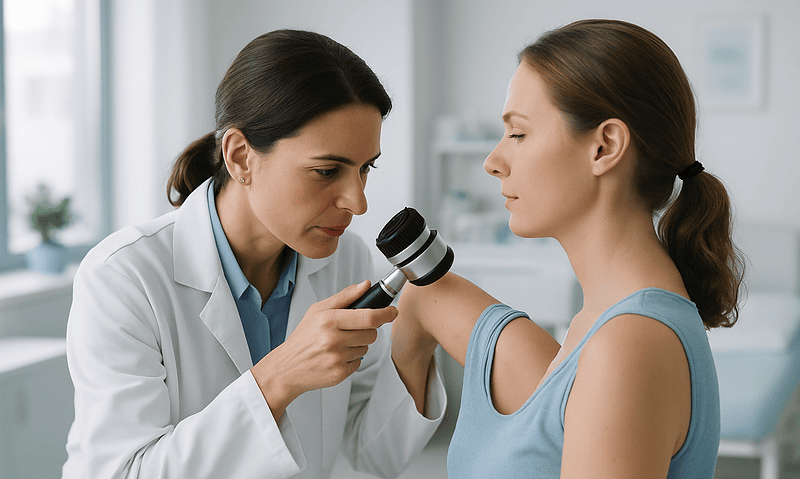
The examination then covers more than the patch you came in about. A dermatologist will typically check the scalp behind the hairline, the ears, the eyebrows and eyelids, the chest and, often, the elbows, knees and nails, because psoriasis declares itself in those places. Some clinicians use a dermatoscope, a handheld magnifier with a light, to study the pattern of vessels and scale.
Tests are the exception. A skin scraping examined under a microscope can rule out a true fungal infection such as tinea. A small skin biopsy, taken under local anesthetic, is reserved for rashes that look atypical, that have failed to respond, or where lupus or another serious condition is being considered. Blood tests are not routine for seborrheic dermatitis itself, though a clinician may suggest them if the overall picture raises concern about immune function.
The appointment should end with three things: a working diagnosis, a plan that explains which product does what and for how long, and a clear idea of when to return. If any of those is missing, the questions listed later in this article are a good place to start.
How do dermatologists treat seborrheic dermatitis that will not settle?
Treatment rests on two levers: reducing the yeast and calming the inflammation. Nearly everything a dermatologist prescribes pulls one or both. Strength, frequency and duration belong to the prescribing clinician; what follows is the mechanism and the general logic, drawn from Mayo Clinic and Cleveland Clinic patient guidance.
Antifungals work on the first lever. Topical azoles such as ketoconazole, and agents such as ciclopirox, reduce Malassezia on the skin surface; selenium sulfide and zinc pyrithione in shampoos have similar antifungal and anti-scaling actions. Because the yeast recolonizes, these are often continued intermittently as maintenance once a flare is under control rather than stopped outright.
Keratolytics loosen scale. Salicylic acid and coal tar preparations soften and lift adherent flakes so that other treatments can reach the skin beneath; they suit the scalp better than the face.
Anti-inflammatories work on the second lever. Topical corticosteroids suppress the immune reaction quickly and are usually used in short courses, because long-term use on thin facial skin can cause thinning, visible vessels and a rebound flare when stopped. Topical calcineurin inhibitors, tacrolimus and pimecrolimus, dampen inflammation through a different pathway and do not thin skin, which makes them a frequent choice for the face and eyelids; a burning sensation on application is a recognized side effect, and Mayo Clinic notes that questions have been raised about their long-term safety.
For extensive or resistant disease, Mayo Clinic lists oral antifungal medicines and light therapy (phototherapy) as options, each with its own risks and monitoring needs. None of these is a one-time fix. The realistic goal, stated plainly by every mainstream source, is control: fewer flares, milder flares, and a maintenance routine light enough to live with. Whether any option suits you is a decision for your treating team, not for an article.
What do the first weeks after a dermatology visit usually look like?
Skin has its own calendar, and it rarely matches the patient’s. The outer layer renews itself over roughly four weeks, which is one reason the NHS asks people to persist with a medicated shampoo for about a month before judging it, and why Mayo Clinic frames self-care results in weeks rather than days.
In the first few days after starting a plan, inflammation usually responds before scale does. Redness and itch tend to ease first, particularly if an anti-inflammatory has been prescribed; the flakes can look worse briefly as loosened scale sheds. Mild stinging from antifungal shampoos or a warm, burning feeling in the early days of a calcineurin inhibitor are recognized effects that often fade, but anything more than mild, or anything that worsens, should be reported rather than endured.
By the second and third weeks, the face and scalp usually look quieter if the diagnosis was right and the plan is being followed. This is the point at which people are tempted to stop everything. Dermatologists generally expect the opposite: a shift from the clearance phase to a lighter maintenance routine, with the stronger anti-inflammatory tapered according to the clinician’s instructions. Stopping abruptly is one of the commonest reasons a flare returns within weeks.
Around the one-month mark, a review is reasonable. If nothing has changed despite consistent use, the plan is usually revisited, and the diagnosis reconsidered, rather than simply intensified. If the skin has settled, the conversation turns to what the next winter, or the next stressful stretch, is likely to bring and how to meet it early.
These ranges are typical, not guaranteed. Timelines vary with skin type, the sites involved, other health conditions and how closely the plan is followed, and your care team is the right source for expectations specific to you.
Does seborrheic dermatitis go away on its own?
The answer most people want is yes, permanently. The answer the evidence gives is more textured.
In infants, yes, almost always. Cradle cap typically clears on its own within months according to NHS guidance, and most children never see it again unless it reappears after puberty.
In adults, seborrheic dermatitis is best thought of as a tendency rather than an episode. Mayo Clinic describes a condition that may go away without treatment but that often needs many repeated treatments before symptoms settle, and that may return later. Cleveland Clinic uses similar language: a long-term condition that tends to flare and settle, often tracking the seasons. Some people have a single run of it in their twenties and nothing more; others manage it on and off for decades. There is no reliable way to predict in advance which pattern an individual will follow.
What this means in practice is that the phrase “treatment failed” is often used too quickly. A flare that returns four months after a successful course is not evidence that the treatment did not work; it is evidence that the condition is behaving normally and that a maintenance strategy, rather than a rescue strategy, might be the better fit. That distinction is exactly the kind of judgment a dermatologist adds.
It also reframes the goal. A reasonable target is skin that is quiet most of the time, flares that are shorter and milder, and a routine that takes a few minutes a week. People who hold out for permanence often cycle through products, stop early when they feel better, and conclude that nothing works. Those who accept a management mindset tend, in clinicians’ experience, to do better with less. The condition does not define you, but it rewards being understood rather than fought.
Cradle cap and children: when does a child's seborrheic dermatitis need a doctor?
A new parent noticing thick yellow crusts on a baby’s scalp will often search before they call anyone, and what they find is reassuring. Cradle cap, the infant form of seborrheic dermatitis, is common, usually appears in the first weeks to months of life, does not itch, and is not caused by poor washing or by anything the parent did. NHS guidance describes it as harmless, generally clearing on its own, with gentle measures such as softening the scales with a plain emollient or baby oil, washing with a mild baby shampoo and loosening flakes with a soft brush.
Picking at the crusts is discouraged because it can break the skin and invite infection. Medicated adult shampoos are not appropriate for infants, and any treatment beyond emollients should come from the child’s own clinician.
When does a child’s rash warrant a doctor? NHS and Cleveland Clinic guidance converge on a short list: the rash spreads to the face, body or diaper area; the skin looks infected, with weeping, wet rather than dry crusting, or swelling; the child seems itchy or distressed, which is unusual for cradle cap and suggests eczema or another cause; or there is no improvement after several weeks of gentle care. Cradle cap that persists well beyond infancy, or that first appears in an older child, is also worth a review, since seborrheic dermatitis is uncommon between early childhood and puberty.
In the diaper area particularly, a clinician will want to distinguish seborrheic dermatitis from a yeast infection, irritant diaper rash or, rarely, a more significant condition, because each is handled differently. Preparing for such a visit is simple: a note of when it started, what has been used, and a photograph or two from a worse day, since rashes have a habit of improving the morning of the appointment.
What people often get wrong about seborrheic dermatitis
Myths cluster around any condition that is common, visible and chronic. These are the ones dermatologists correct most often.
“It’s because I don’t wash enough.” The opposite is closer to the truth. Seborrheic dermatitis is an inflammatory reaction to a yeast that lives on everyone’s skin; scrubbing harder irritates the skin and does nothing to the trigger. Gentle cleansing with the right active ingredient outperforms vigorous cleansing with the wrong one.
“Dry skin is the problem, so I should moisturize more.” The scale looks dry but the skin beneath is often oily. Heavy occlusive creams can feed the yeast. Light moisturizers are reasonable; thick ointments on the face usually are not, and a clinician can advise which.
“If a steroid cream worked, more of it will work better.” Short courses calm a flare. Long or repeated use on the face risks thinning, visible vessels and a rebound that is worse than the original problem. The dermatologist’s reluctance here is caution, not stinginess.
“It’s contagious.” It is not. Nobody catches seborrheic dermatitis from a towel, a pillow or a partner, a point Cleveland Clinic makes explicitly.
“It’s just dandruff; dermatologists have better things to do.” Dandruff is the mild end of the same spectrum. Persistent facial involvement, eyelid involvement, treatment failure and diagnostic uncertainty are legitimate reasons for specialist input, and primary care clinicians refer for them routinely.
“Natural oils like coconut or tea tree are a proven fix.” Evidence is thin and mixed. Some oils feed Malassezia; some essential oils cause contact dermatitis on already-inflamed skin. Nothing in mainstream guidance supports them as a substitute for established treatment.
“Once it clears, I’m done.” For many adults it returns. Planning for maintenance is not pessimism; it is the single most effective way to spend less time thinking about your skin.
Questions to ask your care team
A good consultation is a two-way exchange, and people who arrive with questions leave with a plan they understand. These are worth writing down.
- Is this definitely seborrheic dermatitis, or is there anything about the pattern that makes you consider psoriasis, rosacea, eczema or something else?
- Which of the products you are recommending reduces the yeast, which calms inflammation, and which loosens scale?
- For how long should I use each one, and what should I do if the skin clears before that time is up?
- What does the maintenance phase look like once the flare has settled, and how will I know when to step back up?
- Are any of these treatments unsuitable for the eyelids or the skin around the eyes?
- What side effects should I expect, which ones are a reason to stop and call, and which usually pass?
- Could any of my other medicines or health conditions be contributing?
- Is there anything in my history that makes you want to check for an underlying immune or neurological cause?
- How should I adjust my routine in winter, during stressful periods, or when I exercise heavily?
- When should I come back, and what would make you want to see me sooner?
Bring a list of everything already tried, including over-the-counter products and how long each was used, because “I used it for a week” and “I used it for six weeks” lead to different advice. A few photographs taken during a flare help too, since the skin is often calmer on the day of the appointment.
One more thing to raise, if it is on your mind: how the condition affects your mood or confidence. Mayo Clinic lists embarrassment and anxiety as legitimate reasons to seek care, and clinicians can adjust the intensity of treatment with that in mind. The plan should fit your life, and the person best placed to shape it is the one sitting across from you.
When to call your doctor
Most seborrheic dermatitis can wait for a routine appointment. A smaller set of signs means the call should be made sooner, and a very small set means the same day.
Contact your clinician promptly, within days rather than weeks, if:
- the affected skin becomes painful, swollen, hot or weeping, or develops honey-colored or wet crusts, which can indicate a secondary bacterial infection;
- the eyelid margins are red, crusted or swollen, your eyes feel gritty, or your vision is affected;
- a rash appears suddenly and extensively in an adult with no previous history, especially alongside fever, unexplained weight loss, night sweats or recurrent infections;
- scaling and redness have persisted through about a month of consistent self-care, the review window suggested by NHS guidance, with no improvement, or are spreading to new sites;
- a prescribed treatment is causing burning, stinging or redness that is worsening rather than easing after the first days;
- the condition is costing you sleep, concentration or peace of mind; Mayo Clinic counts these as reasons to see a doctor in their own right.
Seek urgent care the same day if a facial rash is accompanied by fever and rapidly spreading redness, if the skin around the eye is swollen shut or painful to move, or if an infant with a scalp or diaper rash is feverish, unusually drowsy, feeding poorly or has a rash that is spreading quickly.
None of these signs means something serious is definitely happening. They mean the usual assumption, that this is uncomplicated seborrheic dermatitis, should be checked by someone who can examine you. Your treating team will decide what, if anything, needs to change. If you are ever unsure whether a sign belongs on this list, the safest reading is that it does, and the call is worth making.
Frequently asked questions
How long should I try self-care before seeing a dermatologist for seborrheic dermatitis?
About a month of consistent use is the review point the NHS suggests for medicated anti-dandruff shampoos, and Mayo Clinic frames self-care results in weeks rather than days. If scaling and redness are unchanged or spreading after that window, if the face or eyelids keep flaring, or if the skin looks infected, it is reasonable to ask your clinician about referral. Your primary care team can usually start treatment and decide whether specialist input is needed.
What does seborrheic dermatitis on face skin look like, and is it treated differently?
It typically appears as pink or salmon-colored patches with fine greasy scale in the creases beside the nose, the eyebrows, the beard area and around the ears; on darker skin it may look lighter or darker rather than red. Facial skin is thinner, so dermatologists limit topical corticosteroids to short courses and often use antifungal creams or non-steroid anti-inflammatories instead. Eyelid involvement generally warrants a clinician’s assessment rather than trial and error.
Seborrheic dermatitis vs psoriasis: how can I tell which I have?
Often you cannot reliably tell at home, which is one reason to see a clinician. Seborrheic dermatitis tends to produce fine, greasy, loosely attached scale on the scalp, eyebrows, nose creases and chest. Psoriasis more often produces thick, silvery, firmly attached plaques with sharp edges, extends past the hairline, and may involve the elbows, knees and nails. The two can coexist on the scalp, and a dermatologist may examine the nails and joints to decide.
Does seborrheic dermatitis go away permanently?
In infants, cradle cap usually clears on its own within months according to NHS guidance. In adults, Mayo Clinic describes a condition that may settle without treatment but that often needs repeated courses and may return later, frequently tracking the seasons. The realistic goal is control: fewer, milder flares and a light maintenance routine. A flare months after successful treatment is the condition behaving normally, not proof that treatment failed.
What are the most common seborrheic dermatitis flare up causes?
Cold, dry weather and stress are the most consistently reported triggers in Mayo Clinic and Cleveland Clinic guidance, with symptoms often easing in warmer months. Hormonal shifts affecting oil production, recovery from serious illness, certain medications, neurological conditions such as Parkinson’s disease and a weakened immune system are also associated. Diet has no strong supporting evidence. Harsh scrubbing and frequent product switching can irritate the skin and be mistaken for a true flare.
Can a dermatologist tell if my seborrheic dermatitis is actually something else?
Usually, yes, and that is one of the main reasons for a referral. Diagnosis is made mostly by examination, including sites you might not expect, such as the nails, elbows and knees, which help distinguish psoriasis. A skin scraping can rule out a fungal infection and a small biopsy is reserved for rashes that look atypical or fail to respond, when lupus or another condition is being considered. Blood tests are not routine.
Is seborrheic dermatitis contagious or caused by poor hygiene?
Neither. Cleveland Clinic states clearly that it is not contagious, and it is not caused by poor washing. The condition is an inflammatory over-reaction to Malassezia, a yeast that lives on nearly everyone’s skin, so scrubbing harder does not remove the trigger and tends to irritate already-inflamed skin. Gentle cleansing with an appropriate active ingredient, used consistently, is the approach mainstream guidance supports, with details set by your clinician.
Will I need a biopsy or blood tests for seborrheic dermatitis?
Most people will not. Mayo Clinic and MedlinePlus describe a diagnosis made by examining the skin, with tests used only when something does not fit. A skin scraping may be taken to exclude a fungal infection, and a biopsy under local anesthetic is reserved for atypical or unresponsive rashes. Blood tests are not part of routine care, though a clinician may suggest them if a sudden, extensive outbreak raises concern about immune function.
Why does my dermatologist not want me to keep using a steroid cream on my face?
Topical corticosteroids calm inflammation quickly, but prolonged or repeated use on thin facial skin can cause thinning, visible small vessels and a rebound flare when stopped, which can be worse than the original problem. That is why they are generally used in short courses and why non-steroid options, such as antifungal creams or calcineurin inhibitors, are often preferred for longer-term facial control. Any change to a prescribed routine should be made with your prescribing clinician.
Should I see a primary care doctor or go straight to a dermatologist?
In most health systems a primary care clinician is the sensible first stop; they can confirm a likely diagnosis, start first-line treatment and decide whether referral is needed. Dermatology input is usually sought when first-line care has failed over several weeks, when the face or eyelids are repeatedly involved, when infection is suspected, or when the pattern raises other diagnoses. The referral decision rests with your treating team and can be revisited if things change.
References
- Cleveland Clinic: Seborrheic dermatitis
- MedlinePlus: Seborrheic dermatitis
- NHS: Dandruff
- NHS: Cradle cap
This article is for general information only and is not a substitute for professional medical advice. Please consult a qualified doctor about your individual situation.

More from the Blog

Cryotherapy, Topical Treatment or Lesion Removal for Molluscum: How the Options Compare
Cryotherapy, topical treatments and lesion removal all aim to clear molluscum bumps faster than the body would on its own, but no single option…

When Impetigo Needs Urgent Review: Fever, Spreading Redness and Sores That Are Not Healing
Impetigo that is not healing after about a week of treatment, is spreading quickly, or comes with fever, swelling, warmth or pain beyond the…

Skin Tags: Why They Form, and Safe Removal
Skin tags form where skin rubs against skin or clothing, most often on the neck, armpits, eyelids, and groin. Friction, genetics, hormonal shifts such…
How Long Does Acne Treatment Take to Work? Why Early Weeks Can Look Worse Before Skin Settles
Most acne treatments need 4 to 8 weeks before improvement is visible, and clinicians usually judge a treatment at around 6 to 12 weeks…

Castor Oil: Ancient Remedy, Viral Comeback: What Is Actually True
Castor oil is a plant oil with one well-established medical use: short-term relief of occasional constipation, where it acts as a stimulant laxative. It…

Shaving and Folliculitis: Razor Habits Your Dermatologist Will Ask You to Change
Shaving with folliculitis is usually discouraged until the inflamed follicles settle, because each pass of the blade reopens irritated skin and can carry bacteria…